The Curse of Skeleton Munroe

Category: mad art

  • MINOR SUPER-VILLAIN 989: THE ARTIST

    (Jackpot Comics 004, 1941)

    An otherwise-unnamed portraitist, the Artist finds himself down on his luck because he refuses to flatter his clients by painting them in anything but complete realism. After his latest client, a banker, literally kicks him out onto the street, he continues to work on the man’s portrait in a hate-fueled haze until he unlocks a power within himself: once he has painted someone’s portrait realistically enough, their soul becomes trapped inside and the husk of their body is forced to do the Artist’s bidding. It’s the ultimate service worker power fantasy!

    As befits a power born out of hatred and frustration at being rejected, the Artist sets out to enrich himself at the cost of others. He begins with the banker, who he forces to rob his own bank and then allows to be carted off to jail. And he still has his soul stuck in the painting, so in a way he’s in double jail.

    If the Artist’s first crime was at least a little bit justified (I personally would not say that a rude client should be sent to jail for twenty years but I know a fair few artists who might disagree), his subsequent crime spree is exclusively aimed at making money and damn the consequences. In short succession he: forces a woman to kill her husband and then fork over the insurance money, enslaves the leader of Tomania to enable a Nazi invasion of that country, and sells his services as a trial fixer (by way of a desouled District Attorney) to gangster Knuckles Werner.

    You just can’t get away with this kind of thing forever, and especially not in Mr Justice’s unnamed town. Thanks to a little ghostly trickery, the Artist is forced to paint own portrait and confess to his crimes, and I guess that the jury was in a mood to accept the existence of the supernatural because he is found guilty and executed. Perhaps targeting the District Attorney like he did was not the best long-term strategy for the Artist.

    Categorized in: Accessories (Henchmen (Mind-Controlled Thralls), Power (Magic (Soul Theft)), Profession (Artists)

  • MINOR SUPER-VILLAIN 972: THE BLACK TALON

    (Captain America Comics 009, 1941)

    The Black Talon is honestly such a disappointing character. Two-thirds of him is composed of concepts that I love, but that remaining third is very rough. A hard character to endorse.

    First good Part: The Black Talon, aka Pascal Horta, is a mad artist who kills both as a way of eliminating his rivals and as a means of deriving inspiration for his series of horror-themed portraits. I always love seeing the mad arts represented in a field that traditionally favours the mad sciences, plus we must applaud the efficiency.

    Second Good Part: Horta’s origin involves the classic trope of the evil transplant that brings some part of its original owner’s mentality to its new host. Specifically, his right hand is crushed in a car accident and is replaced with that of condemned murderer Strangler Burns. A terrific trope, particularly as it so easily dovetails with a Jekyll/ Hyde concept where you can introduce the idea that the transplant recipient isn’t posessed but it just using the idea of a murderer’s body part to enact their own inmost desires. In this specific instance, this idea is offset somewhat by the fact that the hand itself is portrayed as super-human: incredibly strong, equipped with clawlike fingernails (the eponymous Black Talons) and even fireproof as of its second appearance, but the point still stands. 

    (I’ve never asked a transplant surgeon but I reckon that they must hate this trope)

    If you read through all of the panels up to this point you might have noticed the third, unfun thing about the Black Talon: that at least as much weight is given to the fact that the hand comes from an African American man as from a murderer. Could a thoughtful writer do something interesting with the concept of a man who is horrified by the race of his own hand? Certainly! Do they do this here? Certainly not. It really says something when Marvel’s other Black Talons being chicken-themed Voodoo priests is the less racist option.

    After a couple of encounters with Captain America and Bucky, the Black Talon is killed when Cap punches him out a window to his death. Or so Captain America believes, because he never bothers to go check. In reality, Horta is scuttling off to get ready to return in an upcoming issue of Young Allies. Stay tuned!

    Categorized in: Body (Nonhuman Parts, Hands), Colours (Black), Origin (Evil Transplant)

  • MINOR SUPER-VILLAIN 424: THE FIEND

    (Keen Detective Funnies v2 011, 1939)

    The Fiend is a mad scientist/ musician who has developed a supercharged organ capable of destroying structures such as the Brooklyn Bridge. And he does so, ostensibly as a showcase of his power in aid of his conquest of the world but possibly just as a whim – he’s your classic erratic comic book madman. G-Man Dan Dennis tracks him down with relative ease and the threat of the Fiend is ended forever.

    OR IS IT? No, it isn’t, because the next issue features something that is missing from a lot of Golden and Silver Age comic books: geopolitical ramifications. Specifically, all the nations of the world prick up their ears at the potential acquisition of a powerful new weapon of mass destruction and start mobilizing spies and secret agents to get after the Fiend’s technology. Including the US, whose attempt to negotiate with the Fiend for his schematics is foiled when some crooks make off with him.

    What everyone forgot, of course, is that the Fiend is a raving megalomaniac who turns on all of them at the first possible moment. Dan Dennis has to catch him all over again! Sadly for me, this is the end of the tale – I know that I would love to discover a long serial comic about the FBI managing negotiations with an erratic organist over his WMD but it seems like the good people at Centar Publications weren’t writing comics with me in mind.

  • MINOR SUPER-VILLAIN 237: CZAR THE UNKILLABLE MAN

    (Flash Comics v1 007, 1940)

    Like Echo or Hugo Strange’s Monster Men before him, Czar the Unkillable Man is arguably less a super-villain than a tool created by a super-villain, but where’s the fun in listing a buncha guys named Dr Samuels and Professor Tompkins or in this case Boris Nickaloff?

    Nickaloff is a bit of a mystery – he creates Czar by sculpting a complete human body – inside and out – out of “plasm-clay” and then shocking it to life with a shot of adrenaline. Is this meant to be mad science? Magic? A modern day Pygmalion story? No clues are given. Probably science if the adrenaline is any hint, but I prefer to think it’s reality-bending mad art.

    Nickaloff gets Czar to rob some banks and kill a bunch of people, and it’s here that he maybe turn out to be a bit less of a tool than old Echo after all, as he sets about his rampages with  a bit more gusto than is required. He also kidnaps Shiera Sanders in a fit of man-monster horniness, which is both telling and gross.

    Hawkman of course can’t let such wanton killing and reallocation of funds stand, and he eventually stumbles upon the Unkillable Man’s weakness: he still has to breathe. To be clear, he stumbles upon it because Nickaloff repeatedly states that it is Czar’s only weakness in a loud, clear voice, which favour Hawkman repays by killing the both of them via a set of bolas to the neck.

    (as seen above, Hawkman initially thinks that he is dealing with a vampire rather than a living statue and I must say that I love this kind of thing much much more than when the hero jumps to a wild conclusion that is correct. Keep up the dumbass guesses, Hawkman!)

    As an addendum, an honour! Hawkman gets a vote of thanks from the banks!

  • MINOR SUPER-VILLAIN 237: CZAR THE UNKILLABLE MAN

    (Flash Comics v1 007, 1940)

    Like Echo or Hugo Strange’s Monster Men before him, Czar the Unkillable Man is arguably less a super-villain than a tool created by a super-villain, but where’s the fun in listing a buncha guys named Dr Samuels and Professor Tompkins or in this case Boris Nickaloff?

    Nickaloff is a bit of a mystery – he creates Czar by sculpting a complete human body – inside and out – out of “plasm-clay” and then shocking it to life with a shot of adrenaline. Is this meant to be mad science? Magic? A modern day Pygmalion story? No clues are given. Probably science if the adrenaline is any hint, but I prefer to think it’s reality-bending mad art.

    Nickaloff gets Czar to rob some banks and kill a bunch of people, and it’s here that he maybe turn out to be a bit less of a tool than old Echo after all, as he sets about his rampages with  a bit more gusto than is required. He also kidnaps Shiera Sanders in a fit of man-monster horniness, which is both telling and gross.

    Hawkman of course can’t let such wanton killing and reallocation of funds stand, and he eventually stumbles upon the Unkillable Man’s weakness: he still has to breathe. To be clear, he stumbles upon it because Nickaloff repeatedly states that it is Czar’s only weakness in a loud, clear voice, which favour Hawkman repays by killing the both of them via a set of bolas to the neck.

    (as seen above, Hawkman initially thinks that he is dealing with a vampire rather than a living statue and I must say that I love this kind of thing much much more than when the hero jumps to a wild conclusion that is correct. Keep up the dumbass guesses, Hawkman!)

    As an addendum, an honour! Hawkman gets a vote of thanks from the banks!

  • SUPER-VILLAIN YEARBOOK: CLAYFACE 1941

    Detective Comics v1 049, ‘Clayface Walks Again!’

    Clayface’s 1941 adventure starts with two asylum guards learning a very important lesson a bit too late: if you exist in a fictional setting, never transport a homicidal maniac in a storm. It’s as true in a 1941 comic book as it was in any of the Halloween movies.

    Sadly, they remain unaware of the laws of narrative causality right un until their demise while Basil “Clayface” Karlo, protected by those same laws, escapes into the night to kill a man for theatrical makeup.

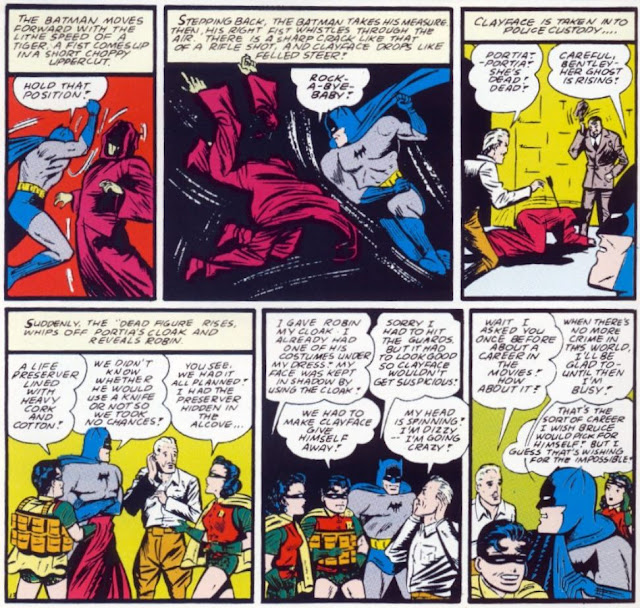
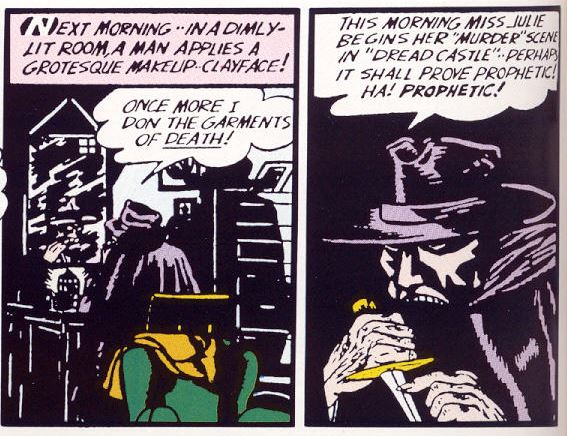
    We are finally treated to a clear look at the Clayface mask and it’s appropriately horrible.

    Since it’s his second outing, there’s no need for the mystery element of the story, which ends up making this a far less bloody yarn than the last one: Clayface sets out to burn down his former movie studio but since this is a very predictable thing for him to do he is interrupted by Batman and Robin. He does almost manage to kill the two of them, but they get out of it as you might have guessed.

    From here on Clayface focusses his efforts on Julie Madison, as-of-this-issue former fiancé of Bruce Wayne and newly famous actress rebranded as “Portia Storme” to fulfil the whims of 1940s Hollywood. It’s never spelled out so his motivation is equally likely to be that she escaped him on his last murder spree as it is that her death would prove most harmful to the studio. 

    Has any wag made much of Bruce Wayne's fiance being exactly the same size as Robin? It seems like the sort of thing they would go on about.

    Clayface is eventually reapprehended after a complicated slight-of hand trick that substitutes Robin for Portia and relies on him using only piercing weapons to the torso. It pays off, so who am I to quibble or suggest that Portia simply wear the life preserver from the start?

    That’s it for Clayface for about thirty years!

    Number of Episodes of the “Super-Villains of Hollywood” podcast: Just one episode for 1941, I’m afraid. It’s an eventful time but not enough to sustain more than an hour and half of podcasting.

    Body Count: 1

    End-of-year Status: Captured

  • SUPER-VILLAIN YEARBOOK: CLAYFACE 1940

    SUPER-VILLAIN YEARBOOK: CLAYFACE 1940

    What did Clayface get up to in 1940?

    Detective Comics v1 040, ‘Untitled’ **First Appearance**

    I’m not surprising anyone when I reveal that Clayface is actually Basil Karlo, an oldtime horror movie star who tanked his own career and couldn’t take it when they started remaking his old movies, thus necessitating a costumed murder spree to ruin the filming of Dread Castle.

    Batman and Robin get involved because one of the prospective victims is Julie Madison, Bruce Wayne’s fiancé (in her last appearance as his fiancé). Much of the action is not, in fact, Clayface-related but rather concerned with the actions of various Clayface suspects such as drunk director Ned Norton, variously-gruntled actors Kenneth Todd and Fred Walker, and Gangster Roxy Brenner.

    Clayface himself wears the common purple hat and cloak combo of an early Batman villain. He doesn’t actually spend much time on-panel, so the degree of grotesqueness of his makeup is hard to judge, whatever the narration boxes say.

    And finally the reveal: Basil Karlo did it and he did it because of horror movies. He might just be the first character in comics to get the Don Quixote “the problematic media of the day is the real villain!” origin for his madness but he certainly won’t be the last.

    Number of Episodes of the “Super-Villains of Hollywood” podcast: Basil’s got to be an entire season all by himself, doesn’t he? If we’re dealing strictly with the events of the year 1940 we’re talking two episodes on his rise and fall, followed by one about the actual Clayface debut.

    Body Count: 2

    End-of-year Status: Captured

  • MINOR SUPER-VILLAIN 173: THE HUNCHBACK

    (Bulletman 002, 1941)

    There are many Hunchbacks, both actual and fake, in the ranks of the minor super-villain, alas. Victor Hugo has much to answer for. This Hunchback is a former actor whose back (and presumably mind) was injured in a fall and thereafter resolved to kill all leading men at a particular theatre via dart to the neck.

    The real standout of the story is not the Hunchback but rather red herring murder suspect Matt Benson, seen here being a completely unsuspicious witness:

    And here being careful not to make himself seem like he might have done it:

    I sincerely think that in all my years of reading this kind of story I have not seen a suspect with less chill. The man could not order a cup of coffee without implying that he had strangled someone for the cash he was using to pay for it.