The Curse of Skeleton Munroe

Category: Spurt Hammond

  • ALIENS AND SO FORTH ROUND-UP 050

    ALIENS AND SO FORTH ROUND-UP 050

    All these fictional aliens and we don’t even get one other inhabited planet in our solar system.

    Moon-Men:

    These Moon-Men are encountered by Phantasmo (seen here in his less-nude human identity) and his pal Whizzer McGee during an impromptu trip to the Moon. They live deep beneath the satellite’s surface and appear to have a mining-based culture that is pretty hostile to outsiders, and that is all we know. While I must commend the “Phantasmo” team for not automatically making every alien race fluent English speakers or gifted telepaths, it does make for a more limited mode of storytelling. “Why are the Moon-Men mad at us, Phantasmo?” “No idea.” (The Funnies 060, 1941)

    Inhabitants of Ru:

    These very humanoid Martians are encountered by Flint Baker and his convict crew upon making the historic first second rocket voyage to Mars. They very specifically inhabit Ru, which is either the name of their country or the entire Light Side of Mars, and are a peaceful society in that sci-fi way that means that they are completely unable to deal with threats. Flint is thus required to save them from both the Earthman Sarko (late of the actual first manned mission to Mars) and then the diabolical Creature and his monster. (Planet Comics 001, 1940)

    One-Eyed Monster Men of Mars: 

    And speaking of Sarko, his plan to conquer Ru revolves around the One-Eyed Monster Men who inhabit the (non-existent) Dark Side of Mars. Though they are intensely fun-looking creatures, the One-Eyed Monster Men don’t get a lot of character development in the course of the story due to being mere foot soldiers and also possibly mind controlled.  (Planet Comics 001, 1940)

    Martians:

    As the “Spurt Hammond, Planet Flyer” series is at least initially set in the year 40 000 CE, there is a strong possibility that both the Martian and Venusian peoples pictured above are descended from some long-ago human colonists. Heck, that might just be the best backstory to explain a planet of warlike Martians or of peaceful Venusians who name their kids things like “Amoura:” because they have built their societies around the cultural assumptions and legends that tie into their planets. (Planet Comics 002, 1940)

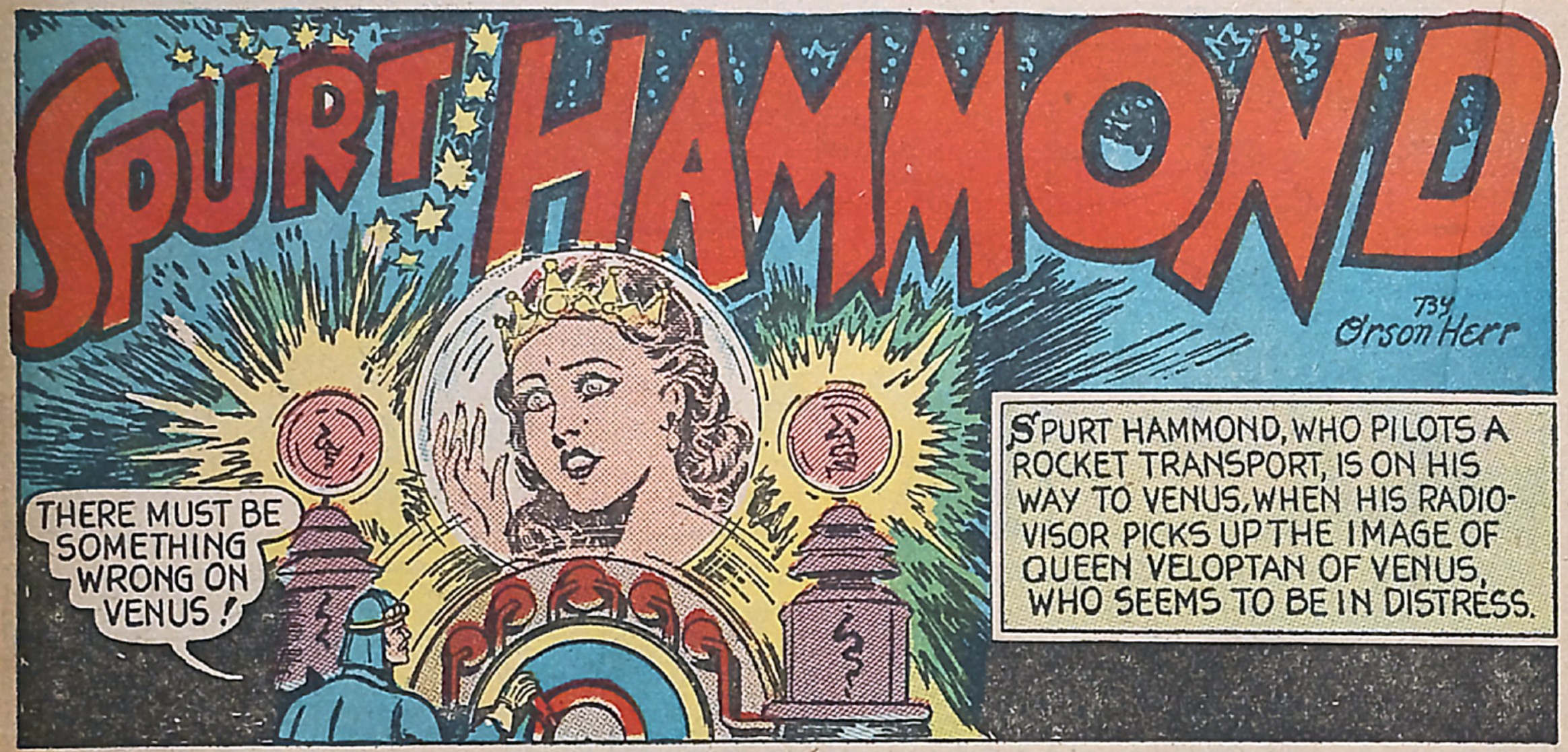
    Despite the fact that Spurt Hammond managed to resolve the conflict between Prince Khangiz of Mars and Queen Amoura, Venus was clearly subject to some sort of political upheaval because just four issues later the planet is ruled by Queen Veloptan. Perhaps Amoura was determined to be just a bit to on-the-nose, even for Venus. (Planet Comics 006, 1940)

    Venus is another one of those conflict-averse pacifist societies, and just two issues later they are turning to Spurt Hammond once more. This time the entire planet is swiftly becoming uninhabitable and the population are forced to become refugees, prompting this array of Plutonian, Saturnian and Jovian rulers doing their best impressions of WWII 20th Century most world leaders throughout modern history. And as a bonus: a new Martian leader named Kaga! (Planet Comics 008, 1940)

  • ALIENS AND SO FORTH ROUND-UP 041

    Once again I am inviting you to look at some aliens.

    Martian Sky-Demons:

    We only really ever see the space fleet belonging to these Martians, who have thrown in with the Axis forces to lend their “long-range, disintegrating super-bombs” to the invasion of North America. What they look like is left as just as much a mystery as what they are getting out this alliance with the Nazis.

    The Sky-Demons end up wasting their payload of super-bombs on a replica Earth that Stardust makes out of smoke, shadows and the bodies of a few hundred unlucky fifth columnists, upon which they abandon the plan and return to Mars. Perhaps those were all the bombs they had, or perhaps they wisely realized that they were flirting with disaster – Stardust is after all not known for his restraint in the face of aggression. (Fantastic Comics 014, 1941)

    Living Diamonds:

    The Living Diamonds are a really terrific species who live on Mystery Isle, on the same planet as the crew of Air Sub DX. I love that they’re literally just big diamonds, that they have little hat-shaped flying platforms to get around on, and that they can spit molten glass at their enemies. And I especially love this guy’s extremely weary facial expression which might just be how he looks and might be because crooks have been trying to turn his people into regular, non-living diamonds. 

    Also please note the second-last panel above, which is the earliest instance of someone calling a giant humanoid vehicle a “mech” that I have ever seen. (Amazing Mystery Funnies v2 008, 1939)

    Lunerzons:

    In the future occupied by space adventurer Spurt Hammond (variously placed anywhere from 2520 to 40 000 CE), the polar regions of the Moon are occupied by a group called the Lunerzons, who are as their name suggests Amazons who live on the Moon. The spelling being Lunerzon and not Lunarzon is, of course, maddening.

    The Lunerzons have ambitions of conquest, and to that end have begun raiding passing transport rockets. One of these rockets is piloted by Spurt Hammond, Planet Flyer, who puts up enough of a fuss in defense of his cargo that he ends up as a captive back on the Moon.

    Perhaps because they admire his tenacity, the Lunerzons treat Spurt more as a guest than a prisoner and so give him the official tour, including visits to the explosives factory where all of their men are employed in gruelling slave labour, and the pens where the Lunarzons breed the delightfully-named goblin-like Mooniacs for sport.

    Your average Golden or Silver Age comic featuring this setup would end with Spurt freeing all of the enslaved men and leading them in a revolution against their female oppressors in a not-so-subtle bit of social commentary. Instead, he drops a Mooniac that has been loaded down with explosives onto the factory roof, and while I enjoy a twist it’s a pretty rough way to treat an enslaved underclass.

    Lest you think that the “Spurt Hammond” scribes were above jokes at the expense of women, Our Hero escapes the Moon while the Lunerzon leaders are having a catfight over him. (Planet Comics 001, 1940)

    Spiderpeople:

    The Spiderpeople inhabit an unnamed moon orbiting an unnamed planet in an undisclosed star system, and only become relevant to our interests when some Earth colonists blunder their way into the planet-wide Spiderperson webs and get themselves captured. This attracts the attention of the mighty Red Comet, who is more kindly disposed to Earth people than any aliens, no matter how trespassed-upon.

    Probably the most interesting thing about the Spiderpeople is the arrangement of their limbs: rather than being kind of spider centaurs like so many of their peers, they have four spider legs emerging from their rib cage area and then a tiny little lower body with two more. While it’s not the most physically imposing design, it is neat. 

    Like I said, the Red Comet is not interested in exploring cultural relativity: the Spiderpeople attempt to sacrifice some Earthlings to their gods and so they get squarshed. Not all of them, but he certainly puts a dent in their population. That’ll show ’em for looking kind of gross. (Planet Comics 001, 1940)

  • ALIENS AND SO FORTH ROUND-UP 028

    Dudes come in all kinds of shapes nowadays.

    Walrus Men:

    We first encounter the Walrus Men in Champ Comics 013 when the newly-reformed Neptina goes to them to ask for help in reclaiming the throne of Amloza from her sister Mhersa, only to discover that the friendly Prince Eon has been overthrown and that the Walrus Men are now ruled by the expansionist tyrant King Walro.

    Not that Walro is unopposed in his rule, as there are still Eon loyalists willing to help Neptina and her friends in their quest.

    Neptina, her friends and the loyalists rescue Eon from the hole that Walro has been keeping him in, upon which it becomes clear that, like the Fish-Man population of Amloza, the Walrus Man of Polaris are ruled by a very human-looking nobility. This isn’t such a huge contrast in the Walrus Men’s initial appearance, when their tusks are small and dainty, but…


    From Champ Comics 014 and onward they really put the walrus in Walrus Men. So no Neptina and Eon represent an ocean-wide ruling class? Did some sub-oceanic Queen Victoria seed the thrones of the Atlantic with her grandchildren? Should Neptina and Eon’s burgeoning romance be quashed for the sake of their children’s genetic health? 

    (this issue also establishes the signature piece of Walrus Man technology: “mole ships” that travel beneath the sea floor for surprise attacks) 

    Finally, Prince Eon is restored to the throne of Polaris in Champ Comics 015 after fatally(? it is under water, after all) punching Walro off of a balcony. 

    Categorized in: Aliens (Earth), Animals (Aquatic Mammals), Generica (Men)

    Fish-Men UPDATE: 

    Speaking of the Fish-Men of Amloza and the morphological differences between them and their ruling class, Neptina and her companions find themselves in the Kingdom of the Fishmen while fleeing from Walrus Men forces. The Fishmen, hyphenated or not, appear to be their own people who just happen to live in Amloza in significant number. Neptina’s chief scientist Mogg is welcomed to the Kingdom as a citizen, which introduces some interesting questions about how the nation-states of the Atlantic work.  (Champ Comics 014, 1941)

    Fernomacs:

    When space adventurer Spurt Hammond is appointed as Earth’s ambassador to the Mercury of the year 2520 CE, he quickly finds favour with Thermod, king of the Mercurian Fernomacs, a species of leather-skinned green humanoids. By contrast, Hammond and his rising influence makes him an enemy in the eyes of the sinister Baron Burno.

    Burno expresses his frustration by staging a coup and dumping Thermod and Hammond on the desolate dark side of Mercury (not how Mercury works). All seems lost until…

    Grubmen:

    … the Grubmen show up! These inhabitants of the dark side of Mercury don’t get a tremendous amount of characterization: they love light and worship the flashlight-wielding Spurt Hammond as a god and he’s happy to exploit their adulation for his own benefit. Pre-religious reformation under Hammond they appear to have been ruled by the largest member of their species but he sees the writing on the wall and joins up with Hammond without a fight.

    In a bit of good luck for the Grubmen, exposure to the light and heat of the light side of the planet causes them to grow powerful and so they are able to effectively combat Burno’s Fernomac forces rather than die en mass as Hammond had presumably assumed they would given the physical and technological gulf between the species initially.

    King Thermod is re-installed on the throne of Ferno and as the Grubmen are of no further use to Hammond he leaves them behind as citizens. A happy ending for everyone but Baron Burno and his co-conspirators! (Planet Comics 009, 1940)

    Categorized in: Aliens (Mercury), Animals (Insects), Generica (Men)

  • ALIENS AND SO FORTH ROUND-UP 028

    Dudes come in all kinds of shapes nowadays.

    Walrus Men:

    We first encounter the Walrus Men in Champ Comics 013 when the newly-reformed Neptina goes to them to ask for help in reclaiming the throne of Amloza from her sister Mhersa, only to discover that the friendly Prince Eon has been overthrown and that the Walrus Men are now ruled by the expansionist tyrant King Walro.

    Not that Walro is unopposed in his rule, as there are still Eon loyalists willing to help Neptina and her friends in their quest.

    Neptina, her friends and the loyalists rescue Eon from the hole that Walro has been keeping him in, upon which it becomes clear that, like the Fish-Man population of Amloza, the Walrus Man of Polaris are ruled by a very human-looking nobility. This isn’t such a huge contrast in the Walrus Men’s initial appearance, when their tusks are small and dainty, but…


    From Champ Comics 014 and onward they really put the walrus in Walrus Men. So no Neptina and Eon represent an ocean-wide ruling class? Did some sub-oceanic Queen Victoria seed the thrones of the Atlantic with her grandchildren? Should Neptina and Eon’s burgeoning romance be quashed for the sake of their children’s genetic health? 

    (this issue also establishes the signature piece of Walrus Man technology: “mole ships” that travel beneath the sea floor for surprise attacks) 

    Finally, Prince Eon is restored to the throne of Polaris in Champ Comics 015 after fatally(? it is under water, after all) punching Walro off of a balcony. 

    Categorized in: Aliens (Earth), Animals (Aquatic Mammals), Generica (Men)

    Fish-Men UPDATE: 

    Speaking of the Fish-Men of Amloza and the morphological differences between them and their ruling class, Neptina and her companions find themselves in the Kingdom of the Fishmen while fleeing from Walrus Men forces. The Fishmen, hyphenated or not, appear to be their own people who just happen to live in Amloza in significant number. Neptina’s chief scientist Mogg is welcomed to the Kingdom as a citizen, which introduces some interesting questions about how the nation-states of the Atlantic work.  (Champ Comics 014, 1941)

    Fernomacs:

    When space adventurer Spurt Hammond is appointed as Earth’s ambassador to the Mercury of the year 2520 CE, he quickly finds favour with Thermod, king of the Mercurian Fernomacs, a species of leather-skinned green humanoids. By contrast, Hammond and his rising influence makes him an enemy in the eyes of the sinister Baron Burno.

    Burno expresses his frustration by staging a coup and dumping Thermod and Hammond on the desolate dark side of Mercury (not how Mercury works). All seems lost until…

    Grubmen:

    … the Grubmen show up! These inhabitants of the dark side of Mercury don’t get a tremendous amount of characterization: they love light and worship the flashlight-wielding Spurt Hammond as a god and he’s happy to exploit their adulation for his own benefit. Pre-religious reformation under Hammond they appear to have been ruled by the largest member of their species but he sees the writing on the wall and joins up with Hammond without a fight.

    In a bit of good luck for the Grubmen, exposure to the light and heat of the light side of the planet causes them to grow powerful and so they are able to effectively combat Burno’s Fernomac forces rather than die en mass as Hammond had presumably assumed they would given the physical and technological gulf between the species initially.

    King Thermod is re-installed on the throne of Ferno and as the Grubmen are of no further use to Hammond he leaves them behind as citizens. A happy ending for everyone but Baron Burno and his co-conspirators! (Planet Comics 009, 1940)

    Categorized in: Aliens (Mercury), Animals (Insects), Generica (Men)

  • ALIENS AND SO FORTH ROUND-UP 012

    You won’t believe these guys. 

    the Mermen: 

    Some undersea jerks who capture explorer Typhon and his crew. Their leader is a real creep named Neptune who has a nigh-fetishistic plan to freeze the crew – and particularly sole female crewmember Cecelia – into blocks of ice and then breathe fire on them. Luckily for all who might venture beneath the waves, he drowns (?) during Typhon’s escape. (Weird Comics 002, 1940)

    the Beaked Men:

    The Beaked Men of Mercury’s mountains operate as an extortion racket on the solar trade routes, raiding and capturing ships from their mobile “space island” ships. Such a threat to the interplanetary commerce of the year 25 000 will not stand, and Spurt Hammond, Planet Flyer successfully manages to explode the whole operation thanks to a handy prisoner revolt. (Planet Comics 004, 1940)

    the Big-Eared Tribe of Saturn: 

    I’m not sure if the implication is that all of the people of Saturn are big-eared or if it’s just a subgroup, but the fact that they seem to be generally feared and that the leader (and father) of this particular bunch of Big-Eared men, Varg Emmos, is a respected scientist who is presumably using his futuristic heardpiece to disguise his own big-eared status points toward the former. 

    Varg and his boys have a plot to take over Earth using an ultrasonic ray that affects only humans but are foiled when Rex Dexter in turn discovers a musical note that kills them and that is seemingly featured heavily in symphonic music. Sucks to be a Big-Eared music lover I guess. (Mystery Men Comics 020, 1941)

    the Coal People:

    The Coal People (also referred to as the Blackmen) reside in an underground kingdom below Colorado and are descended from ancient people who got themselves trapped there and were forced to subsist of coal to survive. Rather than dying of starvation and/or stomach cancer, they instead became humanoid creatures composed of living coal. The problem comes when mining activities bring the Coal People into contact with contemporary surface humans – fairly harmless when they decide to worship the above old man as a kind of captive god, but increasingly menacing after the discovery of a miner’s corpse reveals to them that there are more interesting things to eat than coal.

    Luckily for the surface world (or for Coloradans, at least) the next person to enter the mines and get captured is the super-strong giant Mighty Man, who discovers the in-retrospect-fairly-obvious secret of the Coal People: that they fear fire. He and the erstwhile god escape and seal the mine behind them. Colorado is saved! (Amazing-Man Comics 011, 1940)

  • ALIENS AND SO FORTH ROUND-UP 012

    You won’t believe these guys. 

    the Mermen: 

    Some undersea jerks who capture explorer Typhon and his crew. Their leader is a real creep named Neptune who has a nigh-fetishistic plan to freeze the crew – and particularly sole female crewmember Cecelia – into blocks of ice and then breathe fire on them. Luckily for all who might venture beneath the waves, he drowns (?) during Typhon’s escape. (Weird Comics 002, 1940)

    the Beaked Men:

    The Beaked Men of Mercury’s mountains operate as an extortion racket on the solar trade routes, raiding and capturing ships from their mobile “space island” ships. Such a threat to the interplanetary commerce of the year 25 000 will not stand, and Spurt Hammond, Planet Flyer successfully manages to explode the whole operation thanks to a handy prisoner revolt. (Planet Comics 004, 1940)

    the Big-Eared Tribe of Saturn: 

    I’m not sure if the implication is that all of the people of Saturn are big-eared or if it’s just a subgroup, but the fact that they seem to be generally feared and that the leader (and father) of this particular bunch of Big-Eared men, Varg Emmos, is a respected scientist who is presumably using his futuristic heardpiece to disguise his own big-eared status points toward the former. 

    Varg and his boys have a plot to take over Earth using an ultrasonic ray that affects only humans but are foiled when Rex Dexter in turn discovers a musical note that kills them and that is seemingly featured heavily in symphonic music. Sucks to be a Big-Eared music lover I guess. (Mystery Men Comics 020, 1941)

    the Coal People:

    The Coal People (also referred to as the Blackmen) reside in an underground kingdom below Colorado and are descended from ancient people who got themselves trapped there and were forced to subsist of coal to survive. Rather than dying of starvation and/or stomach cancer, they instead became humanoid creatures composed of living coal. The problem comes when mining activities bring the Coal People into contact with contemporary surface humans – fairly harmless when they decide to worship the above old man as a kind of captive god, but increasingly menacing after the discovery of a miner’s corpse reveals to them that there are more interesting things to eat than coal.

    Luckily for the surface world (or for Coloradans, at least) the next person to enter the mines and get captured is the super-strong giant Mighty Man, who discovers the in-retrospect-fairly-obvious secret of the Coal People: that they fear fire. He and the erstwhile god escape and seal the mine behind them. Colorado is saved! (Amazing-Man Comics 011, 1940)

  • REAL PERSON ROUND-UP 009

    Some day these won’t inevitably start with Hitler. Some day.

    Adolf Hitler:

    Rix, a human living on Venus in the peaceful year 3090 CE, learns about dictators thanks to the time capsule from the 1939 New York World’s Fair and immediately sets out to make himself into the Hitler of the future. Beat down by interplanetary troubleshooter Planet Payson. (Planet Comics 008, 1940)

    Aviator Ted O’Neil is brought down in the warlike nation of Gestapia (one of the more on-the-nose Nazi Germany stand-ins I have encountered), ruled over by dictator “Schnitzler.” (Prize Comics 004, 1940)

    Al Capone:

    It’s just a shorthand reference for “bigtime gangster” but Scarface Marone here is absolutely an Al Capone pastiche for the one and a half panels he appears in before jumping out a window to avoid capture. (Rocket Comics 002, 1940)

    Anna Roosevelt:

    She’s referred to only as “the President’s daughter” throughout this adventure which sees her being kidnapped and almost killed by Gerlandian spies before being rescued by Electro here, but it’s 1940 and the US has had precisely one President’s Daughter for nearly eight years at this point and it’s Anna Roosevelt. (Science Comics 001, 1940)

    Captain Nemo:

    It shouldn’t have surprised me when Navy Jones, established in the previous issue to be descended from the legendary Davy Jones, encounters not-just-fictional-but-fictional-from-about-seventy-years-earlier figure Captain Nemo while noodling around under the sea with his paramour Princess Coral, but I’m afraid that it did. And not only do they team up to battle octopus men and recover an ancient Roman map to Atlantis together but Nemo basically joins the “Navy Jones” cast going forward! (Science Comics 005, 1940)

    FDR:

    Minor Appearances:

    Science Comics 003, 1940

    Genghis Khan:

    Obvious allusion to Genghis Khan in Khangiz, the warlike master of Mars in the year 40 000 CE. (Planet Comics 002, 1940)

    J Edgar Hoover:

    You have a comic book character who works for the FBI and eventually an unnamed J Edgar Hoover is going to show up and congratulate them for doing their job, as happens to FBI agent Buck Brady here. (Prize Comics 005, 1940)

    J Edgar Hoover is not only Joe “the Shield” Higgins’ boss at the FBI but he was the best friend of Tom Higgins, Joe’s father. (Shield-Wizard Comics 001, 1940)

    Minor appearances:

    Science Comics 003, 1940

    Oak Island:

    Even though Fu Chang operates out of San Francisco and thus Money Pit Island is located somewhere in the Pacific, its name alone twigs it as at least inspired by the legend of Oak Island, which (I checked) was indeed going strong as of 1940 (Pep Comics 009, 1940)

  • MINOR SUPER-VILLAIN 700: RADGIO

    (Planet Comics 003, 1940)

    We open on Spurt Hammond, the Planet-Flyer himself, intercepting an alarming series of images from the planet Mercury. Giants? Explosions? Girls!? What could it all mean?

    It turns out that the girl in question is Princess Zilla, erstwhile ruler of Mercury but recently deposed by her Prime Minister Radgio, who schemes to conquer the world using mutated Mercurians such as the previously-seen giant. Which I suppose strongly implies that Zilla was the ruler of only a part of Mercury – I’m so used to assuming that every sci-fi government is global in nature.

    Zilla and Hammond make their way to Radgio’s fortress and dispose of the unfortunate giant by means of an old reliable method, the portcullis. Move over, Rancor! Make way, two-headed dragon from Willow! there’s a new member of the “Killed by a Falling Portcullis” Club!

    It’s okay though: Radgio is done with boring old giants and has moved on to his ultimate creation, a huge six-armed robot. And unlike many so-called humans-turned-robots in 1940s comics, this isn’t merely a case of extreme mind control but, per the little x-ray cutaway, this poor Mercurian is being mutated into some sort of cybernetic organism with what are possibly horrible organic gears and everything.

    Spurt Hammond bursts in just before Radgio is able to release his creation from where it is shackled to the wall (either as part of the roboticization process or for display purposes, I cannot tell) and, as he believes in ironic punishments, pops the Mercurian into his own machine.

    Radgio is reduced to… somewhere between four inches and a foot in height. But even shrunken so, and nude, he almost manages to turn things back around by assuming voice control of the robot. Unfortunately for him, 1) he failed to make the robot ray gun-proof and it goes down with little effort on Hammond’s part and 2) a nearby rat also has a sense of ironic justice and chows down on his tender Prime Ministerial flesh. Mercury is saved!