The Curse of Skeleton Munroe

Category: yearbook

  • SUPER-VILLAIN YEARBOOK: IAN KARKULL & WOTAN 1941

    What were Ian Karkull and Wotan up to in 1941?

    Ian Karkull is my Platonic Ideal of the Median Super-Villain: he has two
    Golden Age appearances (detailed here) and a handful of post-Silver Age
    ones but also was seemingly pulled out of a hat (probably by Roy Thomas) as the villain who did some sort of scheme that blasted the Justice Society with some sort of energies that made them age slower so that otherwise normal WWII veterans like Wildcat and the Sandman could be running around fighting crime well past retirement age. It’s a Big Deal and it means that Karkull has absolutely been mentioned far more than he’s actually appeared.

    1. More Fun Comics 069, ‘Untitled’:But we’re here to talk about 1941! What was Ian Karkull up to then? Well for one thing he wasn’t calling himself ‘Ian’ yet – that was presumably added at the same time that he was revived to irradiate the JSA. Karkull was seemingly just another scientist with a cool invention – a machine that turns people into shadows! – that he is determined to use for crime.

    Surprise of the year: Karkull has if not a good reason for turning to crime then at least a reason. While exploring the lost Saharan city of Ragnor with his partner Everett Dahlen he is betrayed and left for dead so that Dahlen could run off with a huge ruby. Is it the most rock-solid reason to turn to a life of crime? No, but it’s more of an origin than most Golden Age scientists get.

    Karkull’s first outing ends with him at large, albeit trapped in shadow form by Dr Fate as a sort of ad hoc punishment that is fairly out of line with his crimes of one murder and one bank robbery. That’s the Golden Age for you, I guess.
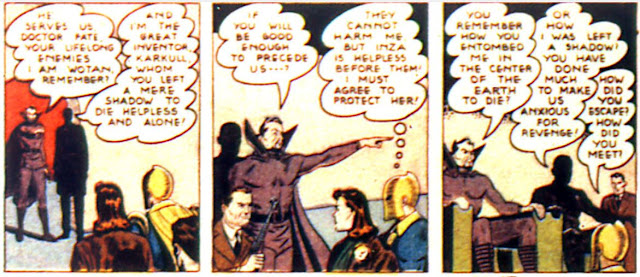
    2. More Fun Comics 070, ‘Untitled’: Not only is Karkull back in the next issue but he brought Wotan with him!

    In a development that is only a bit surprising, Dr Fate’s slapdash brand of vigilante justice has come back to bite him. Yes, Wotan was sealed in a stony cyst for all time and Karkull was left an intangible shadow but the problem with leaving enough foes just out and about like that is that they might team up, which is exactly what happened when Wotan’s wandering astral form (something you really should control for when imprisoning magic guys for all time) met Karkull’s shadowy one and they worked together to release Wotan’s actual body, albeit without his normal green skin for some reason (the colourist forgot that he was green).

    The Wotan/ Karkull team have a plan to conquer and/or attack the nations of Earth from their Arctic base using devices that control 3/4 of the classical elements, namely Earth, Wind and Fire. They accidentally (?) draw Dr Fate’s attention by attacking nearby teams of Arctic explorers with their wind weapon, leading to an ultimate 2 vs 1 confrontation in an Arctic dome!

    In a bit of an anticlimax, Dr Fate merely sidesteps their fire weapon, causing it to rebound and kill them both. Seemingly, at least – they’ll both be back when the continuity nerds start writing comics.

    IAN KARKULL

    Body Count: 6

    End-of-Year Status: Presumed Dead

    WOTAN

    Body Count:1905

    End-of-Year Status: Presumed Dead

    (Karkull kills his enemy; Wotan and Karkull jointly kill explorers; Wotan sinks battleship)

  • SUPER-VILLAIN YEARBOOK: WOTAN 1940

    What was Wotan up to in 1940?

    A trip back in time! A year or so ago when I was reading the 1940 issues of More Fun was before I started doing Super-Villain Yearbook posts and so I skipped poor Wotan, an injustice compounded by the fact that he is what I would call a Median Villain: one who has either enough appearances or importance to a hero’s history to be more than a minor villain but without the name recognition of a Capital S Super-Villain. Wotan has a bit of both: as Dr Fate’s first enemy he gets dredged up every once in a while when a magic guy (or gal, occasionally) is required.

    1. More Fun Comics 055, ‘Untitled’:  Wotan’s Golden Age appearances are pretty standard fare: he is introduced as an evil equivalent to Dr Fate, operating as some sort of magic crime boss – the ins and outs of his operation are less than clear as his main focus is eliminating Fate and his pal Inza Cramer. 

    As time goes on Dr Fate gets more ethereal and mystical and I just want to highlight how rock ’em sock’em, throw ’em out the window he was at the beginning. Just a brutal way to deal with a foe (and perhaps a few passing New Yorkers on the sidewalk below).

    2. More Fun Comics 056, ‘Untitled’: But of course throwing Wotan out of a window wasn’t going to stop him. Would it stop Dr Fate? Of Course it wouldn’t. He returns with a vengeance, quite literally: as revenge for Fate trying to kill him Wotan is going to blow up the whole damn world! Just try to stop that with a sock on the jaw, Fate!

    One sock to the jaw later, Dr Fate seals Wotan in a little rocky cyst for all time.

    Body Count: 0

    End-of-Year Status: Entombed

  • SUPER-VILLAIN YEARBOOK: WOTAN 1940

    What was Wotan up to in 1940?

    A trip back in time! A year or so ago when I was reading the 1940 issues of More Fun was before I started doing Super-Villain Yearbook posts and so I skipped poor Wotan, an injustice compounded by the fact that he is what I would call a Median Villain: one who has either enough appearances or importance to a hero’s history to be more than a minor villain but without the name recognition of a Capital S Super-Villain. Wotan has a bit of both: as Dr Fate’s first enemy he gets dredged up every once in a while when a magic guy (or gal, occasionally) is required.

    1. More Fun Comics 055, ‘Untitled’:  Wotan’s Golden Age appearances are pretty standard fare: he is introduced as an evil equivalent to Dr Fate, operating as some sort of magic crime boss – the ins and outs of his operation are less than clear as his main focus is eliminating Fate and his pal Inza Cramer. 

    As time goes on Dr Fate gets more ethereal and mystical and I just want to highlight how rock ’em sock’em, throw ’em out the window he was at the beginning. Just a brutal way to deal with a foe (and perhaps a few passing New Yorkers on the sidewalk below).

    2. More Fun Comics 056, ‘Untitled’: But of course throwing Wotan out of a window wasn’t going to stop him. Would it stop Dr Fate? Of Course it wouldn’t. He returns with a vengeance, quite literally: as revenge for Fate trying to kill him Wotan is going to blow up the whole damn world! Just try to stop that with a sock on the jaw, Fate!

    One sock to the jaw later, Dr Fate seals Wotan in a little rocky cyst for all time.

    Body Count: 0

    End-of-Year Status: Entombed

  • MINOR SUPER-VILLAIN 333: THE FIVE FINGERS OF THE HAND

    MINOR SUPER-VILLAIN 333: THE FIVE FINGERS OF THE HAND

    (Leading Comics 001, 1941)

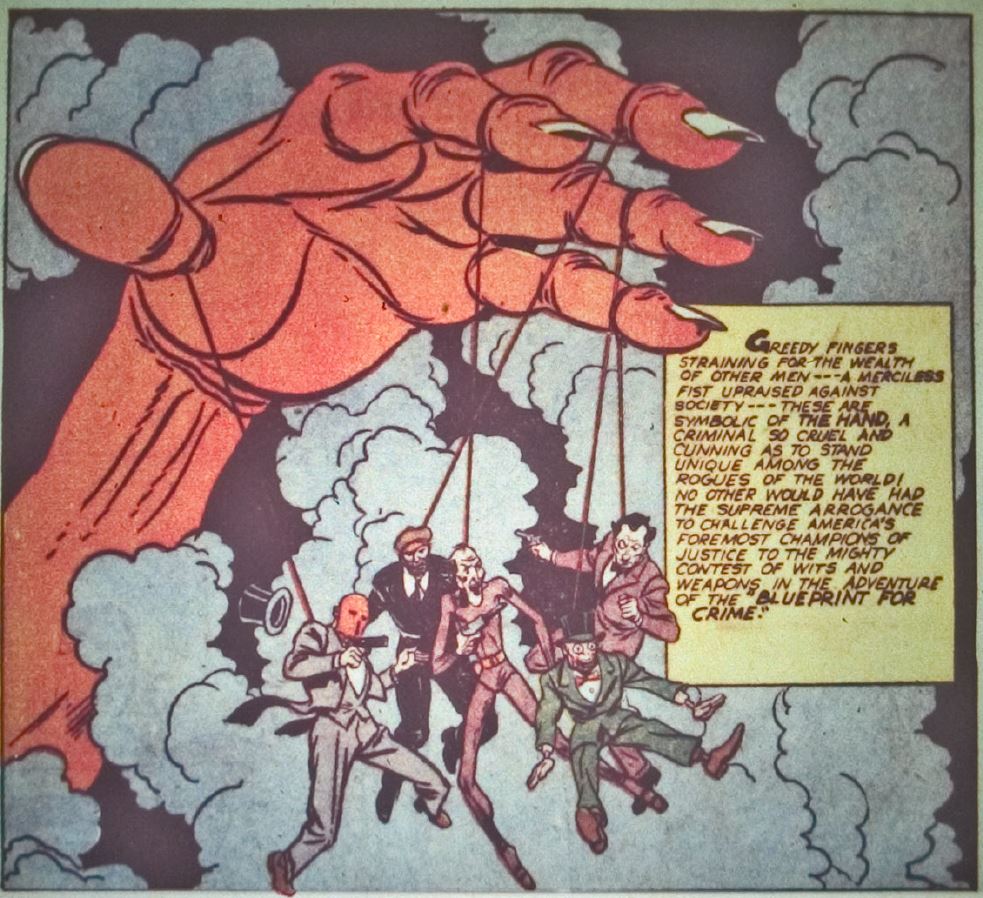
    As promised: the Five Fingers of the Hand! Though the Seven Soldiers would go on the fight more than a few teams of super-henchmen, the Fingers are distinguished by being (mostly) pre-established characters. Fun!

    Big Caesar:

    Big Caesar is whatever. A regular-style gang boss with a good name, elevated by being included in the gang. He appears just this once, in a scheme that involves cutting the power to Broadway and then doing a crimewave in the dark. The Crimson Avenger and Wing take him down without significant effort.

    The Dummy:

    Like Big Caesar, the Dummy appears for the first time in this issue. Unlike Big Caesar, the Dummy would go on to bigger things – so much so that I am declaring him a very marginal full super-villain, which makes this a cheeky Yearbook entry for his 1941. 

    When first seen, the Dummy has two points of interest: 1. he is an “infamous kidnapper” and 2. he may or may not be a real, inanimate ventriloquist’s dummy. Even his gang is convinced that he is a front for one of their number. 

    Per his talents, the Hand sets the Dummy up with a sweet kidnapping job: he grabs various Hollywood types and leaves behind a lifelike statue in their place. The ransom is thus to “return them to life”. Sadly, the sculptor that they must have had on retainer to produce the statues is not shown.

    The Dummy is eventually revealed to be alive, though whether he is a very short human with a penchant for sitting still or some sort of animate wooden doll is not explored. Also unexplored: why the Dummy’s back room is full of duplicates of the statues that he has already left in place of his victims, and why he has statues of the Vigilante and his second-best sidekick Billy Gunn – it’s tough to imagine a scenario in which they might be useful (other than as a heavy object under which to trap the Dummy, of course).

    Number of Episodes of the “Super-Villains of Hollywood” podcast: part of a compilation episode about villains who come to Hollywood to do crimes.

    Body Count: 0

    End-of-Year Status: Captured

    The Needle:

    The Needle is a recurring foe of the Star-Spangled Kid and Stripesy, a tall thin guy with a needle gun and a wild look in his eyes. Due to the fact that I only pay attention to the cover date on comics and that that never actually lines up with the release date, his first appearance in 1942 won’t hit this blog for some time – he’ll likely be Minor Super-Villain 555 or the like.

    Anyway, he steals a ray gun and tries to blow up the Panama Canal for some reason.

    Professor Merlin:

    As with the Needle, Professor Merlin’s first appearance doesn’t take place until 1942. This is especially embarrassing because he actually dies before his first appearance, like one of those RPGs where you can die during character creation.

    Merlin’s scheme involves scamming gold out of a rich old prospector by exploiting his well-known fear of freezing to death, then managing to collapse a mine on himself when he uses dynamite to blow open a lock that looks like you could pick it with a small enough finger. Nobody comes out on top here: Prof Merlin dies a dummy despite ostensibly being a Smart Crook and Green Arrow and Speedy don’t even play that much of a role in his downfall.

    Red Dragon:

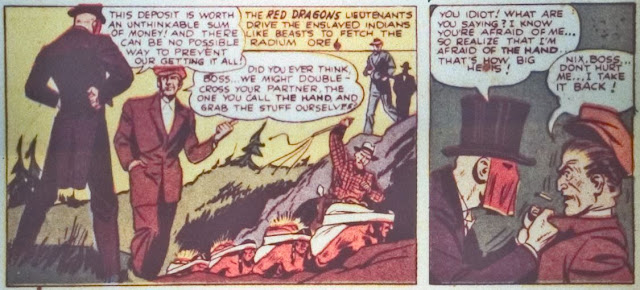
    Our final Finger and the only one to have already shown up previously here, the Red Dragon is his usual terrible self: he takes advantage of an old myth in order to enslave a Native American tribe and force them to mine radium. Lucky for them that the Shining Knight turns up to actually fulfill the prophecy and  kick the Dragon’s rear. It’s a real evil comic book crime rendered a fair bit less enjoyable to read because of all the racism.

    So: the Five Fingers of the Hand. Top notch themed name for a henchman group hampered somewhat by the ease with which they were all taken out. Any time the Hand shows up he should have a different iteration of the Fingers with him, and that’s that. Bring ’em back, at least in name.

  • MINOR SUPER-VILLAIN 333: THE FIVE FINGERS OF THE HAND

    MINOR SUPER-VILLAIN 333: THE FIVE FINGERS OF THE HAND

    (Leading Comics 001, 1941)

    As promised: the Five Fingers of the Hand! Though the Seven Soldiers would go on the fight more than a few teams of super-henchmen, the Fingers are distinguished by being (mostly) pre-established characters. Fun!

    Big Caesar:

    Big Caesar is whatever. A regular-style gang boss with a good name, elevated by being included in the gang. He appears just this once, in a scheme that involves cutting the power to Broadway and then doing a crimewave in the dark. The Crimson Avenger and Wing take him down without significant effort.

    The Dummy:

    Like Big Caesar, the Dummy appears for the first time in this issue. Unlike Big Caesar, the Dummy would go on to bigger things – so much so that I am declaring him a very marginal full super-villain, which makes this a cheeky Yearbook entry for his 1941. 

    When first seen, the Dummy has two points of interest: 1. he is an “infamous kidnapper” and 2. he may or may not be a real, inanimate ventriloquist’s dummy. Even his gang is convinced that he is a front for one of their number. 

    Per his talents, the Hand sets the Dummy up with a sweet kidnapping job: he grabs various Hollywood types and leaves behind a lifelike statue in their place. The ransom is thus to “return them to life”. Sadly, the sculptor that they must have had on retainer to produce the statues is not shown.

    The Dummy is eventually revealed to be alive, though whether he is a very short human with a penchant for sitting still or some sort of animate wooden doll is not explored. Also unexplored: why the Dummy’s back room is full of duplicates of the statues that he has already left in place of his victims, and why he has statues of the Vigilante and his second-best sidekick Billy Gunn – it’s tough to imagine a scenario in which they might be useful (other than as a heavy object under which to trap the Dummy, of course).

    Number of Episodes of the “Super-Villains of Hollywood” podcast: part of a compilation episode about villains who come to Hollywood to do crimes.

    Body Count: 0

    End-of-Year Status: Captured

    The Needle:

    The Needle is a recurring foe of the Star-Spangled Kid and Stripesy, a tall thin guy with a needle gun and a wild look in his eyes. Due to the fact that I only pay attention to the cover date on comics and that that never actually lines up with the release date, his first appearance in 1942 won’t hit this blog for some time – he’ll likely be Minor Super-Villain 555 or the like.

    Anyway, he steals a ray gun and tries to blow up the Panama Canal for some reason.

    Professor Merlin:

    As with the Needle, Professor Merlin’s first appearance doesn’t take place until 1942. This is especially embarrassing because he actually dies before his first appearance, like one of those RPGs where you can die during character creation.

    Merlin’s scheme involves scamming gold out of a rich old prospector by exploiting his well-known fear of freezing to death, then managing to collapse a mine on himself when he uses dynamite to blow open a lock that looks like you could pick it with a small enough finger. Nobody comes out on top here: Prof Merlin dies a dummy despite ostensibly being a Smart Crook and Green Arrow and Speedy don’t even play that much of a role in his downfall.

    Red Dragon:

    Our final Finger and the only one to have already shown up previously here, the Red Dragon is his usual terrible self: he takes advantage of an old myth in order to enslave a Native American tribe and force them to mine radium. Lucky for them that the Shining Knight turns up to actually fulfill the prophecy and  kick the Dragon’s rear. It’s a real evil comic book crime rendered a fair bit less enjoyable to read because of all the racism.

    So: the Five Fingers of the Hand. Top notch themed name for a henchman group hampered somewhat by the ease with which they were all taken out. Any time the Hand shows up he should have a different iteration of the Fingers with him, and that’s that. Bring ’em back, at least in name.

  • SUPER-VILLAIN YEARBOOK: RED SKULL 1941

    (Captain America Comics 007, 1941)

    What was the Red Skull up to in 1941?

    As mentioned in the Red Skull II entry, this here is the real deal bad guy we all know and love to hate, still running around being a total stinker to this day. In-comic there is of course no indication of this, as the decision to differentiate the two was made years later when someone figured that the top Nazi villain worked better as a German guy than an American fascist. Consequently this is a pretty scant Yearbook entry, as most of the Red Skulling for the year was done by another guy.

    Intended or not, this Red Skull has it a bit more together than his semi-predecessor: for one, he has a much creepier mask and has supplemented the red skull calling card with an audible element: Chopin’s Funeral March. AND! He engages with that finest of comic book traditions by wearing a rubberoid mask over his regular mask! Batman eat your heart out.

    As far as actual crimes go… he kills a couple of guys and briefly frames Captain America for kidnapping a General. Mediocre.

    SKULL SCORE: 3/5, just like the other guy. It ain’t gonna change until he melts his face off in… I want to say the early 80s?

    RED SKULL 1941

    BODY COUNT: 2

    END-OF-YEAR STATUS: Presumed dead

  • SUPER-VILLAIN YEARBOOK: RED SKULL 1941

    (Captain America Comics 007, 1941)

    What was the Red Skull up to in 1941?

    As mentioned in the Red Skull II entry, this here is the real deal bad guy we all know and love to hate, still running around being a total stinker to this day. In-comic there is of course no indication of this, as the decision to differentiate the two was made years later when someone figured that the top Nazi villain worked better as a German guy than an American fascist. Consequently this is a pretty scant Yearbook entry, as most of the Red Skulling for the year was done by another guy.

    Intended or not, this Red Skull has it a bit more together than his semi-predecessor: for one, he has a much creepier mask and has supplemented the red skull calling card with an audible element: Chopin’s Funeral March. AND! He engages with that finest of comic book traditions by wearing a rubberoid mask over his regular mask! Batman eat your heart out.

    As far as actual crimes go… he kills a couple of guys and briefly frames Captain America for kidnapping a General. Mediocre.

    SKULL SCORE: 3/5, just like the other guy. It ain’t gonna change until he melts his face off in… I want to say the early 80s?

    RED SKULL 1941

    BODY COUNT: 2

    END-OF-YEAR STATUS: Presumed dead

  • MINOR SUPER-VILLAIN 300: THE RINGMASTER OF CRIME

    (Captain America Comics 005, 1941)

    Finally, FINALLY, after 300  of these guys an arbitrary milestone lines up with a reasonably cool character: the Ringmaster of Crime AKA the Ringmaster of Death. Compounding the fun of the circus of crime aesthetic is the fact that some of that good-style retconning has been going on and the Ringmaster in this tale has been made the father (and presumably later grandfather, per Marvel’s sliding timeline) of the mid-level super-villain the Ringmaster! Uh, if saying that someone is someone else’s grampaw is a retcon, that is.

    The practical upshot of this is that this Minor Super-Villain writeup also functions as Super-Villain Yearbook, 1941 for the Circus of Crime, which, as a family-owned business entity, is contiguous with the version that reappeared in the 60s even though no individual members reoccur.

    All that said, the Ringmaster himself is a fairly regular Nazi creep super-villain. Sure he’s got the Jack Kirby villain snake-man look that we all love to hate but compared to his descendant (or, indeed, a regular circus ringmaster) he’s a positively dour dresser – his actual theming is pretty weak, when you get right down to it.

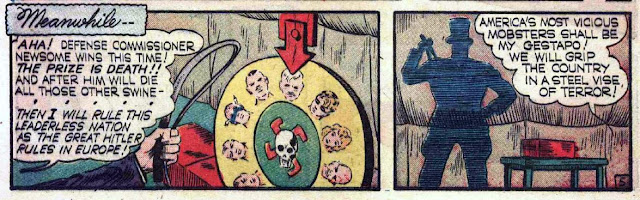
    Although we must not neglect the Wheel of Death, a perfectly cromulent random victim generator that the Ringmaster presumably stole from one of the sideshow games and spends hours/day applying all the little faces to.

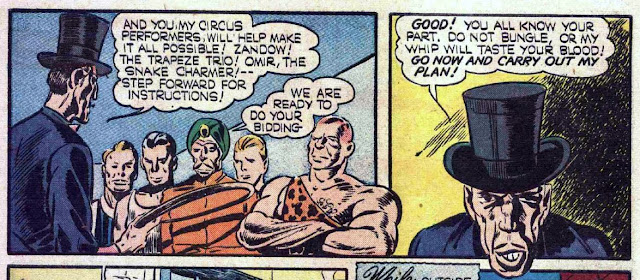
    The real star here is the burgeoning Circus of Crime. Not all of the classic archetypes are present (no tall man, no fat guy) but it’s a pretty good criminal circus lineup already. To whit:

    Omir the Snake Charmer

    the Missing Link putting in an appearance for the sideshow folk

    Tommy Thumb the circus dwarf who might be held against his will? He definitely does not want to be there

    the Trapeze Trio

    Zandow the Strong Man

    various unnamed clowns, roustabouts and elephant handlers

    It’s not quite Princess Python levels but it’s a good showing.

    The Ringmaster of course gets trounced by Captain America, and then according to lore he gets murdered after the war by Nazi loyalists for his failure. His circus endures to this day, however, so that’s something. Speaking of which:

    CIRCUS OF CRIME 1941 

    Body Count: 2

    End-of-year Status: Captured/ Defunct

  • MINOR SUPER-VILLAIN 300: THE RINGMASTER OF CRIME

    (Captain America Comics 005, 1941)

    Finally, FINALLY, after 300  of these guys an arbitrary milestone lines up with a reasonably cool character: the Ringmaster of Crime AKA the Ringmaster of Death. Compounding the fun of the circus of crime aesthetic is the fact that some of that good-style retconning has been going on and the Ringmaster in this tale has been made the father (and presumably later grandfather, per Marvel’s sliding timeline) of the mid-level super-villain the Ringmaster! Uh, if saying that someone is someone else’s grampaw is a retcon, that is.

    The practical upshot of this is that this Minor Super-Villain writeup also functions as Super-Villain Yearbook, 1941 for the Circus of Crime, which, as a family-owned business entity, is contiguous with the version that reappeared in the 60s even though no individual members reoccur.

    All that said, the Ringmaster himself is a fairly regular Nazi creep super-villain. Sure he’s got the Jack Kirby villain snake-man look that we all love to hate but compared to his descendant (or, indeed, a regular circus ringmaster) he’s a positively dour dresser – his actual theming is pretty weak, when you get right down to it.

    Although we must not neglect the Wheel of Death, a perfectly cromulent random victim generator that the Ringmaster presumably stole from one of the sideshow games and spends hours/day applying all the little faces to.

    The real star here is the burgeoning Circus of Crime. Not all of the classic archetypes are present (no tall man, no fat guy) but it’s a pretty good criminal circus lineup already. To whit:

    Omir the Snake Charmer

    the Missing Link putting in an appearance for the sideshow folk

    Tommy Thumb the circus dwarf who might be held against his will? He definitely does not want to be there

    the Trapeze Trio

    Zandow the Strong Man

    various unnamed clowns, roustabouts and elephant handlers

    It’s not quite Princess Python levels but it’s a good showing.

    The Ringmaster of course gets trounced by Captain America, and then according to lore he gets murdered after the war by Nazi loyalists for his failure. His circus endures to this day, however, so that’s something. Speaking of which:

    CIRCUS OF CRIME 1941 

    Body Count: 2

    End-of-year Status: Captured/ Defunct

  • SUPER-VILLAIN YEARBOOK: HATH-SET 1940

    What was Hath-Set up to in 1940?

    That’s actually a tricky question, because Hath-Set is a tricky character! Technically, he did absolutely nothing in 1940, because he died somewhere in the 1200s BC. Because, yes, Hath Set is mixed up in the unholy mess that is Hawkman and Hawkgirl’s origin story.

    Of course, it didn’t start out complicated: Hath-Set was an evil priest of Anubis who murdered Prince Khufu and his lover Shiera and then they all got reincarnated some 3000 years later to do it all over again. Nice and simple. But comic books are comic books, so all three of these fools have been reincarnated more times than any reasonable person would care to count, including retroactively as characters like the Silent Knight. Hath-Set himself doesn’t always show up – his piddly number of appearances in any incarnation would probably net him the status of minor super-villain if he wasn’t such an integral part of the Hawks’ origin story.

    As for Doctor Hastor: he electrocutes passengers on the New York subway system in an attempt to extort the city for big bux but before he can get any further Hawkman shows up, there’s some back-and-forth that includes an attempt to sacrifice Shiera Sanders to Anubis, and Hawkman shoots Hastor dead with a crossbow.

    Don’t worry, he’ll be back!