The Curse of Skeleton Munroe

Category: Wizard Wells

  • MEDIA IN COMICS 012

    It’s a very literary day here in Media in Comics Land.

    Books:

    There are many potential reasons to get into super-science and super-crime, but “reading a get-rich-quick scheme in a book” is one of the better ones, as demonstrated by Wizard Wells foe Mota here and his copy of Cash in Chemistry. (Crack Comics 010, 1941) 

    Crime in the Afternoon (A J.J. van Snyde Detective Novel), enjoyed here by Nickolas, henchman to Black Condor foe the Sophisticated Lady. (Crack Comics 010, 1941)

    This book, The Ritual, has the cover of a murder mystery or other popular bit of fiction, but seeing as the man reading it is a fanatical leopard-worshipper we must allow for it being something a bit more sinister, such as instructions of conducting a human sacrifice. (Jungle Comics 020, 1941)

    As covered in the Bram Thirla entry, Billy Batson learns about the dos and don’ts of vampire hunting from a book called The Vampire Legend, written by HP Lovecraft. A different Lovecraft, perhaps, or did the regular one go in for a bit more of a reference works-based career in the Fawcett Reality? (Captain Marvel Adventures 001, 1941)

    This particular comic adventure involves Darrell “Doll Man” Dane taking exception with the fact that some roughneck are using his local library. While I must decry the classism on display here, I must also begrudgingly acknowledge that Doll Man was right: these guys were learning for all the wrong reasons, specifically as part of a school of crime that the diminutive super-hero later breaks up. 

    Titles on display include: The Art of Murder, Famous Crimes, How to Win Friends, Jiu-Jitsu, Right and Wrong and The Way of All Flesh. (Feature Comics 047, 1941)

    Comics:


    Golden Age comics companies loved to depict their characters reading their own comics, which is why it is not at all unusual that Doiby Dickles here is reading a copy of Flash Comics in an issue of All-American. What is unusual is that rather than describing one of the actual features in Flash, Doiby has apparently been reading some alternate version of the book that exists in the DCU and involves a character named “Colosso.” (All-American Comics 032, 1941)

    Magazines:

    Though modern depictions of the original Dr Mid-Nite tend to categorize him as a crime novelist, his original job post-blindness was in writing for the crime pulps, and more precisely for Crime and Detective Tales. (All-American Comics 025, 1941)

    Freedom Magazine is one of those patriotically-named publications that any good citizen of the 21st Century must immediately suspect of being a cynical way to whitewash fascism, but no, this one seems to be on the up-and-up. They give Les Watts, Radio Amateur a prize for being a cool teen!. (Flash Comics 023, 1941)

    Peep Magazine, on the other hand, is merely concerned with the news, and is willing to help out patriotic hero Don Glory to get it. (Hit Comics 011, 1941)

    It’s possible that Scoop Magazine is entertainment-focused, as they send a photographer to cover this publicity-stunt party in support of a play by a new writer. A party that inspires the Masked Man’s murder spree! (Batman Comics 008, 1941)

    Movie Mag and Screen Stars are just two of the publications covering the meteoric rise of movie star Portia Storme, aka Julie Madison, the former fiance of Bruce Wayne. (Detective Comics 049, 1941)

  • MEDIA IN COMICS 012

    It’s a very literary day here in Media in Comics Land.

    Books:

    There are many potential reasons to get into super-science and super-crime, but “reading a get-rich-quick scheme in a book” is one of the better ones, as demonstrated by Wizard Wells foe Mota here and his copy of Cash in Chemistry. (Crack Comics 010, 1941) 

    Crime in the Afternoon (A J.J. van Snyde Detective Novel), enjoyed here by Nickolas, henchman to Black Condor foe the Sophisticated Lady. (Crack Comics 010, 1941)

    This book, The Ritual, has the cover of a murder mystery or other popular bit of fiction, but seeing as the man reading it is a fanatical leopard-worshipper we must allow for it being something a bit more sinister, such as instructions of conducting a human sacrifice. (Jungle Comics 020, 1941)

    As covered in the Bram Thirla entry, Billy Batson learns about the dos and don’ts of vampire hunting from a book called The Vampire Legend, written by HP Lovecraft. A different Lovecraft, perhaps, or did the regular one go in for a bit more of a reference works-based career in the Fawcett Reality? (Captain Marvel Adventures 001, 1941)

    This particular comic adventure involves Darrell “Doll Man” Dane taking exception with the fact that some roughneck are using his local library. While I must decry the classism on display here, I must also begrudgingly acknowledge that Doll Man was right: these guys were learning for all the wrong reasons, specifically as part of a school of crime that the diminutive super-hero later breaks up. 

    Titles on display include: The Art of Murder, Famous Crimes, How to Win Friends, Jiu-Jitsu, Right and Wrong and The Way of All Flesh. (Feature Comics 047, 1941)

    Comics:


    Golden Age comics companies loved to depict their characters reading their own comics, which is why it is not at all unusual that Doiby Dickles here is reading a copy of Flash Comics in an issue of All-American. What is unusual is that rather than describing one of the actual features in Flash, Doiby has apparently been reading some alternate version of the book that exists in the DCU and involves a character named “Colosso.” (All-American Comics 032, 1941)

    Magazines:

    Though modern depictions of the original Dr Mid-Nite tend to categorize him as a crime novelist, his original job post-blindness was in writing for the crime pulps, and more precisely for Crime and Detective Tales. (All-American Comics 025, 1941)

    Freedom Magazine is one of those patriotically-named publications that any good citizen of the 21st Century must immediately suspect of being a cynical way to whitewash fascism, but no, this one seems to be on the up-and-up. They give Les Watts, Radio Amateur a prize for being a cool teen!. (Flash Comics 023, 1941)

    Peep Magazine, on the other hand, is merely concerned with the news, and is willing to help out patriotic hero Don Glory to get it. (Hit Comics 011, 1941)

    It’s possible that Scoop Magazine is entertainment-focused, as they send a photographer to cover this publicity-stunt party in support of a play by a new writer. A party that inspires the Masked Man’s murder spree! (Batman Comics 008, 1941)

    Movie Mag and Screen Stars are just two of the publications covering the meteoric rise of movie star Portia Storme, aka Julie Madison, the former fiance of Bruce Wayne. (Detective Comics 049, 1941)

  • MEDIA IN COMICS 011

    I’ve heard of comics in the media, but media in comics?

    Books:

    This book is only our second example of a piece of media called Crime Does Not Pay! but I am confident in predicting that that particular phrase – the regular shouting of which appears to be the major means by which people in the 1940s discouraged children from adopting a life outside the law – is going to be the one we see the most as time goes on.

    We don’t learn too much about the contents of this particular book, but it makes a decent projectile for Robin here. (Detective Comics v1 050, 1941)

    Spider Craft, on the other hand, is pretty clearly just a reference book on spiders, albeit one with a very charming name. (Detective Comics v1 057, 1941)

    Movies:

    While attending to his extremely unruly supporting cast, Captain Terry Thunder happens upon a movie improbably being shot in North Africa in 1941. This movie is unnamed, but G.G., the director, is also responsible for the film Lost Souls, about which nothing else is known. (Jungle Comics 020, 1941)

    Radio:

    Radio Quiz show How Do You Know is your place to try your luck at winning two dollars and a big double box of Kracked Korn in a knock down quiz-off against Dolliver King. (Feature Comics 034, 1940)

    If there’s one kind of radio program that comic books love the most it’s the “man on the street” style with their handy remote microphone for all your evidence-gathering or (as seen here) confession-broadcasting needs. This particular show is called Public Opinion. (Nickel Comics 004, 1940)

    Theatre:

    The Fancy Follies of 1940 is a revue-style show that is the site of the first in a series of entertainment industry murders investigated by the Flash. (Flash Comics 002, 1940)

    Billed as a musical, In the Groove is another show plagued by crime. The Purple Trio clear things up after they manage to scrape together enough dough to get inside. (Smash Comics 015, 1940)

    Thanks to the fact that they had to pose as performers to solve the In the Groove case, the Purple Trio get their own self-titled show. The Purple Trio show probably involves more than the acrobatics we see here, but that’s all that the group gets through in this issue before they realize that a) one man has bought out the entire theatre and b) he has been murdered. (Smash Comics 016, 1940)

    This backstage conversation is all we get to see of the melodrama Remote Control, which is a real shame. What does a play with that title look like in 1940? (Crack Comics 008, 1940)

    Finally we have The Totsy Revue, attended by Johnny Thunder in one of his many attempts to impress the ever-fickle Daisy Darling, thanks to a tip that the show’s headliner Hoco tThe One and Only) is passing counterfeit money as part of his act. (Flash Comics 008, 1940)

  • FASCIST GOON CLEARING HOUSE 002

    FASCIST GOON CLEARING HOUSE 002

    More fascist chodes for your edification:

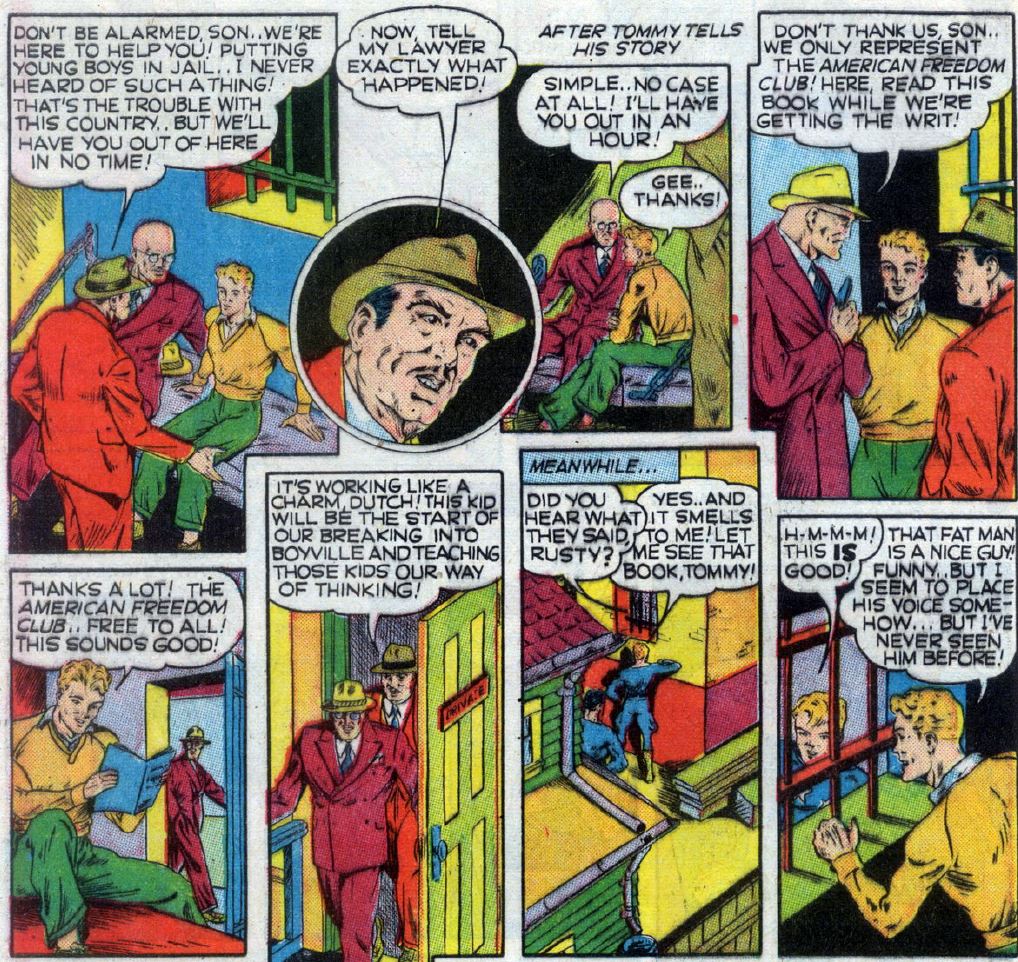
    The American Freedom Club AKA the Movement AKA the New Order were propagandists looking to corrupt the youth of the nation, starting with the Boyville Orphanage and ending with a beating from the Boyville Brigadiers (Feature Comics 047, 1941)

    The Anti-American Bund, a standard outsized play on the weenies that were the German-American Bund (remember them as the ones who ran away before Jack Kirby could ride the elevator down to beat them up). This version is for some reason forcing this lady who merely married a bundist to be their leader until she is rescued by Neon the Unknown (Hit Comics 008, 1941)

    The Double Cross! A non-specific Axis force poised to invade the US from within but foiled by the scientific acumen of Wizard Wells and the rough and tumble charm of his assistant Tug (Crack Comics 012, 1941)

    The Fasdicks/ the Fasdick Company, a fascist organization operating a business as a front for an invasion of the Phillipines and possibly a very oblique rude pun name? Foiled by Spin Shaw (Feature Comics 040, 1941)

  • GENERIC COSTUMED VILLAIN ROUND-UP 002

    Another collection of those middling muddlers who didn’t quite make it to the minor leagues: the generic costumed villains!

    Silas Greer: 

    Tried to kill his own nephew to get his fortune but was walloped by the Clock (and the Orchid!) for his troubles. (Crack Comics 002, 1940)

    Trag: 

    A gentleman with the unlikely name of Trag dressed up in this unusual mask in an attempt to frame a guy with the only slightly less unusual name of Doctor Prowl before Madam Fatal put the kibosh on him. (Crack Comics 008, 1940)

    Natas: 

    This here fella was the secret head of a protection racket shaking down all of the laundries in town. Scientific sleuth Wizard Wells knew it was one of the laundry owners behind the mask but not which one. Surprising nobody, it was the one named Natas. (Crack Comics 009, 1941)

    General Korn: 

    Behind this mask is one General Korn, who responded to the US government not buying his remote bomb detonator by first blowing up part of Washington DC and then trying to explode the US Senate itself. But little did he know that Black Condor was on that senate, so he got caught post haste. (Crack Comics 013, 1941)

  • GENERIC COSTUMED VILLAIN ROUND-UP 002

    Another collection of those middling muddlers who didn’t quite make it to the minor leagues: the generic costumed villains!

    Silas Greer: 

    Tried to kill his own nephew to get his fortune but was walloped by the Clock (and the Orchid!) for his troubles. (Crack Comics 002, 1940)

    Trag: 

    A gentleman with the unlikely name of Trag dressed up in this unusual mask in an attempt to frame a guy with the only slightly less unusual name of Doctor Prowl before Madam Fatal put the kibosh on him. (Crack Comics 008, 1940)

    Natas: 

    This here fella was the secret head of a protection racket shaking down all of the laundries in town. Scientific sleuth Wizard Wells knew it was one of the laundry owners behind the mask but not which one. Surprising nobody, it was the one named Natas. (Crack Comics 009, 1941)

    General Korn: 

    Behind this mask is one General Korn, who responded to the US government not buying his remote bomb detonator by first blowing up part of Washington DC and then trying to explode the US Senate itself. But little did he know that Black Condor was on that senate, so he got caught post haste. (Crack Comics 013, 1941)