The Curse of Skeleton Munroe

Category: undead – ghost

  • MINOR SUPER-VILLAIN 864: THE BLOODY BARON

    (Wonderworld Comics 010, 1940)

    The Bloody Baron was once Karek, Baron of the Duchy of Morziava, somewhere in the spooky part of Eastern Europe. Nine Hundred plus years ago he went off to war and came back a woman-killing creep and so his people burned him at the stake. Ever since, he’s been rising from the dead and carrying off a woman per year – that’s at least eight hundred women as of the story we’re talking about!

    Yarko the Great is passing through Morziava when he runs into the Albert Deach, the son of an old friend, and his Morziavan fiance Sonya Miran. They collectively seek shelter for the night in a nearby castle and have the bad luck to find the Bloody Baron and his cadre of ghostly knights, who grab Sonya and spirit her off to the Valley of Shadows, which is either a euphemism for the underworld or a location in the underworld, take your pick.

    Yarko of course pursues, using the Baron’s own sword as a link to his spirit and then later as a weapon to stab the ghostly knights with.

    The Baron is made of sterner stuff than his subordinate ghosts, and Yarko’s magic is hampered by being in the underworld. but this doesn’t prove to be a problem, because the Baron has spent eight centuries generating an army of vengeful spirits and is completely unprepared to deal with any sort of ghost-on-ghost violence. Yarko only has to summon three dagger-wielding women before he is completely destroyed and descends to some sort of lower underworld yet. The people of Morziava are finally free!

  • MINOR SUPER-VILLAIN 864: THE BLOODY BARON

    (Wonderworld Comics 010, 1940)

    The Bloody Baron was once Karek, Baron of the Duchy of Morziava, somewhere in the spooky part of Eastern Europe. Nine Hundred plus years ago he went off to war and came back a woman-killing creep and so his people burned him at the stake. Ever since, he’s been rising from the dead and carrying off a woman per year – that’s at least eight hundred women as of the story we’re talking about!

    Yarko the Great is passing through Morziava when he runs into the Albert Deach, the son of an old friend, and his Morziavan fiance Sonya Miran. They collectively seek shelter for the night in a nearby castle and have the bad luck to find the Bloody Baron and his cadre of ghostly knights, who grab Sonya and spirit her off to the Valley of Shadows, which is either a euphemism for the underworld or a location in the underworld, take your pick.

    Yarko of course pursues, using the Baron’s own sword as a link to his spirit and then later as a weapon to stab the ghostly knights with.

    The Baron is made of sterner stuff than his subordinate ghosts, and Yarko’s magic is hampered by being in the underworld. but this doesn’t prove to be a problem, because the Baron has spent eight centuries generating an army of vengeful spirits and is completely unprepared to deal with any sort of ghost-on-ghost violence. Yarko only has to summon three dagger-wielding women before he is completely destroyed and descends to some sort of lower underworld yet. The people of Morziava are finally free!

  • MINOR SUPER-HERO ROUND-UP 011

    Lotsa lil guys.

    Mr Justice: 

    Like the Spectre or the Wraith (or Sergeant Spook or the Gay Ghost or the Ghost Patrol…), Mr Justice is your classic restless spirit who remains on Earth to mete out justice to the wicked. Specifically, Mr Justice is the 200 year old ghost of the fictional English Prince James, cruelly slain by followers of Prince Richard during the Rogers Rebellion of the 1740s. Astute readers and students of history might have noticed a few things about the preceding sentence that all boil down to the fact that the 1740s were actually recent enough that we know a whole lot about what was going on then, including that people weren’t running around in Medieval armour even if they were sometimes still using swords and shields during the Jacobite Rebellion of 1745. Also, this is what the crown prince of England looked like in 1741. (they change it to the 11th Century later on, because that makes a lot more sense).
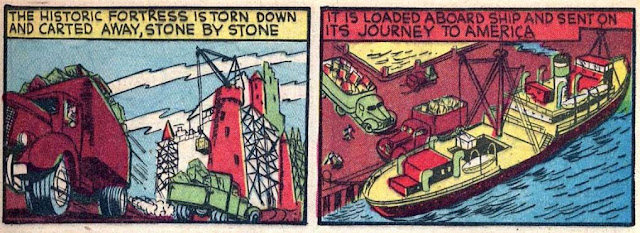
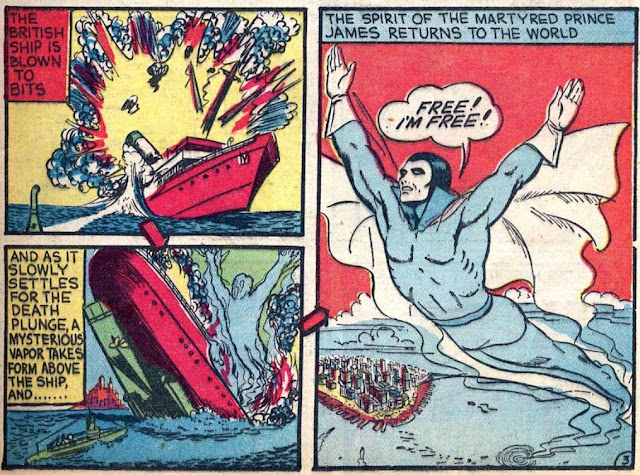
    Prince James’ ghost is tethered to the place of his death per the usual ghost rules but he manages to get around that in a fairly unprecedented way: due the the war, the British government decides to move the castle to America and it is sunk by the Nazis on the way there. And since a pile of stone on the bottom of the Atlantic is not a castle, James is free to go become Mr Justice, the ghost super-hero frequently compared to the Spectre but who doesn’t really get up to the sames sort of divine judgment stuff. He does fight the Devil/Satan a lot, though.
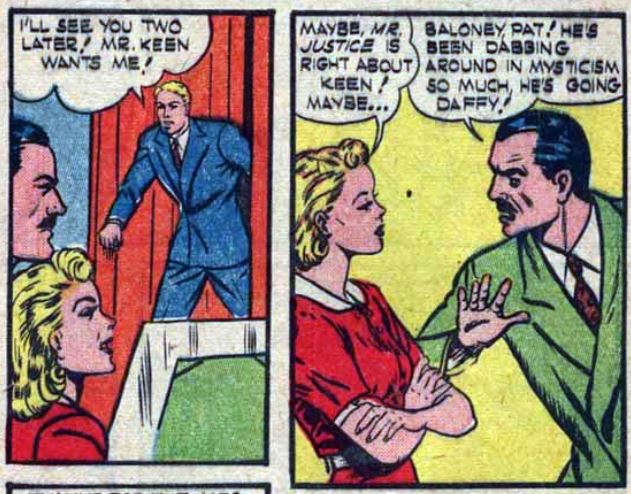
    Possibly my favourite thing about Mr Justice is the fact that his secret identity is a fellow named Mr Justice and nobody really calls any attention to that fact. Mr Justice (secret identity of Mr Justice) is attached to the office of Mayor Clark (city unnamed but very NYC-esque) as a sort of troubleshooter. He kind of has a love interest in mayor’s daughter Pat Clark and a rival in District Attorney Roy Winkler, above, but neither is explored very thoroughly. (Blue Ribbon Comics 009, 1941)

    Inferno:

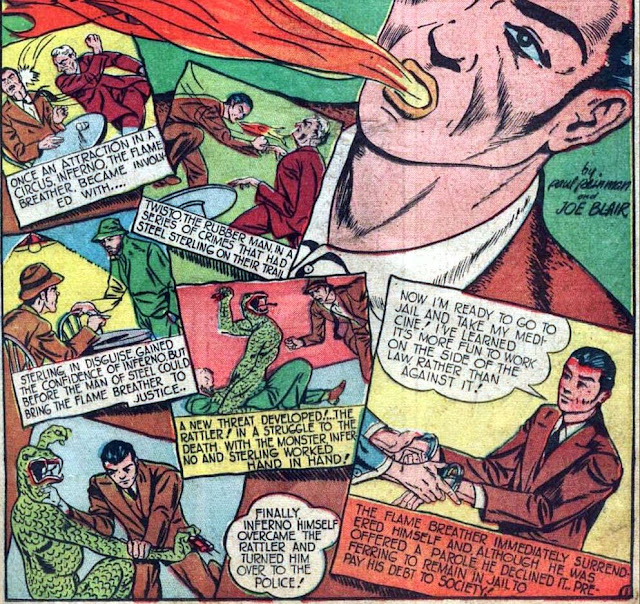
    Above is an abridged account of Inferno’s time as a super-villain, which we will treat separately because… well, because when you’re reading a lot of old comics in a somewhat systematic manner you have to have some sort of organizational method and I chose alphabetical by year, and Inferno’s time on the lists of crime happened in Zip Comics. I simply haven’t gotten there yet. Suffice to say that he was a crook who changed his ways due to the influence of Steel Sterling and opted to do his time.

    Despite his best efforts, Inferno is compelled to break jail to stop a group of prison escapees from murdering a judge and then is encouraged by that same judge to go on the lam because the authorities are going to try to murder Inferno. It’s a real reciprocal life-saving situation! Although I am tempted to think that that judge could possibly have just called someone and arranged for a stay of summary execution for Inferno.

    The rest of Inferno’s career as a Golden Age super-hero is kind of a fun twist on the old trope of the super-hero that everyone thinks is a crook, in that he doesn’t really have a secret identity per se so just travels around doing itinerant labour until he sees a crime go and changes outfits. The idea of this hobo existence kind of goes by the wayside after a couple of issues when Secret Service Agent Virginia Ames enters the picture, as Inferno’s stories were on the shorter side and just didn’t have the real estate for both a love interest and workplace drama.

    Inferno only managed seven adventures before trotting off to limbo to wait for Archie’s 1960s super-hero revival but don’t worry! He got a full pardon in his last adventure so the other heroes won’t be hassling him. (Blue Ribbon Comics 013, 1941)

    Captain Flag:

    On the one hand, Captain Flag is a regular-style patriotic hero but on a different, more entertaining hand he is a patriotic hero with a very fun origin. To whit: one day super-villain the Black Hand is attempting to wrest scientific secrets from inventor John Townsend when his playboy son Tom stumbles in half lit. The Black Hand is about to dispose of Tom using his horrible hand when a huge eagle just kind of… flaps into the room and ends up leaving with Tom Townsend in its talons.

    Thus saved, Tom just kind of lives with the eagle for a while and transforms from a dissipated youth to a lean, athletic man full of fish protein. And then the eagle comes back one day with an American flag! It’s a veritable sign from the heavens it what it is!

    And so, Tom Townsend becomes Captain Flag, who mostly fights the Black Hand. Which makes sense. Something else that would make a lot of sense: adding a belt to that costume. (Blue Ribbon Comics 016, 1941)

    The Red Mask:

    The Red Mask is very minor indeed! He appeared in four issues of Best Comics from Better Publications, of which only issue 2 appears to be available, which in turn was reprinting newspaper strips, of which only a handful are available. 

    What we have on the guy is this: he leads a tribe on the island of Kaukura, which is probably but not definitely in Oceania somewhere. Kaukura is chockablock with things like sacred grottoes, immortal monsters and hostile tribes and the Red Mask has assigned himself the task of protecting a bunch of clueless outsiders like Nina and Danny here who have blundered in looking for their friend and found themselves up to their neck in trouble.

    The most interesting thing about the Red Mask is that he is by a fair margin the first nonwhite super-hero, though thanks to colouring limitations and some inexact geography it’s a bit difficult to get more exact than that. (Best Comics 002, 1939)

  • MINOR SUPER-HERO ROUND-UP 011

    Lotsa lil guys.

    Mr Justice: 

    Like the Spectre or the Wraith (or Sergeant Spook or the Gay Ghost or the Ghost Patrol…), Mr Justice is your classic restless spirit who remains on Earth to mete out justice to the wicked. Specifically, Mr Justice is the 200 year old ghost of the fictional English Prince James, cruelly slain by followers of Prince Richard during the Rogers Rebellion of the 1740s. Astute readers and students of history might have noticed a few things about the preceding sentence that all boil down to the fact that the 1740s were actually recent enough that we know a whole lot about what was going on then, including that people weren’t running around in Medieval armour even if they were sometimes still using swords and shields during the Jacobite Rebellion of 1745. Also, this is what the crown prince of England looked like in 1741. (they change it to the 11th Century later on, because that makes a lot more sense).

    Prince James’ ghost is tethered to the place of his death per the usual ghost rules but he manages to get around that in a fairly unprecedented way: due the the war, the British government decides to move the castle to America and it is sunk by the Nazis on the way there. And since a pile of stone on the bottom of the Atlantic is not a castle, James is free to go become Mr Justice, the ghost super-hero frequently compared to the Spectre but who doesn’t really get up to the sames sort of divine judgment stuff. He does fight the Devil/Satan a lot, though.

    Possibly my favourite thing about Mr Justice is the fact that his secret identity is a fellow named Mr Justice and nobody really calls any attention to that fact. Mr Justice (secret identity of Mr Justice) is attached to the office of Mayor Clark (city unnamed but very NYC-esque) as a sort of troubleshooter. He kind of has a love interest in mayor’s daughter Pat Clark and a rival in District Attorney Roy Winkler, above, but neither is explored very thoroughly. (Blue Ribbon Comics 009, 1941)

    Inferno:

    Above is an abridged account of Inferno’s time as a super-villain, which we will treat separately because… well, because when you’re reading a lot of old comics in a somewhat systematic manner you have to have some sort of organizational method and I chose alphabetical by year, and Inferno’s time on the lists of crime happened in Zip Comics. I simply haven’t gotten there yet. Suffice to say that he was a crook who changed his ways due to the influence of Steel Sterling and opted to do his time.

    Despite his best efforts, Inferno is compelled to break jail to stop a group of prison escapees from murdering a judge and then is encouraged by that same judge to go on the lam because the authorities are going to try to murder Inferno. It’s a real reciprocal life-saving situation! Although I am tempted to think that that judge could possibly have just called someone and arranged for a stay of summary execution for Inferno.

    The rest of Inferno’s career as a Golden Age super-hero is kind of a fun twist on the old trope of the super-hero that everyone thinks is a crook, in that he doesn’t really have a secret identity per se so just travels around doing itinerant labour until he sees a crime go and changes outfits. The idea of this hobo existence kind of goes by the wayside after a couple of issues when Secret Service Agent Virginia Ames enters the picture, as Inferno’s stories were on the shorter side and just didn’t have the real estate for both a love interest and workplace drama.

    Inferno only managed seven adventures before trotting off to limbo to wait for Archie’s 1960s super-hero revival but don’t worry! He got a full pardon in his last adventure so the other heroes won’t be hassling him. (Blue Ribbon Comics 013, 1941)

    Captain Flag:

    On the one hand, Captain Flag is a regular-style patriotic hero but on a different, more entertaining hand he is a patriotic hero with a very fun origin. To whit: one day super-villain the Black Hand is attempting to wrest scientific secrets from inventor John Townsend when his playboy son Tom stumbles in half lit. The Black Hand is about to dispose of Tom using his horrible hand when a huge eagle just kind of… flaps into the room and ends up leaving with Tom Townsend in its talons.

    Thus saved, Tom just kind of lives with the eagle for a while and transforms from a dissipated youth to a lean, athletic man full of fish protein. And then the eagle comes back one day with an American flag! It’s a veritable sign from the heavens it what it is!

    And so, Tom Townsend becomes Captain Flag, who mostly fights the Black Hand. Which makes sense. Something else that would make a lot of sense: adding a belt to that costume. (Blue Ribbon Comics 016, 1941)

    The Red Mask:

    The Red Mask is very minor indeed! He appeared in four issues of Best Comics from Better Publications, of which only issue 2 appears to be available, which in turn was reprinting newspaper strips, of which only a handful are available. 

    What we have on the guy is this: he leads a tribe on the island of Kaukura, which is probably but not definitely in Oceania somewhere. Kaukura is chockablock with things like sacred grottoes, immortal monsters and hostile tribes and the Red Mask has assigned himself the task of protecting a bunch of clueless outsiders like Nina and Danny here who have blundered in looking for their friend and found themselves up to their neck in trouble.

    The most interesting thing about the Red Mask is that he is by a fair margin the first nonwhite super-hero, though thanks to colouring limitations and some inexact geography it’s a bit difficult to get more exact than that. (Best Comics 002, 1939)

  • MINOR SUPER-VILLAIN 525: RIALB

    MINOR SUPER-VILLAIN 525: RIALB

    (Blue Ribbon Comics 012, 1941)

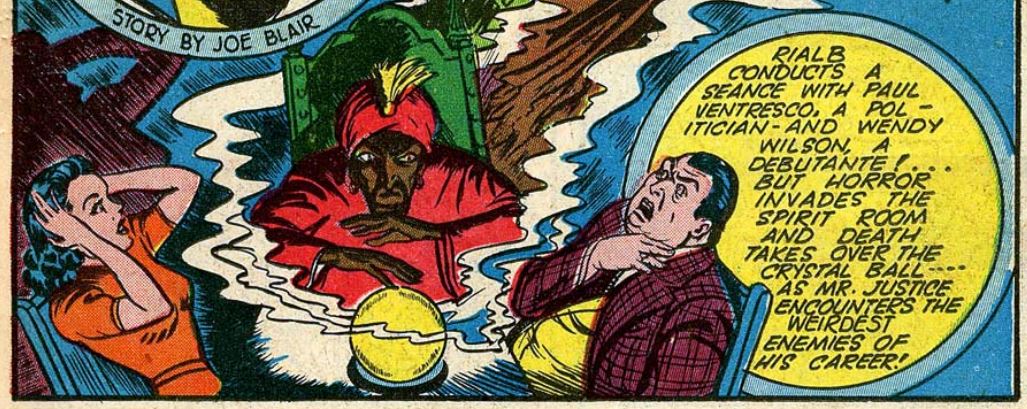
    Here’s a story about my powers of observation: I immediately noticed that our friend Rialb here had a backward name and spent a good half hour trying to figure out which Blair he might be named in reference to (a 1940s spiritualist? a famous skeptic?) before my eyes drifted slightly to the left and I took in the fact that the story was written by Joe Blair. I still have no idea why Joe Blair named the wet-rag villain of the story after himself, but let’s all be happy I figured it out before moaning about it here.

    Speaking of wet rags: let’s discuss Rialb. He’s a fake medium who accidentally discovers that he can actually summon the spirits of the dead but seems to have a knack for bringing back spirits who wish their descendants harm. Further, the first time he does so is witnessed by crooked politician Paul Ventresco, who puts the easily pushed-over Rialb to work as his personal ghost-powered hitman.

    The real stars of the story are the extremely grody ghosts that Rialb manages to conjure up. Just look at this gross old misogynist.

    Shadow imp, skull-faced spectre, pointillism lizard-man… this comic has it all!

    The real star is absolutely this skeleton-limbed hair-face who gets his bony ass kicked back to the netherworld he came from by Mr Justice before he can get up to any mischief. I really enjoy how the unchanging expression on his face reads as both menacing and sad depending on which side of the ass kicking he is.

    Just a regular ghost.

    It’s a bit of a letdown that the last ghosts we see are three sad sack victims of Ventrusco who Mr Justice calls up to cow the pair into surrendering, though he really only needed them for Ventrusco, given that Rialb shows no actual evidence of having a spine during the story – Mr Justice could have just thrown a sheet over a chair and gotten the same result.

  • MINOR SUPER-VILLAIN 525: RIALB

    (Blue Ribbon Comics 012, 1941)

    Here’s a story about my powers of observation: I immediately noticed that our friend Rialb here had a backward name and spent a good half hour trying to figure out which Blair he might be named in reference to (a 1940s spiritualist? a famous skeptic?) before my eyes drifted slightly to the left and I took in the fact that the story was written by Joe Blair. I still have no idea why Joe Blair named the wet-rag villain of the story after himself, but let’s all be happy I figured it out before moaning about it here.

    Speaking of wet rags: let’s discuss Rialb. He’s a fake medium who accidentally discovers that he can actually summon the spirits of the dead but seems to have a knack for bringing back spirits who wish their descendants harm. Further, the first time he does so is witnessed by crooked politician Paul Ventresco, who puts the easily pushed-over Rialb to work as his personal ghost-powered hitman.

    The real stars of the story are the extremely grody ghosts that Rialb manages to conjure up. Just look at this gross old misogynist.

    Shadow imp, skull-faced spectre, pointillism lizard-man… this comic has it all!

    The real star is absolutely this skeleton-limbed hair-face who gets his bony ass kicked back to the netherworld he came from by Mr Justice before he can get up to any mischief. I really enjoy how the unchanging expression on his face reads as both menacing and sad depending on which side of the ass kicking he is.

    Just a regular ghost.

    It’s a bit of a letdown that the last ghosts we see are three sad sack victims of Ventrusco who Mr Justice calls up to cow the pair into surrendering, though he really only needed them for Ventrusco, given that Rialb shows no actual evidence of having a spine during the story – Mr Justice could have just thrown a sheet over a chair and gotten the same result.

  • MINOR SUPER-VILLAIN 519: THE GHOST OF THE CYCLOPS

    (Blue Bolt v2 004-005, 1941)

    We open on a bit of… not hubris but it’s often framed as hubris. I’m sure that TV Tropes has a name for it but danged if I’m going to go hunting for it. It’s the phenomenon in which a character in an ongoing fictional setting jokes about how they’re sure glad that *SPECIFIC THING* isn’t real etc and that thing is the focus of the next story. In this case, Sergeant Spook says he’s glad that mythology doesn’t real and so Ghost Town doesn’t have to contend with the ghosts of mythological characters and BAM the ghost of the Cyclops starts destroying Alaska.

    Although the human world sees these attacks as merely a bizarre and terrifying natural disaster the ghosts of Ghost Town know what’s up and dispatch Sergeant Spook northward. On arrival he is met and guided by several of the Cyclops’ recent victims – always a handy part of being a ghost cop.

    Spook’s encounter with the Cyclops follows a fairly predictable pattern: cornered in a cave, he anages to temporarily blind the other ghost and then trace him back to his lair by clinging to his cyclopean sandals. This encounter does serve to further muddy the waters of how ghosts workin Sergeant Spook comics, however: can a ghost hit another ghost with a corporeal snowball? Is Alaska covered in a layer of ghost snow? Or is the Cyclops just super-vulnerable to eye-damaging attacks like a video game boss?

    The second issue of this two-parter is a bit perfunctory: Spook arrives at the Cyclops’ lair where we learn that when not translucent to signify that he is a ghost in the corporeal world the Cyclops is green. He is also served by other, unidentified ghosts who are presumably being bullied into servitude with the threat of violence like the Ghost of King Tut’s slaves. He also captures Sergeant Spook with very little trouble. Things look bad, but then:

    HERCULES! Because of course if the Cyclops is real then there’s gotta be guys like Hercules (famous foe of the Cyclops) running around too. There’s a bit of a scuffle and then he plants a slobberknocker on the Cyclops that decisively concludes things.

    Hercules’ reward: eternal vigilance. His ghost pledges to guard the Cyclops’ ghost for the rest of time, which will presumably entail regular brawls whenever his charge wakes up and wants to cause more chaos. Maybe this is a good outcome for Hercules? I just hope that someone in Ghost Town thinks to ship him some ghost books or the like.

  • MINOR SUPER-VILLAIN 514: THE GHOST OF ROCK ROOK

    (Blue Bolt v2 001, 1941)

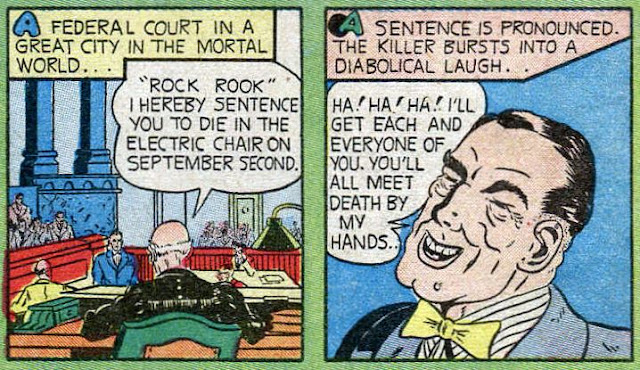
    “Rock” Rook is a gangster with an incredibly annoying name: hard to parse, seems like it should mean something but doesn’t, plus its’ always written as “Rock Rook” and that’s probably just a quirk of early 20th Century English but it makes me think that his last name isn’t even Rook and that makes me think that it means something again but it still doesn’t.

    Anyway, he is sentenced to and executed in the electric chair, ostensibly for murder but his annoying name must have contributed some judicial bloodthirstiness.

    As this is a Sergeant Spook story, Rook’s vow to revenge himself on the judge and jury is not carried out by the traditional methods (fake your own death, hire a mad scientist to resurrect your corpse or put your brain in a gorilla, die but have your secret twin pretend to be your ghost, etc) but rather by his coming back as an actual, factual ghost.

    Unfortunately for Rock Rook the freedom to be a ghostly murderer comes with a major catch: your victim’s ghost can call the ghost cops on you. Sergeant Spook is on the case faster than Rock Rook can line up his next target.

    After that it’s just a matter of experienced ghost vs inexperienced ghost and Rock Rook finds himself in the ghost-proof jail lickety-split.

    Sergeant Spook is still a comic searching for its sweet spot and and for my money this kind of ghost-on-human crime is where it should focus, particularly if it involves stuff like the murder victim calling the ghost cops on the murderer.

    JUDGE AND JURY REVENGE KILLER SCORE: 1/19+ (very weak showing from a unstoppable killing machine)

  • MINOR SUPER-VILLAIN 514: THE GHOST OF ROCK ROOK

    (Blue Bolt v2 001, 1941)

    “Rock” Rook is a gangster with an incredibly annoying name: hard to parse, seems like it should mean something but doesn’t, plus its’ always written as “Rock Rook” and that’s probably just a quirk of early 20th Century English but it makes me think that his last name isn’t even Rook and that makes me think that it means something again but it still doesn’t.

    Anyway, he is sentenced to and executed in the electric chair, ostensibly for murder but his annoying name must have contributed some judicial bloodthirstiness.

    As this is a Sergeant Spook story, Rook’s vow to revenge himself on the judge and jury is not carried out by the traditional methods (fake your own death, hire a mad scientist to resurrect your corpse or put your brain in a gorilla, die but have your secret twin pretend to be your ghost, etc) but rather by his coming back as an actual, factual ghost.

    Unfortunately for Rock Rook the freedom to be a ghostly murderer comes with a major catch: your victim’s ghost can call the ghost cops on you. Sergeant Spook is on the case faster than Rock Rook can line up his next target.

    After that it’s just a matter of experienced ghost vs inexperienced ghost and Rock Rook finds himself in the ghost-proof jail lickety-split.

    Sergeant Spook is still a comic searching for its sweet spot and and for my money this kind of ghost-on-human crime is where it should focus, particularly if it involves stuff like the murder victim calling the ghost cops on the murderer.

    JUDGE AND JURY REVENGE KILLER SCORE: 1/19+ (very weak showing from a unstoppable killing machine)

  • MINOR SUPER-VILLAIN 508: THE GHOST OF KING TUT

    (Blue Bolt v1 009-010, 1940)

    This is a simple one but there are a lot of Lore Implications so I had to use a lot of pictures. To start, Sergeant Spook and his pal Dr Sherlock notice that there are no North African ghosts in Ghost Town (aside from Cleopatra, who was mentioned a few issues earlier) and resolve to go solve that mystery. They get the permissions and passports necessary to enter the mortal realm and head out.

    Arriving in North Africa, Spook and Sherlock are captured by ghost soldiers and brought to a ghost city via ghost chariot where they meet the person in charge of the whole ghost shebang: the ghost of Tutankhamen! And tangentially learn that ghosts turn green when they get sunburned – LORE!

    Tutankhamen (and just why he rather than any other North African ruler ended up in charge is not explored) further reveals that the reason that no ghosts leave North Africa is that he has enslaved them all and is making them build him an enormous ghost pyramid, presumably so that he can be entombed in style if he every dies a second time (and forget my usual questions about how blocks of stone might have become ghosts – just why has this pyramid taken so long to make? Literally thousands of years longer than any other! And with an immortal workforce!).

    Sergeant Spook escapes, of course, and makes his way home to appeal to Ghost Town president George Washington for some good old American-style overseas interventionism.

    There is a big battle, with ghost camels and ghost horses and ghost siege engines throwing ghost boulders. Sergeant Spook lays about him with a flail which is always upsetting to me because it looks so cool and I am against arming living police officers with flails.

    Ultimately, the fact that everyone involved is a ghost and thus none of the fighting can have lasting consequence means that Sergeant Spook must solve things by bopping King Tut on the schnozz, thus showing his subjects that he is fallible and not worthy of the thousands of years of torment that they endured/ inflicted in his name. Everyone except for King Tut goes home happy.