The Curse of Skeleton Munroe

Category: origin

  • MINOR SUPER-HERO ROUND-UP 064

    MINOR SUPER-HERO ROUND-UP 064

    Oh my gosh! It’s more minor super-heroes! 

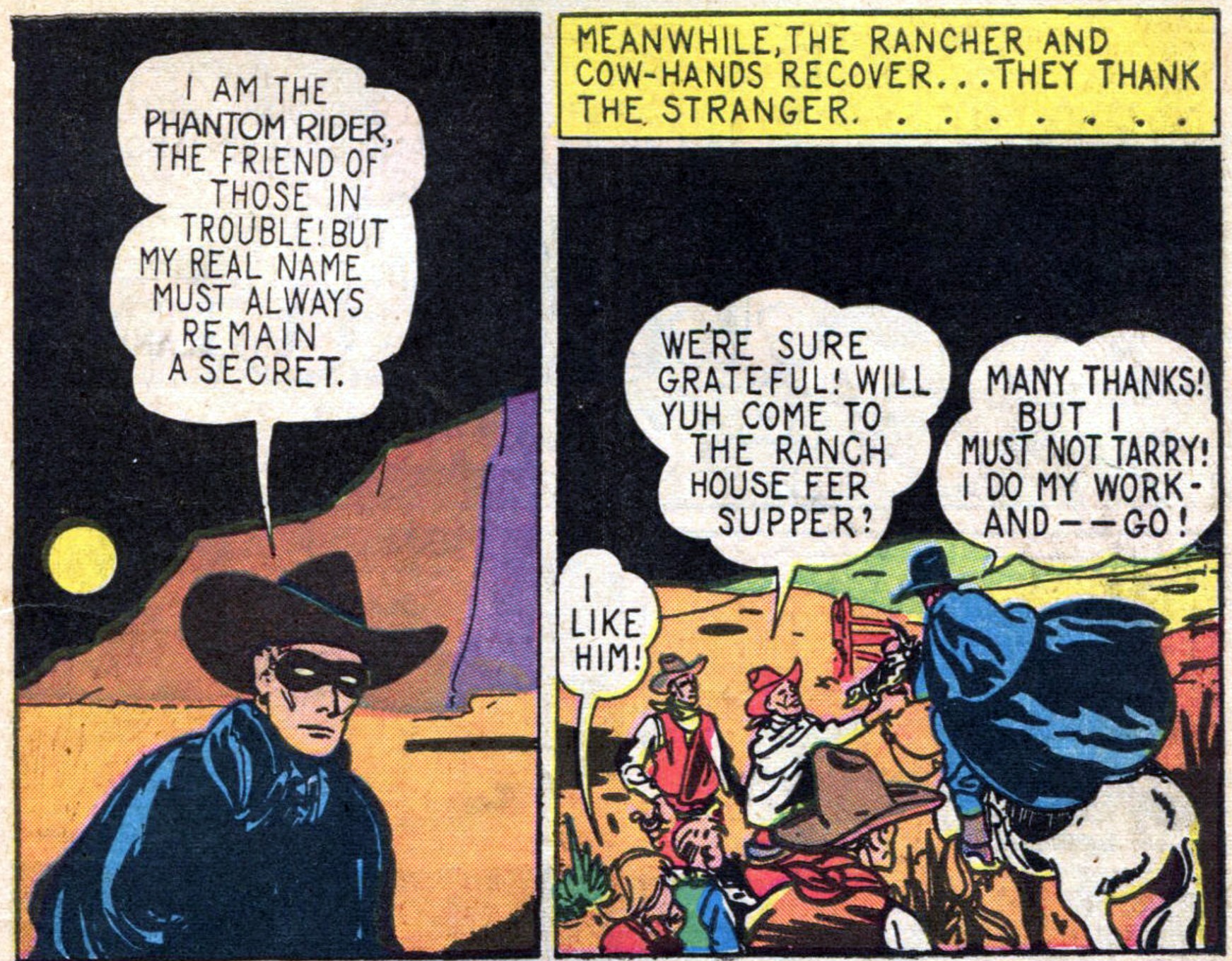
    the Phantom Rider: 

    The Phantom Rider is Tex Maxon, who was already a wandering cowboy who meted out justice for a while before getting into the masked vigilante game. Where a lot of masked cowboy vigilantes are doing a classic secret identity or concealing their identity for more specific reasons like being wanted for a crime they didn’t commit, the Phantom Rider thing honestly just seems like a fashion choice on Maxon’s part, like he found a big black cloak one day and decided to roll with it.

    The above speculation is undermined somewhat by the fact that the Phantom Rider outfit changes to this yellow cowboy shirt/jeans/mask combo pretty quickly, but maybe Maxon just found the cloak too cumbersome (or the artist found it too annoying to draw).

    Far more annoying is the fact that this strip that was clearly set in the Old West from long before the Phantom Rider identity was established switches to a Modern West setting in Wonderworld 015. Have some consistency, people. (Wonderworld Comics 011, 1940)

    **UPDATE** the Flame:

    Once again we have the origin of the Flame, and as I suspected the previous version of this that we had encountered was cut down from this one. Notably, this is the first time that the Flame is given any sort of name, Charteris, and the lack of a first name is even kind of textually supported: he is washed away in the flood immediately after being born – his parents might not have had time to name him yet. He is made Grand High Lama as a baby in this one too, which is still weird to me. (Wonderworld Comics 011, 1940)

    **UPDATE** Yarko the Great:

    In a bit of Silver Age “give everything a significant origin” style storytelling, the jewel on the front of Yarko the Great’s turban is revealed to be the Ada-La-Hoda, one of the Twin Jewels of Blood required for this one Chosen One to become ruler of all India, in a mystical sword-in-the-stone way. Unfortunately for him, his choice to wantonly murder anyone who might get in the way of his acquiring the gem leads Yarko to determine that he is unfit for the role and keep the dang thing in hopes that the next Seventh Son of the Seventh Son of the Order of Aribah might be more reasonable. (Wonderworld Comics 011, 1940)

    the Secret Band of the Purple Hood: 

    The Secret Band of the Purple Hood are a vigilante organization that operate in the city of Shanghai and who induct super-detective Dr Fung into their ranks mid-case as both he and they are attempting to battle the worshippers of Khwass, Great God of Vengeance. Sadly, as this adventure ends in a cliffhanger that is as far as I can tell never resolved, we don’t get to see the Secret Band do much more than beat up a couple of priests, but I’m just so chuffed to find a vanishingly-rare example of non-title-character masked vigilantism that I simply had to include them. (Wonderworld Comics 016, 1940)

  • MINOR SUPER-HERO ROUND-UP 053

    They really do just keep coming. 

    **Update** The Arrow:

    While the Arrow has always been portrayed as a mysterious seven-foot-tall physical prodigy, this particular adventure really goes all in on his being super-humanly strong. This seems significant somehow, even if it is is second-to-last appearance by my reckoning. (The Arrow 002, 1940)

    **UPDATE** the Flame: 

    This is the first actual version of the Flame’s origin that I’ve encountered in a comic book, so here it is. It is also the first time that I’ve encountered the notion of baby the Flame being proclaimed as the Grand High Lama. It’s a weird detail! (The Flame 001, 1940)

    Phantasmo: 

    And speaking of the ancient secrets of Tibet…

    Phantasmo! He spent 25 years in Tibet learning mystic secrets and now he’s returned to the US to mete out supernatural justice! Phantasmo! His main deal is that he can project his astral body and that in that form he is basically omnipotent! Phantasmo! He can grow, shrink, heal, kill, he is an invulnerable and infinitely strong magic man! Phantasmo! He does have one key weakness: while his astral form is out and about, his physical body is vulnerable, so teenaged Whizzer McGee tags along on his adventures to watch over it! Phantasmo!

    Thanks to a combination of an already fairly minimal costume combined with his transparent nature and some odd colour choices, Phantasmo is possibly also the nudest Golden Age super-hero, at least in his cover appearances. (The Funnies 045, 1940)

    Update 1941

    the Black Knight: 

    A young village blacksmith who first helps the Good King Victor of England when his leg is broken in a boar hunt and then goes on to foil several simultaneous attempts on the monarch’s life, the unnamed youth receives the customary reward for doing an excellent job: additional responsibilities. The Black Knight acts as a sort of state-sanctioned vigilante, rooting out evil among the chivalry of England.

    And speaking of England, the more history-minded of you might have noted that “Good King Victor of England” I mentioned as being very much not an actual British monarch. This raises the question of just when the Black Knight stories are set: it’s broadly Medieval (5th to 15th Centuries), operating under the Chivalric Code (12th to 15th Centuries), the King has a Damascus steel sword (post 10th to 11th Century), there is talk of doctors being fairly available (13th Century at earliest)… so what does all this add up to? Absolutely nothing. The Black Knight exists in a pastiche of knight-haunted England that is as historical as your average retelling of the Arthurian mythos, and in fact the whole thing would be a lot neater if Victor were actually Arthur. We must work with what we have, I suppose. (The Funnies 046, 1940) 

    ADDENDUM: I wrote this before I had read the last couple of Black Knight stories for 1940, and immediately after posting it I cracked open The Funnies 049, featuring a tale in which the Black Knight helps defend Cornwall (becomes part of England proper around the 10th to 11th Century) from a force of Huns (4th to 6th Centuries) and their enslaved Viking (8th to 11th Centuries) crew, and let me tell you I was relieved.

    Update 1941