The Curse of Skeleton Munroe

Category: Spirit

  • CATALOGUE OF WOUNDS 014

    I’ve finally caught up on all the backlogged wounds! Only new wounds for the catalogue going forward.

    the Dart:

    The Dart has come all the way from Ancient Rome to the present day (1940) only to be shot in the left arm. (Weird Comics 006, 1940)

    Doc Strange:

    Though the text box says that Doc Strange is “riddled with bullets” in this exchange, the subsequent first aid suggests that his left arm bore the brunt of the damage. (Thrilling Comics 001, 1940)

    the Falcon:

    The Falcon gets a classic head creasing. (Human Torch v1 002, 1940)

    Ferret:

    Despite the fact that these crooks manage to capture Ferret and force him to remove his bulletproof vest, they not only then choose to shoot him in the head but fail to actually shoot him in the head fatally and instead do a classic skull crease. (Marvel Mystery Comics v1 008, 1940)

    the Flame:

    The Flame gets in on the classic skull crease game. (Wonderworld Comics 018, 1940)

    the Masked Rider:

    Not to be left out, the Masked Raider sustains a head crease, classic. (Startling Comics 001, 1940)

    And again a few issues later. (Startling Comics 004, 1940)

    the Spirit:

    The Spirit (who I’m sure will be a frequent visitor to the Catalogue of Wounds) is shot in the left shoulder by Dr Cobra. (Spirit Section, June 9, 1940)

    A few months later: shot in the right shoulder. (The Spirit Section, September 22, 1940) 

    And a few months after that, the right shoulder again, this time by the Black Queen. (The Spirit Section, November 10, 1940)

    Thor, God of Thunder:

    Thor’s alter identity of Grant Farrel is shot in the back, wounding him badly enough that it takes weeks for him to recover. (Weird Comics 003, 1940)

    Yarko the Great:

    Even Yarko’s great magic cannot save him from occasionally being shot in the right arm. (Wonderworld Comics 004, 1940)

  • CATALOGUE OF WOUNDS 014

    I’ve finally caught up on all the backlogged wounds! Only new wounds for the catalogue going forward.

    the Dart:

    The Dart has come all the way from Ancient Rome to the present day (1940) only to be shot in the left arm. (Weird Comics 006, 1940)

    Doc Strange:

    Though the text box says that Doc Strange is “riddled with bullets” in this exchange, the subsequent first aid suggests that his left arm bore the brunt of the damage. (Thrilling Comics 001, 1940)

    the Falcon:

    The Falcon gets a classic head creasing. (Human Torch v1 002, 1940)

    Ferret:

    Despite the fact that these crooks manage to capture Ferret and force him to remove his bulletproof vest, they not only then choose to shoot him in the head but fail to actually shoot him in the head fatally and instead do a classic skull crease. (Marvel Mystery Comics v1 008, 1940)

    the Flame:

    The Flame gets in on the classic skull crease game. (Wonderworld Comics 018, 1940)

    the Masked Rider:

    Not to be left out, the Masked Raider sustains a head crease, classic. (Startling Comics 001, 1940)

    And again a few issues later. (Startling Comics 004, 1940)

    the Spirit:

    The Spirit (who I’m sure will be a frequent visitor to the Catalogue of Wounds) is shot in the left shoulder by Dr Cobra. (Spirit Section, June 9, 1940)

    A few months later: shot in the right shoulder. (The Spirit Section, September 22, 1940) 

    And a few months after that, the right shoulder again, this time by the Black Queen. (The Spirit Section, November 10, 1940)

    Thor, God of Thunder:

    Thor’s alter identity of Grant Farrel is shot in the back, wounding him badly enough that it takes weeks for him to recover. (Weird Comics 003, 1940)

    Yarko the Great:

    Even Yarko’s great magic cannot save him from occasionally being shot in the right arm. (Wonderworld Comics 004, 1940)

  • MEDIA IN COMICS 002

    Fictional books, fictional movies, fictional stage shows: it’s media in comics time! 

    Books:

    Dexter, a friend of Ellsworth “the Sphinx” Forrester, has written a book titled Who’s Who in Murder which is one of those grand exposes that causes everyone in crimedom to attempt to kill the author before they can publish. That’s gotta be great publicity. (Exciting Comics 010, 1941)

    While Guns Make Dust is very plot relevant in this Ellery Queen mystery, as a doped-up stamp thief hides his prize in one of three copies in a local bookstore and subsequently murders several people in search of the right one, we never learn much about the book itself. I think it’s a Western, personally. (Crackajack Funnies 024, 1940)

    We learn even less about Life of Lee, the book that gives DA Tom Kerry the idea that solves a big murder case. Could this be a biography perhaps? Of Robert E. Lee? (Big Shot Comics 007, 1940)

    As we have established, there are many faux Hitlers in comics. Much more rare is the Hitler-alike who has written his own Mein Kampf analog, but such a one is Nargoff, aka the Leader, whose book The New Order is ultimately weaponized against him by the Spirit. (The Spirit, “The Leader,” 29 December, 1940)

    Magazines:

    Roving photographer Fran Frazer works for Strife magazine, an obvious play on LIFE but one which neatly justifies the action-packed lifestyle of the comic book photog. (Top-Notch Comics 009, 1940)

    Movies:

    Real-life animal trainer Clyde Beatty plays some role in the fictional film Jungle Drama, but what it is we cannot say, other than the fact that it involves a lion. (Crackajack Funnies 023, 1940)

    “Gabby Scoops” was a short-lived strip that was an awkward hybrid of goofy humour and crime action that ended after the titular hero went Hollywood and starred in the movie It’s a Scoop! (Crackajack Funnies 030, 1940)

    Shadow Devils, an espionage thriller with an unusual name, is one of those comic book movies that goes on shooting even after female lead Norda Noll is shot dead on-camera. Detective Charlie Chan eventually sorts it all out: it’s all about horse racing somehow. (Big Shot Comics 001, 1940)

    Dick Cole, aka the Wonder Boy, is roped into doing the stunts for a movie called Shining Star over his summer vacation. Interpersonal conflicts and murder attempts stretch the filming over a couple of issues, but it does eventually get made. It’s even well received, despite being an incoherent hodgepodge of action setpieces! (Blue Bolt v1 005, 1940)

    Theatre:

    Like the movie that finishes production despite death an calamity, the play that continues its run while actor after actor is killed on stage is a real staple of the Golden Age mystery comic. Espionage is such a play, albeit with only one murder and a series of near-misses as the show’s conductor fires poisoned darts out of his baton at those who he sees as standing between him and his love of the female lead. (Keen Detective Funnies v2 007, 1939)

  • SEASONAL CONTENT: THE END-OF-YEAR SANTY CLAUS ROUND-UP 2025

    Since it’s Christmas Day I shall now post all comic book Santa Claus action I have encountered in the last year:

    Columbia Comics Universe: 

    Santa Claus is real and he knows Marvelo, Monarch of Magicians. He’s got a modern toy factory and a plane and doesn’t approve of WWII. (Big Shot Comics 020, 1941)

    The Spirit:

    Santa Claus might be real in the world of the Spirit, or maybe this gentleman is just a bearded priest with a real gift for laying on the Christmas spirit, to the extent that he reforms a couple of bad lads. (the Spirit, “Black Henry and Simple Simon”, 22 December, 1940) 

    The Santas were a bit thin on the ground this year, I’m afraid, but the compliments of the season to one and all nonetheless.

  • REAL PERSON ROUND-UP 016

    REAL PERSON ROUND-UP 016

    Are you ready for some comic book versions of real life and fictional people? I sure hope so! 

    Adolf Hitler:  

    Premier Grahvin of the fictional African country of Cadiwa is a pretty broad pastiche of the Axis leaders, but the sheer speed at which he accelerates into full-blown dictator mode (before Mr Mystic turns up to reveal that he had not, in fact killed the king of Cadiwa and was not, in fact, in charge) must be highlighted. (The Spirit Section, 21 July, 1940)

    Likewise, Karoly Gore is an Axis dictator pastiche from a Mr Mystic story a few weeks earlier (but I read them out of order so it’s okay) (The Spirit Section, 9 June, 1940) 

    Axtrol here is a third in our series of Axis dictator pastiches, and he’s possibly the biggest shithead of the bunch. (The Spirit, “Dr Prince von Kalm”, 17 November, 1940)

    Nargoff, aka the Leader, is either a would-be North American dictator or the agent of a European one looking to set up a local franchise. Either way, the Spirit burns down his fake island/submarine base and then engineers a situation in which the might-makes-right philosophies espoused in Nargoff’s book “The New Order” are explored by way of Nargoff and his burly assistant Max being stranded on a small boat in the Caribbean with a limited amount of water. (The Spirit, “The Leader”, 29 December, 1940)

    Don Juan: 

    Mr Mystic and his fiance Elena encounter a whole castle full of ghosts in the woods of Spain, among whom is the spirit of the entirely fictional man Don Juan, who mistakes Elena for his missing wife Ysabel and almost kills her before himself being double-killed by Mystic. (The Spirit Section, 15 December, 1940)

    Khufu aka Cheops: 

    When Mr Mystic decides to go back in time to the creation of the Great Pyramid of Giza, he is mistaken for the god Ammon Ra and of course just immediately gets his grubby little mitts all over the progress of history. It’s kind of okay, though, because the history he’s in seems to already be a big mess – for instance, while Pharaoh Cheops is indeed the ruler supposed to have commissioned the building of the Great Pyramid c. 2600 BCE, the Babylonian invasion they’re worried about is tricky because a) Babylonia is dated from 1890 BCE b) the earliest Nebuchadnezzar I can find ascended to the throne in 1121 BCE and c) given the cultural milieu that this comic was written in they’re probably talking about Nebuchadnezzar II, the one from the Bible, who did invade Egypt a couple of times but didn’t come to power until 605 BCE. Like I said: a real mess. Plus, Amun didn’t even become associated with Ra until the 16th Century BCE!

    There’s also this guy, Prince Sargon of Babylonia, and while there’s a part of me that wants to say that he’s supposed to be Sargon II (the most famous Sargon, 722 BCE), I don’t reckon that Bob Powell, mad as he was with creative power when he wrote this story, would make someone the son of someone else born a hundred years after them. Right? (Sargon does return as a time-travelling mummy out for revenge in the next installment of Mr Mystic but this alas does nothing to clear up the puzzle of his identity) (The Spirit Section, 29 September 1940)

    Misc Arthurian Figures: 

    During one of his jaunts into the past, the Ghost finds himself in Camelot, where he meets a very small selection of Arthurian figures (all of the big name knights are away on the Crusades, we are told). These include Sir Kay, who acts like a weird creep (accurate) and gets beaten up for his efforts, King Arthur, an amiable doormat, and Merlin the Magician, who is portrayed as a fraud with no magical power who sells out Arthur as soon as he gets the chance. An interesting choice for a comic about a magic man, but perfectly in keeping with 1940s secular values. (Thrilling Comics 005, 1940) 

    Myrna Loy & William Powell: 

    A simple flip of the last names renders Myrna Loy and William Powell into Myrna Powell and William Loy on this marquee, with a bonus “Boris Scarloff” for Boris Karloff. (The Spirit Section, 10 November, 1940)

    Ty Cobb: 

    If there’s anything more tedious than a 1940s sports comic it’s a 1940s hillbilly comic, so trust me when I say that this one-off about a baseball-playing hillbilly named Obadiah “Pie” Gobb is one of the the worst things I have ever read. 

    What’s even more egregious is the fact that while Pie Gobb and his new teammate Moe de Muggio (the World’s Greatest Slugger, thanks to the fact that he eats his Fleeties every morning) are easy to identify as Ty Cobb and Joe DiMaggio, respectively, the rest of his team also have goofy names but as far as I can tell none of them are also puns on famous baseball players, meaning that I just spent all that time playing rhyming games on Wikipedia for no reason. (The Funnies 047, 1940)

  • REAL PERSON ROUND-UP 016

    REAL PERSON ROUND-UP 016

    Are you ready for some comic book versions of real life and fictional people? I sure hope so! 

    Adolf Hitler:  

    Premier Grahvin of the fictional African country of Cadiwa is a pretty broad pastiche of the Axis leaders, but the sheer speed at which he accelerates into full-blown dictator mode (before Mr Mystic turns up to reveal that he had not, in fact killed the king of Cadiwa and was not, in fact, in charge) must be highlighted. (The Spirit Section, 21 July, 1940)

    Likewise, Karoly Gore is an Axis dictator pastiche from a Mr Mystic story a few weeks earlier (but I read them out of order so it’s okay) (The Spirit Section, 9 June, 1940) 

    Axtrol here is a third in our series of Axis dictator pastiches, and he’s possibly the biggest shithead of the bunch. (The Spirit, “Dr Prince von Kalm”, 17 November, 1940)

    Nargoff, aka the Leader, is either a would-be North American dictator or the agent of a European one looking to set up a local franchise. Either way, the Spirit burns down his fake island/submarine base and then engineers a situation in which the might-makes-right philosophies espoused in Nargoff’s book “The New Order” are explored by way of Nargoff and his burly assistant Max being stranded on a small boat in the Caribbean with a limited amount of water. (The Spirit, “The Leader”, 29 December, 1940)

    Don Juan: 

    Mr Mystic and his fiance Elena encounter a whole castle full of ghosts in the woods of Spain, among whom is the spirit of the entirely fictional man Don Juan, who mistakes Elena for his missing wife Ysabel and almost kills her before himself being double-killed by Mystic. (The Spirit Section, 15 December, 1940)

    Khufu aka Cheops: 

    When Mr Mystic decides to go back in time to the creation of the Great Pyramid of Giza, he is mistaken for the god Ammon Ra and of course just immediately gets his grubby little mitts all over the progress of history. It’s kind of okay, though, because the history he’s in seems to already be a big mess – for instance, while Pharaoh Cheops is indeed the ruler supposed to have commissioned the building of the Great Pyramid c. 2600 BCE, the Babylonian invasion they’re worried about is tricky because a) Babylonia is dated from 1890 BCE b) the earliest Nebuchadnezzar I can find ascended to the throne in 1121 BCE and c) given the cultural milieu that this comic was written in they’re probably talking about Nebuchadnezzar II, the one from the Bible, who did invade Egypt a couple of times but didn’t come to power until 605 BCE. Like I said: a real mess. Plus, Amun didn’t even become associated with Ra until the 16th Century BCE!

    There’s also this guy, Prince Sargon of Babylonia, and while there’s a part of me that wants to say that he’s supposed to be Sargon II (the most famous Sargon, 722 BCE), I don’t reckon that Bob Powell, mad as he was with creative power when he wrote this story, would make someone the son of someone else born a hundred years after them. Right? (Sargon does return as a time-travelling mummy out for revenge in the next installment of Mr Mystic but this alas does nothing to clear up the puzzle of his identity) (The Spirit Section, 29 September 1940)

    Misc Arthurian Figures: 

    During one of his jaunts into the past, the Ghost finds himself in Camelot, where he meets a very small selection of Arthurian figures (all of the big name knights are away on the Crusades, we are told). These include Sir Kay, who acts like a weird creep (accurate) and gets beaten up for his efforts, King Arthur, an amiable doormat, and Merlin the Magician, who is portrayed as a fraud with no magical power who sells out Arthur as soon as he gets the chance. An interesting choice for a comic about a magic man, but perfectly in keeping with 1940s secular values. (Thrilling Comics 005, 1940) 

    Myrna Loy & William Powell: 

    A simple flip of the last names renders Myrna Loy and William Powell into Myrna Powell and William Loy on this marquee, with a bonus “Boris Scarloff” for Boris Karloff. (The Spirit Section, 10 November, 1940)

    Ty Cobb: 

    If there’s anything more tedious than a 1940s sports comic it’s a 1940s hillbilly comic, so trust me when I say that this one-off about a baseball-playing hillbilly named Obadiah “Pie” Gobb is one of the the worst things I have ever read. 

    What’s even more egregious is the fact that while Pie Gobb and his new teammate Moe de Muggio (the World’s Greatest Slugger, thanks to the fact that he eats his Fleeties every morning) are easy to identify as Ty Cobb and Joe DiMaggio, respectively, the rest of his team also have goofy names but as far as I can tell none of them are also puns on famous baseball players, meaning that I just spent all that time playing rhyming games on Wikipedia for no reason. (The Funnies 047, 1940)

  • GENERIC COSTUMED VILLAIN ROUND-UP 023

    Some real gems here tonite. 

    Executed gangster Black Morger’s four identical sons reconvene twenty-five years after their father’s execution to seek revenge on the four people who they consider to be responsible for his death (and for that of their mother, who had some sort of rage-induced heart attack at the instant of Black Morger’s demise). To their credit, they manage to kill two of them before the Spirit butts in and foils their plot. 

    REVENGE KILLER SCORE: 2/4 (The Spirit, “The Morger Boys”, 18 August, 1940) 

    Waxy Morgan is a gang boss with the bright idea to commit crimes while dressed as the Spirit so as to throw suspicion off of himself and his men. This goes poorly for him. (The Spirit, “The Spirit! Who is He?”, 13 October, 1940)


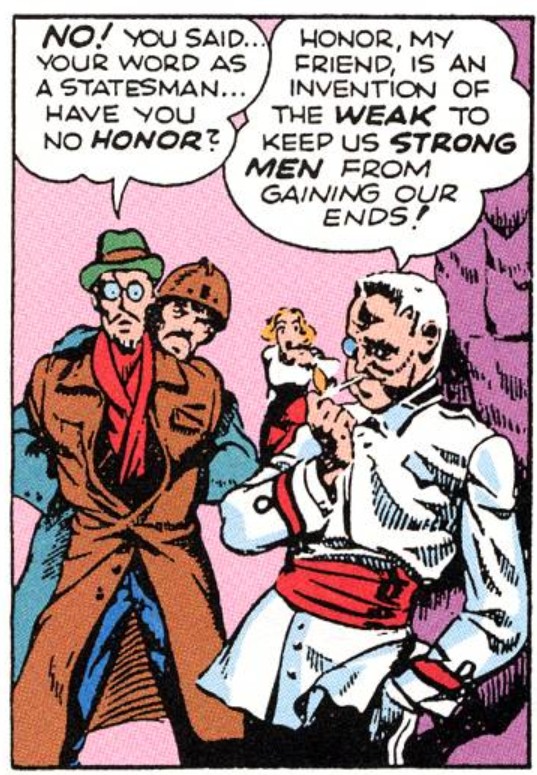
    This unnamed villain deduces Lady Luck’s secret identity by the simple trick of being the only one in the city capable of visualizing a lady in a hat. But though he has this unimaginable deductive power his people skills are lacking, and he fails both to convince Lady Luck to help him kill rich guys and to predict that his huge servant Tortu might eventually tire of being beaten with a whip and subsequently totally pulverize him. (The Spirit Section, 3 November, 1940)
    When Mr Mystic has a ski accident in the Carpathian Mountains, he ends up being cared for in an idyllic village that has been cut off from the outside world for 700 years, but which has one major problem: a horrible ogre who lives in the mountains above and demands the sacrifice of one maiden per year or else he will wipe the place off the map with a well-placed avalanche. What’s worse, this year the Ogre has demanded a red-haired maiden and the village is fresh out. And what’s worse, Mr Mystic’s red-haired friend Penny Douglas has just wandered into town. 

    Anyway, the Ogre turns out to just be some creep hermit who likes making the village kill women for some reason. He manages to yeet himself off the side of a mountain while trying to murder Mr Mystic. (The Spirit Section, 29 December, 1940) 

  • MINOR SUPER-VILLAIN 816: THE MASTERMIND

    (The Spirit, “the Mastermind Strikes”, 6 October, 1940)

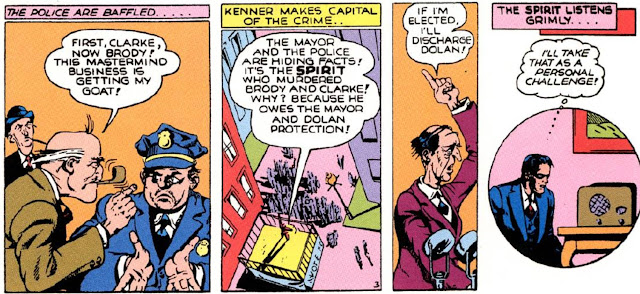
    The Mastermind is really Joel Kenner, a mayoral candidate who tries to get his Tough on Crime campaign a boost by murdering both of his campaign managers and blaming the deaths on the Spirit. This ends poorly for Kenner, who ends up stabbing himself with his own knife like a complete dolt.

  • MINOR SUPER-VILLAIN 815: ORANG, THE APE MAN

    MINOR SUPER-VILLAIN 815: ORANG, THE APE MAN

    (The Spirit, “Orang, the Ape Man”, 1 September 1940)

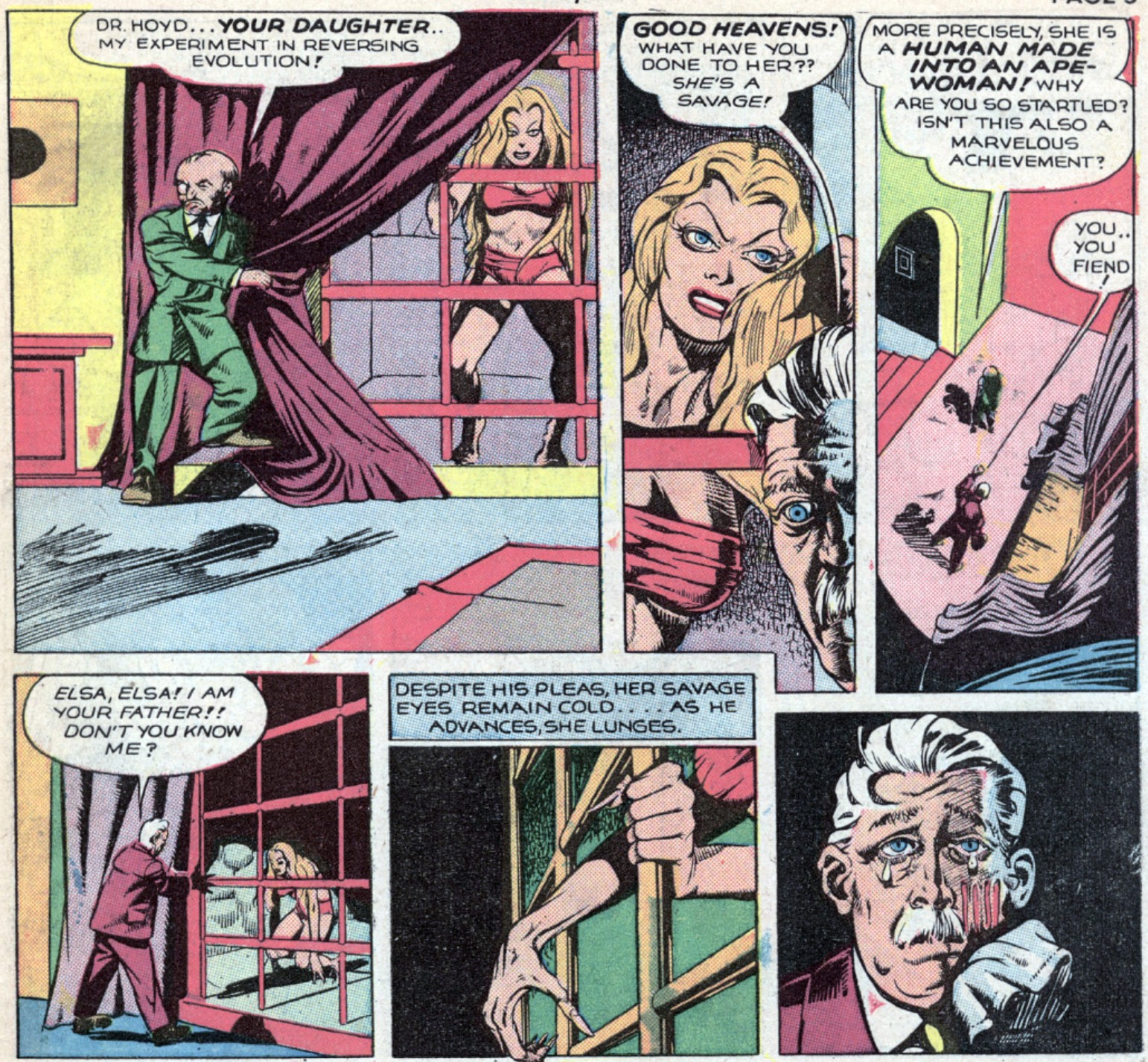
    After an indeterminate time away (ten to fifteen years, I reckon), Dr Hoyd returns to the United States from Europe and reconnects with his colleague Dr Egel. Upon retiring to Egel’s home, Hoyd is astonished to meet Orang, an orangutan who Egel has imbued with human-level intelligence via training and brain surgery. Dr Hoyd is astonished and delighted by this.

    Hoyd is far less impressed when he tries to reconnect with his daughter Elsa who he had entrusted to Dr Egel to take care of following the death of his wife and I guess just… never really communicated with after that? I say this because Dr Egel has used her as the subject of another of his experiments and regressed her to a wild ape-woman, and maybe Hoyd would have known that something was up if he was in regular contact with his kid.

    Dr Hoyd, broken-hearted, is prepared to take the law into his own hands and murder Egel for his actions, but is talked out of it by the Spirit. He is then immediately murdered by Egel, using Elsa as his weapon.

    Simultaneously, Orang has some sort of mental break when it dawns on him that he has human reasoning but is not human and determines that he must kill Egel in revenge for his now tormented existence, and while I don’t agree with the philosophical underpinnings of Orang’s reasoning, it is about time for Dr Egel to get his comeuppance, so I’ll allow it.

    Orang slays Elsa and then tracks Dr Egel to the docks, where he kills his creator and then ends his own life. A sad end.

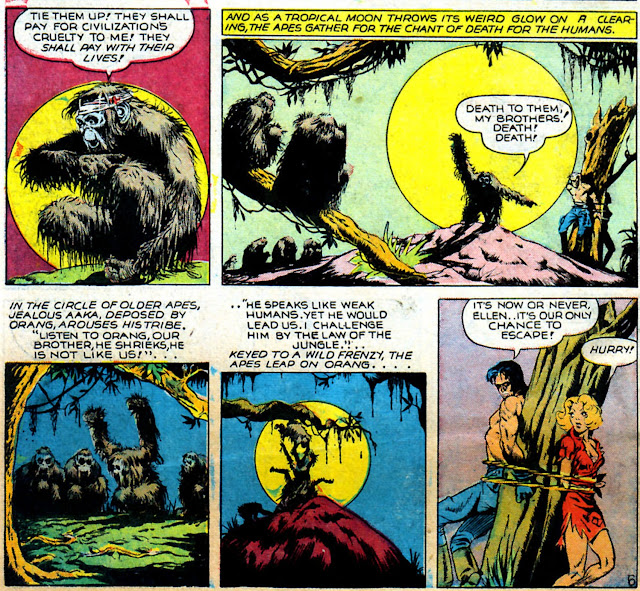
    OR IS IT? No it is not, as Orang turns out to have a thick skull or a shaky hand and survives his own suicide attempt. After seeking out medical treatment he ends up in the care of Police Commissioner Dolan. I quite like the Orang/Dolan dynamic, which is an odd couple-type relationship founded on an argument about whether you can arrest someone for being a talking ape, but Orang eventually spoils it by kidnapping Ellen Dolan and running off to Borneo to be with his people.

    The Spirit of course sets off in hot pursuit and catches up to the two of them just as Orang has finally worn out his welcome with the group of orangutans he set up house with in Borneo. It seems that “meeting a sad and lonely end” was always his destiny, as he ends up being killed by rival ape Aaka whilst being dramatically silhouetted against the Moon.

  • MINOR SUPER-VILLAIN 813: YAGOR

    (The Spirit, “The Death Dolls”, 4 August, 1940)

    In terms of villainy, Yagor ain’t much. Formerly chief engineer at the Battle Arms Co, Yagor murdered the inventor Kalin and stole his inventions and is trying to sell them on when the Spirit tracks him down in a small New England town. Though he gets the drop on the Spirit and captures him when he shows up to take him in, Yagor is undone by his own poor salesmanship and the crucial lack of imagination possessed by munitions buyer Emil Kampf, who dismisses a working robot soldier as a useless toy without, for instance, considering the possibility inherent in a bit of armour plating.

    Among Yagor’s many shortcomings is dismal salesmanship and specifically his failure to present Kampf with the other invention that he stole from Kalin, a smaller automaton capable of tracking a person across tens if not hundreds of kilometres, navigating such obstacles as sheer walls and subway systems, in order to kill them via explosion. Instead, he sends one, charmingly named Jepetto, to kill Kampf.

    (perhaps the oddest thing about this assassination is that as Jepetto is tracking down and killing Kampf Yagor and the Spirit are in New England listening for news of the explosion on the radio, and while this is in the days when the Spirit’s adventures were still set in New York City, the whole process must have taken hours if not days to complete, even if the “dark. mysterious fishing village” of Cape Haven were somehow both at the Southern border of Connecticut and “out of the tourist route.” Just standing around at gunpoint for three days while a small robot walks down the East Coast)

    But perhaps I am giving Yagor too much grief. After all, he was the chief engineer at that munitions company, not the chief salesman. Surely after bungling two whole opportunities to sell his robots (I’m counting the assassination because I think that loading that little robot up with a couple of water balloons or the like would have been a very good proof of concept indeed) he will rally and hike up his pants and really put in a good effort in his next black market arms presentation. What’s that? He just loaded all of his remaining Death Dolls (which is what the little assassin-bots are called) into a big robot soldier and sent them to attack New York for no good reason? Yagor, no. You’re going to get caught by the Spirit!

    Yagor got caught by the Spirit, you guys.