The Curse of Skeleton Munroe

Category: criminal army

  • MINOR SUPER-VILLAIN 808: THE BLACK QUEEN

    (The Spirit, “The Black Queen”, June 16, 1940)

    We first meet the Black Queen as the otherwise-unnamed defense lawyer in the murder trial of gangster Slot Gorgan. She already has a reputation for being brilliant, and that reputation proves to be accurate, as Gorgan is acquitted despite the evidence against him.

    Upon returning to the Black Queen’s penthouse, we learn that she is in fact the very first in the Spirit’s long line of female villains, as it turns out that she is the brains behind Gorgan’s gang. Unfortunately for Gorgan and the Black Queen, the Spirit has been engaging in the long-standing comic book tradition of getting mad about not-guilty trial results, and so has preceded them to the apartment. Now he knows about about the Black Queen’s crime ties and that Slot was actually guilty.

    The Spirit manages to wrangle a confession out of Slot in the presence of the District Attorney, which results in a retrial for the same murder he was originally accused of (and while I am not even remotely a lawyer I reckon that this is exactly what double jeopardy is supposed to be about? Or is it one of those things where he was tried for second degree murder the first time and first degree the second?). This time, the Black Queen’s brilliant legal mind is merely able to get his sentenced reduced from death to life imprisonment, but importantly she herself is still running the gang when the episode concludes.

    The Black Queen returns a few weeks later having made the astonishing decision to move from being the secret head of her gang (smart, secure) to personally leading them in a raid on the New York Sub-Treasury building* (dumb, risky). Why do this when her prior setup was so good that she got to the end of a “crime doesn’t pay” comic with her crime career still intact? Since she talks about taking 25 million dollars for herself and splitting town, I can only assume that she has grown tired of the admin of running a gang while being a successful attorney and just wants to retire.

    *this might be the fifth time I have read a story in which crooks try to rob the New York Sub-Treasury, and having looked it up to see if it was a thing I have found that a) it was – the US used to keep stores of cash and gold in a few major cities, presumably due to longer travel times in the past and b) the sub-treasury system was phased out in the 1920s. The Black Queen and her fellows are actually trying to break into a building now known as Federal Hall, administered by the National Park Service, and in 1940 occupied by exhibits relating to the New York World’s Fair. This raises the question: is the major divergence of the various super-hero universes from our own in fact the passing of the Independent Treasury Act of 1920?

    Though the Black Queen’s gang are captured before they can get away with either fifty million dollars or some dioramas about the history of finance, she alone manages to escape in her private yacht. Thanks to a timely intervention by the Governor’s island defense batteries, the yacht is disabled (a very rare artillery-based entry in my collection of cops shooting fleeing suspects), but the Black Queen herself remains at large for a second appearance in a row thanks to a frankly amazing hand grenade throw that disables the Spirit’s flying car. 

    The Black Queen’s third and final appearance is also the one in which she makes the jump to being a full-fledged femme fatale in the (eventual) grand Spirit tradition, and I say that not just because she has started wearing hot pants and a bustier as her everyday outfit.

    No, what really puts the fatale into this femme is the fact that she is going around giving men the literal kiss of death via some poisoned lip gloss. I’m not even sure why she kills this guy – just for the hell of it, I suppose, as he seems to be totally okay with working for her.

    But just what was that guy killed for? Why a formula for creating artificial diamonds, which means that along with the sub-treasury thing from earlier, the Black Queen has engaged in two of the biggest non-crimes in comics history!

    The Black Queen has also seduced a jeweller named Abner Ames into acting as a fence for her. The Spirit goes pretty far out of his way to rescue this guy from getting the Kiss of Death and make sure that he isn’t held criminally responsible, and while I commend him for being nice to Ames’ poor wife in this way I would humbly suggest that she would be better off without him.

    (the above panels also reveal that the Black Queen’s calling card is the queen of spades, and as someone who loves categorizing things I am just pleased as punch to have confirmation on exactly which black queen she was going for with than name) 

    Ames having been saved, there is a thrilling chase that culminates in a fight on the superstructure of a bridge. Though the Black Queen almost gets him, the Spirit manages to take her in. Sadly for those of us who enjoy her style, the Black Queen chooses to take her own life rather than face trial, even though she might have been the first person in history for whom self-representation was a good idea.
  • MINOR SUPER-VILLAIN 371: THE BLITZ GANG

    MINOR SUPER-VILLAIN 371: THE BLITZ GANG

    (Minute-Man 002, 1941)

    AKA the Blitz Force AKA the Panzer Gang.

    I almost started out by saying that the idea of a criminal gang operating along military lines was an old one but no, it isn’t yet. It’s not a new idea – there might be half a dozen examples in this list so far and I’m sure it cropped up more than once in the pulps – but it’s not quite the mid-tier trope that it eventually will be.

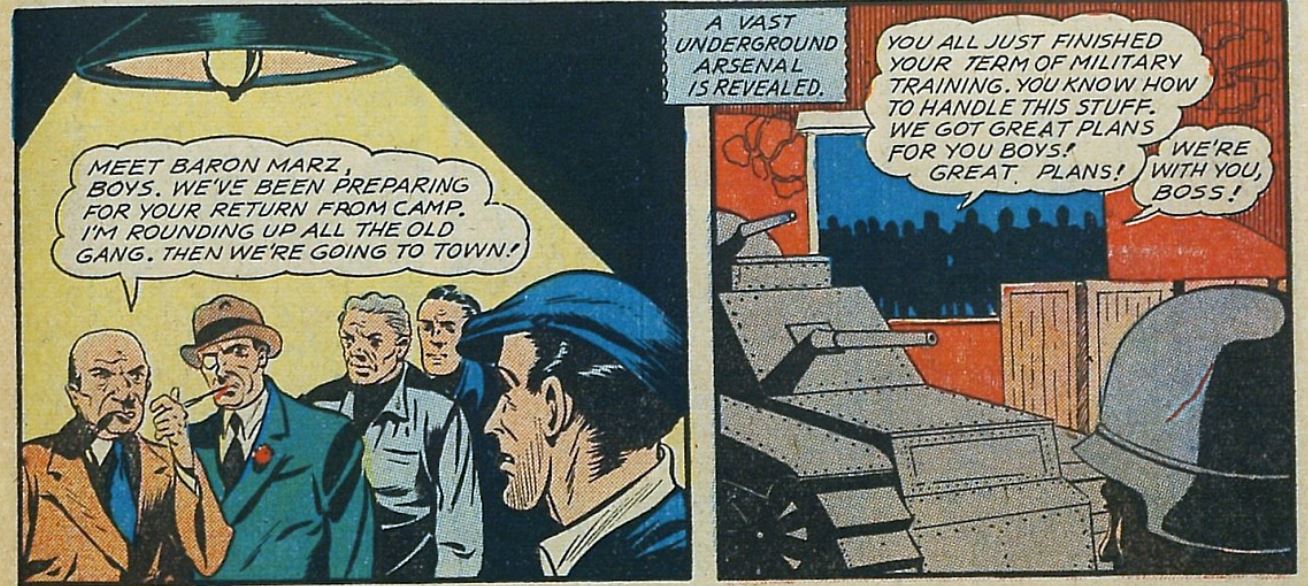
    This time, the idea for a criminal army is inspired by US pre-war military training program crime czar Boss Donker and his don’t-say-he’s-a-Nazi pal Baron Marz have hatched a scheme that takes advantage of the readily-available supply of Army-trained men: arm them and loot cities wholesale (with an optional attempt to conquer the US for “the Fatherland,” wherever that is.

    And of course it all goes swimmingly until Minute-man shows up.

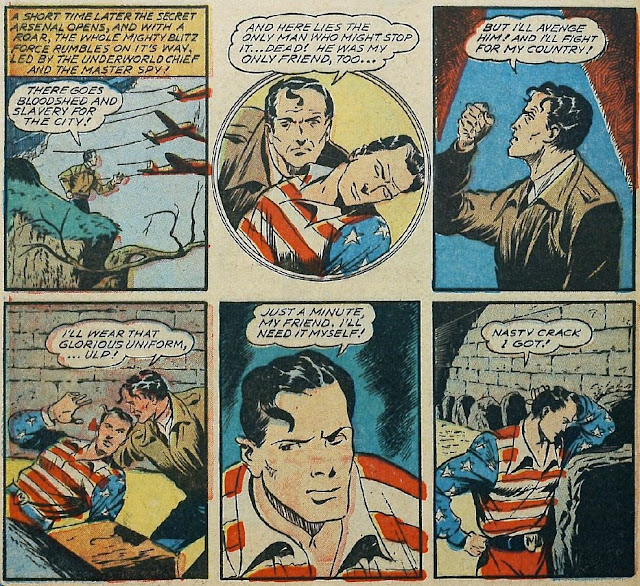
    The best part of the story by far is this bit here. Baron Marz has seemingly killed Minute-Man with a falling block of stone and Slippy, the only former gangster army recruit who doesn’t want to return to a life of crime, is about to take up the mantle in his honour. It’s actually kind of too bad that Minute-Man wasn’t actually dead, because having the identity change hands this way might have given him an interesting hook at last – maybe it could have been a series about person after person taking on th role of Minute-Man as needed and as the previous one falls instead of about a third-rate Captain America knockoff.

  • MINOR SUPER-VILLAIN 338: THE BANDIT FORCE

    (Master Comics 004, 1940)

    This is a simple one because it’s simply a matter of scale, plus the fact that everyone involved is wearing a stylish purple cloak/ robe combo. A mass of bandits loot arsenals across the Eastern US, stealing tanks, artillery and armoured cars. Panic ensues!

    Soon enough, the band makes its goals known with a bold attack on that sweetest of targets: Fort Knox. And they almost get away with it! They actually have the gold loaded up and are speeding away before second-rate Fawcett character Master Man shows up and absolutely ruins everyone’s day.

    And of course the leader of the pack turns out to be the unnamed altruistic banker who somehow manages to sit in on every meeting about how to deal with the situation. What a surprise!

    ADDENDUM: I absolutely forgot to mention the most notable if underplayed thing about these guys: they use golden bullets for some unstated reason. A bizarre choice for a buncha gold thieves!

  • MINOR SUPER-VILLAIN 338: THE BANDIT FORCE

    (Master Comics 004, 1940)

    This is a simple one because it’s simply a matter of scale, plus the fact that everyone involved is wearing a stylish purple cloak/ robe combo. A mass of bandits loot arsenals across the Eastern US, stealing tanks, artillery and armoured cars. Panic ensues!

    Soon enough, the band makes its goals known with a bold attack on that sweetest of targets: Fort Knox. And they almost get away with it! They actually have the gold loaded up and are speeding away before second-rate Fawcett character Master Man shows up and absolutely ruins everyone’s day.

    And of course the leader of the pack turns out to be the unnamed altruistic banker who somehow manages to sit in on every meeting about how to deal with the situation. What a surprise!

    ADDENDUM: I absolutely forgot to mention the most notable if underplayed thing about these guys: they use golden bullets for some unstated reason. A bizarre choice for a buncha gold thieves!

  • MINOR SUPER-VILLAIN 246: KARVAC

    (Flash Comics v1 014, 1941)

    Karvac himself is strictly ho hum territory: a would-be world conqueror who leads his army of heat ray-toting goons on a path of destruction before being beaten up by Hawkman. Snoresville, man.

    BUT: the method by which Karvac managed to acquire his army of heat ray-toting goons, now that’s the kind of comic book nonsense that we love around here.

    Karvac, you see, unearthed rites and rituals connected to Scorio, Alligator God of the Phoenicians, and established both a temple and cult of worshippers to Scorio in the Eastern US, in order to cast ancient ritual magics and bring Scorio to him.

    AND IT WORKS! Korvac summons a god! And that god promptly tells him how to make heat rays for his army of goons to tote! (it’s not exactly clear in the text whether the army of goons are also the Scorio cultists that Hawkman sees performing rituals at the temple earlier in the story, but it’s narratively satisfying to think so)

    Scorio eventually gets banished back to the otherworldly swamp that he usually hangs out in, and as far as I know has never made a return appearance. But he should! Korvac might’ve been a dud, but an ancient and vengeful alligator god who can hand out secret knowledge to evil men is a really neat foe for a guy like Hawkman, particularly once his reincarnation bullshit really gets going – Katar Hol might not know Scorio from a hole in the ground but Scorio knows a soul no matter how many times it’s been reborn. BRING BACK Scorio!

  • MINOR SUPER-VILLAIN 246: KARVAC

    (Flash Comics v1 014, 1941)

    Karvac himself is strictly ho hum territory: a would-be world conqueror who leads his army of heat ray-toting goons on a path of destruction before being beaten up by Hawkman. Snoresville, man.

    BUT: the method by which Karvac managed to acquire his army of heat ray-toting goons, now that’s the kind of comic book nonsense that we love around here.

    Karvac, you see, unearthed rites and rituals connected to Scorio, Alligator God of the Phoenicians, and established both a temple and cult of worshippers to Scorio in the Eastern US, in order to cast ancient ritual magics and bring Scorio to him.

    AND IT WORKS! Korvac summons a god! And that god promptly tells him how to make heat rays for his army of goons to tote! (it’s not exactly clear in the text whether the army of goons are also the Scorio cultists that Hawkman sees performing rituals at the temple earlier in the story, but it’s narratively satisfying to think so)

    Scorio eventually gets banished back to the otherworldly swamp that he usually hangs out in, and as far as I know has never made a return appearance. But he should! Korvac might’ve been a dud, but an ancient and vengeful alligator god who can hand out secret knowledge to evil men is a really neat foe for a guy like Hawkman, particularly once his reincarnation bullshit really gets going – Katar Hol might not know Scorio from a hole in the ground but Scorio knows a soul no matter how many times it’s been reborn. BRING BACK Scorio!

  • MINOR SUPER-VILLAIN 028: CARL KRUGER

    (Detective v1 033, 1939)

    Carl here is a scientist who is obsessed with Napoleon, something that people used to be when there weren’t so many fictional characters to be consumed with – heck, he appears only a few months before the Joker begins his slow crawl to being the one a weird loner would be pictured dressing up as while he makes his Important Plans.

    Since Carl was a scientist he recruited a cabal of other scientists to help him make war machines and since he was a Napoleon Head he recruited an army of dudes and together these formed the backbone of his world domination scheme until he was unexpectedly Batmanned.

    The real notable thing about Carl is that he was basically the last villain that Batman fought before he stopped killing people. In fact, Batman (by my count) kills the most people in this incident: at least 14, including Carl himself!

    ADDENDUM: I was wrong about the “stopped killing people” part because I had a Fan Theory about how Batman stopped killing about the same time he adopted Robin. The major flaw in this Fan Theory was that Batman and Robin kept on killing people.

  • MINOR SUPER-VILLAIN 028: CARL KRUGER

    (Detective v1 033, 1939)

    Carl here is a scientist who is obsessed with Napoleon, something that people used to be when there weren’t so many fictional characters to be consumed with – heck, he appears only a few months before the Joker begins his slow crawl to being the one a weird loner would be pictured dressing up as while he makes his Important Plans.

    Since Carl was a scientist he recruited a cabal of other scientists to help him make war machines and since he was a Napoleon Head he recruited an army of dudes and together these formed the backbone of his world domination scheme until he was unexpectedly Batmanned.

    The real notable thing about Carl is that he was basically the last villain that Batman fought before he stopped killing people. In fact, Batman (by my count) kills the most people in this incident: at least 14, including Carl himself!

    ADDENDUM: I was wrong about the “stopped killing people” part because I had a Fan Theory about how Batman stopped killing about the same time he adopted Robin. The major flaw in this Fan Theory was that Batman and Robin kept on killing people.