The Curse of Skeleton Munroe

Category: hero update

  • SUPER-HERO 006 UPDATE: THE ANGEL 1940

    The Angel is a wandering vigilante, which in turn is a type of super-hero that generates very little new information for these update posts, given that they typically have very little in the way of a supporting cast or everyday life. Even so, we have a couple of Angel developments for 1940.

    First off, the Angel’s secret identity is revealed to be Tom Hallaway – though the accepted spelling is now Halloway – as a consequence of not wearing a dang mask ever. Is this why the Angel travels so much? (Marvel Mystery Comics v1 005, 1940)

    During an adventure under the earth, the Angel encounters an Ancient Greek woman who has been underground for four thousand years and who gifts him the Cape of Mercury, an artifact that allows him to fly. He doesn’t actually use it very often despite how cool and handy it is. (Marvel Mystery Comics v1 011, 1940)

  • SUPER-HERO 006 UPDATE: THE ANGEL 1940

    The Angel is a wandering vigilante, which in turn is a type of super-hero that generates very little new information for these update posts, given that they typically have very little in the way of a supporting cast or everyday life. Even so, we have a couple of Angel developments for 1940.

    First off, the Angel’s secret identity is revealed to be Tom Hallaway – though the accepted spelling is now Halloway – as a consequence of not wearing a dang mask ever. Is this why the Angel travels so much? (Marvel Mystery Comics v1 005, 1940)

    During an adventure under the earth, the Angel encounters an Ancient Greek woman who has been underground for four thousand years and who gifts him the Cape of Mercury, an artifact that allows him to fly. He doesn’t actually use it very often despite how cool and handy it is. (Marvel Mystery Comics v1 011, 1940)

  • SUPER-HERO 007 UPDATE: NAMOR THE SUB-MARINER 1940

    He’s back and newly benevolent after a five-minute speech from Betty Dean, so what does he do now?

    Marvel Mystery Comics v1 005 sees Namor beg off of his eternal war on the surface (and the attitude that Emperor Thakorr gives off really implies that this was less of an Atlantean thing than a side project or Namor and his mother’s). He then heads off the New York City to offer his services to humanit, and is immediately swarmed and taken into custody by some remarkably well-coordinated first responders.

    Despite this harsh welcome, Namor keeps his cool remarkably well considering his prior track record. He cools his heels in jail for a few days and then gets special permission to go on a field trip to help out at a subway disaster, AND then goes on to capture the bank robbers who were responsible for the problem in the first place. I honestly wouldn’t have minded if this tactical jail-based era had continued for a while.

    Sadly, it was not to be, as in Marvel Mystery Comics v1 006 we learn that the State of New York has not forgotten about all of those very recent and public murders that Namor committed, and that he is going on trial. Despite Betty Dean’s assurances that he will be exonerated – despite, again, the fact that he murdered several police officers in front of other police officers – he is in fact found guilty and scheduled for execution.

    Now, far be it from me to suggest that the powerful should not be held to account for their crimes just as much as, if not more than, the weak, but from a purely practical standpoint this is a very bad decision on the part of New York. We’ll cover the particulars in the next Namor as Villain update, but simply put they vastly overestimate their ability to actually kill the guy and so open themselves up to a lot more death and property damage. It’s yet another reason to opposed the death penalty I suppose: that it might just make them mad.

    Namor cools off and decides that Nazis are ultimately more worth fighting than the City of New York by Marvel Mystery Comics v1 013. He and Dorma set out to do so while clad in these stylish new battle uniforms which are armoured (questionably useful considering Namor’s demonstrable toughness) and incorporate gas masks (extremely useful given how vulnerable the Sub-Mariner has proven to be to gas attacks).

    Finally, Dorma casually drops the fact that she, like Namor, is now fully amphibious thanks to a surgical treatment that it’s kind of weird that more Atlanteans don’t get

  • SUPER-HERO 007 UPDATE: NAMOR THE SUB-MARINER 1940

    He’s back and newly benevolent after a five-minute speech from Betty Dean, so what does he do now?

    Marvel Mystery Comics v1 005 sees Namor beg off of his eternal war on the surface (and the attitude that Emperor Thakorr gives off really implies that this was less of an Atlantean thing than a side project or Namor and his mother’s). He then heads off the New York City to offer his services to humanit, and is immediately swarmed and taken into custody by some remarkably well-coordinated first responders.

    Despite this harsh welcome, Namor keeps his cool remarkably well considering his prior track record. He cools his heels in jail for a few days and then gets special permission to go on a field trip to help out at a subway disaster, AND then goes on to capture the bank robbers who were responsible for the problem in the first place. I honestly wouldn’t have minded if this tactical jail-based era had continued for a while.

    Sadly, it was not to be, as in Marvel Mystery Comics v1 006 we learn that the State of New York has not forgotten about all of those very recent and public murders that Namor committed, and that he is going on trial. Despite Betty Dean’s assurances that he will be exonerated – despite, again, the fact that he murdered several police officers in front of other police officers – he is in fact found guilty and scheduled for execution.

    Now, far be it from me to suggest that the powerful should not be held to account for their crimes just as much as, if not more than, the weak, but from a purely practical standpoint this is a very bad decision on the part of New York. We’ll cover the particulars in the next Namor as Villain update, but simply put they vastly overestimate their ability to actually kill the guy and so open themselves up to a lot more death and property damage. It’s yet another reason to opposed the death penalty I suppose: that it might just make them mad.

    Namor cools off and decides that Nazis are ultimately more worth fighting than the City of New York by Marvel Mystery Comics v1 013. He and Dorma set out to do so while clad in these stylish new battle uniforms which are armoured (questionably useful considering Namor’s demonstrable toughness) and incorporate gas masks (extremely useful given how vulnerable the Sub-Mariner has proven to be to gas attacks).

    Finally, Dorma casually drops the fact that she, like Namor, is now fully amphibious thanks to a surgical treatment that it’s kind of weird that more Atlanteans don’t get

  • SUPER-HERO 005 UPDATE: THE HUMAN TORCH 1940

    SUPER-HERO 005 UPDATE: THE HUMAN TORCH 1940

    So just what did the Human Torch get up to in 1940?

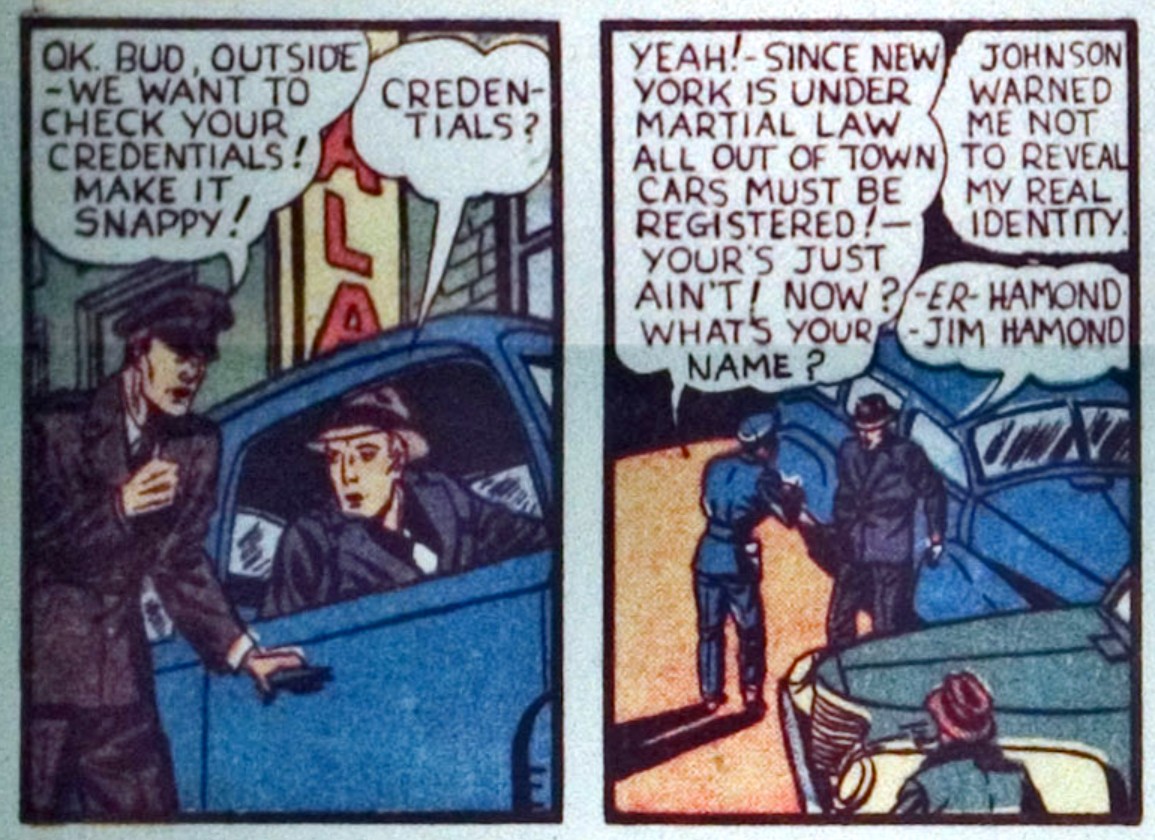
    Well, in Marvel Mystery Comics v1 004 he makes the name Jim Hamond on the fly during a police stop and evidently likes it enough to adopt it as his full-time secret identity. Not sure when he adds the second ‘m’ to make it Hammond. Will report back when he does.

    In Marvel Mystery Comics v1 007 the Human Torch, as Jim Hamond, decides to become a police officer and does so with very little fuss.

    He does, however, immediately discard the idea of operating as a regular secret identity style super-hero due to the fact that he keeps incinerating his uniforms. Instead, he just goes and tells his senior officers the situation and ends up being deputized as a kind of official vigilante working for the city. He maintains the fiction of being a regular beat cop for a couple of more issues before becoming a full-time Human Torch.

    That’s pretty much it for 1940 but thanks to my comic book reading schedule we will be back soon with the 1941 developments in the life of everyone’s favourite android. 

  • MINOR SUPER-HERO ROUND-UP 103

    Soon there will be more minor super-heroes than there are humans for them to protect.

    the Sentinel:

    In 1783, on the Boston Common, the newly-minted Spirit of America charges a cannon with the “powders of patriotism” in anticipation that someday a champion will be needed to defend the new nation from destruction. Finally, in 1941 (the Civil War not, apparently, being enough of a reason), the cannon fires on its own and releases the Sentinel, mystic champion of the American people.

    As one might expect, the Sentinel is broadly superhuman: he can fly, is super strong and is immune to most harm. He also has a halo of fire that he can disappear into and shrink to a tiny flame, effectively rendering him invisible and allowing him to vex friend and foe alike with his comings and goings. Oddly, he has no other control over fire. (Liberty Scouts Comics 003, 1941)

    Doctor Nemesis:

    Doctor Nemesis is really Dr Jim Bradley, intern at Mercy Hospital in an unnamed city (that is probably meant to be NYC but later retconned as San Francisco) who has developed a foolproof truth serum and decided to keep it to himself rather than risk criminals getting their hands on it – presumably the concern is that they would use it to learn bank vault combinations and other secret information. Since he himself continually runs into situations in which a foolproof truth serum is a handy way to solve a crime, Bradley adopts a costumed identity and sets out to achieve a better tomorrow via a series of injections. 


    Doctor Nemesis might just be the most calling card-using super-person who we have yet encountered. He hands out at least four of them in his first adventure alone.

    Doctor Nemesis has a pretty simple crimefighting routine: identify a potential injustice and then drug everyone involved until he has a clear idea of who is responsible, then beat them up and have them give a drugged confession in front of a police witness. The police in turn are perfectly happy to receive these confessions that they technically haven’t coerced from people, though there has to be a clever defense attorney somewhere in Unnamed City who is just waiting to get a Doctor Nemesis client so that they can really dig into the admissibility of admissions given under the influence of mysterious vigilante juice.

    It’s been a while since we have encountered a character who was later revived and incorporated into the Battle-Axis, Marvel’s team of disaffected public domain Golden Age super-heroes who went over to the Nazis, but Doctor Nemesis here is one of them under the technically-but-not-really more badass name of Dr Death. As always, it’s hard to say just who got done dirtiest by Roy Thomas when he was assembling the Battle-Axis roster but Doctor Nemesis is certainly a candidate, if only because he doesn’t even have the Human’s Meteor’s flimsy “I’m Irish American and fuck the British” or the Spider Widow’s “the Commies killed my husband” excuses. Instead, he simply implies that the Nazis are paying him well.

    Subsequent writers (specifically Matt Fraction, if I have things right) clearly thought that Doctor Nemesis was worth revisiting. He was given a long career as a Nazi hunter to counteract his short career as a Nazi and briefly became a core X-Man, though nowadays every time I look up what he’s up to it seems that he has become weirder and more peripheral to the action than the last. (Lightning Comics v1 006, 1941)

    Lash Lightning **UPDATE**:

    I haven’t been very careful to delineate whether the character has been going by “Flash” or “Lash” Lightning due to the fact that it profoundly does not matter (they just call him “Lightning” in the stories themselves, for instance) but I might as well make note of this, the issue in which the actual change was made. (Lightning Comics v2 002, 1941)

    Marvo the Magician **UPDATE**:

    Up until the exact point pictured above, Marvo the Magician was unique among magical comic book super-heroes, for though many of them (including Zatara, the big cheese himself) are said to be using their magic to create illusions and fool the minds of others, it is all demonstrably lies (or more charitably a different definition of “illusion” than I am using), as they all produce material effects in the world. Only pure, beautiful Marvo can claim that he uses illusions and nothing more to frighten and confound his foes, and I have been checking.

    That is, up to this issue, when Marvo creates the “illusion” of an ocean liner (complete with a crooked sailor who kidnaps her and hands her over to pirates!) that the woman he is helping proceeds to board and sail away on. Unless the implication is that she has been so convinced that the liner exists that she has swum or perhaps hovered her way to her destination (well, part way to her destination), the inescapable fact is that this ship is more than a mere illusion. Nothing is certain in this wicked world, folks. (Lightning Comics v2 003, 1941)

  • MINOR SUPER-HERO ROUND-UP 101

    It’s a big year for the jungle-based heroes of Fiction House, and also Radior is here.

    Camilla, Queen of the Lost Empire **UPDATE**:

    1941 is the year of change for Camilla. First off, she faces a series of threats to the Lost Empire itself, beginning when an evil magician nearly conquers and partially razes the city. (Jungle Comics 014, 1941)

    Next issue, the otherwise-unremarkable lech Prince Renardo finishes the job and burns the city to the ground as part of an attempt to win Camilla’s hand in marriage. Camilla and her surviving citizens rebuild but it is a far less grand affair, being more of a wooden stockade. (Jungle Comics 015, 1941)

    Perhaps inspired by the radical change in circumstances, Camilla and her subjects adopt a sort of retro-Norse style in keeping with their ancestry. Camilla’s lover Sir Champion disappears from the narrative at this point, never to be seen again. (Jungle Comics 016, 1941)

    The Viking revival among the people of the Lost Empire really takes off, and soon Camilla and her new paramour Erik are sailing around in longships having adventures with the seemingly endless variety of anachronistic societies littering the Central African jungle. This state of affairs continues for the remainder of 1941, as does Camilla’s insistence on wearing one of the most improbable bikini-chestplates in the history of fantasy illustration. How is it held on? (Jungle Comics 018, 1941)

    Fantomah **UPDATE**: 

    Following the departure of Fletcher Hanks, Fantomah too goes through some changes (and will continue to do so for a while yet). The first stage of this sees her lose a fair portion of her magical power, most importantly including her signature skull-faced “this means war” form. She also drops her black nightie look in favour of a more traditional jungle heroine’s one-piece, albeit made of leaves rather than the more typical animal skins. (Jungle Comics 017, 1941)

    By the end of 1941, Fantomah has become a mostly-regular jungle heroine. She has a panther pal named Fury, an orphan boy companion named Ken, and though she still busts out the odd magical ability – about once per adventure on average –  her supernatural power pales in comparison to the Hanks days. 

    Fantomah’s outfit has continued to evolve over the course of the year: from a green costume made of leaves to a pale blue one made of leaves to a more typical jungle one-piece that merely has the outline of something made of leaves. I can only assume that this change was a present from the (unknown!) artist to themself. (Jungle Comics 024, 1941)

    the Red Panther:

    Our final jungle makeover goes to the Red Panther, who adopts a sporty cowl-and-loincloth look to replace his more traditional super-hero outfit. His adventures don’t change as much as Fantomah or Camilla’s due to the fact that (barring the odd jaunt into outer space) he was about two steps away from being a Tarzan clone to begin with. The only real difference between the Old and New Look Red Panthers is in the latter’s increased use of panther companions to do his dirty work. (Jungle Comics 019, 1941)

    Radior:

    Radior, the X-Ray Powerman, is super strong, bulletproof, can fly, can hear radio waves, see through solid matter, and can transmit images directly into the human mind – a pretty thoroughly superhuman fellow. And just how did he get this way? Why, because his father, the famous Professor Kennedy, disappeared from public view when his son was born and spent the next twenty years feeding Radior as much radium as he could get his hands on. And while we might decry this as irresponsible parenting… hey, it worked! The kid grew up into a radiation and radio-themed superman!

    Sadly Radior only made the one appearance, in the oddball Key Ring Comics, a one-off collection of hole-punched and spot-coloured stories that it is very hard to find any real information about. (Key Ring Comics, 1941) 

  • MINOR SUPER-HERO ROUND-UP 099

    Super-heroes. Like heroes, but super.

    Captain Midnight:

    Like the second, more popular (though still pretty obscure) Captain Midnight that will be published by Fawcett starting in 1942, this fellow is an adaptation of the radio character, and unlike the second Captain Midnight, this one is a pretty direct adaptation. It’s a bit abbreviated and you kind of have to keep referring to the Captain Midnight Wikipedia page to fill in the gaps where your assumed familiarity with the radio show lies, but it’s all there:

    Captain Midnight is an otherwise-unnamed pilot who gets his nickname after returning on the stroke of 12 after completing a secret mission to prevent Paris from being captured by the Germans during World War One. In the present day (1941) he is recruited to head a secret counter-espionage unit called the Secret Squadron by a mysterious government official who is implicitly Franklin Delano Roosevelt in disguise. 

    The Secret Squadron has hidden airbases and headquarters all over the United States and is comprised of a horde of agents referred to by alphanumeric designations starting at SS-1 (Captain Midnight) up to at least SS-85 (the guy who runs the elevator in one of the bases). The “SS” part of the names is quietly changed to “SQ” once the US enters WWII, but I don’t think that this comic book adaptation goes on long enough for that to be a concern.

    Finally, Captain Midnight’s flying clock insignia is very fun. (The Funnies 057, 1941)

    Categorized in: Generica (Captains), Locations (Temporal Locations), Origins (WWI Vets)

    the Great Zarro:

    The Great Zarro is otherwise nameless adventurer with the power of flight. He is also one of the most bland super-heroes in the history of the medium, personality-wise.

    A former circus acrobat, the Great Zarro lost his job, fiance and friends when a gang of extortionists burned the whole circus down and killed everyone but Rags, his lover’s kid brother. The two swear an eternal war on crime and Zarro gains his ability to fly by consuming some magical herbs given to him by the circus fortune teller, who was just good enough to fortell that he would need them but evidently failed to see why. 

    There are precisely two interesting things about this character: Firstly, that as a circus acrobat he was known as Eagle Man, while as a flying super-hero he goes by the Great Zarro. That’s a fun little inversion of naming conventions!

    Secondly, there’s Rags. Rags is an example of something that you occasionally get with comic relief characters, where they and only they are rendered as a full cartoon while everyone else is in a comic book. This is a particularly egregious clash of styles in a comic as full of stiff, human-proportioned figures as “The Great Zarro,” rendering Rags more of a figure of horror than comedy. Rags finally becomes a real boy in the third and final Zarro adventure, but it’s too little too late. (Great Comics 001, 1941)

    Categorized in: Day Jobs (Circus Acrobats), Language (Superlatives (Greats)), Powers (Flight)

    Madame Strange:

    On the one hand, Madame Strange is pretty great: she’s at least somewhat super fast and super strong, will throw a knife at the drop of a hat and prevents the Japanese destruction of Pearl Harbor in November 1941 (though not the one in December). Just like Ripley in Alien, she is an example of a character not being written as a “girl-version” of a default-male archetype but simply as that archetype, which is basically always the more entertaining option.

    On the other hand, Madam Strange suffers from the same lack of depth – including any sort of backstory – as so many of her peers. Sure she can throw a knife into a goon from a city block away, but is that enough? I also do not care for the combination of red top, pale blue bottoms, aesthetically.  (Great Comics 001, 1941)

    Categorized in: Abstract Concepts (Strangeness), Genrica (Madames), Powers (Enhanced Strength and Speed) 

    the Green Mask and Domino the Miracle Boy **Update**:

    I am reasonably certain that this is the first time that Domino is given a first name. Don! He’s Don! (Green Mask v1 006, 1941)

    The same issue that Don gets his name also marks the introduction of the Green Mask’s expanded supporting cast. Joining his reporter pal News Blake are heiress/ love interest Olivia Tracey and her chauffeur Peters, who serves as comic relief thanks to his two character traits of “enthusiastic tinkerer” and “very clumsy and hapless.” (Green Mask v1 006, 1941)

    I can’t find anywhere that it’s explicitly stated (which may be exacerbated by the fact that the only copy of this issue that I can find is missing 8 pages or so) but by Green Mask v1 008 Olivia Tracey seems to explicitly know that Michael Shelby and the Green Mask – and by extension Don and Domino – are the same.

  • MINOR SUPER-HERO ROUND-UP 098

    We’ve got no time for major super-heroes around here. We’re too busy with the minor ones.

    the Black Ace:

    The Black Ace, aka Captain McRae, is yet another American pilot serving in the RAF in advance of the US entrance into WWII. As such, he is not only a highly accomplished pilot and bombardier but fully versed in the arts of prison escape, hand-to-hand combat, impersonating German soldiers and leaping from plane to plane in mid-flight. (Four Favorites 002, 1941)

    Categorized in: Activities (Cards), Colours (Black), Team Memberships (RAF)

    Phantasmo **Update**:

    The thing about Phantasmo is that he does all of his super-heroing while in his super-huge astral form, and I guess that I had somehow gotten the impression that most of his powers were tied to that form, because I while reading his 1941 run of adventures I kept being surprised when he would do something like heal an old man (The Funnies 052) or kill a bunch of guys with a giant fish while in Phil Anson form (The Funnies 051). 

    I guess it’s pretty convenient to have the option of being an invulnerable giant but that getting your mortal hands dirty lends a certain thrill to the crimefighting – that’s probably why he tolerates the poor standard of care that he gets from Whizzer McGee as he guards the unconscious Anson-body, hey?

    In The Funnies 061, Phantasmo and Whizzer witness the murder of a crooked FBI filing clerk named Ted Bart and, partially because they are touched by his dying confession (“I only blackmailed a gang boss-turned politician to help my sister, honest!”) and partially due to this desire for more action in his life (life as an FBI filing clerk v. action packed), Phantasmo takes over his identity. The series ends before this development pays off beyond giving Phantasmo a few crime leads, but it’s still an interesting turn for the character to take.

    Whizzer McGee:

    Phantasmo’s young friend Whizzer McGee does not really qualify as a sidekick most if the time. He’s more of an employee, really, who watches over Phil Anson’s unconscious body while his mind is out terrorizing criminals. And he’s not even good at it! Whizzer and the body are always getting into scrapes because of Whizzer’s incompetence (and also because Phil is very bad at picking a convenient place to leave his mortal coil, in all fairness).

    Despite this, Phantasmo gives Whizzer McGee the opportunity to be a real-deal super-powered guy when he has to go out of town for a few days, in the form of an amulet that gives him invulnerability and super strength. I can only assume that Phil was worried that Whizzer would immediately walk out into traffic if someone wasn’t around to tell him not to and was trying to bump up the likelihood of his survival a bit.  

    Whizzer screws it all up of course – not only does he lose the amulet by trying to capture a smuggling gang single-handed, but he spills Phantasmo’s secrets – including his secret identity and home address! – to the gang boss after he does a low-effort impression of an FBI agent. Surprisingly, this leads to absolutely no consequences going forward: Whizzer keeps his job, the amulet doesn’t end up in the wrong hands… it’s not even a factor in Phantasmo changing secret identities. (The Funnies 056, 1941)

    Categorized in: Accessories (Amulets), Origins (Sidekicks)

    the Black Knight **Update**:

    In our initial look at the Black Knight, we spent a lot of time trying to nail down exactly when the series is supposed to take place, and we are not backing down from that challenge. We have determined that he lived in at least the early 12th Century CE, which the presence of Canterbury Cathedral (looking much as it does today, a form it took after being rebuilt and refurbished in the 11th and 12th Centuries) supports. This is comforting! All of our hard work paid off! Hold on to that feeling for a little while.

    The firmly 12th Century Black Knight’s 1941 adventures continue much as they had in 1940: the Black Knight travels the land slaying villains in the name of Good King Victor. Things get a bit less episodic with the introduction of a mysterious ring that the Knight is given by the King in The Funnies 053, that is then revealed to contain some mysterious drugs in issue 054.

    The Funnies 053 also introduces Peter, an archer who begins travelling with the Black Knight after helping him slay some bandits. He’s very serious about being a sidekick, is Peter.

    So we have: a reasonably firm grasp on the time period, an ongoing plot hook and a new friend. All of which is dumped in the trash as of The Funnies 055-056, when Good King Victor falls victim to an illness with only one known cure, a drug that is only available in Egypt.

    The ring is completely forgotten until the Black Knight need to escape a prison guard and the mysterious drugs turn out to be knockout drops. Peter is technically still around to the end, but he and the other members of the Black Knight’s party are all dressed like desert nomads and usually end up tagging behind him on camelback rather than actually participating in the story. As for the 12th Century… the artist’s vision of what Medieval North Africa looked like was not quite as precisely calibrated as it was for Medieval England, and so we start getting things like hookahs (15th-16th Century and even then in India) almost immediately.

    The transition to Egypt does come with a pretty good alternate costume unlock for the Black Knight, though there are also some weird Jesus overtones. (The Funnies 059)

    The Black Knight’s plan to get the drug involves appealing directly to the Queen of Egypt for aid, which is appropriate, as she is from the same lineage of fictional monarchs as Good King Victor. In actuality, Egypt was in the hands of a series of Muslim dynasties from the 650s through to the 1500s when the Ottomans took it. The plotters above, meanwhile, are all from Sudan, which was Nubian-controlled and matrilineal at the time, so the misogyny is weird.

    Once the Queen actually shows up (The Funnies 061) it is pretty clear that she is based on Cleopatra (died 30 BC), which is fine. One huge anachronism is much easier to deal with than a million mild ones, after all. The Black Knight is clearly set in an alternate timeline or a human zoo built by aliens with poor research skills.

    Finally, the Egyptian odyssey introduces a love interest for the Black Knight in the form of a Persian (?) woman named Zellah who he rescues from a harem in The Funnies 057. There isn’t too much to this relationship – it’s just kind of nice. The Black Knight does get this sick scorpion amulet from her, but it’s just before she and the Queen of Egypt are kidnapped in a cliffhanger ending that is never resolved, so overall, it’s a bummer.

  • MINOR SUPER-HERO ROUND-UP 098

    We’ve got no time for major super-heroes around here. We’re too busy with the minor ones.

    the Black Ace:

    The Black Ace, aka Captain McRae, is yet another American pilot serving in the RAF in advance of the US entrance into WWII. As such, he is not only a highly accomplished pilot and bombardier but fully versed in the arts of prison escape, hand-to-hand combat, impersonating German soldiers and leaping from plane to plane in mid-flight. (Four Favorites 002, 1941)

    Categorized in: Activities (Cards), Colours (Black), Team Memberships (RAF)

    Phantasmo **Update**:

    The thing about Phantasmo is that he does all of his super-heroing while in his super-huge astral form, and I guess that I had somehow gotten the impression that most of his powers were tied to that form, because I while reading his 1941 run of adventures I kept being surprised when he would do something like heal an old man (The Funnies 052) or kill a bunch of guys with a giant fish while in Phil Anson form (The Funnies 051). 

    I guess it’s pretty convenient to have the option of being an invulnerable giant but that getting your mortal hands dirty lends a certain thrill to the crimefighting – that’s probably why he tolerates the poor standard of care that he gets from Whizzer McGee as he guards the unconscious Anson-body, hey?

    In The Funnies 061, Phantasmo and Whizzer witness the murder of a crooked FBI filing clerk named Ted Bart and, partially because they are touched by his dying confession (“I only blackmailed a gang boss-turned politician to help my sister, honest!”) and partially due to this desire for more action in his life (life as an FBI filing clerk v. action packed), Phantasmo takes over his identity. The series ends before this development pays off beyond giving Phantasmo a few crime leads, but it’s still an interesting turn for the character to take.

    Whizzer McGee:

    Phantasmo’s young friend Whizzer McGee does not really qualify as a sidekick most if the time. He’s more of an employee, really, who watches over Phil Anson’s unconscious body while his mind is out terrorizing criminals. And he’s not even good at it! Whizzer and the body are always getting into scrapes because of Whizzer’s incompetence (and also because Phil is very bad at picking a convenient place to leave his mortal coil, in all fairness).

    Despite this, Phantasmo gives Whizzer McGee the opportunity to be a real-deal super-powered guy when he has to go out of town for a few days, in the form of an amulet that gives him invulnerability and super strength. I can only assume that Phil was worried that Whizzer would immediately walk out into traffic if someone wasn’t around to tell him not to and was trying to bump up the likelihood of his survival a bit.  

    Whizzer screws it all up of course – not only does he lose the amulet by trying to capture a smuggling gang single-handed, but he spills Phantasmo’s secrets – including his secret identity and home address! – to the gang boss after he does a low-effort impression of an FBI agent. Surprisingly, this leads to absolutely no consequences going forward: Whizzer keeps his job, the amulet doesn’t end up in the wrong hands… it’s not even a factor in Phantasmo changing secret identities. (The Funnies 056, 1941)

    Categorized in: Accessories (Amulets), Origins (Sidekicks)

    the Black Knight **Update**:

    In our initial look at the Black Knight, we spent a lot of time trying to nail down exactly when the series is supposed to take place, and we are not backing down from that challenge. We have determined that he lived in at least the early 12th Century CE, which the presence of Canterbury Cathedral (looking much as it does today, a form it took after being rebuilt and refurbished in the 11th and 12th Centuries) supports. This is comforting! All of our hard work paid off! Hold on to that feeling for a little while.

    The firmly 12th Century Black Knight’s 1941 adventures continue much as they had in 1940: the Black Knight travels the land slaying villains in the name of Good King Victor. Things get a bit less episodic with the introduction of a mysterious ring that the Knight is given by the King in The Funnies 053, that is then revealed to contain some mysterious drugs in issue 054.

    The Funnies 053 also introduces Peter, an archer who begins travelling with the Black Knight after helping him slay some bandits. He’s very serious about being a sidekick, is Peter.

    So we have: a reasonably firm grasp on the time period, an ongoing plot hook and a new friend. All of which is dumped in the trash as of The Funnies 055-056, when Good King Victor falls victim to an illness with only one known cure, a drug that is only available in Egypt.

    The ring is completely forgotten until the Black Knight need to escape a prison guard and the mysterious drugs turn out to be knockout drops. Peter is technically still around to the end, but he and the other members of the Black Knight’s party are all dressed like desert nomads and usually end up tagging behind him on camelback rather than actually participating in the story. As for the 12th Century… the artist’s vision of what Medieval North Africa looked like was not quite as precisely calibrated as it was for Medieval England, and so we start getting things like hookahs (15th-16th Century and even then in India) almost immediately.

    The transition to Egypt does come with a pretty good alternate costume unlock for the Black Knight, though there are also some weird Jesus overtones. (The Funnies 059)

    The Black Knight’s plan to get the drug involves appealing directly to the Queen of Egypt for aid, which is appropriate, as she is from the same lineage of fictional monarchs as Good King Victor. In actuality, Egypt was in the hands of a series of Muslim dynasties from the 650s through to the 1500s when the Ottomans took it. The plotters above, meanwhile, are all from Sudan, which was Nubian-controlled and matrilineal at the time, so the misogyny is weird.

    Once the Queen actually shows up (The Funnies 061) it is pretty clear that she is based on Cleopatra (died 30 BC), which is fine. One huge anachronism is much easier to deal with than a million mild ones, after all. The Black Knight is clearly set in an alternate timeline or a human zoo built by aliens with poor research skills.

    Finally, the Egyptian odyssey introduces a love interest for the Black Knight in the form of a Persian (?) woman named Zellah who he rescues from a harem in The Funnies 057. There isn’t too much to this relationship – it’s just kind of nice. The Black Knight does get this sick scorpion amulet from her, but it’s just before she and the Queen of Egypt are kidnapped in a cliffhanger ending that is never resolved, so overall, it’s a bummer.