The Curse of Skeleton Munroe

Category: Human Torch

  • ALIENS AND SO FORTH ROUND-UP 057

    Can you tell that I’ve hit the “M” portion of my aliens spreadsheet

    Martians:

    These very humanoid Martians have a whole series of problems: 

    1. some heavenly object is due to smash into their planet 

    2. they are bad at science

    3. when they turned to Earth to look for help with their problem the only person they could get to help them was this jerk named Ritton, who intends to cash in his Mars favour for help in taking over Earth 

    4 Ritton doesn’t even have the Super TNT they need to save their civilization, he just knows where to steal it 

    5. the Human Torch is involved and not happy about the way that Ritton and the Martians are handling things

    All this adds up to a long series of misadventures in which the Martians kind of half-ass attempts to steal the Super TNT formula from its creator Carson and then (because they crashed a train on top of Carson and killed him, right out of the gate) his daughter Diane while the Human Torch flies around beating them up.

    The Torch eventually captures Ritton and the Martians offer a mid-level apology for the hundreds of deaths that they have caused while working for him – they had to because the Great One said so! This is good enough for the Torch and Diane and they hand over the Super TNT. Mars is saved! (Marvel Mystery Comics v1 003, 1940)

    Mercurians:

    Rex Dexter of Mars has to operate outside of his sphere of expertise here, because these vile slavers are from Mercury. What’s worse, they haven’t just been capturing regular people to slave for them (we never actually learn just what kind of slavery the Mercurians are into) but have somehow also got ahold of Dexter’s ladyfriend Cynde.

    Though the Mercurian-on-the-street looks like an axe-wielding pig-man, the Mercurian leader Lord Curo and his elite guards all dress like they are in an owl-themed 1960s super-spy organization, possibly called W.H.O. This is very handy for Rex Dexter, who sneaks in after stealing a guard’s outfit and then sneaks all of the slaves out in some more guard outfits acquired in a quick brawl. Once Curo has no more Earth hostages, his city is bombed to dust by the vengeful humans. (Mystery Men Comics 019, 1940)

    Mercurians:

    These Mercurians are very boring white guys, but even boring aliens get acknowledged here. They might just be Earth colonists, though, so view them with mild suspicion. (Planet Comics 007, 1940)

    Mermen:

    The Mermen are an undersea race who work for the non-Merman and big creep Poseida to strip the ruins of the underwater city of Coralla of its riches. It’s possible that they are descended from the people who lived in Coralla before it was ruined, in which case this situation seems pretty galling, but if it bothers the Mermen, they aren’t complaining. Like most nonhuman servant races in comics they seem to have a pretty bad union. 

    It’s possible that the Mermen are related to the Frogmen of Atlantis, a similarly under-unionized aquatic species. (Fantastic Comics 003, 1940)
  • SUPER-HERO 005 UPDATE: THE HUMAN TORCH 1940

    SUPER-HERO 005 UPDATE: THE HUMAN TORCH 1940

    So just what did the Human Torch get up to in 1940?

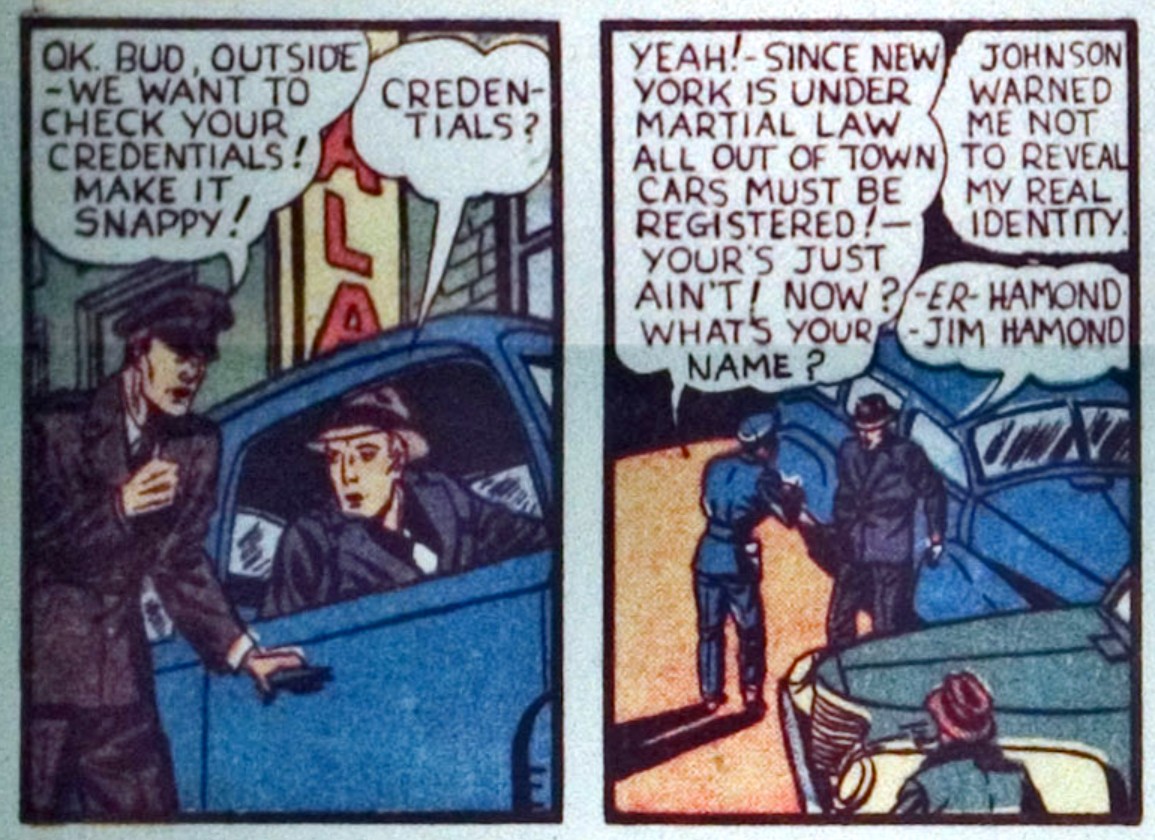
    Well, in Marvel Mystery Comics v1 004 he makes the name Jim Hamond on the fly during a police stop and evidently likes it enough to adopt it as his full-time secret identity. Not sure when he adds the second ‘m’ to make it Hammond. Will report back when he does.

    In Marvel Mystery Comics v1 007 the Human Torch, as Jim Hamond, decides to become a police officer and does so with very little fuss.

    He does, however, immediately discard the idea of operating as a regular secret identity style super-hero due to the fact that he keeps incinerating his uniforms. Instead, he just goes and tells his senior officers the situation and ends up being deputized as a kind of official vigilante working for the city. He maintains the fiction of being a regular beat cop for a couple of more issues before becoming a full-time Human Torch.

    That’s pretty much it for 1940 but thanks to my comic book reading schedule we will be back soon with the 1941 developments in the life of everyone’s favourite android. 

  • MEDIA IN COMICS 014

    Forget lost media, here are some media that only exist in comic books

    Movies: 

    A Modern Macbeth is one of innumerable in-comic movies that we never really learn anything about. Is it a musical? Is that why a singer is speaking at the premiere? Is it a reference to another movie? The only pre-1941 movie with a similar title that I can find is 1917’s A Modern Monte Cristo and that seems a bit of a stretch. (More Fun Comics 072, 1941)

    Captain Marvel stars in a film called Crusher of Crime in one of our earliest examples of a super-hero starring in a film as themselves. No clue what it’s about but we can probably assume that it’s standard 40s super-hero fare. (Whiz Comics 020, 1941)

    More intriguingly, the character of Whitey Murphy joins the Captain Marvel cast just two issues later, and dialogue between him and Billy Batson implies that not only does the real-world film The Adventures of Captain Marvel exist in the comics universe, but that both Captain Marvel and Billy Batson appeared in it and also that some or all the events of the film actually happened.

    This is reinforced by the fact that Billy goes to see “The Guillotine”, the second chapter of the serial, in Captain Marvel Adventures 003 (Whiz Comics 022, 1941)

    The costume party held for the premiere of The Phantom Duelist (film) held in the castle of the Phantom Duelist (ghost) provides the opportunity for the Phantom Duelist (super-villain) to murder Reynolds (film producer, universally-hated). (Doll Man Quarterly 001, 1941)

    One of the minor recurring tropes of comics is “tough guy goes to Hollywood and finds it exhausting,” seen here as the super-hero Hercules is talked into making a sadly unnamed jungle movie and it almost kills him. (Hit Comics 010, 1941)

    Music:

    The song “Icy Igloo Blues” is the key to District Attorney Steve Malone solving a major jewel robbery case. (Detective Comics v1 053, 1941)

    The “Symphony of Death” was employed by the nefarious Doctor Death in his murders. Do music nerds in comic book universes hold Nights of Evil concerts where they play pieces like this? (Wow Comics 002, 1941)

    Speaking of which, here are six extremely on-the-nose songs composed by the Murder Maestro as part of his own efforts in the field of killing: “A Message to My Heart” (victim shot in the heart), “I’m Drowning My Sorrows” (drowned), “I’m Burning Up Over You” (set on fire), “My Sleepy-Time Pal” (poisoned, weirdly), “I’m Walking on Air” (dropped from a plane) and “I’m Getting Up in the World” (fake attempt on own life). (More Fun Comics 072, 1941)

    Newspaper Columns:

    “Walter Winkle on Broadway” is of course yet another take on the gossip column of Walter Winchell. (Feature Comics 049, 1941)

    Television:

    There are in fact Martian invaders in this Human Torch story, but since they don’t get up to any NYC-destroying I must conclude that this is an unnamed and very coincidental television program. (Marvel Mystery Comics v1 003 1940) 

  • REAL PERSON ROUND-UP 029

    Time for a heaping dose of real folk from Golden Age Marvel comics.

    Adolf Hitler:

    Kalph Belgri, dictator of Torpis, takes his own life when his invasion of neighbouring Molivia is thwarted by Electro. (Marvel Mystery Comics v1 005, 1940)

    The Human Torch encounters Adolphe Hiccup, dictator of Slaveland, while foiling a plot to fool his sidekick Toro into aiding their war effort. He is seen colluding with his ally Benny Musclein, who is such a clear Mussolini stand-in that I feel a bit foolish even mentioning it.

    Hiccup’s aide Herr Medals, on the other hand, is quite vexing to me, as despite his physical appearance and love of regalia being clearly based on Hermann Goering, his name makes me think of Goebbels, which caused me to poison my search history a little more by looking up the Nazi high command yet again to make sure I had the right guy. (Human Torch v1 003, 1940)

    Al Capone:

    Mob boss Vince Garrone is the latest in a long line of crooks with Capone-like names. (Marvel Mystery Comics v1 017, 1941)

    Fiorello La Guardia:

    Marvel Comics was a very NYC-heavy operation even back when it was Timely Comics, and as a consequence of that we get far more Mayoral Action from them than other publishers. Here we see Mayor La Guardia showing a lot of moxie while dealing with a hostile Sub-Mariner, for example. (Marvel Mystery Comics v1 007, 1940)

    Not even a year later, here’s the Human Torch helping out a mysterious and unnamed non-La Guardia Mayor of NYC. Just who the heck is this guy? (Marvel Mystery Comics v1 016, 1941)

    La Guardia is back by Marvel Mystery Comics v1 020, just in time to deal with an epidemic of arson and extortion aimed at the city.

    Finally, a chunky little La Guardia thanks the Patriot for fending off the attempted takeover of the city by the fascist Yellowshirts. (Human Torch v1 004, 1941)

    Orson Welles:

    The Human Torch must deal with a Martian invasion, and that means referencing Orson Welles’ War of the Worlds broadcast, here attributed to a “Lawson Bell.” (Marvel Mystery Comics v1 003, 1940)

  • SUPER-HERO FILE 005: THE HUMAN TORCH

    SUPER-HERO FILE 005: THE HUMAN TORCH

    (Marvel Comics 001, 1939)

    The Human Torch! The first major (and first overall) Marvel super-hero, despite the fact that my disorganized ass is writing about him third!

    The Human Torch is a synthetic man, aka an android (aka a synthezoid, which as far as I can tell means “cooler android” and won’t come into use until the 60s anyway) and created by Professor “Not Yet Phineas” Horton. Later stories will add all kinds of influences on and collaborators with Horton (including our recent subject Doctor Nemesis), but in the beginning it was just him, toiling away over his blonde creation.

    The Human Torch’s origin is shaped by three major factors: first, that Horton’s process was flawed in some strange way and as a result his android bursts into flame when exposed to oxygen. Secondly, there is the fact that Horton, despite the obvious scientific acumen and indeed genius on display in his creation, is seemingly devoid of any scientific curiosity outside of this. When confronted with the problem of a flaming android, Horton just throws his hands in the air and gives up without making any kind of real effort to mitigate the problem.

    Finally, the Torch is hampered by the fact that humanity at large, including Horton, is motivated by fame and fortune. Everyone who meets him wants to exploit him in some way, unless they are afraid of him – this is presumably why Horton’s first act upon creating him is to call in reporters rather than work on getting him to stop exploding.

    Though Horton can’t bring himself to work on a solution for the Torch’s problem, he balks at destroying his creation and so opts to seal him inside of an airless steel cylinder and then bury that cylinder in cement.

    Somehow, however, and perhaps relating to the fact that it was dropped into semi-solid cement from a decent height rather than laid down carefully and then covered up, the cylinder develops a crack through which enough air seeps in to set the Torch alight and cause him to burst his prison asunder. Everyone’s worst fears seem to be confirmed, as the newly self-aware android charges through the city streets, setting men, hats and telephone poles alight. A curious thing happens, however, and perhaps this reflects yet another failing on the part of Horton: the Human Torch realizes that he is hurting people and doesn’t want to. You should have talked to your artificial son, Professor, and then you might not have felt it necessary to seal him in concrete.

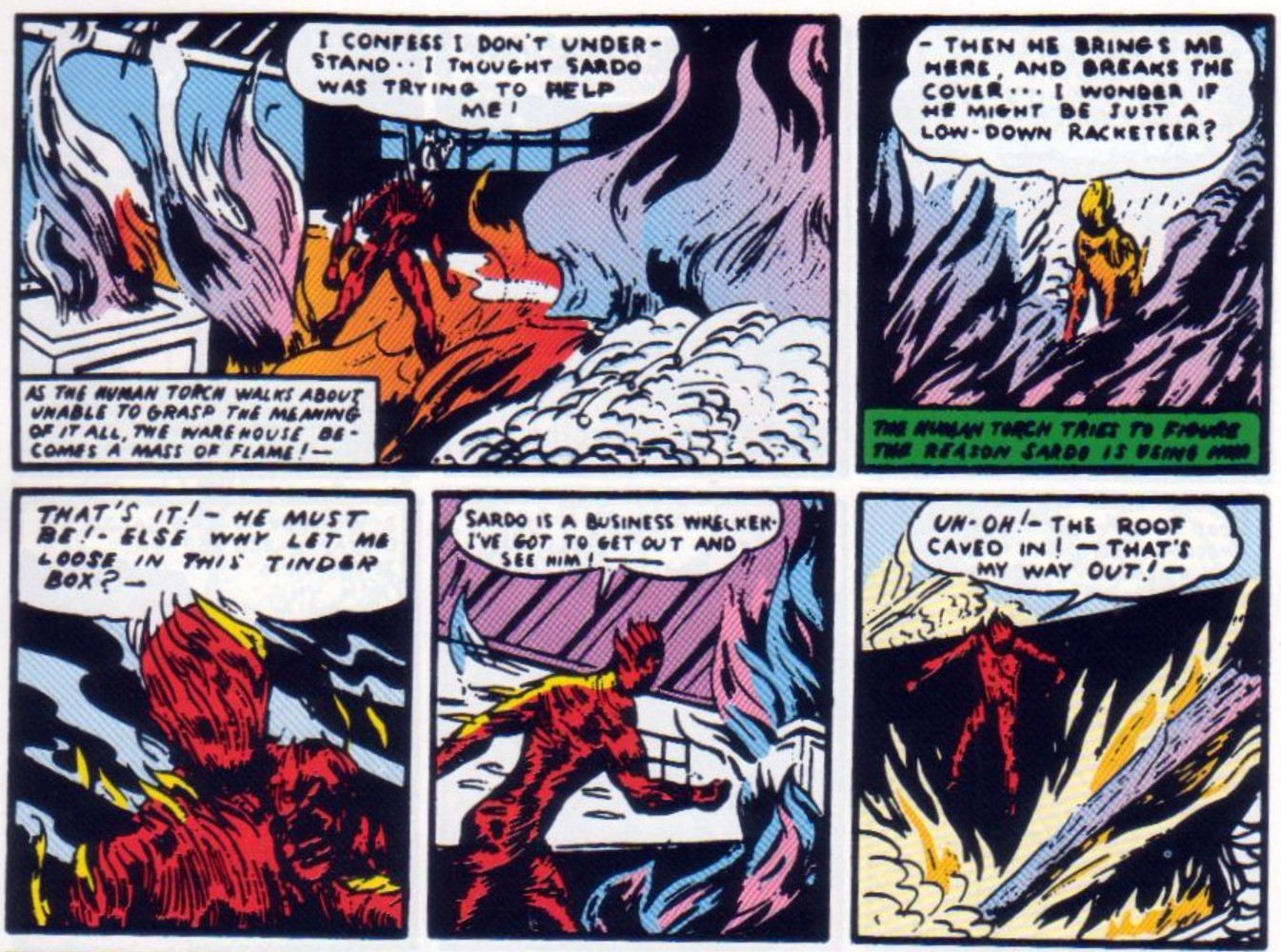
    In attempting to control his own flame (see? once again the child outstrips the parent), the Torch dunks himself in a swimming pool that turns out to belong to a criminal named Sardo who immediately sees the profit potential in a flaming man. Side note: Sardo also has a swimming pool that doubles as a vacuum chamber. Is there any use for such a thing beyond “elaborate deathtrap?”

    Sardo’s reaction to the Torch falls under theme #3 of this origin: Human Greed. He uses his weird pool to transfer the android to a sealed container and then uses him to burn down a warehouse as part of a protection racket scheme. Just like Horton, however, Sardo fails to reckon with the fact that the Torch might have opinions of his own about such things, and meets his end in their subsequent confrontation. 

    The Human Torch eventually figures out how to control his own flame thanks to Sardo’s stockpile of liquid nitrogen tanks – the nitrogen snuff the flame only temporarily but having done so a couple of times the Torch gets the hang of how to do so at will. We almost get a heartwarming father/son reunion as Horton argues for the Torch to be released into his custody, but then he goes and ruins it all by immediately starting to scheme about how much money he is going to make off of his creation’s back. This is the final straw as far as the Human Torch is concerned and he leaves via the most direct route: straight up.

    (Per Marvel Mystery Comics v1 002 this sets Horton’s house on fire and leads to his death, and the Torch isn’t sad about it)

    UPDATES

    Update 1940

  • DIVINE ROUND-UP 035

    DIVINE ROUND-UP 035

    Time to revise the Comparative Religion curriculum again because we found some new gods.

    Adobi:

    Just to what extent these Molemen worship the god Adobi is impossible to say. This particular Moleman hold him in high enough esteem to implore him to sanctify a forced political marriage, if that counts for anything much. I really wish we had a better angle on Adobi’s front side so I could see the big gems in his chest and forehead better.

    God Style: Idol (Lightning Comics v2 002, 1941)

    Vango:

    After escaping the lands of the Adobi-worshipping Molemen, Congo Jack encounters the worshippers of the multi-armed Vango. We don’t learn too much about Vango himself, alas, as the bulk of the narrative is taken up with a religious schism between pro- and anti-human sacrifice Vango worshippers. He looks good!

    God Style: Idol (Lightning Comics v2 004, 1941)

    Fire:

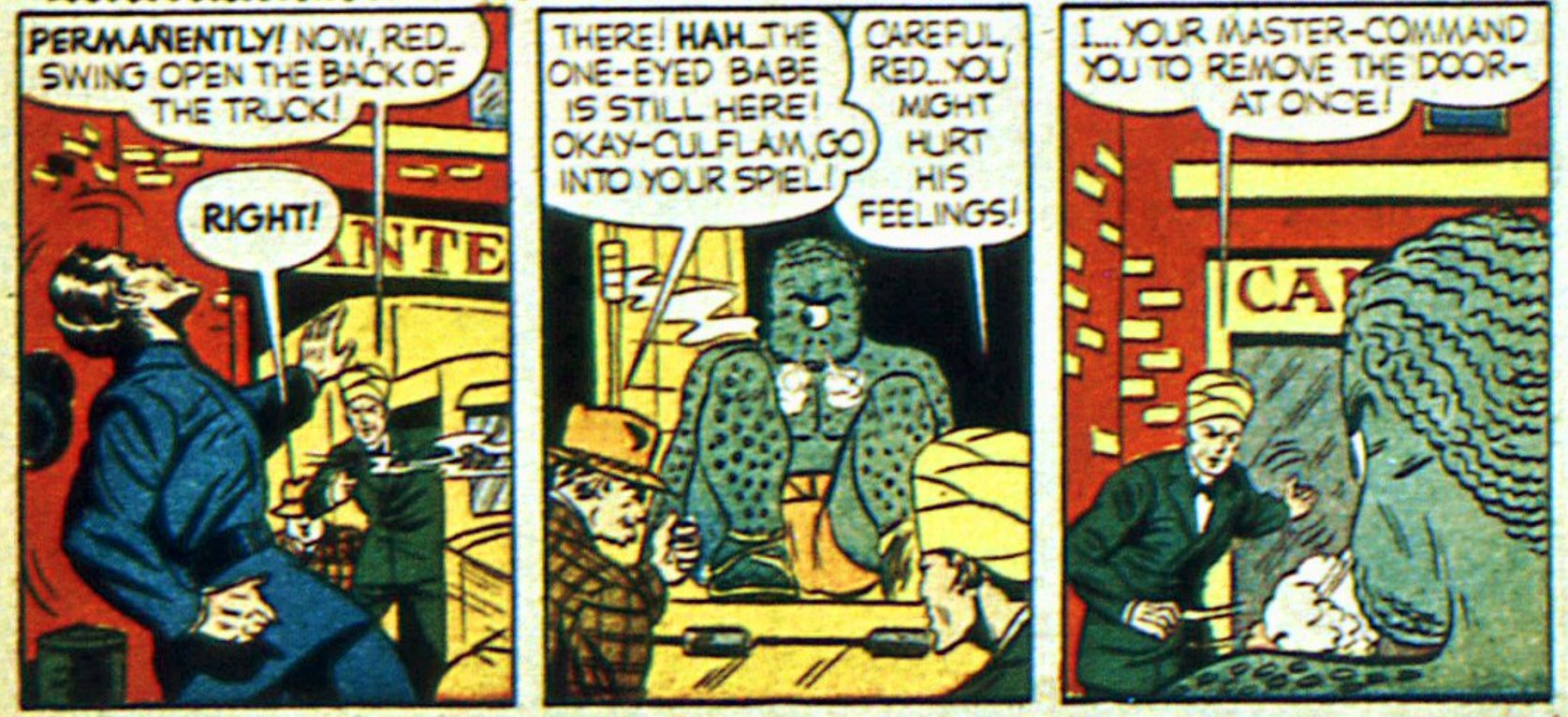
    The Fire-Men (aka the Fire-Cult) are a weird bunch to categorize. They are initially antagonists to the Human Torch, and give him a run for their money with their flame control powers while they hunt down and kill a former member. Then, however, they reveal that he was not merely an apostate but someone who was planning on using the cult’s teachings to profit while causing great destruction, and that he had a partner who is still at large. The Torch is left with to choice but to team up with his former adversaries.

    Though the Fire-Men presumably worship or at least pay fealty to the flame that they control, the real focus of the group is less religious than practical, as they work to contain the rampaging Flame Monsters of Tibet, giant green humanoids who emit flame from their pores. 

    (the second traitor to the cult turns out to be a man named Culflam, who later passes on the Fire-Men’s teachings to the Torch’s enemy the Parrot)

    God Style: Animist (Real?) (Marvel Mystery Comics v1 014, 1940)

    Flamosa the Fire God:

    God of the people of the volcanic Inferno Isle in the Pacific, who appear to have been manipulated into practicing human sacrifice by a group of Nazis in order to dispose of Allied scientists in the area. The Angel semi-accidentally blows up half the island and sets off the volcano, and the worship of Flamosa is abandoned.

    God Style: Idol (Marvel Mystery Comics v1 023, 1941)

  • DIVINE ROUND-UP 035

    Time to revise the Comparative Religion curriculum again because we found some new gods.

    Adobi:

    Just to what extent these Molemen worship the god Adobi is impossible to say. This particular Moleman hold him in high enough esteem to implore him to sanctify a forced political marriage, if that counts for anything much. I really wish we had a better angle on Adobi’s front side so I could see the big gems in his chest and forehead better.

    God Style: Idol (Lightning Comics v2 002, 1941)

    Vango:

    After escaping the lands of the Adobi-worshipping Molemen, Congo Jack encounters the worshippers of the multi-armed Vango. We don’t learn too much about Vango himself, alas, as the bulk of the narrative is taken up with a religious schism between pro- and anti-human sacrifice Vango worshippers. He looks good!

    God Style: Idol (Lightning Comics v2 004, 1941)

    Fire:

    The Fire-Men (aka the Fire-Cult) are a weird bunch to categorize. They are initially antagonists to the Human Torch, and give him a run for their money with their flame control powers while they hunt down and kill a former member. Then, however, they reveal that he was not merely an apostate but someone who was planning on using the cult’s teachings to profit while causing great destruction, and that he had a partner who is still at large. The Torch is left with to choice but to team up with his former adversaries.

    Though the Fire-Men presumably worship or at least pay fealty to the flame that they control, the real focus of the group is less religious than practical, as they work to contain the rampaging Flame Monsters of Tibet, giant green humanoids who emit flame from their pores. 

    (the second traitor to the cult turns out to be a man named Culflam, who later passes on the Fire-Men’s teachings to the Torch’s enemy the Parrot)

    God Style: Animist (Real?) (Marvel Mystery Comics v1 014, 1940)

    Flamosa the Fire God:

    God of the people of the volcanic Inferno Isle in the Pacific, who appear to have been manipulated into practicing human sacrifice by a group of Nazis in order to dispose of Allied scientists in the area. The Angel semi-accidentally blows up half the island and sets off the volcano, and the worship of Flamosa is abandoned.

    God Style: Idol (Marvel Mystery Comics v1 023, 1941)

  • CATALOGUE OF WOUNDS 003

    It’s a dangerous ol’ job, heroing. Thus, the Catalogue of Wounds!

    Green Lantern:

    While tied up in a burning house, Green Lantern must thrust his hands into the flames to escape. (All American Comics 031, 1941)

    Hawkgirl: 

    Hawkgirl is shot in the back by an agent of Mister X while acting as a Hawkman decoy on her very first outing in costume (All-Star Comics 005, 1941)

    Hawkman:

    Shot in the left shoulder by Alexander the Great. (Flash Comics 002, 1940)

    Shot in – I think – the left shoulder again while working on the case of the Hand. (Flash Comics 015, 1941) 

    Shot in the right shoulder for a change, as Carter Hall. (Flash Comics 019, 1941) 

    Perhaps Hawkman preferentially takes bullets to the left shoulder because he took an arrow there during his original incarnation as Prince Khufu. (Flash Comics 001, 1940)  

    Speaking of Prince Khufu, he (along Princess Shiera, off-panel) is famously stabbed by the evil Hath-Set. Hey, a fatal wound is still a wound. (Flash Comics 001, 1940)

    the Human Torch:

    During one of the periods in which the Human Torch is being hunted by the law, he takes a police slug to his right arm. (Marvel Mystery Comics v1 011, 1940)

    the King: 

    Gets his scalp creased by a bullet. (Flash Comics 003, 1940)

    And again a year later. (Flash Comics 016, 1941)

    Aquatic toughie the Scarlet Mermaid gives the King a fashionable bullet wound in the left shoulder while making her escape. (Flash Comics 019, 1941)

    the Pied Piper: 

    Shot in the right arm while wrasslin’ with the Black Panther’s panther. (Cat-Man Comics 004, 1941)

  • MINOR SUPER-VILLAIN 331: THE LEGION OF DESPAIR

    (Human Torch v1 006, 1941)

    A fairly simple one today: am man named Haskell advertises for people with no hope in life, then selects the most desperate of them into a gang. Since they were all prepared to die already, the members of the Legion of Despair are prone to, say, blowing themselves up with grenades in order to see that their compatriots get away with whatever loot they’re scampering off with.

    Aside from this radical investment in the goals of the group, Haskell’s other thematic concept for the Legion is the Dice of Death, which are used to determine who goes on these potential suicide missions by who wins a game of craps (I think? It’s not exactly spelled out).

    It all comes tumbling down once the Human Torch and Toro get involved, because even with five guys willing to blow themselves up to ensure success there’s only so much you can do against a couple of fire men. Haskell turns out to have been cheating in order to avoid risking his life on missions but only after everyone has been captured, offering no real comeuppance other than, presumably, a bad reputation once they’re all in prison. Unsatisfying!

  • MINOR SUPER-VILLAIN 331: THE LEGION OF DESPAIR

    (Human Torch v1 006, 1941)

    A fairly simple one today: am man named Haskell advertises for people with no hope in life, then selects the most desperate of them into a gang. Since they were all prepared to die already, the members of the Legion of Despair are prone to, say, blowing themselves up with grenades in order to see that their compatriots get away with whatever loot they’re scampering off with.

    Aside from this radical investment in the goals of the group, Haskell’s other thematic concept for the Legion is the Dice of Death, which are used to determine who goes on these potential suicide missions by who wins a game of craps (I think? It’s not exactly spelled out).

    It all comes tumbling down once the Human Torch and Toro get involved, because even with five guys willing to blow themselves up to ensure success there’s only so much you can do against a couple of fire men. Haskell turns out to have been cheating in order to avoid risking his life on missions but only after everyone has been captured, offering no real comeuppance other than, presumably, a bad reputation once they’re all in prison. Unsatisfying!