The Curse of Skeleton Munroe

Category: super equivalent

  • MAD AND CRIMINAL SCIENTIST ROUND-UP 028

    These guys use science for crime and evil, for which we excoriate them, but they also make entertaining villains, for which we celebrate them. 

    Dr Stone:

    Dr Elijah Stone has a calling and it is in creating and disseminating deadly plagues upon mankind. This, however, is the kind of passion that society frowns upon and Stone is locked away in the State Mental Hospital. Unfortunately for mankind, the State Mental Hospital seems to be one of those places that contracts its security out to the lowest bidder, because Stone escapes in no time flat.

    Sure enough, there is soon a hot new Dr Stone plague ravaging humanity. This quiet New England Town is absolutely screwed, and the rest of the world is soon to follow if someone doesn’t do something soon.

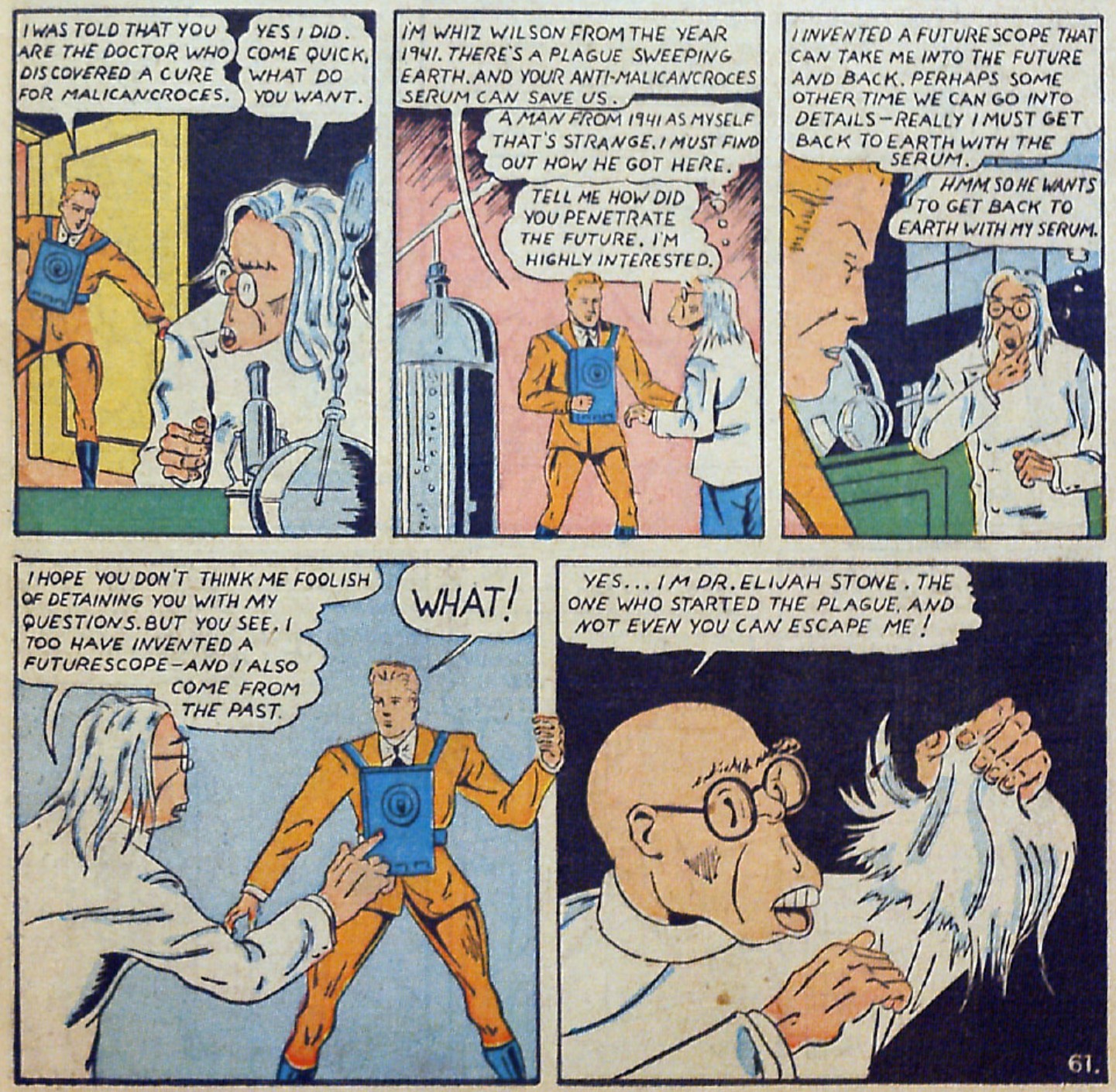
    Enter time/space explorer Whiz Wilson, who pops into the future to a time when there simply must be a cure and is referred to the Medical Center on Mars. His quest hits a small speedbump when the Martian doctor turns out to actually be Dr Stone in disguise – it seems that when not making plagues Stone has dabbled in chronal physics and has independently developed Futurescope technology. He has been using the future as a home base to culture up enough plague germs to wipe out 1941 humanity in one fell swoop, after which he will enjoy some alone time on an unpopulated planet. 

    Whiz Wilson smashes Stone’s Futurescope and makes off with his personal supply of anti-plague serum but is forced to let the man himself escape. Both Stone and the text boxes set up Dr Stone as an upcoming recurring nemesis for Whiz to deal with, presumably in different time periods, but his evil plans are foiled by the fact that this is the final Whiz Wilson story. (Lightning Comics v2 004, 1941)

    Professor Hanley:

    Professor Hanley is one of the many comic book scientists whose development of a means of making artificial diamonds is seen as dangerous and/or criminal by a super-hero. Hanley is at least attempting to pass artificial diamonds off as natural ones so I guess this counts as selling counterfeit good, but I still think that this is not worth your time, the Angel. (Marvel Mystery Comics v1 014, 1940)

    Howland:

    Howland, the second and final foe faced by Sky Wizard, has been causing mass chaos by sending out his army of humanoid robots to loot and kill. He also has a real “evil Vulcan” look that I appreciate.

    In addition to the extremely nifty robots (called the Robot Terrors by one and all, though I suspect that Howland just adopted the very cool name after he heard Sky Wizard use it), Howland is notable for creating these deathtraps that kill their victims by dropping slats out from under their feet at a rate of one per five seconds and then leaving them to dangle and strangle thanks to the tight neck shackle. This is pretty gruesome, but it’s also very quick, and Howland still manages to be out of the room when Sky Wizard and his aide Keeshan manage to escape. 

    Let’s be clear: I was already worked up about this before I noticed that he says how many slats there are because even at, say, one hundred slats that’s only eight and a half minutes, but no, it’s six slats. That’s thirty seconds, Howland. You’re too busy to wait thirty seconds for a super-hero to die? I don’t even feel sorry for you that you eventually die at the cold metal hands of your own robots, because I only feel contempt. (Miracle Comics 004, 1941)

    Captain Kiddlaw:

    Captain Kiddlaw, the Wizard-Pirate, is a scientific scoundrel who vexes the Super Police of the far-flung year 2023. His scheme involves dragging passing cruise ships to the bottom of the ocean for loot and slaves and is never technically foiled due to the cancellation of the “Super Police 2023” serial. They probably get him eventually, though. (New Fun Comics 002, 1935)

  • MAD AND CRIMINAL SCIENTIST ROUND-UP 028

    MAD AND CRIMINAL SCIENTIST ROUND-UP 028

    These guys use science for crime and evil, for which we excoriate them, but they also make entertaining villains, for which we celebrate them. 

    Dr Stone:

    Dr Elijah Stone has a calling and it is in creating and disseminating deadly plagues upon mankind. This, however, is the kind of passion that society frowns upon and Stone is locked away in the State Mental Hospital. Unfortunately for mankind, the State Mental Hospital seems to be one of those places that contracts its security out to the lowest bidder, because Stone escapes in no time flat.

    Sure enough, there is soon a hot new Dr Stone plague ravaging humanity. This quiet New England Town is absolutely screwed, and the rest of the world is soon to follow if someone doesn’t do something soon.

    Enter time/space explorer Whiz Wilson, who pops into the future to a time when there simply must be a cure and is referred to the Medical Center on Mars. His quest hits a small speedbump when the Martian doctor turns out to actually be Dr Stone in disguise – it seems that when not making plagues Stone has dabbled in chronal physics and has independently developed Futurescope technology. He has been using the future as a home base to culture up enough plague germs to wipe out 1941 humanity in one fell swoop, after which he will enjoy some alone time on an unpopulated planet. 

    Whiz Wilson smashes Stone’s Futurescope and makes off with his personal supply of anti-plague serum but is forced to let the man himself escape. Both Stone and the text boxes set up Dr Stone as an upcoming recurring nemesis for Whiz to deal with, presumably in different time periods, but his evil plans are foiled by the fact that this is the final Whiz Wilson story. (Lightning Comics v2 004, 1941)

    Professor Hanley:

    Professor Hanley is one of the many comic book scientists whose development of a means of making artificial diamonds is seen as dangerous and/or criminal by a super-hero. Hanley is at least attempting to pass artificial diamonds off as natural ones so I guess this counts as selling counterfeit good, but I still think that this is not worth your time, the Angel. (Marvel Mystery Comics v1 014, 1940)

    Howland:

    Howland, the second and final foe faced by Sky Wizard, has been causing mass chaos by sending out his army of humanoid robots to loot and kill. He also has a real “evil Vulcan” look that I appreciate.

    In addition to the extremely nifty robots (called the Robot Terrors by one and all, though I suspect that Howland just adopted the very cool name after he heard Sky Wizard use it), Howland is notable for creating these deathtraps that kill their victims by dropping slats out from under their feet at a rate of one per five seconds and then leaving them to dangle and strangle thanks to the tight neck shackle. This is pretty gruesome, but it’s also very quick, and Howland still manages to be out of the room when Sky Wizard and his aide Keeshan manage to escape. 

    Let’s be clear: I was already worked up about this before I noticed that he says how many slats there are because even at, say, one hundred slats that’s only eight and a half minutes, but no, it’s six slats. That’s thirty seconds, Howland. You’re too busy to wait thirty seconds for a super-hero to die? I don’t even feel sorry for you that you eventually die at the cold metal hands of your own robots, because I only feel contempt. (Miracle Comics 004, 1941)

    Captain Kiddlaw:

    Captain Kiddlaw, the Wizard-Pirate, is a scientific scoundrel who vexes the Super Police of the far-flung year 2023. His scheme involves dragging passing cruise ships to the bottom of the ocean for loot and slaves and is never technically foiled due to the cancellation of the “Super Police 2023” serial. They probably get him eventually, though. (New Fun Comics 002, 1935)

  • MINOR SUPER-VILLAIN 1002: MASTERMIND

    (Lightning Comics v2 001, 1941)

    Lash Lightning, while aimlessly flying around the countryside at night, encounters a footsore scientist named Amy Lane. Turns out that her castle (!) has been stolen by a man named Mastermind and that she has been walking for several hours in an attempt to get help. In a move that always seems kind of rude to me, Lightning immediately flies her all the way back to the castle to investigate. The mysterious Mastermind is no longer present when they arrive, but the castle’s laboratory is now filled with strange electrical equipment.

    But just where is Mastermind (who is also frequently called the Mastermind)? As you may recall from our one thousandth entry, he is in the middle of breaking Lightning’s recurring foe the Mummy out of jail in an attempt to wrangle the formula for his invulnerability coating out of him. You don’t see this kind of thing very often and I have to assume that the inherent egomania required to become a super-villain prevents most of them from acknowledging that anyone else might have a good idea.

    Upon returning to the castle and discovering Lightning and Lane in his newly-stolen laboratory, Mastermind demonstrates what the electrical equipment is for by using it to charge himself with lightning in this state he is immune to electricity (and only electricity, hence the need for the Mummy’s radium solution), can throw destructive bolts of lightning, and is able to teleport both himself and others, though just why this makes him resemble a dracula with glowing eyes is not explained.

    Mastermind and the Mummy demonstrate the value of teamwork by subduing Lightning with relatively little effort, then immediately revert to super-villain type and engage in a struggle for dominance that sees the Mummy reduced to a smouldering pile of medical gauze and Mastermind is left forever vulnerable to being punched in the face.

    Undeterred, Mastermind sets out to enact his ultimate scheme: to extort money from the US government in exchange for not helping the Axis to take over America, and as the government (in the form of this room full of Army officers) refuses to pay up based solely on the threats of a goth, he sets out to do just that.

    Mastermind seeks out a nearby cell of pseudo-Nazi spies and offers his services as a saboteur, then proves that he can deliver the goods by blowing up the Washington Monument. I am not ashamed to admit that I yelled aloud when I read this part of the book – that’s the sort of high-tier, messing-with-national-symbols villainy that you don’t get a lot of in this era.

    Mastermind’s pitch to the spies is of course successful and he goes on a real sabotage tear, though none of it is as crazy or memorable as that initial salvo. By this point Lash Lightning has recovered and escaped, and the two have a final confrontation back at Amy Lane’s castle as Mastermind is nipping back for a quick recharge. Instead of that pick-me-up, however, he gets thrown to his doom on the rocks below.

    OR DOES HE??

    No he does not, because Mastermind is back in Lightning Comics v2 002 and he’s explicitly rather than implicitly collaborating with the Nazis. This time, he’s got a mind control serum that he uses to take over the minds of everyone at Fort Hancock.

    And just why does he mind control an entire fort worth of soldiers? Why, to both prevent them from operating the shore defenses as the Nazi fleet is sailing into the nearby city’s harbour and as auxiliary troops for the subsequent shelling and invasion of that city, of course.

    Lightning is of course not going to stand for this kind of thing: he blows up/drives off the fleet, cures the men of the Mastermind’s control with a careful application of electricity and takes care of Mastermind himself with the careful application of a sock on the jaw.

    In his third appearance in Lightning Comics v2 003, Mastermind escapes jail by arranging to have himself sent a tiny recharging device that appears to just plug into the electrical outlet that I never really pictured 1940s prison cells as having but which gives him enough juice for one teleport away.

    This time around, Mastermind steals an experimental dirigible equipped with heat and paralysis rays and uses it to prep the way for yet another Nazi invasion by attacking US defense facilities.

    Not only does Lash Lightning show up and take him down with an almost insulting level of ease, but he does so accompanied by a pretty devastating put-down. It’s the old law of diminishing returns, as a villain who started out as a formidable opponent becomes more and more of a pushover as time goes on. Mastermind jumps to his death rather than being captured this time, only of course he doesn’t because he is a teleporter.

    Sure enough, when Mastermind returns in Lightning Comics v2 004, he confirms that teleportation saved his bacon. This time around he is working for the Nazis yet again, but rather than paving the way for invasion he is attempting to destroy some war materiel making its way from America to the UK via Canada. And speaking of Canada, since Lash Lightning prevents the supplies from being destroyed as they cross the border, the bulk of this issue takes place in my home country. Specifically, Mastermind is the very first super-villain who we have encountered doing supercrime in the province of Quebec!

    Not great supercrime, mind you. He does manage to poison Lightning, but instead of taking proper advantage of this he just throws him off of a roof, something that he would ordinarily survive and something I think would be reasonable to assume he would survive even while half dead.

    And yes, he does survive, returning to to punch out Mastermind’s lights and foil all of his plans. It’s back to prison for our pale friend, and this time they must have made sure to check all of his incoming cake deliveries a bit more thoroughly because as far as I can tell he never appears again.

    Categorized in: Origins (Evil Equivalents), Powers (Teleportation), Professions in Crime (Masterminds)

  • MINOR SUPER-HERO ROUND-UP 069

    Mostly, but not all, updates. 

    Ibis the Invincible **UPDATE**:

    1941 sees Ibis the Invincible’s omnipotence tempered a bit via a slight limitation that is added to the Ibistick: it is not directly able to affect things created by or otherwise powered by evil magic, and it might not work at all in overtly magical areas such as a giant’s floating castle.

    This is balanced out somewhat by the fact that it gives Ibis the chance to demonstrate his lateral thinking skills by indirectly affecting these things, whether it be with a right hook or a summoned Egyptian god. (Whiz Comics 016, 1941)

    the Lieutenant Marvels:

    The Lieutenant Marvels are also the members of the Billy Batson Club, being three other kids with the name Billy Batson who all gather in New York Fawcett City to… share the pain of having the same name as a media figure with the figure in question? I guess that’s what they were doing? Turns out they all get along well enough to form a club, and to distinguish themselves they all choose a nickname: the lanky Westerner becomes Tall Billy, the squat Brooklynite is Fat Billy, the Southerner chooses to be Hill Billy and the famous one is acclaimed as Real Billy. This is the sort of nicknaming system that seems fine when you’re thirteen but can really fester over the years.

    The meetup is not all about comparing names and making friend, however, because these guys all have access to the comic books from our universe somehow and as such they all know about the link between yelling “SHAZAM!” while being named Billy Batson and becoming Captain Marvel, BUT ALSO are surprised when Real Billy does so and transforms. It’s a real pickle how they might have most of the info but not that last piece – perhaps the comics in this world that will eventually be designated Earth-S posit that Billy summons Captain Marvel by yelling for him. 

    Thanks to some name-based misunderstandings, the four all end up being captured by Dr Sivana and his group the Vengeful Four and tied to a deathtrap loud enough that all four Billys need to shout together to get the SHAZAM through to the lightning dispatcher. Surprisingly, the “any Billy Batson yelling SHAZAM = Captain Marvel” idea that they all had in their heads was accurate, and they all transform into equivalently powerful super-beings, with a ready-made names that are not actually used until their second appearance: Tall Marvel, Fat Marvel and Hill Marvel.

    (I have to admit here that I had for many years thought that the “Lieutenant” in Lieutenant Marvels was like when a villain’s top guy is called their lieutenant, like these guys are Captain Marvel’s helpers. I just now realized that it is in fact a straight military hierarchy joke) 

    The Lieutenant Marvels show up now and then to this day when Captain Marvel needs three other guys to help him do something, but given that they debut just a few months before Captain Marvel Jr and a year and a bit before Mary Marvel, their services aren’t as in-demand as one might expect.  (Whiz Comics 021, 1941) 

    Golden Arrow **Update**: 

    Though as previously noted the Golden Arrow strip essentially switched from a Modern West to Old West setting after about two or three issues, there has always been a bit of ambiguity as to the specific century the action was taking place in. Though some might point to the presence of a working stagecoach system or other anachronisms in earlier issues as evidence that Golden Arrow was firmly Old West, I have been burned before and it took something like this declaration of the train as a new-fangled arrival to convince me that the comic wasn’t suddenly going to feature Nazi fifth columnists. (Whiz Comics 021, 1941)

    the Arrow **Update**: 

    The Arrow finally gets an alter ego in his final comic book appearance, and it’s US Intelligence agent Ralph Payne. Is this an improvement over being an unnamed giant of a man? I leave that as an exercise for the reader. He also gets a more conventional super-hero cowl mask (with just a hint of the visible hairline that made his fellow Centaur character the Fantom of the Fair look so distinctive) and some cool boots at the same time. (The Arrow 003, 1941)

  • MINOR SUPER-HERO ROUND-UP 039

    MINOR SUPER-HERO ROUND-UP 039

    We’re reading Shield-Wizard Comics, bay-bee, so here’s some stuff about the Shield and the Wizard.

    the Shield UPDATE:

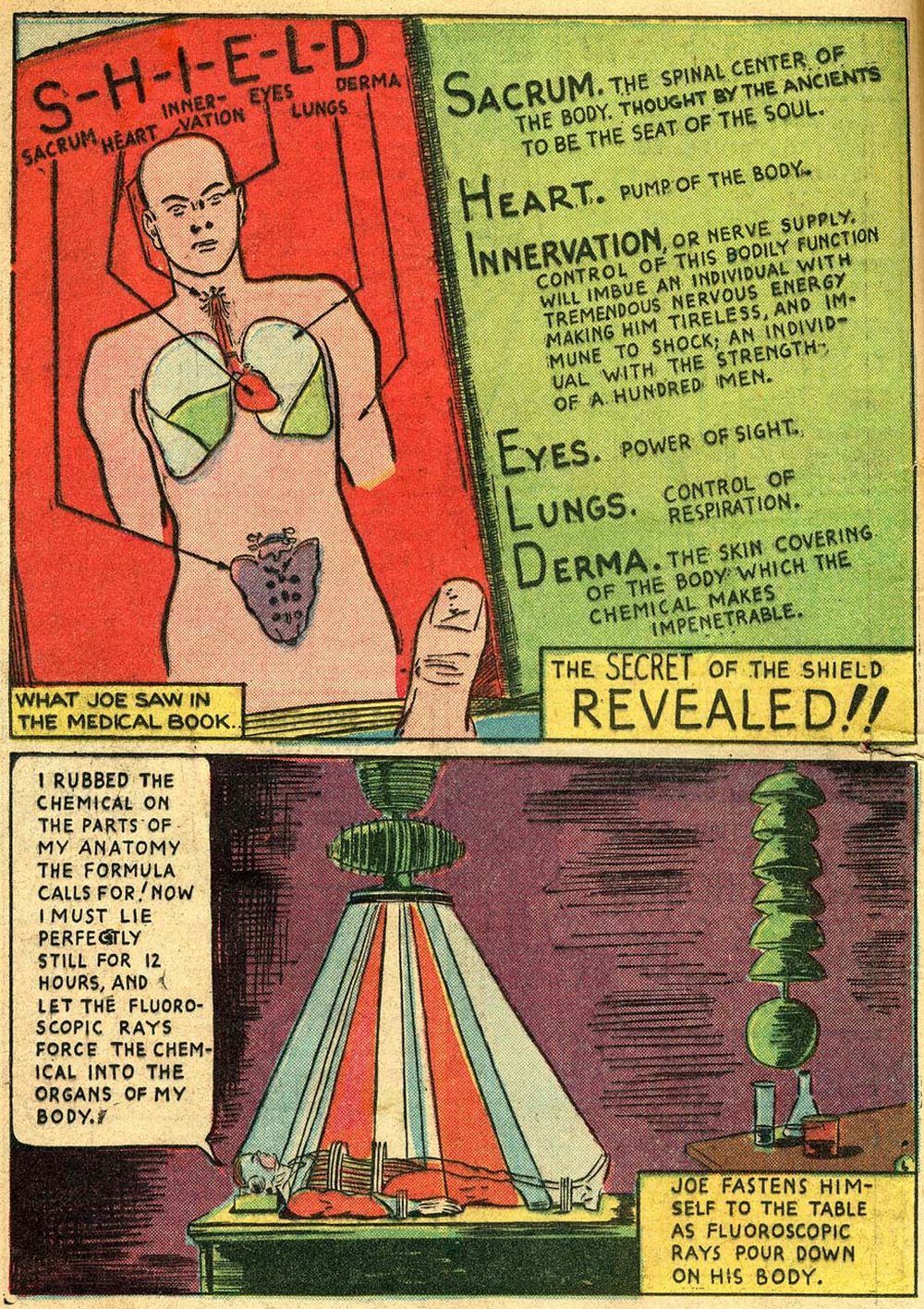
    In our original write-up of the Shield, we noted that the origin of his powers shifted from being solely down to his super-suit to being more of an ingrained thing over time, and the time is now! Yes, Shield-Wizard Comics 001 provides a slightly tweaked version of the Shield’s origin, in which Joe Higgins’ father Tom was not just a US Army Intelligence agent but a gifted scientist who discovered the secret of inducing superpowers but died juuuust before being able to tell Joe the full secret.

    Joe grows up to become a chemist himself but remains puzzled by his father’s last instructions to remember “anatomy formula S•H•I•E•L•D,” and with good reason, because it’s a nonsense jumble of anatomical parts that must have been put together only in the specific medical textbook that Joe eventually finds it in. But hey, he needed to find out where exactly to rub the chemical formula, and how would he otherwise know that it boiled down to “your eyes and skin, but especially the skin over your chest and groin” without that handy mnemonic device?

    The all-white costume that Joe is sporting before he settles down for a 12-hour session under the fluoroscopic ray shows up in at least a few retellings of the Shield’s origin going forward and I always thought that it was a pretty snappy look. Unfortunately, the rays dye his suit (and possibly his limbs?) in patriotic colours and so we get a red-white-and-blue Shield rather than merely a white one.

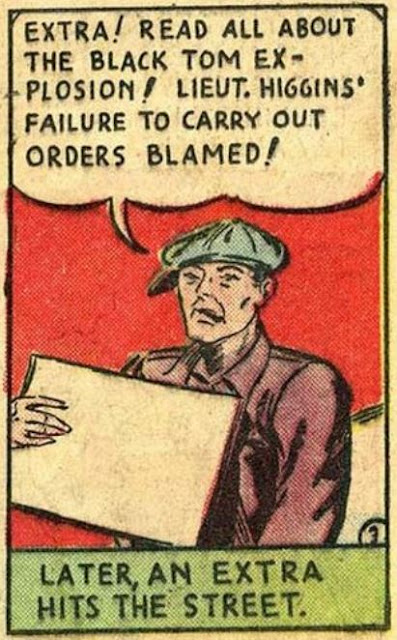
    The other tweak to the Shield’s origin is that rather than merely dying in the Black Tom Explosion of 1916, Tom Higgins is blamed for it, so the Shield now not only has a Batman-style motivation (spies killed my dad and now I must battle espionage) but also a Geoff Johns-Barry Allen-Flash one (I fight crime as part of my attempt to clear my father’s name). Thankfully, his first case involves rounding up the very German Hans Fritz and forcing him to confess, thus clearing Tom Higgins’ name without it becoming a whole thing. (Shield-Wizard Comics 001, 1940)

    the Wizard I:

    In the original account of the Wizard’s origin in Top-Notch Comics 001, the Whitney family’s close connection to American history is pretty thoroughly emphasized, with Whitneys present and getting things done at all major American wartimes. Well, Shield-Wizard Comics took up that gauntlet and ran with it: John Whitney organized the Mayflower expedition, and his son John Whitney organized the first Thanksgiving, and his son or grandson John Whitney thought up the idea of uniting the colonies. 

    But that wasn’t all: the third John Whitney’s son Blane (the main line of Whitneys only have time for three male names: John, Blane and Grover. All other named Whitneys are from dead end branches of the family tree, it seems) is just as super-human as his descendant, and in fact was the first of a line of Whitney family superhumans to call themself the Wizard (adopted as an ironic name after John Whitney was burned at the stake for witchcraft after acting on his son’s extrasensory visions to protect the colonies).

    The Wizard ends up making quite a big difference in the tides of the American Revolution, including:

    – informing Paul Revere that the British were approaching Concord and lighting the “one if by land, two if by sea” lanterns

    – showing up to participate in the fighting at Concord and turning the tide

    – wielding a cannon as a sidearm in the Battle of Bunker Hill and again at the Battle of Saratoga

    – saving Nathan Hale from being executed as a spy only not really because he chooses to die and be an inspiration instead

    – orchestrating the crossing of the Delaware and the surprise attack on the Hessian forces

    -very nearly getting Benedict Arnold before he gets away to join the British forces

    – proving instrumental in the capture of Major André

    – participating in several key battles, including the charge of Mad Anthony Wayne and the defeat of Cornwallis

    – orchestrating the support of the French for the revolution

     This original Wizard also creates a number of anachronistic inventions, including:

    – a glider that seems to function a bit more like a full-fledged airplane

    – a steam powered speedboat

    – something in between a deep sea diving rig and a scuba suit

    – a machine gun

    – radio communication

    – an electrified, battery-powered suit

    – a self-propelled sled

    – a tiny high-powered cannon

    All in all, the tale of the original Wizard holds up as a classic of the form, with the form being “super-heroes added to historical events.” Comics love to showcase the great moments of US history in particular, but as a comic book must prioritize action, any super-heroic character who is present must have an extraordinary amount of influence on history. It’s great! (Shield-Wizard Comics 001, 1940)

    the Wizard II:

    The second Wizard, like his father the original Wizard, is essentially a carbon copy of the modern character in appearance, name (Blane Whitney, natch) and abilities. Blane Whitney II also takes after his father in his commitment to inserting himself into important US historical events, including:

    – participating in various military engagements, including the defeat of the HMS Gurrierre, the Battle of Lake Erie, the Battle of the Thames (I think?) and the Battle of Bladensburg

    – saving William Henry Harrison from an assassination attempt

    – almost preventing the burning of the White House by the British

    – planning the defense of Fort McHenry and then participating in it

    – accidentally enabling Francis Scott Key to get inspired to write the Star-Spangled Banner

    This Wizard also has a lot of ahead of its time technology, including:

    – a version of his father’s glider

    – smoke (possibly tear gas) grenades

    – a dang tank

    The second Wizard obviously has less of a direct impact on the events of US history, if only because the War of 1812 has fewer Stand Up and Cheer moments than its predecessor. Still, he’s in there, and there’s every indication that we’d continue on to see a Civil War Wizard and a World War I Wizard and so forth, and the stated reason that we don’t see them is that as of Shield-Wizard Comics 003, the Wizard’s sidekick Roy the Super-Boy was too popular to not feature and so it was contemporary Wizard from then on out. (Shield-Wizard Comics 002, 1940)

    And speaking of Roy the Super-Boy:

    Tommy the Super-Boy:

    A part of any big project is choosing a methodology and then sticking to it and as my project is “reading all comics, in order” I had to figure out what “in order” meant. And while doing things in a month by month basis might be more true to the spirit of the experience, for my own sanity I opted to go alphabetical by year instead – the prep work alone for that other method hurts my head a bit to contemplate.

    All that is by way of explaining that Tommy, “the Original Super-Boy of History” (aka the original wonder-boy according to that one panel) is a retroactively created predecessor of the Wizard’s sidekick Roy the Super-Boy, who we will not meet until I have read the around 180 other comics between Shield-Wizard Comics 002 and Top-Notch Comics 008. He’s your classic orphan kid who gets to hang around a super-hero because he’s scrappy, and it turns out that that’s not unheard-of in historical youths.

    This particular scrappy kid, Tommy by name, is peeling potatoes when he meets an incognito Blane Whitney II and ends up discovering his secret identity after the Wizard participates in a sea battle and Tommy runs off afterward to berate Blane for cowardice, like a normal person does. And once you have discovered a super-hero’s identity, you get to become a super-hero! If you are a scrappy kid, of course. (Shield-Wizard Comics 002, 1940)

  • MINOR SUPER-HERO ROUND-UP 008

    MINOR SUPER-HERO ROUND-UP 008

    Some real highs and lows in this one.

    the Twister: 

    The Twister is a quite minor Golden Age super-hero – he managed more than one appearance but not more than seven – who has the distinction of having one of the most well-designed costumes of the era. Not my favourite costume, mind you, but boy oh boy, you can really tell that his creators (Ray Gill and Paul Gustavson as it happens) really sat down for a good think about how to evoke “tornado” via the medium of clothing.

    The Twister turns out to be Bob Sanders, and he turns out to be a descendant of perennial fave Greek hero Odysseus. It turns out that the story of Aeolus gifting Odysseus two bags of wind and his men opening the bag of storm winds thinking that it was full of treasure was more than just another delay in Odysseus’ Bad Voyage, it was akin to the opening of Pandora’s Box and Aeolus had charged Odysseus or his descendants to round up all of the evil violent winds and return the to captivity. 

    Evidently over the years the charge to gather up evil winds has expanded to fighting all evil, and the Twister’s power set allows him to run roughshod over just about anyone using wind control, a tornado form and invulnerability to anything that couldn’t harm actual wind. There is some attempt to establish that he is vulnerable to being locked up somewhere with no airflow but that proves even easier to defeat than all the times that Silver Age Aquaman is locked up and forced to source water from unexpected places.

    The Twister’s other claim to fame is that he was introduced as a mysterious tornado that appeared in the Blue Bolt, Sub-Zero and Dick Cole stories in the issue he first appears in, which is enough to be counted as a rare Golden Age crossover even though none of them shared words. (Blue Bolt v2 001, 1941)

    Freezum:

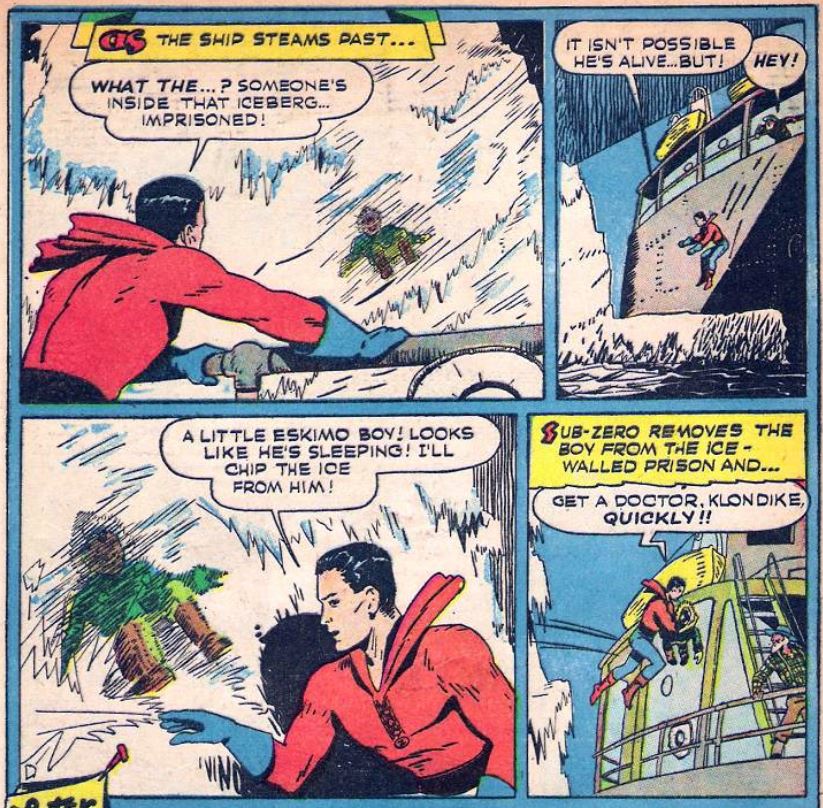
    On an adventure that takes him to Alaska, Sub-Zero happens upon a little Inuit or Aleut boy frozen in a glacier.

    Thawing the kid out and finding him to miraculously be alive, Sub-Zero (as well as an unfortunate doctor) is further astounded to discover that they share the same sort of cold-based powers due to their similar near-death freezing experiences. The kid names himself Freezum, and that’s just the first salvo of a barrage of tired comic relief sidekick shenanigans. Yes, we’ll be sighing and rolling our eyes for the remainder of Sub-Zero’s run – the joys of the Golden Age, friends! (Blue Bolt v2 005, 1941)

    Lois Blake:

    Lois Blake is a woman who Blue Bolt meets while attempting to take down a gang that was swindling immigrants using fake citizenship papers and decides to team up with. At some point when the gang is being particularly elusive he remembers that his pal Dr Bertoff down in the underground Kirby world has a viewscreen that can see virtually any location and so they head down there to use it. Bertoff then very helpfully offers to transfer some of Blue Bolt’s power to Lois and a new crimefighting team is born! (small aside: Golden Age comics don’t get a lot of praise for their art but I really enjoy both the small detail of Lois gripping Blue Bolt’s arm for comfort in the first panel above and her delighted expression in the third).

    Lois never gets a super-hero name and only really makes a handful of appearances before Blue Bolt ditches his costume and powers to become a regular if oddly-named soldier, but he’s such a nonentity post Simon and Kirby that I can’t help but love her for adding some life to the strip.(Blue Bolt v2 007, 1941)

    the Marvel:

    The Marvel is your classic mask-and-tuxedo vigilante, who specializes in showing up to bail reporter Scoop Cody out of the kind of jams you can get in when you’ve cracked a juicy crime story but not accounted for the possibility that the criminals involved might want to stop you from reporting on it.

    Three things about the Marvel: 

    1. The nose cutout never looks as cool as the full-face cowl does but I reckon it’s a heck of a lot more comfortable, so you have to give him some credit for choosing function over form.

    2. Scoop Cody and thus the Marvel only had two appearances and both of them had a teaser at the end promising that the Marvel’s identity would be revealed in the next issue. It’s always possible that they were planning on making the Marvel a completely new, never-before-seen guy but if they weren’t then literally the only suspect is this guy, Scoop Cody’s crusty old unnamed editor.

    3. Love a super-hero calling card, even in the rare cases when it’s a literal calling card.

    Also here is the Marvel’s second appearance in its entirety. (Blue Ribbon Coimcs 002, 1939)

  • MINOR SUPER-HERO ROUND-UP 008

    MINOR SUPER-HERO ROUND-UP 008

    Some real highs and lows in this one.

    the Twister: 

    The Twister is a quite minor Golden Age super-hero – he managed more than one appearance but not more than seven – who has the distinction of having one of the most well-designed costumes of the era. Not my favourite costume, mind you, but boy oh boy, you can really tell that his creators (Ray Gill and Paul Gustavson as it happens) really sat down for a good think about how to evoke “tornado” via the medium of clothing.

    The Twister turns out to be Bob Sanders, and he turns out to be a descendant of perennial fave Greek hero Odysseus. It turns out that the story of Aeolus gifting Odysseus two bags of wind and his men opening the bag of storm winds thinking that it was full of treasure was more than just another delay in Odysseus’ Bad Voyage, it was akin to the opening of Pandora’s Box and Aeolus had charged Odysseus or his descendants to round up all of the evil violent winds and return the to captivity. 

    Evidently over the years the charge to gather up evil winds has expanded to fighting all evil, and the Twister’s power set allows him to run roughshod over just about anyone using wind control, a tornado form and invulnerability to anything that couldn’t harm actual wind. There is some attempt to establish that he is vulnerable to being locked up somewhere with no airflow but that proves even easier to defeat than all the times that Silver Age Aquaman is locked up and forced to source water from unexpected places.

    The Twister’s other claim to fame is that he was introduced as a mysterious tornado that appeared in the Blue Bolt, Sub-Zero and Dick Cole stories in the issue he first appears in, which is enough to be counted as a rare Golden Age crossover even though none of them shared words. (Blue Bolt v2 001, 1941)

    Freezum:

    On an adventure that takes him to Alaska, Sub-Zero happens upon a little Inuit or Aleut boy frozen in a glacier.

    Thawing the kid out and finding him to miraculously be alive, Sub-Zero (as well as an unfortunate doctor) is further astounded to discover that they share the same sort of cold-based powers due to their similar near-death freezing experiences. The kid names himself Freezum, and that’s just the first salvo of a barrage of tired comic relief sidekick shenanigans. Yes, we’ll be sighing and rolling our eyes for the remainder of Sub-Zero’s run – the joys of the Golden Age, friends! (Blue Bolt v2 005, 1941)

    Lois Blake:

    Lois Blake is a woman who Blue Bolt meets while attempting to take down a gang that was swindling immigrants using fake citizenship papers and decides to team up with. At some point when the gang is being particularly elusive he remembers that his pal Dr Bertoff down in the underground Kirby world has a viewscreen that can see virtually any location and so they head down there to use it. Bertoff then very helpfully offers to transfer some of Blue Bolt’s power to Lois and a new crimefighting team is born! (small aside: Golden Age comics don’t get a lot of praise for their art but I really enjoy both the small detail of Lois gripping Blue Bolt’s arm for comfort in the first panel above and her delighted expression in the third).

    Lois never gets a super-hero name and only really makes a handful of appearances before Blue Bolt ditches his costume and powers to become a regular if oddly-named soldier, but he’s such a nonentity post Simon and Kirby that I can’t help but love her for adding some life to the strip.(Blue Bolt v2 007, 1941)

    the Marvel:

    The Marvel is your classic mask-and-tuxedo vigilante, who specializes in showing up to bail reporter Scoop Cody out of the kind of jams you can get in when you’ve cracked a juicy crime story but not accounted for the possibility that the criminals involved might want to stop you from reporting on it.

    Three things about the Marvel: 

    1. The nose cutout never looks as cool as the full-face cowl does but I reckon it’s a heck of a lot more comfortable, so you have to give him some credit for choosing function over form.

    2. Scoop Cody and thus the Marvel only had two appearances and both of them had a teaser at the end promising that the Marvel’s identity would be revealed in the next issue. It’s always possible that they were planning on making the Marvel a completely new, never-before-seen guy but if they weren’t then literally the only suspect is this guy, Scoop Cody’s crusty old unnamed editor.

    3. Love a super-hero calling card, even in the rare cases when it’s a literal calling card.

    Also here is the Marvel’s second appearance in its entirety. (Blue Ribbon Coimcs 002, 1939)