The Curse of Skeleton Munroe

Category: Red Comet

  • ALIENS AND SO FORTH ROUND-UP 041

    Once again I am inviting you to look at some aliens.

    Martian Sky-Demons:

    We only really ever see the space fleet belonging to these Martians, who have thrown in with the Axis forces to lend their “long-range, disintegrating super-bombs” to the invasion of North America. What they look like is left as just as much a mystery as what they are getting out this alliance with the Nazis.

    The Sky-Demons end up wasting their payload of super-bombs on a replica Earth that Stardust makes out of smoke, shadows and the bodies of a few hundred unlucky fifth columnists, upon which they abandon the plan and return to Mars. Perhaps those were all the bombs they had, or perhaps they wisely realized that they were flirting with disaster – Stardust is after all not known for his restraint in the face of aggression. (Fantastic Comics 014, 1941)

    Living Diamonds:

    The Living Diamonds are a really terrific species who live on Mystery Isle, on the same planet as the crew of Air Sub DX. I love that they’re literally just big diamonds, that they have little hat-shaped flying platforms to get around on, and that they can spit molten glass at their enemies. And I especially love this guy’s extremely weary facial expression which might just be how he looks and might be because crooks have been trying to turn his people into regular, non-living diamonds. 

    Also please note the second-last panel above, which is the earliest instance of someone calling a giant humanoid vehicle a “mech” that I have ever seen. (Amazing Mystery Funnies v2 008, 1939)

    Lunerzons:

    In the future occupied by space adventurer Spurt Hammond (variously placed anywhere from 2520 to 40 000 CE), the polar regions of the Moon are occupied by a group called the Lunerzons, who are as their name suggests Amazons who live on the Moon. The spelling being Lunerzon and not Lunarzon is, of course, maddening.

    The Lunerzons have ambitions of conquest, and to that end have begun raiding passing transport rockets. One of these rockets is piloted by Spurt Hammond, Planet Flyer, who puts up enough of a fuss in defense of his cargo that he ends up as a captive back on the Moon.

    Perhaps because they admire his tenacity, the Lunerzons treat Spurt more as a guest than a prisoner and so give him the official tour, including visits to the explosives factory where all of their men are employed in gruelling slave labour, and the pens where the Lunarzons breed the delightfully-named goblin-like Mooniacs for sport.

    Your average Golden or Silver Age comic featuring this setup would end with Spurt freeing all of the enslaved men and leading them in a revolution against their female oppressors in a not-so-subtle bit of social commentary. Instead, he drops a Mooniac that has been loaded down with explosives onto the factory roof, and while I enjoy a twist it’s a pretty rough way to treat an enslaved underclass.

    Lest you think that the “Spurt Hammond” scribes were above jokes at the expense of women, Our Hero escapes the Moon while the Lunerzon leaders are having a catfight over him. (Planet Comics 001, 1940)

    Spiderpeople:

    The Spiderpeople inhabit an unnamed moon orbiting an unnamed planet in an undisclosed star system, and only become relevant to our interests when some Earth colonists blunder their way into the planet-wide Spiderperson webs and get themselves captured. This attracts the attention of the mighty Red Comet, who is more kindly disposed to Earth people than any aliens, no matter how trespassed-upon.

    Probably the most interesting thing about the Spiderpeople is the arrangement of their limbs: rather than being kind of spider centaurs like so many of their peers, they have four spider legs emerging from their rib cage area and then a tiny little lower body with two more. While it’s not the most physically imposing design, it is neat. 

    Like I said, the Red Comet is not interested in exploring cultural relativity: the Spiderpeople attempt to sacrifice some Earthlings to their gods and so they get squarshed. Not all of them, but he certainly puts a dent in their population. That’ll show ’em for looking kind of gross. (Planet Comics 001, 1940)

  • ALIENS AND SO FORTH ROUND-UP 039

    Today we present some of the many aliens of Jupiter.

    Ganymede Pirates: 

    After facing the upsetting menace of Orro, Ted Hunt and Jane Martin, the Star Rovers, are captured by space pirates and taken to their home base on Ganymede. Whether they are native to Ganymede is hard to say, as the Space Rover Solar System is one that is populated mostly by aliens that look like white guys. This could be a completely heterogeneous group of Ceresians, Martians, Venusians, Jovians and humans and we would never be able to tell without some sort of census.

    These pirates are just that, pirates, and are mostly concerned with plundering and partying. More importantly, they have Prince Kongor of Jupiter imprisoned in their dungeons, and he helps the Space Rovers to escape and head down to the (terrestrial, oxygen atmosphere, non-crushing gravity) planet Jupiter. (Exciting Comics 006, 1940)

    Jovians:

    Ted, Jane and Kongor head back to Kongor’s home: Amkor, capital city of the small country of Xalia, which turns out to have been annexed by the nation of Iraz while he was away. Now, Kongor’s treacherous cousin Hajeck rules as Governor under the Dictator Chotan, and while all this is a bit of a word salad it is an extremely nice change of pace after reading so many comics featuring aliens from single-biome worlds featuring homogeneous cultures living under a single world government. Wowee, there are multiple countries on this one, fellows! The Space Rovers topple all of the Bad Governments in favour of putting their personal friend Kongor in charge, of course. (Exciting Comics 007, 1941)

    Jupiter Brutes:

    After the Hardwich family crash their family space-coupe on the terrestrial planet Jupiter, their unnamed son is the only survivor. Raised by a Jovian tiger, the lad grows up big and strong and eventually starts exploring. On top of a nearby cliff he discovers a village of ape-men that the text refers to as “Jupiter Brutes” or merely “Brutes” and befriends them via the universal language: punching. The Jupiter Brute society doesn’t get too much fleshing out over the course of the story but I sure do appreciate their tree house village.

    Oh, by the way: that Jovian jungle lad? Why he was none other than Auro, Lord of Jupiter. (Planet Comics 001, 1940)

    Jupiter Giants: 

    Finally, we have the Jupiter Giants, who are still improbably humanoid but scaled up to improbably size to match that of their planet. We only meet the one Jupiter Giant, who flies over in a huge rocket ship to essentially bully the Earth. Is this sadistic lout representative of his culture or does he have to turn to such acts because he is an outcast at home? Hard to say.

    The Jupiter Giant gets his comeuppance in the form of a beating from the size-changing Red Comet, who would have been justified in subsequently hurling him into the Sun as retribution for the mass murder and destruction, but who instead crams him back into his spaceship and sends him back from whence he came to think about what he did. (Planet Comics 006, 1940)

  • ALIENS AND SO FORTH ROUND-UP 031

    ALIENS AND SO FORTH ROUND-UP 031

    Great value for your alien and so forth dollar today: seven for the price of four!

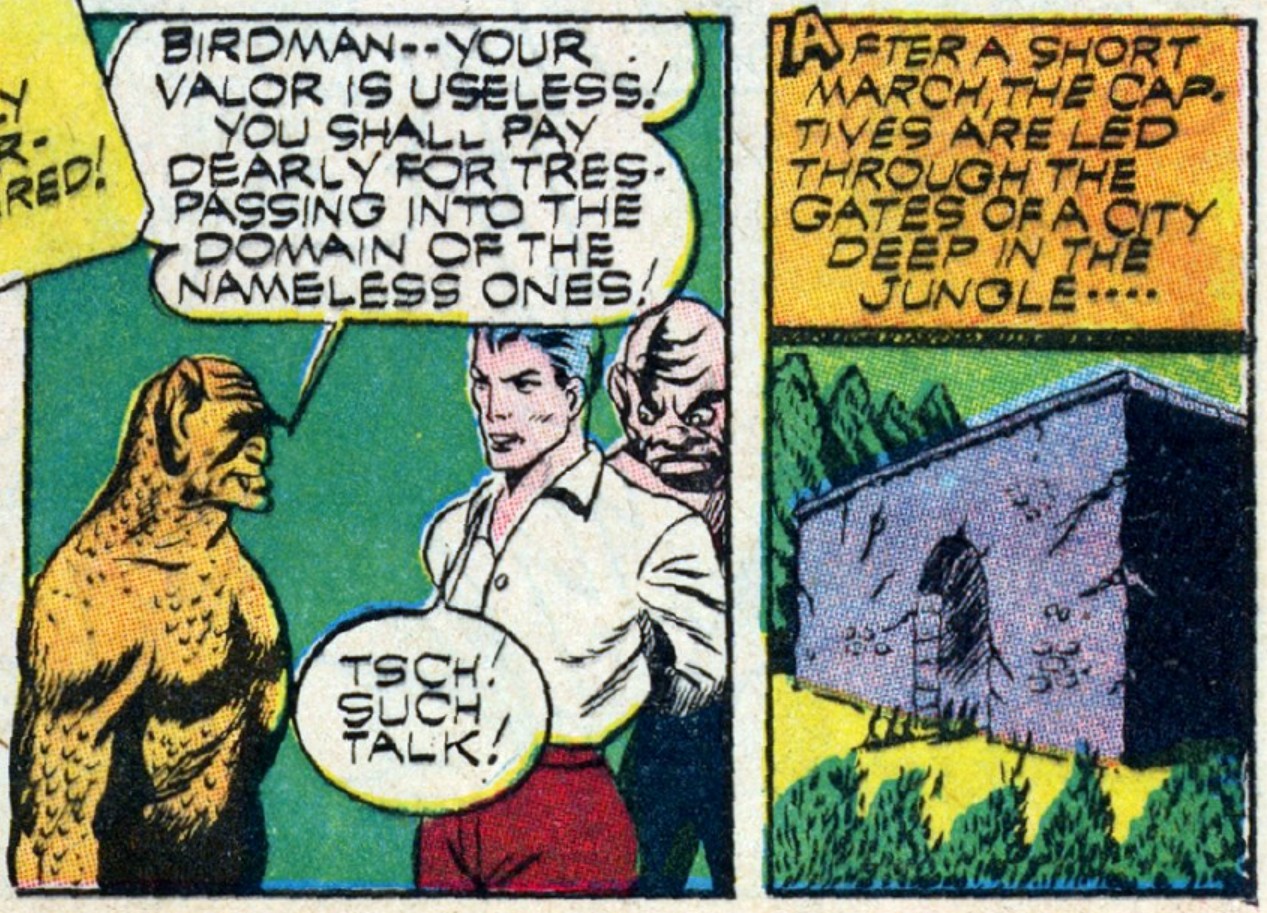
    the Nameless Ones: 

    “The Bingham Boys” was a short-lived feature about twin brothers Billy and Bobby Bingham and their dipshit friend Specs inserting themselves into the life of adventurer Dusty Travis. I their first appearance, the trio tag along on what turns out to be a flight to Mato Grosso, Brazil to search for a clue to the fate of lost Atlantis, for some reason.

    Dusty’s plane crashes thanks to Specs just randomly pushing buttons (I didn’t call him a dipshit for no reason) and the group are quickly set upon and captured by a group of morphologicaly-diverse beings called the Nameless Ones. In a tremendous display of both good and bad luck, the Nameless Ones’ leader – called the Oligarch – confirms that they are the descendants of Atlantis that the four are seeking, but also indicates that they will immediately be sacrificed.

    The Bingham Boys et al cannot be contained by a bunch of scaly weirdos, of course, and once they fight their way free it is time to learn the connection between Atlantis and this extremely inland city, right? WRONG, SUCKA. The Oligarch of the Nameless Ones is extremely serious about the “secret” part of “the secret of the Nameless Ones and Atlantis” and blows up the city rather than giving either Dusty Travis or the reader any kind of satisfaction. (Silver Streak Comics 015, 1941)

    Goors:

    Diver Kinks Mason is testing out a new diving apparatus when a rogue current drags him into an underwater cavern willed with the wreckage of lost ships. There, he encounters two battling groups of aquatic humanoids: the fish-eyed Goors and the conventionally-attractive Proconos.

    Kinks throws in with the Proconos due to the one-two punch of them being led by a hot lady and then telling him that the Goors are evil slavers. We can only hope that they were telling the truth because he proceeds to lead them in an attack that wipes the Goor city off the sub-oceanic map. Using war beasts that look like a cross between a plesiosaur and a duck, to boot! (Fight Comics 001, 1940)

    Grangonians: 

    Space adventurer Flint Baker and his reporter pal Mimi Wilson are noodling around in space one day when they happen upon an old worn-out planet full of immortal old people. These are not the Grangonians but a completely and annoyingly unnamed group. The Grangonians show up later, don’t worry.

    These old aliens have a problem: they discovered the secret to immortality too late and now they are trapped on an old planet. This reflects a kind of… folk belief?… that you get in old science fiction and especially in old science fiction comics, that planets have a sort of life cycle that starts out all swampy and primitive and covered in dinosaurs and ends in dusty ruins. If you’ve encountered this at all it’s probably in the notion of Venus being a younger and thus wetter planet than Earth that continues to crop up in comics into at least the early Sixties.


    Flint and Mimi transport the old aliens to a newly-discovered solar system full of young, vibrant planets, and sure enough they become young aliens as soon as they step foot on the surface of their new home. This is when the Grangonians come in, as their planet (Grango, natch) has been hit by a meteor and they also want to relocate to Planet Dinosaur. Though the Grangonians have more in the way of overt firepower, a combination of dinosaur attacks, old alien technology and Flint Baker’s heroic antics eventually drives them off.

    Both the Grangonians and the old aliens are essentially just regular humans, and while the notion that intelligent life basically looks the same wherever it evolves isn’t exclusive to the “planetary ages” style of sci-fi, it does usually go hand-in-hand with it – just as planets have a life-cycle, so too does the life on them emerge in predictable forms. (Planet Comics 005, 1940)

    Timid Giants:

    The Timid Giants are very appropriately found on the Planet of Timid Giants, where they just kind of keep to themselves. The planet very briefly sees some drama as a group of space explorers are terrified by the Giants’ size, but some light bullying by the Red Comet is sufficient to demonstrate how harmless the aliens are.

    The real threat on the planet are the Stickers, ant-sized aliens who live to torment the Giants and are all too happy to move on to human targets, including a shrunken Red Comet. The Stickers suck. I hate them and their weird cartoon baby faces.

    It turns out that the one thing that can spur the Timid Giants into action is a threat to the life of another, and so one of them eats the Stickers to save the Red Comet. This results in a sequence in which the Comet in turn has to fly his shrunken spaceship inside the giant to save him from being stuck internally, after which he fumigates the entire planet, and while I must still morally be against murdering an entire intelligent species by god do the Stickers make it hard. (Planet Comics 007, 1940) 

  • ALIENS AND SO FORTH ROUND-UP 030

    Luvverly aliens and so forth for ye today, guv.

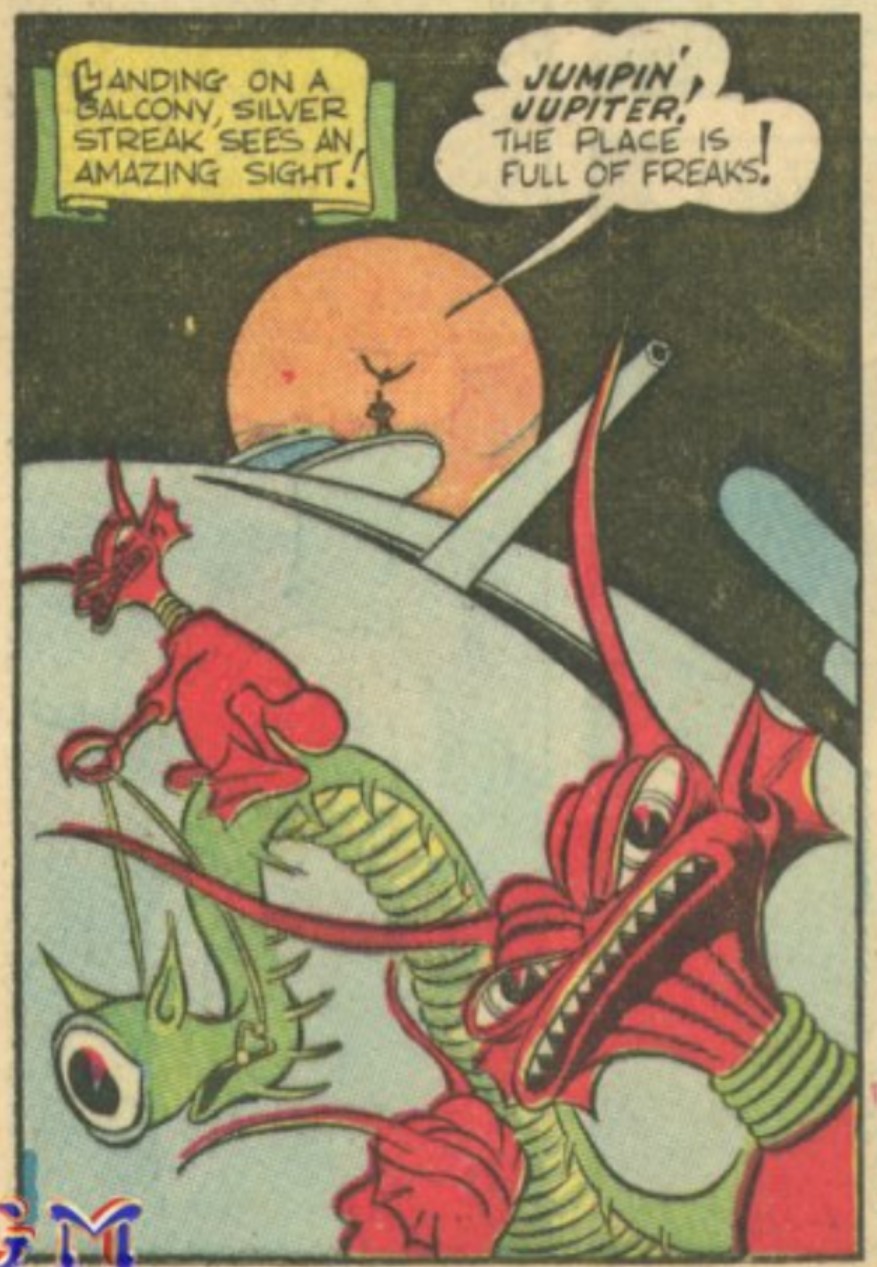
    the Freaks: 

    Silver Streak, investigating a series of mysterious murders, follows a lead to the aptly-named Fantasy Isle in the Pacific Ocean. 

    The inhabitants of Fantasy Isle probably don’t refer to themselves as “the Freaks” but as that is the only thing that they are called in-story I suppose that we must go with it. They are a heterogeneous collection of humanoid who have isolated themselves from the world, presumably due to the threat of persecution, which would make them fairly sympathetic characters if a) they didn’t routinely sink passing ships and imprison their crew in deep dank dungeons, and b) their king didn’t respond to the threat of exposure by attempting to destroy the entirety of North America.

    As so often happens when a nonhuman group threatens the lives of a human one, the Silver Streak’s solution involves mass murder, in this case by dumping the entire population into the ocean. One can only hope that a few of them made it, for anti-genocide reasons.

    It’s hard to tell if the Freaks are supposed to be one species with several different morphologies or several different small populations banding together for mutual benefit. Either way, there are a few recurring types. From top to bottom we have: imp type, weird bird man type, tentacle man type and suction cup lizard man type. The king and that three-eyed guy seem to be unique, but maybe there are more of them lurking around in the shadows. (Silver Streak Comics 007, 1941) 

    Gargantuans:

    The Gargantuans are military expansionists who you expect to be big but are in fact regular sized. Instead, they are at or close to the maximum number of facial affectations that an alien species can have, including green skin covered in little spines, antennae, big pointy ears, fangs, a skeleton nose, satanic eyebrows and in the case of their leader Lobar a matching goatee and mustache.

    The Gargantuans come very close to destroying Earth’s space fleet and turning the planet into a military base, until Lobar makes the mistake of bringing Cosmic Carson onto his flagship and getting within reach of his Earthman fists. (Big 3 001, 1940) 

    Mercurians:

    The Red Panther is helping his pal Toni Beltan test her orbital Stratoplane when it goes haywire and rockets them to Mercury. There, they encounter two types of Mercurians: the Giant Mercurians, who wear cool heat-resistant armour that kind of makes them look like beetles and are enslaved by the Surface Mercurians, big-headed imps who are led by a fellow named Kogh and are frankly assholes.

    Kogh has the Red Panther and Toni tossed in a hole to be devoured by the giant bats of Sub-Mercury, only to unexpectedly benefit when the bats all end up dead at the barrel of the Panther’s Atomic converter, thus opening the riches of the underground to exploitation by the resource-poor Surface Mercurians. To his credit, Kogh then has enough grace to allow the duo to return home. (Jungle Comics 010, 1940)

    Giants:

    One of the lost sci-fi tropes is that of the typical kind of humanoid life that you’d find on each planet of the Solar System. Mercury is hot so you get fire guys or other heat-adapted species there; Venus is either a giant swamp or a “primitive” planet so you get a lot of semi-aquatic lizard guys there etc etc. This is all to say that you don’t get ’em any more but because Jupiter is a great big planet one of the standard kinds of Jovians you would see in sci-fi is the giant humanoid, like these fellows, who are conveniently and simply called Giants.

    Golo, ruler of the Giants, has succumbed to arrogance and issued a challenge to the rest of the Solar System to meet his Giant army in personal combat, seemingly as a precursor to a campaign of wholesale conquest. His challenge is met by the Red Comet, who, despite Golo’s initial disbelief, is able to employ his nigh-limitless power to grow extra-huge and lay waste to the Giant forces.

    Golo himself gets away pretty lightly with a mere bop on the snoot for his hubris. Hopefully the hundreds of dead soldiers outside of his palace are enough of a lesson in humility to curb his warlike instincts in the future. (Planet Comics 003, 1940)

  • ALIENS AND SO FORTH ROUND-UP 030

    ALIENS AND SO FORTH ROUND-UP 030

    Luvverly aliens and so forth for ye today, guv.

    the Freaks: 

    Silver Streak, investigating a series of mysterious murders, follows a lead to the aptly-named Fantasy Isle in the Pacific Ocean. 

    The inhabitants of Fantasy Isle probably don’t refer to themselves as “the Freaks” but as that is the only thing that they are called in-story I suppose that we must go with it. They are a heterogeneous collection of humanoid who have isolated themselves from the world, presumably due to the threat of persecution, which would make them fairly sympathetic characters if a) they didn’t routinely sink passing ships and imprison their crew in deep dank dungeons, and b) their king didn’t respond to the threat of exposure by attempting to destroy the entirety of North America.

    As so often happens when a nonhuman group threatens the lives of a human one, the Silver Streak’s solution involves mass murder, in this case by dumping the entire population into the ocean. One can only hope that a few of them made it, for anti-genocide reasons.

    It’s hard to tell if the Freaks are supposed to be one species with several different morphologies or several different small populations banding together for mutual benefit. Either way, there are a few recurring types. From top to bottom we have: imp type, weird bird man type, tentacle man type and suction cup lizard man type. The king and that three-eyed guy seem to be unique, but maybe there are more of them lurking around in the shadows. (Silver Streak Comics 007, 1941) 

    Gargantuans:

    The Gargantuans are military expansionists who you expect to be big but are in fact regular sized. Instead, they are at or close to the maximum number of facial affectations that an alien species can have, including green skin covered in little spines, antennae, big pointy ears, fangs, a skeleton nose, satanic eyebrows and in the case of their leader Lobar a matching goatee and mustache.

    The Gargantuans come very close to destroying Earth’s space fleet and turning the planet into a military base, until Lobar makes the mistake of bringing Cosmic Carson onto his flagship and getting within reach of his Earthman fists. (Big 3 001, 1940) 

    Mercurians:

    The Red Panther is helping his pal Toni Beltan test her orbital Stratoplane when it goes haywire and rockets them to Mercury. There, they encounter two types of Mercurians: the Giant Mercurians, who wear cool heat-resistant armour that kind of makes them look like beetles and are enslaved by the Surface Mercurians, big-headed imps who are led by a fellow named Kogh and are frankly assholes.

    Kogh has the Red Panther and Toni tossed in a hole to be devoured by the giant bats of Sub-Mercury, only to unexpectedly benefit when the bats all end up dead at the barrel of the Panther’s Atomic converter, thus opening the riches of the underground to exploitation by the resource-poor Surface Mercurians. To his credit, Kogh then has enough grace to allow the duo to return home. (Jungle Comics 010, 1940)

    Giants:

    One of the lost sci-fi tropes is that of the typical kind of humanoid life that you’d find on each planet of the Solar System. Mercury is hot so you get fire guys or other heat-adapted species there; Venus is either a giant swamp or a “primitive” planet so you get a lot of semi-aquatic lizard guys there etc etc. This is all to say that you don’t get ’em any more but because Jupiter is a great big planet one of the standard kinds of Jovians you would see in sci-fi is the giant humanoid, like these fellows, who are conveniently and simply called Giants.

    Golo, ruler of the Giants, has succumbed to arrogance and issued a challenge to the rest of the Solar System to meet his Giant army in personal combat, seemingly as a precursor to a campaign of wholesale conquest. His challenge is met by the Red Comet, who, despite Golo’s initial disbelief, is able to employ his nigh-limitless power to grow extra-huge and lay waste to the Giant forces.

    Golo himself gets away pretty lightly with a mere bop on the snoot for his hubris. Hopefully the hundreds of dead soldiers outside of his palace are enough of a lesson in humility to curb his warlike instincts in the future. (Planet Comics 003, 1940)

  • ALIENS AND SO FORTH ROUND-UP 017

    A panoply of wonders awaits.

    Karnak’s Slaves: 

    This otherwise-unnamed race from an unnamed planet get a pretty raw deal: conquered and mind-controlled into servitude by scientist Karnak, they all seemingly die when he does. It’s a real shame. (Weird Comics 007, 1940) 

    the Deadly Plants: 

    It’s hard to say much about the so-called “Deadly Plants” of planet Vegeto, aside from the fact that they work together to capture a handful of prospective human colonists and dump them in a pit, and that for this act of moderate aggression the Red Comet dumps the entire termite population of Earth on them, seemingly wiping out their entire species. This is what we call “disproportionate response” but is in perfect keeping with the 1940s (and beyond!) view of the relative value of human life vs all other life. (Planet Comics 004, 1940)

    Dhakka Snail-Men: 

    Every undersea race in comics needs a selection of other undersea races to have conflict with, and Neptina’s Fish-Men are no exception. They are menaced by the Dhakkas, aka the Snail-Men, led by Prince Petor, who attempts to invade the territories of Amloza for no stated reason – I guess that’s just what you do when you have an army and an abyssal plain to march across. Unfortunately for Petor and his ambitions, Neptina and the Fish-Men are backed up by Brad Fletcher and his Super-Sub, which are enough to decisively turn the tide. 

    The Snail-Men also might be some of the least like their namesake of any of the [animal]-Men we have yet encountered. They ride snails, sure, but about the only thing that they themselves have in common with snails are some pretty modest eyestalks. (Champion Comics 009, 1940)

    Dragon-Lizard Men: 

    Encountered by detective Fu Chang as he searches for treasure on fabled Money Pit Island, the Dragon-Lizard Men are not so much guardians as obstacles on the way to wealth. The most remarkable thing about them is that if they are as Fu Chang asserts descended from the “lizard and dragons” left on the island by the treasure-burying pirates they managed to not only evolve into fully humanoid forms but also enough of a sense of shame to wear briefs over their mysterious lizard and/or dragon genitals. Nature is really amazing. (Pep Comics 009, 1940)

  • MINOR SUPER-HERO ROUND-UP 034

    Here they are! Some guys you’ve never heard of!

    the Press Guardian: 

    In the Press Guardian’s first outing he is known as the Falcon, but he has the same core mission as he will throughout his career: to clean up crime in Central City via the free press, even if he must do so in a pretty bad costume. A fair few places online list reporter Flash Calvert as the Falcon’s secret identity but this is one of your classic reading comprehension/ research tests: it certainly seems like Calvert is the Falcon right up to the last third of the story, in which they start appearing in the same panels as one another. Thus, a claim that Calvert is the Falcon means that the claimant either skimmed the story in question or is taking the word of another who did so.

    By Pep Comics 002, the Falcon has officially changed his name to the Press Guardian and traded in his Victorian daredevil costume for a classic suit-and-mask combo. His identity is also revealed as Perry Chase, society columnist and universally derided failson of the publisher of the Daily Express. As with a lot of Golden Age heroes the necessity for your secret identity to be the subject of scorn is not really explained – surely the same effect could be achieved by faking a limp or something and then people wouldn’t constantly be insulting you to your face.

    But the papes must go through, and the majority of the Press Guardians adventures have a hand in ensuring that they do, if only tangentially. (Pep Comics 001, 1940)

    Auro, Lord of Jupiter:

    Before Auro was lord of anything he was just some kid with the last name Hardwich who was out on a Sunday space drive with his family when all of a sudden things went wrong and the family space car crashed into the solid, non-gaseous, habitable surface of the planet Jupiter. There, the now-orphaned boy is raised by a Jovian tiger, becomes extra beefy in the high gravity environment, and rises to a position of leadership in the nearby tribe of “Jupiter Brutes,” who name him Auro, meaning “Unconquerable”.

    All this is pretty standard jungle orphan, white guy exceptionalism stuff and I’m sure that one could make a pretty good case for it being just as unpleasant a series of tropes even when divorced from any real-world peoples etc, but what I must focus on is the fact that when you put a jungle guy in space he becomes a space barbarian and is actually pretty entertaining to read. (Planet Comics 001, 1940)

    the Red Comet:

    Speaking of taking character tropes from one comic genre and putting them in another, here’s the Red Comet! Like his fellow Fiction House hero the Red Panther, the Red Comet brings super-hero style to a non-super-heroic world, or worlds in this case, as he beetles around the cosmos righting wrongs.

    The Red Comet’s main trick involves shrinking and growing at will, but over time he demonstrates a wide range of situationally useful abilities including but not limited to: a crime-in-progress sense, insect communication, invisibility, super strength, the ability to survive in space without PPE, flight and the ability to change the size of others.

    The Red Comet’s ability to change size is initially attributed to advanced technology (an “intra-atomic space adjuster,” natch), while his expanded ability set is generally described as “magic.” Then, in Planet Comics 009, he is on a dinner date and explains that he got his size control abilities when he was struck by “some outer space force,” which gives him a more traditional super-hero origin. No word on whether his ability to talk to termites is still magic or as a result of another jolt of cosmic energy. (Planet Comics 001, 1940)

    Tiger Hart of Crossbone Castle:

    Tiger Hart is one of the more obscure Fletcher Hanks characters, a medieval warrior who spends his sole recorded adventure seeking the Great Solinoor Diamond (time for a Real Folk entry for the Koh-i-noor, I suppose) in order to free Queen Hilda from the clutches of the bandit chieftain Turk-the-Terrible. 

    All pretty standard sword and sorcery stuff but, presumably in deference to the fact that the story was being published in Planet Comics, it all takes place on the planet Saturn. This raises many questions! Are Tiger Hart et al Saturnians? Are they from a far enough future that humans have colonized Saturn (and the habitability of Saturn must be taken as a given, alas) and then gone through a societal collapse of some kind, a Dark Age and now a medieval-style era? Or, as the only real reference to Saturn is that the Solinoor is from Saturn, is the story set on a far-future retromedieval Earth? Many things to ponder. (Planet Comics 002, 1940)