The Curse of Skeleton Munroe

Category: Ray

  • MINOR SUPER-VILLAIN 755: STRADIVOUS

    MINOR SUPER-VILLAIN 755: STRADIVOUS

    (Smash Comics 017, 1940)

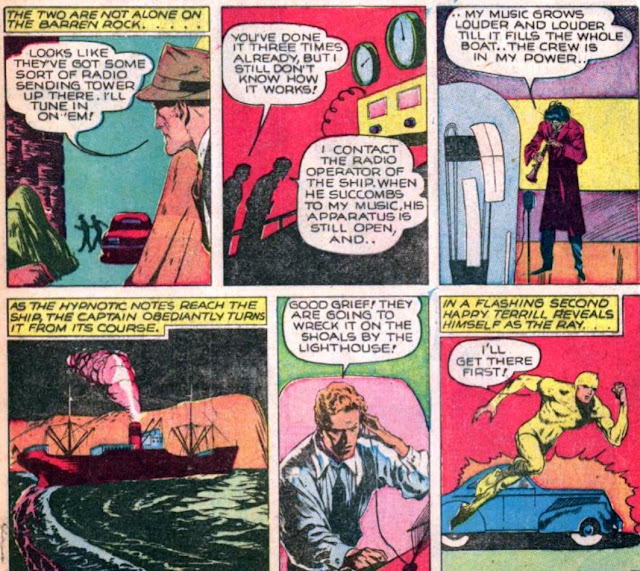
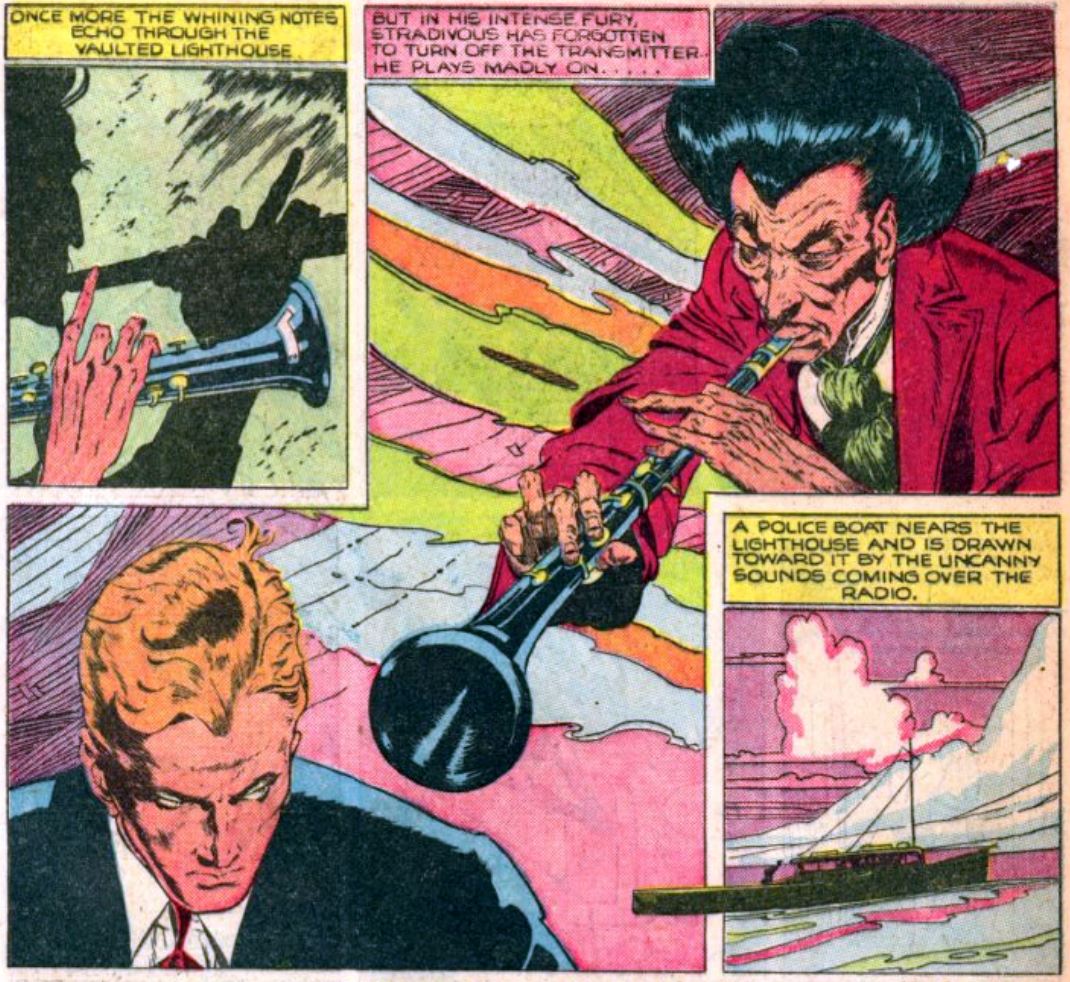
    There are a lot of comic book characters who derive their powers from or express them through music, but Stradivous here is the only one I know of who does so using a clarinet. This is going to be huge if we ever want to draft an all-star comics orchestra someday. He also has a really terrific look, with an eccentric choice in every single aspect of his head and facial hair – I’ll even grudgingly admit that he pulls off a fu manchu, traditionally my least favourite mustache.

    Like many other super musicians, Stradivous specializes in mind control: he can make the people dance and caper as he pleases with but a toot.

    More importantly to the plot, Stradivous can also enthrall the entire crew of a ship by broadcasting his music over the radio, and he and his employer Dock Commissioner Jennings have been doing just that from a nearby lighthouse. Jennings gets the info on valuable incoming shipments and Stradivous wrecks the ships and then the gather up the loot.

    The Ray is of course none too happy about all of this wanton wrecking and looting and steps in to put a stop to it. He approaches as Happy Terrill for some reason, and is thus vulnerable to Stradivous’ hypnotic music. This doesn’t stop Happy/the Ray for long, of course, but as he proceeds to beat the ass of every goon in the lighthouse a secondary drama plays out: two cops, drawn to the island by the hypnotic broadcast, spot Jennings and Stradivous fleeing the scene and summarily execute them for running. It’s like a dog with a ball – if they see someone moving fast enough they just can’t help themself.

  • MINOR SUPER-VILLAIN 755: STRADIVOUS

    (Smash Comics 017, 1940)

    There are a lot of comic book characters who derive their powers from or express them through music, but Stradivous here is the only one I know of who does so using a clarinet. This is going to be huge if we ever want to draft an all-star comics orchestra someday. He also has a really terrific look, with an eccentric choice in every single aspect of his head and facial hair – I’ll even grudgingly admit that he pulls off a fu manchu, traditionally my least favourite mustache.

    Like many other super musicians, Stradivous specializes in mind control: he can make the people dance and caper as he pleases with but a toot.

    More importantly to the plot, Stradivous can also enthrall the entire crew of a ship by broadcasting his music over the radio, and he and his employer Dock Commissioner Jennings have been doing just that from a nearby lighthouse. Jennings gets the info on valuable incoming shipments and Stradivous wrecks the ships and then the gather up the loot.

    The Ray is of course none too happy about all of this wanton wrecking and looting and steps in to put a stop to it. He approaches as Happy Terrill for some reason, and is thus vulnerable to Stradivous’ hypnotic music. This doesn’t stop Happy/the Ray for long, of course, but as he proceeds to beat the ass of every goon in the lighthouse a secondary drama plays out: two cops, drawn to the island by the hypnotic broadcast, spot Jennings and Stradivous fleeing the scene and summarily execute them for running. It’s like a dog with a ball – if they see someone moving fast enough they just can’t help themself.

  • MINOR SUPER-VILLAIN 754: BELA JAT

    (Smash Comics 016, 1940)

    It’s a classic setup: the embittered villain is released from prison and swears vengeance on those who put them there. In this case, the recently released figure is the mystic Bela Jat, who has just spent seven years behind bars for killing someone in a magical experiment and is mighty unhappy about it. Joining him are his excellently named and very loyal henchmen Shimego and Gar.

    Jat sets out to capture and kill the three men who he blames for his incarceration: the police commissioner who captured him back when he was a mere detective, the district attorney who prosecuted him and the judge who handed down the sentence. He does this by the simple expedient of anonymously gifting each with a carved wooden idol containing “ecto-fluid” that Jat is able to animate into a human form via some sort of astral projection, whereupon he simply hauls them back to his underground lair.

    This seems like a good place to raise an important consideration: Bela Jat clearly has real, working magical powers, and thus Detective Healy’s testimony above about seeing him “transform the victim’s body to a grayish fluid” is presumably truthful, but… so what? Like, legally, so what? I can absolutely see a mature super-hero universe like the present-day Marvel or DC ones having legal precedent covering the use of magic, but Bela Jat must have had a terrible lawyer if they didn’t raise the question of how exactly he was responsible for this transformation, like, provably. And that’s ignoring Jat’s assertion that police interference is what caused the victim’s death! Given these considerations, we must conclude that Bela Jat acted as his own lawyer.

    Legalities aside, Jat manages to get ahold of the commissioner and the DA before the Ray gets involved and prevents his kidnapping of the judge. Showing unusual adaptability, he decides to forego the satisfaction of a triple revenge murder in favour of the more achievable double kill now followed by a single when it’s convenient.

    But before Jat can actually murder the two to completion the Ray shows up again and spoils everything: Gar and Shimego get their blocks knocked off, the prisoners get released before Jat’s deathtrap can take effect and one of them (Police Commissioner Healy) gets to show off his skill at knife throwing by planting one in Bela Jat’s back. 

    JUDGE AND JURY REVENGE KILLER SCORE: 0/3 – that’s right friends: Bela Jat is one of the worst to ever do it.

  • MINOR SUPER-VILLAIN 752: CADAVA

    (Smash Comics 015, 1940)

    As we meet Cadava, he is all dressed up and off to attend a costume party, with some pretty harsh words and feeling for humanity in general and a lady named Diane in particular – seems that he has been shunned and rejected after some sort of accident. Also his little friend Soo Choo is there.

    Also in attendance – in his super-hero costume, no less! –  is the Ray, and luckily for Diane he is a naturally nosy guy. He sees the knight kidnapping her while creeping on random conversations (I assume) and while he doesn’t quite manage to prevent it, he is now on the case.

    Back in Cadava’s sewer lair, he reveals his identity to Diane, causing her to faint and effectively removing her from the story. This is a real shame, because Diane was really our major potential source of information on Cadava’s whole deal. Is he a man who has been so hurt by circumstance and an uncaring world that he is lashing out like the Ugliest Man in the World, or was he always just a jerk? Regardless, I think that we can all agree that his decision to smash up what is probably NYC with some sort of earthquake ray is an unnecessary escalation.

    Cadava and Soo Choo manage to put in a pretty good showing against the Ray, considering the fact that they are two regular guys facing off against a man made of light, but ultimately he just up and drowns them both. He who lives by the sewer dies by the sewer, as they say.

  • MINOR SUPER-HERO ROUND-UP 042

    Boys! Boys! Boys! Super powered boys!

    Magno: 

    Magno, aka the Miracle Man, aka the Magnetic Man, aka Tom Dalton, was a power line worker who died when he was shocked with 10 000 volts DC and then revived when he was shocked again with 10 000 volts AC. As a result, Dalton developed electromagnetic powers that he used to fly, simulate super strength when dealing with metal and create magnetic force fields. Not a bad deal.

    Magno’s Golden Age career was short and fairly undistinguished, and his main claim to fame is being the only one of the old Quality heroes to be killed off by Roy Thomas in All-Star Squadron to never be brought back (Magno’s look also reminds me of Jericho of the Teen Titans for some reason, but that’s hardly another claim to fame). (Smash Comics 013, 1940)

    the Ray: 

    I had a couple of issues of The Ray comics from the early 90s when I was younger and so have a tendency to think of the Ray as being a far more prominent character than he actually is – he’s got to be fourth-tier at best, really (assuming that top-tier characters are the ones that everyone knows, your Batmans and Supermans, and second-tier are the ones that even a casual comics reader would consider essential. Third-tier and below is where you get into debating territory).

    Regardless of his level of prominence, the Ray is actually Happy Terrill, a devil-may-care young reporter who signs on as crew in a balloon trip to the upper atmosphere and is… empowered? When he ventures out into a cosmic storm to secure some essential safety equipment. Honestly, as presented on the page Terrill could be assumed to have been replaced with some sort of cosmic entity but maybe I’m the only one who thinks that because it certainly isn’t reflected in subsequent Ray lore.

    Cosmic entity posing as human or no, the Ray is endowed with a startling array of powers, including at least partial invulnerability, the ability to become and travel along light, giant growth, a healing touch, light projection and telekinetic rays. At first, anyway – after a couple of issues he adopts more of a two-fisted adventurer persona whose main power is the ability to change between Happy Terrill and Ray identities and who occasionally remembers that he can fly and shoot rays of light at people.

    A fairly consistent thing that I’ve noticed in depictions of the Ray post-Golden Age is a tendency to portray him as a very dour and serious guy, which seems a disservice to someone with the nickname “Happy.” I suppose I must give it to those later scribes in that the Ray himself almost discards his Happy Terrill identity in his first adventure before eventually coming to his senses. Neither the reason for resuming life as Happy nor the process by which he explained how he made his way back from the upper atmosphere is shown on-panel, but I have to assume that being a super-hero 24/7 just gets boring after a while and he wanted to have a bit of a break. (Smash Comics 014, 1940)

    Master Man: 

    Master Man starts out as a weedy little kid, too small to play, who is gifted a magic vitamin pill by a kindly doctor and becomes incredibly powerful adult man. It’s all there on his one-page introduction, but what’s missing is one important detail: is this a gradual process like the Champ’s origin, where he takes the vitamin every day and grows up big and strong, or did this little kid instantly transmogrify into a grown man, like a permanent Captain Marvel? I suppose that if Master Man really is a little kid in a man’s body it would explain why his first act is to build a cool clubhouse on top of a mountain, presumably containing lots of slides and fireman poles instead of stairs. 

    Being a Fawcett Comics character, Master Man is technically owned by DC Comics now, though they haven’t yet bothered to trot him out of retirement, possibly because of his name, which sounds fascist enough that Marvel Comics has several full-fledged Nazi characters that use it. He would be an interesting character to use as a foil for Superman, since his powers are magic-based, but Captain Marvel does usually fill that role so we’re unlikely to get a Master Man revival any time soon. (Master Comics 001, 1940)

    El Carim:

    One more crime-fighting-stage-magician-with-actual-magical-powers for the pile, El Carim (“miracle” backwards, as the caption box is at some pains to inform you at the start of every story) also subscribes to the same tuxedo and thin black mustache school of fashion as his contemporary Zatara, though the turban does make it easy to tell the two apart.

    What sets El Carim apart from his contemporaries early on is the fact that his crime fighting is done with a series of magical items rather than with magical spells. He has a magical monocle that can deflect bullets (in what must be a very alarming manner, visually) and project illusions and which can be combined with a device called the Spectograph to scry distant locations. In addition, he has a super powerful magnet capable of plucking bullets from the air (useful for when he already has a headache from bouncing a few off of his eye, perhaps) and the Arrestor, which is able to freeze others in place, even against the pull of gravity.

    Over time, El Carim starts slinging spells in a way more in line with the other magic men of comics, and I personally reckon that that’s why he has languished in relative obscurity since the 1940s (other than an appearance in a 2016 issue of Scooby-Doo Team-Up, that is), as without that hook he is not appreciably different from any of his peers. (Master Comics 001, 1940)
  • MINOR SUPER-HERO ROUND-UP 042

    Boys! Boys! Boys! Super powered boys!

    Magno: 

    Magno, aka the Miracle Man, aka the Magnetic Man, aka Tom Dalton, was a power line worker who died when he was shocked with 10 000 volts DC and then revived when he was shocked again with 10 000 volts AC. As a result, Dalton developed electromagnetic powers that he used to fly, simulate super strength when dealing with metal and create magnetic force fields. Not a bad deal.

    Magno’s Golden Age career was short and fairly undistinguished, and his main claim to fame is being the only one of the old Quality heroes to be killed off by Roy Thomas in All-Star Squadron to never be brought back (Magno’s look also reminds me of Jericho of the Teen Titans for some reason, but that’s hardly another claim to fame). (Smash Comics 013, 1940)

    the Ray: 

    I had a couple of issues of The Ray comics from the early 90s when I was younger and so have a tendency to think of the Ray as being a far more prominent character than he actually is – he’s got to be fourth-tier at best, really (assuming that top-tier characters are the ones that everyone knows, your Batmans and Supermans, and second-tier are the ones that even a casual comics reader would consider essential. Third-tier and below is where you get into debating territory).

    Regardless of his level of prominence, the Ray is actually Happy Terrill, a devil-may-care young reporter who signs on as crew in a balloon trip to the upper atmosphere and is… empowered? When he ventures out into a cosmic storm to secure some essential safety equipment. Honestly, as presented on the page Terrill could be assumed to have been replaced with some sort of cosmic entity but maybe I’m the only one who thinks that because it certainly isn’t reflected in subsequent Ray lore.

    Cosmic entity posing as human or no, the Ray is endowed with a startling array of powers, including at least partial invulnerability, the ability to become and travel along light, giant growth, a healing touch, light projection and telekinetic rays. At first, anyway – after a couple of issues he adopts more of a two-fisted adventurer persona whose main power is the ability to change between Happy Terrill and Ray identities and who occasionally remembers that he can fly and shoot rays of light at people.

    A fairly consistent thing that I’ve noticed in depictions of the Ray post-Golden Age is a tendency to portray him as a very dour and serious guy, which seems a disservice to someone with the nickname “Happy.” I suppose I must give it to those later scribes in that the Ray himself almost discards his Happy Terrill identity in his first adventure before eventually coming to his senses. Neither the reason for resuming life as Happy nor the process by which he explained how he made his way back from the upper atmosphere is shown on-panel, but I have to assume that being a super-hero 24/7 just gets boring after a while and he wanted to have a bit of a break. (Smash Comics 014, 1940)

    Master Man: 

    Master Man starts out as a weedy little kid, too small to play, who is gifted a magic vitamin pill by a kindly doctor and becomes incredibly powerful adult man. It’s all there on his one-page introduction, but what’s missing is one important detail: is this a gradual process like the Champ’s origin, where he takes the vitamin every day and grows up big and strong, or did this little kid instantly transmogrify into a grown man, like a permanent Captain Marvel? I suppose that if Master Man really is a little kid in a man’s body it would explain why his first act is to build a cool clubhouse on top of a mountain, presumably containing lots of slides and fireman poles instead of stairs. 

    Being a Fawcett Comics character, Master Man is technically owned by DC Comics now, though they haven’t yet bothered to trot him out of retirement, possibly because of his name, which sounds fascist enough that Marvel Comics has several full-fledged Nazi characters that use it. He would be an interesting character to use as a foil for Superman, since his powers are magic-based, but Captain Marvel does usually fill that role so we’re unlikely to get a Master Man revival any time soon. (Master Comics 001, 1940)

    El Carim:

    One more crime-fighting-stage-magician-with-actual-magical-powers for the pile, El Carim (“miracle” backwards, as the caption box is at some pains to inform you at the start of every story) also subscribes to the same tuxedo and thin black mustache school of fashion as his contemporary Zatara, though the turban does make it easy to tell the two apart.

    What sets El Carim apart from his contemporaries early on is the fact that his crime fighting is done with a series of magical items rather than with magical spells. He has a magical monocle that can deflect bullets (in what must be a very alarming manner, visually) and project illusions and which can be combined with a device called the Spectograph to scry distant locations. In addition, he has a super powerful magnet capable of plucking bullets from the air (useful for when he already has a headache from bouncing a few off of his eye, perhaps) and the Arrestor, which is able to freeze others in place, even against the pull of gravity.

    Over time, El Carim starts slinging spells in a way more in line with the other magic men of comics, and I personally reckon that that’s why he has languished in relative obscurity since the 1940s (other than an appearance in a 2016 issue of Scooby-Doo Team-Up, that is), as without that hook he is not appreciably different from any of his peers. (Master Comics 001, 1940)