The Curse of Skeleton Munroe

Category: aliens

  • ALIENS AND SO FORTH ROUND-UP 057

    Can you tell that I’ve hit the “M” portion of my aliens spreadsheet

    Martians:

    These very humanoid Martians have a whole series of problems: 

    1. some heavenly object is due to smash into their planet 

    2. they are bad at science

    3. when they turned to Earth to look for help with their problem the only person they could get to help them was this jerk named Ritton, who intends to cash in his Mars favour for help in taking over Earth 

    4 Ritton doesn’t even have the Super TNT they need to save their civilization, he just knows where to steal it 

    5. the Human Torch is involved and not happy about the way that Ritton and the Martians are handling things

    All this adds up to a long series of misadventures in which the Martians kind of half-ass attempts to steal the Super TNT formula from its creator Carson and then (because they crashed a train on top of Carson and killed him, right out of the gate) his daughter Diane while the Human Torch flies around beating them up.

    The Torch eventually captures Ritton and the Martians offer a mid-level apology for the hundreds of deaths that they have caused while working for him – they had to because the Great One said so! This is good enough for the Torch and Diane and they hand over the Super TNT. Mars is saved! (Marvel Mystery Comics v1 003, 1940)

    Mercurians:

    Rex Dexter of Mars has to operate outside of his sphere of expertise here, because these vile slavers are from Mercury. What’s worse, they haven’t just been capturing regular people to slave for them (we never actually learn just what kind of slavery the Mercurians are into) but have somehow also got ahold of Dexter’s ladyfriend Cynde.

    Though the Mercurian-on-the-street looks like an axe-wielding pig-man, the Mercurian leader Lord Curo and his elite guards all dress like they are in an owl-themed 1960s super-spy organization, possibly called W.H.O. This is very handy for Rex Dexter, who sneaks in after stealing a guard’s outfit and then sneaks all of the slaves out in some more guard outfits acquired in a quick brawl. Once Curo has no more Earth hostages, his city is bombed to dust by the vengeful humans. (Mystery Men Comics 019, 1940)

    Mercurians:

    These Mercurians are very boring white guys, but even boring aliens get acknowledged here. They might just be Earth colonists, though, so view them with mild suspicion. (Planet Comics 007, 1940)

    Mermen:

    The Mermen are an undersea race who work for the non-Merman and big creep Poseida to strip the ruins of the underwater city of Coralla of its riches. It’s possible that they are descended from the people who lived in Coralla before it was ruined, in which case this situation seems pretty galling, but if it bothers the Mermen, they aren’t complaining. Like most nonhuman servant races in comics they seem to have a pretty bad union. 

    It’s possible that the Mermen are related to the Frogmen of Atlantis, a similarly under-unionized aquatic species. (Fantastic Comics 003, 1940)

  • ALIENS AND SO FORTH ROUND-UP 056

    Aliens are just like us if you think about it, man.

    Atlanteans:

    First things first: these are not actually Atlanteans, at least not yet. As far as I can tell, the word “Atlantis” is not employed in any Namor appearance from 1939-1941, and his people are collectively referred to as “Sub-Mariners” just like their prince. We are left with one of our signature Vexing Conundrums: just when do the Sub-Mariners become Atlanteans? Will we find out before we learn the location of Camp Lehigh or before someone says “Keystone City” in print? Only time will tell. 

    Given that they are only later assigned the status of being descended from the humans of old Atlantis (and then unassigned from it if I understand correctly – my interest in Namor has never been great enough that I internalized a lot of his lore), it makes sense that they are much less humanoid than a lot of their peers. They range from being full-on fish-men like Emperor Thakorr to being essentially human-looking but for their huge eyes. And not just human looking, as Namor’s own parentage attests: they can also successfully interbreed with humanity! And it’s a close enough hybridization that he’s not completely infertile, though the fact that he has only one conventionally-conceived child is a bit telling.

    One of the hallmarks of Marvel’s Atlanteans going forward is of course the fact that they all have blue or green skin, which is fun because it appears to have originally been a stylistic choice on the part of Bill Everett to indicate that they were underwater. Frankly I think that it was a good development: I have no desire to see Emperor Thakoor rendered in shades of pale pink. (Marvel Comics 001 1939)

    Balticans:

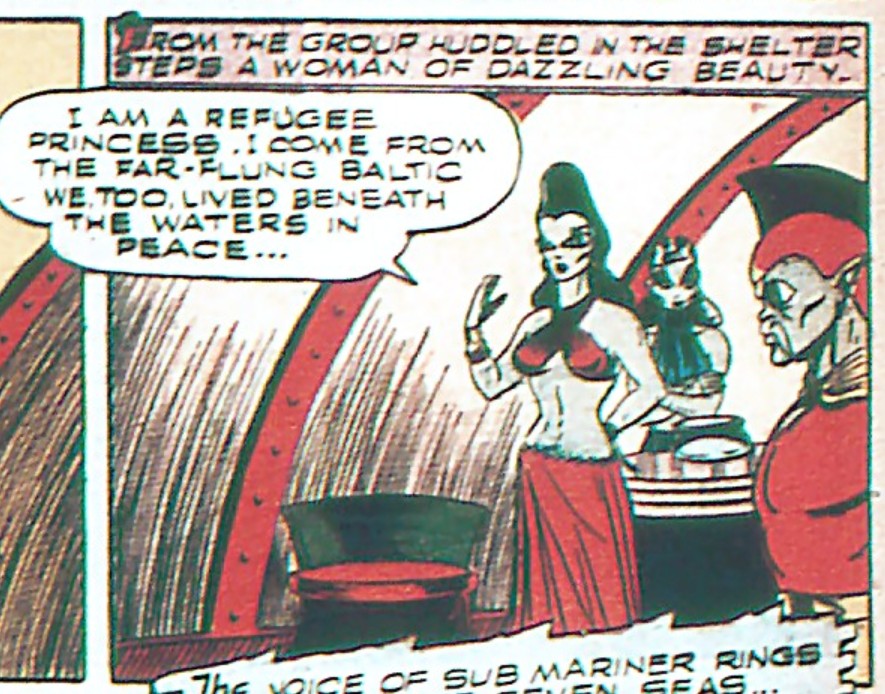
    Represented here by the villainous Rathia, the Balticans are an Atlantean subgroup that live in the Baltic Sea (natch). They might be a different colour than regular Atlanteans, but given the quality of the available scan and the unreliable nature of modern recolouring it is very hard to say for sure. (Human Torch v1 005b, 1941)

    Cygnusians:

    The Cygnusians and their enemies the Draconians are initially set up to star in a little allegorical story about institutionalized racism and the arbitrary nature of warfare, but things get derailed pretty quickly due to the fact that both Queen Luxor of Cygnus and Queen Feros of Draco are women and cheap misogyny laffs are easy. Rock Braddon of the Space Legion ends the war by arranging a queen-on-queen catfight. (Crack Comics 011, 1941) 

    Martians:

    After dealing with all the crazy bullshit that lurks beneath the Earth’s surface in 50032 CE and doing a bit of civilization-rebuilding, Blaze Barton and his romantic/ adventure partner Teddy set out to establish relations with the people of Mars. As they arrive they (and possibly also the Martians) learn that there is a second, bearded population of Martians who live in vast caverns under the planet’s surface and eschew modern technology other than rocket planes and planet-wide smoke screens. These Dark Martians capture Blaze and Teddy in order to hold them for a ransom of lamp oil from an Earth that is probably not equipped to deliver it, given the recent global disasters it has suffered, not to mention the 47 thousand-odd years since the collapse of the whaling industry.

    The main problem with being a low-tech antagonist in a science fiction world is that you are only effective as long as you can keep your opponent off-balance, as the Lord of Martianland learns when he gives Blaze a moment to breathe and finds his men completely outclassed by Blaze’s ray gun and working knowledge of electricity. The king himself is finished off with a low-tech right hook, and his people opt to learn about new and exciting sources of light. (Hit Comics 005, 1940)

  • ALIENS AND SO FORTH ROUND-UP 056

    ALIENS AND SO FORTH ROUND-UP 056

    Aliens are just like us if you think about it, man.

    Atlanteans:

    First things first: these are not actually Atlanteans, at least not yet. As far as I can tell, the word “Atlantis” is not employed in any Namor appearance from 1939-1941, and his people are collectively referred to as “Sub-Mariners” just like their prince. We are left with one of our signature Vexing Conundrums: just when do the Sub-Mariners become Atlanteans? Will we find out before we learn the location of Camp Lehigh or before someone says “Keystone City” in print? Only time will tell. 

    Given that they are only later assigned the status of being descended from the humans of old Atlantis (and then unassigned from it if I understand correctly – my interest in Namor has never been great enough that I internalized a lot of his lore), it makes sense that they are much less humanoid than a lot of their peers. They range from being full-on fish-men like Emperor Thakorr to being essentially human-looking but for their huge eyes. And not just human looking, as Namor’s own parentage attests: they can also successfully interbreed with humanity! And it’s a close enough hybridization that he’s not completely infertile, though the fact that he has only one conventionally-conceived child is a bit telling.

    One of the hallmarks of Marvel’s Atlanteans going forward is of course the fact that they all have blue or green skin, which is fun because it appears to have originally been a stylistic choice on the part of Bill Everett to indicate that they were underwater. Frankly I think that it was a good development: I have no desire to see Emperor Thakoor rendered in shades of pale pink. (Marvel Comics 001 1939)

    Balticans:

    Represented here by the villainous Rathia, the Balticans are an Atlantean subgroup that live in the Baltic Sea (natch). They might be a different colour than regular Atlanteans, but given the quality of the available scan and the unreliable nature of modern recolouring it is very hard to say for sure. (Human Torch v1 005b, 1941)

    Cygnusians:

    The Cygnusians and their enemies the Draconians are initially set up to star in a little allegorical story about institutionalized racism and the arbitrary nature of warfare, but things get derailed pretty quickly due to the fact that both Queen Luxor of Cygnus and Queen Feros of Draco are women and cheap misogyny laffs are easy. Rock Braddon of the Space Legion ends the war by arranging a queen-on-queen catfight. (Crack Comics 011, 1941) 

    Martians:

    After dealing with all the crazy bullshit that lurks beneath the Earth’s surface in 50032 CE and doing a bit of civilization-rebuilding, Blaze Barton and his romantic/ adventure partner Teddy set out to establish relations with the people of Mars. As they arrive they (and possibly also the Martians) learn that there is a second, bearded population of Martians who live in vast caverns under the planet’s surface and eschew modern technology other than rocket planes and planet-wide smoke screens. These Dark Martians capture Blaze and Teddy in order to hold them for a ransom of lamp oil from an Earth that is probably not equipped to deliver it, given the recent global disasters it has suffered, not to mention the 47 thousand-odd years since the collapse of the whaling industry.

    The main problem with being a low-tech antagonist in a science fiction world is that you are only effective as long as you can keep your opponent off-balance, as the Lord of Martianland learns when he gives Blaze a moment to breathe and finds his men completely outclassed by Blaze’s ray gun and working knowledge of electricity. The king himself is finished off with a low-tech right hook, and his people opt to learn about new and exciting sources of light. (Hit Comics 005, 1940)

  • ALIENS AND SO FORTH ROUND-UP 055

    More aliens? Just how many more can there be?

    Fantasans:

    When time/space traveller Whiz Wilson visits Earth of the year 4400 CE, he finds that it is being bombarded by comets originating from the far-off planet Fantasa. Going there with the aid of his trusty Futuroscope, he learns that Molla, the rightful ruler of Fantasa, has been deposed by the wicked Gorano and that Gorano has a fanatical (and unexplained) hatred of humanity that is his reason for the comet attack. One quick Futuroscope-aided counter-coup later and Fantasa is back in more peaceful hands and Earth is safe. (Lightning Comics v2 003, 1941)

    Mercurian Cave-People:

    The very first outer space adventure of the Space Rovers sees them taking an unexpected rocket trip and being forced to make a landing on Mercury to get their bearings. Once they disembark they discover that the fire caused by their landing has been taken as a sign that the local deity (the Fire God, God-Style: Animistic) is angry and demands sacrifice. Ted and Jane pitch in to save the poor sacrifice, and in a rare happy ending for such people she gets to haul ass across the river to marry a dude named Kulu. (Exciting Comics 002, 1940)

    Mercurians of Thian:

    Having ruined the sacrifice, Ted is next up for being burned at the stake, and to make matters worse, Jane is hauled off by a giant bird (which turns out to be called a Mercurian Roc) before she can free him.

    Ted manages to free himself, and the two both end up in the city of Thian, which is populated by a second kind of Mercurian who are possessed of more advanced technology than the Cave-People but who look absolutely terrible. They aren’t even particularly good hosts, as can be seen here when they drug and capture the Star Rovers before the main course arrives.

    And just what is the reason that these Mercurians had for treating their guests so rudely? Because they only live for twenty years and they need people from more long-lived species to study (i.e. vivisect) so that they can live to a somewhat riper old age. 

    Since these particular tests subjects are space heroes, things go poorly from here. Head Scientist Flaedo gets electrocuted, the Star Rovers escape on Roc-back and the Mercurians of Thian hopefully reconsider their commitment to scientific ethics. (Exciting Comics 002, 1940) 

    Mercurians:

    Time adventurer Stuart Taylor and his companions Dr and Laura Hayward encounter this society of possibly human-derived Mercurians when they voyage to the year 4000 in pursuit of a man named Rogro who has stolen Dr Hayward’s time technology. The major difference between Mercurians and humans is the fact that the former all have “synthetic blood” which makes them vulnerable to extreme heat and must be quite inconvenient for someone living on what is generally acknowledge to be a pretty hot planet.

    Though the Mercurian society seems peaceful when they arrive, things go south quickly once Rogro promises the Mercurian king that he can engineer new blood for everyone if he can use the blood inside of Stuart and his friends as raw materials. The time travellers only survive the resulting riots by smashing up the protective dome over the Mercurian city (and note the fact that the writer now says that the Mercurians have a problem with oxygen instead of heat. Why? Who knows). (Jumbo Comics 019, 1940)

  • ALIENS AND SO FORTH ROUND-UP 054

    ALIENS AND SO FORTH ROUND-UP 054

    Comic book aliens: one of the few inexhaustible resources.

    Martians:

    Just as Doc Strong and his followers are starting to get the post-apocalyptic, WWII-lasted-a-century world of 2041 sorted out, a bunch of robot-looking Martians show up to ruin things by invading their territory on the Isle of Right. It’s just one thing after another with that year.

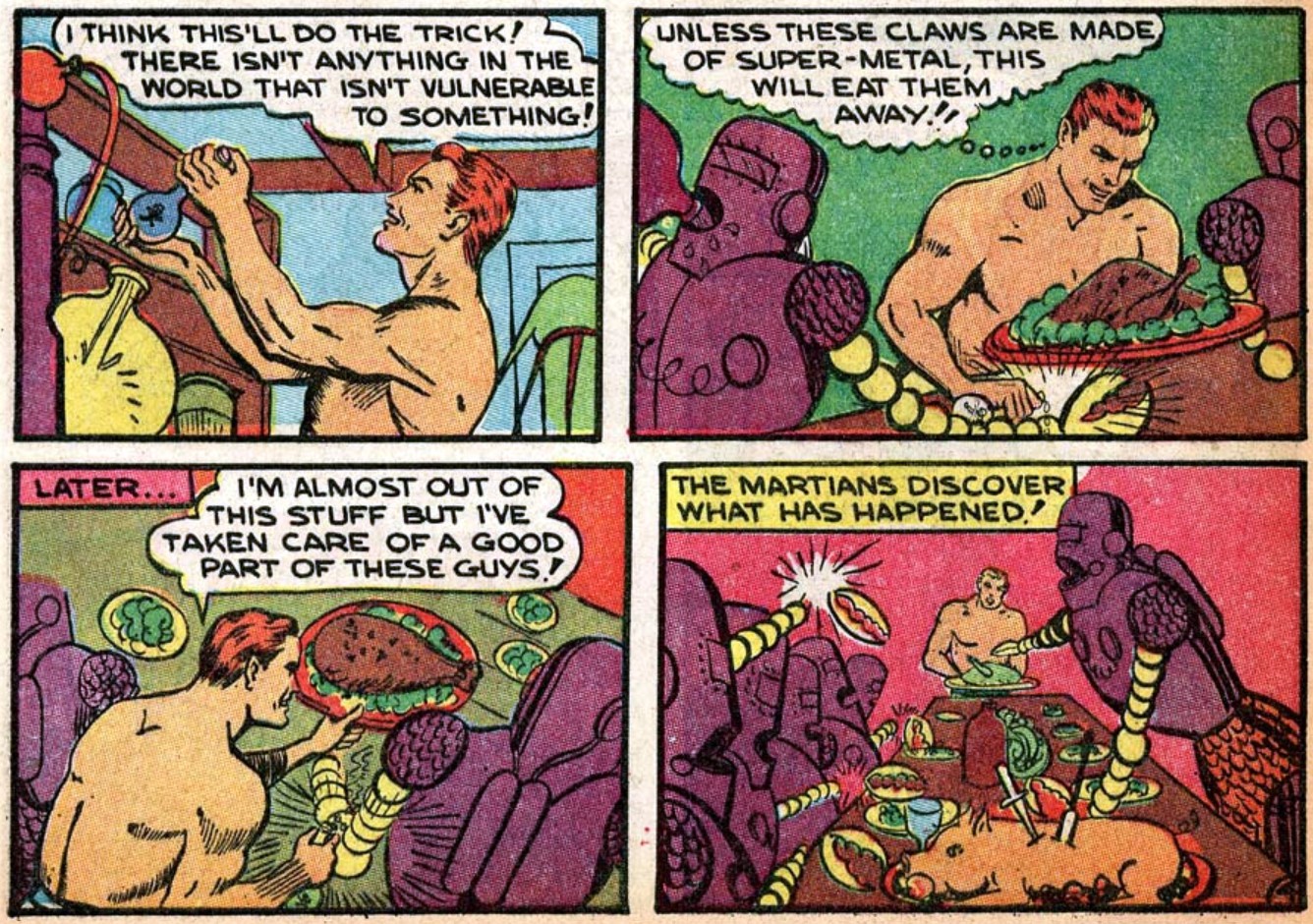
    Though they are fairly generic hostile invaders, these fellows really distinguish themselves among their class by immediately abandoning whatever plans that they had for Earth in order to indulge in a rager of a party. They want meat and they want booze, in that order and plenty of it. And as a bonus, the fact that the colourists at Blue Ribbon never really settled on a consistent colour scheme for these fellows means that the Party Issue is also the issue in which the Martians all look like they are wearing leopardskin briefs.

    Everything works out okay, however. After Doc and his pals are taken back to Mars for judgment by the King of the Martians they learn that he is a mere robot shell built by friendly Earthman Stinky Jones, who is more than happy to lend his subjects’ might to the task of cleaning up the war-ravaged Earth. (Blue Ribbon Comics 007, 1940)

    Masters of the Pit:

    These inhabitants of the Pit of Horrors aren’t given a lot of characterization, seeing as they are acting as more of an extension of Fantomah’s rough justice than as a functioning society. They live in caves underneath the liminal Jungle and can shape stone with a word and a gesture, and that’s all we really get. (Jungle Comics 007, 1940)

    Melubians:

    The interesting thing about planet Melubia is the fact that they use gravity control technology to surround their world with hundreds of small artificial satellites on which are built small cities or individual dwellings. The less interesting thing about Melubia is the fact that there are two intelligent species living on it, one of whom (the Melubians) want to overthrow the rule of the other (the unnamed, more humanoid species headed by King Molat). We never really get a sense of whether this is a colonial situation or if the two groups evolved on Melubia in parallel, but either way, time/space traveller Stuart Taylor and his pals are quick to uphold the established power structure and put down the rebellion. (Jumbo Comics 016, 1940) 

    Mongonians:

    The Mongonians, inhabitants of the planet Mongo (but a different Mongo than the Flash Gordon one) are some cool four-armed aliens with an unfortunate streak of paranoid xenophobia running through their society, as can be seen in their interaction with time/space traveller Whiz Wilson when he visits their planet in the year 2300 CE.

    It may be that the Mongonians are on to something, however, as they are attacked by hostile inhabitants of the planet Zania just after they toss Whiz – along with two hapless explorers from Earth – into their jail. Everything eventually resolves nicely, as the explorers’ spaceship makes an excellent weapon against the relatively fragile ranks of the Zanian Balloon Corps and peaceful Earth/Mongo relations are established. (Lightning Comics v2 001, 1941)

  • ALIENS AND SO FORTH ROUND-UP 053

    Aliens. 

    Molemen:

    These green-skinned humanoids live in an underground kingdom somewhere beneath what was then known as the Belgian Congo. They have been sent to the surface to find some white men – and just why they subscribe to the racial categories of surface humanity is left unexplored – and woe betide any non-white guys who they encounter first.

    The Molemen expedition eventually captures jungle adventurer Congo Jack and returns to the underground with him. Alas, we never quite learn what Queen Moletta of the Molemen wants a white guy for, because her interest in Jack inspires a real crisis in the ambitious expedition leader Sir Lugi and he draws most of the comic’s ongoing focus with a series of attempted coups to seize power for himself. (Lightning Comics v2 001, 1941)

    Blue Dwarfs:

    One of Sir Lugi’s schemes involves him teaming up with the Blue Dwarfs, ancient enemies of the Molemen, to seize the Moleman city by sneak attack.

    The Blue Dwarf victory hinges on the fact that Sir Lugi knocks out Congo Jack in the first couple of minutes of battle. Once he comes to, Jack is able to not only retake the city after exactly one inspiring speech to the Moleman troops, but also slay the Blue Dwarf King Bobo to really drive the victory home. He is then granted his freedom by Queen Moletta. (Lightning Comics v2 002, 1941)

    Martians:

    Meteor Martin, one of the many short-lived Basil Wolverton sc-fi adventurers, is an officer of the Moon Patrol who sallies forth to combat an invading Martian space fleet and finds himself blasted into a strange otherworldly realm. 

    The above is the only actual look we get at the Martians. Is their invasion successful? No idea. I do like their weird Wolvertonian tentacle arms, though.

    Luckily for Martin, he finds himself in the company of fellow humans Rana and her father Romrak, who are able to fill him in on what has happened to him. The Martian weapon he was struck with sends its victims to a “negative world,” implicitly another dimension. Further, the specific region that they are stranded in is a densely-packed cluster of planetoids called Gorikon. (Amazing-Man Comics 025, 1941) 

    Bat Men:

    Gorikon is awash with different lifeforms, though just how many of them are native to the place and how many have been sent there from the positive universe (or are the descendants of positive universe exiles) is unknown. When Meteor first encounters Rana, for example, she has been staked out as a sacrifice for Bat Men. (Amazing-Man Comics 025, 1941)

    Desert Dwellers:

    These excellent humanoid camel people (referred to as “savages” throughout, but that’s a pretty rude thing to refer to an entire people as, so I’ll just go with “dwellers”) are the ones who are attempting to sacrifice Rana to the Bat Men, and if any species in Gorikon is going to get my vote for having actually evolved there it’s them, if only because they have the weak muscles of a people who come from a low-gravity environment. Note how easily Meteor Martin beats them up, after all. (Amazing-Man Comics 025, 1941)

    Assorted Gorikons:

    Romrak and Rana have been residing in a village of interdimensional refugees, most of whom seem to be the same kind of near-human alien as series antagonist Groob here.

    The inhabitants of Groob’s village all seem to be the same kind of four-fingered humanoid as he is, though the presence of one little froggy guy with super-vision in Amazing-Man Comics 026 introduces the possibility of a more diverse cast of alien refugees that we sadly never get to see.

    Please also note the fact that the low gravity and close orbits of the planets of Gorikon means that interplanetary travel is achievable by means of a human cannonball-style cannon (though how Groob intends to return is a mystery to me). (Amazing-Man Comics 025, 1941)

    Insects:

    Meteor, Rana, Romrak and Groob all end up in this quicksand-like trap set by a species referred to as the Insects by the other inhabitants of Gorikon, and true to alien monster convention the Insect who comes to check the trap makes off with Rana rather than one of the men.

    Rana’s fate is to be sacrificed in a pit of fire, though it is Meteor who ends up falling to his doom in the issue’s cliffhanger. Sadly, there is no third Meteor Martin adventure and so we never learn a) how he gets out of it or b) whether these little green guys turn into the big green guy as part of their life-cycle or if he is some sort of distinct creature. I prefer the former! (Amazing-Man Comics 026, 1942)

  • ALIENS AND SO FORTH ROUND-UP 053

    Aliens. 

    Molemen:

    These green-skinned humanoids live in an underground kingdom somewhere beneath what was then known as the Belgian Congo. They have been sent to the surface to find some white men – and just why they subscribe to the racial categories of surface humanity is left unexplored – and woe betide any non-white guys who they encounter first.

    The Molemen expedition eventually captures jungle adventurer Congo Jack and returns to the underground with him. Alas, we never quite learn what Queen Moletta of the Molemen wants a white guy for, because her interest in Jack inspires a real crisis in the ambitious expedition leader Sir Lugi and he draws most of the comic’s ongoing focus with a series of attempted coups to seize power for himself. (Lightning Comics v2 001, 1941)

    Blue Dwarfs:

    One of Sir Lugi’s schemes involves him teaming up with the Blue Dwarfs, ancient enemies of the Molemen, to seize the Moleman city by sneak attack.

    The Blue Dwarf victory hinges on the fact that Sir Lugi knocks out Congo Jack in the first couple of minutes of battle. Once he comes to, Jack is able to not only retake the city after exactly one inspiring speech to the Moleman troops, but also slay the Blue Dwarf King Bobo to really drive the victory home. He is then granted his freedom by Queen Moletta. (Lightning Comics v2 002, 1941)

    Martians:

    Meteor Martin, one of the many short-lived Basil Wolverton sc-fi adventurers, is an officer of the Moon Patrol who sallies forth to combat an invading Martian space fleet and finds himself blasted into a strange otherworldly realm. 

    The above is the only actual look we get at the Martians. Is their invasion successful? No idea. I do like their weird Wolvertonian tentacle arms, though.

    Luckily for Martin, he finds himself in the company of fellow humans Rana and her father Romrak, who are able to fill him in on what has happened to him. The Martian weapon he was struck with sends its victims to a “negative world,” implicitly another dimension. Further, the specific region that they are stranded in is a densely-packed cluster of planetoids called Gorikon. (Amazing-Man Comics 025, 1941) 

    Bat Men:

    Gorikon is awash with different lifeforms, though just how many of them are native to the place and how many have been sent there from the positive universe (or are the descendants of positive universe exiles) is unknown. When Meteor first encounters Rana, for example, she has been staked out as a sacrifice for Bat Men. (Amazing-Man Comics 025, 1941)

    Desert Dwellers:

    These excellent humanoid camel people (referred to as “savages” throughout, but that’s a pretty rude thing to refer to an entire people as, so I’ll just go with “dwellers”) are the ones who are attempting to sacrifice Rana to the Bat Men, and if any species in Gorikon is going to get my vote for having actually evolved there it’s them, if only because they have the weak muscles of a people who come from a low-gravity environment. Note how easily Meteor Martin beats them up, after all. (Amazing-Man Comics 025, 1941)

    Assorted Gorikons:

    Romrak and Rana have been residing in a village of interdimensional refugees, most of whom seem to be the same kind of near-human alien as series antagonist Groob here.

    The inhabitants of Groob’s village all seem to be the same kind of four-fingered humanoid as he is, though the presence of one little froggy guy with super-vision in Amazing-Man Comics 026 introduces the possibility of a more diverse cast of alien refugees that we sadly never get to see.

    Please also note the fact that the low gravity and close orbits of the planets of Gorikon means that interplanetary travel is achievable by means of a human cannonball-style cannon (though how Groob intends to return is a mystery to me). (Amazing-Man Comics 025, 1941)

    Insects:

    Meteor, Rana, Romrak and Groob all end up in this quicksand-like trap set by a species referred to as the Insects by the other inhabitants of Gorikon, and true to alien monster convention the Insect who comes to check the trap makes off with Rana rather than one of the men.

    Rana’s fate is to be sacrificed in a pit of fire, though it is Meteor who ends up falling to his doom in the issue’s cliffhanger. Sadly, there is no third Meteor Martin adventure and so we never learn a) how he gets out of it or b) whether these little green guys turn into the big green guy as part of their life-cycle or if he is some sort of distinct creature. I prefer the former! (Amazing-Man Comics 026, 1942)