The Curse of Skeleton Munroe

Category: vexing conundrum

  • ALIENS AND SO FORTH ROUND-UP 056

    Aliens are just like us if you think about it, man.

    Atlanteans:

    First things first: these are not actually Atlanteans, at least not yet. As far as I can tell, the word “Atlantis” is not employed in any Namor appearance from 1939-1941, and his people are collectively referred to as “Sub-Mariners” just like their prince. We are left with one of our signature Vexing Conundrums: just when do the Sub-Mariners become Atlanteans? Will we find out before we learn the location of Camp Lehigh or before someone says “Keystone City” in print? Only time will tell. 

    Given that they are only later assigned the status of being descended from the humans of old Atlantis (and then unassigned from it if I understand correctly – my interest in Namor has never been great enough that I internalized a lot of his lore), it makes sense that they are much less humanoid than a lot of their peers. They range from being full-on fish-men like Emperor Thakorr to being essentially human-looking but for their huge eyes. And not just human looking, as Namor’s own parentage attests: they can also successfully interbreed with humanity! And it’s a close enough hybridization that he’s not completely infertile, though the fact that he has only one conventionally-conceived child is a bit telling.

    One of the hallmarks of Marvel’s Atlanteans going forward is of course the fact that they all have blue or green skin, which is fun because it appears to have originally been a stylistic choice on the part of Bill Everett to indicate that they were underwater. Frankly I think that it was a good development: I have no desire to see Emperor Thakoor rendered in shades of pale pink. (Marvel Comics 001 1939)

    Balticans:

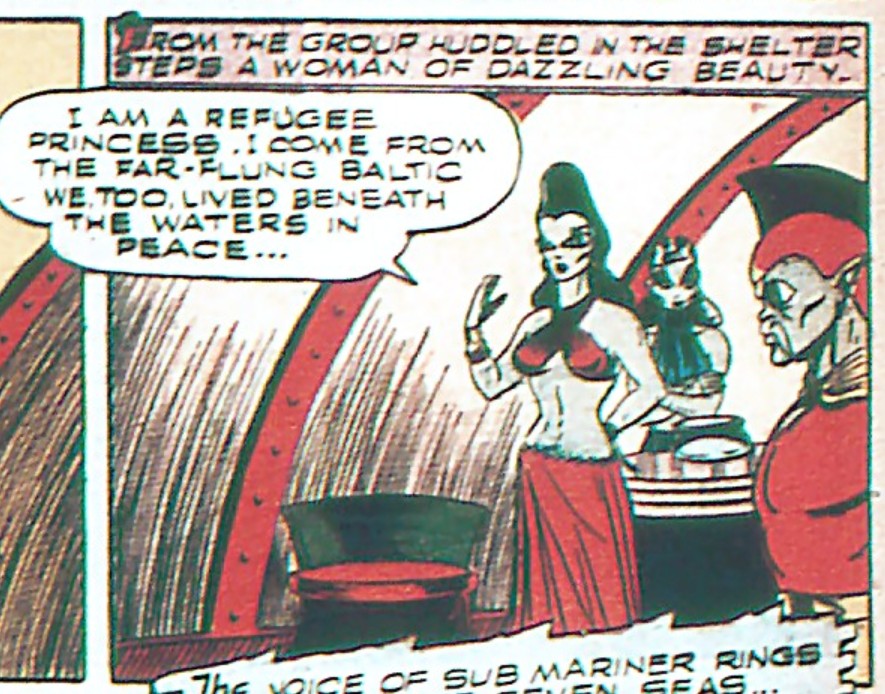
    Represented here by the villainous Rathia, the Balticans are an Atlantean subgroup that live in the Baltic Sea (natch). They might be a different colour than regular Atlanteans, but given the quality of the available scan and the unreliable nature of modern recolouring it is very hard to say for sure. (Human Torch v1 005b, 1941)

    Cygnusians:

    The Cygnusians and their enemies the Draconians are initially set up to star in a little allegorical story about institutionalized racism and the arbitrary nature of warfare, but things get derailed pretty quickly due to the fact that both Queen Luxor of Cygnus and Queen Feros of Draco are women and cheap misogyny laffs are easy. Rock Braddon of the Space Legion ends the war by arranging a queen-on-queen catfight. (Crack Comics 011, 1941) 

    Martians:

    After dealing with all the crazy bullshit that lurks beneath the Earth’s surface in 50032 CE and doing a bit of civilization-rebuilding, Blaze Barton and his romantic/ adventure partner Teddy set out to establish relations with the people of Mars. As they arrive they (and possibly also the Martians) learn that there is a second, bearded population of Martians who live in vast caverns under the planet’s surface and eschew modern technology other than rocket planes and planet-wide smoke screens. These Dark Martians capture Blaze and Teddy in order to hold them for a ransom of lamp oil from an Earth that is probably not equipped to deliver it, given the recent global disasters it has suffered, not to mention the 47 thousand-odd years since the collapse of the whaling industry.

    The main problem with being a low-tech antagonist in a science fiction world is that you are only effective as long as you can keep your opponent off-balance, as the Lord of Martianland learns when he gives Blaze a moment to breathe and finds his men completely outclassed by Blaze’s ray gun and working knowledge of electricity. The king himself is finished off with a low-tech right hook, and his people opt to learn about new and exciting sources of light. (Hit Comics 005, 1940)

  • ALIENS AND SO FORTH ROUND-UP 056

    ALIENS AND SO FORTH ROUND-UP 056

    Aliens are just like us if you think about it, man.

    Atlanteans:

    First things first: these are not actually Atlanteans, at least not yet. As far as I can tell, the word “Atlantis” is not employed in any Namor appearance from 1939-1941, and his people are collectively referred to as “Sub-Mariners” just like their prince. We are left with one of our signature Vexing Conundrums: just when do the Sub-Mariners become Atlanteans? Will we find out before we learn the location of Camp Lehigh or before someone says “Keystone City” in print? Only time will tell. 

    Given that they are only later assigned the status of being descended from the humans of old Atlantis (and then unassigned from it if I understand correctly – my interest in Namor has never been great enough that I internalized a lot of his lore), it makes sense that they are much less humanoid than a lot of their peers. They range from being full-on fish-men like Emperor Thakorr to being essentially human-looking but for their huge eyes. And not just human looking, as Namor’s own parentage attests: they can also successfully interbreed with humanity! And it’s a close enough hybridization that he’s not completely infertile, though the fact that he has only one conventionally-conceived child is a bit telling.

    One of the hallmarks of Marvel’s Atlanteans going forward is of course the fact that they all have blue or green skin, which is fun because it appears to have originally been a stylistic choice on the part of Bill Everett to indicate that they were underwater. Frankly I think that it was a good development: I have no desire to see Emperor Thakoor rendered in shades of pale pink. (Marvel Comics 001 1939)

    Balticans:

    Represented here by the villainous Rathia, the Balticans are an Atlantean subgroup that live in the Baltic Sea (natch). They might be a different colour than regular Atlanteans, but given the quality of the available scan and the unreliable nature of modern recolouring it is very hard to say for sure. (Human Torch v1 005b, 1941)

    Cygnusians:

    The Cygnusians and their enemies the Draconians are initially set up to star in a little allegorical story about institutionalized racism and the arbitrary nature of warfare, but things get derailed pretty quickly due to the fact that both Queen Luxor of Cygnus and Queen Feros of Draco are women and cheap misogyny laffs are easy. Rock Braddon of the Space Legion ends the war by arranging a queen-on-queen catfight. (Crack Comics 011, 1941) 

    Martians:

    After dealing with all the crazy bullshit that lurks beneath the Earth’s surface in 50032 CE and doing a bit of civilization-rebuilding, Blaze Barton and his romantic/ adventure partner Teddy set out to establish relations with the people of Mars. As they arrive they (and possibly also the Martians) learn that there is a second, bearded population of Martians who live in vast caverns under the planet’s surface and eschew modern technology other than rocket planes and planet-wide smoke screens. These Dark Martians capture Blaze and Teddy in order to hold them for a ransom of lamp oil from an Earth that is probably not equipped to deliver it, given the recent global disasters it has suffered, not to mention the 47 thousand-odd years since the collapse of the whaling industry.

    The main problem with being a low-tech antagonist in a science fiction world is that you are only effective as long as you can keep your opponent off-balance, as the Lord of Martianland learns when he gives Blaze a moment to breathe and finds his men completely outclassed by Blaze’s ray gun and working knowledge of electricity. The king himself is finished off with a low-tech right hook, and his people opt to learn about new and exciting sources of light. (Hit Comics 005, 1940)
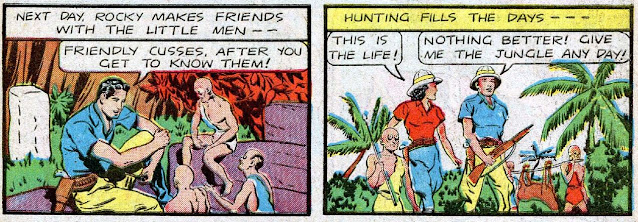
  • MINOR SUPER-VILLAIN 730: THE LITTLE MEN

    (Silver Streak Comics 002, 1940)

    Normally I try to put things in my own words and really work out the ins and outs of the motivations of the super-weirdos I write about, but I gotta be honest: I have so little idea of what the Little Men’s problem is (problems are?) that I’m just going to point to the intro caption: they’re trying to rid the world of all beautiful women. Simple as that.

    Why are they trying to rid the world of all beautiful women (and/or all beauty, as their leader puts it)? Not a clue. Are they just weird incel creeps or is it something more? No idea.

    One point in favour of the Little Men not being a weird misogynistic serial killer cult (not just a weird misogynistic serial killer cult, at least) is the fact that they have an artificial man with the amazing name Noman, though as with his creators we have so little information to work from that we can’t say for sure if Noman is an android, a homunculus, a frankenstein or something else. It’s all very genre dependent!

    (Mister Midnite is also there)

    The only real clue that we get to the nature of the Little Men is unfortunately also very genre-dependent: during Mister Midnite’s battle with Noman a “strange gas” is released from a cool heart-shaped container. The gas is harmless to humans, but disintegrates the Little Men on contact, indicating that yes, they were not human, but what were they then? Were they: magical beings, aliens, homunculi, magical constructs, earthbound spirits, underground beings, extradimensional creatures, reified fictional beings, elementals, thought projections, time travellers, mutants, chronal echoes, genii loci, regular guys who all had an extreme allergy… there just isn’t enough information, and so we must simplify: they were a bunch of weird little creeps, and the gas was creep remover, which they shouldn’t have just left lying around.

  • MINOR SUPER-VILLAIN 640: YEW BEE

    (Fantastic Comics 013, 1940)

    Yew Bee! A scientist/fifth columnist working for an unnamed nation to soften the US up for invasion! A pretty common type of guy in Golden Age comics if I’m honest, and I might have passed him by if he weren’t a Stardust the Super Wizard villain. Even the most rote Fletcher Hanks creations have at least a couple of interesting things about them.

    The first thing is obviously the name. Yew Bee. Is it a reference to a public figure who I have been unable to track down? Is it a private joke? If Yew Bee looked anything like Ub Iwerks I might’ve tried to figure out if he and Hanks had ever crossed paths and had a bad interaction but he really doesn’t. Another one of those mysteries of the ages, I guess!

    The invasion is nothing special, though it is suitably over the top. I will highlight these cool and also dumb looking super tanks, though. A fun design, say I!

    Stardust pulverizes the entire invasion force without breaking a sweat, of course.

    The real reason to cover Yew Bee is the fact that after a surprising amount of Stardust villains being shown leniency over the course of 1940, this is the group that really draws his ire. The bulk of their leadership are turned into icicles and melted. This turns out to be comparatively merciful.

    The top four leaders are turned to rats and chased through the streets of New York by Stardust in the form of a panther until they swim out to sea and drown. Except for Yew Bee, of course.

    Changed into a horrible little rat man, Yew Bee gets to spend his days being interrogated by the FBI. It really does feel like this guy is a reference to someone specific who Fletcher Hanks did not like, doesn’t it?

  • NOTES – OCTOBER 2024

    Cops Shooting at Fleeing Suspects:

    The NYPD (or the cops in some other town. but probably the NYPD) attempt to murder the Green Mask and Domino the Miracle Boy because they were wearing masks near a crime and had the audacity to run away. (Green Mask v1 003, 1940)

    Vexing Conundrum:

    These panels are from a strip called Flyin’ Jenny, the details of which are not important, save for the fact that a character has cheated in an air race and is now travelling incognito only to be given away by her signature piece of jewelry: a little tag with her name on it worn on a chain or string around her thigh. But… is this a thing? Did anyone wear these c. 1940 or is it a weird affectation made up for the strip? It seems to be impossible to hunt up online! (Reg’lar Fellers Heroic Comics 003, 1940)

    Golden Age Policing:

    Just had to pull these panels as it’s the closest I’ve seen to cops actually torturing someone on-panel in a comic (usually it’s just heavily implied to be good and just and a great idea). (Hyper Mystery Comics 001 1940)

    Honours:

    Wambi the Jungle Boy is awarded a silver sword for helping to prevent a rebellion/ helping to perpetuate colonial rule in Africa. (Jungle Comics 001, 1940)

  • NOTES – MARCH 2024

    The Foot Test For Guns:

    I sincerely can’t believe we’ve found another person trying the Foot Test For Guns, the worst of all ways to see if a gun is working. (Big Shot Comics 004, 1940)

    Kids Playing Super-Heroes:

    Jibby Jones is a pretty weak sauce comic strip (seen here in comic book reprint, natch) but dang if I’m not intrigued by this Moon Man character. (Big Shot Comics 005, 1940)
    Honours:

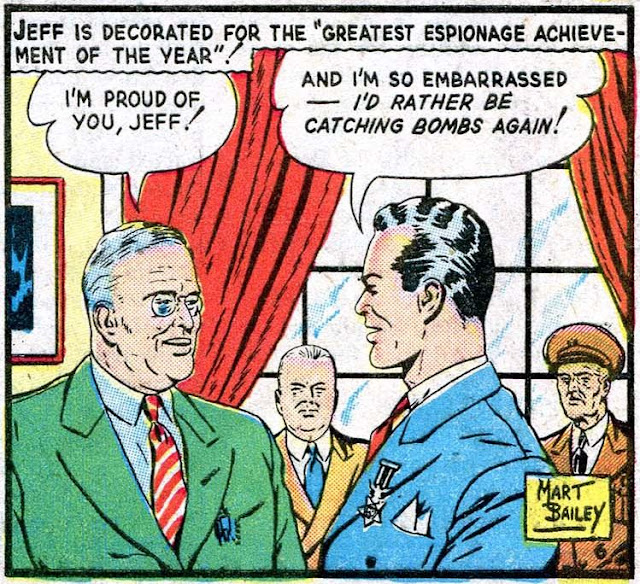
    Jeff Cardiff, Spy-Chief saves Washington DC from being exploded by unspecified foreigners and is rewarded with the very official-sounding honour of “Greatest Espionage Achievement of the Year” by FDR himself! And is that J Edgar Hoover in the background? Probably! (Big Shot Comics 006, 1940)

    Who is Lazy Ray?:

    I’ve been reading Big Shot Comics from the Columbia Comic Corporation for the last week or so and I believe that I’ve spotted an in-joke. But who is the “Lazy Ray” referenced in the two panels? Both Spy-Chief (above) and the Face (below) are Mart Bailey joints, so it could be a personal joke of his or it could be a joke among the contributors of this magazine as a whole (like the seeming industry-wide joke of putting Gil Fox’s name in as a reference at every opportunity – wish I’d though to screenshot those as I came across them). The only Ray associated with Big Shot that I can find is Ray McGill, who seems to have mainly done gag panels. Who can say but I shall be watching out for Lazy Ray going forward.

    MORE LAZY RAY SIGHTINGS:

    “the Face” (Big Shot Comics 011, 1941)

    “the Face” (Big Shot 018, 1941)

    Nova Scotia:

    It’s not like it matters to the plot but the action of this Marvelo story takes place largely on a beach on Cape Breton. (Big Shot Comics 013, 1941)

    the Fate of Mu:

    A fairly straightforward account of a Pacific continent sinking, with the fun added detail that it’s because of Earth’s lost second moon exploding. It’s never actually called Mu and in fact it’s Atlantis that gets namechecked, but a close reading of the relevant text suggests that the two continents merely sank at the same time, so Atlantis was also presumably moonstruck.

    Really fond of these little bug-eyed guys, by the way. (Big Shot Comics 014, 1941)

    Weed Propaganda:

    Santy Claus:

    To the extent that the Columbia Comic Corporation has a shared universe, Santa Clause is confirmed real in it. (Big Shot Comics 020, 1941)

    Drawn Without Reference:

    (Blackstone Super-Magic 001, 1941)

  • NOTES: JUNE 2023

    Where is Camp Lehigh?

    As noted previously, Camp Lehigh has been assigned a retroactive location of Virginia, but when that happened is hard to pin down– the earliest citation on the Marvel Comics Wiki is Captain America: White in 2008, which is recent enough that I’m surprised that the MCU location of New Jersey didn’t take precedence when the 2011 movie came out. Was it in fact established earlier? More notes follow:

    -nothing in the various Handbooks of the Marvel Universe

    -nor any issues of What If?, which I thought might have added a little detail like that to the scene-setting portion at the beginning of a Cap issue

    -various officers stationed at Camp Lehigh are shown to live in NYC

    -travel between the camp and NYC is frequent and speedy. Bucky’s class visits New York Harbor on a lark

    -BUT Captain America Comics 006 places Camp Lehigh within a similar distance of San Francisco, leading me to conclude that it’s the Brigadoon of army camps, popping up where it’s needed.

    At this point I guess it’s just a matter of watching out for the word “Virginia” to be explicitly written next to the words “Camp Lehigh” because that’s all we can really hold onto.

    EDIT: A late addition to the fun confusion: Captain America Comics 009 introduces “Lehigh City” as the nearby urban area that Cap and Bucky visit and it’s clearly one of your classic NYC stand-ins, down to the lions on the Lehigh Public Library:

  • NOTES: JUNE 2023

    Where is Camp Lehigh?

    As noted previously, Camp Lehigh has been assigned a retroactive location of Virginia, but when that happened is hard to pin down– the earliest citation on the Marvel Comics Wiki is Captain America: White in 2008, which is recent enough that I’m surprised that the MCU location of New Jersey didn’t take precedence when the 2011 movie came out. Was it in fact established earlier? More notes follow:

    -nothing in the various Handbooks of the Marvel Universe

    -nor any issues of What If?, which I thought might have added a little detail like that to the scene-setting portion at the beginning of a Cap issue

    -various officers stationed at Camp Lehigh are shown to live in NYC

    -travel between the camp and NYC is frequent and speedy. Bucky’s class visits New York Harbor on a lark

    -BUT Captain America Comics 006 places Camp Lehigh within a similar distance of San Francisco, leading me to conclude that it’s the Brigadoon of army camps, popping up where it’s needed.

    At this point I guess it’s just a matter of watching out for the word “Virginia” to be explicitly written next to the words “Camp Lehigh” because that’s all we can really hold onto.

    EDIT: A late addition to the fun confusion: Captain America Comics 009 introduces “Lehigh City” as the nearby urban area that Cap and Bucky visit and it’s clearly one of your classic NYC stand-ins, down to the lions on the Lehigh Public Library:

  • A VEXING CONUNDRUM: KEYSTONE CITY

    In short: the state of online wiki-based comics scholarship run by people with poor reading comprehension and an adherence to post-hoc continuity decisions makes it very hard to determine when Jay Garrick explicitly starts operating out of Keystone City as the Flash.

    Flash Comics v1 001 features his origin at Midwestern University, which has since been located in Keystone, but does not mention the city by name. For the rest of 1940 at least, he is pretty explicitly in NYC. No idea when the move happens, guess I’ll have to keep on reading and see.