The Curse of Skeleton Munroe

Category: Bill Barnes

  • REAL PERSON ROUND-UP 028

    Mostly a case of the Usual Suspects today here in the Real Person Round-Up, I’m afraid.

    Adolf Hitler:

    The bulk of the comic this panel comes from is MIA as far as people without hundreds of dollars of Buy Golden Age Comics money are concerned, and this is the only real look we get of this slightly off-brand Hitler and Goering. I might not have bothered to include them here devoid of other context except for…

    … the splash page for the story, featuring our Hitler-alike in a beast-man form and commanding a horde of Hitlerian minions that are probably both allegorical but which are very representative of the “mad-dog” framing that he was being given in a lot of the comics of the time. Presumably air ace Bill Barnes really scuttles his plans. (Bill Barnes America’s Air Ace Comics 002, 1941)

    This husky Hitler look-alike is the head of a fascist force that almost manages to destroy the US military presence in Alaska but is himself destroyed by the Liberty Guards. (Man of War Comics 001, 1941)

    Here time/space traveller Whiz Wilson encounters a particularly low-rent Hitler-alike named Raggo. (Lightning Comics v1 006, 1941)

    Cordell Hull:

    When Bill Barnes needs two hundred jeeps to defend the Panama Canal, who does he call? Secretary of State Cordell Hull, that’s who! (Bill Barnes, America’s Air Ace Comics 005, 1941)

    Franklin Roosevelt:

    A more on-model  (and more face-forward) version of Roosevelt than we usually see in comics learns of the existence of the Liberty Scouts from their sponsor, retired patriotic millionaire Patrick Henry (who named himself such after immigrating to the US as a young man). (Liberty Scouts Comics 002, 1941)

    FDR returns in the second Liberty Scouts comic to tour the very on-the-nose Fort America (Liberty Scouts Comics 003, 1941)

    Hermann Goering:

    Orders the destruction of Bill Barnes. (Bill Barnes America’s Air Ace Comics 004, 1941)

    Hollywood Shuffle:

    It’s another classic case of mixing up first and last names of movie stars to make all-new ones, in this case Tyrone Taylor (Tyrone Power/ Robert Taylor, probably), and Myrna Rogers (Myrna Loy/ Ginger Rogers, almost certainly). (Detective Comics v1 046, 1940)

    Leopard Men:

    Since I recently realized that I had failed to be curious enough and that the Leopard Men were not just a fanciful idea that people kept coming up with but in fact a vilified version of real African secret societies, they now get a place in the Real Person Round-Up. These particular Leopard Men are just as bloodthirsty and savage as the rest of their fictional ilk, but are distinguished by being some of the few to not wear some sort of leopard-head cowl. Possibly because the Red Panther already has that bit of fashion sewn up. (Jungle Comics 020, 1941)

  • REAL PERSON ROUND-UP 028

    Mostly a case of the Usual Suspects today here in the Real Person Round-Up, I’m afraid.

    Adolf Hitler:

    The bulk of the comic this panel comes from is MIA as far as people without hundreds of dollars of Buy Golden Age Comics money are concerned, and this is the only real look we get of this slightly off-brand Hitler and Goering. I might not have bothered to include them here devoid of other context except for…

    … the splash page for the story, featuring our Hitler-alike in a beast-man form and commanding a horde of Hitlerian minions that are probably both allegorical but which are very representative of the “mad-dog” framing that he was being given in a lot of the comics of the time. Presumably air ace Bill Barnes really scuttles his plans. (Bill Barnes America’s Air Ace Comics 002, 1941)

    This husky Hitler look-alike is the head of a fascist force that almost manages to destroy the US military presence in Alaska but is himself destroyed by the Liberty Guards. (Man of War Comics 001, 1941)

    Here time/space traveller Whiz Wilson encounters a particularly low-rent Hitler-alike named Raggo. (Lightning Comics v1 006, 1941)

    Cordell Hull:

    When Bill Barnes needs two hundred jeeps to defend the Panama Canal, who does he call? Secretary of State Cordell Hull, that’s who! (Bill Barnes, America’s Air Ace Comics 005, 1941)

    Franklin Roosevelt:

    A more on-model  (and more face-forward) version of Roosevelt than we usually see in comics learns of the existence of the Liberty Scouts from their sponsor, retired patriotic millionaire Patrick Henry (who named himself such after immigrating to the US as a young man). (Liberty Scouts Comics 002, 1941)

    FDR returns in the second Liberty Scouts comic to tour the very on-the-nose Fort America (Liberty Scouts Comics 003, 1941)

    Hermann Goering:

    Orders the destruction of Bill Barnes. (Bill Barnes America’s Air Ace Comics 004, 1941)

    Hollywood Shuffle:

    It’s another classic case of mixing up first and last names of movie stars to make all-new ones, in this case Tyrone Taylor (Tyrone Power/ Robert Taylor, probably), and Myrna Rogers (Myrna Loy/ Ginger Rogers, almost certainly). (Detective Comics v1 046, 1940)

    Leopard Men:

    Since I recently realized that I had failed to be curious enough and that the Leopard Men were not just a fanciful idea that people kept coming up with but in fact a vilified version of real African secret societies, they now get a place in the Real Person Round-Up. These particular Leopard Men are just as bloodthirsty and savage as the rest of their fictional ilk, but are distinguished by being some of the few to not wear some sort of leopard-head cowl. Possibly because the Red Panther already has that bit of fashion sewn up. (Jungle Comics 020, 1941)

  • FASCIST GOON CLEARING HOUSE 015

    If there’s one thing I know it’s that the world has a seemingly-inexhaustible supply of odious little fascist worms.

    the All-American League:

    The All-American League is nothing so exciting as your Nazi spies trying to poison the reservoir or prevent and/or encourage the US entrance into WWII. Instead, they are the more banal type of fascism that is popular nowadays, in which patriotism is weaponized as a way to enrich and empower a few petty men (yes, yes that’s what the Axis was too but they killed a lot of people while doing it so we hold them in higher esteem). The Flame is more than a match for a collection of small-minded opportunists.

    Please note that this is the one and only adventure in which the Flame is said to live in a place called Metropolis before someone presumably thought better of it, and that it features an ethnic neighbourhood with the hilariously on-the-nose name of “Foreign Town.” (The Flame 007, 1941)

    the Nazi Bund:

    This is our second instance of a group called the Nazi Bund and as the other one occurred in Fantastic Comics I would be tempted to posit that it represents a rare connection between two Fox Features titles. Not a strong connection, as this particular branch is completely annihilated by the Green Mask, just as that other was by Samson. (Green Mask v1 005, 1941)

    the Yellow-Jackets:

    Though the Yellow-Jackets, the recurring foes of America’s Air Ace Bill Barnes, are described as a kind of freelance band of international bandit spies, in practice they are just another bunch of Nazis-by-another-name. It’s a good name, though. Menacing. (Shadow Comics v1 002, 1940)

    Unnamed Saboteurs:

    This band of Nazi saboteurs are not the most distinguished but also not the least. Their big plan involves starting a forest fire outside of the war production centre of Brownstown and then burning down the town itself while everyone is out fighting the first blaze. Not a bad plan, if doomed to failure because of the presence of human fire extinguisher Fire-Man, but what really sets these guys apart is their weird cloth masks that sport one big central lens to see out of. These are not given any sort of narrative justification, so one must presume that they are worn solely to look cool. (Man of War Comics 001, 1941)

  • MINOR SUPER-VILLAIN 990: THE EMPEROR

    (Bill Barnes, America’s Air Ace Comics 003, 1941)

    The first chunk of the story that the Emperor appears in is not available anywhere that I can find, but what remains is enough to evaluate him and determine that yes, he is a super-villain. Specifically, he is a scientist who discovered “the secret of atomic power” and decided that the best way to use it was as part of an attempt to conquer the world. Plus he has all of his henchmen running around in little uniforms, a clear sign of super-villainy.

    The part of the Emperor’s plans that we get to see involves using cool-looking rocket bombers to blow big holes in various US cities and then sending out agents provocateur to stir up public support for surrender as an alternative to continued explosions.

    Unfortunately for the Emperor, Bill Barnes (America’s Air Ace) is on the case, and he’s such a mechanical genius that he is able to divine the secrets of atomic energy merely by creeping around the engine room of one of those cool rocket bombers for about half an hour. Barnes builds his own fleet of nuclear-powered aircraft, tracks the Emperor to a secret base in the Rockies and then wipes him off the map with atomic bombs. I suppose that the actual Emperor himself might have suvived, since we never actually see him alive or dead, but it’s pretty unlikely.

    BONUS: Bill Barnes is awarded “the highest honor of the nation” by FDR for stopping the Emperor, which is either the Medal of Honor or… some precursor to the Medal of Freedom that I can’t find (logically there had to be a highest civilian honour before 1942 but Wikipedia is being coy). It all depends on whether America’s Air Ace is a military or civilian role.

    Categorized in: Accessories (Mountain Base), Royalty (Emperors), Supercrime (Attempted Conquest of the US)

  • MINOR SUPER-VILLAIN 990: THE EMPEROR

    (Bill Barnes, America’s Air Ace Comics 003, 1941)

    The first chunk of the story that the Emperor appears in is not available anywhere that I can find, but what remains is enough to evaluate him and determine that yes, he is a super-villain. Specifically, he is a scientist who discovered “the secret of atomic power” and decided that the best way to use it was as part of an attempt to conquer the world. Plus he has all of his henchmen running around in little uniforms, a clear sign of super-villainy.

    The part of the Emperor’s plans that we get to see involves using cool-looking rocket bombers to blow big holes in various US cities and then sending out agents provocateur to stir up public support for surrender as an alternative to continued explosions.

    Unfortunately for the Emperor, Bill Barnes (America’s Air Ace) is on the case, and he’s such a mechanical genius that he is able to divine the secrets of atomic energy merely by creeping around the engine room of one of those cool rocket bombers for about half an hour. Barnes builds his own fleet of nuclear-powered aircraft, tracks the Emperor to a secret base in the Rockies and then wipes him off the map with atomic bombs. I suppose that the actual Emperor himself might have suvived, since we never actually see him alive or dead, but it’s pretty unlikely.

    BONUS: Bill Barnes is awarded “the highest honor of the nation” by FDR for stopping the Emperor, which is either the Medal of Honor or… some precursor to the Medal of Freedom that I can’t find (logically there had to be a highest civilian honour before 1942 but Wikipedia is being coy). It all depends on whether America’s Air Ace is a military or civilian role.

    Categorized in: Accessories (Mountain Base), Royalty (Emperors), Supercrime (Attempted Conquest of the US)

  • NOTES – JULY 2026

    Honours:

    Pilot Bill Barnes is almost certainly awarded the Victoria Cross for blowing up a Nazi gas stockpile. He also gets a pie. (Bill Barnes, America’s Air Ace Comics 004, 1941)

    The Liberty Scouts are given nonspecific (but secret) medals for saving NYC from being destroyed. Strut also gets a pie. (Liberty Scouts Comics 002, 1941)

  • DIVINE ROUND-UP 005

    Once again we add to the scriptures. 

    the Shadowman: 


    Like his predecessor/inspiration Yarko the Great, Mr Mystic also has a semi-friendly/ semi-adversarial relationship with the personification of death. In this case, Death is a guy in a cool suit with a half-cape, and he is called the Shadowman, presumably because of his perpetually-in shadow face.

    The Shadowman’s first couple of appearances cast him as a mysterious stranger who helps Mr Mystic in his battle against various evils (including scientist Ghantse, who the Shadowman seems to work for in his initial appearance). At this point the Shadowman is merely a mysterious man who has a miraculous ability to survive the most deadly of situations.

    In the 17 November 1940 Spirit Section, Mr Mystic ventures into the Land of Mythology on a quest for the Ring of the Gods, which turns out to be held by Death. This version of Death is a traditional Grim Reaper style skeleton in a robe, and he swears vengeance on Mr Mystic for the theft of the ring. 

    The Grim Reaper version of Death is never explicitly tied to the Shadowman, and it’s possible that they were intended to be different in some fundamental way – different aspects of death, perhaps. The Whole Ring of the Gods incident is not brought up by the Shadowman the next time he meets Mr Mystic (1 December 1940), so Mystic might be off the hook for that. It’s a bit of a moot point, however, as this installment of “Mr Mystic” is all about him saving the life of a little girl named Joan Barton, and it allows us to get more of a grip on the Shadowman’s code: he objects to bot murder and life-saving interventions as equally disruptive to the natural order. Mr Mystic now has two threats from Death hanging over him. 

    (this episode also establishes the deal with the Shadowman’s shadowy face: if you look at it sans shadow, you die) 

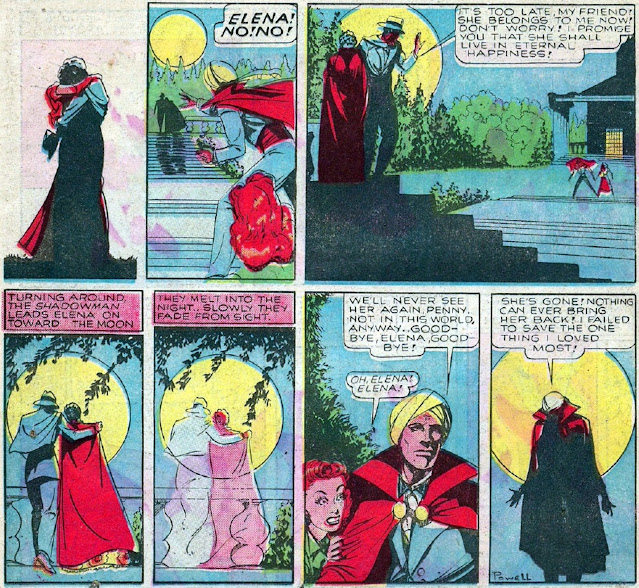
    The second-to-final Mr Mystic comic of the year (22 December 1940) features the Shadowman’s revenge on Mystic: he is going to seduce/kill his fiance Elena.

    While the Shadowman seems to have access to some sort of primordial seductive power relating to the inevitable entropic march toward the grave, he is not above employing cheap romantic comedy plot devices to drive a wedge between the lovers.

    Death is the inevitable winner of the contest, of course, and Elena goes off with him to… the afterlife? His home? Are they married now or is she just dead? We shall never know, alas, though we will see the Shadowman again.

    God Style: real anthropomorphic personification (The Spirit Section, 22 September, 1940)

    Jwang Tyoy:

    We don’t get a lot of the teachings of Jwang Tyoy beyond the fact that he is the god of a South American “anti-civilization” cult. The focus of the comic is much more focused on the very off-model pterodactyls that the cult leader uses to do he bidding, and for good reason!

    God Style: idol (Shadow Comics v1 004, 1940) 

    Kutu: 

    Kutu, aka Tuku, is possibly a moon god, definitely South American, and has the traditional jewel socketed into his idol for adventurers to steal and get into Big Trouble. 

    God Style: idol (Comics Magazine 002, 1936)  

    Nahapatan: 

    Nahapatan, the Golden Idol, is housed in a hidden Aztec city, where it is the subject of active worship. Does this stop Professor Roberts, his nephew Tim and adventurer Ken Masters from barging in and stealing it to put in Robert’s museum? It does not.

    God Style: idol (Masked Marvel 001, 1940)

  • DIVINE ROUND-UP 005

    Once again we add to the scriptures. 

    the Shadowman: 


    Like his predecessor/inspiration Yarko the Great, Mr Mystic also has a semi-friendly/ semi-adversarial relationship with the personification of death. In this case, Death is a guy in a cool suit with a half-cape, and he is called the Shadowman, presumably because of his perpetually-in shadow face.

    The Shadowman’s first couple of appearances cast him as a mysterious stranger who helps Mr Mystic in his battle against various evils (including scientist Ghantse, who the Shadowman seems to work for in his initial appearance). At this point the Shadowman is merely a mysterious man who has a miraculous ability to survive the most deadly of situations.

    In the 17 November 1940 Spirit Section, Mr Mystic ventures into the Land of Mythology on a quest for the Ring of the Gods, which turns out to be held by Death. This version of Death is a traditional Grim Reaper style skeleton in a robe, and he swears vengeance on Mr Mystic for the theft of the ring. 

    The Grim Reaper version of Death is never explicitly tied to the Shadowman, and it’s possible that they were intended to be different in some fundamental way – different aspects of death, perhaps. The Whole Ring of the Gods incident is not brought up by the Shadowman the next time he meets Mr Mystic (1 December 1940), so Mystic might be off the hook for that. It’s a bit of a moot point, however, as this installment of “Mr Mystic” is all about him saving the life of a little girl named Joan Barton, and it allows us to get more of a grip on the Shadowman’s code: he objects to bot murder and life-saving interventions as equally disruptive to the natural order. Mr Mystic now has two threats from Death hanging over him. 

    (this episode also establishes the deal with the Shadowman’s shadowy face: if you look at it sans shadow, you die) 

    The second-to-final Mr Mystic comic of the year (22 December 1940) features the Shadowman’s revenge on Mystic: he is going to seduce/kill his fiance Elena.

    While the Shadowman seems to have access to some sort of primordial seductive power relating to the inevitable entropic march toward the grave, he is not above employing cheap romantic comedy plot devices to drive a wedge between the lovers.

    Death is the inevitable winner of the contest, of course, and Elena goes off with him to… the afterlife? His home? Are they married now or is she just dead? We shall never know, alas, though we will see the Shadowman again.

    God Style: real anthropomorphic personification (The Spirit Section, 22 September, 1940)

    Jwang Tyoy:

    We don’t get a lot of the teachings of Jwang Tyoy beyond the fact that he is the god of a South American “anti-civilization” cult. The focus of the comic is much more focused on the very off-model pterodactyls that the cult leader uses to do he bidding, and for good reason!

    God Style: idol (Shadow Comics v1 004, 1940) 

    Kutu: 

    Kutu, aka Tuku, is possibly a moon god, definitely South American, and has the traditional jewel socketed into his idol for adventurers to steal and get into Big Trouble. 

    God Style: idol (Comics Magazine 002, 1936)  

    Nahapatan: 

    Nahapatan, the Golden Idol, is housed in a hidden Aztec city, where it is the subject of active worship. Does this stop Professor Roberts, his nephew Tim and adventurer Ken Masters from barging in and stealing it to put in Robert’s museum? It does not.

    God Style: idol (Masked Marvel 001, 1940)