The Curse of Skeleton Munroe

Category: Fantomah

  • ALIENS AND SO FORTH ROUND-UP 054

    ALIENS AND SO FORTH ROUND-UP 054

    Comic book aliens: one of the few inexhaustible resources.

    Martians:

    Just as Doc Strong and his followers are starting to get the post-apocalyptic, WWII-lasted-a-century world of 2041 sorted out, a bunch of robot-looking Martians show up to ruin things by invading their territory on the Isle of Right. It’s just one thing after another with that year.

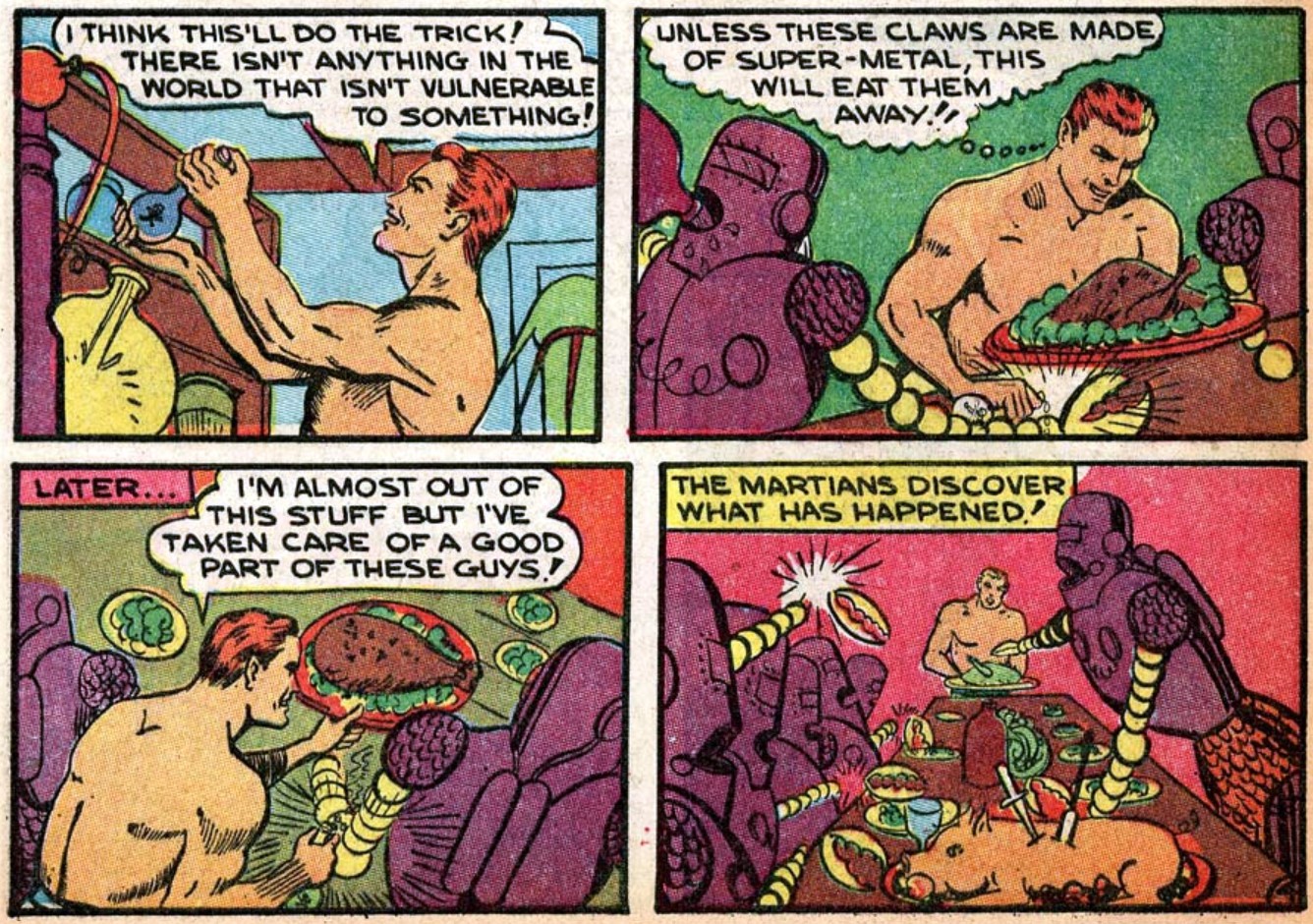
    Though they are fairly generic hostile invaders, these fellows really distinguish themselves among their class by immediately abandoning whatever plans that they had for Earth in order to indulge in a rager of a party. They want meat and they want booze, in that order and plenty of it. And as a bonus, the fact that the colourists at Blue Ribbon never really settled on a consistent colour scheme for these fellows means that the Party Issue is also the issue in which the Martians all look like they are wearing leopardskin briefs.

    Everything works out okay, however. After Doc and his pals are taken back to Mars for judgment by the King of the Martians they learn that he is a mere robot shell built by friendly Earthman Stinky Jones, who is more than happy to lend his subjects’ might to the task of cleaning up the war-ravaged Earth. (Blue Ribbon Comics 007, 1940)

    Masters of the Pit:

    These inhabitants of the Pit of Horrors aren’t given a lot of characterization, seeing as they are acting as more of an extension of Fantomah’s rough justice than as a functioning society. They live in caves underneath the liminal Jungle and can shape stone with a word and a gesture, and that’s all we really get. (Jungle Comics 007, 1940)

    Melubians:

    The interesting thing about planet Melubia is the fact that they use gravity control technology to surround their world with hundreds of small artificial satellites on which are built small cities or individual dwellings. The less interesting thing about Melubia is the fact that there are two intelligent species living on it, one of whom (the Melubians) want to overthrow the rule of the other (the unnamed, more humanoid species headed by King Molat). We never really get a sense of whether this is a colonial situation or if the two groups evolved on Melubia in parallel, but either way, time/space traveller Stuart Taylor and his pals are quick to uphold the established power structure and put down the rebellion. (Jumbo Comics 016, 1940) 

    Mongonians:

    The Mongonians, inhabitants of the planet Mongo (but a different Mongo than the Flash Gordon one) are some cool four-armed aliens with an unfortunate streak of paranoid xenophobia running through their society, as can be seen in their interaction with time/space traveller Whiz Wilson when he visits their planet in the year 2300 CE.

    It may be that the Mongonians are on to something, however, as they are attacked by hostile inhabitants of the planet Zania just after they toss Whiz – along with two hapless explorers from Earth – into their jail. Everything eventually resolves nicely, as the explorers’ spaceship makes an excellent weapon against the relatively fragile ranks of the Zanian Balloon Corps and peaceful Earth/Mongo relations are established. (Lightning Comics v2 001, 1941)
  • DIVINE ROUND-UP 034

    DIVINE ROUND-UP 034

    Here come some more gods and god-adjacent beings for you.

    the Golden Skull:

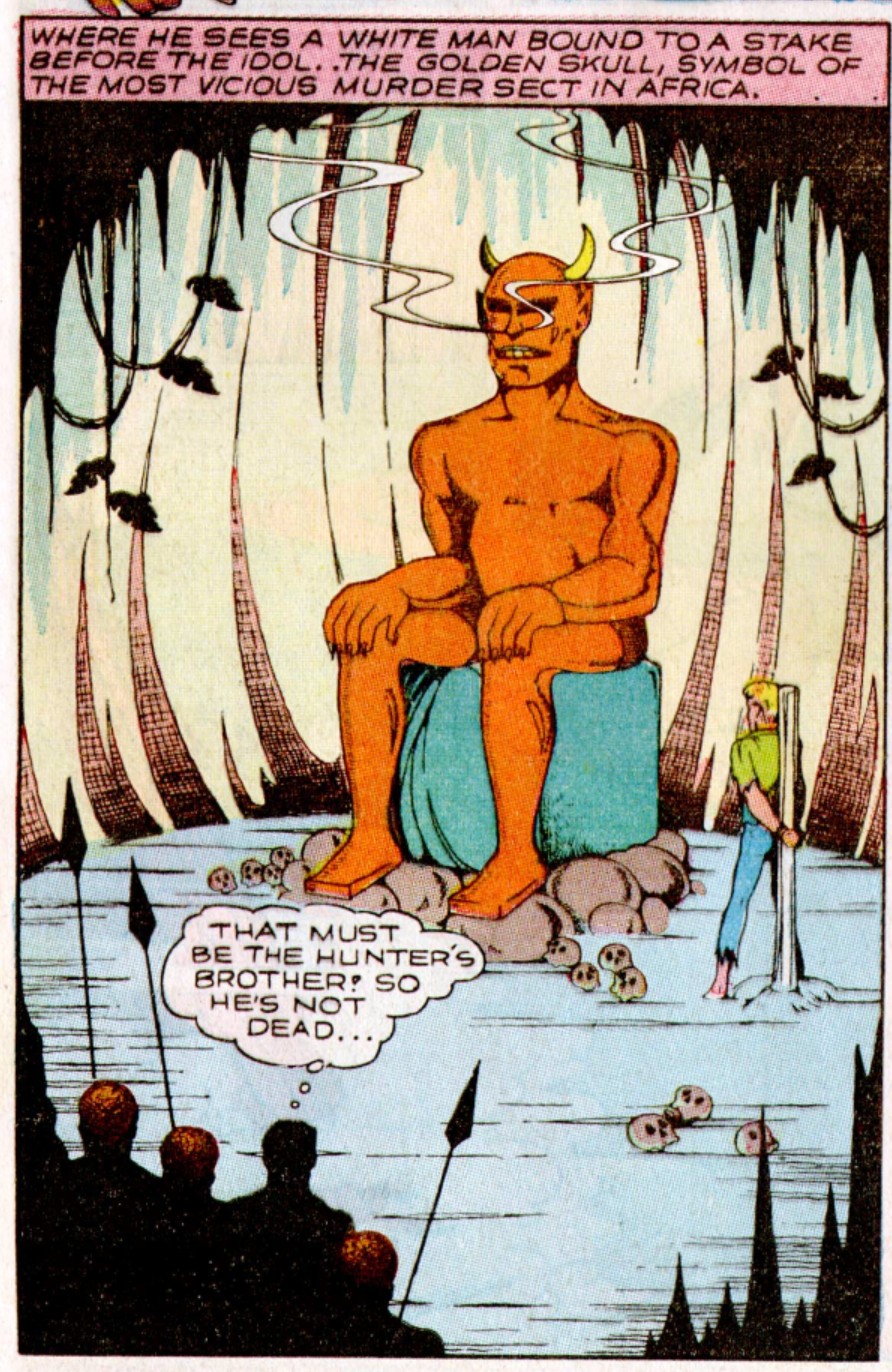
    While I must of course frown and shake my head at the concept of human sacrifice, you really have to hand it to the worshippers of the Golden Skull (who is, yes, very much not golden and also not especially skully), for giving their god a name that guarantees that a constant stream of American and European treasure hunters would arrive on their doorstep in search of swag. It’s the perfect sustainable human sacrifice supply solution!

    Sadly, the Golden Skull sect are not quite as canny about the location of their temple as they are about marketing, and the whole operation gets blown sky high when the volcano it is housed in erupts at an inopportune time.

    God Style: Idol (Jungle Comics 024, 1941)

    God of the Apes:

    We don’t learn much about the God of the Apes other than the fact that it is presumably worshipped or otherwise connected to apes and that it is real enough that Fantomah can call upon it to turn some crooked big game hunters into gorillas.

    God Style: Invoked (Real) (Jungle Comics 024, 1941)

    Mars:

    This right here is a pretty traditional comic book depiction of Mars, God of War, right down to the fact that he is loving the carnage and slaughter in Europe (and is implicitly the Guy Behind WWII). He loves it so much, in fact, that he creates Man of War as his personal agent on Earth to speed the whole process up, but he then fumbles the process so badly that he accidentally creates an Allied super-hero instead. 

    God Style: Real (Liberty Scouts Comics 002, 1941)

    the Spirit of America:

    This Spirit of America is in the Columbia mode, being an ethereal and star-spangled woman who implicitly comes into existence as a result of the American Revolution. In 1783 she primes a cannon with “powders of patriotism” just in case she ever needs to create a mystic champion at some point in the future (i.e., upcoming super-hero the Sentinel). 

    God Style: Real (Anthropomorphic Personification) (Liberty Scouts Comics 003, 1941)

  • MINOR SUPER-VILLAIN 995: ORG

    (Jungle Comics 015, 1941)

    Org is a fellow with a gift – the power to play the drums hypnotically – and also the knowledge of the location of a hidden valley full of giant spiders. He combines these two factors as a part of his scheme to conquer “all of Jungleland,” which probably means Africa and possibly means India but in my heart will always mean a humid pocket dimension summoned into being by Fletcher Hanks and his fellow Jungle writers’ lack of geographic savvy.

    Org quickly organizes a spider army with his sick beats, earning him one strike on Fantomah’s personal “should I kill this guy” tracker.

    This is often the point at which Fantomah gives her target a little hint that he might want to cut back on the wanton slaughter, etc. for his own sake, but Org is given no such grace – perhaps Fantomah just hates spiders. Or drummers. In any case, Org appears to be a pretty thoroughly rotten guy who delights in having his minions attack human and animal alike. It is at this point that I must point out the horrific fact that Org’s spiders have what appear to be human hands on the end of each of their legs, which is gross.

    Attacking people and animals like this were evidently strikes two and three, because it is at this point that Fantomah steps in, just a little too late as per usual. Org is paralyzed and unceremoniously fed to his own erstwhile troops, who in turn are shrunken down to the size of regular everyday spiders. We can only hope that there wasn’t some sort of catastrophic megafauna that they were keeping in check with their predations, I guess.

    Appropriately for what I am almost certain is our last Fletcher Hanks comic (but not out final Fantomah), our hero gives a little farewell at the end of the comic!

    Categorized in: Accessories (Giant Spiders), Powers (Animal Control), Supercrime (Attempted Conquest)

  • DIVINE ROUND-UP 033

    The theme today is animal gods.

    Joboloa the Elephant God:

    Joboloa the Elephant God is invoked by Fantomah to punish the evil M’Dibo by means of a horde of spectral pachyderms. Honestly he is an odd choice for the job, as while M’Dibo’s crimes involve elephant ivory it’s not so much that he’s killing elephants to get it as stealing it from other people. Is Joboloa cool with elephant hunting as long as a proper chain of possession is maintained?

    God Style: Real (Jungle Comics 020, 1941)

    God of the Vultures:

    We don’t learn too much about the God of the Vultures other than that its worship involves human sacrifice and that its devotees seem to have some control over the vultures that live near the temple. Possibly because they are into the human sacrifices. Tabu, Wizard of the Jungle, someone who is very much not into human sacrifices, busts them up.

    God Style: Idol (Jungle Comics 021, 1941)

    Monkey and Cobra Cults:

    In possibly the only time that the fact that Jungle Comics stories just kind of saw wildly between being set in Africa and India is justified, Fantomah is captured by slavers in Africa and comes ashore in India when she escapes them. There, she immediately gets mixed up in a conflict between the Cobra Cult who worship the Sacred Cobras, and the Monkey Cult who presumably do the same but with sacred monkeys. The former try to sacrifice Fantomah, so they are the bad guys.

    God Style: Animist (Jungle Comics 021, 1941)

    Crocodile God:

    This unnamed crocodile deity this is has some rivalry with the priesthood of Damballah, or at least its representative in this village does. It can be hard to differentiate the tenets of a religion from the actions of its worst adherents, after all. One thing is certain, however: a crocodile theme makes for some terrific architectural and fashion options.

    God Style: Idol (Jungle Comics 023, 1941)

  • MINOR SUPER-VILLAIN 993: ZOMAX

    (Jungle Comics 014, 1941)

    Zomax, the “demonized marine scientist,” has a very over-the-top, Fletcher Hanks villain goal: to kill every animal in the jungle. And he isn’t afraid to say it.

    I won’t say that Zomax has a good reason for wanting to destroy all jungle life, but he does have some justification, stemming from a big game hunt he went on that involved, in order:

    1. being mauled by a fatally wounded lion. Once the lion died, Zomax wandered away, only to…

    2. be grabbed by a man-hating elephant and tossed into a stagnant pond where…

    3. swarms of poisonous gnats shredded his skin. Zomax crawled out of the muck in torment, only to be…

    4. crushed by a boa constrictor, but not killed, because he was…

    5. pulled away by the Hannibal Lector of gorillas, who then proceeded to take Zomax home to his nest and inflict months of psychological torture on him.

    Though one might see all of this as a kind of ironic punishment for going on a big game hunt in the first place, Zomax does not in fact see it that way, and concludes that the jungle is an evil place fit only for destruction. And since he is a “marine scientist,” what better tool of that destruction than the ocean itself?

    Specifically, Zomax has built a machine that can create and control a bespoke tidal wave to to wash over the entire continent of Africa (or that portion of it that contains jungle animals) and destroy all of his tormentors. Other than the gnats, I reckon: I bet they do just fine in a landscape covered in brackish ponds. 

    As violence against any jungle is violence against the universal Jungle that Fantomah protects, she is out to get Zomax as soon as he actually initiates the tidal wave engine (though please note the silhouettes that indicate that Zomax gets revenge against one representative of each animal species that wronged him, gnats excepted).

    Having been given an unusual number of chances to repent and stop his machines by Fantomah, Zomax instead decides to flee in a plane, leaving her not choice but to destroy him with his own tidal wave, or, as Fantomah (and the second Paul Karasik collection of Hanks comics) puts it “YYou shall die by your own creation!”

    Categorized in: Generica (Ends in -x), Origin (Vengeance Quest), Supercrime (Disaster Causers)

  • MINOR SUPER-VILLAIN 993: ZOMAX

    (Jungle Comics 014, 1941)

    Zomax, the “demonized marine scientist,” has a very over-the-top, Fletcher Hanks villain goal: to kill every animal in the jungle. And he isn’t afraid to say it.

    I won’t say that Zomax has a good reason for wanting to destroy all jungle life, but he does have some justification, stemming from a big game hunt he went on that involved, in order:

    1. being mauled by a fatally wounded lion. Once the lion died, Zomax wandered away, only to…

    2. be grabbed by a man-hating elephant and tossed into a stagnant pond where…

    3. swarms of poisonous gnats shredded his skin. Zomax crawled out of the muck in torment, only to be…

    4. crushed by a boa constrictor, but not killed, because he was…

    5. pulled away by the Hannibal Lector of gorillas, who then proceeded to take Zomax home to his nest and inflict months of psychological torture on him.

    Though one might see all of this as a kind of ironic punishment for going on a big game hunt in the first place, Zomax does not in fact see it that way, and concludes that the jungle is an evil place fit only for destruction. And since he is a “marine scientist,” what better tool of that destruction than the ocean itself?

    Specifically, Zomax has built a machine that can create and control a bespoke tidal wave to to wash over the entire continent of Africa (or that portion of it that contains jungle animals) and destroy all of his tormentors. Other than the gnats, I reckon: I bet they do just fine in a landscape covered in brackish ponds. 

    As violence against any jungle is violence against the universal Jungle that Fantomah protects, she is out to get Zomax as soon as he actually initiates the tidal wave engine (though please note the silhouettes that indicate that Zomax gets revenge against one representative of each animal species that wronged him, gnats excepted).

    Having been given an unusual number of chances to repent and stop his machines by Fantomah, Zomax instead decides to flee in a plane, leaving her not choice but to destroy him with his own tidal wave, or, as Fantomah (and the second Paul Karasik collection of Hanks comics) puts it “YYou shall die by your own creation!”

    Categorized in: Generica (Ends in -x), Origin (Vengeance Quest), Supercrime (Disaster Causers)

  • MINOR SUPER-VILLAIN 992: THE VAHINES

    (Jungle Comics 013, 1941)

    The Vahines, aka the Tiger-Women of Wildmoon Mountain, have a plan: kill every other woman in the world, which will then give them ultimate power over all men. Some thoughts on this setup:

    1. The logistics of this plan are trash. There are maybe 15 to 20 Vahines total and estimates put world population at around 2.3 billion in 1940, so murdering half of those people will be a full-time job that will probably take the rest of their lives*. And if they succeed, what then? They rule over a population that is going to die out in a single generation? They certainly can’t repopulate the planet because they spent their fertile years slaughtering people.

    *It’s just possible that “the world” referred to by the Vahines is the weird liminal Jungle-Dimension that Fantomah comics seem to be set in, but seeing as how that’s mostly something I made up to explain how weird the worldbuilding in these stories is, I doubt it.

    2. I keep saying that we’re almost out of Fletcher Hanks stories but I really mean it this time, so it’s nice to get one last instance of women surfing around on the backs of big cats.

    3. “The Vahines have come down off of Wildmoon Mountain to murder all other women” sounds like the synopsis of a MADtv sketch about PMS. 

    Regardless of the canonicity of the liminal Jungle, that’s where their mountain is located and so that is where they start murdering women. This goes against Fantomah’s mission to protect Jungle life, and so they meet resistance in the form of All Animals. The Vahines, however, are no fools. They knew that Fantomah wouldn’t be cool with their insane mission and so they have prepared a salve that makes them glow in a way that is scary to animals. Problem solved!

    Or is it? in a classic blunder, the Vahines have failed to contend with the fact that Fantomah a) is not afraid of a mild glowing effect and b) is a minor deity. It takes the merest exertion of her powers to remove the glow, and soon the Vahines’ tigers are a mere smudge on the jungle floor.

    As for the Vahines themselves, it is now the time for the extreme retribution. Fantomah begins this by extracting the enormous moonstone called the Wild Moon from inside of Wildmoon Mountain – it seems that the name was more than just cool but that it also meant something – and sticking the Vahines to it. This is initially very concerning to the Vahines because of a prophecy about their lives ending if the Wild Moon leaves…

    … and then very, very concerning, as the Wild Moon, with its Vahine cargo, is blasted off to slam into the surface of Mars. The prophecy was correct! If unhelpful!

    Categorized in: Animals (Tigers), Ideologies (Misogyny), Murder (Mass Murderers)

  • MAD AND CRIMINAL SCIENTIST ROUND-UP 027

    A series of cautionary tales for budding young scientists.

    Orid Dass:

    Orid Dass is your standard jungle scientist: he’s out there making apes into men and men into apes, all for the love of the ape-man game. He also has the distinction of being the only foe faced by Fantomah the one post-Fletcher Hanks adventure in which she is still kind of a jungle demigod rather than a jungle hero who knows some magic.

    In that capacity, Fantomah does a little man/ape transformation of her own, turning both Dass and his ape-men into little green monkeys until he reverts his latest victim (a white guy) to human form, though why she couldn’t just do it herself is not explored.

    Dass briefly gets one over on Fantomah by dropping her into a pit lined with radioactive ore, as this is also the one issue in which her powers are neutralized in the presence of radiation, but is subsequently crushed when his entire base collapses on top of him – the downside to the convenience of building your science compound on top of a huge radioactive cavern system, I guess. (Jungle Comics 016, 1941)

    Doktor Teufel:

    Doktor Teufel lives on the aptly-named Death Mountain and spends his time enslaving passing US aviators and building advanced radio-powered technology, implicitly in service to some nefarious plot against the United States. He’s a prime example of the kind of villain who is perfectly positioned to achieve all of his goals but who has not planned for the fact that a radium-powered super-hero – specifically Radior, the X-Ray Powerman – is going to walk fly a convertible through his front door and dismantle his entire operation in twenty minutes. (Key Ring Comics, 1941)

    Dr Dietz:

    We meet Dr Dietz after he has successfully stolen a high-powered experimental aircraft, and he spends so much time bragging about this and about how great a weapon it will make once he has mounted his disintegrator ray cannon (or “death-beam”) on it to Federal Agent Steve Crawford* that he never actually gets around to mentioning whether he intends to use it for espionage or for personal gain. He himself is disintegrated before he gets a chance to clarify. (Liberty Scouts Comics 002, 1941)

    *Referred to as “Steve Crawford, Undercover Man” despite the fact that in this, his only recorded adventure he is operating under his own name and openly as a lawman.

    the Mad Scientist:

    The aptly-named Mad Scientist has been setting forest fires as a way of capturing strapping young firefighters from the nearby CCC* base as fodder for his experiments. He is aided in this by his mind-controlled niece Nancy and a huge goon named Gaston (who wears a very cool-looking protective suit while traipsing through the burning forests).

    And just what is the radical theory that has driven the Mad Scientist to both the fringes of society and the outskirts of scientific ethics? Why, he believes that if he electronically incinerates a human body just right then it will become “solid gas.” Exactly what does this mean? I cannot really say, but going by the available evidence from his eventual successful creation the result is a living, tangible human with a massively decreased density and a radically different metabolism. 

    *the Civilian Conservation Corps, a New Deal work program.

    As I said, the process is eventually successful, turning a CCC firefighter named Jim into the mighty Fire-Man, but while the Mad Scientist was able to conceptualize and bring into existence an entirely new form of life he was not as visionary about the benefits of proper lab safety and both he and Gaston were fatally exploded in Fire-Man’s subsequent attempt to escape his captor. (Liberty Scouts Comics 002, 1941)

  • MAD AND CRIMINAL SCIENTIST ROUND-UP 027

    A series of cautionary tales for budding young scientists.

    Orid Dass:

    Orid Dass is your standard jungle scientist: he’s out there making apes into men and men into apes, all for the love of the ape-man game. He also has the distinction of being the only foe faced by Fantomah the one post-Fletcher Hanks adventure in which she is still kind of a jungle demigod rather than a jungle hero who knows some magic.

    In that capacity, Fantomah does a little man/ape transformation of her own, turning both Dass and his ape-men into little green monkeys until he reverts his latest victim (a white guy) to human form, though why she couldn’t just do it herself is not explored.

    Dass briefly gets one over on Fantomah by dropping her into a pit lined with radioactive ore, as this is also the one issue in which her powers are neutralized in the presence of radiation, but is subsequently crushed when his entire base collapses on top of him – the downside to the convenience of building your science compound on top of a huge radioactive cavern system, I guess. (Jungle Comics 016, 1941)

    Doktor Teufel:

    Doktor Teufel lives on the aptly-named Death Mountain and spends his time enslaving passing US aviators and building advanced radio-powered technology, implicitly in service to some nefarious plot against the United States. He’s a prime example of the kind of villain who is perfectly positioned to achieve all of his goals but who has not planned for the fact that a radium-powered super-hero – specifically Radior, the X-Ray Powerman – is going to walk fly a convertible through his front door and dismantle his entire operation in twenty minutes. (Key Ring Comics, 1941)

    Dr Dietz:

    We meet Dr Dietz after he has successfully stolen a high-powered experimental aircraft, and he spends so much time bragging about this and about how great a weapon it will make once he has mounted his disintegrator ray cannon (or “death-beam”) on it to Federal Agent Steve Crawford* that he never actually gets around to mentioning whether he intends to use it for espionage or for personal gain. He himself is disintegrated before he gets a chance to clarify. (Liberty Scouts Comics 002, 1941)

    *Referred to as “Steve Crawford, Undercover Man” despite the fact that in this, his only recorded adventure he is operating under his own name and openly as a lawman.

    the Mad Scientist:

    The aptly-named Mad Scientist has been setting forest fires as a way of capturing strapping young firefighters from the nearby CCC* base as fodder for his experiments. He is aided in this by his mind-controlled niece Nancy and a huge goon named Gaston (who wears a very cool-looking protective suit while traipsing through the burning forests).

    And just what is the radical theory that has driven the Mad Scientist to both the fringes of society and the outskirts of scientific ethics? Why, he believes that if he electronically incinerates a human body just right then it will become “solid gas.” Exactly what does this mean? I cannot really say, but going by the available evidence from his eventual successful creation the result is a living, tangible human with a massively decreased density and a radically different metabolism. 

    *the Civilian Conservation Corps, a New Deal work program.

    As I said, the process is eventually successful, turning a CCC firefighter named Jim into the mighty Fire-Man, but while the Mad Scientist was able to conceptualize and bring into existence an entirely new form of life he was not as visionary about the benefits of proper lab safety and both he and Gaston were fatally exploded in Fire-Man’s subsequent attempt to escape his captor. (Liberty Scouts Comics 002, 1941)

  • MINOR SUPER-HERO ROUND-UP 101

    It’s a big year for the jungle-based heroes of Fiction House, and also Radior is here.

    Camilla, Queen of the Lost Empire **UPDATE**:

    1941 is the year of change for Camilla. First off, she faces a series of threats to the Lost Empire itself, beginning when an evil magician nearly conquers and partially razes the city. (Jungle Comics 014, 1941)

    Next issue, the otherwise-unremarkable lech Prince Renardo finishes the job and burns the city to the ground as part of an attempt to win Camilla’s hand in marriage. Camilla and her surviving citizens rebuild but it is a far less grand affair, being more of a wooden stockade. (Jungle Comics 015, 1941)

    Perhaps inspired by the radical change in circumstances, Camilla and her subjects adopt a sort of retro-Norse style in keeping with their ancestry. Camilla’s lover Sir Champion disappears from the narrative at this point, never to be seen again. (Jungle Comics 016, 1941)

    The Viking revival among the people of the Lost Empire really takes off, and soon Camilla and her new paramour Erik are sailing around in longships having adventures with the seemingly endless variety of anachronistic societies littering the Central African jungle. This state of affairs continues for the remainder of 1941, as does Camilla’s insistence on wearing one of the most improbable bikini-chestplates in the history of fantasy illustration. How is it held on? (Jungle Comics 018, 1941)

    Fantomah **UPDATE**: 

    Following the departure of Fletcher Hanks, Fantomah too goes through some changes (and will continue to do so for a while yet). The first stage of this sees her lose a fair portion of her magical power, most importantly including her signature skull-faced “this means war” form. She also drops her black nightie look in favour of a more traditional jungle heroine’s one-piece, albeit made of leaves rather than the more typical animal skins. (Jungle Comics 017, 1941)

    By the end of 1941, Fantomah has become a mostly-regular jungle heroine. She has a panther pal named Fury, an orphan boy companion named Ken, and though she still busts out the odd magical ability – about once per adventure on average –  her supernatural power pales in comparison to the Hanks days. 

    Fantomah’s outfit has continued to evolve over the course of the year: from a green costume made of leaves to a pale blue one made of leaves to a more typical jungle one-piece that merely has the outline of something made of leaves. I can only assume that this change was a present from the (unknown!) artist to themself. (Jungle Comics 024, 1941)

    the Red Panther:

    Our final jungle makeover goes to the Red Panther, who adopts a sporty cowl-and-loincloth look to replace his more traditional super-hero outfit. His adventures don’t change as much as Fantomah or Camilla’s due to the fact that (barring the odd jaunt into outer space) he was about two steps away from being a Tarzan clone to begin with. The only real difference between the Old and New Look Red Panthers is in the latter’s increased use of panther companions to do his dirty work. (Jungle Comics 019, 1941)

    Radior:

    Radior, the X-Ray Powerman, is super strong, bulletproof, can fly, can hear radio waves, see through solid matter, and can transmit images directly into the human mind – a pretty thoroughly superhuman fellow. And just how did he get this way? Why, because his father, the famous Professor Kennedy, disappeared from public view when his son was born and spent the next twenty years feeding Radior as much radium as he could get his hands on. And while we might decry this as irresponsible parenting… hey, it worked! The kid grew up into a radiation and radio-themed superman!

    Sadly Radior only made the one appearance, in the oddball Key Ring Comics, a one-off collection of hole-punched and spot-coloured stories that it is very hard to find any real information about. (Key Ring Comics, 1941)