The Curse of Skeleton Munroe

Category: Ragman

  • MEDIA IN COMICS 007

    We’ve got some real early media for you today, so get ready for the crustiest scans of microfiche you ever saw.

    Movies:

    Steve Rogers and Bucky almost get to the movies to see a flick called Million Dollar Robbery before being interrupted by a real, if smaller-scale, robbery. BONUS: a classic case of real movies stars barely obfuscated by having their first names swapped, in Humphrey Raft and George Bogart, aka George Raft and Humphrey Bogart. (Captain America Comics 004, 1941)

    Hired to look into dirty dealings on the Stupendous Films lot, Slam Bradley and Shorty Morgan go undercover as stunt doubles. The comedy film that Shorty works on is never named, but Slam briefly works on a film called Jungle Man. (Detective Comics v1 004, 1937)

    Larry Steele’s own investigations into a series of high-profile kidnappings take him to the set of Too Much Money, a movie we never learn anything about. (Detective Comics v1 005, 1937)

    It’s just barely possible to make out that this movie that the Radio Squad boys watch is called The Fighting Cop. A bit on the nose, boys! (More Fun Comics 038, 1938)

    Music:

    Detective Bruce Nelson investigates a series of murders committed on stage while each victim was singing the same song. That song was originally called “The Night is Blue,” but is now known as “The Song of Death.” (Detective Comics 020, 1938)

    In Action Comics 006, a grifter named Nick Williams falsifies some contracts and begins licensing Superman’s name all over town, and one of the results of this is a song! Specifically, a big band tune called “You’re a Superman!”

    I wouldn’t call it the greatest song ever written (no song should include the word “resistless,” for example), but it’s not entirely terrible. (Action Comics v1 006, 1938)

    Newspaper Columns:

    Written by Paul Revere Sr, ultra-patriot and father to comic book adventure kid Paul Revere Jr, “America Awake!” is one of those exciting titles that works for an anti-Nazi column in 1941 and also potentially for a pro-Nazi one in the present. (Banner Comics 003, 1941)

    Jay Garson Jr, aka the Ragman, wrote his “Crime Does Not Pay” column right up until someone tried to kill him for it and he was forced to fake his own death. And then kept on writing it for a while afterward, seemingly mostly in order to give his old editor a hard time. (Cat-Man Comics 001, 1941)

    Radio Shows:

    In addition to “You’re a Superman!” Nick Wilson’s Superman-licensing deals included a Superman radio show, meaning that the DC Universe had one a full two years before we did.

    Wilson also mentions having sold movie and comic book rights, but as he is beaten up and forced to stop his scheme by the real Superman not long after this conversation it’s likely that those never saw the light of day. (Action Comics v1 006, 1938)

    Theatre:

    Slam Bradley and Shorty Morgan investigate the crimes of the Broadway Bandit by getting jobs on Broadway, specifically as tap dancers in a production called Love on Ice that despite its name seems to be a variety show rather than anything with a discernible plot. (Detective Comics v1 016, 1938)

    Renick’s Frolics, the show in which “The Song of Death” appears, is another of these variety productions. (Detective Comics v1 020, 1938)

    We learn nothing about Darkest Dawn other than the fact that someone is trying to kill the lead actress and Nadir, Master of Magic, is on the case. (New Adventure Comics 028, 1938)
  • MEDIA IN COMICS 007

    We’ve got some real early media for you today, so get ready for the crustiest scans of microfiche you ever saw.

    Movies:

    Steve Rogers and Bucky almost get to the movies to see a flick called Million Dollar Robbery before being interrupted by a real, if smaller-scale, robbery. BONUS: a classic case of real movies stars barely obfuscated by having their first names swapped, in Humphrey Raft and George Bogart, aka George Raft and Humphrey Bogart. (Captain America Comics 004, 1941)

    Hired to look into dirty dealings on the Stupendous Films lot, Slam Bradley and Shorty Morgan go undercover as stunt doubles. The comedy film that Shorty works on is never named, but Slam briefly works on a film called Jungle Man. (Detective Comics v1 004, 1937)

    Larry Steele’s own investigations into a series of high-profile kidnappings take him to the set of Too Much Money, a movie we never learn anything about. (Detective Comics v1 005, 1937)

    It’s just barely possible to make out that this movie that the Radio Squad boys watch is called The Fighting Cop. A bit on the nose, boys! (More Fun Comics 038, 1938)

    Music:

    Detective Bruce Nelson investigates a series of murders committed on stage while each victim was singing the same song. That song was originally called “The Night is Blue,” but is now known as “The Song of Death.” (Detective Comics 020, 1938)

    In Action Comics 006, a grifter named Nick Williams falsifies some contracts and begins licensing Superman’s name all over town, and one of the results of this is a song! Specifically, a big band tune called “You’re a Superman!”

    I wouldn’t call it the greatest song ever written (no song should include the word “resistless,” for example), but it’s not entirely terrible. (Action Comics v1 006, 1938)

    Newspaper Columns:

    Written by Paul Revere Sr, ultra-patriot and father to comic book adventure kid Paul Revere Jr, “America Awake!” is one of those exciting titles that works for an anti-Nazi column in 1941 and also potentially for a pro-Nazi one in the present. (Banner Comics 003, 1941)

    Jay Garson Jr, aka the Ragman, wrote his “Crime Does Not Pay” column right up until someone tried to kill him for it and he was forced to fake his own death. And then kept on writing it for a while afterward, seemingly mostly in order to give his old editor a hard time. (Cat-Man Comics 001, 1941)

    Radio Shows:

    In addition to “You’re a Superman!” Nick Wilson’s Superman-licensing deals included a Superman radio show, meaning that the DC Universe had one a full two years before we did.

    Wilson also mentions having sold movie and comic book rights, but as he is beaten up and forced to stop his scheme by the real Superman not long after this conversation it’s likely that those never saw the light of day. (Action Comics v1 006, 1938)

    Theatre:

    Slam Bradley and Shorty Morgan investigate the crimes of the Broadway Bandit by getting jobs on Broadway, specifically as tap dancers in a production called Love on Ice that despite its name seems to be a variety show rather than anything with a discernible plot. (Detective Comics v1 016, 1938)

    Renick’s Frolics, the show in which “The Song of Death” appears, is another of these variety productions. (Detective Comics v1 020, 1938)

    We learn nothing about Darkest Dawn other than the fact that someone is trying to kill the lead actress and Nadir, Master of Magic, is on the case. (New Adventure Comics 028, 1938)

  • CATALOGUE OF WOUNDS 002

    CATALOGUE OF WOUNDS 002

    Just which comic book character has taken the most punishment down through the years? join me as we compile the definitive guide to bodily trauma in the super class. 

    Blackhawk:

    Blackhawk must set off an explosion from closer-than-optimal range and ends up getting lightly shredded. (Military Comics 003, 1941)

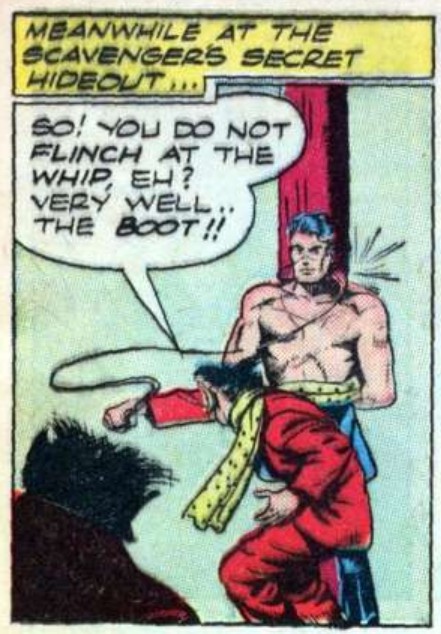
    Blackhawk’s next two adventures feature him getting whipped badly enough to mark up his torso, by the Black Tigress and the Scavengers, respectively. (Military Comics 004 & 005, 1941)

    Blackhawks:

    Blackhawk stalwart Andre is shot in the back by Nazis and then starts an avalanche with his own body to bury those same Nazis. Though he does survive, Andre is believed to be dead for the next six issues. (Military Comics 003, 1941)

    Blue Beetle:

    Blue Beetle is shot in a gang drive-by while in his civilian identity of Dan Garret. He only survives thanks to an operation to remove the bullet lodged two inches from his heart. Bonus fact: Dan has Type B blood! (Blue Beetle Comics v1 004, 1940)

    Dan Garret’s partner/ the Blue Beetle’s most dogged persecutor Mike Mannigan is a bit of a wound magnet. Here he is getting his skull creased by a bullet while attempting to round up one of the Sphinx’s men… (Mystery Men Comics 018, 1941)

    And here he is getting shot in the right arm. (Mystery Men Comics 026, 1941)

    Congo Bill:

    1941 is a bad year for Congo Bill’s shoulders. First he gets shot in the left… (Action Comics v1 038, 1941)

    … and then he gets a spear thrown clear through the right. (Action Comics v1 041, 1941)

    Dr Fate:

    Inza Cramer – long-time Dr Fate Companion/ eventual Dr Fate herself – takes a bullet meant for Kent “Dr Fate” Nelson by an agent of Mister X and is almost killed. (All-Star Comics 005, 1941)

    the Flash: 

    Jay “the Flash” Garrick gets his skull creased by a bullet while moving slow to avoid risking his secret identity. (All-Flash Quarterly 002, 1941)

    the Patriot: 

    Future Captain America stand-in the Patriot is shot and seemingly killed at the end of his story in Marvel Mystery Comics 024 but at the resolution of the cliffhanger in the next issue he turns out to have sustained a fashionable bullet crease to the skull. (Marvel Mystery Comics v1 024, 1941)

    the Ragman:

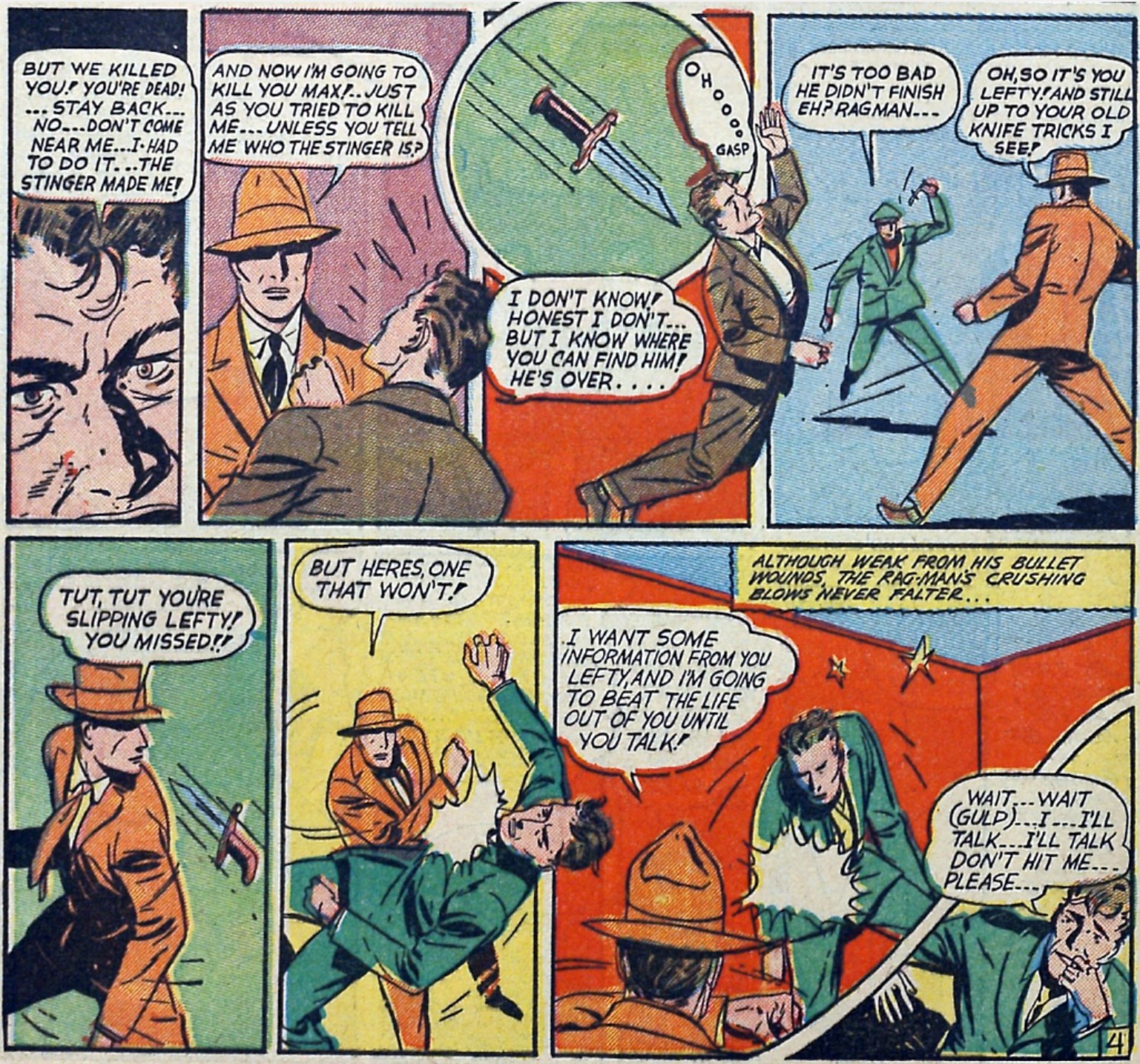
    Ambushed and shot up by agents of the Stinger, the Ragman survives thanks to a bulletproof vest, but evidence would suggest that he was shot at least once and possibly twice in the right arm. (Cat-Man Comics 003, 1941)

  • CATALOGUE OF WOUNDS 002

    CATALOGUE OF WOUNDS 002

    Just which comic book character has taken the most punishment down through the years? join me as we compile the definitive guide to bodily trauma in the super class. 

    Blackhawk:

    Blackhawk must set off an explosion from closer-than-optimal range and ends up getting lightly shredded. (Military Comics 003, 1941)

    Blackhawk’s next two adventures feature him getting whipped badly enough to mark up his torso, by the Black Tigress and the Scavengers, respectively. (Military Comics 004 & 005, 1941)

    Blackhawks:

    Blackhawk stalwart Andre is shot in the back by Nazis and then starts an avalanche with his own body to bury those same Nazis. Though he does survive, Andre is believed to be dead for the next six issues. (Military Comics 003, 1941)

    Blue Beetle:

    Blue Beetle is shot in a gang drive-by while in his civilian identity of Dan Garret. He only survives thanks to an operation to remove the bullet lodged two inches from his heart. Bonus fact: Dan has Type B blood! (Blue Beetle Comics v1 004, 1940)

    Dan Garret’s partner/ the Blue Beetle’s most dogged persecutor Mike Mannigan is a bit of a wound magnet. Here he is getting his skull creased by a bullet while attempting to round up one of the Sphinx’s men… (Mystery Men Comics 018, 1941)

    And here he is getting shot in the right arm. (Mystery Men Comics 026, 1941)

    Congo Bill:

    1941 is a bad year for Congo Bill’s shoulders. First he gets shot in the left… (Action Comics v1 038, 1941)

    … and then he gets a spear thrown clear through the right. (Action Comics v1 041, 1941)

    Dr Fate:

    Inza Cramer – long-time Dr Fate Companion/ eventual Dr Fate herself – takes a bullet meant for Kent “Dr Fate” Nelson by an agent of Mister X and is almost killed. (All-Star Comics 005, 1941)

    the Flash: 

    Jay “the Flash” Garrick gets his skull creased by a bullet while moving slow to avoid risking his secret identity. (All-Flash Quarterly 002, 1941)

    the Patriot: 

    Future Captain America stand-in the Patriot is shot and seemingly killed at the end of his story in Marvel Mystery Comics 024 but at the resolution of the cliffhanger in the next issue he turns out to have sustained a fashionable bullet crease to the skull. (Marvel Mystery Comics v1 024, 1941)

    the Ragman:

    Ambushed and shot up by agents of the Stinger, the Ragman survives thanks to a bulletproof vest, but evidence would suggest that he was shot at least once and possibly twice in the right arm. (Cat-Man Comics 003, 1941)

  • MINOR SUPER-VILLAIN 917: THE GHOST

    (Cat-Man Comics 004, 1941)

    The Upper New York Castle District appears to also exist in the Temerson/Helnit universe, because when NYC-based vigilante the Ragman is hired to investigate a supposed haunting at a place called Glascow Castle he hops in his car and drives there. Glascow Castle’s owner, Sir Wilkens Sidney, claims to have seen the ghost of 18th Century murder victim Duke Edgeroy wandering the halls of his home and believes that the Ragman is the man to get to the bottom of things before he flees into the night screaming.

    And it turns out that Sir Sidney is correct, because the Ragman isn’t in the castle for five minutes before he discovers a secret basement full of counterfeiting equipment and finds himself battling a very solid Ghost and his even less ghostly henchmen.

    After a bit of back and forth involving swordplay, deathtraps and a trained attack dog the Ghost is finally unmasked and revealed to be racketeer Marty Vance, who was so invested in the castle as a perfect location for his operation that he moved in despite the fact that Sir Sidney was already living there. Perhaps he was in it for the love of the haunting game as much as the counterfeiting, who knows.

    One thing I’ll say about this particular Ghost: he’s got one of the more horrifying masks that I’ve seen on one of his ilk.

    Categorized under: Accessories (Headquarters (Castle)), Extortion & Fraud (Counterfeiting/ Fake Ghost), Supranormal Beings (Ghosts) 

  • MINOR SUPER-VILLAIN 917: THE GHOST

    (Cat-Man Comics 004, 1941)

    The Upper New York Castle District appears to also exist in the Temerson/Helnit universe, because when NYC-based vigilante the Ragman is hired to investigate a supposed haunting at a place called Glascow Castle he hops in his car and drives there. Glascow Castle’s owner, Sir Wilkens Sidney, claims to have seen the ghost of 18th Century murder victim Duke Edgeroy wandering the halls of his home and believes that the Ragman is the man to get to the bottom of things before he flees into the night screaming.

    And it turns out that Sir Sidney is correct, because the Ragman isn’t in the castle for five minutes before he discovers a secret basement full of counterfeiting equipment and finds himself battling a very solid Ghost and his even less ghostly henchmen.

    After a bit of back and forth involving swordplay, deathtraps and a trained attack dog the Ghost is finally unmasked and revealed to be racketeer Marty Vance, who was so invested in the castle as a perfect location for his operation that he moved in despite the fact that Sir Sidney was already living there. Perhaps he was in it for the love of the haunting game as much as the counterfeiting, who knows.

    One thing I’ll say about this particular Ghost: he’s got one of the more horrifying masks that I’ve seen on one of his ilk.

    Categorized under: Accessories (Headquarters (Castle)), Extortion & Fraud (Counterfeiting/ Fake Ghost), Supranormal Beings (Ghosts) 

  • MINOR SUPER-VILLAIN 916: THE STINGER

    MINOR SUPER-VILLAIN 916: THE STINGER

    (Cat-Man Comics 003, 1941)

    The Stinger is in most respects an extremely generic masked gang boss of the kind that we have seen so frequently before, right down to the fact that he is wearing one of those hanging cloth face masks, an item only worn by generic masked gang bosses of the 1940s. The real difference between all those other guys and the Stinger is that the Stinger’s very first move was to send out some goons to ambush and murder local vigilante and only credible threat to his operations the Ragman. 

    This important step having been completed, the Stinger launches a massive crimewave, that includes four simultaneous bank robberies and the kidnapping of the police commissioner. Mayor Not La Guardia is not happy about all this, as he expresses to conspicuous named character police Lieutenant Burns.

    The only major flaw in the Stinger’s plan is that his gang is made up of 1940s comic book gangsters who don’t think to check for a pulse when they are sent to murder someone. This is important because it turns out that the Ragman was wearing a bulletproof vest the whole time and was just playing dead when he was dumped in the river. 

    Having beaten up the Stinger’s entire operation, the Ragman is able to track him down and unmask him as, you might have guessed it, Lt, Burns, the only new named character in the story. It’s the old classic “crooked cop becomes masked crimelord” story again, though this is the first crooked police lieutenant we’ve seen. 

    Categorized under: Body (Nonhuman Body Parts), Location (NYC), Profession (Law Enforcement)

  • MINOR SUPER-VILLAIN 916: THE STINGER

    (Cat-Man Comics 003, 1941)

    The Stinger is in most respects an extremely generic masked gang boss of the kind that we have seen so frequently before, right down to the fact that he is wearing one of those hanging cloth face masks, an item only worn by generic masked gang bosses of the 1940s. The real difference between all those other guys and the Stinger is that the Stinger’s very first move was to send out some goons to ambush and murder local vigilante and only credible threat to his operations the Ragman. 

    This important step having been completed, the Stinger launches a massive crimewave, that includes four simultaneous bank robberies and the kidnapping of the police commissioner. Mayor Not La Guardia is not happy about all this, as he expresses to conspicuous named character police Lieutenant Burns.

    The only major flaw in the Stinger’s plan is that his gang is made up of 1940s comic book gangsters who don’t think to check for a pulse when they are sent to murder someone. This is important because it turns out that the Ragman was wearing a bulletproof vest the whole time and was just playing dead when he was dumped in the river. 

    Having beaten up the Stinger’s entire operation, the Ragman is able to track him down and unmask him as, you might have guessed it, Lt, Burns, the only new named character in the story. It’s the old classic “crooked cop becomes masked crimelord” story again, though this is the first crooked police lieutenant we’ve seen. 

    Categorized under: Body (Nonhuman Body Parts), Location (NYC), Profession (Law Enforcement)

  • MINOR SUPER-HERO ROUND-UP 075

    Every hero comes with a free sidekick! 

    the Deacon:

    An otherwise unnamed man headquartered in the disused Marshlands Church that is located in a kind of liminal space just outside of several urban areas (including but not limited to: Coast Town, Midland City and Central City), the Deacon was himself once a young criminal mastermind.

    Two years after his original gang is rounded up by the police, the future Deacon is still on the wrong side of the law as part of another crook’s gang, but he’s starting to have some doubts about the path his life is on, particularly the part where his boss Marty is going to murder a night watchman during their next job. He tips off the police and in return they shoot him in the arm as he runs away

    Making his way to the aforementioned abandoned Marshlands Church, the wounded ex-criminal puts on a suit of priest’s clothes that he finds there, and when Marty and his old gang track him down to extract some revenge for his betrayal he is able to muster up enough righteous vigour to beat them up and deliver them into the hands of the law.

    One thing about the  Deacon that might not be evident from my retelling is that despite the sort of gentle world-weariness that the character is portrayed with, based on the timeline presented in the story of his origin, he is at most about twenty-eight years old, and that is a pretty funny age to have already seen it all. (Cat-Man Comics 001, 1941)

    Mickey Matthews: 

    In common with his mentor, the Deacon’s sidekick Mickey Matthews is a former juvenile crook who decided that a life of crime was not for him and paid the price for it, in his case in the form of being beaten up and tossed out of a speeding car for dead. After the Deacon finds him and patches him up he decides to turn his life around and join his benefactor’s war on crime. (Cat-Man Comics 001, 1941)

    the Ragman:

    Millionaire newspaper columnist Jay Garson Jr has really been stirring up trouble with his column “Crime Does Not Pay,” so much so that he is lured into Central Park and murdered one night. Or so the criminal element think! What actually happens is that a nearby homeless man who looks exactly like Garson is accidentally killed instead of him, and so Garson swaps clothes with the corpse in order to fake his own death.

    Taking inspiration from his new wardrobe, Garson dubs himself the Ragman (also Rag Man and Rag-Man) and sets out to solve his own murder, and then decides to continue fighting crime rather than resuming his old life.

    Though Garson declines to inform his fiance Joan that he is in fact alive, he does continue to send his newspaper column to the Daily Star to get printed, much to the consternation of his editor. (Cat-Man Comics 001, 1941)

    Tiny: 

    Jay “Ragman” Garson might not have thought it necessary to loop in his fiance re: him being alive, but one person who he does make sure to inform is his chauffeur, Tiny, who immediately joins him as a sidekick. 

    Tiny is an annoying character to write about: he is a very good sidekick, especially by the standards of African American characters in 1940s comics, who tend to get assigned all kinds of stereotypes (laziness, superstition, cowardliness, stupidity) in the name of comic relief. Tiny doesn’t have any of those qualities – aside from a bit of understandable nervousness at meeting what he believes to be a dead man – but he certainly talks like a character who does. Various sources assure me that the accent is toned down eventually, but the 1941 version of the character makes it rough for someone (me) trying to find good pictures of him. (Cat-Man Comics 001, 1941)

    Categorized under: Minor Super-Heroes, Origin by Choice (Face Turn, Faking Your Own Death), Profession (Religious)