The Curse of Skeleton Munroe

Blog

  • MINOR SUPER-VILLAIN 971: THE MONSTER

    (Fantastic Comics 023, 1941)

    The comic opens in media res, as a (the) Monster bursts into the hotel room of art critic Iona Hall and carries her off into the night. Cut to the Gorman Art Gallery the next day, where we see… Iona Hall!?

    As you might have guessed, this isn’t the real Iona Hall, and “famous art connoisseur” Dan Kenneth spots this when he is introduced to the false Hall by gallery owner Gorman. When Kenneth attempts to discover the reason for this imposture, however, he and the repentant fake are attacked by gun-toting goons and have to engage in a thrilling chase, and then, when he is able to ask the question a second time, the Monster shows up and carries away the double in the same manner as the original.

    It’s such a weird situation that Kenneth can’t even convince the police to look into it lest he be thrown in the drunk tank for challenging their view of reality. He simply has to adopt a new identity as the vigilante Gladiator in order to knock the beast out and discover just what the heck is going on.

    So what the heck is going on? It’s perfectly simple: art collector Craven has a painting by the great artist Velasquez and wants to have both it and some more money. To that end here is his plan:

    1. Bring in art critic Iona Hall
    2. Kidnap Hall as the Monster
    3. Replace Hall with lookalike June Starr
    4. Have his crony Gorman sell the painting at auction
    5. Buy his own painting for less than it’s worth
    6. Ask Dan Kenneth to give the painting the once-over for him
    7. As the Monster again, steal the painting from Kenneth
    8. Hold Kenneth responsible for the loss of the painting
    9. Collect the money from Kenneth and enjoy it while the painting hangs in his home.

    Some flaws in this plan include:

    1. Iona Hall seems to be completely superfluous to the plan, unless she is there to authenticate the painting
    2. Even if this is the case, kidnapping and replacing Hall is only necessary if the painting is fake, which it isn’t
    3. June Starr is an unwilling accomplice who acts against the plan at least three times – an unkidnapped Iona Hall is far preferable
    4. The auction is completely unnecessary if Craven openly owns the painting – just ask Kenneth to clean it for you
    5. Plus you’ve driven down the price by buying it cheap. Perhaps they sold it for the amount that they thought that they could get out of Kenneth, in which case they chose the wrong scam and they should have been doing:
    6. Insurance fraud. The scam they should have been pulling was insurance fraud

    All in all I must assume that Craven was just too excited about his cool monster suit and came up with a plan that allowed him to use it a couple of times, because that is the only lens through which this scheme makes a lick of sense.

    Categorized in: Accessories (Personal Transport – Robotic Exoskeletons), Animals (Monsters), Narrative Footballs (Misc Origin Story Guys) 

  • ALIENS AND SO FORTH ROUND-UP 048

    Gosh! How alien they are!

    Frog-Men:

    These two Frog-Men cause trouble for Sub Saunders when they steal his ship for a little joyriding/ piracy session. They are undone by the fact that neither of them know how to drive, and are ultimately head-konked into submission after crash landing. What this tells us about Frog-Man society is unclear – if this were a Star Wars then the Frog-Men would end up being a race of car thieves, of course, but most societies don’t work like that. (Fantastic Comics 021, 1941)

    Martians:

    Today’s selection of Martians is going to include some classic design elements! First we have this species represented by the very helpful Darek. Darek is based on the old Speculative Evolution version of a Martian, with spindly limbs due to the lower gravity and huge ears and lungs to aid in hearing and breathing in a thin atmosphere. As a bonus, he’s also from a Mars that is covered in some classic canals, and has a hint of an interesting culture and mythology thanks to some early Jack Kirby writing. And of course he is green. A true classic Martian in many ways. (Crash Comics Adventures 003, 1940)

    Martians:

    These Martians aren’t quite as cool as the previous ones, but the ruddy tint to their skin is a real classic design element for aliens from the Red Planet. I also appreciate that they look a bit like Space Elves wearing little green hats. If “Space Smith” was still being created by Fletcher Hanks when they appeared I might speculate that they were of the same species as the Brain, but I can’t in good conscience do so now. Besides, even Hanks’ version of Mars supports multiple humanoid species.

    As a bonus, these Martians help Space Smith and Dianna defeat an attempted invasion of the Solar System by an extrasolar group called the Generals of Capella. We never actually learn much about these guys due to the fact that they attack with the aid of remote controlled meteors called “sandblasts,” but when has that ever mattered: they’re going on the list. (Fantastic Comics 009, 1940) 

    Martians:

    For our final Classic Martian Design Element, we have these warlike Martians dressed in futuristic Roman gear! The connection between the planet Mars and the god Mars has dramatically extended the reach of the brush-topped helmet in fiction over the years, and given us countless Martian aggressors to boot.

    These particular Martians are hell-bent on claiming the interior of one of the Living Planet Monsters as their own, for some reason, and the fact that they attack the human colonists who are already there is especially egregious because they don’t actually want to be there, they just got eaten. This unreasonable aggression is enough to make Saber, the Spy Fighter (there to rescue the Earth colonists) use his mega-powers to grow enormous and turf the entire Mars contingent out into the void of space. (Fight Comics 010, 1940)

  • MAD AND CRIMINAL SCIENTIST ROUND-UP 025

    I feel like we could avoid some of this unpleasantness if we made the Mad Arts a required part of the curriculum again.

    Unnamed Sorcerer:

    The Golden Knight and Alice are up to some good old-fashioned adventure, as they travel into the land of Kongola to seek out the cause of mysterious disappearances of people in adjoining Kooran. Just where are Kongola and Kooran? I’m going to say somewhere in what is now the United Kingdom since that that is where the Golden Knight is headquartered, but they could literally be anywhere given that he has started visiting his supernatural brothers in-law on the Moon and the Sun and thus has an interplanetary range.

    Kongola turns out to be a good place for adventure, as it is filled with magical and monstrous threats including:

    – hypnotic illusions

    – carnivorous trees hiding behind those illusions

    – club-wielding minotaurs

    – giant bats

    – ape men, who manage to carry off Alice

    Pressing on, the Golden Knight arrives at a huge tower that he says has been built by the enslaved people of Kooran, but I never see them.

    So just who is responsible for the kidnappings, the tower and the monsters? Why, this insane magician, who claims to have done it all so that he can be safe from floods and then promptly jumps off the tower into a… lake? and drowns. More importantly, why is he listed here in the space reserved for low-rent mad scientists? Because while comic book magic users fill a very similar ecological niche as super-scientists they don’t have as great a population and consequently a far lesser rate of one-note losers, and I had to put him somewhere. (Fantastic Comics 019, 1941)

    the Professor:

    The Professor is a hypnotist of some stripe who uses his powers to turn lawmen into agents of his gang. He meets his match in detective Spencer Steel, who as a comic book protagonist is of course immune to such feeble things as mind control and quickly turns the tables on his would-be master. (Fight Comics 011, 1941)

    Unnamed Scientist:

    Though this unnamed scientist talks a bit like a kindly mentor who gives you super-powers in order to save mankind from aliens etc, in practice he just has a kid tied up in his jungle compound who he feeds potions to. Perhaps he had some sort of important plan that would justify this behaviour but if so it is lost to the ages when he wanders out into the jungle to get hilariously killed by an extremely jumpy snake.

    The poor kid, meanwhile, grows into a giant and aimlessly wanders the countryside battling various world militaries until Power-Man shows up and tosses a bomb at his gut. It’s a bummer ending that wouldn’t happen in most comics and I kind of respect it. (Fight Comics 012, 1941)

    Dr Moluk:

    Dr Moluk and his assistant Scorpo have developed a machine that takes germs and bacteria and assembles them into multicellular organisms that resemble golden dragon-dogs. He intends to use these creatures to sow mass panic and ultimately take over the world. An evil plan, but a cool one. 

    Unfortunately for Moluk, his assigned heroic enemy is Guy Gorham, who is billed as the World’s Greatest Chemist but acts like the World’s Most Thorough Ass-Kicker. He busts in, beats ten kinds of hell out of Moluk and Scorpo, and ends up feeding the former to his own dragons. It honestly feels like bullying by the end. (Great Comics 001, 1941)

  • PROBLEMATIC ROUND-UP 008

    Once again I must regretfully inform you that some comic books are problematic. Like, racially.

    the Laughing Hyenas: 

    Hey, it’s our first racial hate group, and I think I’m just going to preemptively file these under “problematic” because they’re a) not fun to talk about and b) necessitate talking about hate-crimes even if I, for example, choose not to use the panels with lynchings in them.

    The Laughing Hyenas are actually kind of a hate group by proxy, as they have been hired to keep the Black residents of the geographically-nonspecific town of Souda “in line” by murdering one of them every once in a while, and have been doing so frequently enough and/or long enough that even the local folks willing to volunteer for such a task have gotten sick of it, so boss Bull Karson had to import some Chicago toughguys to do his dirty work for him.

    Oddly, given the sheer volume of murder that the Laughing Hyenas were perpetrating, the Silver Streak doesn’t actually bring them in to the authorities ore even extra-judiciously kill them. Instead, he just dumps them on a slow boat to Rangoon. (Silver Streak Comics 013, 1941)

    the Modern Thief of Bagdad:

    Ali Hassan, aka the Modern Thief of Bagdad, is an Iraqi thief who comes to NYC to steal the Konoor Diamond, and as a result comes into conflict with Captain Battle and his young protege Hale Battle. A simple story that would ordinarily wrap up quite quickly, but this is a book-length yarn, which means that there is an extended chase sequence that occupies the 28 pages between the theft and Hassan’s arrival back in Baghdad. Some highlights:

    Chapter 1, “The Modern Thief of Bagdad!”: Hassan steals the gem, then give Battle and Hale the slip in Chinatown. Olyra, the mysterious guardian of the Konoor Diamond, is kidnapped.

    Chapter 2, “Perils of the Sargasso Sea!”: Hassan’s submarine becomes mired in sargassum and is attacked by a sea monster. Battle and Hale kill the beast. Hassan and his men dress up like ghost pirates. Olyra is rescued and then kidnapped again.

    Chapter 3, “Lost in the Underground World!”: Hassan’s plane crashes in Africa and he and Olyra are captured by cannibals (lil’ bonus racism for you there). Battle and Hale rescue them before being betrayed and dumped in a pit of quicksand. There is a brief interlude in an cave system full of monsters before it suddenly blows up. Hassan and his men dress up like ghosts. Olyra is rescued.

    Chapter 4, “House of Giants”: Battle & co track Hassan to a castle in Tibet, where they are captured and subjected to a shrink ray. They have various adventures as tiny men before resuming their original size. Olyra is kidnapped.

    I would call Hassan himself… an average amount of racist. He’s depicted in much the same generically foreign vein as I’ve seen in a South American president or a Basque fisherman (or indeed a Cape Breton fisherman at least once). As a villain, he’s pretty great: bombastic, treacherous, fond of leaving boastful notes for his enemies. If it was just him I might have skipped making this a Problematic Round-Up entry.

    It’s not just him, however, and once the story hits Chapter 5, “Magic Spell of the Arabian Nights” we get a real dose of Orientalism full in the face, as our heroes touch down in a Baghdad straight out of the Arabian Nights, complete with a wicked ruler (confusingly named Emperor Pasha Golu) who Hassan has been working for the whole time.

    It’s such a pastiche of a city, in fact, that Hale and Olyra just kind of stumble across Aladdin’s lamp and flying carpet while they are escaping from a dungeon. I suppose that all this is at least a little thematically appropriate, as Ali Hassan, the Modern Thief of Bagdad, is a reference to a movie that is a remake of a different movie that is itself a pastiche of the Arabian Nights.

    The Modern Thief of Bagdad meets his end in a pretty underwhelming manner: Captain Battle ducks as he swings a sword at him and he falls off of a balcony. A pretty terrible way to go for a villain who clearly thought that he was very cool, to be honest. The evil Pash Golu also meets his end in the process, leaving Olyra free to reveal that she is actually Olyria, Princess and true ruler of Bagdad. A truly impenetrable alias! 

    Finally, such is Hale Battle’s hunger for souvenirs that he uses his third genie with to acquire a replica of the diamond for his collection, even though for my money the real deal Lamp of Aladdin with one wish left on it would be the ultimate keepsake. (Captain Battle Comics 002, 1941)

    the King:

    The King is a fellow who gains control over a Romani group by showing them a… birthmark? tattoo? that proves his right to rule and that looks so intensely falsifiable that I am shocked there isn’t some sort two-factor authentication, or even a code phrase. And just what is is reason for exerting this control? Why, so that he can turn his new subjects into a child kidnapping ring. You can see how I would consider this problematic.

    The King is of course not the real ruler, that is not a real skull birthmark and he is no match for Dynamic Man. He turns out to be a crooked newspaper publisher named Brower who loves money more than making good plans to acquire it. (Dynamic Comics 002, 1941)

    the Dragon:

    The Dragon is a very ordinary Yellow Peril villain who is after some top secret bomber plans on behalf of an unspecified Asian nation. There are exactly four interesting things about him: 1) he is the first villain faced by Samson and David in their brief New Look era before they disappear along with most of Fox Features’ other characters during their financial trouble. 2) he is a classic calling card leaver in the form of a claw mark on the chests of men he has killed

     3) he works alongside his sister Orchid, which isn’t the rarest arrangement but is always fun to note

     4) he has these stone lions outside of his HQ that grab intruders as they come through. It’s a fun trap but never actually explained: are they some sort of mechanism, or demonic magic like the caption box suggests?

    Much of the issue in questioned is concerned with Samson chasing the Dragon and Orchid around. Once he catches up to them it’s all over. (Fantastic Comics 022, 1941)

  • PROBLEMATIC ROUND-UP 008

    Once again I must regretfully inform you that some comic books are problematic. Like, racially.

    the Laughing Hyenas: 

    Hey, it’s our first racial hate group, and I think I’m just going to preemptively file these under “problematic” because they’re a) not fun to talk about and b) necessitate talking about hate-crimes even if I, for example, choose not to use the panels with lynchings in them.

    The Laughing Hyenas are actually kind of a hate group by proxy, as they have been hired to keep the Black residents of the geographically-nonspecific town of Souda “in line” by murdering one of them every once in a while, and have been doing so frequently enough and/or long enough that even the local folks willing to volunteer for such a task have gotten sick of it, so boss Bull Karson had to import some Chicago toughguys to do his dirty work for him.

    Oddly, given the sheer volume of murder that the Laughing Hyenas were perpetrating, the Silver Streak doesn’t actually bring them in to the authorities ore even extra-judiciously kill them. Instead, he just dumps them on a slow boat to Rangoon. (Silver Streak Comics 013, 1941)

    the Modern Thief of Bagdad:

    Ali Hassan, aka the Modern Thief of Bagdad, is an Iraqi thief who comes to NYC to steal the Konoor Diamond, and as a result comes into conflict with Captain Battle and his young protege Hale Battle. A simple story that would ordinarily wrap up quite quickly, but this is a book-length yarn, which means that there is an extended chase sequence that occupies the 28 pages between the theft and Hassan’s arrival back in Baghdad. Some highlights:

    Chapter 1, “The Modern Thief of Bagdad!”: Hassan steals the gem, then give Battle and Hale the slip in Chinatown. Olyra, the mysterious guardian of the Konoor Diamond, is kidnapped.

    Chapter 2, “Perils of the Sargasso Sea!”: Hassan’s submarine becomes mired in sargassum and is attacked by a sea monster. Battle and Hale kill the beast. Hassan and his men dress up like ghost pirates. Olyra is rescued and then kidnapped again.

    Chapter 3, “Lost in the Underground World!”: Hassan’s plane crashes in Africa and he and Olyra are captured by cannibals (lil’ bonus racism for you there). Battle and Hale rescue them before being betrayed and dumped in a pit of quicksand. There is a brief interlude in an cave system full of monsters before it suddenly blows up. Hassan and his men dress up like ghosts. Olyra is rescued.

    Chapter 4, “House of Giants”: Battle & co track Hassan to a castle in Tibet, where they are captured and subjected to a shrink ray. They have various adventures as tiny men before resuming their original size. Olyra is kidnapped.

    I would call Hassan himself… an average amount of racist. He’s depicted in much the same generically foreign vein as I’ve seen in a South American president or a Basque fisherman (or indeed a Cape Breton fisherman at least once). As a villain, he’s pretty great: bombastic, treacherous, fond of leaving boastful notes for his enemies. If it was just him I might have skipped making this a Problematic Round-Up entry.

    It’s not just him, however, and once the story hits Chapter 5, “Magic Spell of the Arabian Nights” we get a real dose of Orientalism full in the face, as our heroes touch down in a Baghdad straight out of the Arabian Nights, complete with a wicked ruler (confusingly named Emperor Pasha Golu) who Hassan has been working for the whole time.

    It’s such a pastiche of a city, in fact, that Hale and Olyra just kind of stumble across Aladdin’s lamp and flying carpet while they are escaping from a dungeon. I suppose that all this is at least a little thematically appropriate, as Ali Hassan, the Modern Thief of Bagdad, is a reference to a movie that is a remake of a different movie that is itself a pastiche of the Arabian Nights.

    The Modern Thief of Bagdad meets his end in a pretty underwhelming manner: Captain Battle ducks as he swings a sword at him and he falls off of a balcony. A pretty terrible way to go for a villain who clearly thought that he was very cool, to be honest. The evil Pash Golu also meets his end in the process, leaving Olyra free to reveal that she is actually Olyria, Princess and true ruler of Bagdad. A truly impenetrable alias! 

    Finally, such is Hale Battle’s hunger for souvenirs that he uses his third genie with to acquire a replica of the diamond for his collection, even though for my money the real deal Lamp of Aladdin with one wish left on it would be the ultimate keepsake. (Captain Battle Comics 002, 1941)

    the King:

    The King is a fellow who gains control over a Romani group by showing them a… birthmark? tattoo? that proves his right to rule and that looks so intensely falsifiable that I am shocked there isn’t some sort two-factor authentication, or even a code phrase. And just what is is reason for exerting this control? Why, so that he can turn his new subjects into a child kidnapping ring. You can see how I would consider this problematic.

    The King is of course not the real ruler, that is not a real skull birthmark and he is no match for Dynamic Man. He turns out to be a crooked newspaper publisher named Brower who loves money more than making good plans to acquire it. (Dynamic Comics 002, 1941)

    the Dragon:

    The Dragon is a very ordinary Yellow Peril villain who is after some top secret bomber plans on behalf of an unspecified Asian nation. There are exactly four interesting things about him: 1) he is the first villain faced by Samson and David in their brief New Look era before they disappear along with most of Fox Features’ other characters during their financial trouble. 2) he is a classic calling card leaver in the form of a claw mark on the chests of men he has killed

     3) he works alongside his sister Orchid, which isn’t the rarest arrangement but is always fun to note

     4) he has these stone lions outside of his HQ that grab intruders as they come through. It’s a fun trap but never actually explained: are they some sort of mechanism, or demonic magic like the caption box suggests?

    Much of the issue in questioned is concerned with Samson chasing the Dragon and Orchid around. Once he catches up to them it’s all over. (Fantastic Comics 022, 1941)

  • ALIENS AND SO FORTH ROUND-UP 047

    ALIENS AND SO FORTH ROUND-UP 047

    It’s more of those dastardly (and not-so-dastardly) aliens!

    Zutarians:

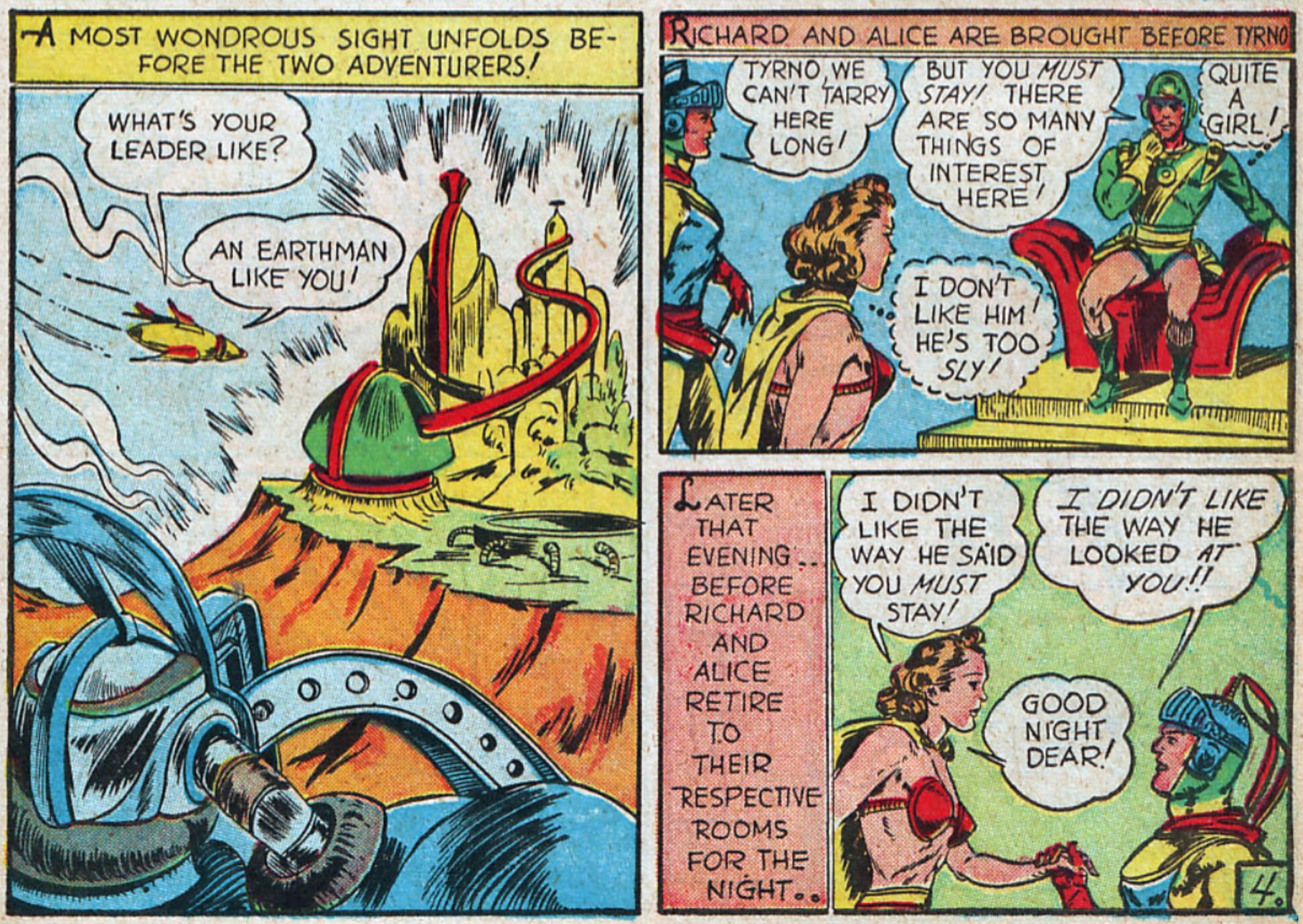
    One day while on a trip to visit his magic brother in-law who lives on the sun, the Golden Knight and Alice are thrown off course and crash on planet Zutarn, where they are picked up by some friendly-yet-threatening Zutarians. As is often the case in Golden Age comics, the exact location of Zutarn is not stated – for bookkeeping reasons I’m going to say it’s in an unspecified star system, but it’s equally likely to have been intended to be somewhere within our own.

    The dichotomy inherent in the friendly nature of the Zutarians versus the fact that they take our heroes away at gunpoint is soon explained when it is revealed that their leader Tyrno is an Earthling and a real underhanded creep tyrant. Just how did a 12th Century human get to another planet, let alone take it over? Did one of his siblings marry a magic spaceman as well?

    Just how or why Tyrno is King of Zutarn becomes moot, because he attempts to murder the Golden Knight and marry Alice against her will, and in the process finally pushes the Zutarians a bit too far and so they murder him. I imagine that they must have been pretty close to doing so already, but their naturally hospitable natures finally had too much as Tyrno proved himself a bad host in addition to a tyrant. (Fantastic Comics 020, 1941)

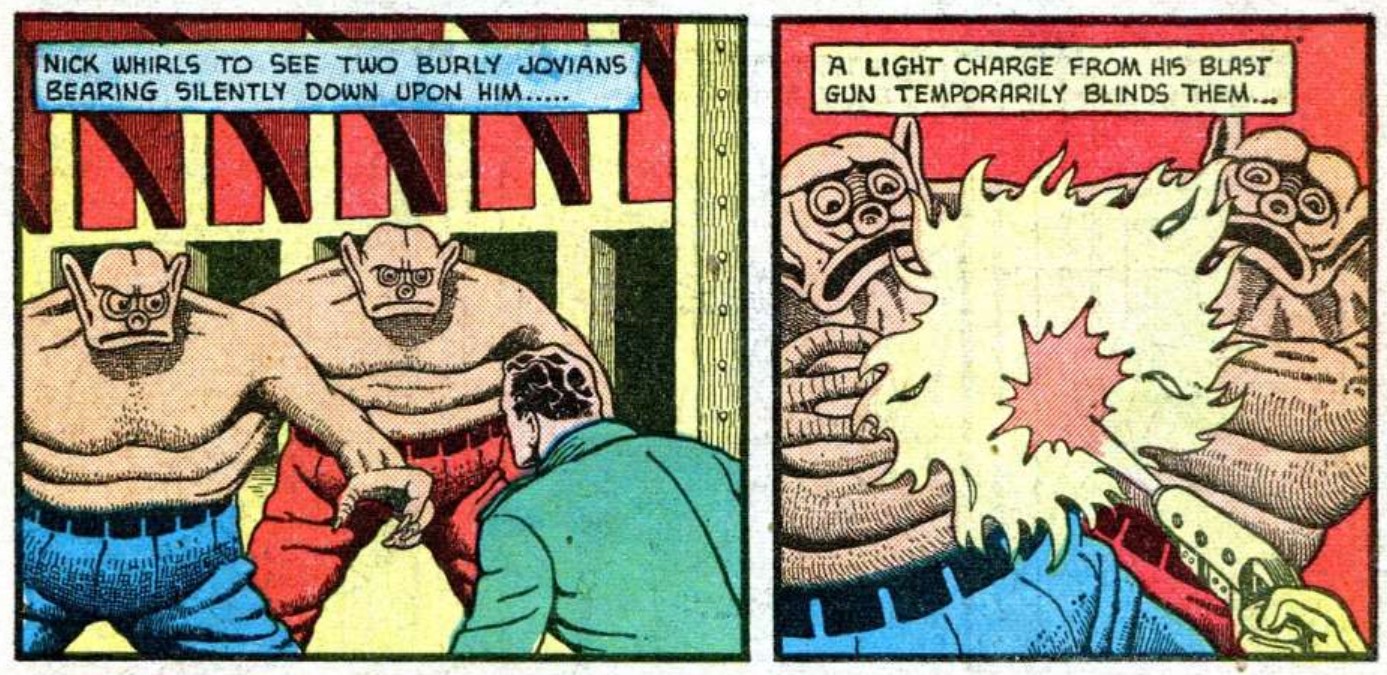
    In Amazing Mystery Funnies 022 (aka Amazing Mystery Funnies v3 006 for all those who like their issue numbering to be consistent), Nick Nelson of the Space Patrol infiltrates a seedy space casino in order to get the goods on its owner’s misdeeds. As is only appropriate, the place is jam-packed with criminal types from across the Solar System, including:

    Jovians: 

    We have actually seen these fellows before, in the previous issue of Amazing Mystery Funnies and also about 37 instalments of “Aliens and So Forth” ago, in the person of the Haggur. I am strangely proud of Basil Wolverton for remaining so consistent with an alien design, even if it was from just one issue earlier.

    Martians: 

    Case in point: these two Martian space bandits. Just how are they related to the Martian species that Nelson’s partner Kodi (who was in this comic not two pages earlier) belongs to, you reckon? I am very intrigues by this disc game that they are playing – do you reckon that it is closer to cards or dominoes?

    Mercurians: 

    And then by contrast with the Martians, we have the Mercurians, who absolutely look like they are part of the same species as the one who we met last time, but who are members of a different regional phenotype.

    Saturnians: 

    I am not fond of just how lumpy this guy is. Maybe it’s a side effect of the drug smuggling and all Saturnians don’t have to deal with this much texture in their lives.

    Venusians:

    We don’t get a good look at these Venusians. They kind of look like smoother Mercurians – perhaps the two species are related somehow. 

    Plutonians:

    The owner of the casino is a fellow named Jol the Plutonian, and while he is a dirtbag of the highest order he doesn’t handle Nelson as well as he could. Rather than merely kick the Space Patrolman out of his establishment (he literally has no evidence), he attempts to have him killed, fails and gets into a high-speed space chase that ends with him crashing into the Moon and dying. Very uncool.

    Like many Wolverton aliens, Plutonians are just kind of lizardy humanoids with weird facial features, but I must say I enjoy the tentacle arms.

  • ALIENS AND SO FORTH ROUND-UP 047

    ALIENS AND SO FORTH ROUND-UP 047

    It’s more of those dastardly (and not-so-dastardly) aliens!

    Zutarians:

    One day while on a trip to visit his magic brother in-law who lives on the sun, the Golden Knight and Alice are thrown off course and crash on planet Zutarn, where they are picked up by some friendly-yet-threatening Zutarians. As is often the case in Golden Age comics, the exact location of Zutarn is not stated – for bookkeeping reasons I’m going to say it’s in an unspecified star system, but it’s equally likely to have been intended to be somewhere within our own.

    The dichotomy inherent in the friendly nature of the Zutarians versus the fact that they take our heroes away at gunpoint is soon explained when it is revealed that their leader Tyrno is an Earthling and a real underhanded creep tyrant. Just how did a 12th Century human get to another planet, let alone take it over? Did one of his siblings marry a magic spaceman as well?

    Just how or why Tyrno is King of Zutarn becomes moot, because he attempts to murder the Golden Knight and marry Alice against her will, and in the process finally pushes the Zutarians a bit too far and so they murder him. I imagine that they must have been pretty close to doing so already, but their naturally hospitable natures finally had too much as Tyrno proved himself a bad host in addition to a tyrant. (Fantastic Comics 020, 1941)

    In Amazing Mystery Funnies 022 (aka Amazing Mystery Funnies v3 006 for all those who like their issue numbering to be consistent), Nick Nelson of the Space Patrol infiltrates a seedy space casino in order to get the goods on its owner’s misdeeds. As is only appropriate, the place is jam-packed with criminal types from across the Solar System, including:

    Jovians: 

    We have actually seen these fellows before, in the previous issue of Amazing Mystery Funnies and also about 37 instalments of “Aliens and So Forth” ago, in the person of the Haggur. I am strangely proud of Basil Wolverton for remaining so consistent with an alien design, even if it was from just one issue earlier.

    Martians: 

    Case in point: these two Martian space bandits. Just how are they related to the Martian species that Nelson’s partner Kodi (who was in this comic not two pages earlier) belongs to, you reckon? I am very intrigues by this disc game that they are playing – do you reckon that it is closer to cards or dominoes?

    Mercurians: 

    And then by contrast with the Martians, we have the Mercurians, who absolutely look like they are part of the same species as the one who we met last time, but who are members of a different regional phenotype.

    Saturnians: 

    I am not fond of just how lumpy this guy is. Maybe it’s a side effect of the drug smuggling and all Saturnians don’t have to deal with this much texture in their lives.

    Venusians:

    We don’t get a good look at these Venusians. They kind of look like smoother Mercurians – perhaps the two species are related somehow. 

    Plutonians:

    The owner of the casino is a fellow named Jol the Plutonian, and while he is a dirtbag of the highest order he doesn’t handle Nelson as well as he could. Rather than merely kick the Space Patrolman out of his establishment (he literally has no evidence), he attempts to have him killed, fails and gets into a high-speed space chase that ends with him crashing into the Moon and dying. Very uncool.

    Like many Wolverton aliens, Plutonians are just kind of lizardy humanoids with weird facial features, but I must say I enjoy the tentacle arms.

  • MINOR SUPER-HERO ROUND-UP 094

    Super-heroes, coincidentally arranged in ascending order of notability!

    Kalkor:

    A faithful priest of Isis c.1000 BC, Kalkor is restored to life at the same time as Nagana, the Queen of Evil, as a foil to her power. He is empowered with the same immortality and comic book magic as Nagana so that he may combat her effectively (and perhaps as a way for Isis to make up for crushing him to death as a byproduct of collapsing a temple on Nagana to put an end to her evil ways).  

    Important note: though many Golden and Silver Age super-heroes may act like they have taken a vow of celibacy, Kalkor is one of the few who may have actually done so, as part of his Christianity-influenced version of Isis-worship. (Fantastic Comics 022, 1941)

    Kalkor is not really a super-hero in the traditional sense – he doesn’t roam around looking for guys mugging old ladies or Fifth Columnists sabotaging munitions factories. Instead, he follows Nagana around and foils whatever scheme she pursues in her ongoing effort to conquer the world. And like many characters who operate purely in reference to the actions of others, Kalkor is kind of dull.

    In order to get around our era more easily, Kalkor adopts the funny-about-twenty-years-ago-our time alias of John Kerry. He also seems to shop at the same Big Coat Store as fellow Fox super-hero Samson.

    Categorized in: Day Job (Priest), Origin (Divine Empowerment, Mystic Mutate, Resurrected Mystic Champion)

    the Gladiator:

    The Gladiator is Dan Kenneth, a “famous art connoisseur.” This baffled me hardcore until I realized that there was a pretty good chance that he was in fact an art conservationist or something like that, and sure enough a critical aspect of the villain’s scheme in his first outing is having Kenneth “recondition” a painting he has just bought, and in his second and final appearance they just go ahead and call him an art dealer.

    Kenneth gets mixed up in an overly-complicated plot by the aforementioned client to steal his own painting and still get cash – not insurance fraud but a second, stupider thing, see the upcoming entry on the Monster for further details – that is in fact so ridiculous that he can’t even convince the police to help him out. What else can he do but engage in a bit of vigilante justice in such a situation. He puts on a Roman gladiator outfit that he happens to have laying around, grabs his favourite cestus and bowling pin and sets out to meet his destiny. And then, as so frequently happens, the one-time foray into vigilante justice becomes a full-fledged hobby. (Fantastic Comics 023, 1941)

    Categorized in: Activities (Gladiators), Day Job (Art Dealer), Powers (Weapons Master)

    the Avenger:

    The Avenger is maybe the third most popular Street & Smith pulp character, and as such was adapted to comics in the early 40s and again every time the old gang gets together for another shot at the comics page in DC Front Line or wherever. Alas, just like his pulp career, none of the Avenger’s forays into comic books last very long, especially as compared to those of Doc Savage or the Shadow.

    Maybe I’m wrong, but the problem with comic book adaptations of the Avenger always seems to be that they take a premise like “solder of fortune loses family to criminals and thus sets out to balance the scales, armed with face that can be moulded like putty, a gun called Mike, a knife called Ike and a diverse cast of assistants called Justice Inc” and boil it down to “unsmiling widower tackles depressing crime.” (Shadow Comics v1 002, 1940)

    Categorized in: Accessories (Sidekicks), Origin (Mental Mutate, Motivated by Loss), Power (Moldable Face)

    Betty Ross:

    Betty Ross, aka Agent X-13, is a government agent who first appears as the seemingly-elderly-but-really beautiful guardian of the curio shop that conceals the super-soldier facility where Steve Rogers becomes Captain America (okay, it’s not 100% clear that this is Betty Ross in the original comics, but retcons have firmly established that it is). She goes on to take part in many of Captain America and Bucky’s Golden Age adventures – more, in fact, than the original Cap/Bucky duo (retcons again, being deployed to explain how they kept having adventures after they were supposedly frozen and dead, respectively. Or frozen and frozen, depending on the retcon). Late in the WWII era she even adopts a costumed identity of her own: Golden Girl.

    Betty plays a big enough role in these Golden Age comics that I was tempted to give her a full-fledged Super-Hero page such as characters like Lois Lane or Alfred will probably get but alas, she has been almost entirely replaced by Peggy Carter in comics published in the Silver Age and beyond. Is this because she shares a name with the Hulk’s love interest (who she was made the great aunt of in yet another retcon)? Possibly! (Captain America Comics 001, 1940)

    Categorized in: Accessories (Rubberoid Mask), Day Job (FBI Agent), Team Membership (FBI)

  • MINOR SUPER-VILLAIN 970: THE QUEEN OF EVIL

    (Fantastic Comics 022, 1941)

    Nagana, high priest of Isis in Thebes, achieves great power and the secret of immortality through her position and is seemingly consumed with megalomania. Importantly, these magical secrets do not appear to be tied to her faith in Isis so much as accessed as a result of it, as she retains them even after she rejects Isis and declares herself to be her enemy. She sets out to use this power to become the ruler of Thebes and sets her eyes on a hot new priest named Kalkor as her chosen consort.

    Trouble is, Kalkor rejects her due to her casual Isis-disrespect (and possibly also a vow of chastity? It can be hard to pick out specifically why a super-manly comic book character is going “ew, girls”) and Nagana attempts to have him killed for it. Kalkor survives due to his aforementioned manliness and confronts her, at which point she goes on a tirade so blasphemous that Isis drops the entire temple on them, killing hundreds spelling the end of Thebes as a major religious centre (in what is probably a big coincidence, the real-life Egyptian city of Thebes went also into decline about three thousand years ago, but due to an administrative scandal rather than divine wrath).

    Though Nagana is immortal, Isis curses her and transforms her to stone, until she is unearthed in the present day and exposed to moonlight. So restored, she murders the man who found her and vows to take over the world.

    Though Isis is much reduced in the modern world, she is able to resurrect Kalkor and give him the same powers as Nagana as a foil to her evil schemes (luckily for humanity, Kalkor hold Nagana responible for the destruction of Thebes rather than Isis’ fairly broadly-applied wrath).

    For all her big talk of taking over the world, Nagana’s only evil scheme of 1941 consists of her attempting to con an old man out of his fortune using a fortune telling con that is enhanced by a little real magic. She is also foiled by Kalkor with almost ridiculous ease. But fear not! Nagana and Kalkor will return in 1942 for more thrilling conflict!

    Categorized in: Day Jobs (Priests), Origins (Resurrected (Petrified Humans)), Royalty (Queens)

  • MINOR SUPER-VILLAIN 970: THE QUEEN OF EVIL

    (Fantastic Comics 022, 1941)

    Nagana, high priest of Isis in Thebes, achieves great power and the secret of immortality through her position and is seemingly consumed with megalomania. Importantly, these magical secrets do not appear to be tied to her faith in Isis so much as accessed as a result of it, as she retains them even after she rejects Isis and declares herself to be her enemy. She sets out to use this power to become the ruler of Thebes and sets her eyes on a hot new priest named Kalkor as her chosen consort.

    Trouble is, Kalkor rejects her due to her casual Isis-disrespect (and possibly also a vow of chastity? It can be hard to pick out specifically why a super-manly comic book character is going “ew, girls”) and Nagana attempts to have him killed for it. Kalkor survives due to his aforementioned manliness and confronts her, at which point she goes on a tirade so blasphemous that Isis drops the entire temple on them, killing hundreds spelling the end of Thebes as a major religious centre (in what is probably a big coincidence, the real-life Egyptian city of Thebes went also into decline about three thousand years ago, but due to an administrative scandal rather than divine wrath).

    Though Nagana is immortal, Isis curses her and transforms her to stone, until she is unearthed in the present day and exposed to moonlight. So restored, she murders the man who found her and vows to take over the world.

    Though Isis is much reduced in the modern world, she is able to resurrect Kalkor and give him the same powers as Nagana as a foil to her evil schemes (luckily for humanity, Kalkor hold Nagana responible for the destruction of Thebes rather than Isis’ fairly broadly-applied wrath).

    For all her big talk of taking over the world, Nagana’s only evil scheme of 1941 consists of her attempting to con an old man out of his fortune using a fortune telling con that is enhanced by a little real magic. She is also foiled by Kalkor with almost ridiculous ease. But fear not! Nagana and Kalkor will return in 1942 for more thrilling conflict!

    Categorized in: Day Jobs (Priests), Origins (Resurrected (Petrified Humans)), Royalty (Queens)