The Curse of Skeleton Munroe

Blog

  • MINOR SUPER-HERO ROUND-UP 087

    If the last group of minor Marvel super-heroes had a tiny chance of appearing in a modern comic book I would say that this group’s chances are tiny-plus. Like a further 5% chance. Except for Dynaman.

    Dynaman:

    Dynaman, aka Lagaro, which means “Dynaman”, was born in the ancient super-advanced Kingdom of Korug, located somewhere in the Atlantic Ocean. Endowed with super strength, a photographic memory and enhanced intelligence, the ability to fly and a general superiority to even his peers in the ancient Korugan super society, Dynaman had it all.

    Korug eventually suffers the fate of all ancient island super-societies and sinks into the sea, leaving Lagaro as the only survivor. He makes his way to Ancient Egypt (and the presence of the Sphinx when he does so gives us a more accurate guess than usual as to when in the past this adventure takes place, if only by telling us that it was some time after 2500 BCE) where he helps the heretofore unknown Pharaoh Khufor with a couple of problems (i.e., a giant caveman invasion). His further adventures go unrecorded.

    Dynaman, like Breeze Barton before him, is a simple concept (super guy) wrapped up in a lot of extra layers (last survivor of a super-race, in the past, somehow still looks like a 20th Century super-hero). This is one of two things that they have in common, with the other being that they were both brought back in the same Marvel Zombies sequel, only to be gruesomely killed off. (Daring Mystery Comics 006, 1940) 

    the Fin:

    The Fin is in reality Lieutenant Peter Noble, engineer in the US Naval Reserve, whose submarine is wrecked while on manoeuvres in the Atlantic. Noble, the only survivor, finds that for never-explained reasons he is able to breathe underwater and makes his way to the underground kingdom of Neptunia (a big cave). He then becomes the new Sub-Ruler of Neptunia via the traditional methods of attaining nobility: being a colossal jerk, picking a fight with the reigning Prince Ikor and shooting him in the head, then shooting anyone who disagrees with his rule.

    This would be the origin of a villain, if the Neptunii didn’t immediately declare him to be the reincarnation of their ancient hero the Fin, making him a bit less likely to blow them away. Over time he grows into the role and becomes the true champion of Neptunia, and hey, perhaps he is the real Fin after all, which might explain his water-breathing ability an innate ability to speak Neptunian.

    As with so many great super-hero costumes, the Fin’s is just thrown together out of some old crap that Peter Noble had lying around. (Daring Mystery Comics 007, 1941) 

    Blue Diamond:

    GOOD NEWS: Professor Elton Morrow’s Antarctic expedition was a success! He found a huge blue diamond!

    BAD NEWS: Morrow’s ship was sunk by Nazis on the way home.

    GOOD NEWS: He escaped the sinking ship and managed to bring the diamond with him!

    BAD NEWS: The Nazis shelled the bit of wreckage he was clinging to, causing the diamond to explode and riddle his body with shards. 

    The final bit of good news is that despite the loss of the diamond, the shards in Morrow’s body have somehow made him”super hard,” which is an inelegant way of saying resistant to pain, invulnerable to harm and extra dense or simply unable to be moved by something like a truck hitting him, and though he’s not precisely super strong, these features add up to produce something like super strength.

    After foiling a pretty low-stakes museum robbery, Morrow decides to adopt a costumed persona to continue fighting crime. Every time I see his costume I am surprised by a) just how much yellow is on it and b) just how big that diamond on the chest it. It’s also a wild move to have a completely exposed face and call yourself the Blue Diamond when you are the one guy who is prominently associated with a blue diamond. (Daring Mystery Comics 007, 1941) 

    the Silver Scorpion:

    Betty Barstow, secretary for private detective and huge asshole Dan Hurley, is secretly vigilante the Silver Scorpion. I want to say that Golden Age Marvel has very few female super-heroes compared to its contemporaries, but my reckoning is probably being biased by the fact that DC’s stable includes all of Quality and Fawcett’s female characters. I reckon that the percentage is pretty much the same on a per-publication basis.

    Betty’s origin as the Silver Scorpion is in fact identical to that of Barbara Gordon as Batgirl, in that she is on her way to a costume party when she stumbles upon the scene of a crime (in this case a bunch of counterfeiters operating out of a cemetery rather than whatever the Killer Moth was doing) and intervenes, armed with a pre-concealed identity and some martial arts knowledge. She only has three Golden Age appearances but they’re all pretty fun.

    Finally the obvious question when discussing the Silver Scorpion: what’s with the name? Why silver when her costume is mostly yellow and red? The answer: the silver scorpion in question is this little fellow on the back of her cape, though just what the significance of it is is left unsaid. It is a masquerade costume, after all – since when do they have to make total sense? (Daring Mystery Comics 007, 1941)

  • ALIENS AND SO FORTH ROUND-UP 036

    Once again we bring you some aliens.

    the Tribe of Gurban:

    The Tribe of Gurban come down out of “the upper valley of the Nile” and clash with the ancient superhuman Dynaman in his one Golden Age adventure, and there’s a part of me questions whether it’s even worth noting groups like this who are just humans but bigger (about eight to ten feet tall if I’m any judge). But no: giants in caveman singlets who attempt to conquer Egypt c. 2500 BCE and who use sauropods as beasts of burden always deserve recognition, particularly when they’re very technically canon to the Marvel Comics Universe.

    Dynaman doesn’t have too much trouble sending Chief Ribur and his compatriots packing, but not before they unleash their ultimate weapon: the Wild War Beasts. (Daring Mystery Comics 006, 1940)

    Inhabitants of Phobos:

    I didn’t really cover them in the entry on Spacehawk’s Martian enemy Glork, but his plan to smash Phobos into Mars in revenge for him losing an election wasn’t just bad news for the Martians but also for these adorable little dudes. They’re just trying to live on a very small moon, Glork! Why are you hassling them? (Target Comics v1 009, 1940)

    Insect-Men:

    Not two issues after his adventures with the Serviles and their enemies the Heidites, Flip Falcon is hopping back into his all-purpose machine and heading back to Mercury for a little aimless exploring. There, he is confronted by a completely different group of aliens than the two he had already met, and while the out-of-universe explanation for this is simply that the “Flip Falcon” comic was nobody’s baby and had a very loose relationship with internal continuity, it is fun to imagine that the sun-blasted surface of Mercury is just teeming with weird life forms. 

    Though the Insect-Men are huge cool-looking bug-men who communicate using long warbling cries (and are able to break the strand of energy that tethers Flip to his machine, a strand that can restrain Lucifer himself), by fat the most interesting thing about them is their unnamed queen, who shows up soon after her followers capture Flip and reveals that she is the child of a similarly-unnamed human man and an Insect. This raises an enormous number of questions: just who is this human? How did he get to Mercury? When did he decide to make love to an enormous humanoid bug? How is it possible to produce hybrid Earth mammal/ Mercurian insect offspring? Is it just her feet that are weird looking or does she have insectoid legs? None of these questions are in fact answered in the text.

    The Queen of the Insect-Men is, it seems, a more picky lover than her father, and so falls for Flip Falcon the instant she lays eyes on him. After watching a little light gladiatorial combat she is ready for the marriage to commence, and the only thing that saves Flip from a lifetime of caring for weird little grubs with baby faces is that his faithful assistant Adele reinstates the connection between Flip and his machine in time, which fries the wedding party and allows him to fly on home. (Fantastic Comics 007, 1940)

    Insects:

    Like Flip Falcon, Stuart Taylor has a time-space machine and a penchant for blasting himself into the void to see what is there. In this instance, Stuart has flung himself randomly forward in time and fetched up on the shores of the year 9250 CE to find that while humanity yet endures they are at the mercy of a species of giant intelligent insects. After helping to repel an Insect attack on one of the remaining human settlements, Stuart offers to infiltrate their capitol, where he is quickly captured and taken to the Insects’ long-winded ruler.

    Stuart jumps the ruler while it is busy manning the city’s defenses against an attack by the humans, and I must say that I really like the image of it in its little console chair. It really looks like the artist (Lou Fine) really sat down for a minute and thought about how that would work. Though the Insect ruler outclasses Taylor physically, it is undone by its own prowess, as it throws him into a control console and causes an electrical overload that leads to its own death (Taylor is fine). (Jumbo Comics 013, 1940)

  • ALIENS AND SO FORTH ROUND-UP 036

    Once again we bring you some aliens.

    the Tribe of Gurban:

    The Tribe of Gurban come down out of “the upper valley of the Nile” and clash with the ancient superhuman Dynaman in his one Golden Age adventure, and there’s a part of me questions whether it’s even worth noting groups like this who are just humans but bigger (about eight to ten feet tall if I’m any judge). But no: giants in caveman singlets who attempt to conquer Egypt c. 2500 BCE and who use sauropods as beasts of burden always deserve recognition, particularly when they’re very technically canon to the Marvel Comics Universe.

    Dynaman doesn’t have too much trouble sending Chief Ribur and his compatriots packing, but not before they unleash their ultimate weapon: the Wild War Beasts. (Daring Mystery Comics 006, 1940)

    Inhabitants of Phobos:

    I didn’t really cover them in the entry on Spacehawk’s Martian enemy Glork, but his plan to smash Phobos into Mars in revenge for him losing an election wasn’t just bad news for the Martians but also for these adorable little dudes. They’re just trying to live on a very small moon, Glork! Why are you hassling them? (Target Comics v1 009, 1940)

    Insect-Men:

    Not two issues after his adventures with the Serviles and their enemies the Heidites, Flip Falcon is hopping back into his all-purpose machine and heading back to Mercury for a little aimless exploring. There, he is confronted by a completely different group of aliens than the two he had already met, and while the out-of-universe explanation for this is simply that the “Flip Falcon” comic was nobody’s baby and had a very loose relationship with internal continuity, it is fun to imagine that the sun-blasted surface of Mercury is just teeming with weird life forms. 

    Though the Insect-Men are huge cool-looking bug-men who communicate using long warbling cries (and are able to break the strand of energy that tethers Flip to his machine, a strand that can restrain Lucifer himself), by fat the most interesting thing about them is their unnamed queen, who shows up soon after her followers capture Flip and reveals that she is the child of a similarly-unnamed human man and an Insect. This raises an enormous number of questions: just who is this human? How did he get to Mercury? When did he decide to make love to an enormous humanoid bug? How is it possible to produce hybrid Earth mammal/ Mercurian insect offspring? Is it just her feet that are weird looking or does she have insectoid legs? None of these questions are in fact answered in the text.

    The Queen of the Insect-Men is, it seems, a more picky lover than her father, and so falls for Flip Falcon the instant she lays eyes on him. After watching a little light gladiatorial combat she is ready for the marriage to commence, and the only thing that saves Flip from a lifetime of caring for weird little grubs with baby faces is that his faithful assistant Adele reinstates the connection between Flip and his machine in time, which fries the wedding party and allows him to fly on home. (Fantastic Comics 007, 1940)

    Insects:

    Like Flip Falcon, Stuart Taylor has a time-space machine and a penchant for blasting himself into the void to see what is there. In this instance, Stuart has flung himself randomly forward in time and fetched up on the shores of the year 9250 CE to find that while humanity yet endures they are at the mercy of a species of giant intelligent insects. After helping to repel an Insect attack on one of the remaining human settlements, Stuart offers to infiltrate their capitol, where he is quickly captured and taken to the Insects’ long-winded ruler.

    Stuart jumps the ruler while it is busy manning the city’s defenses against an attack by the humans, and I must say that I really like the image of it in its little console chair. It really looks like the artist (Lou Fine) really sat down for a minute and thought about how that would work. Though the Insect ruler outclasses Taylor physically, it is undone by its own prowess, as it throws him into a control console and causes an electrical overload that leads to its own death (Taylor is fine). (Jumbo Comics 013, 1940)

  • COMEDY CHARACTER ROUND-UP 001

    Comedy and parody super-hero strips are just as old as the more sincere kind, but they don’t get very plentiful or very good until the MAD Magazine era (and even if I’m setting myself up for a fall by saying that, I would love to be proven wrong). Until we get to that far-off time this will be a round-up in name only – I have enough partially-completed entries clogging up my drafts as it is.

    Stuporman:

    As befits his status as one of the earliest comedy super-heroes, Stuporman, aka Marmaduke Snood Jr, is both a parody of Superman, the big guy, and also a clearing-house for every dumb joke that the writer (credited as Harry Douglas, who is also listed as the creator of the Blue Blaze) could come up with on the fly.

    Stuporman has all of what is already the standard array of super powers: he is super fast and strong is invulnerable and can fly. Comedy super-heroes are generally either hyper-competent or ludicrously incompetent, and while Stuporman is the former this is balanced out by the fact that he is extremely lazy. A pretty basic super-hero parody over all, but I suppose that’s to be expected when you’re looking at what is quite possibly the first example of such. (Daring Mystery Comics 006, 1940)

  • COMEDY CHARACTER ROUND-UP 001

    Comedy and parody super-hero strips are just as old as the more sincere kind, but they don’t get very plentiful or very good until the MAD Magazine era (and even if I’m setting myself up for a fall by saying that, I would love to be proven wrong). Until we get to that far-off time this will be a round-up in name only – I have enough partially-completed entries clogging up my drafts as it is.

    Stuporman:

    As befits his status as one of the earliest comedy super-heroes, Stuporman, aka Marmaduke Snood Jr, is both a parody of Superman, the big guy, and also a clearing-house for every dumb joke that the writer (credited as Harry Douglas, who is also listed as the creator of the Blue Blaze) could come up with on the fly.

    Stuporman has all of what is already the standard array of super powers: he is super fast and strong is invulnerable and can fly. Comedy super-heroes are generally either hyper-competent or ludicrously incompetent, and while Stuporman is the former this is balanced out by the fact that he is extremely lazy. A pretty basic super-hero parody over all, but I suppose that’s to be expected when you’re looking at what is quite possibly the first example of such. (Daring Mystery Comics 006, 1940)

  • DIVINE ROUND-UP 028

    Religions of the world: you are not being well-represented in fiction.

    the Dream Warner: 

    While they never actually say the words “Tibetan Buddhism” in either of Thun-Dohr’s two appearances, he was brought up in a lamasery in Tibet and is personally mentored by the Dalai Lama (though not the one you’re thinking of), so I think that we can extrapolate and assign the Dream Warner to that religious tradition. Though it does not actually appear on-panel, the Dream Warner does give the Dalai Lama an accurate heads-up on the machinations of the villainous Sin Khaii, so me must conclude that it actually exists. It also has a very fun if on-the-nose name.

    God Style: Real (Silver Streak Comics 014, 1941)

    Ratzinatzi: 

    In Cloud Curtis’ final adventure he sets out alone to solve the mystery of some mysterious disappearances and air raids across South America, and ends up crashing his plane in the middle of the jungle. There he stumbles upon an idol to “Ratzinatzi, the Demon-God of the Ancient Incas” and is seemingly about to enter a chamber that opens up underneath it when the story ends. Sadly for all the completionists out there the story never concludes and so we never learn what kind of pseudo-Nazi air base or whatever lies below, though I think that we can safely assume that it continues to be pretty disrespectful to the Incas.

    God Style: Idol (Silver Streak Comics 017, 1941)

    the Devil-Flower:

    Trojak the Tiger Man’s friend Edith’s brother is sick, and according to the nearest wise man the only thing that will aid him is the juice of the sacred Devil-Flower, as worshipped by the Gemba tribe.

    Trojak and Edith brave fanatical cultists and flower-charmed animals until they are able to harvest the sacred juice and seemingly kill the plant. One can only hope that the Devil-Flower, which not only has magical powers but also seemingly some degree of self-awareness, had the foresight to do a little precautionary propagation.

    God style: Animist (Real?) (Daring Mystery Comics 005, 1940)

    Mars:

    Seen overlooking the Axis war machine in an image I would say is meant to be purely allegorical if it wasn’t from the origin of Marvel Boy, a reincarnation of Hercules in whose story Jupiter figures prominently. Were the Marvel Boy stories to have continued I’m sure that this version of Mars would have gotten a sock on the jaw in due time.

    God style: Real (Daring Mystery Comics 006, 1940)

  • ALIENS AND SO FORTH ROUND-UP 035

    Aliens! Aliens? Aliens.

    the Black-Light Men:

    Like the Emerald Men of Asperus, the Black-Light Men travel on a mobile planet (the Black-Light Planet, natch, so named because it is not visible using conventional light) and like so many Fletcher Hanks villains they are looking to take over the Earth, in this case by pulling the whole planet out of orbit and freezing it solid before selling it on to the Martians. Due to the Black-Light Planet’s perpetual cold, the Black-Light Men are all blubbery. Just what the little rhino horn situation they have going on is for is beyond me. 

    Luckily for the Earth, space hero Whirlwind Carter is on the case and the planet-jacking is halted before more than a measly few million people are killed. Carter leads the Earth military in a retaliatory strike on the Black-Light Planet but it quickly turns into a hand-to hand battle that leaves the human forces ata severe disadvantage.

    Thanks to Whirlwind Carter’s companion Brenda, the Black-Light Men are discovered to have a crippling fear of fire and armed with that knowledge the Earthian forces are able to drive them to self-destruction. (Daring Mystery Comics 005, 1940)

    Serviles: 

    Flip Falcon’s portal to the Fourth Dimension allows him to do a whole lot of different things, for instance: look at images of the planet Mercury and notice that there is a cool-looking city there, then visit that city with his partner Adele. We soon learn that the city is called Servil, and it is inhabited by some truly delightful aliens with the bodies of plucked chickens and the heads of bargain-basement mannequins and who are revealed to be called Serviles in a text box several issues after this appearance.

    The Serviles communicate using extremely cute golden helmets. Up until this point they might just be the perfect alien species, but they have to go and ruin it all by being weird 1940s misogynists and denying women the ability to speak (!) because they “talk too much.”

    Anyway, Servile civilization is plagued by these cool-looking dragonoid beasts called Heidites that crawl over from the hot side of Mercury to eat them, but who could care? (Fantastic Comics 005, 1940)

    Hoof-Men: 

    The Hoof-Men are 1. extremely burly 2. hoofed and 3. of a class of science fiction alien that can best be described as “space bullies,” who exist to give humans a hard time. In this case they have captured the (also very burly) space explorer Professor Darrel and are threatening to turn him into a bug if he doesn’t say that Hoof-Men are better than humans, and it all gets a little too real until space hero Cosmic Carson has to step in and break things up. (Science Comics 003, 1940)

    Hoppers:

    The Hoppers are yet another group of Fletcher Hanks aliens who live on a wandering planetoid, in this case on that looks just like a cartoon tropical island and seems to just aimlessly float through space. As might be expected given their name the Hoppers a big on jumping and can seemingly do so to get from planet to planet. They have the beefiest legs in comics and show them off in what I can only describe as bicycle shorts, in an astounding bit of predictive design-work.

    Unlike most Fletcher Hanks aliens, the Hoppers don’t have some sort of over-the-top plan to destroy humanity – they aren’t even hostile, as far as I can tell. They do hop on over to Space Smith’s ship as soon as it comes into range, which he interprets as a hostile act, but I’m inclined to disagree. The only aggression the Hoppers display is after they are trapped under a big metal net, and even then it is nonlethal.

    Perhaps Smith agrees with me after all, because instead of gruesomely killing the Hoppers he instead essentially pranks them by bringing them to New York City to be spooked by the hustle and bustle of big city life, with its bodegas and whatnot. Unable to hack the Big Apple, they hop back to their small-town planetoid. (Fantastic Comics 005, 1940)

  • MINOR SUPER-HERO ROUND-UP 086

    In contrast to the last group of minor super-heroes, 3/4 of these guys have a teeny-tiny chance of appearing in a modern comic. Like, 5% more.

    Mister E: 

    Mister E, aka “wealthy sportsman Victor Jay,” is a masked vigilante of the suit-and-cape type, and is remarkable mainly for the fact that Marvel Comics doesn’t really have that many of those kind of guy. In his one recorded adventure he battles the very entertaining Vampire to a stalemate. After this singular adventure, Mr E is not seen again until J. Michael Straczynski’s The Twelve, in which he mainly exists to be emotionally crushed as an object lesson in how being a super-hero can have an impact on your real life, you guys. (Daring Mystery Comics 002, 1941)

    Categorized in: Alphanumeric (E)*, Day Jobs (Wealthy Socialites), Generica (Misters)

    *we’re up to 12 out of 26 letters! 

    the Laughing Mask:

    Dennis Burton, assistant district attorney and latest in a long line of Burton lawmen, is also one of the many, many comic book law officers who adopt a costumed identity in order to enact justice via fist and gun. Burton’s real spin on the concept of vigilantism is in his choice of costume: a simple red-and-yellow number topped off with a theatrical comedy mask. Eerie! 

    The Laughing Mask is a calling card leaver of the ominous school, and while this is not exactly groundbreaking stuff I do enjoy seeing how he sets it all up. Someone like the Blue Beetle must be doing all this creeping around in crawlspaces to achieve this kind of effect too, but we never get to see it. (Daring Mystery Comics 002, 1940)

    Categorized in: Accessories (Calling Card Leavers), Activities (Laughing), Day Jobs (Assistant District Attorneys) 

    the Purple Mask:

    Nothing gold can stay, as Ponyboy, or possibly Sodapop, said, and quirky Golden Age super-heroes are no exception. For the second and third of his three appearances, Dennis Burton sets aside his golden mask to adopt a far more generic costume. At least it’s a new mask colour for us. (Daring Mystery Comics 003, 1940)

    Categorized in: Colours (Purple), Objects (Masks) 

    Breeze Barton:

    Breeze Barton is more of a science fiction adventurer than a super-hero, but the particulars of his story are weird enough that I want to talk about them. Breeze is a US soldier fighting in World War II, only not our World War II but a near future version of the war (1945 CE) in which American and Japanese forces are clashing in South Africa and the US Army Air Force has instituted a furry-shouldered look in their pilots’ uniforms. Shot down while on a scouting flight, Breeze crashes his plane in the Sahara Desert (a truly staggering distance to travel between being shot down and crashing – the entire length of Africa, essentially!). 

    While wandering around the desert, Breeze then falls through a dimensional portal called the Spot and finds himself in Miracle City, which is populated by people from across the breadth of human history who have fallen through the Spot and who now do not age thanks to the properties of the Spot Dimension. There are also dinosaurs running around, plus the hostile Demon Folk, who are native to the dimension and who want to invade the Earth for some reason. To finally know death, I guess? 

    Breeze eventually figures out the trick to going back through the Spot and returns to Earth to find that it is now 1995 and that the war has been going on for the entire 50 years that he was away. Thanks to the relentless grind of the war humanity has reverted to a state ranging between medieval and stone age. The exception to this is a small remnant of the military forces, who have now banded together as the last bastion of civilization. This is all very interesting, especially if you consider the intermediate period in which society is starting to stagnate but the military is still organized and powerful enough to maintain the former state of things within its ranks. Now, as the military forces finally start to fall, Breeze Barton emerges to rally them and rebuild a non-war-based society.

    In conclusion, Breeze Barton is a fellow from a near-future alternate history and then a moderate-future alternate history (but both in the past as far as we’re concerned) with a bit of dimensional travel in between. Also he is eventually and inexplicably brought back to die in a 2012 Marvel Zombies book. (Daring Mystery Comics 003, 1940)

    Categorized in: Day Jobs (Military), Origin (Heroes of the Future)

    the Phantom Reporter:

    The Phantom Reporter is actually Dick Jones, smart alec cub reporter for the Daily Express, and like his fellow news-themed super-hero the Press Guardian I really must stress that making such a clear link between your secret and public identities is a bad idea in the long run. Why, if Clark Kent had chosen “Super-Reporter” as his nom de geurre, Lois Lane would’ve been on him like a hawk.

    There are no shortage of suit-wearing mystery men in comics (though as mentioned in the Mister E entry, not so many in Marvel Comics) and they all trend toward the mildly superhuman in their physical prowess. The Phantom Reporter goes a bit farther than that, with a punch so powerful that he straight-up kills his first three opponents with his bare mitts. There was only the one Golden Age adventure for the Reporter, so we cannot say if this trend would have continued or not but it definitely would have set him apart from the regular vigilante crowd.

    Dick “the Phantom Reporter” Jones is of course eventually brought back in The Twelve just like Mr E and the Laughing Mask, in his case as the audience surrogate. One thing that falls by the wayside in the course of this is the fact that newspaper reporter Dick “the Phantom Reporter” Jones is also a wealthy socialite named Mr van Ergen, with the implication being that van Ergen is the real, original guy and that Jones and the Reporter are both alternate identities. Interesting, but not particularly conducive to being an everyman character. (Daring Mystery Comics 003, 1940)

    Categorized in: Day Jobs (Newspaper Reporters), Professions (Journalism), Supranormal (Phantoms)

  • ALIENS AND SO FORTH ROUND-UP 034

    We got your aliens right here.

    Martians: 

    While I think that we might have a couple of Fletcher Hanks aliens in our future, the number is definitely going down at a fairly rapid clip, so let’s enjoy these here Martians while we have them. Like so many aliens, these guys are looking to conquer the Earth, and like so many Fletcher Hanks antagonists they have come up with a completely bonkers and over-the-top method of doing so: by stupefying the entire population with gas and then loading them all into individual rocket pods that are then shot into space to drift forever. This is a Whirlwind Carter adventure and thus set in an undefined future date, which means that the Earth’s population is effectively a big question mark, but the Martians have to be firing off billions of these things, right?

    Perhaps this is why these fellows look so satisfied as they look out over a conquered New York, because they have just put in a very hard day’s work to get it.

    Like I said: this is a Whirlwind Carter story, and the key thing about Whirlwind Carter is that he lives on Venus and is thus not present for the Martian gas attack. Carter rounds up the stranded Earthians and employs them as the crew of a space fleet to take back the planet using a combination of gas and hand-to-hand street combat.

    It makes only a brief appearance in the issue, but perhaps the most intriguing thing that we see in this issue is the Martian vapor arm that is deployed to kidnap Carter’s partner Brenda. Is it a creature? A technology? Something that Martians can just do? Throw these questions on the big Never To Be Answered pile. (Daring Mystery Comics 004, 1940)

    Hawk-Men:

    The people of Earth in the year 3090 CE are being troubled by a series of bright flashes in the clouds, and when troubleshooter Planet Payson flies up to investigate the cause he discovers a hitherto-unknown society of winged people called the Hawk-Men living in a floating city. The flashes turn out to be ray gun blasts, resulting from a war that the Hawk-Men are engaged in with a second, unnamed group of cloud-dwellers. It’s not entirely clear whether the Hawk-Men are a separate species, an offshoot of humanity or simply a group of humans who have bioengineered themselves some wings and taken to the skies, but what is clear is that they were pretty directly inspired by Vultan and the other Hawkmen of Flash Gordon fame. Just look at this Brian Blessed-ass Hawk Commander, for gosh sakes.

    Payson and his companions take it upon themselves to stop the war by invading the cloud city of the other side (unnamed, but led by a jerk named Buzzlark). They aren’t particularly successful, but while Buzzlark is gloating over them after sticking them in some clear tubes, the Hawk Commander is able to sneak in and assassinate him. War over on account of coup t’etat!

    Another technology shout-out: this zippy little one-man tank that Buzzlarks men patrol his city in. (Planet Comics 002, 1940)

    Hawkmen:

    Speaking of things that are pretty clearly inspired by Flash Gordon, I now realize that that is exactly what the Rocket’s adventures in and around the Diamond Empire are, and what would a Flash Gordon pastiche be without some Hawkmen? These particular Hawkmen are introduced in the person of Prince Falkar, who meets the Rocket and the Queen of Diamonds during a pitched battle with some Lizard-Men and becomes their staunch ally thereafter. After a brief interlude with some Ape-Men, he brings the duo back home to the Hawk Kingdom with him.

    Rocket and the Queen’s visit to the Hawk Kingdom causes some Big Problems: Falkor’s fiance Princess Abbie becomes in turn jealous of the Queen and then attracted to Rocket, and the latter’s rejection of her in favour of the former inspires her to assassinate the King and take the throne for herself. Falkor is forced to flee his home for the Diamond Empire, and as of the end of the series is still waiting for a little help in reclaiming his rightful throne. (Pep Comics 004, 1940)

    Headless Men:

    When scientists discover a weird new asteroid, space adventurer Buzz Crandall and his aide Sandra Curan are sent out to investigate. They discover a species of humanoids held in servitude by a bunch of big pitcher plants (who are not really ever given a name other than Plants, so that’s what we’ll go with).

    The Headless Men have been systematically bred by the Plants into small, low-intellect, easy-to-control  creatures by the Plants, but the downside to this is that they are now too feeble to fix a problem that has developed in the solar concentrators that the Plants derive sustenance from. Buzz fixes this problem under threat and is immediately betrayed, and he and Sandra are eaten by the Plant king.

    The Headless Men are not, it turns out, completely without volition, and rise up in defense of Buzz and Sandra. Under Buzz’ direction the solar concentrators are repurposed into heat weapons that fry the Plant population instead of feeding them. (Planet Comics 005, 1940)

  • MINOR SUPER-HERO ROUND-UP 085

    MINOR SUPER-HERO ROUND-UP 085

    Welcome to “The Four Characters Least Likely to Return in a Modern Comic” Theatre.

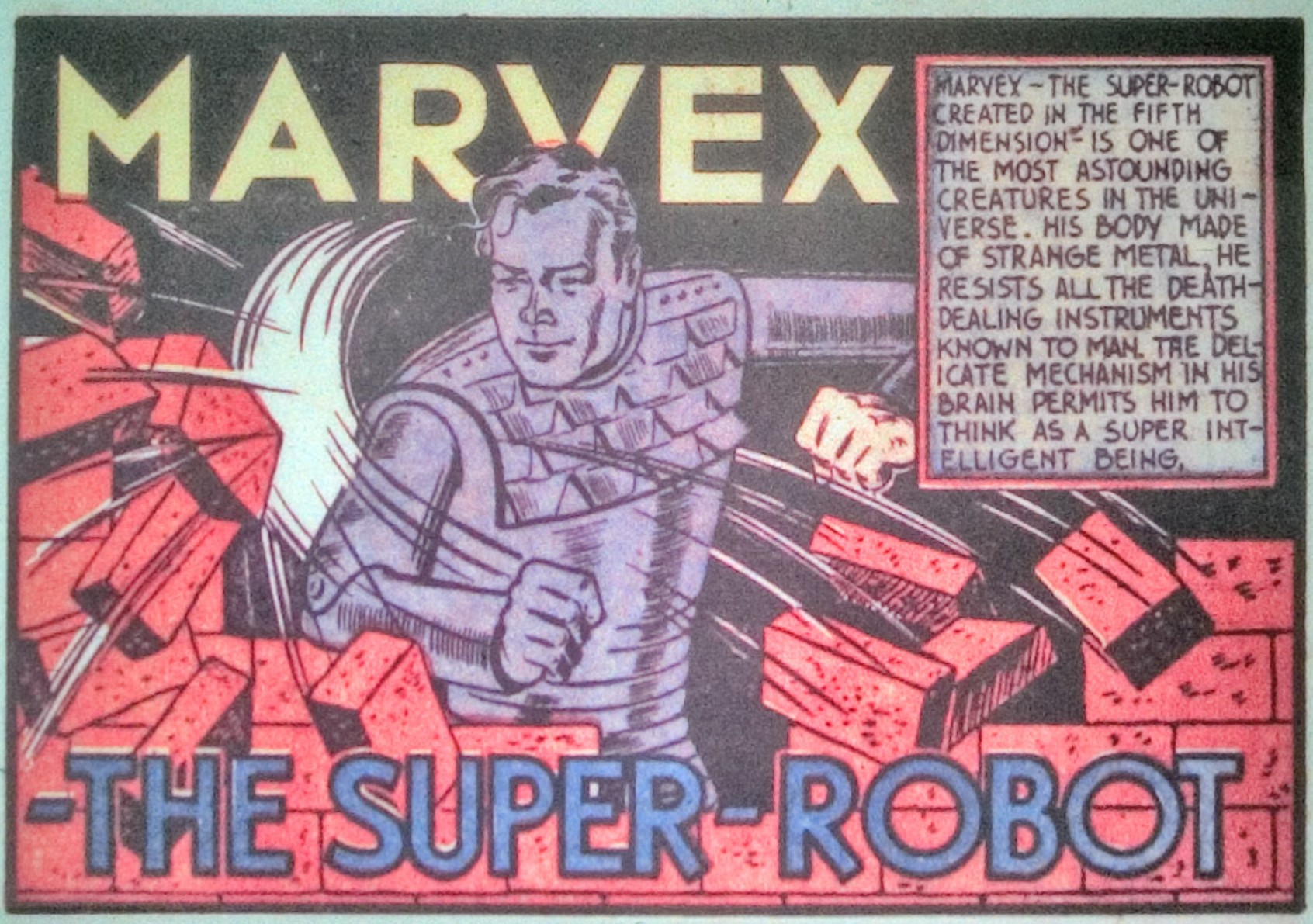
    Marvex the Super-Robot: 

    Marvex the Super-Robot! Created to be a slave by a Fifth Dimensional jerk named Bolo, Marvex rejects his fate, kills Bolo and his associates and accidentally blasts himself to Earth while smashing up Bolo’s lab equipment.

    If you’re already aware of who Marvex is then it’s likely because of the Michael Kupperman strip featuring the character during Marvel’s 70th Anniversary run of comics, and indeed, Marvex’ propensities for cartoonish violence, shutting down romance with sudden nudity and receiving twenty dollars all make him a perfect Kupperman character.

    Sadly, the nudity and twenty dollar reward system go the way of Marvex’ hair in his second and third appearances, but he never stops yelling about being a robot whenever his companion Clara gets a bit too comfortable around him. (Daring Mystery Comics 003, 1940)

    Categorized in: Language (Superlatives – Super), Origins (Extradimensional, Robot), Supranormal Beings (Robots)

    the Falcon:

    The Falcon is Carl Burgess, assistant district attorney in an unnamed city who is kind of betraying the spirit of his office by meting out vigilante justice when he feels like the legal system isn’t working. Though he is a pretty average costumed vigilante, the Falcon has precisely four interesting things to note. The first is that his name is weirdly close to that of Carl Burgos, the creator of the Human Torch. This might be a coincidence, but still. The second is of course that he is the original Marvel Falcon but by far the least-known of the half dozen or so Marvel characters to share that name.

    Like the Eagle, the Falcon is a bit of a fashion plate or at least someone who adjusts his costume on every adventure and for the same reason: a different artist on every one of his appearances.

    Finally, the Falcon has been retroactively assigned an accessory based on an assumption, just like his fellow Daring Mystery Comics alum the Fiery Mask and his morning star. In this case, it’s that his suit gives him the ability to glide. I assume that this is because of a stylistic choice on the part of his various illustrators to have him dive down on his enemies like a falcon stooping on prey, because the suit does not come up in his handful of Golden Age appearances. (Daring Mystery Comics 005, 1940)

    Categorized in: Animals (Falcons), Day Jobs (Assistant District Attorneys)

    Marvel Boy:

    Up until about 2012 I’d have confidently said that “Marvel Boy” was one of the most commonly-shared super-hero identities in the Marvel Universe, but it seems that the concept of the legacy identity has gone through a weird mutation in the last decade or so and I am now regularly surprised to find that there are way more Wolverines or Captains America than I had previously imagined. With that in mind, we’ll revise my statement to be that there are more Marvel Boys than you might expect, like Starmans over at DC.

    This particular Marvel Boy is the Earthly reincarnation of Hercules, come down from Valhalla (?!) to aid a world threatened by fascism. His human form is named Martin Burns and like a veritable Silver Age Superboy he is born with so much physical strength that he must constantly hold himself back lest he endanger those around him and out himself as something strange and different.

    On Martin’s fourteenth birthday a mysterious stranger (who is implicitly the Roman god Jupiter) delivers a package containing his heroic costume to him and then somewhat redundantly also appears in his bedroom to really spell out his whole deal and charge him to uphold democracy etc.

    Marvel Boy is super strong, very agile and fast enough to run from New York City to Washington DC and back – carrying three grown men on the first leg of the trip – in the course of a night that also includes the aforementioned visit from Jupiter and busting up two fifth column cells.

    Both this Marvel Boy and his successor (coming up in 1942) never returned after making a single appearance, and while I can’t say just why they didn’t have further Golden Age adventures, the lack of a modern appearance for either of them is almost certainly down to the fact that their origins both revolve around a dead Hercules, who is in fact more often than not a very living second- or third-tier hero in the Marvel Universe. They’re also both named Martin Burns for some reason, which means that later handbook writers have felt compelled to differentiate them by giving them middle names based on their creators, making this one Martin Simon Burns.

    Frankly, I think that the fact that the two Marvel Boys have origins that are incompatible with both Marvel Comics continuity and also one another is terrific fodder for comic book storytelling. Both of them should be BRUNG BACK immediately, preferably in a comic that also has Hercules in it. (Daring Mystery Comics 006, 1940)

    Categorized in: Generica (Boys), Language (Superlatives – Marvels), Origin (Reincarnated God) 

    the Flying Flame:

    The Flying Flame is a red fighter plane flown for the RAF by the two-fisted American pilot Captain Red Ruff, who is also known as the Flying Flame due to his shock of red hair. During his brief comic book career, Ruff battled the Black Ace and ferreted out some spies at an airbase. (Daring Mystery Comics 006, 1940)

    Categorized in: Activities (Flying), Elements (Fire), Team Membership (RAF)