The Curse of Skeleton Munroe

Blog

  • MINOR SUPER-HERO ROUND-UP 081

    Lev Gleason characters filling every available ecological niche over here. 

    Thun-Dohr:

    We’ve seen it before and we’ll see it again: Thun-Dohr (Thun-dohr?) is a white guy brought up in the traditions of a Tibetan monastery and he’s just the best dang mystic anyone’s ever seen, much better than all those Tibetan monks could ever be. 

    Like Iron Fist, the 1970s version of this character archetype, Thun-Dohr was orphaned when his parents succumbed to the elements while attempting to reach the fabled monastery. Baby Thun-Dohr (and I can no longer think of new ways to ask why these people brought their baby along on this super dangerous expedition) was found and brought to safety by the monks, who acclaimed him as some sort of prophesied kid. 

    Thanks to his training in “the arts of the Gom-Pa,” Thun-Dohr has a wide variety of mystic powers, including invisibility, teleportation, invulnerability to a variety of environmental conditions, the ability to see the last moments of a person’s life in their corpse’s eyes, astral projection and so on and so forth. He also has a mystical bracelet that allows him to remain in mental contact with the 300+ year-old Dalai Lama (not the one you’re thinking of) who raised him as he goes out into the world to battle evil (i.e., the other guy from the same monastery who is attempting to end the world – could’ve used a prophecy telling them not to let him in, amirite?). (Silver Streak Comics 013, 1941)

    Categorized in: Day Jobs (Lamas), Elements (Thunder), Origin (Mystic Traditions)

    Undercover Man:

    Police Detective Phil Barrows is unpopular at the Centre Street Homicide Department due to his habit of working alone (I think? Nobody seems to like him and this is the only stated reason why) so what does he do? Create a secondary identity called the Undercover Man so that he can work even more alone while adopting a variety of disguises. During his one published adventure he takes down corrupt politician Eduardo Donati and while I’m not normally one to critique someone’s decision to adopt a costumed identity I think he probably could have done it as a regular cop if he’d tried to. (Captain Battle Comics 001, 1941)

    Categorized in: Day Jobs (Police Detective), Powers (Master of Disguise), Professions (Law Enforcement)

    Blackout: 

    Blackout is the new name adopted by Dr Basil Brusiloff after he is mutated by chemicals randomly mixed together during a Nazi air raid on the hospital in which he is working. Unlike many other super-heroes who undergo physical transformations, Brusiloff’s new, jet-black form appears to be a permanent change and not something that he can switch on and off.

    Blackout is able to fly at speed comparable to a fighter plane, but his main power is the ability to emit a thick black smoke from his pores, the specificity of which somehow makes it seem more gross than a smoke power usually does.

    In addition to being opaque, this smoke is thick enough to suffocate someone in an unventilated environment (this is also gross. Huff my gas, miscreants!). Blackout is able to direct this smoke and even shape it to some degree (such as when he forms a long tunnel out of it to shield fleeing civilians from Nazi eyes), but most remarkably is able to emit it in large enough quantities that at one point he escapes a sealed room by bursting the walls through sheer air pressure.

    Aside from his powers, there are two remarkable things about Blackout: firstly, his origin takes place in Belgrade, which makes him the first in what is sure to be a pretty short list of Yugoslavian superhumans. Secondly, Blackout is the subject of some very minor debate vis-a-vis just how hairy/furry he is, with the two sides boiling down to “the text never says he’s hairy so it must just be something else” versus “he looks very hairy.” I am inclined to side with the latter side. He looks very hairy!

    Related to the hairiness question is a third interesting thing about Blackout: it is quite possible that he is completely nude, aside from that stylish green mask. (Captain Battle Comics 001, 1941)

    Categorized in: Activities (Blackouts), Colours (Black), Origin (Chemical Mutates)

    Nightro: 

    Nightro is Hugh Goddard, a scientist who was betrayed and left to die by his associates after they found a rich radium deposit in Alaska and Goddard expressed his desire to donate it to medical research, and though I do have some sympathy for his partners’ position that as the expedition’s financial backers they should see some profit from the mine they resort to murder a bit too quickly for my tatse. Surely this is a case for the courts!

    If you look Nightro up online, odds are that you will be told that he is blinded by the ambient radiation from the deposit. This is not true! What actually happens is that he wanders around in the snow until he is found by some helpful Inuit fellows and ends up with an extreme case of snow-blindness. Radiation doesn’t even come up.

    Goddard eventually makes his way back to the US, where a Dr Frank Miller (!) discovers that polarized lenses will allow him to see. Unlike his blind super-hero contemporaries the Mask and Dr Mid-Nite, Nightro does not appear to have any kind of enhanced dark vision. Instead, his stated reason for adopting a costumed alias is that his goggles are too ugly for him to be accepted in polite society.

    Goddard continues to live as a blind man as part of maintaining his secret identity as Nightro, meaning that from his second appearance onward he has a seeing eye dog companion named Blackie. He is called the “Streamlined Robinhood,” supposedly because he takes money from crooks and redistributed it to the needy – I reckon that it’s just a way to attach a buzzword to the character – if he had debuted tenyears later he might’ve been “the Jet Age Robinhood.”  (Daredevil Comics 002, 1941)

    Categorized in: Accessories (Dogs), Locations (Temporal), Origins (Blind Characters)

  • MINOR SUPER-VILLAIN 935: PROFESSOR BLANKHORNE

    (Silver Streak Comics 013, 1941)

    Dickie Dean, Boy Inventor has a new invention: the Photo-Lightning Machine, with which he can cause a bolt of lightning to crash down on anyplace he pleases, like the deserted house across the road from him that nobody was planning on using, hopefully. The only catch is that he hasn’t yet figured out how to get the lightning to strike a target that is in water.

    Dickie and his pal Zip Todd take the plans for the machine to Dickie’s lawyer to have it registered at the patent office, only to find a new face ready to take his business. This is C.B. Wolf, a foreign agent who has infiltrated the firm specifically to steal Dickie’s inventions for his home country. Wolf wires the plans home to the laboratory of Professor Blankhorne, the second greatest inventor in the world, barring Dickie (and how that must rankle Professor Skinn), who decides that rather than using them to construct his own machine he will save time by travelling to Castleton to acquire the original.

    Dickie is of course unwilling to sign over his shiny new weapon of mass destruction to an Axis agent and capable of defeating the Professor’s crude attempt to mug him for it, which forces Blankhorne to establish a Stateside volcano lair to operate out of.

    Blankhorne’s second attempt at obtaining the Photo-Lightning Machine involves sending a storm of remote-controlled and explosive model planes down on Castleton, Pennsylvania and presumably just kind of hoping that they will kill Dickie but leave his invention intact. This attempt is foiled by a patented Dickie Dean lightning storm that brings all of the planes down safely outside of town.

    It is at this point that I must question Professor Blankhorne’s motives for confronting Dickie Dean. As mentioned above, he claims that stealing the machine will be quicker than building one, yet between the trans-Atlantic journey and the time spent in preparing his drone fleet, this effort has taken Blankhorne at least three and a half months so far. Is this the sunk cost fallacy at play, or is the Professor trying to prove that he is not merely the second-greatest inventor on Earth?

    Blankhorn (along with the surprisingly hands-on CB Wolf) are seemingly handed victory on a platter when Dickie’s pal Zip Todd sets out to confront them with a baseball bat and is promptly imprisoned and – both inexplicably and importantly – tied up and suspended in a big tub of water.

    Thanks to the aforementioned flaw in the Photo-Lightning Machine’s targeting, Dickie is able to blast Blankhorne’s entire base without hitting Zip Todd, and when the villains attempt to escape in the Sky Bug he blows them out of the air with a complete lack of remorse. 

    Astonishingly (considering the fact that he was blown up on-panel), Professor Blankhorne manages to return in Silver Streak Comics 015. He infiltrates Dickie Dean’s new high-tech laboratory in the guise of an old flower seller (and gruesomely murders Dickie’s head of security in a vat of lye) as part of a scheme to loot the place of all of its technological wizardry. A solid plan, though I will note that he does so on the first day that the lab is in operation and so his haul is mostly made up of the stuff that Dean had already created.

    Though the law is no match for Dickie Dean’s lightning cannon (a distinct invention from the Photo-Lightning Machine), Blankhorne is no match for a couple of teenaged boys in a smoke screen, and he is captured with much greater ease than in his first appearance.

    Categorized in: Accessories (Drones), Doctors & Professors, Ideologies (Crypto-Fascists)

  • MINOR SUPER-VILLAIN 935: PROFESSOR BLANKHORNE

    (Silver Streak Comics 013, 1941)

    Dickie Dean, Boy Inventor has a new invention: the Photo-Lightning Machine, with which he can cause a bolt of lightning to crash down on anyplace he pleases, like the deserted house across the road from him that nobody was planning on using, hopefully. The only catch is that he hasn’t yet figured out how to get the lightning to strike a target that is in water.

    Dickie and his pal Zip Todd take the plans for the machine to Dickie’s lawyer to have it registered at the patent office, only to find a new face ready to take his business. This is C.B. Wolf, a foreign agent who has infiltrated the firm specifically to steal Dickie’s inventions for his home country. Wolf wires the plans home to the laboratory of Professor Blankhorne, the second greatest inventor in the world, barring Dickie (and how that must rankle Professor Skinn), who decides that rather than using them to construct his own machine he will save time by travelling to Castleton to acquire the original.

    Dickie is of course unwilling to sign over his shiny new weapon of mass destruction to an Axis agent and capable of defeating the Professor’s crude attempt to mug him for it, which forces Blankhorne to establish a Stateside volcano lair to operate out of.

    Blankhorne’s second attempt at obtaining the Photo-Lightning Machine involves sending a storm of remote-controlled and explosive model planes down on Castleton, Pennsylvania and presumably just kind of hoping that they will kill Dickie but leave his invention intact. This attempt is foiled by a patented Dickie Dean lightning storm that brings all of the planes down safely outside of town.

    It is at this point that I must question Professor Blankhorne’s motives for confronting Dickie Dean. As mentioned above, he claims that stealing the machine will be quicker than building one, yet between the trans-Atlantic journey and the time spent in preparing his drone fleet, this effort has taken Blankhorne at least three and a half months so far. Is this the sunk cost fallacy at play, or is the Professor trying to prove that he is not merely the second-greatest inventor on Earth?

    Blankhorn (along with the surprisingly hands-on CB Wolf) are seemingly handed victory on a platter when Dickie’s pal Zip Todd sets out to confront them with a baseball bat and is promptly imprisoned and – both inexplicably and importantly – tied up and suspended in a big tub of water.

    Thanks to the aforementioned flaw in the Photo-Lightning Machine’s targeting, Dickie is able to blast Blankhorne’s entire base without hitting Zip Todd, and when the villains attempt to escape in the Sky Bug he blows them out of the air with a complete lack of remorse. 

    Astonishingly (considering the fact that he was blown up on-panel), Professor Blankhorne manages to return in Silver Streak Comics 015. He infiltrates Dickie Dean’s new high-tech laboratory in the guise of an old flower seller (and gruesomely murders Dickie’s head of security in a vat of lye) as part of a scheme to loot the place of all of its technological wizardry. A solid plan, though I will note that he does so on the first day that the lab is in operation and so his haul is mostly made up of the stuff that Dean had already created.

    Though the law is no match for Dickie Dean’s lightning cannon (a distinct invention from the Photo-Lightning Machine), Blankhorne is no match for a couple of teenaged boys in a smoke screen, and he is captured with much greater ease than in his first appearance.

    Categorized in: Accessories (Drones), Doctors & Professors, Ideologies (Crypto-Fascists)

  • GENERIC COSTUMED VILLAIN ROUND-UP 038

    Criminals!

    Unnamed Gambler: 

    Not much is revealed about this fellow, but what we do know for sure is that he has access to a super strength drink and that he has been using it to clean up on gambling by slipping it to boxers and race horses with long odds. He also relies on the potion to help him escape from the cops, which backfires on him because Presto Martin, having taken the place of one of the boxers, is also hopped up on super juice and engages him in thrilling aerial combat.

    This super strength potion is the sort of thing I accuse crooks of employing shrtsightedly for quick crime profit rather than marketing legitimately for unimaginable wealth but I might give this fellow a pass due to his clear gambling problem. (Silver Streak Comics 007, 1941)

    the White Dragon Flower:

    She might just be a generic femme fatale spy chief who shows up for three panels before her whole operation gets busted up by aviator Cloud Curtis but I’ll be danged if a) that isn’t a great look and b) “White Dragon Flower” isn’t a terrific name, even if it was clearly thrown together to sound as mysterious and Asian as possible. (Silver Streak Comics 007, 1941)

    Categorized in: Animals & Plants (Plants)

    the Murder Syndicate, Inc: 

    As thier name suggests, the Murder Syndicate, Inc are hitmen for hire, distinguished mainly by the fact that the Daredevil has to round them up twice thanks to a mid-trial escape engineered by their boss, the mysterious Man in Black.

    And just who is the Man in Black? Why, it’s Judge Harkins, the man presiding over the trial in question! Is this surprising? Only if this is your first-ever experience reading a piece of fiction. (Silver Streak Comics 012, 1941)

    Categorized in: Murder (Assassins), Professions (Corporations) 

    Armando Siam:

    Armando Siam and his henchman Alfonze are a couple of generically foreign crooks who roll into Castleton in their absurdly long car one day and just kind of stumble into gaining control over Dickie Dean’s army of deep sea salvage robots, which they of course immediately set to looting the place.

    The duo eventually get word of the treasure that Dickie had been intending to use the robots for in the first place and hijack a salvage vessel in a very visually entertaining manner. Alas, it is at this point that the Boy Inventor himself catches up with them and the due end up as octopus fodder during their escape attempt. (Silver Streak Comics 014, 1941)

  • MINOR SUPER-VILLAIN 934: THE LADY KILLER

    (Silver Streak Comics 012, 1941)

    The Lady Killer makes his debut at the glamorous Crane Club, in which he attacks and nearly kills rising stage star Betty Crawford and takes a moment to grandstand a bit before making his escape. The name is a somewhat presumptuous one here, given the fact that he has yet to kill a lady.

    He makes up for this over the next few days as he murders a whopping fourteen women and injures a similar number of people and leaves a “Lady Killer” calling card at the scene of each crime. Though this is a fast turnaround on murder, I think that technically he is a serial rather than spree killer as he seems to be choosing his victims rather than attacking targets of opportunity – it’s just that his pool of potential victims is so huge that he can kill whenever he feels like it.

    Presto Martin eventually lays hands on the Lady Killer in his usual manner, through disguise. Specifically, by announcing that the villain will reappear at the Crane Club and then impersonating him there at the appointed time, and sure enough, the Lady Killer’s ego is too great to allow this imposture to stand and he gets within range of the detective’s fists and has his big hat knocked off.

    This is the point at which a mystery story would pay off and one of the suspects would be unmasked, but the thing about this story is that there are no suspects. Like, literally none – the only named characters in the comic other than Presto and his supporting cast are Betty Crawford and her beau and they are the only ones who it couldn’t be. Instead the Lady Killer is just Some Guy who had a very bad breakup and lost all his money and decided to take it out on an entire gender instead of dealing with his issues in a more mature manner. As a fan of a mystery I feel robbed.

    Categorized in: Crime Theme (Killers), Language (Expressions), Murder (Serial Killers)

  • DIVINE ROUND-UP 027

    I wonder if we’ll ever synthesize a unified theory of comic book religion out of this stuff.

    Isis:

    While attempting to thwart the magical con man Ahman-Ka-Lukor, Doctor Miracle calls upon the power of the Egyptian goddess Isis, who aids him by summoning the shade of the man whose reincarnated soul is now Ka-Lukor’s, and all so that Doctor Miracle can compare the two and make sure that he has the right man – it’s the most elaborate alternative to acquiring a photograph of the guy that I can imagine.

    Isis is depicted with a horns/sun disc/vulture headdress that is reasonably accurate to at least one era’s iconography, which is impressive enough for a just-wing-it medium like comics, but even more impressively for 1941 she is also totally topless, though also completely nipple-less.

    It’s not really anything to do with Isis, but Ka-Lukor has a cat familiar named Oasi who can turn into a lady who looks weirdly like the depiction of Isis and who caused me some confusion when I skimmed the story. I think that sh might just have represented another chance to draw a topless woman. (Champ Comics 013, 1941)

    the God of Hate: 

    The God of Hate is worshipped by the Claw’s followers at his skull castle in Tibet, and might just have the biggest head to body ratio that we have seen thusfar.

    Given the way that the God of Hate descends into the fiery pit and is then replaced with the Claw, it is possible that they are seen as aspects of the same being, that the Claw is the Earthly representative of the GoH, or even that the God works for the Claw, given the fanatical devotion that he elicits from his minions.

    Also: check out these guys. I’m sure that they came straight out of a National Geographic photo shoot but they also look quite cool. (Silver Streak Comics 007, 1941)

    the Great One: 

    This happens all the time when you’re a jungle adventurer: you rock up to an ancient temple to a near-forgotten god that is still worshipped with grisly rites and human sacrifice, and it turns out that there’s a big snake or other monster in there, just living it up. In this case, god of death the Great One has been played by Kadu, the Man-Eating Rat, who adventurer Lance Hale has personal beef with from a prior encounter, it seems. 

    God Style: Animist (Silver Streak Comics 011 1941)

    Moko:

    Moko is the god of a group of Tibetan bandits referred to as the Hoods, who I initially thought just had that weird yellow skin tone that comics used to render Asians with, but are later revealed or revised to be wearing cape and cowl getups. The actual worship of Moko is not detailed but does involve human sacrifice via a pit-and-pendulum style swinging blade.

    God Style: Idol (Silver Streak Comics 012, 1941)

  • DIVINE ROUND-UP 027

    I wonder if we’ll ever synthesize a unified theory of comic book religion out of this stuff.

    Isis:

    While attempting to thwart the magical con man Ahman-Ka-Lukor, Doctor Miracle calls upon the power of the Egyptian goddess Isis, who aids him by summoning the shade of the man whose reincarnated soul is now Ka-Lukor’s, and all so that Doctor Miracle can compare the two and make sure that he has the right man – it’s the most elaborate alternative to acquiring a photograph of the guy that I can imagine.

    Isis is depicted with a horns/sun disc/vulture headdress that is reasonably accurate to at least one era’s iconography, which is impressive enough for a just-wing-it medium like comics, but even more impressively for 1941 she is also totally topless, though also completely nipple-less.

    It’s not really anything to do with Isis, but Ka-Lukor has a cat familiar named Oasi who can turn into a lady who looks weirdly like the depiction of Isis and who caused me some confusion when I skimmed the story. I think that sh might just have represented another chance to draw a topless woman. (Champ Comics 013, 1941)

    the God of Hate: 

    The God of Hate is worshipped by the Claw’s followers at his skull castle in Tibet, and might just have the biggest head to body ratio that we have seen thusfar.

    Given the way that the God of Hate descends into the fiery pit and is then replaced with the Claw, it is possible that they are seen as aspects of the same being, that the Claw is the Earthly representative of the GoH, or even that the God works for the Claw, given the fanatical devotion that he elicits from his minions.

    Also: check out these guys. I’m sure that they came straight out of a National Geographic photo shoot but they also look quite cool. (Silver Streak Comics 007, 1941)

    the Great One: 

    This happens all the time when you’re a jungle adventurer: you rock up to an ancient temple to a near-forgotten god that is still worshipped with grisly rites and human sacrifice, and it turns out that there’s a big snake or other monster in there, just living it up. In this case, god of death the Great One has been played by Kadu, the Man-Eating Rat, who adventurer Lance Hale has personal beef with from a prior encounter, it seems. 

    God Style: Animist (Silver Streak Comics 011 1941)

    Moko:

    Moko is the god of a group of Tibetan bandits referred to as the Hoods, who I initially thought just had that weird yellow skin tone that comics used to render Asians with, but are later revealed or revised to be wearing cape and cowl getups. The actual worship of Moko is not detailed but does involve human sacrifice via a pit-and-pendulum style swinging blade.

    God Style: Idol (Silver Streak Comics 012, 1941)

  • MINOR SUPER-VILLAIN 933: THE RIPPER

    (Silver Streak Comics 011, 1941)

    For the third issue in a row, a souped up super-plane takes to the skies of probably-California to menace law-abiding aviators. The Ripper, like the Heater before it, is a vehicle with a singular name being run by a group, which is a mildly interesting taxonomic trend that unfortunately does not continue to occur.

    Where the Wingers and the Heater were armed with sci-fi ray cannons, the Ripper relies on a comparatively low-tech blade that is used to slice up aircraft and parachutes alike. Ironically, this is a far less believable means of attacking a plane on the wing than a thermodynamic ray of some sort. Just what kind of flying does the Ripper’s pilot have to be doing to slice off a wing with a comparatively short, fixed blade, anyway? Just how sharp can that thing be considering that it looks perfectly cylindrical? There are some wavy lines around the blade in precisely one panel – perhaps it’s meant to be a vibro-blade of some kind.

    Like the Heater before them, the crew of the Ripper are prepared for Cloud Curtis and his crew to interfere in their plans. In addition to the standard-issue bulletproofing, their plane is equipped with a magnetic generator to lock the Golden Bullet’s grapplers in place on their hull and knockout gas dispensers on the plane’s exterior act as a counter to Curtis’ favoured tactic of clambering onto an enemy aircraft’s exterior. Cloud and his assistants are taken into custody but not, crucially, immediately murdered.

    In contrast to the Heater, the Ripper has an actual defined goal: shut down US aviation in order to weaken the country for vague foreign agent reasons. And it’s astonishingly effective!

    Having not been murdered, Cloud and pals soon escape and take to the skies, where the Ripper crew learn the same posthumous lesson as the Heater gang before them: if you render yourself impossible to capture then you are much more likely to be killed outright. One shattered propeller later, the skies are safe for trainee pilots once more.

    Categorized in: Accessories (Aircraft), Activities (Ripping), Espionage (Saboteurs)

  • MEDIA IN COMICS 001

    MEDIA IN COMICS 001

    I’ve often mentioned how comics as a medium has a grand tradition of not using the real names for people (see about half the entries in our collection of Real Folk in comics) places (see the grand list of fictional countries on every continent of our list of Locations) and things, so I hope that it won’t surprise you when I say that they make up all the media, too. And since I have a big list of all the made-up books, newspaper columns, stage shows and movies sitting around already I figured I should share.

    Movies:

    Lover Mine (Funny Picture Stories v2 005, 1938)

    Flying Cadets, Colossal Pictures, stunts by the Four Aces (The Funnies 021, 1938)

    Star-Dust (Funny Picture Stories v3 002, 1939)

    War Eagles, Colossal Studios (Keen Detective Funnies v2 006, 1939)

    Pilots All, Mammoth Film Company (Keen Detective Funnies v2 010, 1939)

    The Mystery of the Creeping Spook, Superbo Pictures (Keen Detective Funnies v2 011, 1939)

    White Goddess (Funny Pages v3 008 1939) 

    Newspaper Columns:

    “On Broadway” by Walt “Bob Phantom” Whitney. (Blue Ribbon Comics 002, 1939)

    Plays:

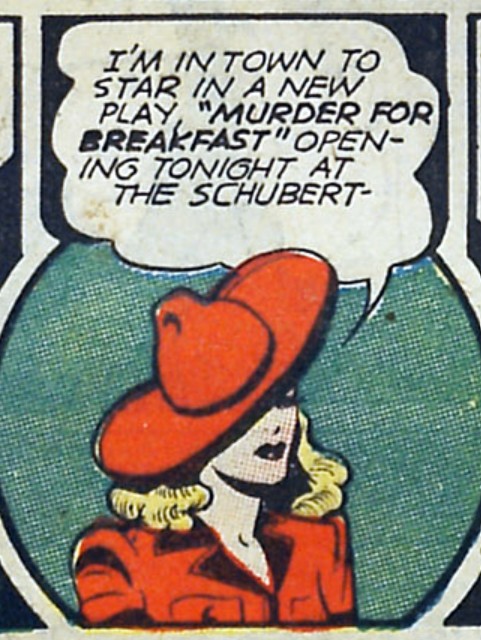
    “Murder for Breakfast”, starring Kay Kenyon, one of Presto Martin’s many Hollywood friends. (Silver Streak Comics 010, 1941)

    Songs:

    “Boogie-Woogie Blast” (Champion Comics 002, 1939)

  • MEDIA IN COMICS 001

    I’ve often mentioned how comics as a medium has a grand tradition of not using the real names for people (see about half the entries in our collection of Real Folk in comics) places (see the grand list of fictional countries on every continent of our list of Locations) and things, so I hope that it won’t surprise you when I say that they make up all the media, too. And since I have a big list of all the made-up books, newspaper columns, stage shows and movies sitting around already I figured I should share.

    Movies:

    Lover Mine (Funny Picture Stories v2 005, 1938)

    Flying Cadets, Colossal Pictures, stunts by the Four Aces (The Funnies 021, 1938)

    Star-Dust (Funny Picture Stories v3 002, 1939)

    War Eagles, Colossal Studios (Keen Detective Funnies v2 006, 1939)

    Pilots All, Mammoth Film Company (Keen Detective Funnies v2 010, 1939)

    The Mystery of the Creeping Spook, Superbo Pictures (Keen Detective Funnies v2 011, 1939)

    White Goddess (Funny Pages v3 008 1939) 

    Newspaper Columns:

    “On Broadway” by Walt “Bob Phantom” Whitney. (Blue Ribbon Comics 002, 1939)

    Plays:

    “Murder for Breakfast”, starring Kay Kenyon, one of Presto Martin’s many Hollywood friends. (Silver Streak Comics 010, 1941)

    Songs:

    “Boogie-Woogie Blast” (Champion Comics 002, 1939)