The Curse of Skeleton Munroe

Blog

  • SUPER-VILLAIN FILE 003: NAMOR THE SUB-MARINER

    (Marvel Comics 001, 1939*)

    No character in comics history swings more wildly and frequently between super-villain and super-hero than Namor the Sub-Mariner, Prince of Atlantis, and since as established in the case of Spy Smasher and Smasher Spy we treat the villainous and heroic actions of the same individual as different subjects we must start with Namor the villain (Namor the hero here).

    Namor’s origin is a relatively simple one, and to my knowledge one that has remained fairly unchanged to this day: in 1920 a scientific expedition to the Antarctic inadvertently blows up large portions of the sunken city of Atlantis while doing some sort of hydrological survey. The Atlanteans send their most human-looking citizen (and please note the all the weird racial stuff here, just like the recent Molemen entry. Why do these sea-swelling blue people care about how white the surface peoples’ skin is? Because they aren’t really being written as underwater near-humans but as any non-white group would be), who just so happens to be the Princess Fen, Beautiful Goddess of Seals.

    While posing as a mysterious amnesiac to pass on information about the humans to her people, Fen also falls in love with, marries and conceives a child with the expedition’s Commander Leonard McKenzie This extreme communion between disparate groups does not sway her from her purpose, however, and the only reason the human expedition survives is that they accidentally finish blowing up Atlantis before the counterattack can commence.

    Cut to the present day (1939) and dutiful son Namor (with his occasional sidekick and eventual unrequited love interest Dorma in tow) sets out to enact vengeance on humanity white people for their crimes against Atlantis. Namor’s first outing is an absolute bloodbath that sees him wiping out an entire small Naval outpost.

    The continuation of this story in Marvel Mystery Comics v1 002 sees the Sub-Mariner make his way to NYC, where he starts to show his more mellow side. Sure he spends much of his time in the city murdering police officers, but he also meets a very flammable woman and saves her life with the seldom-seen ability to barf water out of his pores.

    It’s safe to say that Namor the Sub-Mariner is defined by a few different drives and that those drives are the reason for his frequent shifts in alignment on the super-hero/super-villain spectrum. The first of these is his dedication to duty – the campaign against the surface world is much more his mother’s idea than it is Namor’s, but as a dutiful boy he obeys her wishes. The second of these drives is stubbornness – once Namor sets his mind to something he pursues it for longer and with more effort than one might expect, even if it is a bad idea. Next is his temper, which flares up hot and pairs disastrously with his stubbornness to inspire long hot grudges.

    The final important drive that Namor is ruled by can be seen above and it is his horniness. Every so often he becomes taken with a woman and it causes him to act like a complete maniac, as here when he attempts to kidnap the severely injured and very much air-breathing Miss Drayson and drag her into the ocean depths.

    That’s pretty much it for Namor’s first foray into villainy: for a variety of reasons he barges into the US and then smashes people and things for a while. Tune in later this week to see him try out benevolence for a while. 

    *yes, okay, Motion Picture Funnies 001 is his real first appearance, but it’s the same story in an unpublished comic that had it been published wouldn’t have been by Marvel/Timely, so I would consider that more of a trivia fact than a fact fact.

  • MEDIA IN COMICS 014

    Forget lost media, here are some media that only exist in comic books

    Movies: 

    A Modern Macbeth is one of innumerable in-comic movies that we never really learn anything about. Is it a musical? Is that why a singer is speaking at the premiere? Is it a reference to another movie? The only pre-1941 movie with a similar title that I can find is 1917’s A Modern Monte Cristo and that seems a bit of a stretch. (More Fun Comics 072, 1941)
    Captain Marvel stars in a film called Crusher of Crime in one of our earliest examples of a super-hero starring in a film as themselves. No clue what it’s about but we can probably assume that it’s standard 40s super-hero fare. (Whiz Comics 020, 1941)

    More intriguingly, the character of Whitey Murphy joins the Captain Marvel cast just two issues later, and dialogue between him and Billy Batson implies that not only does the real-world film The Adventures of Captain Marvel exist in the comics universe, but that both Captain Marvel and Billy Batson appeared in it and also that some or all the events of the film actually happened.

    This is reinforced by the fact that Billy goes to see “The Guillotine”, the second chapter of the serial, in Captain Marvel Adventures 003 (Whiz Comics 022, 1941)

    The costume party held for the premiere of The Phantom Duelist (film) held in the castle of the Phantom Duelist (ghost) provides the opportunity for the Phantom Duelist (super-villain) to murder Reynolds (film producer, universally-hated). (Doll Man Quarterly 001, 1941)

    One of the minor recurring tropes of comics is “tough guy goes to Hollywood and finds it exhausting,” seen here as the super-hero Hercules is talked into making a sadly unnamed jungle movie and it almost kills him. (Hit Comics 010, 1941)

    Music:

    The song “Icy Igloo Blues” is the key to District Attorney Steve Malone solving a major jewel robbery case. (Detective Comics v1 053, 1941)

    The “Symphony of Death” was employed by the nefarious Doctor Death in his murders. Do music nerds in comic book universes hold Nights of Evil concerts where they play pieces like this? (Wow Comics 002, 1941)

    Speaking of which, here are six extremely on-the-nose songs composed by the Murder Maestro as part of his own efforts in the field of killing: “A Message to My Heart” (victim shot in the heart), “I’m Drowning My Sorrows” (drowned), “I’m Burning Up Over You” (set on fire), “My Sleepy-Time Pal” (poisoned, weirdly), “I’m Walking on Air” (dropped from a plane) and “I’m Getting Up in the World” (fake attempt on own life). (More Fun Comics 072, 1941)

    Newspaper Columns:

    “Walter Winkle on Broadway” is of course yet another take on the gossip column of Walter Winchell. (Feature Comics 049, 1941)

    Television:

    There are in fact Martian invaders in this Human Torch story, but since they don’t get up to any NYC-destroying I must conclude that this is an unnamed and very coincidental television program. (Marvel Mystery Comics v1 003 1940) 

  • SUPER-HERO FILE 006: THE ANGEL

    (Marvel Comics 001, 1939)

    A two-fisted vigilante in the Batman mode, the Angel was a big enough name in Marvel’s Golden Age comics that it would be kind of surprising that he has never really been revived post-Silver Age if not for the fact that his name was, and that the subsequent and ongoing popularity of the X-Men means that there was always a full “Angel” slot on the Marvel roster. On top of this (and probably because of this) the Angel was eventually revealed to be the mastermind behind the Scourge of the Underworld program, lending a villainous tarnish to his name that certainly contributed to his lack of a modern legacy.

    The Angel never really gets an origin in the Golden Age, and thanks to the fact that he was never brought back in any meaningful way, this persists until the Marvel 70th Anniversary books in 2009, when he is revealed to have grown up in a prison or something. It’s not better than just mysteriously having no origin at all, so I never internalized it.

    One thing that the Angel does have, however, is a calling card. Two of them, in fact, as he both signs his notes to police and criminals with a little drawing of an angel and also projects long-lasting shadow images of an angel onto nearby surfaces, this latter also being his only real super-power.

  • REAL PERSON ROUND-UP 029

    Time for a heaping dose of real folk from Golden Age Marvel comics.

    Adolf Hitler:

    Kalph Belgri, dictator of Torpis, takes his own life when his invasion of neighbouring Molivia is thwarted by Electro. (Marvel Mystery Comics v1 005, 1940)

    The Human Torch encounters Adolphe Hiccup, dictator of Slaveland, while foiling a plot to fool his sidekick Toro into aiding their war effort. He is seen colluding with his ally Benny Musclein, who is such a clear Mussolini stand-in that I feel a bit foolish even mentioning it.

    Hiccup’s aide Herr Medals, on the other hand, is quite vexing to me, as despite his physical appearance and love of regalia being clearly based on Hermann Goering, his name makes me think of Goebbels, which caused me to poison my search history a little more by looking up the Nazi high command yet again to make sure I had the right guy. (Human Torch v1 003, 1940)

    Al Capone:

    Mob boss Vince Garrone is the latest in a long line of crooks with Capone-like names. (Marvel Mystery Comics v1 017, 1941)

    Fiorello La Guardia:

    Marvel Comics was a very NYC-heavy operation even back when it was Timely Comics, and as a consequence of that we get far more Mayoral Action from them than other publishers. Here we see Mayor La Guardia showing a lot of moxie while dealing with a hostile Sub-Mariner, for example. (Marvel Mystery Comics v1 007, 1940)

    Not even a year later, here’s the Human Torch helping out a mysterious and unnamed non-La Guardia Mayor of NYC. Just who the heck is this guy? (Marvel Mystery Comics v1 016, 1941)

    La Guardia is back by Marvel Mystery Comics v1 020, just in time to deal with an epidemic of arson and extortion aimed at the city.

    Finally, a chunky little La Guardia thanks the Patriot for fending off the attempted takeover of the city by the fascist Yellowshirts. (Human Torch v1 004, 1941)

    Orson Welles:

    The Human Torch must deal with a Martian invasion, and that means referencing Orson Welles’ War of the Worlds broadcast, here attributed to a “Lawson Bell.” (Marvel Mystery Comics v1 003, 1940)

  • NOTES – SEPTEMBER 2026

    NOTES – SEPTEMBER 2026

    The Looming Spectre of Death:


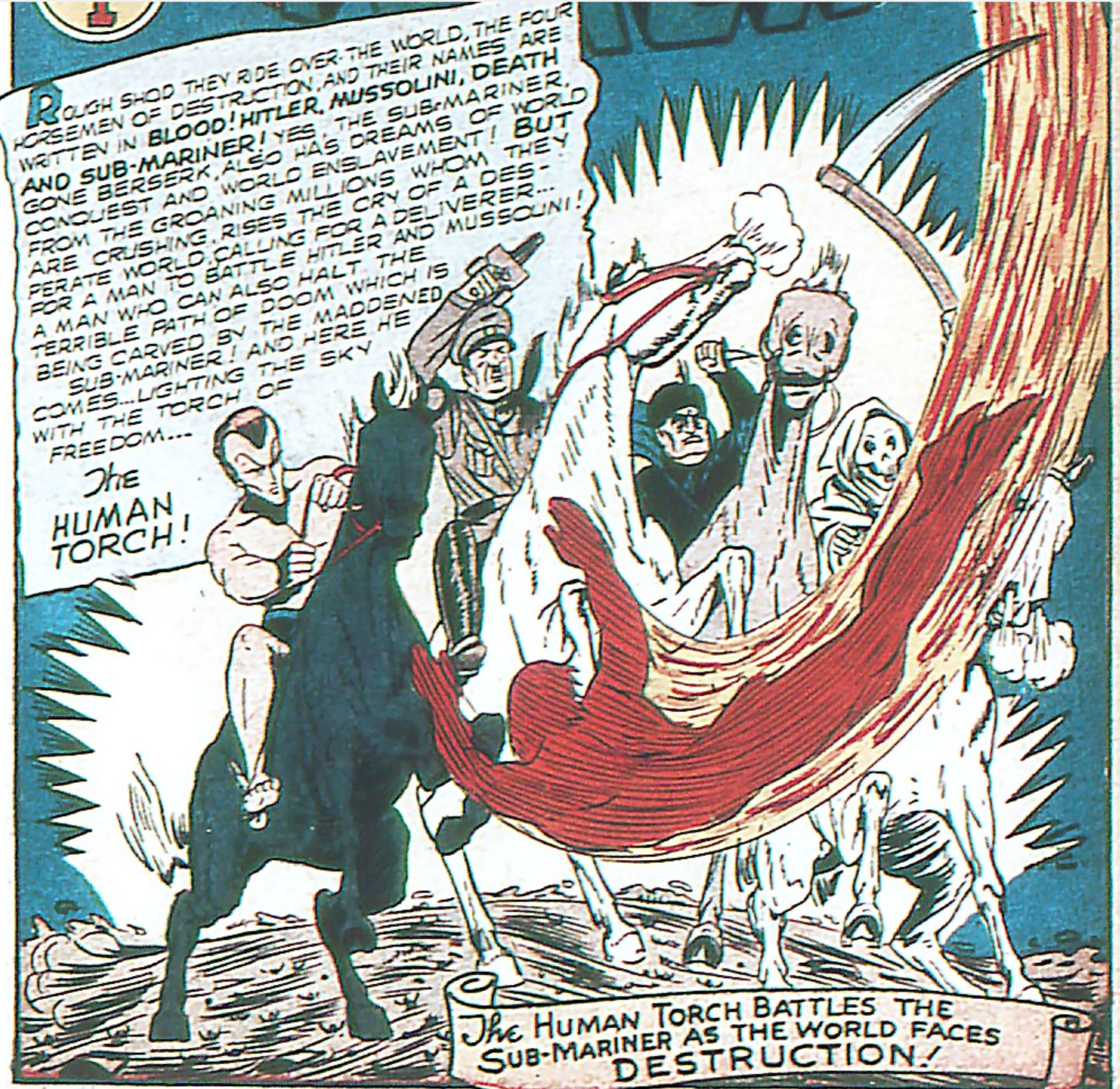
    Death rides, menaces the Human Torch in a flooding tunnel, advances as a glacier and looks over Hitler’s shoulder, all from the same busy issue: Human Torch v1 005b, 1941

    The Looming Spectre of War:

    Also from Human Torch v1 005b: the looming spectre of war, in the form of Mars, menaces the USA and rejoices in the flooding of Berlin.

  • NOTES – SEPTEMBER 2026

    NOTES – SEPTEMBER 2026

    The Looming Spectre of Death:


    Death rides, menaces the Human Torch in a flooding tunnel, advances as a glacier and looks over Hitler’s shoulder, all from the same busy issue: Human Torch v1 005b, 1941

    The Looming Spectre of War:

    Also from Human Torch v1 005b: the looming spectre of war, in the form of Mars, menaces the USA and rejoices in the flooding of Berlin.

  • SUPER-HERO FILE 005: THE HUMAN TORCH

    SUPER-HERO FILE 005: THE HUMAN TORCH

    (Marvel Comics 001, 1939)

    The Human Torch! The first major (and first overall) Marvel super-hero, despite the fact that my disorganized ass is writing about him third!

    The Human Torch is a synthetic man, aka an android (aka a synthezoid, which as far as I can tell means “cooler android” and won’t come into use until the 60s anyway) and created by Professor “Not Yet Phineas” Horton. Later stories will add all kinds of influences on and collaborators with Horton (including our recent subject Doctor Nemesis), but in the beginning it was just him, toiling away over his blonde creation.

    The Human Torch’s origin is shaped by three major factors: first, that Horton’s process was flawed in some strange way and as a result his android bursts into flame when exposed to oxygen. Secondly, there is the fact that Horton, despite the obvious scientific acumen and indeed genius on display in his creation, is seemingly devoid of any scientific curiosity outside of this. When confronted with the problem of a flaming android, Horton just throws his hands in the air and gives up without making any kind of real effort to mitigate the problem.

    Finally, the Torch is hampered by the fact that humanity at large, including Horton, is motivated by fame and fortune. Everyone who meets him wants to exploit him in some way, unless they are afraid of him – this is presumably why Horton’s first act upon creating him is to call in reporters rather than work on getting him to stop exploding.

    Though Horton can’t bring himself to work on a solution for the Torch’s problem, he balks at destroying his creation and so opts to seal him inside of an airless steel cylinder and then bury that cylinder in cement.

    Somehow, however, and perhaps relating to the fact that it was dropped into semi-solid cement from a decent height rather than laid down carefully and then covered up, the cylinder develops a crack through which enough air seeps in to set the Torch alight and cause him to burst his prison asunder. Everyone’s worst fears seem to be confirmed, as the newly self-aware android charges through the city streets, setting men, hats and telephone poles alight. A curious thing happens, however, and perhaps this reflects yet another failing on the part of Horton: the Human Torch realizes that he is hurting people and doesn’t want to. You should have talked to your artificial son, Professor, and then you might not have felt it necessary to seal him in concrete.

    In attempting to control his own flame (see? once again the child outstrips the parent), the Torch dunks himself in a swimming pool that turns out to belong to a criminal named Sardo who immediately sees the profit potential in a flaming man. Side note: Sardo also has a swimming pool that doubles as a vacuum chamber. Is there any use for such a thing beyond “elaborate deathtrap?”

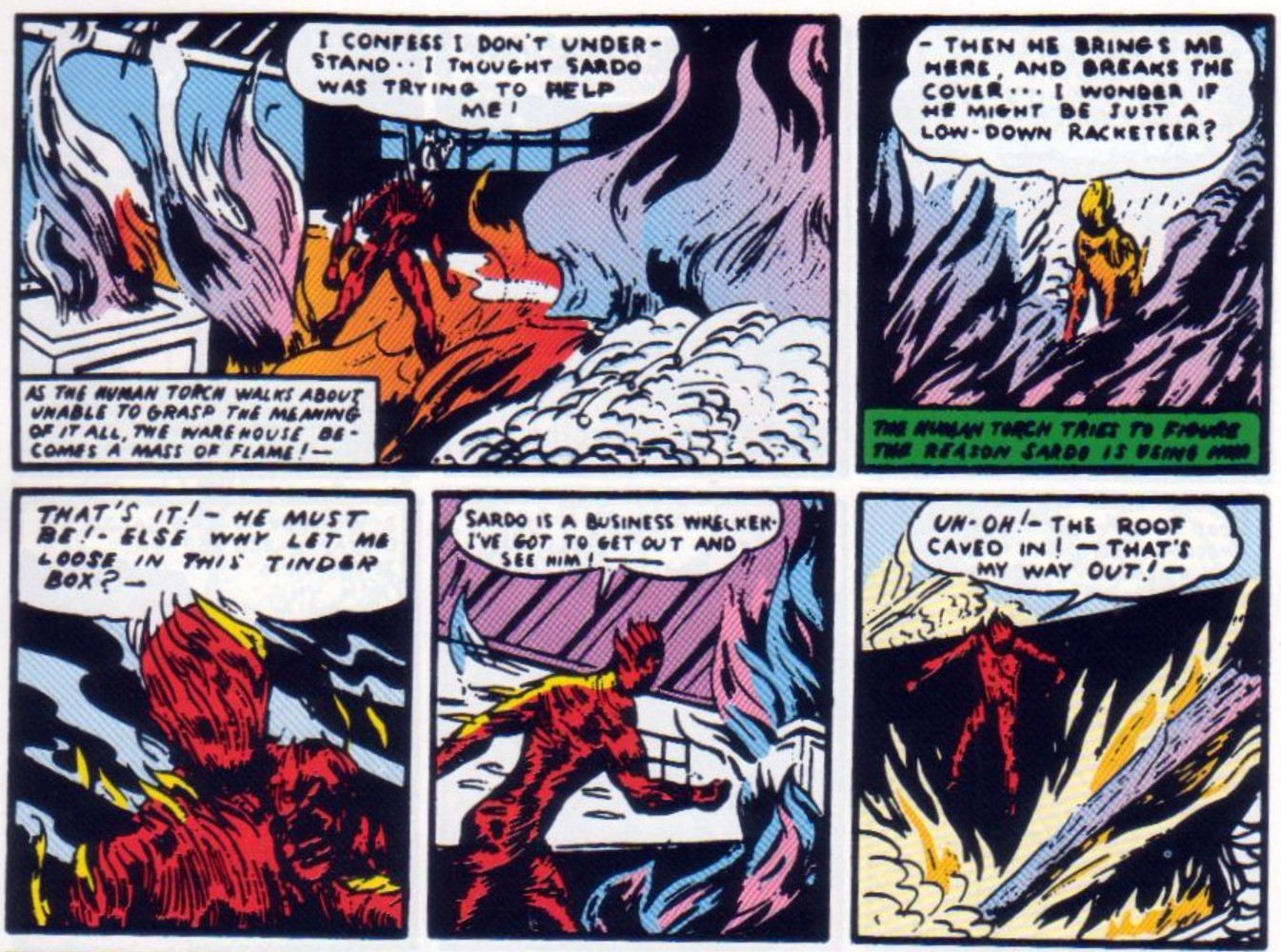
    Sardo’s reaction to the Torch falls under theme #3 of this origin: Human Greed. He uses his weird pool to transfer the android to a sealed container and then uses him to burn down a warehouse as part of a protection racket scheme. Just like Horton, however, Sardo fails to reckon with the fact that the Torch might have opinions of his own about such things, and meets his end in their subsequent confrontation. 

    The Human Torch eventually figures out how to control his own flame thanks to Sardo’s stockpile of liquid nitrogen tanks – the nitrogen snuff the flame only temporarily but having done so a couple of times the Torch gets the hang of how to do so at will. We almost get a heartwarming father/son reunion as Horton argues for the Torch to be released into his custody, but then he goes and ruins it all by immediately starting to scheme about how much money he is going to make off of his creation’s back. This is the final straw as far as the Human Torch is concerned and he leaves via the most direct route: straight up.

    (Per Marvel Mystery Comics v1 002 this sets Horton’s house on fire and leads to his death, and the Torch isn’t sad about it)

    UPDATES

    Update 1940

  • DIVINE ROUND-UP 035

    Time to revise the Comparative Religion curriculum again because we found some new gods.

    Adobi:

    Just to what extent these Molemen worship the god Adobi is impossible to say. This particular Moleman hold him in high enough esteem to implore him to sanctify a forced political marriage, if that counts for anything much. I really wish we had a better angle on Adobi’s front side so I could see the big gems in his chest and forehead better.

    God Style: Idol (Lightning Comics v2 002, 1941)

    Vango:

    After escaping the lands of the Adobi-worshipping Molemen, Congo Jack encounters the worshippers of the multi-armed Vango. We don’t learn too much about Vango himself, alas, as the bulk of the narrative is taken up with a religious schism between pro- and anti-human sacrifice Vango worshippers. He looks good!

    God Style: Idol (Lightning Comics v2 004, 1941)

    Fire:

    The Fire-Men (aka the Fire-Cult) are a weird bunch to categorize. They are initially antagonists to the Human Torch, and give him a run for their money with their flame control powers while they hunt down and kill a former member. Then, however, they reveal that he was not merely an apostate but someone who was planning on using the cult’s teachings to profit while causing great destruction, and that he had a partner who is still at large. The Torch is left with to choice but to team up with his former adversaries.

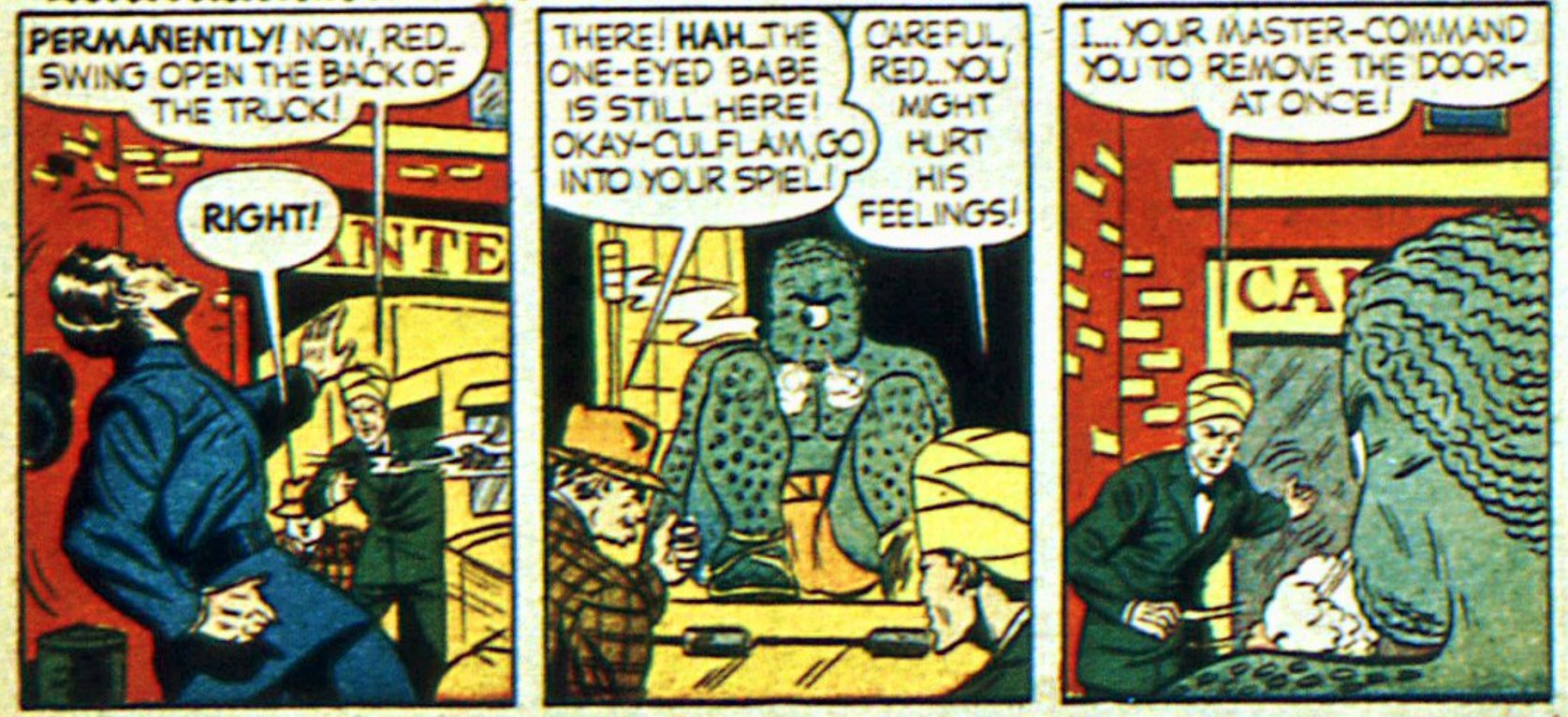
    Though the Fire-Men presumably worship or at least pay fealty to the flame that they control, the real focus of the group is less religious than practical, as they work to contain the rampaging Flame Monsters of Tibet, giant green humanoids who emit flame from their pores. 

    (the second traitor to the cult turns out to be a man named Culflam, who later passes on the Fire-Men’s teachings to the Torch’s enemy the Parrot)

    God Style: Animist (Real?) (Marvel Mystery Comics v1 014, 1940)

    Flamosa the Fire God:

    God of the people of the volcanic Inferno Isle in the Pacific, who appear to have been manipulated into practicing human sacrifice by a group of Nazis in order to dispose of Allied scientists in the area. The Angel semi-accidentally blows up half the island and sets off the volcano, and the worship of Flamosa is abandoned.

    God Style: Idol (Marvel Mystery Comics v1 023, 1941)

  • DIVINE ROUND-UP 035

    DIVINE ROUND-UP 035

    Time to revise the Comparative Religion curriculum again because we found some new gods.

    Adobi:

    Just to what extent these Molemen worship the god Adobi is impossible to say. This particular Moleman hold him in high enough esteem to implore him to sanctify a forced political marriage, if that counts for anything much. I really wish we had a better angle on Adobi’s front side so I could see the big gems in his chest and forehead better.

    God Style: Idol (Lightning Comics v2 002, 1941)

    Vango:

    After escaping the lands of the Adobi-worshipping Molemen, Congo Jack encounters the worshippers of the multi-armed Vango. We don’t learn too much about Vango himself, alas, as the bulk of the narrative is taken up with a religious schism between pro- and anti-human sacrifice Vango worshippers. He looks good!

    God Style: Idol (Lightning Comics v2 004, 1941)

    Fire:

    The Fire-Men (aka the Fire-Cult) are a weird bunch to categorize. They are initially antagonists to the Human Torch, and give him a run for their money with their flame control powers while they hunt down and kill a former member. Then, however, they reveal that he was not merely an apostate but someone who was planning on using the cult’s teachings to profit while causing great destruction, and that he had a partner who is still at large. The Torch is left with to choice but to team up with his former adversaries.

    Though the Fire-Men presumably worship or at least pay fealty to the flame that they control, the real focus of the group is less religious than practical, as they work to contain the rampaging Flame Monsters of Tibet, giant green humanoids who emit flame from their pores. 

    (the second traitor to the cult turns out to be a man named Culflam, who later passes on the Fire-Men’s teachings to the Torch’s enemy the Parrot)

    God Style: Animist (Real?) (Marvel Mystery Comics v1 014, 1940)

    Flamosa the Fire God:

    God of the people of the volcanic Inferno Isle in the Pacific, who appear to have been manipulated into practicing human sacrifice by a group of Nazis in order to dispose of Allied scientists in the area. The Angel semi-accidentally blows up half the island and sets off the volcano, and the worship of Flamosa is abandoned.

    God Style: Idol (Marvel Mystery Comics v1 023, 1941)

  • MINOR SUPER-HERO ROUND-UP 104

    Here are some very minor Marvel Comics super-heroes, or at least super-hero adjacent comic book adventurers.

    the Masked Raider:

    The Masked Raider is actually Jim Gardley, a small-time rancher in the town of Cactusville (which has apparently been officially placed in California? the hell?) is run off his land and framed as a rustler by crooked business interests. Adopting his masked persona and acquiring a souped-up horse named Lightning, he strikes back at his persecutors and goes on to spread justice throughout the West.

    Recently (well, seven years ago), Marvel Comics 1000 recontextualized the Masked Raider as being part of a chain of super-heroes who are empowered by an artifact known as the Eternity Mask, but that’s all future stuff. As far as we are concerned, for the next 80-odd years worth of comics the Masked Raider is just a two-fisted cowboy. (Marvel Comics 001, 1939)

    Ka-Zar:

    Ka-Zar is in actuality David Rand, who was gradually orphaned after his family was stranded in the jungle when he was a toddler. First his mother dies of a fever, which, along with a bit of head trauma, causes his father to have a mental break and decide to settle down in the jungle rather than try to get back home. Some years later, the vile emerald hunter de Kraft invades this jungle life and kills David’s father, leaving David to be brought up the rest of the way by the lion Zar and his mate. Ka-Zar = “Brother of Zar,” which is a better origin than most jungle man nonsense names get. Ka-Zar’s origin ends when he slays de Kraft, who has returned to get more delicious emeralds.

    This particular Ka-Zar is of course doomed to obscurity thanks to the existence of the other Ka-Zar, who somehow continues to appear to this day. Marvel has no need of any more jungle heroes, let alone a surplus Ka-Zar. (Marvel Comics 001, 1939)

    Ferret:

    Though private detective characters are a dime a dozen in Golden Age comics, Ferret here is distinguished in a few ways: firstly by the fact of his cool name, secondly by dint of having a bit of the weaselly appearance of his namesake rather than being your typical comic book squarejaw, and finally because he is a bit of a go-to in more modern comic flashbacks when they want to add a bit of non-costumed 40s flair. (Marvel Mystery Comics v1 004, 1940)

    Most importantly, as of Marvel Mystery Comics v1 005, Ferret has a real ferret named Nosey for a pet.

    Terry Vance:

    Terry Vance, aka the Schoolboy Sleuth, aka the Boy of a Hundred Hobbies is a science-minded youth, of the subtype that deals in actual science and not comic book super tech. Mostly, at least – he does occasionally stretch the bounds of what a remote controlled plane can do.

    Vance splits his time between school, the Bike Club, his famed Hundred Hobbies and solving grisly murders that have the police flummoxed, and he does it all with the aid of a monkey named Dr Watson and a reporter pal named Deadline Dawson. 

    If any of these characters is a ripe candidate for revival, it’s Terry*, as a venerable old detective, an embittered old tech billionaire, a benevolent old tech billionaire… the possibilities are finite but vast! Heck, have him still be a teen, having gotten too close to the super-villainous side of crime and been blasted through time and/or space. (Marvel Mystery Comics v1 010, 1940)

    *Ferret was killed off by Ed Brubaker, alas.