The Curse of Skeleton Munroe

Blog

  • MINOR SUPER-VILLAIN 914: THE BRIDGE-DESTROYERS

    (Cat-Man Comics 001, 1941)

    Some villains are puzzles, high-concept enigmas whose motivations and goals are a mystery that must be solved to understand them. The Bridge-Destroyers are not that. They are exactly what their name declares them to be: a couple of guys in a tower who destroy bridges using a long-range heat-ray cannon.

    But why the Bridge-Destroyers destroy bridges, that must be a mystery, yes? Perhaps it is, but the authorities are pretty certain that they are working for “some foreign power” to disrupt America’s ability to move troops and war materiel from place to place. Despite this, the official response to the group seems to be resigned acceptance as their defenses are so good that it is considered foolhardy to even try to stop them.

    Despite their fearsome reputation, Cat-Man is determined to face the Bridge-Destroyers head-on, which means that he meets their fist line of defense: a bunch of guys who live in a hole just outside the tower and suck up intruders using a giant vacuum. This might be enough to stop your every-day lawman, but the Cat-Man has all the powers of a cat, man. He simply avoids being battered to death by the whirling storm of debris and beats up the hole-dwellers when they come to retrieve his corpse.

    To their credit, the Bridge-Destroyers do manage to kill Cat-Man with a blast from their heat-ray as he makes his second approach to the tower but then they are treated to a lesson about how the “nine lives” part of his super-powers works. Stripped of their ray, their tower and their hole full of men, the masterminds between the war on America’s infrastructure are swiftly subdued.

  • MINOR SUPER-VILLAIN 914: THE BRIDGE-DESTROYERS

    (Cat-Man Comics 001, 1941)

    Some villains are puzzles, high-concept enigmas whose motivations and goals are a mystery that must be solved to understand them. The Bridge-Destroyers are not that. They are exactly what their name declares them to be: a couple of guys in a tower who destroy bridges using a long-range heat-ray cannon.

    But why the Bridge-Destroyers destroy bridges, that must be a mystery, yes? Perhaps it is, but the authorities are pretty certain that they are working for “some foreign power” to disrupt America’s ability to move troops and war materiel from place to place. Despite this, the official response to the group seems to be resigned acceptance as their defenses are so good that it is considered foolhardy to even try to stop them.

    Despite their fearsome reputation, Cat-Man is determined to face the Bridge-Destroyers head-on, which means that he meets their fist line of defense: a bunch of guys who live in a hole just outside the tower and suck up intruders using a giant vacuum. This might be enough to stop your every-day lawman, but the Cat-Man has all the powers of a cat, man. He simply avoids being battered to death by the whirling storm of debris and beats up the hole-dwellers when they come to retrieve his corpse.

    To their credit, the Bridge-Destroyers do manage to kill Cat-Man with a blast from their heat-ray as he makes his second approach to the tower but then they are treated to a lesson about how the “nine lives” part of his super-powers works. Stripped of their ray, their tower and their hole full of men, the masterminds between the war on America’s infrastructure are swiftly subdued.

  • MINOR SUPER-HERO ROUND-UP 072

    Extremely minor super-heroes? Don’t mind if I do!

    the Flag-Man:

    The Flag-Man is one standard unit of patriotic American super-hero: he loves the United States and is willing to put on a costume and punch guys until it is safe. And speaking of costumes: the Flag-Man and his pal Rusty are prime examples of how piggybacking off of the iconography of the American flag can really paper over some pretty bad costume design. I mean, tank-top and cape and flared gloves? Give me a break.

    The Flag-Man’s alter ego is Captain Hornet (occasionally Major Hornet), trouble-shooter for the President, who presumably knows about the whole Flag-Man thing.

    Since Captain Hornet/the Flag-Man seems the be dedicated to solving problems exclusively via the medium of hand-to-hand combat, he is in effect a fist that FDR can send to punch anyone he wants. Mostly Nazis, to his credit. (Captain Aero Comics 001, 1941)

    Rusty:

    Just as the Flag-Man is the elemental patriotic hero, his sidekick Rusty is the basic unit of kid sidekick: no last name, no alter-ego, just a scrappy teen who tags along on adventures. I do find him the most irritating of all the Golden Age sidekicks we have yet encountered, so that’s at least one distinction. (Captain Aero Comics 001, 1941)

    Solar, Master of Magic: 

    Solar, Master of Magic is as you might have guessed another of Golden Age comics’ many, many magic guys, which in practical terms means that he can do basically anything he wants to. In contrast to a lot of his peers, he chooses to use his fists as much or more than his magic. 

    Although Solar presents as a pure magic guy, he is in fact a magic item guy, with a magic cape of invisibility and a magic ring of doing everything else. It’s a minor distinction but it introduces the possibility of the source of his powers being stolen from him, which does in fact happen during the final of his four appearances. (Captain Aero Comics 001, 1941)

    Captain Fearless:

    Comics love to tie their characters to history, usually by making them the descendant of someone famous but often by inserting their ancestors into real events, as can be seen in the case of the Wizard. This might be the first time I’ve seen it done to this extent, however, as John Fearless here is not only the instigator of the Boston Tea Party, but a member of the First and probably Second Continental Congresses and could reasonably be expected to be a signatory of the Declaration of Independence. In other words, he’s a whole-ass made-up Founding Father!

    John Fearless goes on to die in one of the opening battles of the Revolutionary War, upon which… well, the speech balloon placement is annoying, but either he ascends into heaven as an otherworldly voice tells him that his patriotism will live on in his family line or an angelic being from the newly-formed United States of Heaven descends in full uniform to collect his soul and tell him the same. I prefer the latter, but who can tell.

    Regardless of the otherworldly voice’s source, its words prove true, as evidenced when young John Fearless VI, latest member of a family of patriots, visits his ancestor’s grave and then gets to meet that very ancestor.

    The ghost of John Fearless I relates the glorious history of the other four Captains John Fearless, fighting to protect the American values of justice and liberty for all (and also in the Mexican- and Spanish-American Wars) and gasses on for a while about patriotism and so forth.

    In contrast to his forebears, John Fearless VI’s assignment is not military but vigilante in nature, as the ghost of John Fearless I is concerned about the threat of fifth columnists and is of the opinion that a costumed crimefighter is the best way to root them out. To that end, his great-great-great grandson is outfitted with a not-great costume and sent off to battle.

    He also gets an antique powder horn that doubles as a musical one, and annoyingly does not blow it during his first case. Once he finally gets around to trying it out, it summons the ghost of the original Captain Fearless to help him out by invisibly beating people up and flying him around in his ghost arms.  (Captain Fearless Comics 001, 1941)

  • MINOR SUPER-HERO ROUND-UP 072

    Extremely minor super-heroes? Don’t mind if I do!

    the Flag-Man:

    The Flag-Man is one standard unit of patriotic American super-hero: he loves the United States and is willing to put on a costume and punch guys until it is safe. And speaking of costumes: the Flag-Man and his pal Rusty are prime examples of how piggybacking off of the iconography of the American flag can really paper over some pretty bad costume design. I mean, tank-top and cape and flared gloves? Give me a break.

    The Flag-Man’s alter ego is Captain Hornet (occasionally Major Hornet), trouble-shooter for the President, who presumably knows about the whole Flag-Man thing.

    Since Captain Hornet/the Flag-Man seems the be dedicated to solving problems exclusively via the medium of hand-to-hand combat, he is in effect a fist that FDR can send to punch anyone he wants. Mostly Nazis, to his credit. (Captain Aero Comics 001, 1941)

    Rusty:

    Just as the Flag-Man is the elemental patriotic hero, his sidekick Rusty is the basic unit of kid sidekick: no last name, no alter-ego, just a scrappy teen who tags along on adventures. I do find him the most irritating of all the Golden Age sidekicks we have yet encountered, so that’s at least one distinction. (Captain Aero Comics 001, 1941)

    Solar, Master of Magic: 

    Solar, Master of Magic is as you might have guessed another of Golden Age comics’ many, many magic guys, which in practical terms means that he can do basically anything he wants to. In contrast to a lot of his peers, he chooses to use his fists as much or more than his magic. 

    Although Solar presents as a pure magic guy, he is in fact a magic item guy, with a magic cape of invisibility and a magic ring of doing everything else. It’s a minor distinction but it introduces the possibility of the source of his powers being stolen from him, which does in fact happen during the final of his four appearances. (Captain Aero Comics 001, 1941)

    Captain Fearless:

    Comics love to tie their characters to history, usually by making them the descendant of someone famous but often by inserting their ancestors into real events, as can be seen in the case of the Wizard. This might be the first time I’ve seen it done to this extent, however, as John Fearless here is not only the instigator of the Boston Tea Party, but a member of the First and probably Second Continental Congresses and could reasonably be expected to be a signatory of the Declaration of Independence. In other words, he’s a whole-ass made-up Founding Father!

    John Fearless goes on to die in one of the opening battles of the Revolutionary War, upon which… well, the speech balloon placement is annoying, but either he ascends into heaven as an otherworldly voice tells him that his patriotism will live on in his family line or an angelic being from the newly-formed United States of Heaven descends in full uniform to collect his soul and tell him the same. I prefer the latter, but who can tell.

    Regardless of the otherworldly voice’s source, its words prove true, as evidenced when young John Fearless VI, latest member of a family of patriots, visits his ancestor’s grave and then gets to meet that very ancestor.

    The ghost of John Fearless I relates the glorious history of the other four Captains John Fearless, fighting to protect the American values of justice and liberty for all (and also in the Mexican- and Spanish-American Wars) and gasses on for a while about patriotism and so forth.

    In contrast to his forebears, John Fearless VI’s assignment is not military but vigilante in nature, as the ghost of John Fearless I is concerned about the threat of fifth columnists and is of the opinion that a costumed crimefighter is the best way to root them out. To that end, his great-great-great grandson is outfitted with a not-great costume and sent off to battle.

    He also gets an antique powder horn that doubles as a musical one, and annoyingly does not blow it during his first case. Once he finally gets around to trying it out, it summons the ghost of the original Captain Fearless to help him out by invisibly beating people up and flying him around in his ghost arms.  (Captain Fearless Comics 001, 1941)

  • MINOR SUPER-VILLAIN 913: CAPTAIN HOOD

    (Captain Aero Comics 001, 1941) 

    Captain Hood is your classic fascist of indeterminate allegiance, who has been holed up with a crew of pseudo-Nazis and pseudo-Imperial Japanese agents in a cave underneath Easter Island for four long years working on an “undersea tractor” designed to haul a cargo of explosives to the Panama Canal and then blow it up. Just why he requires a mask in order to oversee this operation is an exercise left for the reader – I prefer to imagine that he got into cosplay as a way to while away the long hours.

    Captain Hood makes two glaring errors over the course of this issue, the biggest of which is the fact that he is so punchy as the culmination of his plan approaches that he has his men open fire on the tramp steamer Suzy Q for merely approaching the island, with no indication that they are going to land. This of course enrages the ship’s captain and only survivor, adventurer Grit Grady. 

    The fact that Grady takes his revenge on Captain Hood by storming the cave and ultimately blowing the entire place, undersea tractor and all, to high heaven means that Hood never has to face up to his other, much larger error: choosing to set up shop on Easter Island.

    I feel like I’m going to be talking about this a lot, because Easter Island is a beloved exotic setting in comic books, but it is so far away from everything else. Once that undersea tractor was completed, the next step was going to be to drive it five thousand kilometres across the bottom of an ocean that was virtually unmapped at the time but speaking as someone with an Internet connection and thus a collection of maps at my disposal: it’s not a smooth path. I, personally, would not place a bet on Captain Hood making it there with his twenty thousand tons of explosives in one piece, no matter how good his tractor is.

  • MINOR SUPER-VILLAIN 913: CAPTAIN HOOD

    (Captain Aero Comics 001, 1941) 

    Captain Hood is your classic fascist of indeterminate allegiance, who has been holed up with a crew of pseudo-Nazis and pseudo-Imperial Japanese agents in a cave underneath Easter Island for four long years working on an “undersea tractor” designed to haul a cargo of explosives to the Panama Canal and then blow it up. Just why he requires a mask in order to oversee this operation is an exercise left for the reader – I prefer to imagine that he got into cosplay as a way to while away the long hours.

    Captain Hood makes two glaring errors over the course of this issue, the biggest of which is the fact that he is so punchy as the culmination of his plan approaches that he has his men open fire on the tramp steamer Suzy Q for merely approaching the island, with no indication that they are going to land. This of course enrages the ship’s captain and only survivor, adventurer Grit Grady. 

    The fact that Grady takes his revenge on Captain Hood by storming the cave and ultimately blowing the entire place, undersea tractor and all, to high heaven means that Hood never has to face up to his other, much larger error: choosing to set up shop on Easter Island.

    I feel like I’m going to be talking about this a lot, because Easter Island is a beloved exotic setting in comic books, but it is so far away from everything else. Once that undersea tractor was completed, the next step was going to be to drive it five thousand kilometres across the bottom of an ocean that was virtually unmapped at the time but speaking as someone with an Internet connection and thus a collection of maps at my disposal: it’s not a smooth path. I, personally, would not place a bet on Captain Hood making it there with his twenty thousand tons of explosives in one piece, no matter how good his tractor is.

  • MINOR SUPER-HERO ROUND-UP 071

    It’s time for another round of aviator-heroes, most of whom hail from Air Fighters Comics 001, a distinguished publication that was home to many storied characters. None of those characters appear here.

    the Black Commander: 

    A little while ago I covered the character Spitfire Ace and posited that he had one of the most complicated origins in comic books, and while the origin of the Black Commander doesn’t quite manage to take the crown away from its predecessor it is written as if creators Kermit Jaediker & Harry Anderson had read my comment and taken it as a challenge. Some notes:

    • Barry Haynes, an American pilot commanding an RAF squadron, agrees to go undercover to infiltrate a Nazi spy network for one Commander Northrup. He does so by getting caught selling information to a German spy, then effecting an escape on the morning of his scheduled execution.
    • Haynes flies a stolen plane across the English channel to “defect” to the Nazis, but is spotted by the Luftwaffe and shot down over France. His body shattered and near-dead, he is rebuilt with a completely different appearance by a surgeon named Dr Gort.
    • As Barry Haynes is believed dead, the Nazis send him back over the Channel to infiltrate the RAF and pave the way for a big air raid, under the new identity of Ronald Joyce.
    • Haynes/Joyce attempts to report the Nazi’s plans to Colonel Northrup, only to discover that he had been captured by the Axis some time earlier. Since Northrup was the only one who knew that Haynes was innocent and nobody in England knows Joyce, he steals an experimental plane called the Commander (but it’s painted black, see, hence the Black Commander) and foils the attack himself. Now he’s wanted by both sides while trying to help one.

    Presumably future adventures of the Black Commander would have seen him embarking on a quest to prove his innocence and/or rescue Commander Northrup but since he never returned we must assume that he never moved on from the last place we saw him: crashing on his aunt’s couch. (Air Fighters Comics v1 001, 1941)

    the Black Sheep Squadron: 

    The Black Sheep Squadron is your classic gang of highly-skilled misfits brought together and forged into a greater whole by a charismatic leader, in this case RAF Captain Logan Black. Only replace “charismatic” with “huge jerk.”

    Aside from Black’s odious personality, main problem with the Black Sheep Squadron is that we only really get to see one misfit, the girl-crazy Gunner Wilson, who’s always sneaking off to party. The whole appeal of a set-up like this is the eccentricities of the various squad-mates, and Reclining Redhead, Smoker and Bald are just not compelling enough personality traits to carry a series. (Air Fighters Comics v1 001, 1941)

    the Mosquito: 

    The Mosquito, aka Steve Stanton, is the rare entry in the “pilot with a cool name” brand of super-hero who kind of actually has a super-power. Raised on the slopes of Chile’s Mt Aconcagua, the highest mountain in the Americas (by an American father, as the text is at great pains to point out), Stanton has a much greater tolerance for high altitudes than other pilots. He’s also a short king, which is the origin of his name. Stanton is recruited from the US Border Patrol by Army Intelligence to deal with airplane based espionage in the US. (Air Fighters Comics v1 001, 1941)

    Captain Aero: 

    Our only recurring character for today is Captain Aero, a pretty standard two-fisted pilot-adventurer who is at least loosely affiliated with the US military and whose adventures tend to veer into the fantastic, as seen above as he discovers an artificial Nazi island that has been capturing Allied bombers using a super magnet and a fog generator.

    The most intriguing thing about Captain Aero is of course his name: is it a code name or one of comics’ many cases of nominative determinism?  (Captain Aero Comics 001, 1941) 

  • MINOR SUPER-VILLAIN 912: COMMANDER DARKE

    MINOR SUPER-VILLAIN 912: COMMANDER DARKE

    (Bang-Up Comics 001, 1941)

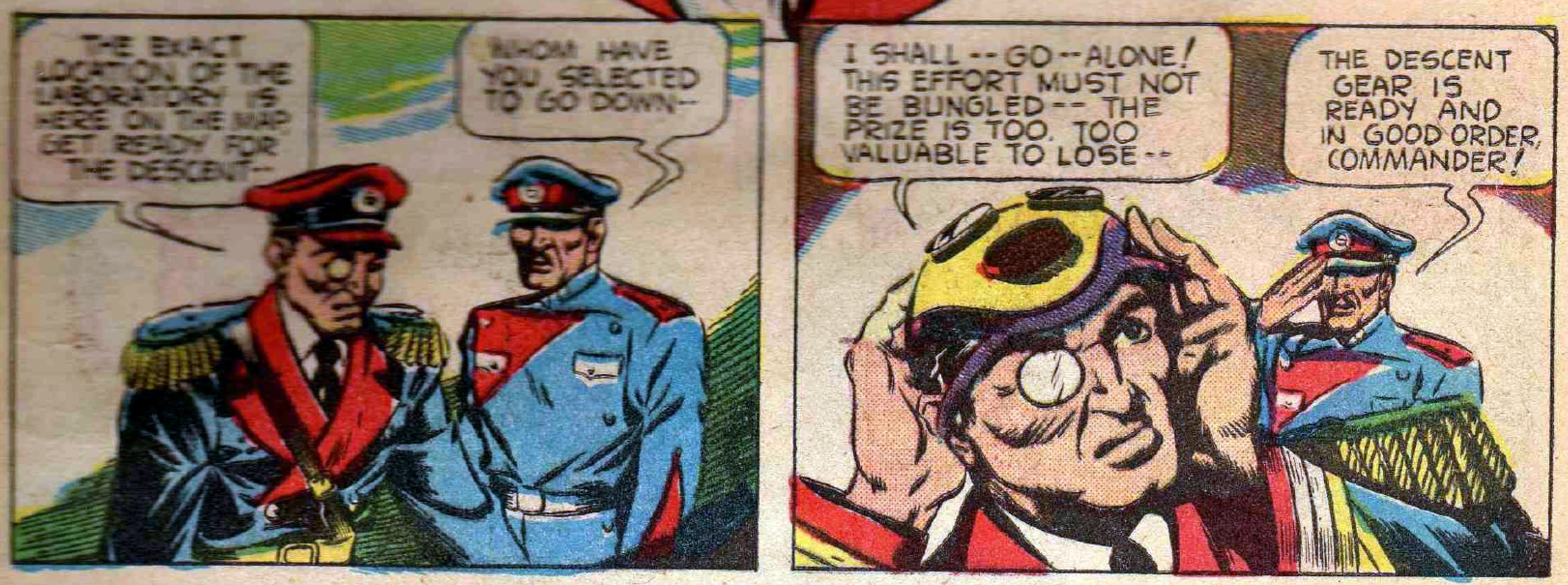
    Commander Darke, though ostensibly on a mission to invade the United States with his private military, is the arch-foe of scientist-adventurer Cosmo Mann and as such spends his entire career trying to Steal Those Gizmos. Perhaps things would be different if there had been more than three issues of Bang-Up Comics for Darke and Mann to clash, but as it stands all we get are the opening moves of their epic struggle.

    You probably already took note of the extreme ostentation on display in Commander Darke’s (almost certainly self-designed) uniform, but the seriousness with which he takes his wardrobe is really underscored in the above panels in which we can not only see that he took the care to screw in his monocle even when waking up in the middle of the night to take a call but that even his double-breasted pyjamas have epaulettes on them. 

    I was all ready to give Darke a bit of credit for undertaking the mission to secure Cosmo Mann’s Sun Ray Gun himself, but once he left his captured underlings behind to die in a cloud of poison gas I was forced to reevaluate: going himself is a part of his being a Bad Boss, an expression of his disdain for the ability of his minions to do even this simple task. He does have a cool-looking gas mask though.

    Commander Darke has a lot of villainous presence or potential, but never really gets a chance to show it off: he captures the Sun Ray and a man who he thinks is Cosmo Mann but turns out to be his assistant Archy and then spends his next appearance on the back foot as Mann attempts to recapture them from Darke as he escapes in his dirigible. His particular brand of bombastic villainy was lost to the vagaries of the comic book boom, alas.

  • MINOR SUPER-HERO ROUND-UP 070

    MINOR SUPER-HERO ROUND-UP 070

    No more of those fancy-pants vigilantes that you’ve had a chance to have heard of: here’s some real minor super-heroes for you:

    the Rainbow: 

    The Rainbow, aka Jim Travis, may just be the first super-hero whose origin involves reading a comic book and taking inspiration from it, but unlike the other examples of this that I can think of Jim reads less like someone finding a solution to a problem that they have and more like one of those guys who is convinced that they could score a point off of a professional athlete if they tried. Most of his motivation honestly seems to come from a desire to prove his girlfriend wrong when she says that his idea is not good. 

    To his credit, Jim does put in a pretty good show as the Rainbow. He hops around the rooftops and foils some crooks with a few timely punches. Though the real-world reason that he only made one appearance was the fact that Centaur Comics was a very short-lived phenomenon that tailed off pretty sharply in 1941/1942, it is very tempting to imagine that the Rainbow’s second outing ended in some sort of career-ending and unpublishable disaster.

    Finally, the name: while the natural assumption is that Jim called himself the Rainbow after assembling such a multicoloured outfit (and making some real choices, too! The barely laced-up shirt, the cape depending from the cowl mask, the footie tights… this is one of the more eccentric costumes in comics, if only at a second or third glance), I personally think that the name was chosen solely in order to make the above very poor virtually incomprehensible joke. (The Arrow 003, 1941)

    Cosmo Mann: 

    Cosmo Mann is a scientific adventurer who has developed an extremely bulky ray gun with three different modes: a “Sun Ray” capable of vaporizing a tank, a paralysis ray and an ill-defined “G Ray” that seems to both increase the mass of the bullets being fired at him in the above demonstration and also melt them somehow. He also has a cool personal flight suit called the Sun Ray Suit that he dons in his second appearance to rescue his cigar-chomping aide Archy from the diabolical Commander Darke.

    Like all Progressive Publications characters, any enthusiasm I feel toward Cosmo Mann is tempered by the fact that he only ever appeared in three comics, one of which is currently lost to the ages. Still, I have to admit that he is a pretty cool guy. (Bang-Up Comics 001, 1941)

    Buzz Balmer: 

    Buzz Balmer is a young aircraft enthusiast whose father has just perfected his Minus-Ray shrinking device, and thanks to his youthful enthusiasm he ends up bounding directly into the Minus beam and becoming permanently shrunk to a few inches tall.

    Thanks to his guilty conscience, Professor Balmer makes sure to equip him with the very latest in shrunken aviation technology so that he can fly around the countryside making up excuses to kill the wildlife for fun. Eventually – perhaps thanks to all the favours that his dad has been calling in to procure ever-faster fighter planes – military intelligence gets wind of Buzz and recruits him as an asset. His second and final appearance is spent tooling around Europe for the Army.

    The most vexing thing about Buzz Balmer is that I want to say that his name is a pun on “buzz bomber” but I can only really find evidence of v1 Rockets being called that and they don’t start being used for three more years. While it seems like the term might have been used for something before that, any further web-based research is hampered by the popularity of both the Sonic the Hedgehog enemy and novelty fishing lures that also use the name. (Bang-Up Comics 001, 1941)

    Lady Fairplay: 

    Lady Fairplay, the “Goddess of Chastisement,” is actually Mary Lee, a mild-mannered schoolteacher given super powers by the never-seen Professor Amazo. I find her costume quite charming, particularly the scale-mail skirt.

    Here’s the thing about Lady Fairplay: she is a perfectly generic super-hero. She is super fast, super strong, agile enough to climb up the side of a plane while it is in flight. She drives around in a super car and ducks out of her day job to fight crime at the drop of a hat. 

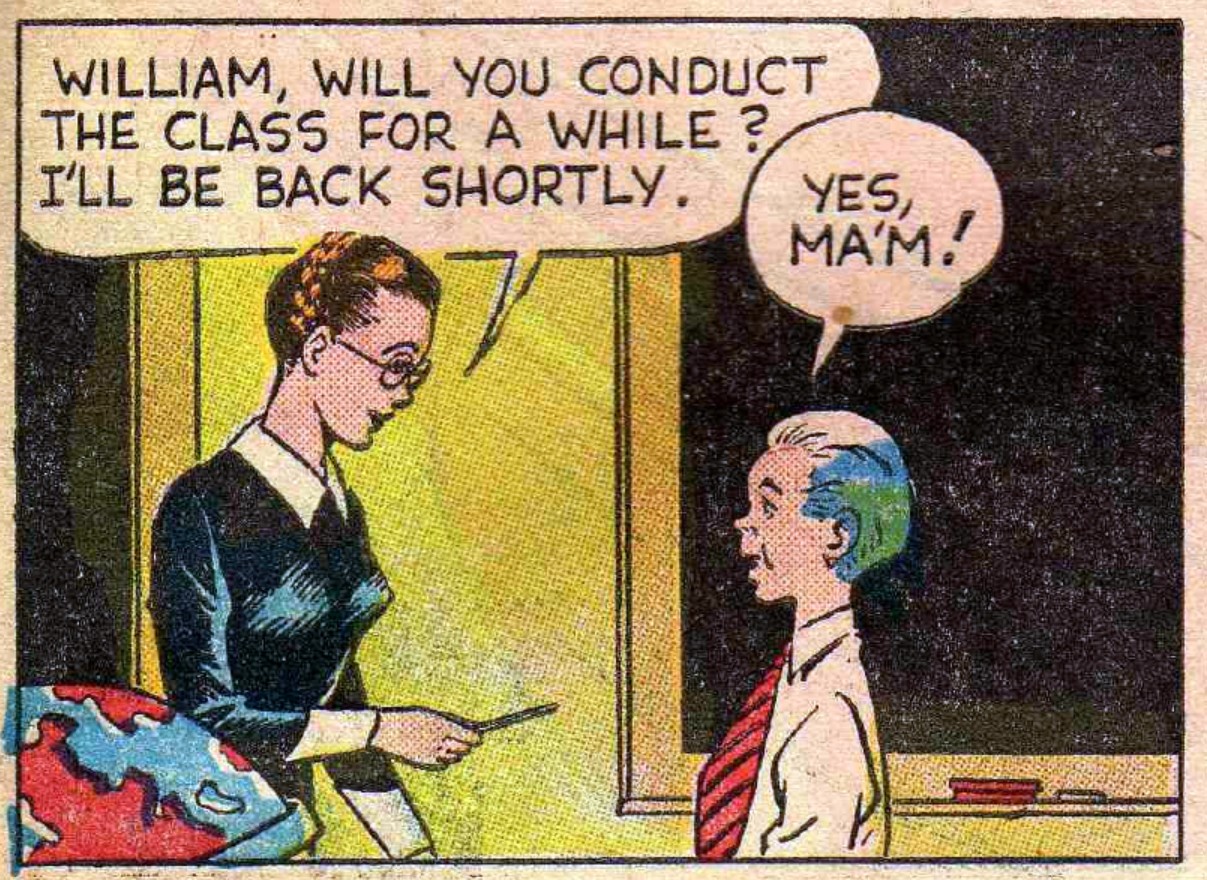
    Perhaps the most extraordinary thing about Lady Fairplay is that she just leaves some kid named William in charge of her class while she runs off to fight crime. Good luck on the bullying, William! (Bang-Up Comics 001, 1941)

  • SUPER-HERO FILE 002: CAPTAIN MARVEL JUNIOR

    SUPER-HERO FILE 002: CAPTAIN MARVEL JUNIOR

    (Whiz Comics 025, 1941)

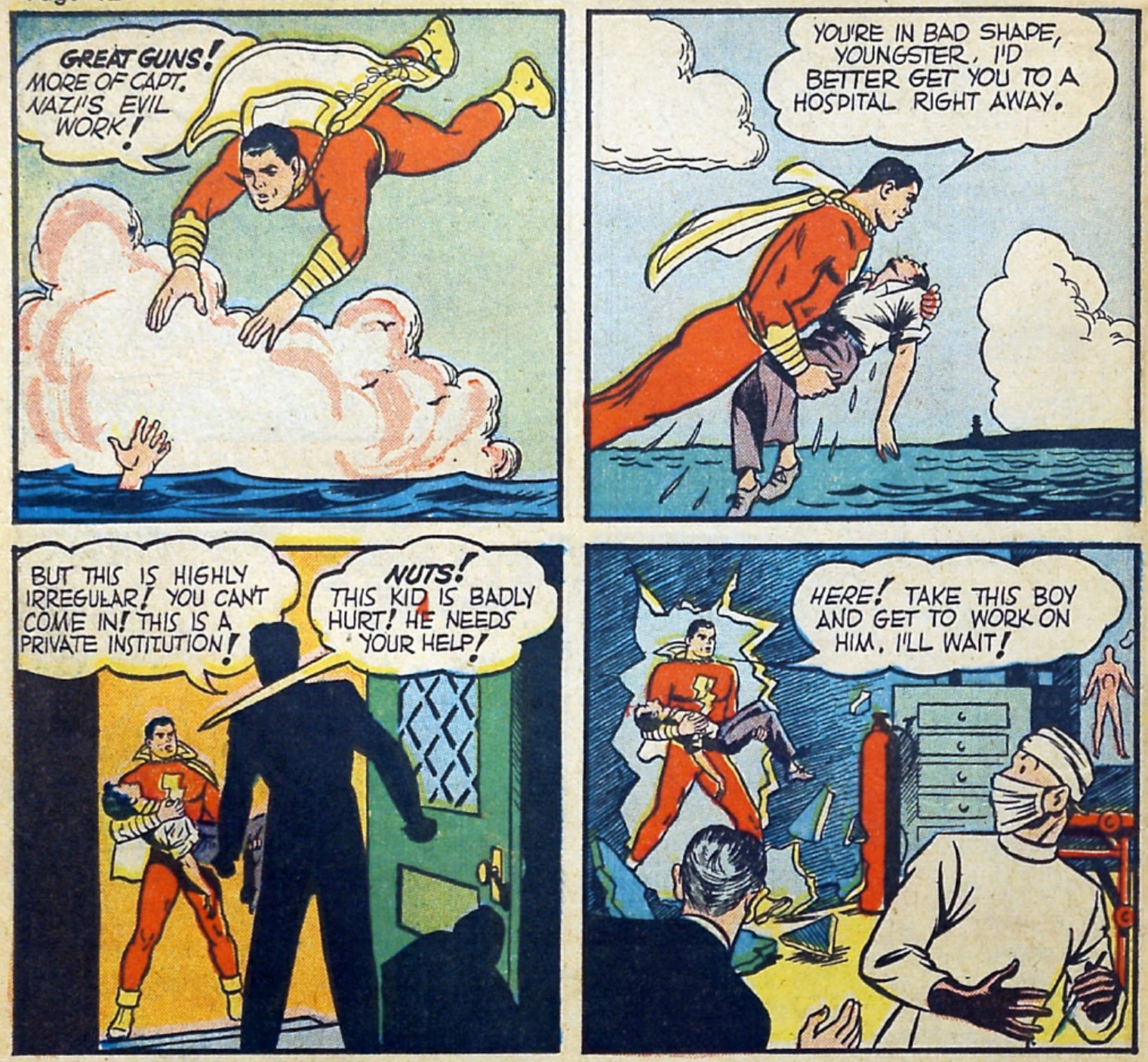
    After the vile Captain Nazi is knocked into New York Fawcett City Harbor during a battle with Captain Marvel, he is pulled from the water by young Freddy Freeman and his grandfather and immediately rewards their good deed by murdering them both. Or so he thinks! It turns out that Freddy is merely grievously injured, and Captain Marvel is able to bring him to a hospital for care.

    Informed that Freddy is not expected to live through the night, Billy Batson makes the decision to bring him to the secret underground realm of the wizard Shazam in hopes that he might be able to do something for him. The wizard’s shade is summoned via an apparently mystical brazier (and hey, I think that this is Shazam’s first appearance since he was squashed by that huge block of stone during Billy’s origin!) but rather than help Freddy, Shazam places the onus of doing so on Captain Marvel’s shoulders.

    In practical terms, this means that rather than SHAZAM, the newly-minted Captain Marvel Junior says “Captain Marvel” to transform, which as many have pointed out before me means that he cannot actually say his own name without changing identities. Does the fact that Captain Marvel can do this ever come up again? Perhaps it ties in to the more modern conception of him as a sort of larval being who will eventually evolve into a new wizard, but I’m not sure if it come up in the intervening decades.

    Perhaps my favourite thing about Captain Marvel Junior is that since his comics were not drawn by CC Beck they have a different style to them and that when the Marvel Family are all together they emphatically do not adjust this. Everyone else (except perhaps Mary Marvel) is running around with that clean art style with those little black eyes and Cap Jr just keeps on looking like a young Elvis. It’s always fun!

    UPDATES: