The Curse of Skeleton Munroe

Blog

  • MINOR SUPER-VILLAIN 1001: BARON KRAWMAN

    (Lightning Comics v1 005, 1941)

    Whiz Wilson and his Futuroscope are once again engaging in the Doctor Who style of time travel, in which you just kind of pop into a random time and place and ask a bystander how things are going. In this case he has ended up in Florida in the year 3000, and the vest-wearing Florida Man he speaks to is pretty smug about how great things have been for the past thousand years. Perhaps he is rounding up or thinking extremely locally, because previous Whiz Wilson stories have established a general civilizational collapse in 2040 CE and a more localized one in South America around 2500 CE.

    More importantly, as if summoned by the words “these are wonderful times,” this is the moment that a squad of giant robots attack the city.

    Whiz Wilson is as ever a man of action and takes advantage of a poorly-secured access hatch on the back of one of the robots to get inside and beat up the pilot. This in turn causes the over-cautious leader of the robot pilots, now revealed to be a man named Baron Krawman, to recall his forces.

    Joining the queue of robots in his newly-commandeered ride, Whiz follows them to a domed underwater city “about ten miles” off the Florida coast.

    A quick and stealthy search of the city leads Wilson to an imprisoned woman who introduces herself as Betty Walters, Krawman’s former assistant. She tells him that a) the city is part of the lost continent of Atlantis that Krawman stumbled upon (though how it was missed during a thousand years-plus of intensely ocean-facing Florida life is beyond me) and b) that he is bent on destroying civilization because they laughed at him. Annoyingly, she does not explain why all of Krawman’s minions are nigh-identical bearded beefcakes, because that is all that I am asking about. Was he experimenting with cloning? Are these the descendants of lost Atlantis? Does he just have a type? 

    Whiz and Betty return to the commandeered robot and engage Krawman in thrilling robot-hand-to-robot-hand combat for the future of Florida, a combat that ends with Krawman dead and his city flooded. Once again Whiz Wilson has saved the people of a time period so far in his own future that his bones are naught but dust. Hooray!

    Categorized in: Accessories (Giant Robots), Origins (Villains of the Future), Royalty (Barons)

  • MINOR SUPER-VILLAIN 1001: BARON KRAWMAN

    (Lightning Comics v1 005, 1941)

    Whiz Wilson and his Futuroscope are once again engaging in the Doctor Who style of time travel, in which you just kind of pop into a random time and place and ask a bystander how things are going. In this case he has ended up in Florida in the year 3000, and the vest-wearing Florida Man he speaks to is pretty smug about how great things have been for the past thousand years. Perhaps he is rounding up or thinking extremely locally, because previous Whiz Wilson stories have established a general civilizational collapse in 2040 CE and a more localized one in South America around 2500 CE.

    More importantly, as if summoned by the words “these are wonderful times,” this is the moment that a squad of giant robots attack the city.

    Whiz Wilson is as ever a man of action and takes advantage of a poorly-secured access hatch on the back of one of the robots to get inside and beat up the pilot. This in turn causes the over-cautious leader of the robot pilots, now revealed to be a man named Baron Krawman, to recall his forces.

    Joining the queue of robots in his newly-commandeered ride, Whiz follows them to a domed underwater city “about ten miles” off the Florida coast.

    A quick and stealthy search of the city leads Wilson to an imprisoned woman who introduces herself as Betty Walters, Krawman’s former assistant. She tells him that a) the city is part of the lost continent of Atlantis that Krawman stumbled upon (though how it was missed during a thousand years-plus of intensely ocean-facing Florida life is beyond me) and b) that he is bent on destroying civilization because they laughed at him. Annoyingly, she does not explain why all of Krawman’s minions are nigh-identical bearded beefcakes, because that is all that I am asking about. Was he experimenting with cloning? Are these the descendants of lost Atlantis? Does he just have a type? 

    Whiz and Betty return to the commandeered robot and engage Krawman in thrilling robot-hand-to-robot-hand combat for the future of Florida, a combat that ends with Krawman dead and his city flooded. Once again Whiz Wilson has saved the people of a time period so far in his own future that his bones are naught but dust. Hooray!

    Categorized in: Accessories (Giant Robots), Origins (Villains of the Future), Royalty (Barons)

  • MONSTER, CRITTER AND CREATURE ROUND-UP 002

    It’s time for more monsters! And also critters and creatures!

    Prehistoric Gorilla:

    This carnivorous cave-dwelling ape lives in a hidden valley in Africa and has a pretty sweet deal going with the local pterodactyls, whereby they bring him things to eat and he seemingly doesn’t have to do anything. This arrangement does eventually backfire after the pterodactyls grab Kaänga’s mate Ann and the justifiably miffed jungle lord follows them and slays the gorilla. (Jungle Comics 017, 1941)

    A few bonus dinosaurs from the hidden valley: some generic carnosaurs, the aforementioned pterodactyls, and a mean aquatic sauropod.

    Creatures of Argus:

    When the wicked Sklar, tyrant of the planet Argus, attempts to invade the Earth of the far-off Year 1982, he sends these fairly cool flame-spewing robots to do his dirty work for him. While I always appreciate a good killer robot, these ones are especially satisfying because they conform to the proportions of the people of Argus and it’s always nice to see non-humans adhering to their own aesthetics rather than defaulting to ours. 

    Though the robots are smashed up by champion of the people Power Nelson in short order the risk of invasion remains, so he and his love interest/companion Zora head to Argus to settle things once and for all. During their time there, they are forced to take a detour that leads them through the through the Cave of Terror, a monster-haunted locale containing such beasts as…

    … the beefy, fire-breathing Dreaded Cave Monster! (smashed against a wall)

    The cephalopoid Creatures of the Quicksand! (deprived of their meal but otherwise unharmed)

    The extremely compelling giant rodentoid Saber Tooth Crawler! (punched out) (Prize Comics 006, 1940)

    Morg:

    Adventurer Planet Payson encounters this morg while investigating malfeasance on Mars, and manages to escape its clutches by merely making it sleepy rather than killing it. A true win for xeno-conservation! (Planet Comics 006, 1940)

    Pteridons:

    Analogous to our own woolly mammoths, these pteridons were once native to Pluto but now lie frozen beneath a layer of ice. Though a gang of crooks attempt to exploit these curiously adorable beasts by thawing them out and deploying them as rampaging engines of destruction, they are stopped by Buzz Crandall before things get too out of hand. (Planet Comics 006, 1940)

    Aqua-Scorpio:

    Despite the fact that people in the 40s thought that octopuses were inherently gross, menacing and deadly,  sometimes the comic book people felt the need to up the ante a bit and so we get things like the aqua-scorpio her, as encountered by oceanic adventurer Captain Gallant. I really like this guy’s head, especially the combination of the compound eyes and chinless beak, but the hooked tentacles might be overkill. (Super-Mystery Comics v1 005, 1940)

    Arena Monsters:

    The wicked ‘bdula Khan pits these three beasts against the Golden Knight seemingly purely for the love of being evil. Only one of them, the bat wing monster, gets anything approaching a name, but that doesn’t prevent it from being slain as easily as its companions generic dragon and land kelpie. (Fantastic Comics 006 1940)

    Bat-Serpent:

    The Rocket is confronted with and slays this bat-serpent while he is the captive of a group of Ape-Men, and it’s a good thing that he does so because it moves him out of the category of “prisoner” and into that of “potential leader.” I do feel a little bad for the bat-serpent here, though. Sure, the caption box says that it is a “blood seeking enemy of all animal and human life” but that face says “adorable puppy-cow” and that holds a lot of weight with me.

    As part of his ascent to chiefdom, the Rocket must venture into the Cave of Horrors and face the various horrors therein. He only gets to one of them before being interrupted, but it’s a good one, the fire-breathing, flashlight-headed rayoceros, which look like the kind of creature you’d find in an early Sixties comic set on Krypton. (Pep Comics 005, 1940)

  • MINOR SUPER-VILLAIN 1000: THE MUMMY

    MINOR SUPER-VILLAIN 1000: THE MUMMY

    Number 1000!!*

    (Lightning Comics v1 005, 1941)

    The Old Man of the Pyramids summons (F)lash Lightning to his thundercloud lair to warn him about trouble at Midton College, and he is right, as can only be expected of a wise old oracular father figure. This particular trouble is called Professor Vatz and is a professor of chemistry who is ready to give up academia for the heady world of supercrime.

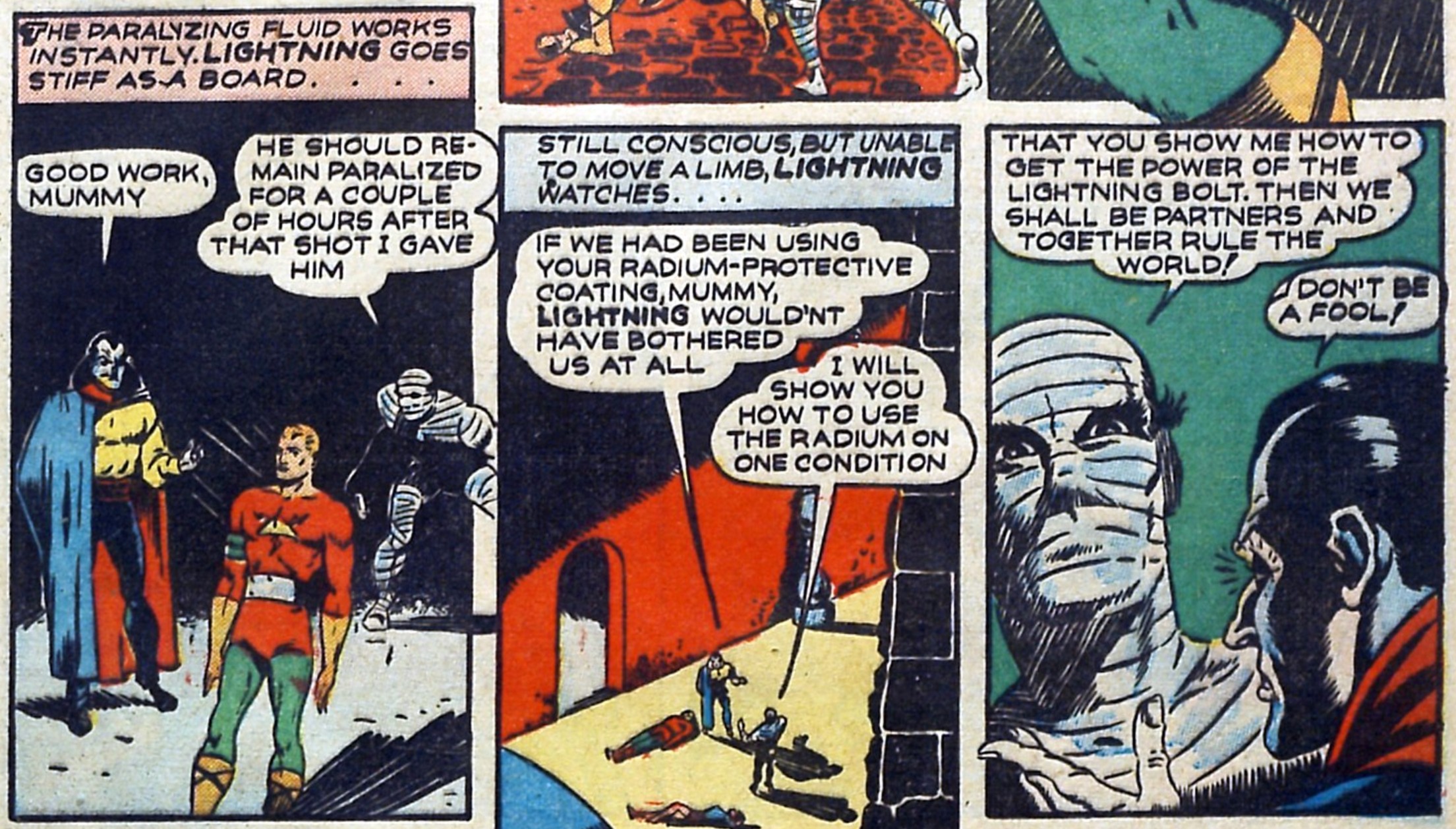
    Vatz’s new career is founded on two inventions: his “Hotlight,” a ray gun that seems to spit out both bright light and great heat sufficient to kill a regular person or knock out a superhuman figure like Lightning, and a radium compound that makes ordinary cloth into a form of armour resistant to conventional attack. Vatz decides to apply this solution to mummy wrappings, and while I can kind of see that being a way to ensure that the his armour is applied as close to his body as possible, but just what his justification is for using wrappings from an actual mummy is completely inscrutable to me.

    As always, mummy wrappings are a fantastic look and they are only enhanced by the fact that Vatz either chooses to leave the little flyaway portions of his hair sticking out of the sides or simply does not care that they are. It’s some very very strong bald guy energy and perhaps the most significant addition to the mummy look in two thousand years.

    The newly-fledged Mummy recruits a few gangsters and goes on a mild crime spree but is soon tracked down by a recovered Lightning. This leaves the problem of the Mummy’s invincibility to solve, and Lightning does so with aplomb: if the wrappings are the vehicle for the invulnerability, simply remove the wrappings before applying violence.

    (please note that the Mummy had a calling card all ready to go, and it’s a cute one. He only ever gets to use it the once, however)

    The Mummy returns in Lightning Comics v1 006, in what is effectively a bottle episode. Professor Vatz, given far both too much credit for a rapid reformation and unfettered access to the prison laboratory, is able to recreate his radium solution and take over – but not actually escape – the prison he has been locked up in.

    The only thing that the Mummy seems to be unable to replicate in prison is his Hotlight. Instead, he sports a much cooler “Nitro Gun” that shoots explosive pellets. He is also able to whip up a “Lightning Arrester” to drain the electric energy from Lash Lightning’s body when he inevitably turns up to foil the Mummy’s plans.

    Despite the fact that he is able to disable Lightning and throw him into the prison gas chamber, the Mummy does not account for the possibility that his lightning powers might return to him and allow him to escape. He is soon recaptured in the exact same manner as he was in their first encounter and I must say that the fact that Professor Vatz failed to account for this – perhaps by means of a tricky little knot or fastener – really lowers him in my estimation.

    In the Mummy’s final appearance, in Lightning Comics v2 001, he is broken out of a prison hospital by Lash Lightning’s new archfoe Mastermind, who is hoping to learn the secret of Professor Vatz’s radium coating in order render himself immune to harm. 

    The Mummy makes three key mistakes in his dealings with Mastermind: 1) he tries to negotiate after the initial deal has been struck, proposing that the radium formula be revealed in exchange for the secret to Mastermind’s own ability to command lightning. This might work if the Mummy were dealing with a reasonable person, but Mastermind is a super-villain, a class of inherently unreasonable people. 2) The Mummy escalates the confrontation to a physical one without first applying the radium solution and thus rendering himself immune to harm, and 3) he gets himself obliterated by a lightning bolt. he does therefore mess up Mastermind’s plans by taking his formula to the grave, but it must be cold comfort when one is a smouldering corpse.

    Farewell, the Mummy. You weren’t a very good super-villain but you were an entertaining one.

    Categorized in: Accessories (Anti-Hero; Heat Rays), Day Jobs (College Professors), Supranormal Beings (Mummies)

    *technically Fang Ryan is number 1000 and the Mummy is number 999, but I like mummies more than snake-themed gangsters so I fudged it for the sake of the round number.

  • MEDIA IN COMICS 013

    Today in Media in Comics, we’re all about the Movies:

    Movie star Dawn O’Dare returns to her home town of Holtville to premiere her new picture Love Me Forever! but the whole affair is almost undone when her understudy attempts to impersonate her and make off with the theatrical take, only to in turn be foiled by local copy boy Hap Hazard. (Lightning Comics v2 004, 1941)

    Angry Waves, a sea epic, features a found footage action scene as one of the Strange Twins rescues the other from drowning. (Hit Comics 016, 1941)

    It’s time for our first movie titled Crime Doesn’t Pay, starring police officer Sally O’Neil and featuring a real on-screen murder. (National Comics 010, 1941)

    I fear that we will only be able to evaluate all of the Gone with the Wind parody titles once we have enough of then together to compare. That said, Flown with the Breeze, here about to be attended by Allan “the Hunchback” Lanier and date, has to be one of the more goofy of the bunch. (Wow Comics 002, 1941)

    This adaptation of Ivanhoe had a troubled production thanks to an on-set protection racket. It is also distinguished by the fact that its arms and armour consultant was Justin Arthur, aka the Shining Knight. (Adventure Comics 068, 1941)

    Jungle Justice, another troubled production due to on-set criminals, boasts its own heroic consultant in the person of Congo Bill. (Action Comics v1 042, 1941)

    Though Red River Days managed to get made without any notable hiccups, its premiere in the actual town of Red River is marred by organized crime. (Adventure Comics 060, 1941)

    Thrills of Africa, is a jungle movie that gives one crook the opportunity to dress up in a gorilla suit and rob the theatre it’s playing in after posing as a statue in the lobby for who knows how long. Also, his two pals are there in blackface.

    While chasing these problematic miscreants, Hourman passes a poster for The Count of… something. Perhaps Monte Cristo? Whatever it is, it must be printed real small, given the size of that poster. (All-Star Comics 006, 1941)

    During the Dummy’s tenure ans one of the Five Fingers of the Hand, he heads off to Hollywood to run a kidnapping scheme, and of course this ends up involving a whole plethora of movies. To begin, we have Aircraft Carrier, the premiere of which is ruined when star Rex Mason is seemingly turned to stone but actually spirited away.

    Six-Gun Serenade, a Western, features occasional Vigigilante sidekick Billy Gunn as an extra.

    While Vigilante is visiting Billy on-set, he gets involved in the latest kidnap attempt on the nearby set of sports film Touchdown Blues.

    The crooks’ getaway then takes then through the set of Bars and Stripes, which may or may not be a patriotic prison movie.

    Finally, the Dummy’s men are run to ground on the set of jungle picture Tropic Doom. (Leading Comics 001, 1941)

  • MINOR SUPER-VILLAIN 999: FANG RYAN

    (Lightning Comics v1 005, 1941)

    We meet Fang Ryan after he grabs a payroll from the recently-deceased messenger who was in the process of delivering it. He then escapes despite the fact that Police Detective Danny “the Raven” Dartin is on the scene to engage him in thrilling gunplay, but drops his signature weapon, a stick with a couple of snake fangs on one end. It’s a neat gimmick: the stick has a reservoir full of poison inside of it, so when Fang whacks someone with it they die of what looks like a snakebite. It is therefore a shame that he does not actually use this item in the story (aside from in killing the courier, implicitly).

    Since Ryan has lost his weapon, the Raven knows that he will need a new supply of snake venom to make another, and waits in ambush for him at the zoo from which he had previously sourced the stuff. Sure enough, Ryan shows up in time for a fist fight, which ends in… perhaps not the only time that a super-hero is knocked out by a zebra but surely one of a very limited number of times that it happens.

    When a supercrook has rendered a super-hero unconscious and captured them, there are a few ways that they can proceed. The standard approach is of course to place the hero in a deathtrap in full costume and then leave the room, followed closely by “go to unmask them but take so long that they wake up and start fighting you again.” Fang Ryan instead opts for one of the rarer options and just immediately unmasks the Raven, and thanks to the gunfight from earlier he even recognizes him!

    Ryan’s next thoughts are both good: frame the Raven for his next job and expose the Raven’s identity, thus taking all the focus off of him and his piddly little crime spree. Where it all falls apart that he tries to do both at the same time instead of sequentially, as he calls up Dartin’s boss and rats him out before heading out to do the next robbery.

    The one-two punch of this means that when an insomniac sees the Raven and reports him to the cops, the entire police force shows up to get him rather than a car or two worth of guys.

    Meanwhile Dartin has escaped from where Ryan left him hogtied in the woods and shows up to avenge his honour. He ends up killing Ryan in a shootout, which somehow completely overwrites the part of Police Chief Lash’s brain that heard the information about Dartin being the Raven. It’s just the luck of the costumed vigilante, I guess.

    Categorized in: Animals (Snakes), Body (Nonhuman Parts), Fraud (Identity Theft (Hero Impostors))

  • MINOR SUPER-HERO ROUND-UP 103

    Soon there will be more minor super-heroes than there are humans for them to protect.

    the Sentinel:

    In 1783, on the Boston Common, the newly-minted Spirit of America charges a cannon with the “powders of patriotism” in anticipation that someday a champion will be needed to defend the new nation from destruction. Finally, in 1941 (the Civil War not, apparently, being enough of a reason), the cannon fires on its own and releases the Sentinel, mystic champion of the American people.

    As one might expect, the Sentinel is broadly superhuman: he can fly, is super strong and is immune to most harm. He also has a halo of fire that he can disappear into and shrink to a tiny flame, effectively rendering him invisible and allowing him to vex friend and foe alike with his comings and goings. Oddly, he has no other control over fire. (Liberty Scouts Comics 003, 1941)

    Doctor Nemesis:

    Doctor Nemesis is really Dr Jim Bradley, intern at Mercy Hospital in an unnamed city (that is probably meant to be NYC but later retconned as San Francisco) who has developed a foolproof truth serum and decided to keep it to himself rather than risk criminals getting their hands on it – presumably the concern is that they would use it to learn bank vault combinations and other secret information. Since he himself continually runs into situations in which a foolproof truth serum is a handy way to solve a crime, Bradley adopts a costumed identity and sets out to achieve a better tomorrow via a series of injections. 


    Doctor Nemesis might just be the most calling card-using super-person who we have yet encountered. He hands out at least four of them in his first adventure alone.

    Doctor Nemesis has a pretty simple crimefighting routine: identify a potential injustice and then drug everyone involved until he has a clear idea of who is responsible, then beat them up and have them give a drugged confession in front of a police witness. The police in turn are perfectly happy to receive these confessions that they technically haven’t coerced from people, though there has to be a clever defense attorney somewhere in Unnamed City who is just waiting to get a Doctor Nemesis client so that they can really dig into the admissibility of admissions given under the influence of mysterious vigilante juice.

    It’s been a while since we have encountered a character who was later revived and incorporated into the Battle-Axis, Marvel’s team of disaffected public domain Golden Age super-heroes who went over to the Nazis, but Doctor Nemesis here is one of them under the technically-but-not-really more badass name of Dr Death. As always, it’s hard to say just who got done dirtiest by Roy Thomas when he was assembling the Battle-Axis roster but Doctor Nemesis is certainly a candidate, if only because he doesn’t even have the Human’s Meteor’s flimsy “I’m Irish American and fuck the British” or the Spider Widow’s “the Commies killed my husband” excuses. Instead, he simply implies that the Nazis are paying him well.

    Subsequent writers (specifically Matt Fraction, if I have things right) clearly thought that Doctor Nemesis was worth revisiting. He was given a long career as a Nazi hunter to counteract his short career as a Nazi and briefly became a core X-Man, though nowadays every time I look up what he’s up to it seems that he has become weirder and more peripheral to the action than the last. (Lightning Comics v1 006, 1941)

    Lash Lightning **UPDATE**:

    I haven’t been very careful to delineate whether the character has been going by “Flash” or “Lash” Lightning due to the fact that it profoundly does not matter (they just call him “Lightning” in the stories themselves, for instance) but I might as well make note of this, the issue in which the actual change was made. (Lightning Comics v2 002, 1941)

    Marvo the Magician **UPDATE**:

    Up until the exact point pictured above, Marvo the Magician was unique among magical comic book super-heroes, for though many of them (including Zatara, the big cheese himself) are said to be using their magic to create illusions and fool the minds of others, it is all demonstrably lies (or more charitably a different definition of “illusion” than I am using), as they all produce material effects in the world. Only pure, beautiful Marvo can claim that he uses illusions and nothing more to frighten and confound his foes, and I have been checking.

    That is, up to this issue, when Marvo creates the “illusion” of an ocean liner (complete with a crooked sailor who kidnaps her and hands her over to pirates!) that the woman he is helping proceeds to board and sail away on. Unless the implication is that she has been so convinced that the liner exists that she has swum or perhaps hovered her way to her destination (well, part way to her destination), the inescapable fact is that this ship is more than a mere illusion. Nothing is certain in this wicked world, folks. (Lightning Comics v2 003, 1941)

  • MINOR SUPER-VILLAIN 998: THE CHIEF

    (Liberty Scouts Comics 002, 1941)

    The Chief is one of two things, either a not-very-specific Hitler stand-in who is leading his forces from the front in an attempted invasion of the US, or the representative of such a figure in such an invasion. Either way, he is clearly a pseudo-Nazi. When we meet the Chief he is preoccupied with discovering the identities of the mysterious figures (who we know to be the Liberty Scouts) who have been thwarting his attempts to weaken the US war effort.

    Though he makes a decent try at it, the Chief just barely fails at an attempt to destroy both the Liberty Scouts and the President of the United States while they are meeting at Liberty House. Their next encounter, by contrast, ends with him capturing the Scouts and gloating about his plans before leaving them tied up next to a bomb. It doesn’t work out, of course, but setting up a deathtrap that will kill the hero while you are in a second location is a core super-villain activity. It’s enrichment for them.

    The Chief is at the forefront of Axis superweapon technology, with such innovations as a secret naval base in a hollowed-out iceberg off Newfoundland, a fleet of remote-controlled ships housed in that base, and heat ray cannons mounted on those ships, with which New York City as the first move in his invasion of the US.

    Though New York ends up taking some heat ray fire, the Liberty Scouts (conspicuously not dead, as is the norm when super-heroes are left in deathtraps) show up in time take control of the robot fleet and turn the rays on the Chief’s own forces.

    Though the Chief makes a valiant attempt to escape to fight another day, he ends up flying his plane directly into the path of a heat ray and exploding.

    The Liberty Scouts face a second Chief in Liberty Scouts Comics 003, who is also attempting to conquer the US on behalf of the same faux-Nazi government (they have the same crossed-knives symbol standing in for the swastika). This time the plan hinges on stealing a super knockout gas developed by Liberty Scout member Smokey and deploying it nation-wide, and once again the Chief’s deadliest enemy proves to be aviation safety, and he doesn’t even have a convenient heat ray cannon to blame for it: he just up and crashed his plane.

    Categorized in: Generica (Chiefs), Ideologies (Crypto-Fascists), Supercrime (Attempted Conquest (United States))

  • MINOR SUPER-VILLAIN 998: THE CHIEF

    (Liberty Scouts Comics 002, 1941)

    The Chief is one of two things, either a not-very-specific Hitler stand-in who is leading his forces from the front in an attempted invasion of the US, or the representative of such a figure in such an invasion. Either way, he is clearly a pseudo-Nazi. When we meet the Chief he is preoccupied with discovering the identities of the mysterious figures (who we know to be the Liberty Scouts) who have been thwarting his attempts to weaken the US war effort.

    Though he makes a decent try at it, the Chief just barely fails at an attempt to destroy both the Liberty Scouts and the President of the United States while they are meeting at Liberty House. Their next encounter, by contrast, ends with him capturing the Scouts and gloating about his plans before leaving them tied up next to a bomb. It doesn’t work out, of course, but setting up a deathtrap that will kill the hero while you are in a second location is a core super-villain activity. It’s enrichment for them.

    The Chief is at the forefront of Axis superweapon technology, with such innovations as a secret naval base in a hollowed-out iceberg off Newfoundland, a fleet of remote-controlled ships housed in that base, and heat ray cannons mounted on those ships, with which New York City as the first move in his invasion of the US.

    Though New York ends up taking some heat ray fire, the Liberty Scouts (conspicuously not dead, as is the norm when super-heroes are left in deathtraps) show up in time take control of the robot fleet and turn the rays on the Chief’s own forces.

    Though the Chief makes a valiant attempt to escape to fight another day, he ends up flying his plane directly into the path of a heat ray and exploding.

    The Liberty Scouts face a second Chief in Liberty Scouts Comics 003, who is also attempting to conquer the US on behalf of the same faux-Nazi government (they have the same crossed-knives symbol standing in for the swastika). This time the plan hinges on stealing a super knockout gas developed by Liberty Scout member Smokey and deploying it nation-wide, and once again the Chief’s deadliest enemy proves to be aviation safety, and he doesn’t even have a convenient heat ray cannon to blame for it: he just up and crashed his plane.

    Categorized in: Generica (Chiefs), Ideologies (Crypto-Fascists), Supercrime (Attempted Conquest (United States))

  • DIVINE ROUND-UP 034

    DIVINE ROUND-UP 034

    Here come some more gods and god-adjacent beings for you.

    the Golden Skull:

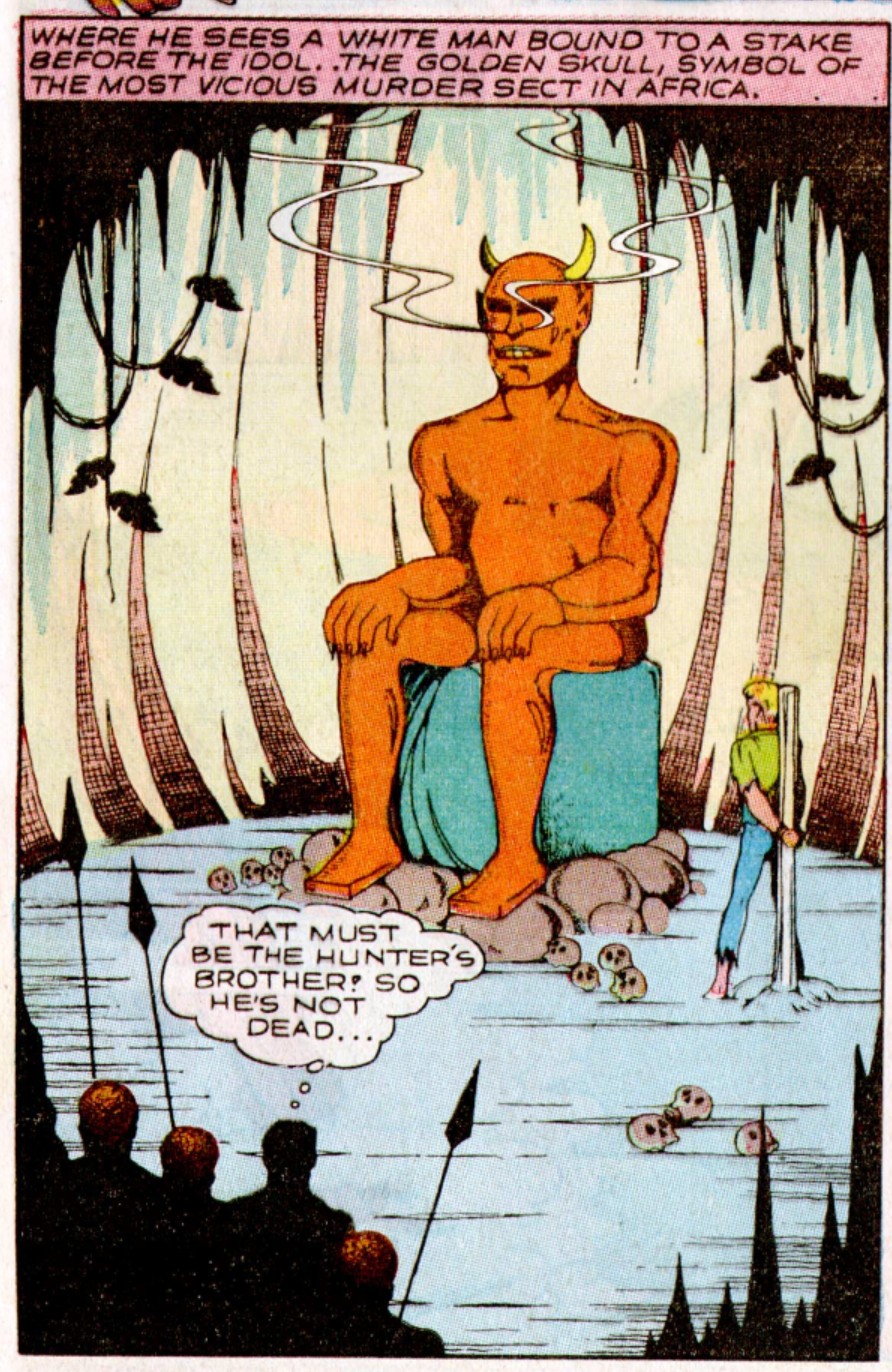
    While I must of course frown and shake my head at the concept of human sacrifice, you really have to hand it to the worshippers of the Golden Skull (who is, yes, very much not golden and also not especially skully), for giving their god a name that guarantees that a constant stream of American and European treasure hunters would arrive on their doorstep in search of swag. It’s the perfect sustainable human sacrifice supply solution!

    Sadly, the Golden Skull sect are not quite as canny about the location of their temple as they are about marketing, and the whole operation gets blown sky high when the volcano it is housed in erupts at an inopportune time.

    God Style: Idol (Jungle Comics 024, 1941)

    God of the Apes:

    We don’t learn much about the God of the Apes other than the fact that it is presumably worshipped or otherwise connected to apes and that it is real enough that Fantomah can call upon it to turn some crooked big game hunters into gorillas.

    God Style: Invoked (Real) (Jungle Comics 024, 1941)

    Mars:

    This right here is a pretty traditional comic book depiction of Mars, God of War, right down to the fact that he is loving the carnage and slaughter in Europe (and is implicitly the Guy Behind WWII). He loves it so much, in fact, that he creates Man of War as his personal agent on Earth to speed the whole process up, but he then fumbles the process so badly that he accidentally creates an Allied super-hero instead. 

    God Style: Real (Liberty Scouts Comics 002, 1941)

    the Spirit of America:

    This Spirit of America is in the Columbia mode, being an ethereal and star-spangled woman who implicitly comes into existence as a result of the American Revolution. In 1783 she primes a cannon with “powders of patriotism” just in case she ever needs to create a mystic champion at some point in the future (i.e., upcoming super-hero the Sentinel). 

    God Style: Real (Anthropomorphic Personification) (Liberty Scouts Comics 003, 1941)