The Curse of Skeleton Munroe

Category: scientist

  • MAD AND CRIMINAL SCIENTIST ROUND-UP 018

    I’m not sure that these guys all have degrees. 

    This fellow is known only as the Professor, and he conducts experiments in long- and short-range mind control on Lost Hope Island until Secret Naval Agent Spike Marlin shows up in search of a missing ship’s crew. (Speed Comics 009, 1940) 

    This unnamed scientist has developed a drug that puts people into indefinite comas and has used it to kidnap and store ten millionaires, presumably with the intent of ransoming them back to their families. Before he actually gets to the point of sending the ransom notes, however, he makes the mistake of allowing his gangster hirelings go out and use the drug to mug people on the street, thus leaving a trail of mysterious coma victims that the indomitable Detective Crane follows all the way to the scientist’s secret penthouse. (Superworld Comics 002, 1940)

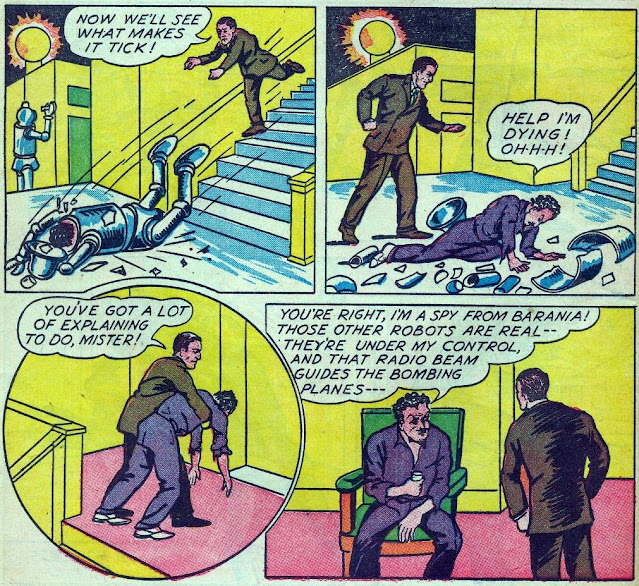
    Detective Crane is back to investigate the destruction of several West Virginian steel mills. It turns out that remote controlled drone bombers are responsible for the attacks, and he trails them back to a base near Pittsburgh filled with awesome robots, plus one Baranian spy who is merely dressed like a robot, presumably in case someone like Crane were to show up. The whole place gets absolutely annihilated.(Superworld Comics 003, 1940)

    Overworked and underappreciated Department Public Sanitation scientist Dr Sheldon might be justified in his workplace dissatisfaction but he expresses his negative emotions in an unproductive manner, by poisoning the city reservoir and killing thousands of people. It must be cathartic though, because the Arrow has to shoot him with one of his trademark arrows in order to prevent him from poisoning the reservoir even more than it was before. (The Arrow 002, 1940)

  • MAD AND CRIMINAL SCIENTIST ROUND-UP 018

    I’m not sure that these guys all have degrees. 

    This fellow is known only as the Professor, and he conducts experiments in long- and short-range mind control on Lost Hope Island until Secret Naval Agent Spike Marlin shows up in search of a missing ship’s crew. (Speed Comics 009, 1940) 

    This unnamed scientist has developed a drug that puts people into indefinite comas and has used it to kidnap and store ten millionaires, presumably with the intent of ransoming them back to their families. Before he actually gets to the point of sending the ransom notes, however, he makes the mistake of allowing his gangster hirelings go out and use the drug to mug people on the street, thus leaving a trail of mysterious coma victims that the indomitable Detective Crane follows all the way to the scientist’s secret penthouse. (Superworld Comics 002, 1940)

    Detective Crane is back to investigate the destruction of several West Virginian steel mills. It turns out that remote controlled drone bombers are responsible for the attacks, and he trails them back to a base near Pittsburgh filled with awesome robots, plus one Baranian spy who is merely dressed like a robot, presumably in case someone like Crane were to show up. The whole place gets absolutely annihilated.(Superworld Comics 003, 1940)

    Overworked and underappreciated Department Public Sanitation scientist Dr Sheldon might be justified in his workplace dissatisfaction but he expresses his negative emotions in an unproductive manner, by poisoning the city reservoir and killing thousands of people. It must be cathartic though, because the Arrow has to shoot him with one of his trademark arrows in order to prevent him from poisoning the reservoir even more than it was before. (The Arrow 002, 1940)

  • MINOR SUPER-VILLAIN 790: DR HORTON

    MINOR SUPER-VILLAIN 790: DR HORTON

    (Sure-Fire Comics 003a, 1940)

    The town of Branton, no state specified, has been struck by a mysterious plague, and X, the Phantom Fed, is suspicious. He infiltrates the quarantine zone around the town in the guise of a doctor and starts investigating the various odd facts of the plague, beginning with 1) the fact that is is being spread by a troop of escaped gorillas that were being used in medical testing and are now apparently just wandering the town and attacking people at random.

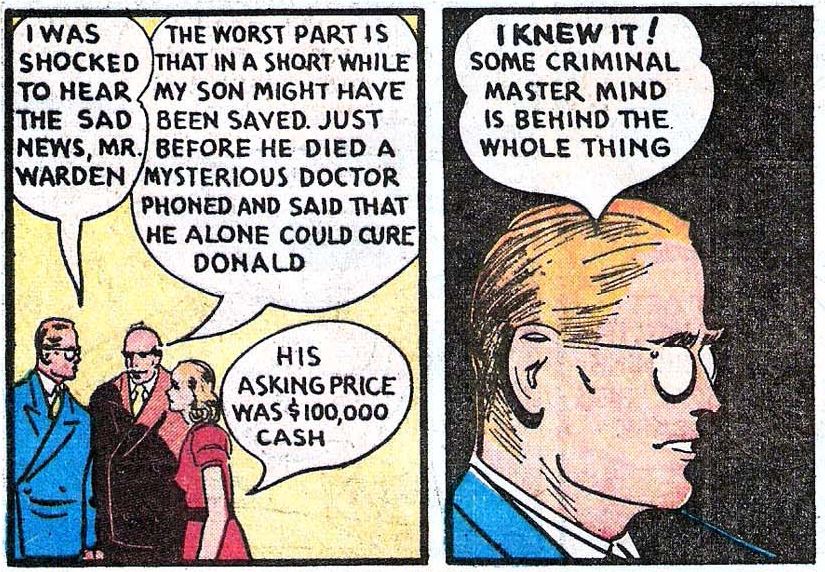
    Or are these attacks actually random? They are not, and weird thing number 2) is the fact that the gorillas seem to only be attacking the wealthiest inhabitants of Branton, such as young Donald Warden here.

    3) Speaking of amazing coincidences, a mysterious doctor just happens to have an antidote to the disease spread by the gorillas, and is willing to provide it for a hundred grand a pop, which is again an amazing coincidence since all of the victims just happen to have that kind of money.

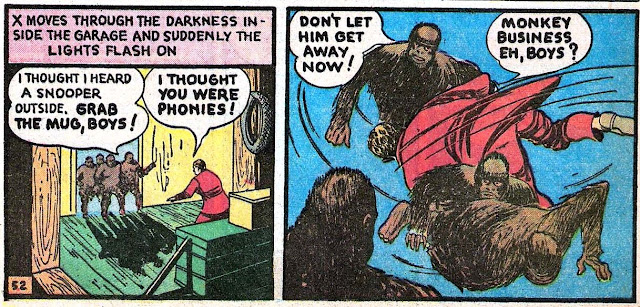
    X disguises himself as the deceased Donald Warden and arranges to get the antidote so that he can trail the agents of the mysterious doctor back to their headquarters. There, he makes an amazing discovery: the gorillas are actually men in gorilla outfits, administering fake diseased bites using a weird fork. Let me tell you: it has been too long since we have had some gorillas, real or not, in this online space.

    The thing about a gang made up of a bunch of guys in gorilla suits is that it is pretty easy to infiltrate, and X does just that, tagging along as Dr Horton, the supposed researcher who supposedly accidentally lost the gorillas, orchestrates an all-out attack on City Hall to loot the town treasury before presumably wrapping up the entire operation and skipping town. Horton’s luck has run out, however, and he is corralled with relative ease by the Man of a Million Faces.

  • MINOR SUPER-VILLAIN 782: ERIC MACFADDEN

    (Superworld Comics 001, 1940*)

    Eric MacFadden is a criminal scientist who has some sort of longstanding beef with Hip Knox, the Super Hypnotist, that was presumably covered in Superworld Comics 001, a comics I have yet to encounter for the simple reason that it would cost me at least $ 2000 US.

    MacFadden’s signature technology is the extremely stylish mesh anti-hypnosis mask that he wears to protect him from Hip Knox’s super-hypnotism, and he even has extras made to shield his men from the same (not a guarantee from your typical self-obsessed super-villain), making them the Mask Gang.

    As Superworld Comics represents Hugo Gernsback’s sole foray into comic book publishing, people more familiar with the politics and personalities of the sci-fi pulps than I am have speculated that Eric MacFadden is in some way based on Bernarr Macfadden, an enemy of Gernsback’s, and I gotta say that he’s a plausible guy to base a super-villain on. Like, obviously a man’s whole life cannot be summed up by his Wikipedia article, but an anti-medicine physical culture weirdo who gave himself the name “Bernarr” because he thought it sounded like a lion’s roar is at the very least super-villain adjacent.

    If MacFadden is indeed based on Macfadden (he also changed his last name from “McFadden” to “Macfadden” because he thought that it was “a more masculine spelling!) due to a deep Gernsback/Macfadden beef then it would go a long way toward explaining the dynamic between the two, wherein MacFadden attempts to destroy Hip Knox and then Knox turns around and ritually humiliates MacFadden rather than seeking more traditional forms of justice, and for that reason Eric MacFadden joins the ranks of super-villains who are still at large as of their final appearance.

    I would also like to make a special note of the fact that despite Hip Knox developing anti-mask technology in Superworld Comics 002, MacFadden does not then abandon the masks entirely, as is so frequently the case with science villains when their tech is countered. MacFadden is savvy – he knows that Knox isn’t going to wear that big-ass backpack every time he leaves the house.

    *Still haven’t read Superworld Comics 001 but I am assured that he was in it.

  • MINOR SUPER-VILLAIN 781: DR ANDERSON

    (Super Spy 001, 1940)

    A series of bank robberies rock the community of Unnamed Comics Book City, USA. Witnesses place local physician Doc Anderson at the scene of each crime, but when detectives look into it they find that he has a terrible alibi for each one: he was home alone. It sounds like an open and shut case, but another robbery occurs while the police are at his house. Just what is happening? Could the fact that the title of this comic is “the Twin Terror Case” play into it?

    The cops give up on Dr Anderson as a suspect following the alibi thing, even though they subsequently capture a zombie-like double of him at the scene of one of the crimes. The alibi is just that good. Fortunately for the forces of law and order, while Anderson might have figured out the ultimate crime hack he did not reckon with boorish local jock Gary Ross and his dislike of being snubbed by a casual acquaintance. Ross follows Anderson to an old abandoned house, where he witnesses the creation and destruction of an Anderson duplicate (this seems to be the necessary process to destroy the Anderson in police custody too, if you’re wondering).

    Ross beats up Anderson until he spills the beans: while attempting to earn more money by inventing something cool, he figured out how to create a mentally-controlled duplicate of himself and immediately hit upon the idea of using it to rob banks. As is the custom, I now present my problems with this scheme:

    1. Obligatory screed about how this is a very poor use of this technology. Depending on just how organic and subject to human frailties these duplicates are they could represent either a significant or world-changing advance in human labour. Heck, even if they are 1:1 duplicates of the human body, a human body that can go into a dangerous situation with minimal concern for its safety would revolutionize mining, manufacturing, space travel if range was no impediment… so many industries.

    2. Anderson keeps the machine in an old abandoned house for some reason instead of his own basement. I know that for plot reasons it’s so that Gary Ross can follow him to a second location, but it’s still a very strange thing to do.

    3. The duplicates are so perfectly useful as alibi-generators that Anderson gets too invested in generating alibis rather than getting away with his crimes. If he’d only put a disguise on the duplicate and then made sure to establish an actual alibi rather than sitting at home while a double of him maches into a bank holding a sign that says “DOCTOR ANDERSON?” then he might just have gotten away with it.

    Unfortunately for humanity as a whole and people in high-risk jobs in particular, Gary Ross is a philistine and a thug and smashes up the duplication machine because it is “trouble-making.” Also I’m no fancy big city lawyer, but I think that this might mean that Anderson is going to walk free once the prosecution is asked to prove this wild duplication theory that they are advancing.

  • MINOR SUPER-VILLAIN 781: DR ANDERSON

    (Super Spy 001, 1940)

    A series of bank robberies rock the community of Unnamed Comics Book City, USA. Witnesses place local physician Doc Anderson at the scene of each crime, but when detectives look into it they find that he has a terrible alibi for each one: he was home alone. It sounds like an open and shut case, but another robbery occurs while the police are at his house. Just what is happening? Could the fact that the title of this comic is “the Twin Terror Case” play into it?

    The cops give up on Dr Anderson as a suspect following the alibi thing, even though they subsequently capture a zombie-like double of him at the scene of one of the crimes. The alibi is just that good. Fortunately for the forces of law and order, while Anderson might have figured out the ultimate crime hack he did not reckon with boorish local jock Gary Ross and his dislike of being snubbed by a casual acquaintance. Ross follows Anderson to an old abandoned house, where he witnesses the creation and destruction of an Anderson duplicate (this seems to be the necessary process to destroy the Anderson in police custody too, if you’re wondering).

    Ross beats up Anderson until he spills the beans: while attempting to earn more money by inventing something cool, he figured out how to create a mentally-controlled duplicate of himself and immediately hit upon the idea of using it to rob banks. As is the custom, I now present my problems with this scheme:

    1. Obligatory screed about how this is a very poor use of this technology. Depending on just how organic and subject to human frailties these duplicates are they could represent either a significant or world-changing advance in human labour. Heck, even if they are 1:1 duplicates of the human body, a human body that can go into a dangerous situation with minimal concern for its safety would revolutionize mining, manufacturing, space travel if range was no impediment… so many industries.

    2. Anderson keeps the machine in an old abandoned house for some reason instead of his own basement. I know that for plot reasons it’s so that Gary Ross can follow him to a second location, but it’s still a very strange thing to do.

    3. The duplicates are so perfectly useful as alibi-generators that Anderson gets too invested in generating alibis rather than getting away with his crimes. If he’d only put a disguise on the duplicate and then made sure to establish an actual alibi rather than sitting at home while a double of him maches into a bank holding a sign that says “DOCTOR ANDERSON?” then he might just have gotten away with it.

    Unfortunately for humanity as a whole and people in high-risk jobs in particular, Gary Ross is a philistine and a thug and smashes up the duplication machine because it is “trouble-making.” Also I’m no fancy big city lawyer, but I think that this might mean that Anderson is going to walk free once the prosecution is asked to prove this wild duplication theory that they are advancing.

  • MINOR SUPER-VILLAIN 769: DR SLADE

    (Startling Comics 001, 1940)

    “Dr
    Slade is one of those rare and unfortunate villains who are a part of a
    super-hero’s origin story but who also die as a part of that origin, so that
    they don’t even have the dignity of actually properly being a part of
    that hero’s rogues gallery. That’s sad! On the other hand, Slade did
    develop his resurrection technology in order to build an army of the
    formerly-dead in aid of a fascist takeover of the United States, so
    maybe he got everything he deserved.”

    That right there is what I wrote about Dr Slade in what will be the next Mad and Criminal Scientist Round-Up, and it’s all true. That’s a wrap on Dr Slade, I thought, and took a big gulp of coffee as I turned to the Mystico story in Startling Comics 002. 

    What I’m trying to convey here is that I was shocked, nay, ultrashocked to find out that Dr Slade had not in fact died when his lab exploded but was back to properly vex Mystico as a villain and not a hapless facilitator of his resurrection. And he looks great! As a villain, I mean. It’s the only profession where having your face blown off has a lot of positives to it.

    Slade is presumably still working for the unnamed fascist country that was behind the Green Shirts and their attempt to take over the US with an army of the dead, and on their behalf he has created the hydrophage, a device that can split water into hydrogen and oxygen at a rate of a billion gallons per hour (that’s nearly 3.8 billion litres for all my fellow metric heads out there)! An impressive device with a cool name, but Slade’s proposal for how to use it in war – to lower the ocean level to such an extent that Allied ships run aground and become easy targets for Slade-aligned forces – is one of the stupidest plans in comics history.

    I mean, sure: it’s going to be effective. You’re absolutely going to catch some ships off guard with this one. But significantly reducing the amount of liquid water on Earth is going to have some wild knock-on effects for everyone, including fascist dictatorships, and that’s without mentioning that they’re just releasing the oxygen into the atmosphere (they’re saving the hydrogen for presumably nefarious purposes)! And what’s going on with the salt, I just realized! I was already concerned about the effects on the world’s ocean life, but now it’s going to have to contend with a supersaturated salt ocean as well? Yikes.

    Luckily for the fishes and the rest of us, Mystico is on the case. He dives into the hydrophage-created bubble that houses Slade’s sub-sea base (a cool use of water-destroying technology, I must admit) and though he is captured by some costumed henchmen that is not enough to prevent him from blowing the whole place to smithereens using the stored hydrogen. 

    Despite all of my hopes for a progressively more blown-up Dr Slade to keep coming back as Mystico’s major recurring foe, this is the last we’ll see of him.

  • MINOR SUPER-VILLAIN 769: DR SLADE

    (Startling Comics 001, 1940)

    “Dr
    Slade is one of those rare and unfortunate villains who are a part of a
    super-hero’s origin story but who also die as a part of that origin, so that
    they don’t even have the dignity of actually properly being a part of
    that hero’s rogues gallery. That’s sad! On the other hand, Slade did
    develop his resurrection technology in order to build an army of the
    formerly-dead in aid of a fascist takeover of the United States, so
    maybe he got everything he deserved.”

    That right there is what I wrote about Dr Slade in what will be the next Mad and Criminal Scientist Round-Up, and it’s all true. That’s a wrap on Dr Slade, I thought, and took a big gulp of coffee as I turned to the Mystico story in Startling Comics 002. 

    What I’m trying to convey here is that I was shocked, nay, ultrashocked to find out that Dr Slade had not in fact died when his lab exploded but was back to properly vex Mystico as a villain and not a hapless facilitator of his resurrection. And he looks great! As a villain, I mean. It’s the only profession where having your face blown off has a lot of positives to it.

    Slade is presumably still working for the unnamed fascist country that was behind the Green Shirts and their attempt to take over the US with an army of the dead, and on their behalf he has created the hydrophage, a device that can split water into hydrogen and oxygen at a rate of a billion gallons per hour (that’s nearly 3.8 billion litres for all my fellow metric heads out there)! An impressive device with a cool name, but Slade’s proposal for how to use it in war – to lower the ocean level to such an extent that Allied ships run aground and become easy targets for Slade-aligned forces – is one of the stupidest plans in comics history.

    I mean, sure: it’s going to be effective. You’re absolutely going to catch some ships off guard with this one. But significantly reducing the amount of liquid water on Earth is going to have some wild knock-on effects for everyone, including fascist dictatorships, and that’s without mentioning that they’re just releasing the oxygen into the atmosphere (they’re saving the hydrogen for presumably nefarious purposes)! And what’s going on with the salt, I just realized! I was already concerned about the effects on the world’s ocean life, but now it’s going to have to contend with a supersaturated salt ocean as well? Yikes.

    Luckily for the fishes and the rest of us, Mystico is on the case. He dives into the hydrophage-created bubble that houses Slade’s sub-sea base (a cool use of water-destroying technology, I must admit) and though he is captured by some costumed henchmen that is not enough to prevent him from blowing the whole place to smithereens using the stored hydrogen. 

    Despite all of my hopes for a progressively more blown-up Dr Slade to keep coming back as Mystico’s major recurring foe, this is the last we’ll see of him.

  • MINOR SUPER-HERO ROUND-UP 044

    A full hand of Better (Nedor/Standard/Pines) Comics characters for ye.

    Captain Future:

    When young Dr Andrew Bryant finds himself fired from his job as a… research physicist? electrical engineer?… at the Pacific Electrical Corporation he responds like any rational person would: by working day and night in in a desperate bid to finish his research in the time he has left, until his tired brain thinks its way into an industrial accident. Luckily for Bryant he lives in a super-hero universe, so when he crosses gamma and infra-red rays and blows up his laboratory he is not gruesomely killed but instead filled with super-energies.

    Dubbing himself Captain Future (because he represents the future state of humanity, natch) and donning a pretty minimal costume, Bryant sets out to mete out fist-based justice on the world using a suite of super powers including: mind reading, remote viewing, the ability to both hear and broadcast radio, flight, enhanced strength, energy blasts and a magnetic forcefield that repels bullets but is ineffective against cowardly blows to the head. Sometimes his powers run out or are used up and he has to scurry off and blast himself with radiation again, which makes him one of the earlier super-heroes to have that kind of narratively-interesting power limitation. Plus he is occasionally vulnerable to high levels of electricity or other energy disrupting his powers in a kryptonite kind of way – he’s just a “my powers don’t work on this specific material” away from the Limiting Your Super Powered Character trifecta! (Startling Comics 001, 1940)

    Mystico:

    When scientist Dr Slade needs to test his Vita-Ray device to see if it really can resurrect the dead like he thinks it can, does he start out on easy mode with a selection of freshly deceased lab mice like some sort of rule-following nerd? He does not! Instead, he gets ahold of a 2000-year-old mummy, perhaps the most dead guy available, and turns the power up as high as it can go. And it works! The mummy is restored to life! And also his flailing causes a power feedback that results in an explosion that kills everyone involved… maybe the lab mice would have been a good starting point after all.

    The one person to survive the lab explosion is the newly-resurrected mummy, who turns out to have a wide array of magical powers – lucky for the narrative that Slade grabbed the wizard mummy and not some minor aristocrat’s 3rd Dynasty failson or an unlucky desiccated tomb robber. Dubbing himself Mystico, the formerly-ancient Egyptian fast-tracks his assimilation to future society with some new clothes and a top-of-the-line car.

    In a fortuitous turn of events for the local authorities, Mystico also adopts a set of conventional American values and immediately sets his vast powers to the task of rooting out crime. I suppose that if you’re an ancient and powerful wizard suddenly thrust into a strange world your options boil down to overthrowing the status quo (super-villain), maintaining the status quo (super-hero) or keeping your head down and living a quiet life (boring comic book). (Startling Comics 001, 1940)

    Dr X:

    At first glance, Dr X slots neatly into the category of “scientist super-villains who headline their own comics serial” alongside such luminaries as Dr Doom and Landor, Maker of Monsters. After all, he’s a creepy looking rodent-man whose primary field of study is seeing just how many dangerous alien worlds he can send his niece Cynthia’s astral form to without really briefing her on what she’s getting into first, or indeed without a clear idea of exactly what happens to someone if their astral form is eaten by an alien dinosaur.

    But no, Dr X is a good guy! He tries his hardest to keep Cynthia and her boyfriend Bob Stone from getting eaten by those dinosaurs (after metaphorically delivering them to them on a platter, sure, but the thought is there), and even staves off an invasion of Earth by the Moon! Truly we must all learn not to judge a book by its sinister cover.

    That said, is it reasonable that Alan Moore made him a weird creepy murderer in the pages of Terra Incognito? Completely! (Startling Comics 001, 1940)

    the Masked Rider: 

    The Masked Rider is really Bronc Randall, cowboy and ex-rodeo performer, who returns home after two years to find small-town Western injustice running rampant and decides to do something about it by donning a small cloth mask and otherwise changing nothing about his fairly distinctive look. And it works! The Masked Rider then goes on to dispense justice for another dozen issues or so. 

    (is the Masked Raider another Western comic that fooled me into thinking it was set in the Old West until several issues in when someone rocked up in a truck? Indeed it is)

    This is actually Better Publications’ second Masked Rider, appearing one month after the one we have already encountered if I have my dates right. Plus, there was a bit of text fiction featuring a third Masked Rider in Best Comics the previous year. Did someone at the company have a thing for the name or is the Masked Rider just one of the most generic Western hero monikers? (Startling Comics 001, 1940)

  • MAD AND CRIMINAL SCIENTIST ROUND-UP 017

    The science is flying fast and loose in here.

    Professor Krauss’ theories about a method for passing matter through matter were scorned and laughed at, so he turned them to crime, killing three and robbing the New York subtreasury*. Unfortunately for him he also gave an interview about his theories, which really helped research-savvy reporter Chic Carter track down and capture him. (Smash Comics 011, 1940)

    *A Note on Subtreasuries: A frequent target for theft in the Golden Age or at least one that I’ve encountered 3-6 times, the New York Subtreasury was part of a US financial management system that distributed the storage of US gold reserves, but, critically, was phased out in 1920. I don’t know what all these guys were after in there but there sure wasn’t any gold.

    Professor Abbot, disgraced former physics instructor at Stamton College, has developed a machine capable of paralyzing the population of a small city long enough for his men to rob it blind, but since the device also disrupts electrical signals this draws the attention of lineman Tom Dalton, aka Magno, the Magnetic Man. Abbot proves to be unusually well-prepared for the appearance of the local super-hero at his hideout and disables Magno with a prepared dose of knockout gas, which is really, really impressive, I have to say. 

    Abbot’s downfall comes in the form of every villain’s worst enemy, the deathtrap. Sure, slinging Magno down a well to slowly drown is satisfying, in an evil kind of way, but it introduces the possibility of him escaping from the trap, and if he does that then you are screwed. Just stab him with a wooden stake or something if you need to avoid using metal!

    Anyway, Magno of course escapes from the trap and ends up blowing Abbot, his machine, his hideout and his gang to high heaven by the medium of some hastily smashed up mad science equipment. (Smash Comics 014, 1940)

    This unnamed scientist does a bit of old-fashioned grave robbing in order to get only the finest parts for his frankenstein (though the fact that he made sure to include the brain of a scholar doesn’t seem to have played out in the mentality of the creature) which he then uses a growth hormone on and makes huge, super strong and bulletproof. Dubbed Brutus and deemed unstoppable, this creation is sent out to loot and plunder.

    I always appreciate it when a character has to contend with a foe who is their rough equivalent from time to time – this is part of the appeal of Hellboy, for example – and Brutus offers just that opportunity for Bozo the Iron Man, being essentially a Bozo-shaped and-sized human of equivalent strength. Brutus manages to win the day in their first encounter by hitting Bozo over the head hard enough that Hugh Hazzard is knocked out through the armour of his robo-suit, but their second bout results in the deaths of both Brutus and his unnamed creator. (Smash Comics 014, 1940)

    Across the US, buildings, trains, planes and ships begin sailing off into the sky, accompanied by a totally radical visual effect of a giant green mummy that I’m not 100% certain is actually visible to regular non-comic-reading witnesses – it’s never commented on in any case, and if I saw a giant mummy carry a train off into the void I assure you that you would hear me speak of little else.

    The culprit turns out to be one Doctor Robb, an unscrupulous archaeologist who murdered his colleague Professor Hill in order to steal an ancient artifact called the Power of Tutkamen (named after original owner Ra Tutkamen, natch).

    Robb presumably refines his control over the power, as he seems to be using it to plunder passing shipping from his island base and that’s hard to do if you’re just blasting ships and planes into orbit. The party comes to an end once the Invisible Hood gets involved, as Robb discovers to his chagrin that having the power to levitate anything you see doesn’t help you very much in a confrontation with an invisible guy. Rather than be captured, Robb does a header out the window of his lighthouse HQ. (Smash Comics 016, 1940)