The Curse of Skeleton Munroe

Category: scientist

  • MINOR SUPER-VILLAIN 622: PROFESSOR SIMM

    MINOR SUPER-VILLAIN 622: PROFESSOR SIMM

    (Fantastic Comics 009, 1940)

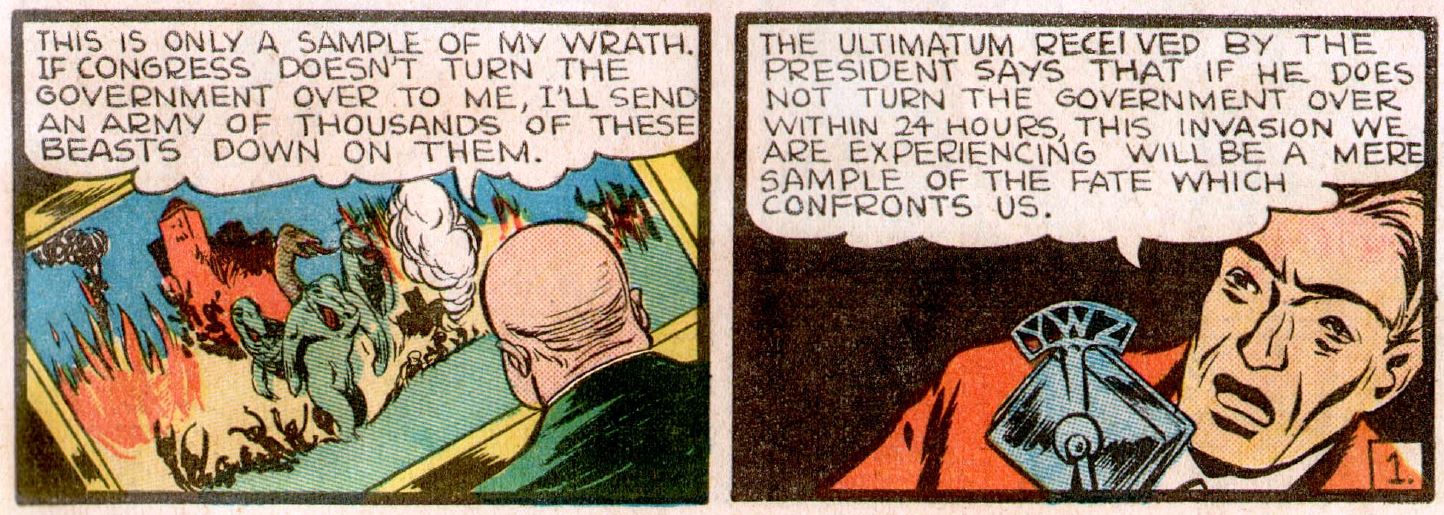
    We open on a very exciting scene! Professor Simm has unleashed giant monsters on an unnamed US city! Chaos reigns!

    I unironically love these monsters. They have that half-baked quality that you get in generic kids toys – the kind of thing you got as a cheap way for your parents to occupy you on a trip and because they have no built-in lore you end up inventing a whole backstory for them. That picture of the humanoid reptile standing next to the giant anthropoid would be on the packaging.

    Having front-loaded a lot of positivity (one last dollop: look at the cavemen riding away on the creatures! It’s very cute!) I must now reveal that this is a pretty bad comic book adventure. I don’t know what was going on at Fox Features in mid-to-late 1940 but they were wildly swapping writer/artists in and out of serials – this very issue features both a Stardust the Super Wizard and a Space Smith story drawn by someone other than Fletcher Hanks!

    While this is a minor problem in terms of narrative consistency – this is as far as I know the only time that Samson it depicted as being three times taller than an average human, for example – it also feels like the story was put together in haste or as the third or fourth thing on someone’s mind. Nothing quite hangs together – Professor Simm starts out demanding control over the US government and later is purely interested in money, for example.

    Once Samson makes his way to Simm’s island castle the story becomes a series of loosely connected vignettes: Samson finds a cage full of cavemen and gets inside, only to immediately leave again. Samson finds a room full of prisoners and skeletons and frees the prisoners. Samson confronts Simm, who escapes. Samson frees more prisoners. Samson kills Simm. It could all be assembled into a coherent plot but very much is not.

    That said, it certainly is a comic full of incident, such as this scene in which Samson sets off a volcano to destroy all the monsters (and hopefully not the prisoners. Hopefully they escaped off-panel) and flies away on a giant bird.It just doesn’t all hold together as a narrative. Things can only get more coherent as we make our way through the Golden Age, right? (SPOILER: not necessarily)

  • MINOR SUPER-VILLAIN 618: THE GREAT WHITE CHIEF

    (Fantastic Comics 007, 1940) 

    The Great White Chief is a chubby scientist who wears stirrup pants with no shoes or socks and lives in a dormant volcano (that he makes look non-dormant using special effects) where he makes animal-headed monstrosities like Cinu the Unicorn Man here. This is all very good classic villain stuff.

    The name is pretty annoying. It implies a lot about his relationship with the native peoples of wherever his volcano is located (probably Africa as he has kidnapped the daughter of an ivory trader) and so I am constantly on edge while reading about him, waiting for him or Captain Kidd to say or do something really racist, but nothing concrete ever happens. But the name!

    I guess the only thing to do is to focus on how fun a design the unicorn man is. Look! Captain Kidd is stabbing him with his own horn!

    After finishing off poor Cinu, Captain Kidd gets the drop on the GWC and socks him into a boiling sulphur pit. I was going to make a joke about Kidd being just as weirded out by the name as I was but then I remembered that Captain Kidd is himself pretty racist. Welp…

    Hey look, more animal headed people! Check out that bird head!

  • MINOR SUPER-VILLAIN 618: THE GREAT WHITE CHIEF

    (Fantastic Comics 007, 1940) 

    The Great White Chief is a chubby scientist who wears stirrup pants with no shoes or socks and lives in a dormant volcano (that he makes look non-dormant using special effects) where he makes animal-headed monstrosities like Cinu the Unicorn Man here. This is all very good classic villain stuff.

    The name is pretty annoying. It implies a lot about his relationship with the native peoples of wherever his volcano is located (probably Africa as he has kidnapped the daughter of an ivory trader) and so I am constantly on edge while reading about him, waiting for him or Captain Kidd to say or do something really racist, but nothing concrete ever happens. But the name!

    I guess the only thing to do is to focus on how fun a design the unicorn man is. Look! Captain Kidd is stabbing him with his own horn!

    After finishing off poor Cinu, Captain Kidd gets the drop on the GWC and socks him into a boiling sulphur pit. I was going to make a joke about Kidd being just as weirded out by the name as I was but then I remembered that Captain Kidd is himself pretty racist. Welp…

    Hey look, more animal headed people! Check out that bird head!

  • MINOR SUPER-VILLAIN 617: MOROSIO

    (Fantastic Comics 007, 1940)

    Like so many Space Smith adventures do, this one begins with Space and his ladyfriend Dianna being waylaid as they make their way around the Solar System. In this case a mysterious gas disables their spaceship and causes them to land on the moon Ganymede. From whence did this gas come? Why, it was the sinister laboratory of Morosio, not just a mad and/or criminal scientist but a mad and/or criminal scientist who has already been caught once and escaped to do further science crimes and/or madness.

    I like his sass (“Say Emperor Morosio”) and I love a villain with pre-baked backstory but I gotta say that Morosio’s hair leaves a lot to be desired.

    The really great thing about Morosio is that his henchmen of choice are these fellows who he made with his own two hands. They’re called the Crustaceans and they are peak character design. The base model is the size of a large cat, with a lobster body and a crab claw head, but they can range in size all the way up to maybe five feet tall. They have between zero and two arms and either have wings or little bipedal legs… I think that given a more advanced colour palette and a visual guide to different crab claw shapes you could populate an entire video game enemy ecosystem based off of the Crustacean design.

    The major flaw in the Crustaceans as henchmen is that they are vulnerable to radioactive beryllium, in that it makes them explode. Coincidentally, Ganymede is littered with radioactive beryllium, to the extent that not only is Space Smith able to defeat the entire Crustacean swam using a slingshot but also blow up Morosio’s whole operation to hell and gone with some spare radiation. A true design oversight!

  • MINOR SUPER-VILLAIN 615: SANGLOR

    (Fantastic Comics 007, 1940)

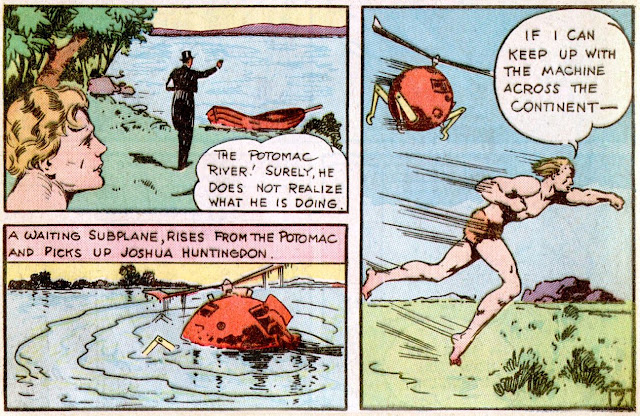
    Sanglor starts out strong. He immediately charms me with his aesthetic sense: his ‘Automatic Subplane’ spy drones are delightful, his ‘Flying Castle’ is simultaneously one of the most ridiculous and great-looking mobile bases I have ever seen and his costume manages to evoke the dress sense of a 1940s comic book movie villain in a way I have not seen since the Vampire, almost exactly 300 entries ago.

    He manages to mess things up almost immediately, of course. His plan is to take over the world by hypnotizing key politicians and diplomats etc., and then presumably induce them to shift the reins of political power his way. This is the kind of scheme that requires some degree of care to set up – you have to get all of your assets in place without causing undue suspicion, so having them for example act all weird and then disappear is problematic. People are noticing your plan, Sanglor.

    This is the first evidence of what I will call Sanglor Self-Sabotages. This one seems to stem from the fact that Sanglor works completely solo, without even a weird little lab assistant to test his hypnotic ray on to see if it makes people freak out in noticeable ways before using it in a sensitive espionage operation.

    The big upshot of this Sanglor Self-Sabotage is that Samson is on the case basically the instant that the scheme is put in motion

    The second Sanglor Self-Sabotage is an extension of the first: he has no real defenses. Once Samson makes his way to the Flying Castle his only real opposition is a crowd of tuxedo-clad diplomats flailing away with their soft fists.

    Sanglor does think to call out his drone army to deal with the intruder but they don’t seem to even be armed, despite their little gun barrels – they just fly at Samson until he smashes them all.

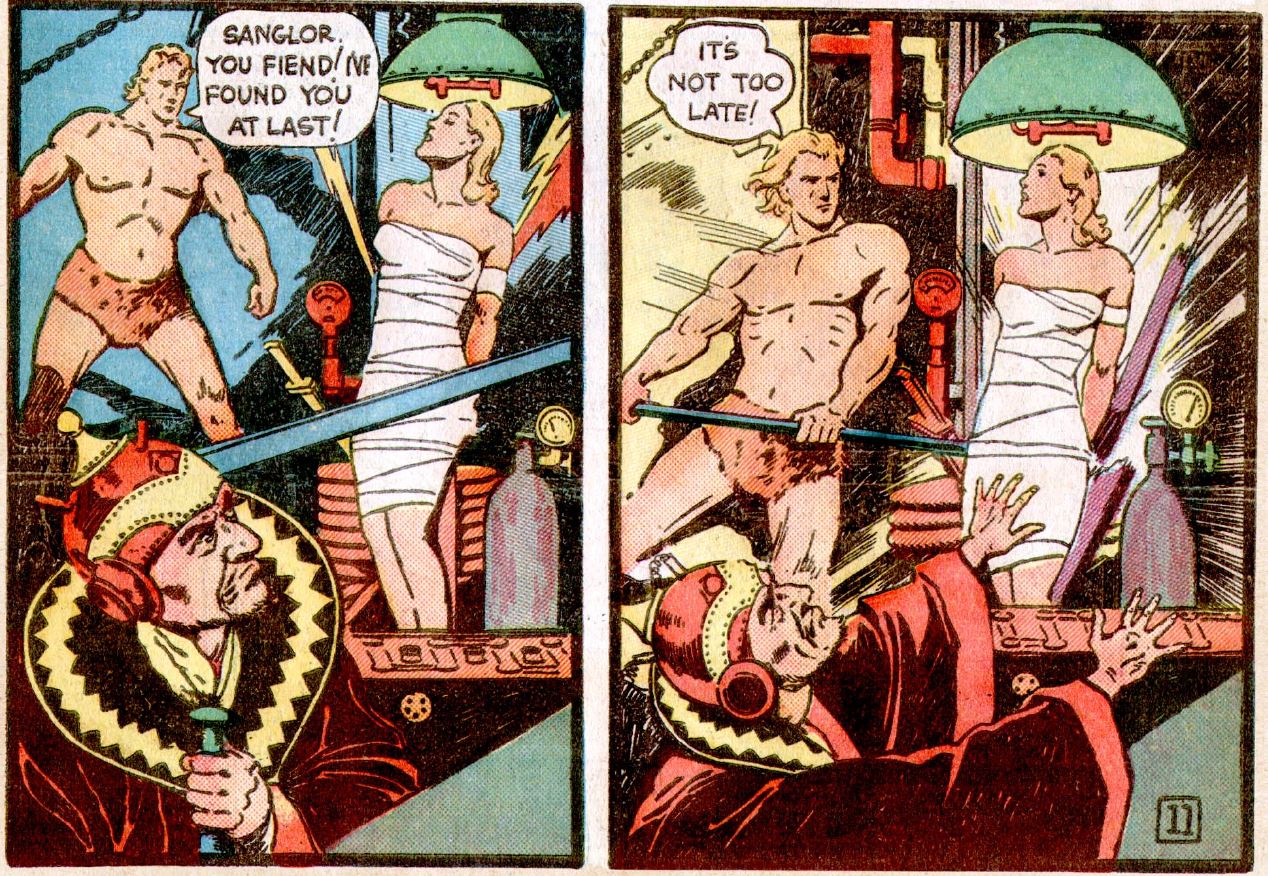
    The really big final Sanglor Self-Sabotage is revealed once Samson bursts into his inner sanctum: Sanglor is too busy being a weird creep to actively manage the defense of his headquarters. It’s not exactly clear what he’s doing with this young woman or who she is (it’s unlikely to be Miss Royce, a politician’s daughter in England and the only named female character in the story) but it’s real creep shit and it’s an unnecessary distraction from the approaching vigilante.

    Sanglor is probably still distracted as he flees through an industrial section of his base, because he can’t even run correctly – he manages to heave himself off what looks to be a pretty solid catwalk into the first available cauldron of boiling chemicals.

    I think that ultimately Sanglor serves as an object example of the need for villains to do a couple of trial runs before attempting world domination. If he’d attempted to take over a county or a small business first, maybe some of these kinks would’ve been worked out.

  • MINOR SUPER-VILLAIN 615: SANGLOR

    MINOR SUPER-VILLAIN 615: SANGLOR

    (Fantastic Comics 007, 1940)

    Sanglor starts out strong. He immediately charms me with his aesthetic sense: his ‘Automatic Subplane’ spy drones are delightful, his ‘Flying Castle’ is simultaneously one of the most ridiculous and great-looking mobile bases I have ever seen and his costume manages to evoke the dress sense of a 1940s comic book movie villain in a way I have not seen since the Vampire, almost exactly 300 entries ago.

    He manages to mess things up almost immediately, of course. His plan is to take over the world by hypnotizing key politicians and diplomats etc., and then presumably induce them to shift the reins of political power his way. This is the kind of scheme that requires some degree of care to set up – you have to get all of your assets in place without causing undue suspicion, so having them for example act all weird and then disappear is problematic. People are noticing your plan, Sanglor.

    This is the first evidence of what I will call Sanglor Self-Sabotages. This one seems to stem from the fact that Sanglor works completely solo, without even a weird little lab assistant to test his hypnotic ray on to see if it makes people freak out in noticeable ways before using it in a sensitive espionage operation.

    The big upshot of this Sanglor Self-Sabotage is that Samson is on the case basically the instant that the scheme is put in motion

    The second Sanglor Self-Sabotage is an extension of the first: he has no real defenses. Once Samson makes his way to the Flying Castle his only real opposition is a crowd of tuxedo-clad diplomats flailing away with their soft fists.

    Sanglor does think to call out his drone army to deal with the intruder but they don’t seem to even be armed, despite their little gun barrels – they just fly at Samson until he smashes them all.

    The really big final Sanglor Self-Sabotage is revealed once Samson bursts into his inner sanctum: Sanglor is too busy being a weird creep to actively manage the defense of his headquarters. It’s not exactly clear what he’s doing with this young woman or who she is (it’s unlikely to be Miss Royce, a politician’s daughter in England and the only named female character in the story) but it’s real creep shit and it’s an unnecessary distraction from the approaching vigilante.

    Sanglor is probably still distracted as he flees through an industrial section of his base, because he can’t even run correctly – he manages to heave himself off what looks to be a pretty solid catwalk into the first available cauldron of boiling chemicals.

    I think that ultimately Sanglor serves as an object example of the need for villains to do a couple of trial runs before attempting world domination. If he’d attempted to take over a county or a small business first, maybe some of these kinks would’ve been worked out.

  • MINOR SUPER-VILLAIN 614: KOZAR

    MINOR SUPER-VILLAIN 614: KOZAR

    (Fantastic Comics 006, 1940)

    Once again the nations of he world of the year 10 000 CE are faced with an oceanic menace. Twenty ships have been sunk – seems like a case for Sub Saunders! Could we be faced with yet another jerk ruler from the population of undersea humans? It seems likely! (aside: gotta give a shoutout to Thog here: having a name like that in a comic from 1940 is absolutely an early indicator that you are a villain yet he has rejected nominative determinism to instead serve the public goo. Good on ya, Thog)

    But no! After five issues and four separate evil underwater rulers we have a c-c-c-combo breaker in the form of Kozar, a scientist with a weirdly concave face. I mean, sure, he is an antisocial guy who does rule an area under the ocean, but he’s originally from the surface! It’s totally different!

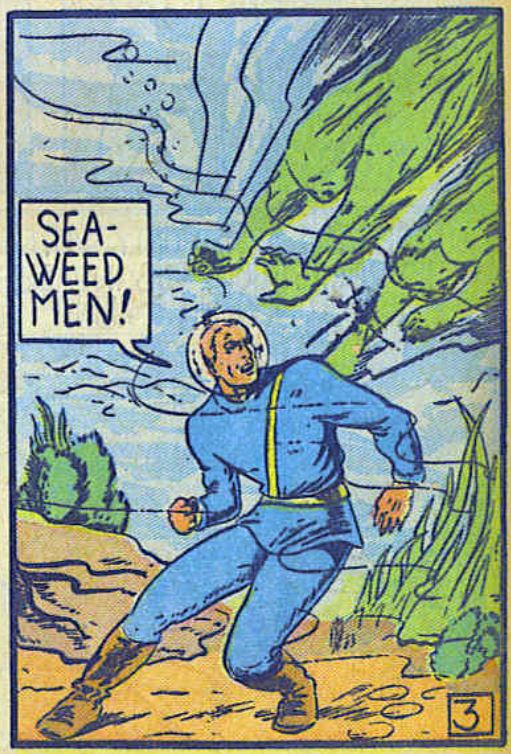
    Kozar has some terrific henchmen at his disposal – forget your Frogmen and Mermen: the Sea-Weed Men are the new greatest underwater goons of the year 10 000. I especially like that their flowing fronds accidentally evoke the 1970s stock character of the Fringed Clothing Hippy.

    Kozar’s motivation for sinking airships and killing hundreds of people is an unspecified rejection by society. The two most common reasons for this type of rejection are for having really wild out-there scientific theories or for being a creep/looking like a creep and if it’s not stated outright then you can usually tell which it is. It’s not crystal clear with Kozar but… I reckon he was a real creep and a half.

    Kozar actually manages to defeat Sub Saunders pretty decisively by catching him in a mechanical clamp! He actually might have won, except for the fact that his undersea base has one small design flaw: if someone’s not constantly monitoring the air pressure etc it will flood and implode. To me personally that seems like an important thing to have multiple automatic failsafes and backups on but what do I know, I’m not a mad genius. Maybe the real thing that Kozar was rejected by society for was his rejection of OSHA guidelines.

    Though the story ends on a bit of a melancholy note we must take heart that the Sea-Weed Men are okay. Maybe without the stress of being under the thumb of a homicidal madman they can build a free and just society on the ocean floor.

  • MAD AND CRIMINAL SCIENTIST ROUND-UP 011

    Incorrigible scamps the lot of them.

    This unnamed scientist uses fake spirits, death traps and so forth to drive adventurer Ted Crane and his companions away from the jungle temple he is looting. BUT! He has made a classic mistake: they weren’t planning on entering the temple in the first place and based on their action in earlier issues they certainly don’t object to white people hauling off as much ancient African swag as possible. He gets punched out a window to his death for no reason! (Exciting Comics 004, 1940)

    This fellow, name of Terro, has a scheme to peddle his noiseless super explosive bombs to the hostile Kordian government, a sound, if evil, plan. His inventive genius is not however matched by his common sense, however, and he makes the key mistake of demonstrating his explosive by bombing the village just outside his front door. Like, if his castle wasn’t on top of a mountain I reckon it would be about a ten minute walk from the crater. Needless to say, Yank Wilson explodes him with extreme prejudice. (Fantastic Comics 004, 1940)

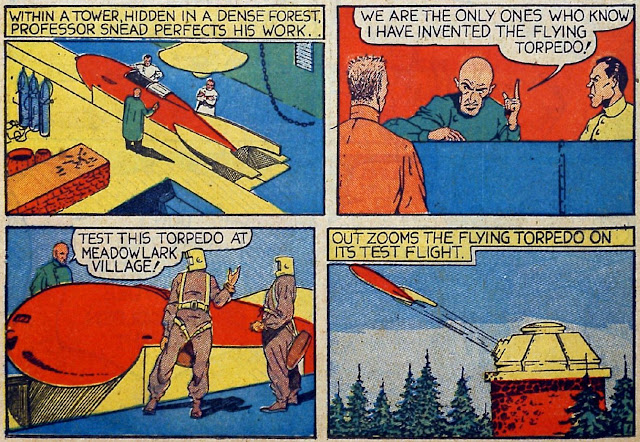
    Like Terro, Professor Snead here is a scientist of the near future who makes the critical error of testing his new explosive (in this case one of the military holy grails of the 40s, the flying torpedo, or to us savvy moderns, the guided missile) on a small town instead of, for example, a big rock. Wholesale loss of human life again leads Yank Wilson to show up and Snead too is exploded by his own creation. (Fantastic Comics 005, 1940)

    These unnamed Mexican scientists have an okay plan – sabotage the US agricultural industry so that they are forced to import food from South of the border – but I question the efficacy of giant crop-eating rat-lizards over, say, a plague of regular-sized mice. I also question the sanity of everyone who sees these things and calls them “giant insects”, i.e., everyone in the story.

    Samson of course steps in and defeats not only the – ugh – “giant insects” but also some chemically mutated bulls, and given the sensitive depictions of Mexicans above would it surprise you that the comic ends with him building a wall along the US-Mexico border? (Fantastic Comics 006, 1940)

  • MINOR SUPER-VILLAIN 603: THE MAD GIANT

    (Fantastic Comics 004, 1940)

    The Mad Giant is another Fletcher Hanks villain with a straightforward motivation: civilization has ruined his domination of a slave group (presumably a tribal society as he refers to them by the formerly much-used and now depricated term “savage”) and so he is simply going to end civilization. And given the method that he has chosen – pumping the Earth full of a chemical that will raise its temperature and cause widespread geologic upheaval – he might just be trying to destroy the planet itself!

    (the exact circumstances of the Mad Giant losing his slaves are left as unexplored as those of him being such a big beefcake. He just did and he just is)

    The Mad Giant might just have the most rational plan to deal with Stardust the Super Wizard of any of his foes. Like most of them he seems to have a pretty good inkling that Stardust will show up, so a barrage of missiles (anti-ray missiles, natch) to delay, incapacitate or destroy him will hopefully buy enough time for the Giant and his lil’ pal Kamet to finish destroying the planet. Too bad for the Mad Giant that he is very easily fooled: Stardust fakes his own death and ends up taking them by surprise on his second approach.

    Giant or no, it’s all over once Stardust gets close enough to put those big mitts on you. The Mad Giant is knocked silly and summarily whisked off to… prison? What an odd place for a Stardust villain to end his days. I assume Kamet gets a pass because there’s a high chance he was there against his will.

  • MINOR SUPER-VILLAIN 586: THE RED BLIGHT

    (Exciting Comics 003, 1940)

    Technically, the Red Blight is a ray weapon developed by mad scientist Dr Hodl on behalf of ideologically nonspecific aggressor General Pasko in order to facilitate the conquest of Europe, but just like when a guy with a regular name is tooling around in a vehicle with a cool codename I reckon that the good name should take precedence, particularly as 1) Dr Hodl never returns and 2) people make reference to the Red Blight as an entity more than once during the course of the story.

    Besides, the Red Blight is a super-weapon worth being named after: a ray that rapidly corrodes inorganic matter with a range of at least 2000 kilometres (Hodl’s Transylvanian castle to the North Sea) – why sleep on that, Hodl? Be the Red Blight!

    Dr Hodl spends most of his time attempting to eliminate John “Son of the Gods” Thesson, who he correctly views as his only real opposition. Why, before Thesson shows up, none of the authorities concerned with the Red Blight’s attacks even thought about discovering his location by triangulation. Clearly this is a case where the villain is right: the hero is the only thing standing between him and complete victory.

    Ultimately, Hodl and the Red Blight come up against the real problem with the weapon of mass destruction as an all-purpose tool: it’s very hard to select your targets. Despite an army of spies attempting to stymie him at every turn, the Son of the Gods makes his way to Hodl’s castle and chucks him off a wall.