The Curse of Skeleton Munroe

Category: mind control

  • MINOR SUPER-VILLAIN 315: THE ZOMBIE MASTER

    (Daring Mystery Comics 001, 1940)

    The Zombie Master has layers. Top level is deeds: he is a scientist who kidnaps people on the fringes of society and uses a combination of hypnosis and radiation to turn them into bright green mind controlled thralls – fairly standard stuff for a mad scientist. Next though, is his origin: he felt rejected by society because of his great height – something like 20 feet tall, according to some sources – and so moved underground in order to work in isolation (and as a side note he mentions that he’s been working for about 50 years, so he’s a rare Golden Age character who we have an approximate age for: somewhere in his late 60s or early 70s seems reasonable). A giant scientist!

    The next layer is only interesting to me: he is not given a name in the story. Luckily, the Zombie Master moniker is later assigned to him because there’s no really good option in the text and I’d’ve ended up calling him something like Unnamed Giant Scientist.

    For our final layer we must note that the Zombie Master is a part of the origin story of the Fiery Mask, and that the Fiery Mask was one of the characters who appeared in J. Michael Straczynski’s The Twelve, wherein it was revealed that he had not received his powers due to an explosion in the Zombie Master’s lab but essentially by murdering the previous Fiery Mask – the Zombie Master was just a story he made up in order to cover for himself/ assuage his guilt. The greatest trick the Zombie Master ever pulled, it seems, was to have never existed at all.

    (which of course makes him a perfect candidate to be BRUNG BACK – what better foe than a nonexistent giant science man?)

  • MINOR SUPER-VILLAIN 306: THE FIDDLER

    (Captain America Comics 007, 1941)

    The Fiddler, being a man who can play his violin at special pitches in order to hypnotize or kill, has the dubious honour of being our first super-powered Nazi villain. 

    The Fiddler is an overplanner, no bones about it. His mission in the US is to kill anti-Nazi politicians (specifically senators, or maybe he’s working up  to governors etc). Here’s his process for doing so:

    -become an acclaimed musician with regular radio gigs

    -establish an employment agency for butlers

    -have butlers placed in his victims’ homes

    -have the butlers install music-activated bombs in the victims’ radios while simultaneously fixing it so that the radio can only be tuned to the station that the Fiddler is going to be appearing on

    -hope that the victim will be listening to the radio at the right time

    -hypnotize the crowd at the performance for some reason, play the Melody of Death to trigger the bomb, et voila

    And it works three times! He bumps off two senators, and would have gotten a third if Captain America hadn’t figured out his plan via one of the one million suspicious things about it.

    It’s frankly a mercy that the Fiddler ultimately melts his own brain while trying to kill an earplug-equipped Bucky via sonic attack, because this is the kind of thing that embarrasses you for life.

  • MINOR SUPER-VILLAIN 280: PRINCE ITOR

    (Marvel Mystery Comics v1 021, 1941)

    I like Prince Itor because he’s a weenie. Not enough of those in the Golden Age. He’s not even really the focus of this story, which ain’t called “The Idol of Death” for nothing.

    So: Morrison here owns the titular Idol and is loaning it to the Egyptian Museum, but the transfer process and time was leaked in the papers, which leads to at least half of he story being taken up with a heist that Prince Itor has absolutely no involvement in.

    Itor himself doesn’t get a lot of backstory: his family are presumably like those deposed European royals who are always mooching around high society, but for thousands instead of hundreds of years. Unless of course there is an ancient prophecy about the power of the pharaohs awakening in a completely unrelated family. Either would be good!

    Itor does eventually get ahold of the idol, by the simple method of having his men take it off of the crooks who went to the hard work of actually stealing it. That pharaonic power turns out to have a kick to it, in the form of a bad case of monster-face. 

    Whatever powers the ancient monster-Pharaohs wielded do not get a full exploration, as Itor discovers pretty quickly that he can control the people around him. What follows is a pretty brief and unsuccessful attempt to destroy the Human Torch using a subwayful of commuters that ends when  the Torch melts the idol and a fleeing Prince conveniently flings himself onto the third rail – no fuss, no muss.

    But why did I call Prince Itor a weenie? Very simply it’s because he’s the kind of villain who hangs back and lets his employees do all of the work, whether it’s stealing the idol or marching in mind-controlled lockstep against a man of living flame. He’s the kind of bumbling aristocratic oaf who can’t even escape without accidentally electrocuting himself – I love to loathe him. And as with every other good aristocratic oaf, he has a highly-competent aide to take care of all of the nitty-gritty for him

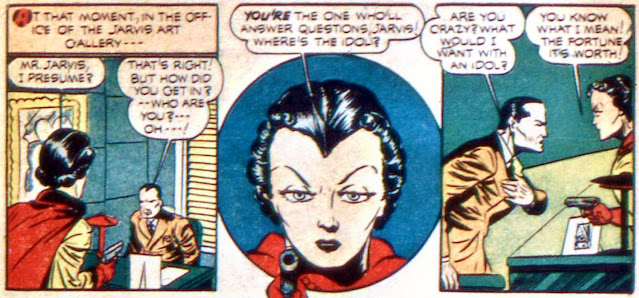
    Nalda! The Jeeves to Itor’s Wooster, if Jeeves was a pistol-wielding femme fatale in a cape and a pair of buccaneer gloves. Nalda! The kind of second-in-command that is clearly the power behind the throne. Nalda!

    I was going to say that it’s sad that Nalda only appears on a single page but no, I’m glad. That means that she survived the adventure and likely got away to empty Itor’s bank accounts and set herself up in Madripoor or the like. She’s probably still there, something like 105 years old, running her underground casino/ assassination service/ chain of cat cafes like a ruthless raisin. Godspeed, Nalda.

  • MINOR SUPER-VILLAIN 271: PRINCE OMEI

    (Marvel Mystery Comics v1 016, 1941)

    This guy’s a real ding-dong, and I was sorely tempted to just pass him by. I couldn’t in good conscience not mention a guy who not only hypnotizes Professor Zog and (by proxy) Electro as his minions and does so while wearing both an eye patch and a monocle. PLUS he’s one of my favourite types of villains: a complete failure. Literally all he does after acquiring his new giant robot/ robot operator team is deal with some organizational strife in his gang, then Zog breaks free of his mental influence and Omei ends up blowing himself up in what is becoming a running theme in the world of Electro’s villains. 

  • MINOR SUPER-VILLAIN 261: THE SACRED ONE

    MINOR SUPER-VILLAIN 261: THE SACRED ONE

    (Marvel Mystery Comics v1 003, 1940)

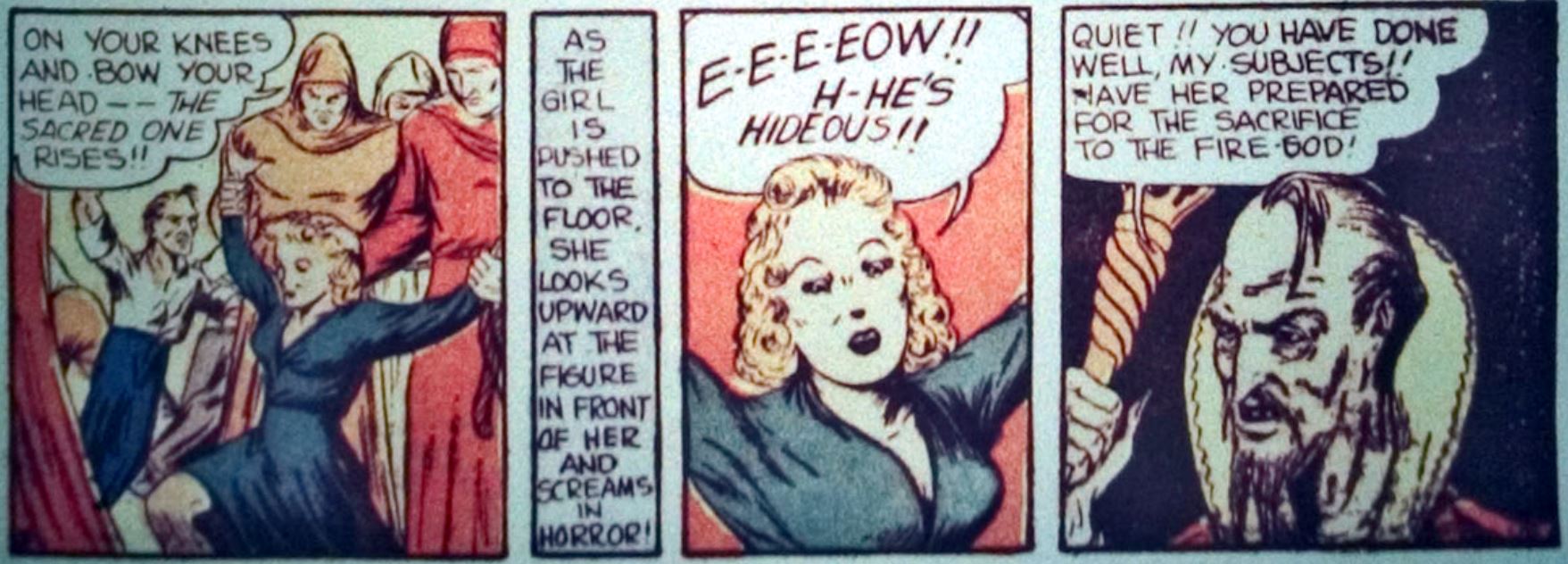
    The Sacred one is a pretty bog-standard cult leader in a way that was cliched even in 1940: he’s got a bunch of people in a castle in the New York countryside somewhere and they kidnap beautiful white women to sacrifice to their Fire God until the Angel shows up to murderize them. 

    The only really interesting things about him are the questions that the loose plotting leaves you with: he has hypnotic powers – were these given to him by the Fire God or did he have them already and use them to set himself up as a cult leader? Are all of these guys sequentially using the same castle or is NY just lousy with them?

    The biggest question (and the creepiest part of the story) is what exactly is the nature of the Sacred One’s cult. Once he takes a header into his own pit trap, the cultists all silently line up and shrink down into nothingness. Is this the Sacred One’s death curse? Some sort of ritual suicide? Did they never actually exist in the first place but rather were the creations of either the Sacred One or the Fire God? We will never know!

  • MINOR SUPER-VILLAIN 261: THE SACRED ONE

    (Marvel Mystery Comics v1 003, 1940)

    The Sacred one is a pretty bog-standard cult leader in a way that was cliched even in 1940: he’s got a bunch of people in a castle in the New York countryside somewhere and they kidnap beautiful white women to sacrifice to their Fire God until the Angel shows up to murderize them. 

    The only really interesting things about him are the questions that the loose plotting leaves you with: he has hypnotic powers – were these given to him by the Fire God or did he have them already and use them to set himself up as a cult leader? Are all of these guys sequentially using the same castle or is NY just lousy with them?

    The biggest question (and the creepiest part of the story) is what exactly is the nature of the Sacred One’s cult. Once he takes a header into his own pit trap, the cultists all silently line up and shrink down into nothingness. Is this the Sacred One’s death curse? Some sort of ritual suicide? Did they never actually exist in the first place but rather were the creations of either the Sacred One or the Fire God? We will never know!

  • MINOR SUPER-VILLAIN 258: THE FOUR LAMAS

    (Hit Comics 007, 1941)

    If Tibetan Lams aren’t the top religious figures cast as super-villains then they at least have to be in the top three, along with druids and Catholic priests – we won’t see any of those for a while but once they get going they go hard.

    This bunch of Lamas have decided to turn their formidable mental powers (natch) to the task of world conquest, and have chosen to do so by influencing the mind of one President Karla of an unnamed European state to become a rabid warmonger.

    The “Scheming Oriental Mastermind” bit was old before comics existed, and honestly I’d be tempted to skip these guys if this story didn’t include two truly incredible bits: 1. Neon the Unknown flies Karla across Europe and Asia as a sort of human dowsing rod to determine exactly where the mental influence is being broadcast from.

    2. Neon resolves things via mental combat with all three of the Four Lamas (the artist lost track of one of them midway through the story). He of course wins…

    … and their brains explode! Truly a redeeming end for some cliched characters.

  • MINOR SUPER-VILLAIN 258: THE FOUR LAMAS

    (Hit Comics 007, 1941)

    If Tibetan Lams aren’t the top religious figures cast as super-villains then they at least have to be in the top three, along with druids and Catholic priests – we won’t see any of those for a while but once they get going they go hard.

    This bunch of Lamas have decided to turn their formidable mental powers (natch) to the task of world conquest, and have chosen to do so by influencing the mind of one President Karla of an unnamed European state to become a rabid warmonger.

    The “Scheming Oriental Mastermind” bit was old before comics existed, and honestly I’d be tempted to skip these guys if this story didn’t include two truly incredible bits: 1. Neon the Unknown flies Karla across Europe and Asia as a sort of human dowsing rod to determine exactly where the mental influence is being broadcast from.

    2. Neon resolves things via mental combat with all three of the Four Lamas (the artist lost track of one of them midway through the story). He of course wins…

    … and their brains explode! Truly a redeeming end for some cliched characters.

  • MINOR SUPER-VILLAIN 244: THE GREAT ARTURO

    (Flash Comics v1 013, 1941) 

    Like Crime & Corruption Inc before him, I almost skipped over the Great Arturo or banished him to the ranks of the generic villains, because a) the Great Arturo is a terrible villain name and b) he appears in a Les Watts comic. But the more I looked at this guy, the more it became clear that he was like a savoury stew made up of all the things I love about comic book creepos.

    We’ve already passed judgement on his name (bad), but let’s run down some of the other pertinent details of the Great Arturo’s career:

    Appearance: he’s seven feet tall and both dresses like a vampire and also looks like one – whether his widow’s peak, fangs and shadowed eyes are natural or stage makeup matters not.

    Motivation: According to his henchman Spider, Arturo just “went insane” one day and decided that he was going to acquire the US’ new warship tech or destroy it, which is meh so far as villainous origins go, but according to Arturo himself he sometimes believes that he is the Devil, and if you’re going to be an insane villain I think it’s important to go big. 

    Powers: According to his henchman Spider, Arturo was a great enough hypnotist that he held Spider completely in thrall to his will. Emphasis added because it’s entirely possible that ol’ Spider is just a fast talker looking to save his own hide.

    Hideout: He lives in a secret tomb that you enter through a hollow tree in a graveyard – one of the top secret lair types of all time.

    In conclusion, he’s a seven foot-tall goth hypnotist with a henchman named Spider who lives in a cemetery. Wotta catch!

    BONUS: About Les Watts, Radio Amateur

    I don’t think I’m going to do a full entry on ol’ Les, but in brief, he’s an earlier example of a character archetype that persists through to today, probably, the Teen Hobbyist (I initially went with Boy Hobbyist, because they are almost all boys). The Teen Hobbyist has a healthy obsession with the hot new tech of the day: ham radios, light aircraft, hot rods, CB radios, computers, the Internet… They don’t usually invent things, but they are completely up to date on the latest developments in their field, leaving the adults around them admiringly befuddled.

    Teen Hobbyists had their heyday in the 40s and 50s, but were still going strong in the 60s – Snapper Carr and Rick Jones were absolutely from the hot rodder school of Teen Hobbyist – and on into the 80s and 90s as Computer Whiz Kids and so forth. I’m sure there’s some version of them running round today.

    Les Watts (later renamed Les Sparks for some reason) is a kid who likes fooling around with ham radios, as do all his friends. He specializes in picking up hints of a crime in progress on the radio waves and then zooming to the location with a bunch of teens. That’s about it.

  • MINOR SUPER-VILLAIN 232: THE THOUGHT TERROR

    (Flash Comics v1 004, 1940)

    I have complicated feelings about the Thought Terror! He has both good and bad traits! 

    Off the bat, the basics. His costume choice is pretty entry level for the Golden Age, but suitable for a guy who employs eye-based super-powers (which he does) and wants to project a certain aura of fear. 

    His name, by contrast, is both unusual and bad, and made all the worse for the fact that it’s almost good. Terror is usually a decent word to use in a name but it just doesn’t have the gravitas to work with a mealy word like Thought. The Thought Tyrant, the Thought Titan, the Thinking Terror… there had to be a better name.

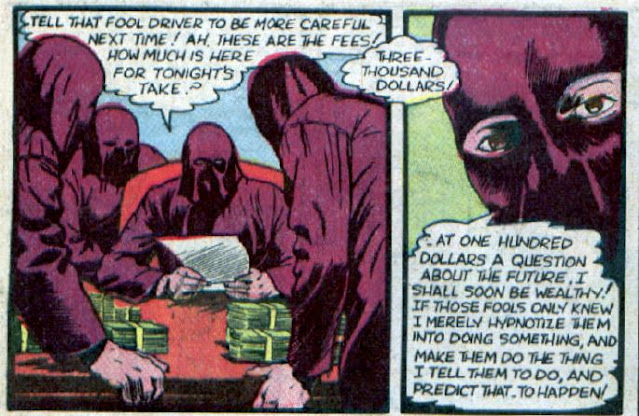
    But maybe a poorly thought-out name is appropriate for this guy, because he’s not a very good planner in general. See, he has these amazing hypnotic powers, and he uses them to convince a little cult of people that he has amazing precognitive powers. He tells fortunes at a hundred bucks a pop and then fulfils them by planting hypnotic suggestions in his subjects’ minds, causing them to act out his predictions.

    Ordinarily, I’d be cheering for this guy – the thing that thinking a lot about super-villains does is give you a lot of opinions about how they should all just stick to easy small-scale scores and that’s what this is – but TT must be getting bored, because he’s making predictions like “you’re going to get drunk and wander into traffic,” and if you’re running a cult complete with costumed goons in New York City in a SUPER-HERO UNIVERSE the thing you absolutely do not want to do is draw attention to yourself by, for instance, killing someone.

    (this does of course happen – Hawkman shows up and ruins the whole operation, including the Thought Terror’s mind)

    One point in the Thought Terror’s favour is his use of costumed goons, in this case dressed just like him and given a dose of hypnotic mind-over-matter treatment such that they are physical powerhouses. Always a great choice, costumed goons. Plus they’re called the Mesmerized Men, a great name!

    Wildly, Thought Terror (without the “the”, not that it improves the name) was brought back in the year of our Lord 2005 along with several other Golden and Silver Age Hawkman foes (Thought Terror specifically in Hawkman v4 039). He’s just kind of a super-torturer, though, and he just kind of disappears halfway through the issue. I guess that’s about as good as he could hope to get.