The Curse of Skeleton Munroe

Category: mind control

  • MINOR SUPER-VILLAIN 776: THE BLUE SPARK

    (Super-Mystery Comics v1 002, 1940)

    In terms of crime, the Blue Spark is ambitious but not extraordinary: a little corporate extortion, some bank robbery, a few kidnappings. Nothing we haven’t seen a few hundred times by now.  When it comes to the trappings of super-villainy, however, the Blue Spark is on the cutting edge.

    Just look at that costume – it’s not quite the standardized super-villain getup we will eventually see on so many one-shot Batman villains but it’s pretty damn close, and particularly in an era in which most villains are still pairing a mask with a suit and tie or a robe. Even more impressive and ahead of its time is the Blue Spark’s choice to dress his henchmen in a simplified version of his own uniform. Just really impressive stuff.

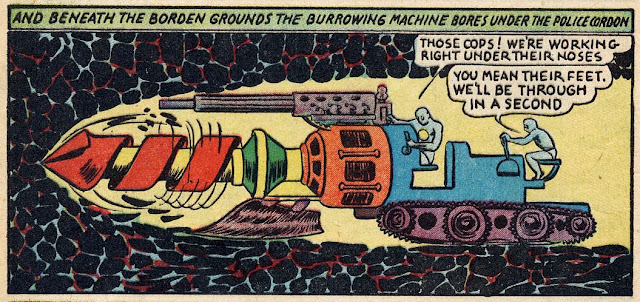
    The Blue Spark’s main gimmick, a heat ray cannon mounted on a truck, isn’t quite as remarkable but it is a pretty sweet bit of gear. Plus he has another one mounted on a cool-ass drilling machine!

    (it is somewhat unclear if the Blue Spark has a second ray that allows him to mind control people or if his heat ray doubles as a mind control ray, and determining this is not helped by the fact that he clearly has an aesthetic fondness for that particular style of scientific greebling on the outside of the rays. It’s a good clean visual on the mind control ray, I will say that)

    The Blue Spark’s henchmen (called the Blue Rubber Men at one point, btw) are not just well-dressed:  their costumes have  little nozzles in the chest that lets them be inflated like a balloon to render them immune to fisticuffs  – another idea that sounds like something out of a Silver Age comic, twenty years early.

    Technology or no, inflation fetish suits or no, the Blue Spark vs Magno is your classic case of a villain who is so little of an even match for the hero that the plotter’s concern must lie in keeping them apart for as long as possible because the instant they meet up, something like the above happens. Magno didn’t even give him a chance to blow up his suit, the poor guy.

  • MINOR SUPER-VILLAIN 776: THE BLUE SPARK

    (Super-Mystery Comics v1 002, 1940)

    In terms of crime, the Blue Spark is ambitious but not extraordinary: a little corporate extortion, some bank robbery, a few kidnappings. Nothing we haven’t seen a few hundred times by now.  When it comes to the trappings of super-villainy, however, the Blue Spark is on the cutting edge.

    Just look at that costume – it’s not quite the standardized super-villain getup we will eventually see on so many one-shot Batman villains but it’s pretty damn close, and particularly in an era in which most villains are still pairing a mask with a suit and tie or a robe. Even more impressive and ahead of its time is the Blue Spark’s choice to dress his henchmen in a simplified version of his own uniform. Just really impressive stuff.

    The Blue Spark’s main gimmick, a heat ray cannon mounted on a truck, isn’t quite as remarkable but it is a pretty sweet bit of gear. Plus he has another one mounted on a cool-ass drilling machine!

    (it is somewhat unclear if the Blue Spark has a second ray that allows him to mind control people or if his heat ray doubles as a mind control ray, and determining this is not helped by the fact that he clearly has an aesthetic fondness for that particular style of scientific greebling on the outside of the rays. It’s a good clean visual on the mind control ray, I will say that)

    The Blue Spark’s henchmen (called the Blue Rubber Men at one point, btw) are not just well-dressed:  their costumes have  little nozzles in the chest that lets them be inflated like a balloon to render them immune to fisticuffs  – another idea that sounds like something out of a Silver Age comic, twenty years early.

    Technology or no, inflation fetish suits or no, the Blue Spark vs Magno is your classic case of a villain who is so little of an even match for the hero that the plotter’s concern must lie in keeping them apart for as long as possible because the instant they meet up, something like the above happens. Magno didn’t even give him a chance to blow up his suit, the poor guy.

  • MINOR SUPER-VILLAIN 553 UPDATE: LANDOR, MAKER OF MONSTERS (1940)

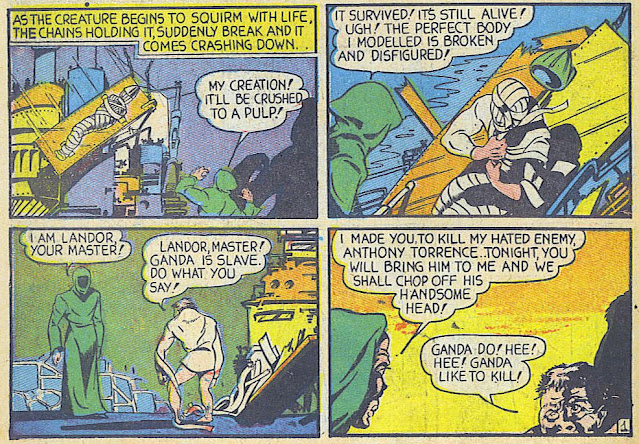
    When last we saw Landor, Maker of Monsters, he had just been exploded along with his castle and giant mosquito minions. But did you honestly expect a simple thing like a huge explosion to stop a villain of Landor’s calibre? No! He merely becomes more burned up and crusty and bitter! Landor has not shifted his goals since 1939 and is consumed with the twin urges to 1) make monsters and 2) get revenge on Tony Torrence and Marcia Merrill.

    Landor makes his dramatic return at the perfect time: US officials, including Landor’s old foe Anthony “Tony” Torrence, are completely unable to deal with the menace of the Fire-Men. This gives Landor the perfect opportunity to get Torrence under his thumb, using the power of patriotism!


    As usual, Landor has not rested on his laurels. Rather than trot out a version of one of his prior creations, such as a frankenstein or a giant insect or a surprisingly flammable woman, he has dipped his toe into the twin fields of robotics and cybernetics to produce a giant robot powered by a human brain! A fireproof one!

     
    The brain-bot disposes of the Fire-Men without a problem. Well, I say without a problem, but in fact there is one tiny hiccup in Landor’s plan: the cyborg is not strictly 100% fireproof after all, and the Fire-Men’s last desperate flamethrower attacks end up driving it berserk and it makes a murderous beeline for Landor and Tony Torrence. Torrence manages to destroy it by luring it into an electrical substation, and since he has saved Landor’s life he is forced to relinquish his claim over Torrence’s. Foiled by his own sense of honour!

    In Speed Comics 005, Landor accepts a commission to help a couple of foreign agents rob the US Treasury. Being the Maker of Monsters that he is, Landor proceeds to create a giant mole to aid in the tunnelling process. This escapade ends with Tony Torrence gunning down the agents and collapsing the tunnel on top of Landor, but the “IS LANDOR DEAD?” cliffhanger lacks a bit of oomph as he is in fact standing next to the giant mole when last seen.

    If Landor had given up his quest for revenge following the giant cyborg incident then the tunnel collapse brought it back in force, and so in Speed Comics 006 he puts a very strange revenge scheme into motion: he creates the Cat-Girl, a two-foot-tall human woman with the head of a cat, and uses her to kidnap Tony Torrence’s niece Gloria as a test subject in an experiment to see if he can turn a human being into solid diamond. I’m a bit winded just typing all that out.

    Tony Torrence of course rushes Landor’s castle just in time to rescue Gloria and deal with both the Cat-Girl and Landor using his new fighting technique: throw your opponent at the nearest solid object. Landor of course survives though the Cat-Girl is not so lucky.

    Speed Comics 007 introduces eminent biologist Dr Sina Zurat, who has long admired Landor’s work and wishes to join him in it.

    Together, Landor and Zurat create the bestial woman Creeta, and at some point along the way the two fall in love! Could a stable home life and a loving partner who gets all of his jokes about gene-splicing finally cure Landor of his antisocial ways? We will never know, as poor Creeta was seemingly born already in love with him and only gets about an hour to grapple with having feelings at all, let alone powerful ones. Consumed with jealousy, Creeta attacks Dr Zurat.

    Tony Torrence of course shows up in time to stop Creeta (by turning a screw on the side of her neck that is attached to her steel wire nervous system – a particularly grisly failsafe!), but too late to save Zurat. And here is the point, I reckon, where the Landor/Torrence relationship could turn around. A little compassion from Tony could show Landor that there is a better way to live than in a constant cycle of revenge and biological constructs. Instead, Tony is a huge jerk about the whole thing, ensuring that the cycle continues.

    Landor’s final four appearances are exclusively revenge-oriented: in Speed 008, he goes with what he knows best and makes a humanoid monster, but unfortunately for him, he drops the dang thing before it’s finished… cooking?… and so ends up as a classic Igor rather than the Adonis that Landor had intended. Still, any creature in a storm, and so Ganda, as this particular creation is known, is sent to capture Tony.

    Ganda goofs and brings back Torrence’s house guest, criminologist Kung Fu Tse (sadly just a name in the “mash together a lot of vaguely Chinese-sounding syllables” mode and not a 70s style martial arts master), but that turns out to be okay, as it turns out that Landor, Tse and Torrence all went to the same college and that the beefs between them began back then.

    As usual, Tony shows up in the nick of time, and while Landor escapes unscathed poor Ganda is not so fortunate.

    Landor’s revenge plot in Speed 009 involves kidnapping Marcia Merrill and injecting her with a chemical to make her blind. It’s not a particularly great plan, and Landor absolutely should have seen the end result coming: Tony beats him up until he gives up the antidote to the blindness serum. There are however two points of interest in the story:

    1) Landor’s chosen henchman for this one is the fantastically-named Stumbi the Fish-Man. It’s like I always say: if you’re going to be a biological construct created specifically to kidnap people off of boats then you might as well get a great name out of it. 

    2) From this issue onward Tony Torrence is instead called Jack Torrence, for no clear reason. Is it simple loose Golden Age continuity standards? Burgeoning anti-Italian sentiment relating to WWII? Something else? No idea, but what it certainly is is annoying, though mitigated slightly by the fact that it’s almost the name of the guy from The Shining.

    Landor’s lowest moment comes in Speed Comics 010, as this is the issue in which he doesn’t make a monster at all. At least unless you stretch the definition of “monster” to include a prominent criminologist who has been kidnapped and mind-controlled into a willing participant in a plot to frame Tony “Jack” Torrence as a jewel thief. And I do not do so.

    Tony ends up spending most of this issue in jail, so Kung Fu Tse is the one who hurls Landor into the nearest hard surface before freeing criminologist John Powers from the mind control.

    Speed Comics 011 marks Landor’s final appearance and fortunately for his reputation he does in fact make a monster in this one. Specifically, he tricks fugitive Spike Hart into accepting a job and some free plastic surgery and then proceeds to turn him into the Tiger-Man, i.e., Spike Hart with claws, oversized fangs and little stripes on his face.

    Sent to bring back Torrence alive or dead, the Tiger-Man comes closer to actually doing so than any creature since the Brute, way back in Speed Comics 001. It is not to be, however, as he ultimately meets his end at the hands of Torrence’s butler, a truly ignominious fate.

    As often happens in stories with recurring villains, Landor’s final appearance was not written as a final appearance. Tony/Jack socks him out the window and he scurries away into the night to get ready for their next encounter, which will never happen. 

    ADDENDUM: As I was about to publish this it occurred to me that Landor is of course a revenge killer, albeit one with a terrible score. Counting up all of the various attempts on Tony, Marcia and Kung Fu’s lives over the course of his career, he ends up with an abysmal final score of 0/9.

  • MINOR SUPER-VILLAIN 755: STRADIVOUS

    MINOR SUPER-VILLAIN 755: STRADIVOUS

    (Smash Comics 017, 1940)

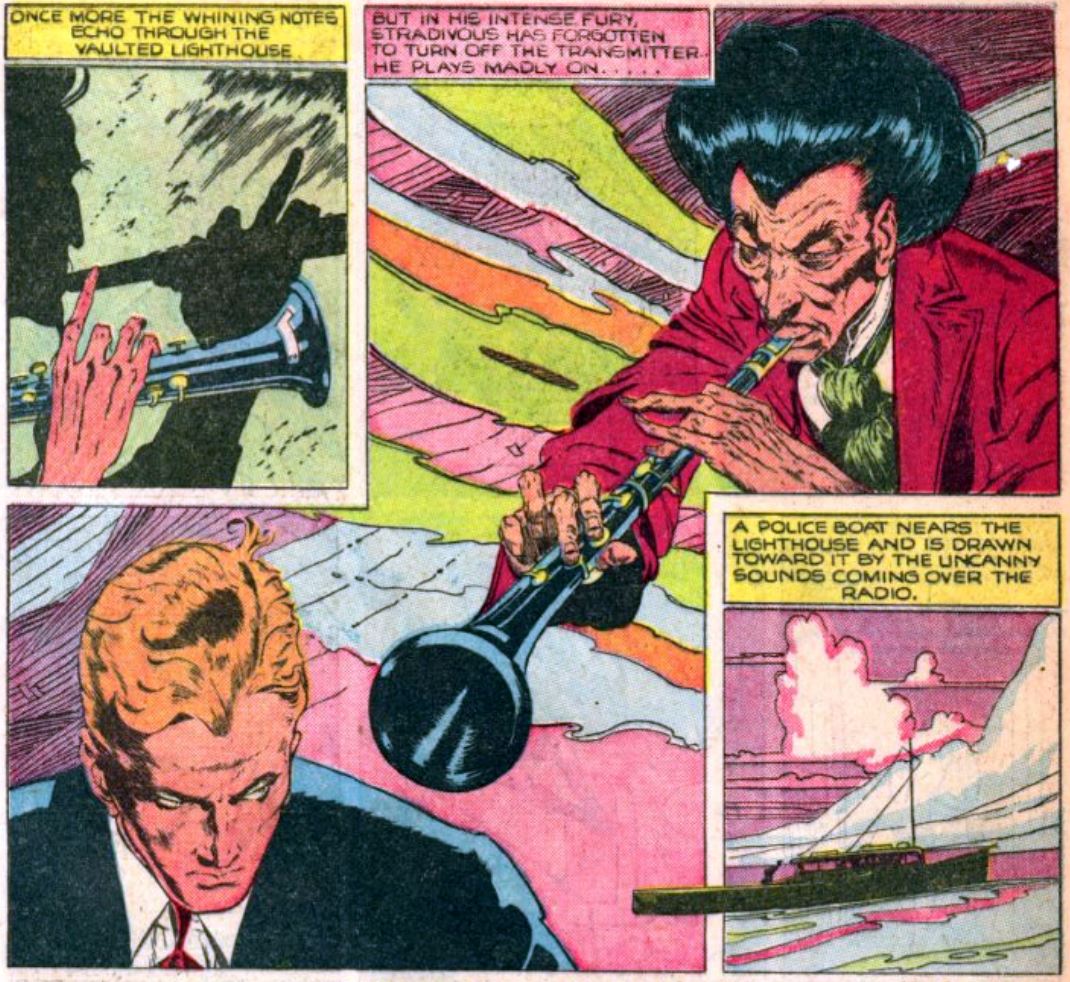
    There are a lot of comic book characters who derive their powers from or express them through music, but Stradivous here is the only one I know of who does so using a clarinet. This is going to be huge if we ever want to draft an all-star comics orchestra someday. He also has a really terrific look, with an eccentric choice in every single aspect of his head and facial hair – I’ll even grudgingly admit that he pulls off a fu manchu, traditionally my least favourite mustache.
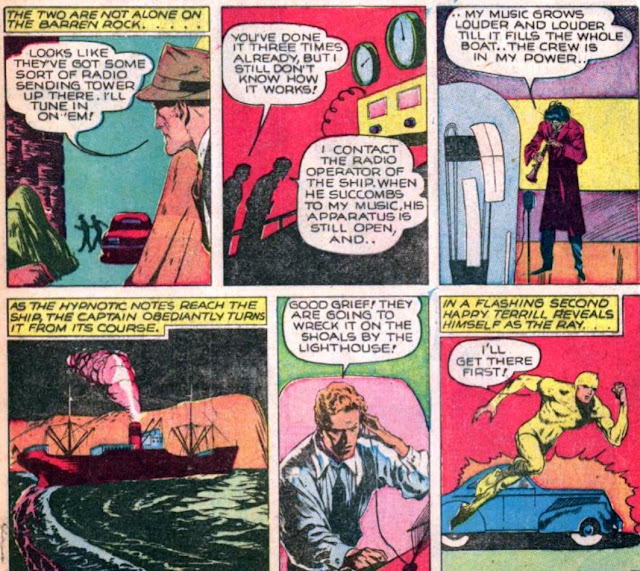
    Like many other super musicians, Stradivous specializes in mind control: he can make the people dance and caper as he pleases with but a toot.

    More importantly to the plot, Stradivous can also enthrall the entire crew of a ship by broadcasting his music over the radio, and he and his employer Dock Commissioner Jennings have been doing just that from a nearby lighthouse. Jennings gets the info on valuable incoming shipments and Stradivous wrecks the ships and then the gather up the loot.

    The Ray is of course none too happy about all of this wanton wrecking and looting and steps in to put a stop to it. He approaches as Happy Terrill for some reason, and is thus vulnerable to Stradivous’ hypnotic music. This doesn’t stop Happy/the Ray for long, of course, but as he proceeds to beat the ass of every goon in the lighthouse a secondary drama plays out: two cops, drawn to the island by the hypnotic broadcast, spot Jennings and Stradivous fleeing the scene and summarily execute them for running. It’s like a dog with a ball – if they see someone moving fast enough they just can’t help themself.

  • MINOR SUPER-VILLAIN 755: STRADIVOUS

    (Smash Comics 017, 1940)

    There are a lot of comic book characters who derive their powers from or express them through music, but Stradivous here is the only one I know of who does so using a clarinet. This is going to be huge if we ever want to draft an all-star comics orchestra someday. He also has a really terrific look, with an eccentric choice in every single aspect of his head and facial hair – I’ll even grudgingly admit that he pulls off a fu manchu, traditionally my least favourite mustache.

    Like many other super musicians, Stradivous specializes in mind control: he can make the people dance and caper as he pleases with but a toot.

    More importantly to the plot, Stradivous can also enthrall the entire crew of a ship by broadcasting his music over the radio, and he and his employer Dock Commissioner Jennings have been doing just that from a nearby lighthouse. Jennings gets the info on valuable incoming shipments and Stradivous wrecks the ships and then the gather up the loot.

    The Ray is of course none too happy about all of this wanton wrecking and looting and steps in to put a stop to it. He approaches as Happy Terrill for some reason, and is thus vulnerable to Stradivous’ hypnotic music. This doesn’t stop Happy/the Ray for long, of course, but as he proceeds to beat the ass of every goon in the lighthouse a secondary drama plays out: two cops, drawn to the island by the hypnotic broadcast, spot Jennings and Stradivous fleeing the scene and summarily execute them for running. It’s like a dog with a ball – if they see someone moving fast enough they just can’t help themself.

  • MINOR SUPER-VILLAIN 743: THE VOODOO MASTER

    MINOR SUPER-VILLAIN 743: THE VOODOO MASTER

    (Smash Comics 008, 1940)

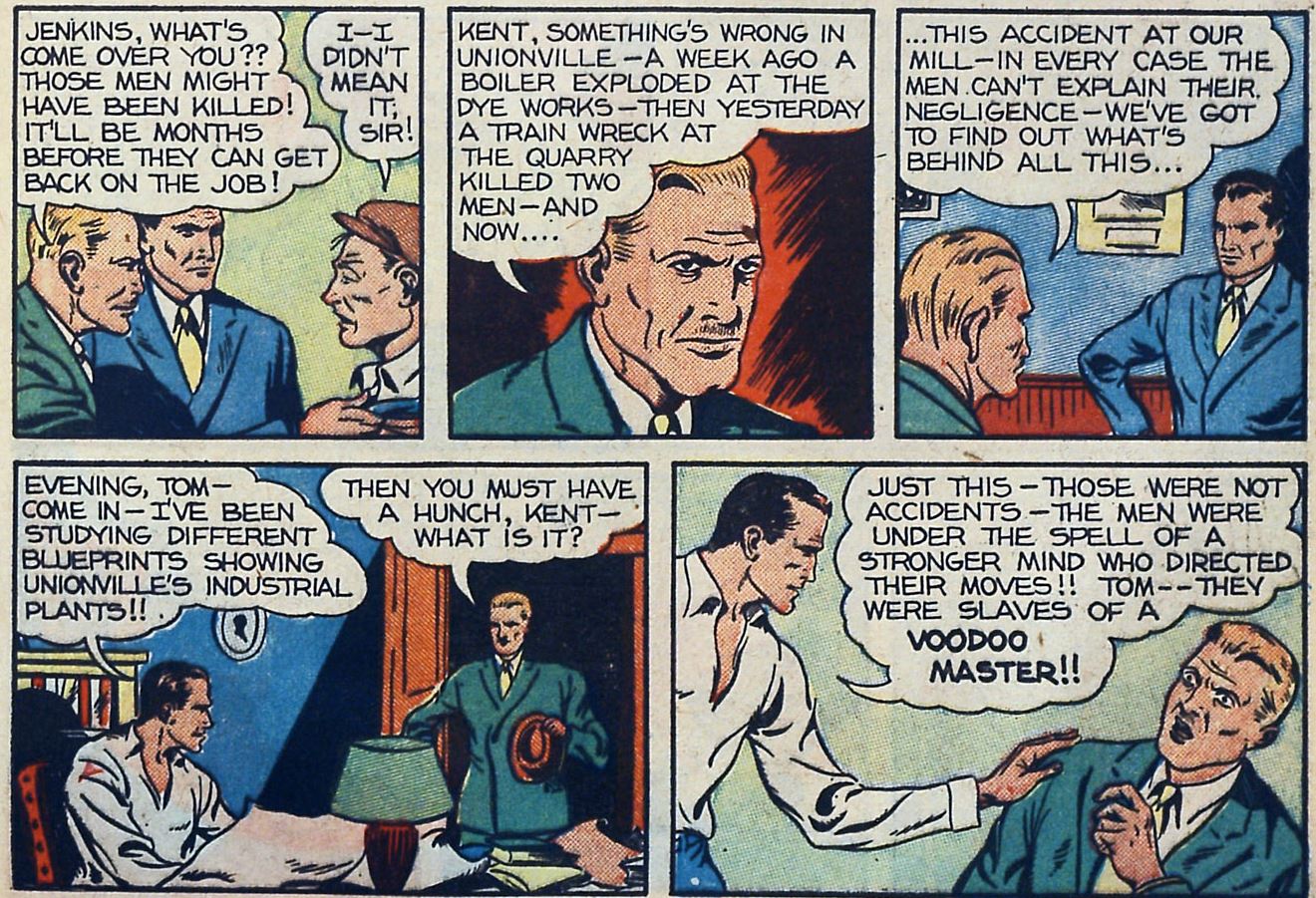
    Times are tough in Unionville: the local factories are all suffering accidents which appear to be due to systemic worker negligence but which add up to a campaign of sabotage, and since it’s a factory town, if things continue as they are then everyone is completely screwed.

    Luckily for the good folk of Unionville, the steel mill that the latest incident occurred at is managed by a guy named Tom, and Tom is friends with a fellow named Kent Thurston, and Kent Thurston is also known as the Invisible Hood, who immediately works out that the obvious culprit must be… a voodoo master!

    The Invisible Hood’s theories are vindicated when the next incident of sabotage triggers an explosion that knocks loose a couple of memories in the unwitting steelworker who set it in motion. Turns out that the mysterious villain is hiding out in the nearby abandoned castle, which is a new one on me.

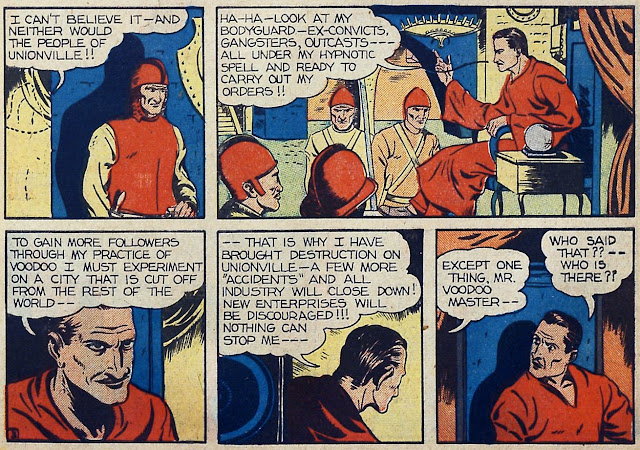
    Inside, the Hood does indeed discover the Voodoo Master (and whether this is a name he had for himself is rendered irrelevant by the fact that he accepts it as his when it is used by others – a real relief after a month or so heavy in unofficial names). The Voodoo Master has surrounded himself with crooks in faux-Medieval garb, and the goofiness of this aesthetic almost overshadows just how sinister and creepy the man’s actual scheme is: he plans to ruin Unionville financially and so isolate it from the rest of the country so that he can use its population as fodder to test out the extent of his powers. That’s some twisted 90s psychothriller shit, the sort of thing that can get very dark, very quickly.

    Invisible Hood stories aren’t very long, so there are only two further points of interest vis-a-vis the Voodoo Master. The first is that he does seem to have some credible magical acumen, as he whips up a quick anti-invisibility spell once he becomes aware of the Hood’s presence in his lair. This is honestly a lot more flexible than non-heroic comic book magic users usually are – the Voodoo Master seems to be the rare one not working off of AD&D Magic User rules.

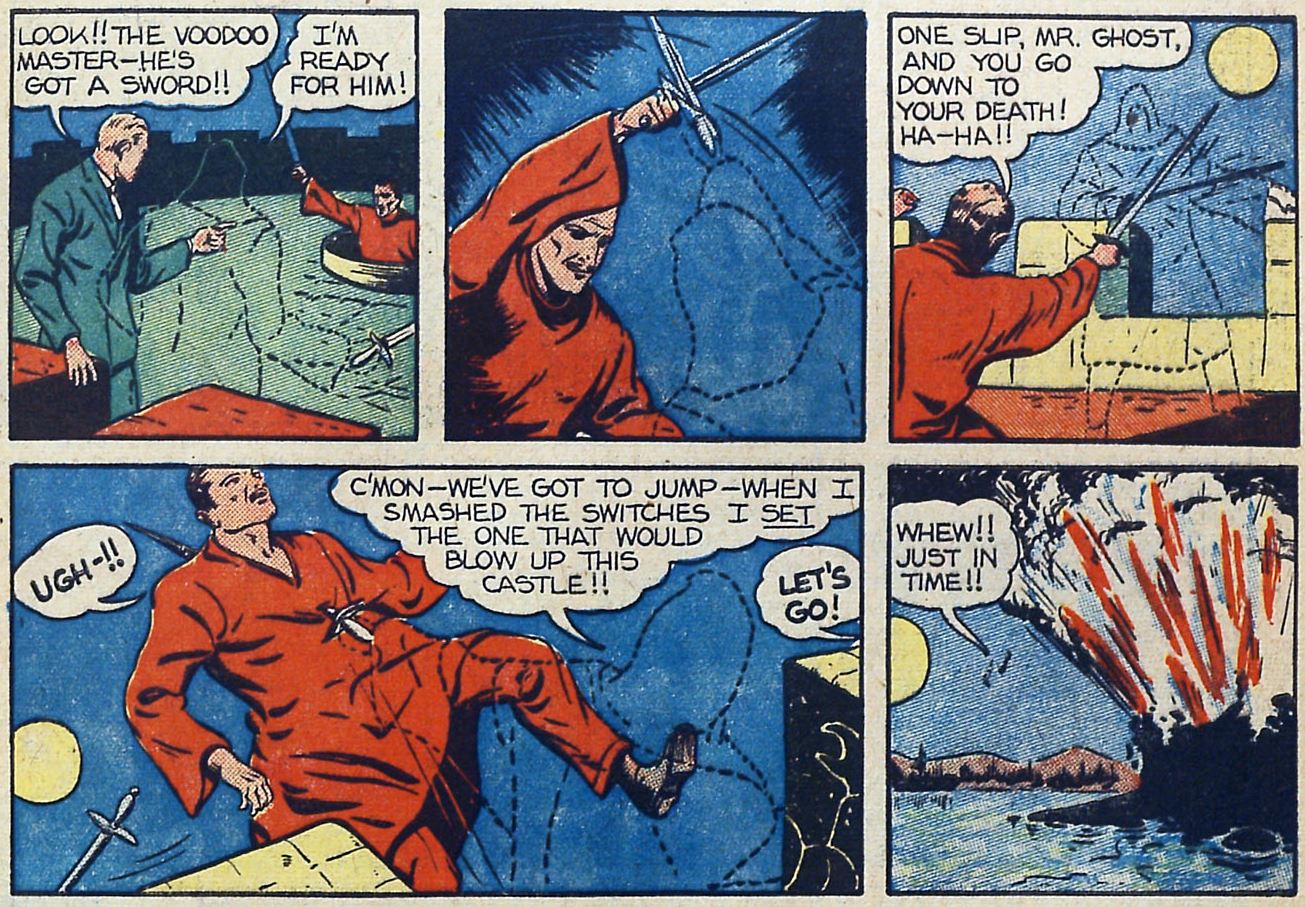
    There’s such a thing as getting too confident, however, as the Voodoo Master proves when, brimming over with hubris, he challenges an invisible man to a sword fight on his castle parapet. This ends predictably, and Unionville is saved!

  • MINOR SUPER-VILLAIN 743: THE VOODOO MASTER

    MINOR SUPER-VILLAIN 743: THE VOODOO MASTER

    (Smash Comics 008, 1940)

    Times are tough in Unionville: the local factories are all suffering accidents which appear to be due to systemic worker negligence but which add up to a campaign of sabotage, and since it’s a factory town, if things continue as they are then everyone is completely screwed.

    Luckily for the good folk of Unionville, the steel mill that the latest incident occurred at is managed by a guy named Tom, and Tom is friends with a fellow named Kent Thurston, and Kent Thurston is also known as the Invisible Hood, who immediately works out that the obvious culprit must be… a voodoo master!

    The Invisible Hood’s theories are vindicated when the next incident of sabotage triggers an explosion that knocks loose a couple of memories in the unwitting steelworker who set it in motion. Turns out that the mysterious villain is hiding out in the nearby abandoned castle, which is a new one on me.

    Inside, the Hood does indeed discover the Voodoo Master (and whether this is a name he had for himself is rendered irrelevant by the fact that he accepts it as his when it is used by others – a real relief after a month or so heavy in unofficial names). The Voodoo Master has surrounded himself with crooks in faux-Medieval garb, and the goofiness of this aesthetic almost overshadows just how sinister and creepy the man’s actual scheme is: he plans to ruin Unionville financially and so isolate it from the rest of the country so that he can use its population as fodder to test out the extent of his powers. That’s some twisted 90s psychothriller shit, the sort of thing that can get very dark, very quickly.

    Invisible Hood stories aren’t very long, so there are only two further points of interest vis-a-vis the Voodoo Master. The first is that he does seem to have some credible magical acumen, as he whips up a quick anti-invisibility spell once he becomes aware of the Hood’s presence in his lair. This is honestly a lot more flexible than non-heroic comic book magic users usually are – the Voodoo Master seems to be the rare one not working off of AD&D Magic User rules.

    There’s such a thing as getting too confident, however, as the Voodoo Master proves when, brimming over with hubris, he challenges an invisible man to a sword fight on his castle parapet. This ends predictably, and Unionville is saved!

  • PROBLEMATIC ROUND-UP 004

    Get ready for a collection of MLJ’s finest racially-problematic villains.

    Yen Fat Sing: 

    Yen Fat Sing’s deal is that he knows about a treasure buried on Fu Chang’s charity farm and, in an effort to grab that treasure for himself, has been murdering the workers using man-eating plants. He’s a pretty standard type of minor super-villain but because he is a Fu Chang foe he is of course a generic Yellow Peril character on top of that. A couple of remarkable things about Yen Fat Sing: 

    1. after all the effort to run everyone off the farm, once Fu Chang is closing in he just sneaks onto the grounds and digs up the treasure, suggesting that he could have done that all along and particularly so because nobody knew about the treasure at all until he ran his mouth about it.

    2. Yen Fat Sing is killed in the course of the story but, unlike virtually every other comic book villain to have anything to do with carnivorous plants, he is not eaten by a tree but rather dies in a car crash.

    I do rally like that the man-eating plants only attack in the dark. That’s a fun detail. (Pep Comics 005, 1940)

    Joodar the Evil:

    Joodar the Evil starts out as an evil equivalent to Fu Chang, only instead of accessing his power via supplication to an ancestral god with a tonsure, Joodar worships the Great Genii of the Water Demons, and instead of a very eclectic set of animated chess figures…

    … Joodar is granted the services of – you guessed it – water demons. Though his stated plans involve world domination, Joodar has a lot of trouble with step 1: destroy Fu Chang, to the extent that both the Great Genii and his Water Demon crew end up destroyed. (Pep Comics 006, 1940)

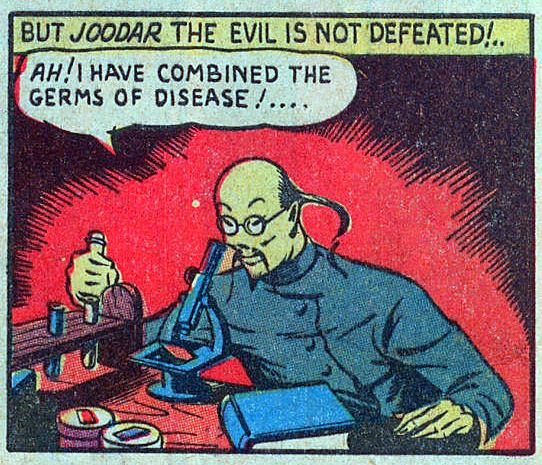
    Joodar returns in the next issue, potentially because “summoning water demons” isn’t a crime in San Francisco. This time he is without his demon pals and so he turns to the next best things: bacteria and mosquitoes! Specifically, he has mixed up a big batch of different harmful bacteria and stuck ’em in some mosquitoes in order to create havoc in San Francisco’s Chinatown. Why does he do this? It’s not entirely clear. Generic revenge? Mass chaos? Joodar doesn’t really deliver a coherent thesis statement I’m afraid.

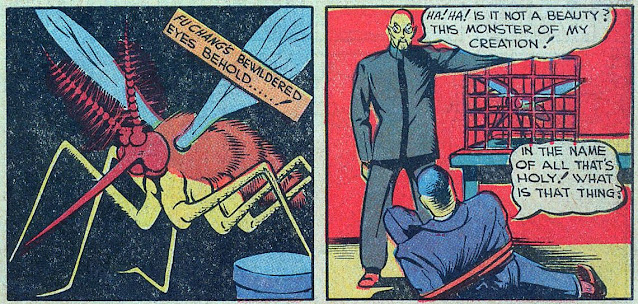
    Joodar’s greatest creation is this enormous mosquito, which almost takes out Fu Chang and his fiance Tay Ming but ultimately cannot contend with those pesky magic chessmen. Joodar, as far as I know, just absconds into the night – perhaps mosquito-crime is also not illegal in San Francisco. (Pep Comics 007, 1940)

    Dr Wang:

    Dr Wang is a Yellow Peril villain in the true Fu Manchu mould, a sinister genius who strikes at the security of the US for no stated reason. It’s possible that we are meant to read Asian villain = Japanese, but if I’m honest an evil mastermind who plots against the United States for the sheer cussed challenge of it it quite a bit more evocative.

    Dr Wang is so threatening to the secuirty of the country, in fact, that we are introduced to him in media res ad the Shield attempts to murder him by dropping a boulder on his car. This is that proactive super-hero action that we al1 wanted in the late aughts!

    Dr Wang has two things going for him: the first is his mask, which looks great. Terrific style of mask, particularly with a hat. The second is his plan to disrupt US war production, by rounding up a bunch of guys who are afflicted with cholera and hypnotizing them into getting jobs in arms factories, thus starting a targeted cholera epidemic. And the very fun thing about this is that cholera is mostly spread by contact with infected feces, so these factories must be disgusting.

    The Shield cannot of course let this stand, and goes back for another try at solving the Dr Wang Problem, and you know what they say: the second time is the charm – plus it’s a bit more narratively satisfying for the Shield not to do a premeditated murder! (Shield-Wizard Comics 002, 1940)

  • MINOR SUPER-VILLAIN 728: THE GREAT BRAIN

    (Science Comics 007, 1940)

    Perisphere Payne, futureman of the year 2000, has his work cut out for him when six Earth battle rockets go missing and then subsequently attack their home planet! And upon defeating their seemingly traitorous crews, Payne discovers that they are being remotely mind controlled via a chunky black box stuck to each of their backs in a place that looks like it would be pretty annoying to live with. Good thing they’re mind controlled and presumably not capable of being annoyed, I guess.

    Following the mind control carrier wave to an unnamed planet, Perisphere Payne and his associate Doyle (and here I was going to make a joke about Doyle also being named after a defunct bit of architecture but in trying to find one starting with D I discovered that it’s surprisingly hard to do that. Therefore, we’re gonna call him Trylon Doyle and be done with this whole tangent) are attacked by what are clearly centaurs but are consistently called satyrs, which is about as annoying as being unable to find a list of defunct symbolic architecture.

    Payne and Doyle are eventually captured by the centaurs satyrs centaurs and ushered into the presence of the Great Master, aka the Great Brain, a human brain in a glass ball who wants to conquer the human race for unclear reasons.

    Luckily for Payne, Doyle, humanity and basically everyone except for centaurs and centaur-lovers, though the Great Brain was savvy enough to make their dome ray gun proof, they forgot about the ballistic properties of the humble Oscar statuette. Once released, the Brain’s energies start a chain reaction that destroys the whole planet, centaurs and all.

  • MAD AND CRIMINAL SCIENTIST ROUND-UP 015

    They can’t help themselves and/or they’re choosing to be horrible.

    Dr Zynnon has been asked along to help Dr Curan, his daughter Sandra and protagonist Buzz Crandall in their mission to prevent the Moon from exploding, presumably dooming us all. This turns out to be a Bad Choice, because unbeknownst to all, Dr Zynnon harbours a deep misanthropy and would love nothing more than for the world to be doomed.

    Despite the fact that I love not being scoured from the face of the planet by hurtling lunar debris I must give Zynnon credit for one of the most adorable doomsday devices ever conceived of: tiny moon lizard carrying vials of acid powerful enough to bring down the roof of the lunar cavern the bulk of the adventure takes place in. Powerful enough, that is, if they were delivered to the correct location. Which they weren’t, presumably because Zynnon didn’t bother to train or condition them in any way and just let loose as many lizards as he could smuggle onto the moon bathysphere under his coat. In the end, the only casualty of Zynnon’s plot was Zynnon himself. (Planet Comics 004, 1940)

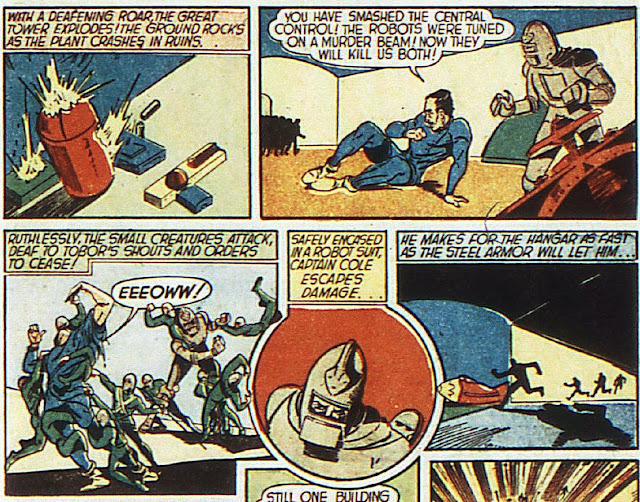
    Tobor the Evil is a Plutonian scientist who has been using an army of child-sized robots to steal Martian gold, with the end goal of conquering Mars and making it a Plutonian territory. With the help of Captain Nelson Cole of the Solar Force, he learns two important lessons about fielding robot armies: 1) don’t leave robot shells that can be repurposed into armour by your foes just lying around, and 2) if your robots have an “indiscriminate murder” setting, make sure to build in a failsafe that excludes yourself from the list of viable targets. (Planet Comics 008, 1940)

    Von Dorf, a mad physiologist and asylum escapee, was so singularly obsessed with the hybridization of humans and panthers that he kidnapped a nurse and turned her into Marga the Panther Woman. It’s likely that he would have his own numbered entry on the Minor Super-Villain list if literally the only other things he ever did weren’t a) get his ass kicked and b) blow himself up. Truly being part of an origin story is the most hazardous job in comics. (Science Comics 001, 1940)

    Dr Passendorf here managed to perfect the quite respectable criminal science inventions of a mind control device and a paralysis ray and then had to lower himself to using both in the employ of a shifty Wall Street jerk named Augustus Elba who needed to cover up some light embezzlement. Just as well that he ends up riddled with shrapnel after the Eagle blows up his machine – the roasting at the next Criminal Science Convention would have been severe. (Science Comics 005, 1940)