The Curse of Skeleton Munroe

Category: mind control

  • MINOR SUPER-VILLAIN 446: THE ROOK

    (Mystery Men Comics 018, 1941)

    This here is the Rook, the only recurring antagonist of Golden Age duo the Lynx and Blackie the Mystery Boy. In terms of crime, he’s your basic thief and murderer with a sideline in opportunistic kidnapping and extortion. He does have several notable attributes, however:

    Tactics: The Rook has a hypnoray and he is going to use it, dammit. He’s not one of those fickle super-villains who blame their tools every time a plan doesn’t come together. The hypnoray is SOLID, it’s a VALUED MEMBER OF THE TEAM and it’s STAYING.

    The Rare Hate Triangle: In his first appearance, the Rook kills his henchman Killer Burke rather than split the take of their latest job with him. Killer’s brother Baldy Burke swears revenge and attempts to get it for the next four issues. It’s a very fun dynamic because Baldy also hates the Lynx, so his allegiance is fluid. Sometimes he teams up with the Lynx to get the Rook, sometimes the opposite. At least once, Baldy just pops up out of the Rook’s back seat and attempts to shoot him.

    More books should feature a wildcard antagonist! I can’t think of too many examples off the top of my head but those I can are terrific additions to the plot. Also, more super-villains should have non super-hero enemies given how they behave – if nothing else a guy like the Joker should be taking fire from opportunists any time he shows his face in public.

    Eyes: Not only does the Rook have really great staring eyes (and they just keep getting more intense – by the end of his appearances he’s got Muppet-style half ping pong balls going on) but the subjects of his hypnoray also have them. It’s a nice touch and I appreciate it.

    Physical Resilience (or Possibly a Series of Carefully-Planned Escape Routes): The Rook ends his first six appearances in the same way: missing, presumed dead. Specifically, he meets his theoretical end, in order, by fire, a fall, quicksand, drowning, explosion, and being thrown out a window onto sharp rocks and pounding surf far below. The Rook, in other words, operates on slasher movie villain rules – if he surely must have been killed but you don’t have a body then he isn’t dead. And the Lynx must have figured that out because in their final encounter he just breaks both of the Rooks legs rather than trying to kill him like he usually does.

    In conclusion: while the Rook himself isn’t the greatest villain in the world, virtually everything about him is worth incorporating into a villainous MO. Except for the part where he teamed up with literal Nazis. None of that.

  • MINOR SUPER-VILLAIN 432: THE CONQUEROR

    (Keen Detective Funnies 011, 1939)

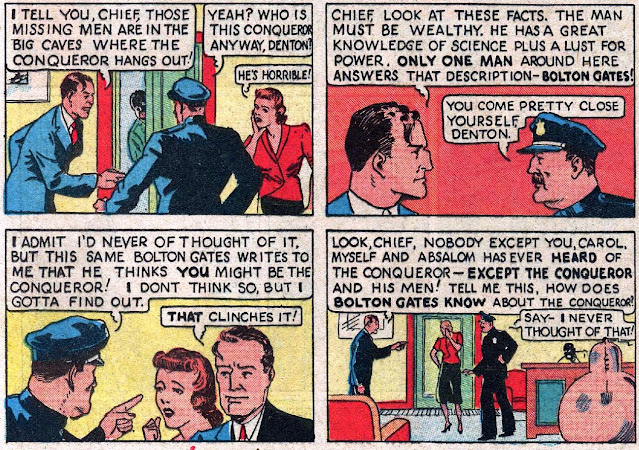
    The Conqueror is the major recurring foe of Dean Denton, Scientific Adventurer, about whom we will briefly aside: Dean Denton was created by Harry Campbell, who was also responsible for such characters as Ace of Space, Bruce Blackburn and the wretched Scarlet Seal, but also Wizard Wells and John Law, Scientiective, who form a kind of thematic triad of scientific detectives with Dean Denton.

    Dean Denton is definitely the most entertaining of the three to read (with the unfortunate caveat that his are the adventures that are most riddled with racial stereotypes. The Golden Age, folks!) due partially to his former occupation as a well-known ventriloquist but mostly to his archfoe the Conqueror, who beats John Law’s Avenger and Wizard Wells’ collection of no-name goons hands down.

    The Conqueror is actually rich guy Bolton Gates and over the course of a couple of dozen appearances he has my favourite villainous character arc: the villain of means with vast resources is foiled several times by Our Hero and ends up scrabbling around doing comparatively petty crimes for chump change. 

    In his first few appearances the Conqueror has a lavish estate under which is a technologically advanced lair filled with brainwashed minions. After Dean Denton blows all that up it seems like the Conqueror is forever seeking to recreate it with schemes that place him in positions of high status: not only does he pose as divine figures to dupe tribal groups in both Central America and Africa but he founds somewhere between two to three cults:

    Somewhat surprisingly, the White Crusaders, over which the Conqueror presided as the Master Crusader/ the White Master, was not a racially problematic group.

    Meanwhile the Cult of Astra was mostly a way to flimflam flaky Hollywood types and blackmail their studios with the threat of religion-related work stoppages (a scheme that nets him a two-episode arc on the Villains of Old Hollywood podcast).

    The third example is somewhere between a cult and his old habit of minion recruitment through mind control: he takes advantage of the conflict between the countries of Namreg and Feltia (and in case “Namreg” was too subtle for you they clash near the “Tonigam Line”) to capture and brainwash both Namreg and Feltian forces. 

    Even though the Conqueror gets away as per usual at the end of this scheme, it’s his last appearance in comics (that I know of, natch). One can imagine his conflict with Dean Denton continuing indefinitely and why not. It’s more fun than most things that might logically happen to a lone civilian trapped in the midst of two armies that he recently made enemies of. after all.

  • MINOR SUPER-VILLAIN 419: PSYK

    (Funny Picture Stories v2 001-003, 1937)

    I think I recently mentioned the dreamlike quality of some Golden Age comics. This is one of them, and only partially because the villain operates out of some sort of pocket dimension in the collective human subconscious. 

    Psyk is a would-be world conqueror with three really good tricks in his arsenal: travel between Earth and the aforementioned Realm of the Subconscious, the ability to raise the dead and mental domination of both the raised dead and the living. His plan seems to be to raise an army of dead and living thralls and then transport them to strategic invasion points. It’s not a bad plan, even if the thralls are all armed with swords and nothing else.

    Psyk is opposed by Jack Strand, who ultimately prevails by exploiting Psyk’s two weaknesses: a power-sapping “ray” (and here I think they’re using ray in the not-much-used sense of a radiation rather than a beam of energy) and the fact that each person affected by Psyk’s power has a weak point where that power entered their body – this point is the only vulnerable place on a thrall’s body and so they cover it with a very obvious and easily removed green piece of metal. Strike a living thrall in the spot and they are freed from Psyk’s power; do the same to a dead thrall and they die for good.

    What’s odd is that Psyk himself has such a spot: his cheekbones (as you might be able to tell from his stylish green cheek armour). What does this imply? Is Psyk himself just a thrall to a more powerful being? Maybe! Doesn’t matter though because Jack Strand punches him right in the cheek and blows up his dream castle.

    He’s an interesting guy, Psyk – definitely has the feel of a character bridging the pulp/comic transition. I’d love to see him BRUNG BACK in a limited series told in a more modern style.

  • MINOR SUPER-VILLAIN 404: THE AVENGER

    (More Fun Comics 074, 1941)

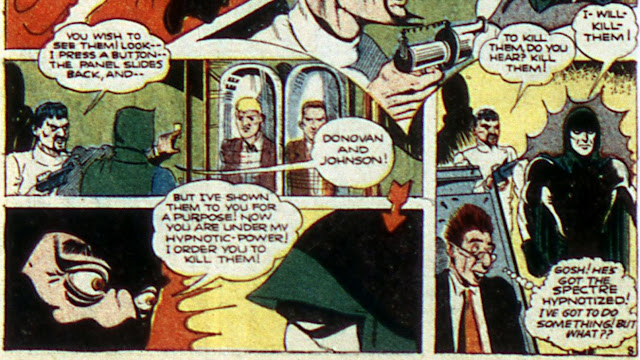
    Another day, another Avenger. This Avenger is a disgruntled scientist named Mortimer Crandall who is seeking revenge on his old bosses for firing him because of his wacky scientific theories that, you guessed it, turned out to be correct. He uses his working technology to kidnap the men responsible in preparation for their murders.

    This Avenger also demonstrates a flair for comic-book style hypnosis sufficient to place the Spectre himself under his power, which is impressive even in the Golden Age, before the whole “the Spectre is literally an angel” thing.

    The Avenger ultimately fails in his bid to exact revenge and instead is given that most rare of choices for a Spectre foe: the chance to reform (with a little help from the mystic radiations of the Nebula of Truth, of course). Is it because he had genuinely been wronged? Because he had not yet taken a life? Or is the Spectre just a capricious guy? Regardless, the Avenger will venge no more.

    This issue also marks the first appearance of Spectre sidekick Percival Popp, the Super Cop and I find myself in a familiar place: here is a charming oddball character that I like, being treated like an unbearable pain by all the other characters that I like. It’s one of the more annoying literary dynamics! Hope it doesn’t stick around!

  • MINOR SUPER-VILLAIN 394: BANDAR

    (More Fun Comics 070, 1941)

    I got some gripes about Bandar and they’re not really Bandar’s fault. But let’s start with who Bandar is: the source of a mysterious spectral figure that keeps bamboozling the Spectre and killing former members of the Crimson Circle Mystic Society.

    Jim Corrigan goes deep cover and joins the Society in order to get to the bottom of what the heck is going on and discovers that they’re just a bunch of dupes that society leader Bandar hypnotizes and makes steal for him. The former members are being killed – by Bandar’s astral form, it turns out – not to preserve some sort of mystic secret, etc., but to keep them from possibly remembering their actions and blabbing to the fuzz.

    The Spectre eventually solves the problem in his own inimitable way: by destroying Bandar’s human form so that his astral self is doomed to wander forever. Efficient!

    Now for the gripes: 

    1. While I appreciate the consistency of the “ghosts are chalk-white figures in a purple/grey hooded robe” design, it does get pretty samey after a while and there have been quite a lot of ghosts in 1941’s Spectre adventures.

    2. When I started reading this story I got pretty excited about the Crimson Circle Mystic Society (or the much cooler Order of the Crimson Circle, according to their signage) being the villain and Bandar is a bit of a step down from that.

    I acknowledge that those are unfair and subjective reasons to dislike a character so here are a couple of subjective things I liked about this tale to balance the scales:

    1. Bandar is an example of a trope that I don’t really know the name for – monster of the week? Basically, an antagonist who is able to enact a complete runaround on the very capable protagonist because they don’t know what the Deal is and thus can’t effectively counter the Deal. In this case, the Spectre can’t stop or catch Bandar until he figures out that he’s not actually a ghost but an astral projection. It’s just a fun way to make what would on paper be a mismatched foe work.

    2. This story marks at least the third time that Jim Corrigan is murdered while on a case, a fun recurring bit.

    So: Bandar!

  • MINOR SUPER-VILLAIN 377: MAYOOR

    (More Fun Comics 064, 1941)

    Mayoor is an ancient evil god with no in-comic-defined portfolio but if I had guess I would venture that he’s the God of Disappointment. Here’s the sum total of his plots and plans: enthrall a society adventurer named Bill Credon, who then lure Dr Fate chum Inza Cramer to Mayoor’s Yucatan Peninsula temple-cum-prison. Then there’s a bit about using her to spread Mayoor’s message and worship but unfortunately for Mayoor that’s the point at which Dr Fate shows up and kills him.

    It’s not even a challenge! And Mayoor should have known that he was outclassed, because Dr Fate* is the one who imprisoned him in the first place. About the only good thing about this guy is that because he was such a nothing villain he could probably be BRUNG BACK as a regional threat without a lot of baggage, just bedeviling the heroes of Central America for decades – it’s not as if there were any piece of fiction in which it was easy to kill a god, after all. Worldbuilding!

    *this story is a few issues prior to the Dr Fate’s origin story, so while retroactively it was probably Nabu or someone else wearing the Helmet of Fate who imprisoned Mayoor, in-story it’s still Dr Fate being treated as an immortal wizard.

  • MINOR SUPER-VILLAIN 374: THE MAN WHO WAS DEAD

    (More Fun Comics 063, 1941)

    I’m just as guilty as I was with the Jungle Scientist of being immediately seduced by the subject’s name as presented in the title of the story. The Man Who Was Dead – a terrific name if I’ve ever seen one. Pure bonus points to the guy for being a weird little imp about it.

    The Man Who Was Dead of course escapes from police custody and so the Radio Squad here are forced to follow up on their only clue: a cufflink with some weird writing on it which they of course take to a university History Department and of course discover that the Man Who Was Dead is in fact History Professor Greene, who recently had a nervous breakdown. Also there is a sinister Indian gentleman named Professor Silna.

    It all comes to a head in an abandoned house on the edge of town, in which Silna is of course revealed to have drugged and hypnotized Greene into an obedient and invulnerable servant using his Ancient Hindu Magicks. Silna realizes too late that he should have made himself immune to gunfire as well, as he is gunned down by Radio Squad member Sandy Kean. Greene gets to heal from the tremendous amount of abuse his body endured while under Silna’s control and all the loot gets returned – a happy ending for all!

  • MINOR SUPER-VILLAIN 374: THE MAN WHO WAS DEAD

    (More Fun Comics 063, 1941)

    I’m just as guilty as I was with the Jungle Scientist of being immediately seduced by the subject’s name as presented in the title of the story. The Man Who Was Dead – a terrific name if I’ve ever seen one. Pure bonus points to the guy for being a weird little imp about it.

    The Man Who Was Dead of course escapes from police custody and so the Radio Squad here are forced to follow up on their only clue: a cufflink with some weird writing on it which they of course take to a university History Department and of course discover that the Man Who Was Dead is in fact History Professor Greene, who recently had a nervous breakdown. Also there is a sinister Indian gentleman named Professor Silna.

    It all comes to a head in an abandoned house on the edge of town, in which Silna is of course revealed to have drugged and hypnotized Greene into an obedient and invulnerable servant using his Ancient Hindu Magicks. Silna realizes too late that he should have made himself immune to gunfire as well, as he is gunned down by Radio Squad member Sandy Kean. Greene gets to heal from the tremendous amount of abuse his body endured while under Silna’s control and all the loot gets returned – a happy ending for all!

  • MINOR SUPER-VILLAIN 350: THE TERROR

    (Master Comics 012, 1941)

    At first I was fairly unimpressed with the Terror – I regarded him as yet another low-ambition super-crook, a guy with the wherewithal to invent a hypnotic ray belt and mount the output in the villain-standard rubberoid mask but with no greater ambition than to murder his uncle and half sister to get his mitts on the family fortune. But… is there another, non-crime way to get rich off of a hypnotic ray projector? I imagine that it would be quite useful in a psychologist’s practice but that’s a get-somewhat-rich-slowly scheme if I ever heard one. I suppose crime might have been the way to go for a young man in need of money, though speaking as an uncle, avunculicide is never the answer.

    Once I looked at the Terror with fresh eyes I realized something else: as the Terror, young Stephen Barish was completely committed to the bit. He decided to kill his family, adopted an over-the-top cackling movie villain persona and kept that shit up until he was unmasked (and even then he tried to knife Zoro the Mystery Man and got sword caned for his trouble). Just look at this behaviour:

    Just grinning and laughing and gloating and hopping around like a goblin until he is physically skewered. This is the kind of villain I like, even if he has an anti-uncle bias.

  • MINOR SUPER-VILLAIN 315: THE ZOMBIE MASTER

    (Daring Mystery Comics 001, 1940)

    The Zombie Master has layers. Top level is deeds: he is a scientist who kidnaps people on the fringes of society and uses a combination of hypnosis and radiation to turn them into bright green mind controlled thralls – fairly standard stuff for a mad scientist. Next though, is his origin: he felt rejected by society because of his great height – something like 20 feet tall, according to some sources – and so moved underground in order to work in isolation (and as a side note he mentions that he’s been working for about 50 years, so he’s a rare Golden Age character who we have an approximate age for: somewhere in his late 60s or early 70s seems reasonable). A giant scientist!

    The next layer is only interesting to me: he is not given a name in the story. Luckily, the Zombie Master moniker is later assigned to him because there’s no really good option in the text and I’d’ve ended up calling him something like Unnamed Giant Scientist.

    For our final layer we must note that the Zombie Master is a part of the origin story of the Fiery Mask, and that the Fiery Mask was one of the characters who appeared in J. Michael Straczynski’s The Twelve, wherein it was revealed that he had not received his powers due to an explosion in the Zombie Master’s lab but essentially by murdering the previous Fiery Mask – the Zombie Master was just a story he made up in order to cover for himself/ assuage his guilt. The greatest trick the Zombie Master ever pulled, it seems, was to have never existed at all.

    (which of course makes him a perfect candidate to be BRUNG BACK – what better foe than a nonexistent giant science man?)