The Curse of Skeleton Munroe

Category: chemical mutate

  • MINOR SUPER-HERO ROUND-UP 039

    MINOR SUPER-HERO ROUND-UP 039

    We’re reading Shield-Wizard Comics, bay-bee, so here’s some stuff about the Shield and the Wizard.

    the Shield UPDATE:

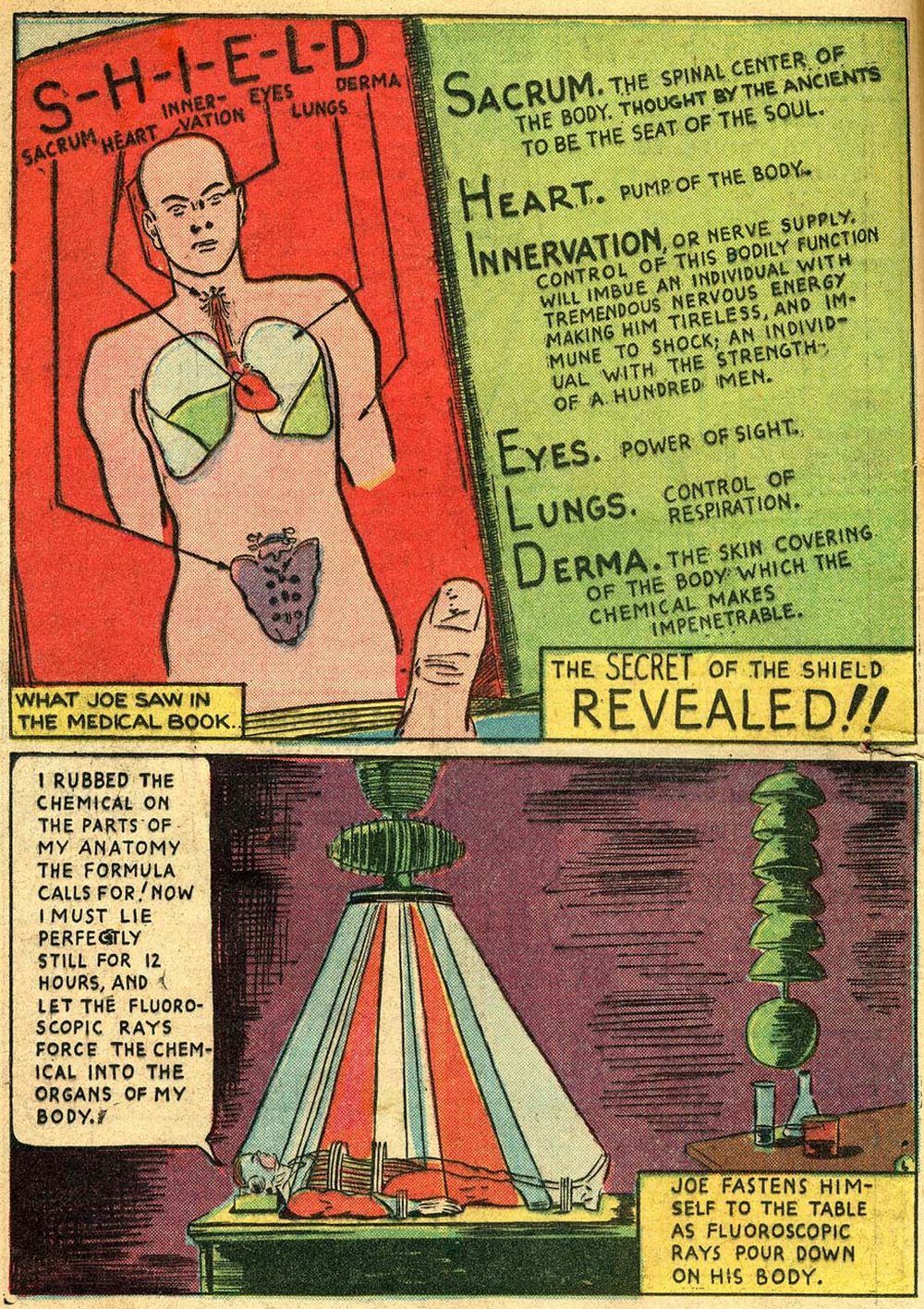
    In our original write-up of the Shield, we noted that the origin of his powers shifted from being solely down to his super-suit to being more of an ingrained thing over time, and the time is now! Yes, Shield-Wizard Comics 001 provides a slightly tweaked version of the Shield’s origin, in which Joe Higgins’ father Tom was not just a US Army Intelligence agent but a gifted scientist who discovered the secret of inducing superpowers but died juuuust before being able to tell Joe the full secret.

    Joe grows up to become a chemist himself but remains puzzled by his father’s last instructions to remember “anatomy formula S•H•I•E•L•D,” and with good reason, because it’s a nonsense jumble of anatomical parts that must have been put together only in the specific medical textbook that Joe eventually finds it in. But hey, he needed to find out where exactly to rub the chemical formula, and how would he otherwise know that it boiled down to “your eyes and skin, but especially the skin over your chest and groin” without that handy mnemonic device?

    The all-white costume that Joe is sporting before he settles down for a 12-hour session under the fluoroscopic ray shows up in at least a few retellings of the Shield’s origin going forward and I always thought that it was a pretty snappy look. Unfortunately, the rays dye his suit (and possibly his limbs?) in patriotic colours and so we get a red-white-and-blue Shield rather than merely a white one.
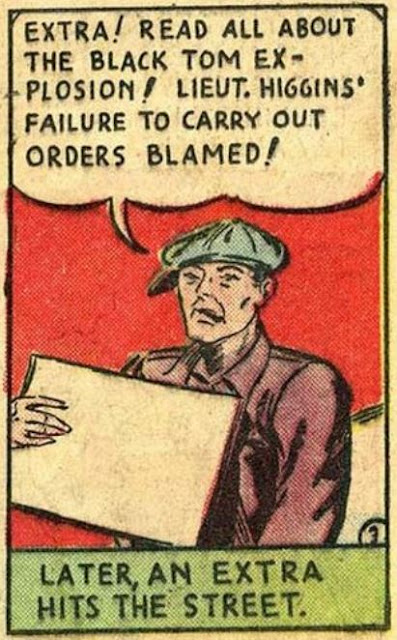
    The other tweak to the Shield’s origin is that rather than merely dying in the Black Tom Explosion of 1916, Tom Higgins is blamed for it, so the Shield now not only has a Batman-style motivation (spies killed my dad and now I must battle espionage) but also a Geoff Johns-Barry Allen-Flash one (I fight crime as part of my attempt to clear my father’s name). Thankfully, his first case involves rounding up the very German Hans Fritz and forcing him to confess, thus clearing Tom Higgins’ name without it becoming a whole thing. (Shield-Wizard Comics 001, 1940)

    the Wizard I:

    In the original account of the Wizard’s origin in Top-Notch Comics 001, the Whitney family’s close connection to American history is pretty thoroughly emphasized, with Whitneys present and getting things done at all major American wartimes. Well, Shield-Wizard Comics took up that gauntlet and ran with it: John Whitney organized the Mayflower expedition, and his son John Whitney organized the first Thanksgiving, and his son or grandson John Whitney thought up the idea of uniting the colonies. 

    But that wasn’t all: the third John Whitney’s son Blane (the main line of Whitneys only have time for three male names: John, Blane and Grover. All other named Whitneys are from dead end branches of the family tree, it seems) is just as super-human as his descendant, and in fact was the first of a line of Whitney family superhumans to call themself the Wizard (adopted as an ironic name after John Whitney was burned at the stake for witchcraft after acting on his son’s extrasensory visions to protect the colonies).

    The Wizard ends up making quite a big difference in the tides of the American Revolution, including:

    – informing Paul Revere that the British were approaching Concord and lighting the “one if by land, two if by sea” lanterns

    – showing up to participate in the fighting at Concord and turning the tide

    – wielding a cannon as a sidearm in the Battle of Bunker Hill and again at the Battle of Saratoga

    – saving Nathan Hale from being executed as a spy only not really because he chooses to die and be an inspiration instead

    – orchestrating the crossing of the Delaware and the surprise attack on the Hessian forces

    -very nearly getting Benedict Arnold before he gets away to join the British forces

    – proving instrumental in the capture of Major André

    – participating in several key battles, including the charge of Mad Anthony Wayne and the defeat of Cornwallis

    – orchestrating the support of the French for the revolution

     This original Wizard also creates a number of anachronistic inventions, including:

    – a glider that seems to function a bit more like a full-fledged airplane

    – a steam powered speedboat

    – something in between a deep sea diving rig and a scuba suit

    – a machine gun

    – radio communication

    – an electrified, battery-powered suit

    – a self-propelled sled

    – a tiny high-powered cannon

    All in all, the tale of the original Wizard holds up as a classic of the form, with the form being “super-heroes added to historical events.” Comics love to showcase the great moments of US history in particular, but as a comic book must prioritize action, any super-heroic character who is present must have an extraordinary amount of influence on history. It’s great! (Shield-Wizard Comics 001, 1940)

    the Wizard II:

    The second Wizard, like his father the original Wizard, is essentially a carbon copy of the modern character in appearance, name (Blane Whitney, natch) and abilities. Blane Whitney II also takes after his father in his commitment to inserting himself into important US historical events, including:

    – participating in various military engagements, including the defeat of the HMS Gurrierre, the Battle of Lake Erie, the Battle of the Thames (I think?) and the Battle of Bladensburg

    – saving William Henry Harrison from an assassination attempt

    – almost preventing the burning of the White House by the British

    – planning the defense of Fort McHenry and then participating in it

    – accidentally enabling Francis Scott Key to get inspired to write the Star-Spangled Banner

    This Wizard also has a lot of ahead of its time technology, including:

    – a version of his father’s glider

    – smoke (possibly tear gas) grenades

    – a dang tank

    The second Wizard obviously has less of a direct impact on the events of US history, if only because the War of 1812 has fewer Stand Up and Cheer moments than its predecessor. Still, he’s in there, and there’s every indication that we’d continue on to see a Civil War Wizard and a World War I Wizard and so forth, and the stated reason that we don’t see them is that as of Shield-Wizard Comics 003, the Wizard’s sidekick Roy the Super-Boy was too popular to not feature and so it was contemporary Wizard from then on out. (Shield-Wizard Comics 002, 1940)

    And speaking of Roy the Super-Boy:

    Tommy the Super-Boy:

    A part of any big project is choosing a methodology and then sticking to it and as my project is “reading all comics, in order” I had to figure out what “in order” meant. And while doing things in a month by month basis might be more true to the spirit of the experience, for my own sanity I opted to go alphabetical by year instead – the prep work alone for that other method hurts my head a bit to contemplate.

    All that is by way of explaining that Tommy, “the Original Super-Boy of History” (aka the original wonder-boy according to that one panel) is a retroactively created predecessor of the Wizard’s sidekick Roy the Super-Boy, who we will not meet until I have read the around 180 other comics between Shield-Wizard Comics 002 and Top-Notch Comics 008. He’s your classic orphan kid who gets to hang around a super-hero because he’s scrappy, and it turns out that that’s not unheard-of in historical youths.

    This particular scrappy kid, Tommy by name, is peeling potatoes when he meets an incognito Blane Whitney II and ends up discovering his secret identity after the Wizard participates in a sea battle and Tommy runs off afterward to berate Blane for cowardice, like a normal person does. And once you have discovered a super-hero’s identity, you get to become a super-hero! If you are a scrappy kid, of course. (Shield-Wizard Comics 002, 1940)

  • MINOR SUPER-HERO ROUND-UP 033

    Minor super-heroes, we got ’em.

    Little Giant: 

    Professor Rednow has some inventions to test and he has secured an orphan boy named Rusty for that purpose. Rusty is first given a serum that is supposed to turn him into a big hunk of beefcake but instead he becomes a kid with super strength. He then gets an outfit with anti-gravity properties that allow him to leap around like a small Hulk and finally is coated in “impurvogen,” a high-tech chemical that renders him invulnerable.

    In case you were having some doubts about Professor Rednow’s devotion to scientific ethics: I don’t think that he has any. It’s just lucky for young Rusty that all of this stuff works or he might end up buried in the Professor’s back yard alongside half a dozen other orphan boys.

    Rusty and the Professor end up moving to NYC and becoming special deputies in the NYPD but, as with the Phantom Knight before him, the Little Giant only really had a couple of adventures and the second one continues to be out of my price range. (OK Comics 001, 1940)

    the Shield:

    The Shield is Joe Higgins, “G-Man Extraordinary,” an FBI agent who battles threats to the US using a super-suit of his own design (a design that supposedly was the reason for Captain America switching from his original shield to the round one so as not to look too much like his patriotic counterpart, by the way). 

    Over the years the Shield’s status is subject to the usual comic drift: his powers go from being solely derived from his suit to involving some sort of super serum or ray or two of those, or all three. We’re talking about the 1940 version of the character, though, and he was all suit, baby. The suit itself did slim down considerably from the first issue to the second, but we can chalk that up to a refinement of the technology (and to the more form-fitting top being a bit more flattering than the big chunky breastplate look).

    One thing about the Shield that I had never known prior to reading his first appearance was that his motivation for becoming a costumed crimefighter was that his father died in the Black Tom Explosion as a result of German sabotage during WWI. Thus, the Shield has the Batman origin but for espionage!  (Pep Comics 001, 1940)

    UPDATE (Shield-Wizard Comics 001, 1940)

    the Comet:

    John Dickering is a scientist who invents a gas that when injected gives him super jumping abilities. Too late he learns the reason that so many scientists do extensive testing before trying out serums etc on themselves, as the gas also gives him disintegrating ray vision that can only be held in check by a glass visor, Cyclops-style. Thus, he becomes the Comet.

    There are a number of remarkable things about the Comet over the years but the only ones relevant to the 1940 version of the character are 1. the fact that he has one of the truly great Golden Age costumes and 2. just how very willing he is to kill his foes. I guess when all you have is a disintegrating ray every problem looks like a disintegratable nail. (Pep Comics 001, 1940)

    the Rocket:

    The Rocket is your classic example of an explorer coming to a lost/hidden/alien world and becoming its greatest champion. The most common example of this is your garden-variety jungle adventurer, with “modern man transported into an effete future” and “guy falls through hole into underground world” being other common examples.

    The Rocket’s adventures, on the other hand, happen… somewhere. He
    arrives via his namesake rocket ship – is the Diamond Empire located in
    the future? on an alien world? on a lost mesa or in a hidden valley? No
    idea, never addressed. He just shows up because he heard there was a hot
    queen running the joint and that’s all we get.

    After a rocky start, the Rocket manages to win over the titular Queen of Diamonds, going from her slave to her bodyguard to eventually becoming her lover/ adventuring companion. And if you read the above panels you might have noticed how very racist the Queen’s origin story is, another thing that is extremely in keeping with this man-in-a-strange-land style comic: white guy exceptionalism. (Pep Comics 001, 1940)

  • MINOR SUPER-HERO ROUND-UP 029

    They’re trying, bless ’em.

    Hydroman:

    I was going to say that much levity has been mined from Hydroman’s origin over the years, but realistically this guy is obscure at best. Some levity has been mined from Hydroman’s origin over the years. Is it deserved? Certainly.

    Scientist Harry Thurston is having fun mixing up chemicals (specifically water, alcohol and sulphuric acid, though there is some speculation that there might have been some mystery residue in the glassware used) and manages to get some on his hand, which promptly turns to water. In a panic, he calls his friend Bob Blake over to help, and when Bob arrives, fellow scientist Tom Kinsman dumps an entire bucket of the mixture over him like they’re all in a dang slapstick comedy.

    They manage to counteract the formula, at which point Bob agrees to have the formula injected into him, and while this works as comic book science (if a big splash turned me to water, surely an injection will allow me to control the process! Because it’s deliberate and thus more scientific!), surely by all other metrics it is an insane decision. What’s to say, for instance, that an injection won’t merely turn all of your blood or veins to water, killing you?

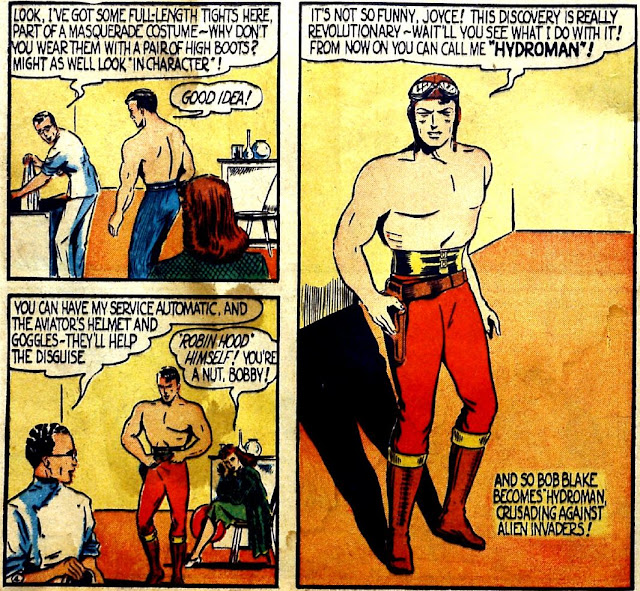
    Against all odd, the injection works and Bob Blake decides to use his newfound power to fight the wave of crime that is plaguing NYC. To go with his new role, Blake adopts a new moniker – Hydroman – and makes a super-hero costume in perhaps my favourite way, by scraping up all of the random crap in Harry Thurston’s lab.

    By issue 2, Hydroman gets what only I think of as his iconic look, a baggy suit of bulletproof Translite. It’s objectively kind of dumb looking but also… kind of great? It might be the combination of the leather pilot’s helmet and the riveted brass collar but the overall effect is very cool and retrofuturistic. Plus the transparent effect really plays well with Hydroman’s whole water theme. Finally, note that Hydroman’s assistant/ girlfriend Joyce Church is also wearing a bulletproof suit under her coat and I must commend him for being the rare Golden Age super-hero who thinks to distribute such protective super equipment to his civilian aides. (Reg’lar Fellers Heroic Comics 001, 1940)

    Update 1941 

    the Purple Zombie:

    Doctors Hale and Malinsky are partners, but while Hale was working to prolong human life, Malinsky was taking his research and using it to create an army of the undead in order to take over the world. His prototype is Zoro, the Purple Zombie, and once his zombification tech is proven to work (and once Hale starts mouthing off a bit to much), Malinsky decides that things might run a bit smoother if it was just him and the zombie and bumps off Hale.

    Unfortunately for Malinsky, some quirk of the zombie technology has made Zoro 1) amoral 2) bulletproof and super strong, and 3) loyal only to Hale, and so he makes short work of not only his erstwhile master but also his three foreign investors.

    Zoro is captured by the police and scheduled for an execution that hits a slight hitch when it turns out that in addition to bullets the Purple Zombie is immune to electricity (he also turns a more purpley purple when electrocuted!). Stymied, the authorities agree to release Zoro into the stewardship of Dr Hale (who survived the murder attempt, by the way). The Purple Zombie is not so much a hero as a gun that Hale points at people and situations, but as a pair they basically fit the brief. (Reg’lar Fellers Heroic Comics 001, 1940)

    Hyper the Phenomenal:

    Visually, Hyper the Phenomenal is great. I really like the… well “retrofuturistic” is the best description of it but of course at the time it was just futuristic. I really like his look, particularly what I assume is a breastplate since it seems to be separate to the shirt – there aren’t enough non-aquatic super-heroes with the courage to wear a big scallop shell as armour.

    Hyper is really the oddly-named Don-Vin, a scientist who has some sort of affiliation with the US Secret Service, either as an official agent or just a helpful pal. His main tools in the fight against evil are his Neogas Helmet that allows him to fly (plus is has a nifty two-way radio inside) and his Magno-Hydro Gauntlets, capable of both magnetic attraction and repulsion and with which he can both perform feats of superhuman strength (equivalent) and deflect incoming bullets.

    I chose the cover image above because it’s probably the most dynamic and interesting view available, due to the unfortunate fact that in Hyper the Phenomenal’s sole outing he does very, very little of note. His adventure on the Isle of Arunta was serialized over two issues and for fully half of that time (and somewhere between 1 and 2 days in-story), Hyper stands in front of a steel wall using his gauntlets to prevent a crushing room deathtrap from killing his ally Agent 2Y. A heroic act, to be sure, but not a visually interesting one. And since the first quarter of the story was devoted to setting up the action, Hyper only gets the final quarter to really strut his stuff, and even then he probably only gets the job done because the villains had oppressed the island’s inhabitants enough to start a rebellion. A poor showing indeed, Don-Vin. (Hyper Mystery Comics 001, 1940)

    Kaänga:

    Run-of-the-mill Tarzan clone who was orphaned in the jungle at a young age and whose Jane equivalent is named Ann Morgan. Kaänga’s only real point of interest is the umlaut on his second a, but he has close to 200 appearances over the years so I’m sure we’ll be seeing more from him. (Jungle Comics 001, 1940)

  • MINOR SUPER-VILLAIN 650: RANGO OF SLAVONIA/ MINOR SUPER-HERO: THE MASTER MYSTIC

    (Green Giant Comics 001, 1940)

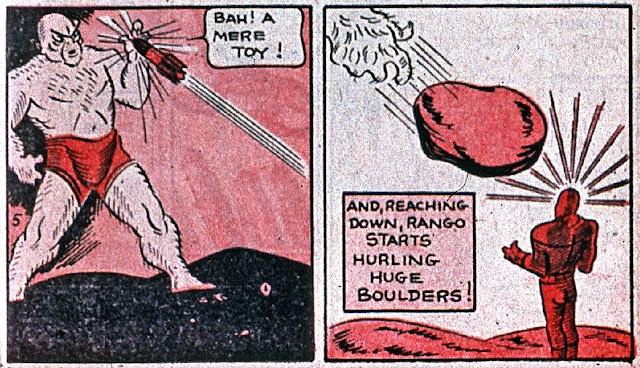
    We join Rango, a science villain of some description, after he has failed to conquer Europe. His next move: total destruction.

    After absolutely devastating a city in what is probably Slavonia, Rango heads for the United States by the simple expedient of swimming across the Atlantic.

    And now we encounter the main attraction, Master Mystic! What a character! Master Mystic is very much ahead of his time, both in his art style and degree of superhuman omnipotence.

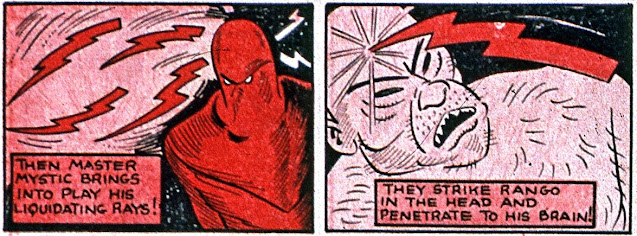
    Master Mystic’s entire battle with Rango feels like something out of a 60s underground comic, slightly unreal and rubbery and full of visual excess. Appropriately, Master Mystic was created by Victor E. Pazmino, whose other credits tended more toward the funny animal content that informed so much of the underground comix scene.

    (see also Pazmino’s other super-heroic creation, TNT Todd, for some fun costume compare-and-contrast)

    It really is a shame that Pazmino didn’t do more work along these lines, assuming that he wanted to. Stuff like this visualization of the Master Mystic’s telekinesis stands out as innovative by any era’s standards.

    Master Mystic eventually melts Rango into horrible goo and then returns to his Arctic stronghold to resume his protective watch over humanity North America, and if the super-powered one-upsmanship of their battle felt like something out of 60s counterculture comics then this detached, omnipotent man routine feels very 1980s post-Watchmen, or at least one step away from that. Should some entrepeneur BRING BACK the Master Mystic the next time metatextual super-hero analysis characters like Miracleman come into vogue? It’s worth a shot!

  • MINOR SUPER-HERO ROUND-UP 017

    Another fresh hot basket of also-rans, just for you.

    the Mask:

    Scoop Cody, society reporter, is secretly vigilante crimefighter the Mask. He’s not terrific at concealing this fact – both love interest Elaine and villain Carlos figure it out during the course of the one extant Mask story – but he gets the job done. Of mild interest is that Scoop Cody is also the name of the Marvel’s reporter pal. (Star Comics v1 013, 1938*)

    the Phantom Rider: 

    The Phantom Rider is your standard masked cowboy, identity unknown. Given their similar names and that they are both Centaur Comics characters it is equally likely that he is a renamed Phantom o’ the Hills as it is that he is a separate creation. His horse is named Thunder. (Star Comics 016, 1938*)

    Air Man:

    Air Man is Drake Stevens, an ornithologist who embarks on a vigilante career after his father is murdered in an insurance scam on the high seas. He only makes a handful of appearances before Centaur folds, and here are the salient things about him:

    -Air Man is a “realistic” version of Hawkman, i.e., not realistic but in a slightly more plausible way than an antigravity belt. His wings are filled with helium and he has a little jet engine for propulsion (at least, as of his second appearance. Maybe he’s just very slowly gliding around in his first). He also has egg-shaped bombs, which isn’t relevant to the flying but is fun.

    -Air Man is not a generic bird-themed hero but in fact an albatross-themed protector of the seas, which is a niche that I have not encountered before and the closest that I can think of is the Marvel hero Stingray, and that’s just because they both fly and are ocean-based.

     -Air Man believes in protecting the high seas so much that he breaks up with his fiance rather than just… living in a lighthouse with her or whatever. Super-heroes love breaking up with people and then feeling noble about it. (Keen Detective Funnies 023, 1940)

    TNT Todd:

    TNT Todd had been a regular FBI agent having FBI agent adventures in Keen Detective Funnies for about a year when he became if not the earliest then certainly our first example of a non-super character getting a super-heroic makeover to fit comic trends (I tell a lie Tex Thomson/ Mr America has come up before but he made the switch in 1941). While overshadowed by fellow explosion-based hero the Human Bomb a year or so later I must admit to enjoying TNT Todd more on a conceptual level. Just a guy careening through a city via a series of explosions, theoretically helping people. (Keen Detective Funnies 021, 1940)

    *there are several issues of Star Comics from this time that are not readily available, including issues 012, 014 and 015. This means that both the Mask and the Phantom Rider could have earlier first appearances.

  • MINOR SUPER-HERO ROUND-UP 014

    Some real niche characters this time.

    the Lone Star Rider:

    An Old West hero so generic he only appeared once and never even got to track down the owlhoots who killed his parents in order to steal their land. Good gloves. (Smash Comics 002, 1939)

    Shock Gibson:

    Like Barry Allen after him, Charles (later Robert) Gibson is a young scientist working late into a stormy night when he is simultaneously struck by lightning and bathed in chemicals. Though he is called the Human Dynamo, for the first chunk of his career he functions as more of a Human Battery who stores an electrical charge that can be used to fuel various superhuman feats – super-strength, super-jumping (later full-on flight), and a shocking grasp.

    Shock Gibson goes through more than a few costume changes over the years – sadly this goofy helmet is axed during the first one – but one consistent element in his design is lotsa cool electricity crackle when he uses his powers. (Speed Comics 001, 1939)

    Shock Gibson UPDATE 1940: He loses the hat.

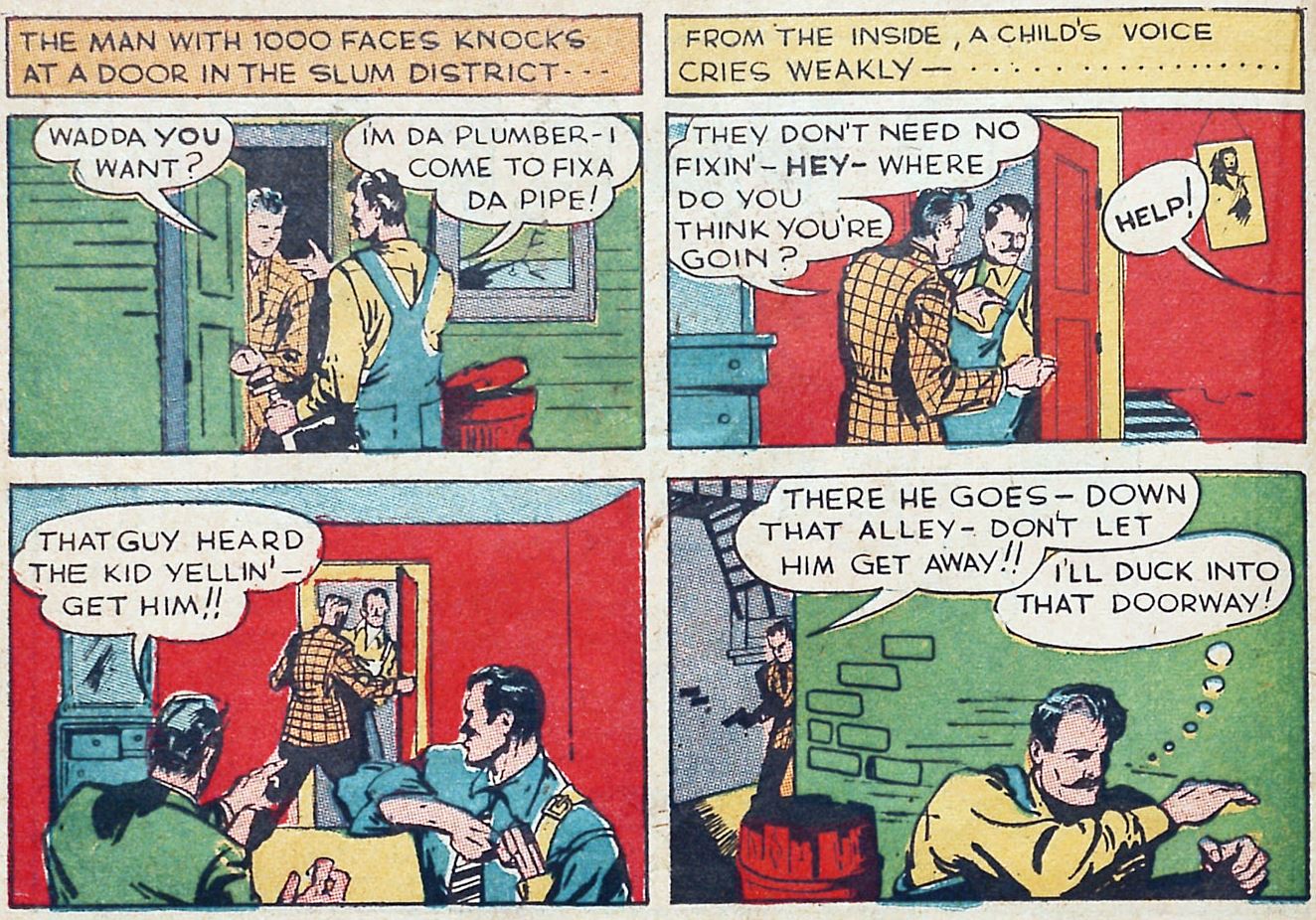
    the Man With 1000 Faces:

    Ted Parrish, famous film star, is bored with his humdrum life and so turns his considerable talent for quickchange artistry and disguise to the task of crimefighting. Just where he gets all of his accessories from is not elaborated on, so it’s equally likely that he scavenges them from the environment as it is that he just hauls around an enormous hockey bag full of clothing etc everywhere he goes.

    Parrish’s mission is obviously hampered somewhat by the fact that Los Angeles’ criminal fraternity knows that the Man With 1000 Faces exists and they should be on the lookout for him. How did they find out? Did Parrish blab to up the challenge and excitement of it all? (Speed Comics 001, 1939)

    the Wizard:

    Blane Whitney, AKA the Wizard, is the latest in seven generations of Whitneys (some of whom were also called the Wizard) to dedicate their lives in patriotic service to the USA. Plus he was a child prodigy who was charged to use his abilities to better mankind by Woodrow Wilson. Plus he’s an inventive genius in virtually all fields, particularly various forms of engineering. Plus he has nearly superhuman physical abilities and a mind so highly developed that it is superhuman in that he can employ remote viewing to locate dangers and clues.

    The Wizard was a pretty big player at MLJ in the 40s but has largely been abandoned in the various attempts to revive the MLJ characters at Archie and elsewhere – his biggest post-Golden Age appearance that I am aware of was as a super-villain fighting the Mighty Crusaders in the 60s. What does this say about the character – that he’s perfectly serviceable but not very conceptually exciting? Yes, I reckon that sums him up. (Top-Notch Comics 001, 1939)

    UPDATE 1940a

    UPDATE 1940b 

  • MINOR SUPER-HERO ROUND-UP 014

    MINOR SUPER-HERO ROUND-UP 014

    Some real niche characters this time.

    the Lone Star Rider:

    An Old West hero so generic he only appeared once and never even got to track down the owlhoots who killed his parents in order to steal their land. Good gloves. (Smash Comics 002, 1939)

    Shock Gibson:

    Like Barry Allen after him, Charles (later Robert) Gibson is a young scientist working late into a stormy night when he is simultaneously struck by lightning and bathed in chemicals. Though he is called the Human Dynamo, for the first chunk of his career he functions as more of a Human Battery who stores an electrical charge that can be used to fuel various superhuman feats – super-strength, super-jumping (later full-on flight), and a shocking grasp.

    Shock Gibson goes through more than a few costume changes over the years – sadly this goofy helmet is axed during the first one – but one consistent element in his design is lotsa cool electricity crackle when he uses his powers. (Speed Comics 001, 1939)

    Shock Gibson UPDATE 1940: He loses the hat.

    the Man With 1000 Faces:

    Ted Parrish, famous film star, is bored with his humdrum life and so turns his considerable talent for quickchange artistry and disguise to the task of crimefighting. Just where he gets all of his accessories from is not elaborated on, so it’s equally likely that he scavenges them from the environment as it is that he just hauls around an enormous hockey bag full of clothing etc everywhere he goes.

    Parrish’s mission is obviously hampered somewhat by the fact that Los Angeles’ criminal fraternity knows that the Man With 1000 Faces exists and they should be on the lookout for him. How did they find out? Did Parrish blab to up the challenge and excitement of it all? (Speed Comics 001, 1939)

    the Wizard:

    Blane Whitney, AKA the Wizard, is the latest in seven generations of Whitneys (some of whom were also called the Wizard) to dedicate their lives in patriotic service to the USA. Plus he was a child prodigy who was charged to use his abilities to better mankind by Woodrow Wilson. Plus he’s an inventive genius in virtually all fields, particularly various forms of engineering. Plus he has nearly superhuman physical abilities and a mind so highly developed that it is superhuman in that he can employ remote viewing to locate dangers and clues.

    The Wizard was a pretty big player at MLJ in the 40s but has largely been abandoned in the various attempts to revive the MLJ characters at Archie and elsewhere – his biggest post-Golden Age appearance that I am aware of was as a super-villain fighting the Mighty Crusaders in the 60s. What does this say about the character – that he’s perfectly serviceable but not very conceptually exciting? Yes, I reckon that sums him up. (Top-Notch Comics 001, 1939)

    UPDATE 1940a

    UPDATE 1940b 

  • MINOR SUPER-VILLAIN 513: DOKTOR KARNO AND SIMBA

    (Blue Bolt v2 001, 1941)

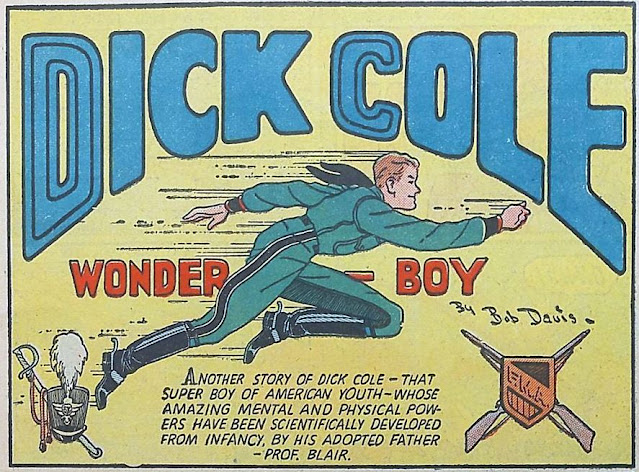
    Twelve issues into the story of Dick Cole, Wonder-Boy, a wrinkle is introduced: another Wonder-Boy! And rather than the usual thing where an evil lab assistant etc. steals Professor Blair’s research for his own use, this story introduces the concept of the double-thought wave. This is a theory that all the times in history that two people have had the same idea at the same time are not as a result of coincidence but rather some sort of psychic connection and thus when Professor Blair had his idea to raise a perfect boy the villainous Doktor Karno in Vienna had it too, and while Blair raises Dick to be a paragon of virtue, Karno is raising his Wonder-Boy Simba to be the perfect criminal.

    This would be a parable of nurture over nature if Simba wasn’t also specified to be the orphan child of two convicted murderers by the very chatty nun that Karno gets him from. As it stands we have two Wonder-Boys, ignorant of one another, one min/maxed for physical prowess and one with a more morality-heavy build.

    Eventually, Karno and Simba hit the Big Apple and are immediately made aware of Dick’s exploits. Simba has an immediate hatred for Dick so they hit upon the idea of doing some robberies while dressed as him – frame your rival/ make a few bucks at the same time!

    The first hint of a rift in the Doktor Karno/ Simba team come when Simba is so taken with Dick Cole’s military school uniform that he insists on joining the school himself.

    Meanwhile, Dick is subjected to torture by the local idiot cops until they bother to check his alibi and learn that it is watertight. His initial effort having failed, Simba settles in at Farr Military Academy in what amounts to a bully role with occasional forays into crime with Doktor Karno. In both capacities he regularly gets beaten up by Dick Cole.

    Eventually, one of those beatings must have knocked something loose, because Simba realizes that what he really wants is not to destroy Dick Cole but befriend him. 

    To that end, Simba tries to reform but Karno blackmails him into one last job, with the clear implication that this will continue ad nauseam. Simba confesses to Dick who helps him go straight – he’s put on probation in the school’s care and Karno is arrested. A happy ending for all!

    BUT HOLD ON KARNO GETS OUT and uses brain surgery to return Simba to his former amoral state!

    Simba is almost doomed to be Karno’s criminal tool forever but lucky for him Dick gets word, stops him from stealing a mess of radium and forces Karno reverse the operation. Karno is sent packing and the next time he’s heard from it’s because he’s died. Finally a happy ending for everyone! Except Doktor Karno!

    Going forward in the Dick Cole strip, Simba is just part of the gang – I just checked and he’s in Blue Bolt v10 002, the final issue of the series. Just a second super-powered boy palling around with the first one, though given Novelty Press’ commitment to removing all elements of unreality from their comics Simba is eventually just a regular guy with a very weird backstory. Still, it’s all very wholesome, although my Been On the Internet Too Much sense tells me that if it were a thing today I’ll bet the shippers would have their filthy mitts all over its unintentional homoeroticism.

  • MINOR SUPER-VILLAIN 513: DOKTOR KARNO AND SIMBA

    (Blue Bolt v2 001, 1941)

    Twelve issues into the story of Dick Cole, Wonder-Boy, a wrinkle is introduced: another Wonder-Boy! And rather than the usual thing where an evil lab assistant etc. steals Professor Blair’s research for his own use, this story introduces the concept of the double-thought wave. This is a theory that all the times in history that two people have had the same idea at the same time are not as a result of coincidence but rather some sort of psychic connection and thus when Professor Blair had his idea to raise a perfect boy the villainous Doktor Karno in Vienna had it too, and while Blair raises Dick to be a paragon of virtue, Karno is raising his Wonder-Boy Simba to be the perfect criminal.

    This would be a parable of nurture over nature if Simba wasn’t also specified to be the orphan child of two convicted murderers by the very chatty nun that Karno gets him from. As it stands we have two Wonder-Boys, ignorant of one another, one min/maxed for physical prowess and one with a more morality-heavy build.

    Eventually, Karno and Simba hit the Big Apple and are immediately made aware of Dick’s exploits. Simba has an immediate hatred for Dick so they hit upon the idea of doing some robberies while dressed as him – frame your rival/ make a few bucks at the same time!

    The first hint of a rift in the Doktor Karno/ Simba team come when Simba is so taken with Dick Cole’s military school uniform that he insists on joining the school himself.

    Meanwhile, Dick is subjected to torture by the local idiot cops until they bother to check his alibi and learn that it is watertight. His initial effort having failed, Simba settles in at Farr Military Academy in what amounts to a bully role with occasional forays into crime with Doktor Karno. In both capacities he regularly gets beaten up by Dick Cole.

    Eventually, one of those beatings must have knocked something loose, because Simba realizes that what he really wants is not to destroy Dick Cole but befriend him. 

    To that end, Simba tries to reform but Karno blackmails him into one last job, with the clear implication that this will continue ad nauseam. Simba confesses to Dick who helps him go straight – he’s put on probation in the school’s care and Karno is arrested. A happy ending for all!

    BUT HOLD ON KARNO GETS OUT and uses brain surgery to return Simba to his former amoral state!

    Simba is almost doomed to be Karno’s criminal tool forever but lucky for him Dick gets word, stops him from stealing a mess of radium and forces Karno reverse the operation. Karno is sent packing and the next time he’s heard from it’s because he’s died. Finally a happy ending for everyone! Except Doktor Karno!

    Going forward in the Dick Cole strip, Simba is just part of the gang – I just checked and he’s in Blue Bolt v10 002, the final issue of the series. Just a second super-powered boy palling around with the first one, though given Novelty Press’ commitment to removing all elements of unreality from their comics Simba is eventually just a regular guy with a very weird backstory. Still, it’s all very wholesome, although my Been On the Internet Too Much sense tells me that if it were a thing today I’ll bet the shippers would have their filthy mitts all over its unintentional homoeroticism.

  • MINOR SUPER-HERO ROUND-UP 007

    All Novelty Press edition!

    Dick Cole, Wonder-Boy: 

    Dick Cole was left on the front steps of scientist Professor Blair as a baby, and according to him there was an accompanying note requesting that he use his hitherto-untested experimental child-rearing techniques to bring the kid up to be superhuman. And it works! Dick Cole is stronger and faster and smarter than everyone else, and works to help those around him in whatever way he can.

    Sadly for me the Dick Cole series is set at a military academy, a surprisingly popular location in early comics. I think that the weird pseudo-military class structure that such places had/have was popular for the easy drama inherent in the noble protagonists being forced to kowtow to undeserving upperclassmen but reading comics about teenagers being assholes to each other for imaginary reasons palls quickly. (ADDENDUM: I wrote this at the beginning of my Dick Cole reading and am pleased to say that the military academy stuff isn’t as bad as it is in other comics of the time) (Blue Bolt v1 001, 1940)

    BONUS: here’s Dick Cole as a very cool baby.

    Sub-Zero:

    AKA Sub-Zero Man. Part of a Venusian expedition to Earth whose extremely awesome looking spaceship crashed through a frozen gas ball en route, killing everyone but Our Hero, who instead becomes uncontrollably and destructively super-cold.

    After a couple of issues of misunderstood wandering and being hunted, Sub-Zero endears himself to the city of Centro… Oregon? by saving it from a volcano. (highway signs place Centro somewhere between Los Angeles and Topeka, so it’s probably either Oregon or Northern California, and Oregon is closer to volcano country). There, he settles down to a regular super-hero life, albeit one with no secret identity, Centro slowly becomes NYC like so many other comic book cities and people basically forget the fact that he’s an alien. (Blue Bolt v1 001, 1940)

    the Phantom Sub: 

    A bunch of young men led by Jack Damon and Slim Dugan construct an advanced submarine in secret, as you do, and end up as wanted fugitives dispensing justice on the high seas via an electrified water cannon and some plucky attitudes. (Blue Bolt v1 001, 1940)

    Near the end of 1941 the Phantom Sub added the power of flight to its many features, and shortly after that the Phantom Sub crew were able to come in from the cold and begin aiding the US war effort. (Blue Bolt v2 006, 1941)

    the White Rider and Super Horse:

    During a stagecoach holdup, a youngster named Peter (no last name given) is orphaned and flung into a river that eventually flows into the mysterious Lost Valley, where he befriends and is raised by an old hermit named Jeb and a cool horse named Cloud. Eventually, the hermit dies of puma and Peter and Cloud make their way to the outside world where it turns out that due to the valley’s depth it somehow had more gravity and thus the two are super strong. Anyhow, Peter immediately hunts down and kills the bandit who orphaned him and resolves to stamp out crime as the White Rider and Super Horse. 

    Despite the superpowers the White Rider is a bit of a dud, hero-wise and Super Horse does most of the heavy lifting, both literally and metaphorically. (Blue Bolt v1 001)