The Curse of Skeleton Munroe

Category: group

  • MINOR SUPER-VILLAIN 229: THE FAULTLESS FOUR

    (Flash Comics v1 001, 1940)

    I have a lot of fondness for the Faultless Four, the first super-foes of original Flash Jay Garrick. Firstly and most simply, they are a perfect illustration of the power creep that super-heroes introduced to comic books: where this group of criminal scientists armed with mildly-fantastic skills and tactics would have been sufficient to occupy your traditional adventure hero for months if not years, the Flash walks all over them without a care in the world. Crime must adapt to this new reality!

    The second reason for my fondness requires a breakdown of the membership, so here we go, from left to right above:

    Sieur Satan: The biggest talker of the group and absolutely the one with the best look. I don’t think I’m alone in thinking of him as the leader of the Faultless Four even though the only real indication of this is his big mouth. The only thing he actually accomplishes, in fact, is to kill the other three as part of an attempt to get the Flash.

    Serge Orloff: Does absolutely nothing aside from looking cool. He might be suggesting that he is a great enough surgeon that he can bring the dead back to life in the above panel but I wouldn’t believe that he could do it unless I saw the frankenstein in question myself.

    Duriel: I always remember Duriel as “the handsome one” but he’s actually a very weird looking dude! In charge of torturing the Flash’s future father in-law Major Williams for information, he also is the group’s resident pilot.
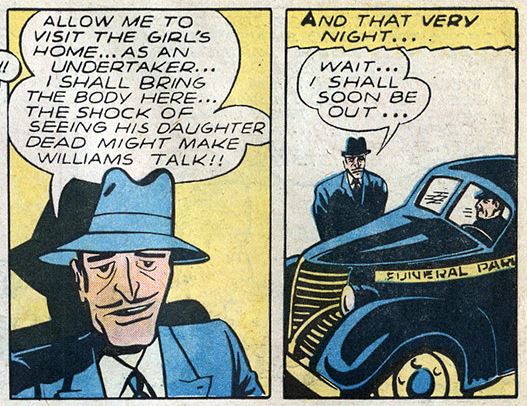
    Smythe: Absent from the first panel for a very good reason – Smythe is the guy who seems to do all of the footwork for the group. He’s the one who does a drive-by assassination attempt on Joan Williams and then later the one who goes to steal the (nonexistent) corpse in order to taunt Major Williams with it. He even has a minion of his very own! A little hearse driver guy!

    There’s a correlation here: how visually interesting a member of the Faultless Four is is inversely proportional to how useful they are. Thus, the one member of the gang to make a second appearance (in a Roy Thomas-penned All-Srar Squadron annual, natch) is Sieur Satan, the biggest fuckup and coolest-looking of the bunch. And as an indignity for poor Smythe alone, his entire role is taken by Duriel in the Secret Origins retelling of the story, leaving him to just stand around like some sort of Serge Orloff until he gets electrocuted.

    In conclusion, Sieur is a semi-archaic French honorific that is a root of the more familiar monsieur.

  • MINOR SUPER-VILLAIN 225: SPEED INC

    (Feature Comics 040, 1941)

    It’s a common enough story in comics: a patriotic scientist (Dr Devlin) develops a bit of cool super-science (a speed serum) and his treacherous (and possibly dangerously Foreign, if his occasional Yoda-isms are any indication) assistant (Karl) appropriates it for criminal purposes. Karl’s real innovation here is that he’s prepared to scale up his operation beyond what a treacherous lab assistant usually does – per the panel caption above he has at least 30 super-fast men in his employ.

    But even 30 guys with dangerously accelerated metabolisms (at one point it’s asserted that they have only 2 years to live! Hopefully there’s a counter serum) are no match for the jodhpur-clad giant Ace of Space. Still, I can only admire Karl’s effort to achieve something greater than the usual penny-ante antics of the crooked lab assistant. Good job, Karl!

  • MINOR SUPER-VILLAIN 217: THE STONE IDOL

    (Detective Comics v1 056, 1941)

    The Stone Idol is a bit of a weird one: a miner living in the ghost town of Ghost Gulch City discovers silver on town land and recruits an unscrupulous group of circus performers to aid him in driving out the town’s remaining inhabitants so as to have all the silver for themselves. The actual Stone Idol is the circus strongman disguised as a local Native American statue in order to play on the local superstitions but really it’s a group effort.

    Sadly for Mad Mack the prospector and his circus of crime, the Stone Idol’s push to take over the town coincides with Bruce Wayne and Dick Grayson’s stay in a local hotel and the entire group of them die in a mine collapse while fighting Batman and Robin. Perils of living in a comic book world, I guess.

  • MINOR SUPER-VILLAIN 215: THE THREE DEVILS

    (Detective Comics v1 050, 1941) 

    The Three Devils are an early example of a fairly common minor super-villain archetype: the acrobat who turns their skill to criminal ends (and of course this is a subset of “circus folk who use their talents for crime” which itself is a subset of “talented professional turns their talent to crime” and then I guess above that is “criminals”). 

    I don’t think I’m going to bother calling it out every time it happens but they also appear in an early example of what will eventually be a staple of Batman story structure through the 60s, told in three acts:

    Act I: the villain’s novel methods allow them to triumph over Batman and Robin and get away with their goal – a lot of stories following this structure take place after the Comics Code, so usually this is a theft of some kind.

    Act II: Batman and Robin foil the villain’s scheme but they still get away.

    Act III: the villain is captured while attempting to achieve their goal.

    In this case, the Three Devils are flung to their deaths from a clock tower rather than being captured but like I said, it’s an early iteration of the format. It’s also a format that I noticed while reading Silver Age Batman stories, so it’ll be interesting to take note of how it develops and how much it is reflected in other super-hero comics of the time.

    The other interesting thing about the Three Devils is that despite falling to their deaths in 1941 they return in Batman Comics v1 107 in 1957 as the Daredevils:

    Now, I learned about this Three Devils/Daredevils connection on a fan wiki and so approached it with some skepticism but damned if they weren’t right about this one:

    They even use the same fence!

    Now 1957 is a tricky year – Barry Allen had just debuted as the Flash; Martian Manhunter is running around… this could just be an Earth-One retelling of the Three Devils story, scrubbed of some supernatural cruft. Or these could be the same characters, not actually dead after all – this is the kind of thing that inspired nerds to come up with stuff like Earth-Two-A and Earth-B and so forth.

  • MINOR SUPER-VILLAIN 215: THE THREE DEVILS

    (Detective Comics v1 050, 1941) 

    The Three Devils are an early example of a fairly common minor super-villain archetype: the acrobat who turns their skill to criminal ends (and of course this is a subset of “circus folk who use their talents for crime” which itself is a subset of “talented professional turns their talent to crime” and then I guess above that is “criminals”). 

    I don’t think I’m going to bother calling it out every time it happens but they also appear in an early example of what will eventually be a staple of Batman story structure through the 60s, told in three acts:

    Act I: the villain’s novel methods allow them to triumph over Batman and Robin and get away with their goal – a lot of stories following this structure take place after the Comics Code, so usually this is a theft of some kind.

    Act II: Batman and Robin foil the villain’s scheme but they still get away.

    Act III: the villain is captured while attempting to achieve their goal.

    In this case, the Three Devils are flung to their deaths from a clock tower rather than being captured but like I said, it’s an early iteration of the format. It’s also a format that I noticed while reading Silver Age Batman stories, so it’ll be interesting to take note of how it develops and how much it is reflected in other super-hero comics of the time.

    The other interesting thing about the Three Devils is that despite falling to their deaths in 1941 they return in Batman Comics v1 107 in 1957 as the Daredevils:

    Now, I learned about this Three Devils/Daredevils connection on a fan wiki and so approached it with some skepticism but damned if they weren’t right about this one:

    They even use the same fence!

    Now 1957 is a tricky year – Barry Allen had just debuted as the Flash; Martian Manhunter is running around… this could just be an Earth-One retelling of the Three Devils story, scrubbed of some supernatural cruft. Or these could be the same characters, not actually dead after all – this is the kind of thing that inspired nerds to come up with stuff like Earth-Two-A and Earth-B and so forth.

  • MINOR SUPER-VILLAIN 211: THE MAD MADESPOS

    (Crackajack Funnies 038-040, 1941)

    It’s my favourite Golden Age Batman knockoff the Owl again and this time he’s up against the Madespos, a whole family of homicidal maniacs with their very own gorilla pal!

    The Madespos had already been collared by the Owl (in an unseen adventure of his civilian guise of Nick Terry, PI) some time earlier, so our tale begins with their escape from Lenmoor Asylum for the Criminally Insane with the help of their well-dressed gorilla friend. 

    In addition to the gorilla the family consists of Ma Madespo and her four unnamed, nearly identical sons (one wears glasses and two are taller than the rest. This is not relevant). They’re armed to the teeth and have holed up in a fortified mansion supplied by…

    The Masked Ambassador! A surprise second Minor Super-Villain 212 (if just barely) and smarter-than-average fifth columnist from Axis-coded Yugonia who has weaponized the Madespos rather than risk his own hide in sabotaging the American military. If he wasn’t caught by the Owl literally one panel after putting on his mask he might just be the most effective villain on this list.

    Sadly for the Madespos, the Owl soon takes advantage of a police siege of their mansion to befriend the ill-treated gorilla and bring the whole lot of them in.

  • MINOR SUPER-VILLAIN 188: THE SKULL GANG

    (Crack Comics 006, 1940)

    What makes them a super-villain (group)? They’re a gang of thieves who are so devoted to this generic hooded guy that they all take small doses of arsenic to give themselves an emaciated skeletal appearance! The penalty for not thieving enough is death! What a dumb thing to dedicate your life to! Absolutely they qualify as a team of very stupid super-villains.

    SKULL SCORE: 1/5 Bald guys with gritted teeth just don’t cut the mustard, I’m afraid.

  • MINOR SUPER-VILLAIN 160: THE FOUR CARDS

    (Batman Comics 005, 1941)

    A while ago I decided that groups were going to go into my lists (and charts and graphs) of super-villains. After all, if I was willing to accord one fellow who went around as the Masked Bandit, why should I spurn four guys who do exactly the same, only pluralized? Accordingly, masked gangs get as much credit as masked crooks, if they fulfil enough other criteria. The Four Cards, however, introduce a new wrinkle.

    Simply put: if any other four people with card-based nicknames had formed a card-themed gang I’d count them as minor super-villains, but one of them is the Joker. So the group is minor and three quarters of its members are – is that enough? Evidently!

    Aside from my categorization panic, the Four Cards are a bit basic: they operate a semi-legal gambling ship in international waters off Gotham and a disguised Joker, seductive Black Queen and socially adroit Jack of Diamonds line up wealthy targets for the King of Clubs to beat up and rob.

    Inevitably, Batman and Robin step in. The Black Queen falls in love with Batman and she and the Jack of Diamonds bump one another off over him. Meanwhile, the Joker has pulled his inevitable double cross and left (having set the ship on fire as he went), leaving poor Clubbsy as the only one left to be hauled away to jail.

  • MINOR SUPER-VILLAIN 136: THE LEGION OF THE MASKED

    (Adventure Comics 058, 1941)


    The Barry O’Neill serial in Adventure Comics had basically been about Barry battling the dastardly villain Fang Gow (Minor Super-Villain 001) from its inception in 1935 to his death by sea mine six years later and evidently someone thought that it could continue as more of a free form adventure strip despite losing that structure (as well as its setting, having started as a comic set in Paris that had quietly moved to London about the time that the German Army marched in). In fact, it lasted for two issues before Barry and his pal Inspector LeGrande retired to New York City and Starman took over the page real estate.

    The Legion of the Masked are the one other super-foe that Barry faced after the death of Fang Gow and… they did okay, getting up to a little arson, a little insurance fraud and a fair bit of theft and murder. Why they chose to dress like they are in the Klan while doing it, we will never know.

  • MINOR SUPER-VILLAIN 120: THE BLUE DEVILS

    (Nickel Comics 006, 1940)

    A costumed gang that managed to take over a small town under the direction of head devil Lucifer. Not the most distinguished costumed gang ever but you gotta give them credit for trying. And not only do they have devil horns on their hood but there’s a skull-and-crossbones on both the hood and the chest! Sartorially speaking, they’re years ahead!

    Anyway, most of them get drowned by Bulletman.