The Curse of Skeleton Munroe

Category: group

  • MINOR SUPER-HERO ROUND-UP 092

    MINOR SUPER-HERO ROUND-UP 092

    Who ever thunk that there could be quite so many minor super-heroes?

    Invisible Scarlet O’Neil:

    Young Scarlet O’Neil, being the kind of person who will touch an arc of mysterious energy in her scientist father’s lab, finds herself rendered invisible, a condition that she eventually learns is reversed by touching a certain nerve in her wrist.* She uses this power to fight mid-tier injustice eventually (I am assured) parleys it into a career as a newspaper reporter. Before that, she functions as a very low-level vigilante – she solves some crimes, yes, but also gets mixed up in a lot of people’s personal lives. She is also one of the few invisible characters to regularly suffer any consequences for going out in public without reflecting any light: she is regularly beaned by baseballs, pushed into traffic, etc.

    Sticklers might note that “Invisible Scarlet O’Neil” was a comic strip first and that what I am showing here are images from the comic book reprints of such, and I must confess that I do not have the wherewithal to source comic strip dates every time I want to refer to this character. All references to her will be from the Eastern Color comics. (Famous Funnies 081, 1941)

    *As presented, the timeline is extremely sad: 1) her father accidentally causes her to become invisible by not taking her poor lab safety practices into account 2) he works to find a cure but cannot 3) he dies, presumably in despair over his child’s life of invisible obscurity 4) she figures out the nerve thing

    Categorized in: Body (Invisible), Origin (Mysterious Ray Mutate), Power (Invisibility)

    Fearless Flint, the Famous Flint Man:

    Jack Bradley, a worker on the carving of Mount Rushmore (and let me tell you: every time I think that I’m done being surprised by the real-world events that super-hero origins are being roped into I am dead wrong) is flung down the face of the mountain when his pneumatic drill is sabotaged. Instead of being killed horribly as one might expect, Jack survives because the flint shards that litter the Rushmore debris field merge with his skin rather than shredding it. Now, upon touching any metal, he turns to red hot flint complete with little sparks flying off of him, and becomes super strong and invulnerable. A few things:

    – Flint’s elemental transformation is very on brand for the small stable of Eastern Color super-heroes, cv Hydroman, the upcoming Man o’Metal, etc.

    – Despite the fact that he requires the touch of metal to transform, Flint notably fails to consider carrying any around with him in any of the half dozen of his adventures I have flipped through. He always needs one of his enemies to bop him with a metal weapon or push him into a railing or drop a chandelier on his head, and in later adventures simply turns to flint when he gets angry.

    – Flint’s drill was sabotaged by agents of the Lava Man, his first enemy, whose appearances are serialized across half a dozen issues in 1942 and who we will be covering once that year rolls around. I will give you a spoiler, however: he has absolutely no reason to have sabotaged the construction of Mount Rushmore, so either this was a classic example of the Reel (agents of a super-villain go far afield for no reason other than to draw the hero to a second location and move the plot forward) or the Lava Man is very sympathetic to the plight of the Sioux people.

    – Finally, I looked very hard and while I can’t say this with 100% certainty I can do so at 95%: the Black Hills in general and Mount Rushmore in particular do not seem to be particularly rich in flint. But maybe that’s the secret to Flint’s transformation, that they were magic flint shards that shouldn’t ought to have been there.

    All in all a true oddball of a character as befits a member of the Eastern Color stable. (Famous Funnies 089, 1941)

    Categorized in: Element (Minerals (Flint)), Origin (Material Mutate), Power (Phyiscal Transformation, Super Strength)

    the Sixth Column:

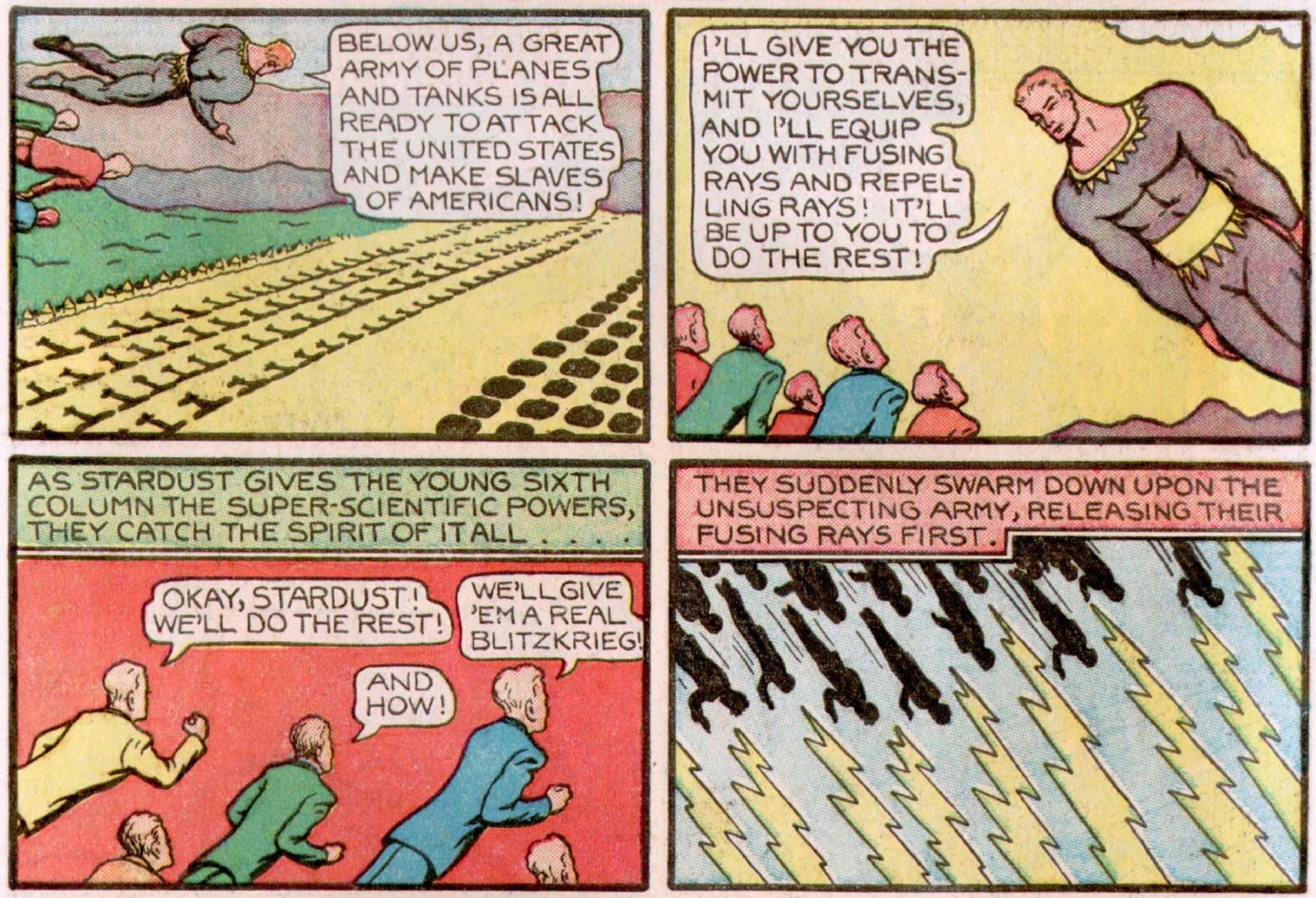
    Nineteen Forty-One: Stardust the Super Wizard, concerned about a mass mobilization of Axis fifth columnists into the Americas, vows to form a sixth column to counter their efforts. As his agents, he chooses the boys of the United States (more on this). Also please note that in between declaring that he would found the Sixth Column and actually getting around to doing so, Stardust roots out and murders every Fifth Columnist in America as part of his defense of Earth against the Martian Sky Demons.

    With no counter-espionage work to do, the Sixth Column is instead given a portion of Stardust’s power (flight, fusing rays to mess up the enemy’s war machines, repelling rays to levitate the enemy troops) and set loose as a super powered child army versus an Axis invasion force that is approaching from South America. (Fantastic Comics 014, 1941)

    The Sixth Column returns in Fantastic Comics 015, and this time they get official Stardust the Super Wizard outfits. In addition to the star-metal costumes (possibly invulnerable), the boys are equipped with mind-reading devices to root out fifth columnists and metal-repelling rays to protect the US from enemy missiles. Curiously, this time they are not given the power of flight.

    The thing that I find myself thinking while reading the two stories featuring the Sixth Column is “why is Stardust doing this?” It’s not for any lack of ability to keep on top of things, that’s for sure, as the boys do not do anything that Stardust hasn’t already done on a bigger scale, and in any case he is monitoring them the entire time as seen here when they lose control of a missile and destroy an ocean liner and he jumps in to take over immediately.

    Is it meant to be some sort of mentoring? Of ensuring that there will be a new stardust? Is he just bored? He’s probably just bored with crime fighting while being so grotesquely overpowered, isn’t he.

    Categorized in: Alphanumeric (Six), Origin (Sidekicks), Powers (Various) 

    Stardust the Super Wizard **UPDATE**:

    And speaking of Stardust the Super Wizard: we’ve seen him shapeshift before and we’ve seen him impossibly grab a man by the torso before but in this, his very last appearance, he combines the two by grabbing the villain “Slant-Eye” with a gross tentacle hand. It truly is an iconic image for the guy to go out on. (Fantastic Comics 016, 1941)

  • MINOR SUPER-VILLAIN 951: THE DEADLY DOZEN

    (Daredevil Comics 005, 1941)

    We open on a demonstration by one Dr Roe of his invention the Death Detector, which he purports is able to determine if someone is incapable of murder (yellow light displayed), potentially capable of murder (red light) or has in fact murdered someone (blue light). 

    While the implications and legalities of this device are legion (e.g., how does it determine this, does it distinguish between killing in self defense and manslaughter and premeditated murder, would widespread adoption of this technology create a semi-criminal class of Red Light People who are discriminated against despite having done nothing wrong, etc, etc), the really important thing about this demonstaration is that Bart “Daredevil” Hill taunts mobster “Nat” Nattony into going up on stage, whereupon he murders Dr Roe. Would the machine give Bart a blue light for being directly if inadvertently responsible for Roe’s death, I wonder.

    Daredevil makes off with the device in order to keep it safe, but the upside of whole sordid affair was that it provided a means of proving the machine’s efficacy, as before taking off he had used it to search the crowd for Nattony and instead turned up a different wanted murderer. Now the FBI wants the Death Detector and the Daredevil aims to get it to them.

    Nattony’s boss Curly is understandably concerned about this development and calls the nation’s gang bosses together in Atlantic City for a Crime Convention to discuss the matter. After a lot of goofy business with gangsters picking each others’ pockets and so forth, the assembled ranks of crimedom take a vote and determine that the best way to deal with the Daredevil is to pick out twelve of gangland’s most proficient killers and send them after him. Thus: the Deadly Dozen!

    The members of the Deadly Dozen are: the Crusher, Egg Head, Snake Eyes, Skully, Benito, the Butcher, the Giant Killer, the Owl, Satan, the Sniffer, the Turk and Lady Killer, and though I love the idea of this group on many levels (gather together a bunch of vicious assassins! With diverse and distinct idiosyncrasies and fun names! Yes please!) there is one notable flaw with the concept of the Deadly Dozen, and that is that every single one of its appearances takes place in an anthology comic in which there is simply not enough room to spotlight every member of a twelve-strong team. 

    This might be the only story in which each member of the Dozen gets even a token shoutout, rather than mooching around in the background while a couple of highlighted characters get on with the action. As such, we’ll take a quick look at them in the order that they appear in-story:

    the Sniffer:

    The Sniffer stands out from the moment that he appears in that initial group shot, and it’s no surprise that he is the breakout star of the bunch, with his own ongoing feature starting in Daredevil Comics 008. A rough, crude, hairy, flat-headed brute who wears rough clothes and rope belt while everyone else is in a suit or tuxedo, the Sniffer is a real rough-and-tumble rowdy boy. As his name suggests, he also has a superhuman sense of smell, capable of locating, for example, the Daredevil in a warehouse full of criminals.

    Lady Killer: 

    Lady Killer doesn’t even get a line before he is beaten up and hung from the telephone pole he was lurking behind for the Daredevil. Hopefully his name derives from the fact that he is a handsome man and not from the fact that he tends to kill ladies, like his recent fellow Lev Gleason character, but it is possible that we will never know.

    the Crusher and Egg Head: 

    The Crusher and Egg Head fall prey to the ol’ duck-out-of-the-way-when-they’re-about-to-shoot-you-from-two-sides-so-that-they-shoot-one-another trick, but don’t worry, they survive. I’m no gun expert but I’ll bet that they specifically tell you not to shoot at something that’s in front of someone you don’t want to shoot for exactly this reason.

    Both Egg Head and Crusher are mainstays of the Deadly Dozen, with speaking lines in just about every story I scanned through just now. With Egg Head this is likely because of his visually distinct bald dome, while Crusher has the distinction of becoming known as Sniffer’s best friend over time. He even appears in the very last Sniffer story in the far-distant future of 1956!

    Snake Eyes, the Owl and the Turk:

    Snake Eyes, the Owl and the Turk make a decent attempt at ambushing the Daredevil while pretending to be FBI agents, only to be beaten up in pretty short order. I haven’t read through every Deadly Dozen appearance, but I reckon that this poor showing is also their career highlight, which is a real shame in the cases of the very visually-interesting Owl and Snake Eyes.

    Skully and the Butcher: 

    Skully and the Butcher get tricked into shooting and knifing one another, respectively, with embarrassing ease by the Daredevil. Once again they are retroactively fine due to the demands of future stories, though this does call their competence as killers into question somewhat.

    Though the Butcher seems to be just another face-in-the-crowd member of the Dozen, Skully gets a fair number of speaking roles going forward.

    (Skull Score: 1 – just an emaciated face on ol’ Skully I’m afraid)

    the Sniffer (again), Satan, Giant Killer, Benito: 

    Here we have a very contrasting group, with Sniffer and Satan (de facto leader, visually interesting, always in a speaking role) alongside Benito (most boring member, couldn’t even muster up a nickname, I’d be surprised if he ever gets another line of dialogue) and Giant Killer (solid middle of the roader, not just bald but short, probably gets a line now and then). All four of them get tossed off the train, and that’s it for the Deadly Dozen.

    Like I said, I love the Deadly Dozen conceptually and I love the Sniffer specifically, and it’s nice to have those feeling about characters who will be returning, for once. I don’t think that the problem of one dozen being too damn many members to showcase in a single comic, but who knows? Maybe I’m wrong and some hidden Golden Age gem awaits me still.

    As for the Death Detector, not only does it get safely delivered to the FBI so that they can start planning out the dystopian society they’re going to form around it (Gattaca meets Minority Report, I reckon), but the Daredevil is able to lead them back to Atlantic City to round up the whole Crime Convention for use as test subjects. 

    (almost forgot to include this terrific pic of Daredevil vs the Sniffer from the cover)

    Categorized in: Alphanumeric (Twelve), Language (Superlatives – Deadly), Team Index

  • MINOR SUPER-VILLAIN 933: THE RIPPER

    (Silver Streak Comics 011, 1941)

    For the third issue in a row, a souped up super-plane takes to the skies of probably-California to menace law-abiding aviators. The Ripper, like the Heater before it, is a vehicle with a singular name being run by a group, which is a mildly interesting taxonomic trend that unfortunately does not continue to occur.

    Where the Wingers and the Heater were armed with sci-fi ray cannons, the Ripper relies on a comparatively low-tech blade that is used to slice up aircraft and parachutes alike. Ironically, this is a far less believable means of attacking a plane on the wing than a thermodynamic ray of some sort. Just what kind of flying does the Ripper’s pilot have to be doing to slice off a wing with a comparatively short, fixed blade, anyway? Just how sharp can that thing be considering that it looks perfectly cylindrical? There are some wavy lines around the blade in precisely one panel – perhaps it’s meant to be a vibro-blade of some kind.

    Like the Heater before them, the crew of the Ripper are prepared for Cloud Curtis and his crew to interfere in their plans. In addition to the standard-issue bulletproofing, their plane is equipped with a magnetic generator to lock the Golden Bullet’s grapplers in place on their hull and knockout gas dispensers on the plane’s exterior act as a counter to Curtis’ favoured tactic of clambering onto an enemy aircraft’s exterior. Cloud and his assistants are taken into custody but not, crucially, immediately murdered.

    In contrast to the Heater, the Ripper has an actual defined goal: shut down US aviation in order to weaken the country for vague foreign agent reasons. And it’s astonishingly effective!

    Having not been murdered, Cloud and pals soon escape and take to the skies, where the Ripper crew learn the same posthumous lesson as the Heater gang before them: if you render yourself impossible to capture then you are much more likely to be killed outright. One shattered propeller later, the skies are safe for trainee pilots once more.

    Categorized in: Accessories (Aircraft), Activities (Ripping), Espionage (Saboteurs)

  • MINOR SUPER-VILLAIN 931: THE HEATER

    (Silver Streak Comics 010, 1941)

    Having so recently weathered the cold-based threat of the Wingers, the US aviation community is now faced with another elemental enemy in the form of the Heater, a mysterious plane that is attacking aircraft with a heat ray. Cloud Curtis, self-appointed defender of the airways, is of course keenly interested in this development.

    Unlike the Wingers, the Heater’s motivations are never explored. They could be spies, territorial smugglers, extortionists like their predecessors, any number of things. And yes: despite being a group of at least four men they are called the Heater singular, probably because it is the plane that is being referred to rather than the gang inside of it.

    Cloud Curtis’ first attempt to stop the Heater is stymied when they melt the grappling arms right off of his Golden Bullet. This marks the second out of two times that his signature move (grab ahold of a plane and then personally board it and punch everyone out) has been stymied by these uncouth plane gangs.

    Thankfully for Curtis and the other denizens of the skies, while he was trading bullets for heat ray blasts his ally Pop Whistler was back at their home base inventing a new type of plastic that not is only heatproof but reflects heat back at its source. Once the Golden Bullet is coated in this material it is a simple matter of engaging the Heater in another dogfight and they are soon treated to a dose of their own incendiary medicine.

    Categorized in: Accessories (Aircraft & Rays), Elements (Fire), Murder

  • MINOR SUPER-VILLAIN 926: THE WINGERS

    (Silver Streak Comics 009, 1941)

    One day while noodling around in his super plane, Cloud Curtis comes across a crashed plane in Death Valley, with near-dead pilot speaking of snow on the wings. What could this mean?

    Cloud and his entourage check in with Mr Richmond, owner of the plane, and find that it is the latest in a series of crashes and disappearances. This is all highly suspicious, and what’s even more suspicious is the brick with a note wrapped around it that comes smashing through the window as they discuss it, containing an extortion demand from a group calling themselves the Wingers (and signed with a cool little winged skull).

    Cloud determines that the surest way to ferret out the Wingers is with a decoy plane that he even goes to the trouble to stuff full of passenger-dummies for some reason. Sure enough, the gang show up in a high-powered plane equipped with what amounts to a snow cannon, which they use to ice up the decoy’s wings. Not only does this explain the “snow in Death Valley” thing, but also the reason why they call themselves the Wingers – because they attack wings!

    The Wingers are admirably well-prepared to deal with Cloud Curtis: their plane is not only bulletproof but treated with some sort of low friction coating that prevents the Golden Bullet’s robot grappling arms from working on it. This comes back to bite them, as Curtis, out of other ideas, just ends up blowing them up with a hand grenade rather than continuing to try to capture them.

    Categorized in: Body (Nonhuman Parts), Extortion (Corporate), Location (Death Valley)

  • GENERIC COSTUMED VILLAIN ROUND-UP 037

    For the first time in a very long time: the generic costumed villains all have costumes! 

    Unnamed Costumed Gang: 

    This unnamed gang has gone to a heckuva lot of trouble to steal the Kalaka Emerald from millionaire Byron Nelson: they’ve dug out a secret lair under his weird mesa-top home, murdered several of his guests in order to create terror and of course dressed up like the background characters in a costume party scene, presumably also in order to create terror.

    Sadly for them, they have failed to reckon with two important facts: 1) that Nelson has already stolen his own gem in order to do a little insurance fraud and 2) that he has hired adventurer Lance Rand to protect the emerald and throw a bit of suspicion off of himself. Rand cleans up the costumed crew with ease, and bags Nelson to boot. (Cat-Man Comics 003, 1941)

    Puggsy Sloane: 

    When famed gorilla Monstro escapes from the Jenks Bros. Circus, the unnamed city is gripped with terror. And the terror is seemingly justified, as citizen after citizen is murdered by an ape and the police are unable to prevent it despite expending all of their manpower in order to do so. Lance Rand is once again on the case, however, and thanks to a tip-off that Monstro is in fact harmless from the circus owner is able to piece together the fact that it is not the gorilla doing the murders but gorilla-suited gang boss Puggsy Sloane. Why is he doing so? Why, to stretch the police force to the limit and distract them from all of the robbing that his gang was getting up to, of course. (Cat-Man Comics 004, 1941)

    Categorized in: Accessories (Style (Gorilla Costume)) 

    Dr Carl Resdale: 

    Dr Resdale, a famous plastic surgeon, has been operating a face-changing service for criminals out of the old disused family manor for the last twenty years and NOW the rest of the family is looking to use the manor and he has to scare them off by sneaking around in a mask and getting up to spookiness. And not only does he have to keep his young relatives from living in his place of work but he must conceal the fact that he killed his own brother in the manor twenty years before (this is why it’s disused). 

    Fear not for the younger Resdales, because Dr Miracle is on the case, the villain is soon deprived of his low-effort mask.  (Champion Comics 012, 1941)

    Brady: 

    A masked killer working for a gambling syndicate active in the Florida horse tracks, Brady’s signature weapon is a club with a horse shoe nailed to it to simulate a deadly horse kick to his victims’ heads. While a neat little murder weapon, this isn’t quite enough to help him when he comes up against Johnny Fox. (Champ Comics 015, 1941)

    Categorized in: Accessories (Weapons (Clubs)) 

  • FASCIST GOON CLEARING HOUSE 012

    I know we’re all tired of fascist, but these are fake, historical fascists who get beat up, so it’s cathartic at least. 

    the Blitzys:


    The Blitzys, aka the Yellowshirts, have a never-clearly-articulated plan to divide American society by beating people up for not joining the Army. I assume that there must be more to it than that but the focus of the adventure is not on Spy Smasher beating up these particular fascists (though beat them he does) but in avoiding them long enough to get to Washington and warn the President about this fifth column activity. (Whiz Comics 020, 1941)

    The Blitzys, armed with a completely silent bomber plane, continue to vex Spy Smasher and America on behalf of their boss the War Lord through to Whiz Comics 022, when their leader Kurt Bund is finally run to ground in his base underneath a local cemetery and properly walloped.

    Categorized in: Crime as Theme (Naziism), Objects (Shirts)

    the Ring:

    A gang of airplane saboteurs with so little assigned motivation that they might as well be in it for the love of the game, the Ring is undone by FBI agent Dick Star and his aide, the unusually-named Pinky Dink. (Bang-Up Comics 001, 1941)

    Categorized in: Generica (Rings), Ideologies (Crypto-Fascists)

    Unnamed Giant Robot Unit: 

    Eventually the comic timeline that I’m working on is going to get to the point that the US is World War II, and the flow of vague Nazi-adjacent antagonist groups is going to dry up and be replaced mainly with overt Nazi and Japanese super-villains. Does this mean the end of the Fascict Goon Round-Up? surely not, because there needs to be a place to document the weird over-the-top schemes that the comic book version of the Axis powers get up to.

    Take this one: two enormous robots rise out of the depth of New York Harbor and destroy a patrol boat before stomping into the city proper. 

    Then, after making their way downtown, they disgorge a bunch of Nazi soldiers to… do something. Honestly it’s unclear what these guys are up to and more to the point just what havoc they could raise that a giant Robot couldn’t. In any case they don’t have long on the ground before they are beaten up by the Flag-Man and Rusty. 

    All this action in the city is especially baffling as the actual plan is to blow up a chunk of the US fleet with a minefield. Maaaybe the idea is to draw them in with the giant robot attack? In any case, the Flag-Man steers one of the robots into the minefield and takes care of the entire problem with one huge explosion. (Captain Aero Comics 001, 1941)

    Categorized in: Accessories (Mecha)

    the Swastika Council:

    It’s not entirely clear just what kind of fascist group the Swastika Council is, thanks to the fact that their sole appearance concerns the fact that David Merrywether, aka the Cat-Man, is about to expose their membership to the papers and their efforts to prevent him from doing that. My money’s on them being some sort of fifth columnists. (Cat-Man Comics 004, 1941)

    Categorized in: Crime as Theme (Naziism), Generica (Councils)

  • FASCIST GOON CLEARING HOUSE 012

    I know we’re all tired of fascist, but these are fake, historical fascists who get beat up, so it’s cathartic at least. 

    the Blitzys:


    The Blitzys, aka the Yellowshirts, have a never-clearly-articulated plan to divide American society by beating people up for not joining the Army. I assume that there must be more to it than that but the focus of the adventure is not on Spy Smasher beating up these particular fascists (though beat them he does) but in avoiding them long enough to get to Washington and warn the President about this fifth column activity. (Whiz Comics 020, 1941)

    The Blitzys, armed with a completely silent bomber plane, continue to vex Spy Smasher and America on behalf of their boss the War Lord through to Whiz Comics 022, when their leader Kurt Bund is finally run to ground in his base underneath a local cemetery and properly walloped.

    Categorized in: Crime as Theme (Naziism), Objects (Shirts)

    the Ring:

    A gang of airplane saboteurs with so little assigned motivation that they might as well be in it for the love of the game, the Ring is undone by FBI agent Dick Star and his aide, the unusually-named Pinky Dink. (Bang-Up Comics 001, 1941)

    Categorized in: Generica (Rings), Ideologies (Crypto-Fascists)

    Unnamed Giant Robot Unit: 

    Eventually the comic timeline that I’m working on is going to get to the point that the US is World War II, and the flow of vague Nazi-adjacent antagonist groups is going to dry up and be replaced mainly with overt Nazi and Japanese super-villains. Does this mean the end of the Fascict Goon Round-Up? surely not, because there needs to be a place to document the weird over-the-top schemes that the comic book version of the Axis powers get up to.

    Take this one: two enormous robots rise out of the depth of New York Harbor and destroy a patrol boat before stomping into the city proper. 

    Then, after making their way downtown, they disgorge a bunch of Nazi soldiers to… do something. Honestly it’s unclear what these guys are up to and more to the point just what havoc they could raise that a giant Robot couldn’t. In any case they don’t have long on the ground before they are beaten up by the Flag-Man and Rusty. 

    All this action in the city is especially baffling as the actual plan is to blow up a chunk of the US fleet with a minefield. Maaaybe the idea is to draw them in with the giant robot attack? In any case, the Flag-Man steers one of the robots into the minefield and takes care of the entire problem with one huge explosion. (Captain Aero Comics 001, 1941)

    Categorized in: Accessories (Mecha)

    the Swastika Council:

    It’s not entirely clear just what kind of fascist group the Swastika Council is, thanks to the fact that their sole appearance concerns the fact that David Merrywether, aka the Cat-Man, is about to expose their membership to the papers and their efforts to prevent him from doing that. My money’s on them being some sort of fifth columnists. (Cat-Man Comics 004, 1941)

    Categorized in: Crime as Theme (Naziism), Generica (Councils)

  • MINOR SUPER-VILLAIN 914: THE BRIDGE-DESTROYERS

    (Cat-Man Comics 001, 1941)

    Some villains are puzzles, high-concept enigmas whose motivations and goals are a mystery that must be solved to understand them. The Bridge-Destroyers are not that. They are exactly what their name declares them to be: a couple of guys in a tower who destroy bridges using a long-range heat-ray cannon.

    But why the Bridge-Destroyers destroy bridges, that must be a mystery, yes? Perhaps it is, but the authorities are pretty certain that they are working for “some foreign power” to disrupt America’s ability to move troops and war materiel from place to place. Despite this, the official response to the group seems to be resigned acceptance as their defenses are so good that it is considered foolhardy to even try to stop them.

    Despite their fearsome reputation, Cat-Man is determined to face the Bridge-Destroyers head-on, which means that he meets their fist line of defense: a bunch of guys who live in a hole just outside the tower and suck up intruders using a giant vacuum. This might be enough to stop your every-day lawman, but the Cat-Man has all the powers of a cat, man. He simply avoids being battered to death by the whirling storm of debris and beats up the hole-dwellers when they come to retrieve his corpse.

    To their credit, the Bridge-Destroyers do manage to kill Cat-Man with a blast from their heat-ray as he makes his second approach to the tower but then they are treated to a lesson about how the “nine lives” part of his super-powers works. Stripped of their ray, their tower and their hole full of men, the masterminds between the war on America’s infrastructure are swiftly subdued.

  • MINOR SUPER-VILLAIN 914: THE BRIDGE-DESTROYERS

    (Cat-Man Comics 001, 1941)

    Some villains are puzzles, high-concept enigmas whose motivations and goals are a mystery that must be solved to understand them. The Bridge-Destroyers are not that. They are exactly what their name declares them to be: a couple of guys in a tower who destroy bridges using a long-range heat-ray cannon.

    But why the Bridge-Destroyers destroy bridges, that must be a mystery, yes? Perhaps it is, but the authorities are pretty certain that they are working for “some foreign power” to disrupt America’s ability to move troops and war materiel from place to place. Despite this, the official response to the group seems to be resigned acceptance as their defenses are so good that it is considered foolhardy to even try to stop them.

    Despite their fearsome reputation, Cat-Man is determined to face the Bridge-Destroyers head-on, which means that he meets their fist line of defense: a bunch of guys who live in a hole just outside the tower and suck up intruders using a giant vacuum. This might be enough to stop your every-day lawman, but the Cat-Man has all the powers of a cat, man. He simply avoids being battered to death by the whirling storm of debris and beats up the hole-dwellers when they come to retrieve his corpse.

    To their credit, the Bridge-Destroyers do manage to kill Cat-Man with a blast from their heat-ray as he makes his second approach to the tower but then they are treated to a lesson about how the “nine lives” part of his super-powers works. Stripped of their ray, their tower and their hole full of men, the masterminds between the war on America’s infrastructure are swiftly subdued.