The Curse of Skeleton Munroe

Category: group

  • MINOR SUPER-VILLAIN 906: THE VENGEFUL FOUR

    (Whiz Comics 021, 1941)

    The Vengeful Four is an example of a phenomenon that I am not sure is common enough that I need to come up with a special name for it: the big-name villain (in this case Dr Sivana) teaming up with a selection of nobodies as if they were equals. The Four Cards represent one other example of this, and the Penguin is a part of another called the Birds of a Feather that we will cover once we hit the year 1942. Are there more? Will I need to make up a term for this? We shall see.


    The non-Sivana members of the Vengeful Four include gang boss Biggy Brix, who crawls away from his busted-up getaway car and straight into an opportunity to get revenge on Captain Marvel for busting it up;

    Captain Death, a heavily cloak-based villain who I posited might be the same as the Captain Marvel foe and pirate submariner of the same name nearly three and a half years ago and I’m still not sure either way;

    And finally Herr Geyer, one of the not-quite Nazis from the end of the Smasher Spy saga, who seems to have taken Captain Marvel’s interference much harder than the several beatings he got from Spy Smasher both before and after he recovered his moral compass.

    Since Dr Sivana already knows that Captain Marvel is actually Billy Batson, he hits upon a plan that is brilliant in its simplicity: send his three compatriots out into the city to find and kidnap Billy. Honestly, he should be doing this constantly, and frequently is, come to think of it.

    (there is a part of me that objects to the concept of Sivana sharing this valuable information with just anyone, but I must acknowledge that this is as a result of decades of poisoning by comic book writing. Of course the best thing to do with a super-hero’s secret identity is to spread it far and wide, and jealously guarding it is something that only serves to keep the status quo. Still feels weird to read, though)

    Thanks to the fact that there is an unofficial Billy Batson convention going on in town, all three junior members of the Vengeful Four, though successful in grabbing a Billy Batson, do not get the Billy Batson. Though a setback, this does provide them with three ready-made hostages to draw the fourth Billy in and soon all available Billys Batson are loaded into a classic industrial deathtrap: the sawmill.

    The Vengeful Four, to their extremely small credit, don’t stick around to watch four teenage boys get bisected. This allows the Billys the opportunity to escape by pooling their voices and sending out a combined “SHAZAM” that is louder than the sawmill, thus not only allowing Original Billy to transform but incidentally transforming the other three into the Lieutenant Marvels thanks, presumably, to some lazy spell-writing on the wizard Shazam’s part. 

    The small aircraft that the Vengeful Four are travelling in is no match for four speeding super-guys and is soon nothing but a pile of smouldering wreckage – this is after all during the early part of Captain Marvel’s career when he has no problem with killing a sufficiently dangerous foe. Dr Sivana will of course return, but for Biggy Brix, Captain Death and Herr Geyer this is the end of the line.
  • MINOR SUPER-VILLAIN 906: THE VENGEFUL FOUR

    (Whiz Comics 021, 1941)

    The Vengeful Four is an example of a phenomenon that I am not sure is common enough that I need to come up with a special name for it: the big-name villain (in this case Dr Sivana) teaming up with a selection of nobodies as if they were equals. The Four Cards represent one other example of this, and the Penguin is a part of another called the Birds of a Feather that we will cover once we hit the year 1942. Are there more? Will I need to make up a term for this? We shall see.


    The non-Sivana members of the Vengeful Four include gang boss Biggy Brix, who crawls away from his busted-up getaway car and straight into an opportunity to get revenge on Captain Marvel for busting it up;

    Captain Death, a heavily cloak-based villain who I posited might be the same as the Captain Marvel foe and pirate submariner of the same name nearly three and a half years ago and I’m still not sure either way;

    And finally Herr Geyer, one of the not-quite Nazis from the end of the Smasher Spy saga, who seems to have taken Captain Marvel’s interference much harder than the several beatings he got from Spy Smasher both before and after he recovered his moral compass.

    Since Dr Sivana already knows that Captain Marvel is actually Billy Batson, he hits upon a plan that is brilliant in its simplicity: send his three compatriots out into the city to find and kidnap Billy. Honestly, he should be doing this constantly, and frequently is, come to think of it.

    (there is a part of me that objects to the concept of Sivana sharing this valuable information with just anyone, but I must acknowledge that this is as a result of decades of poisoning by comic book writing. Of course the best thing to do with a super-hero’s secret identity is to spread it far and wide, and jealously guarding it is something that only serves to keep the status quo. Still feels weird to read, though)

    Thanks to the fact that there is an unofficial Billy Batson convention going on in town, all three junior members of the Vengeful Four, though successful in grabbing a Billy Batson, do not get the Billy Batson. Though a setback, this does provide them with three ready-made hostages to draw the fourth Billy in and soon all available Billys Batson are loaded into a classic industrial deathtrap: the sawmill.

    The Vengeful Four, to their extremely small credit, don’t stick around to watch four teenage boys get bisected. This allows the Billys the opportunity to escape by pooling their voices and sending out a combined “SHAZAM” that is louder than the sawmill, thus not only allowing Original Billy to transform but incidentally transforming the other three into the Lieutenant Marvels thanks, presumably, to some lazy spell-writing on the wizard Shazam’s part. 

    The small aircraft that the Vengeful Four are travelling in is no match for four speeding super-guys and is soon nothing but a pile of smouldering wreckage – this is after all during the early part of Captain Marvel’s career when he has no problem with killing a sufficiently dangerous foe. Dr Sivana will of course return, but for Biggy Brix, Captain Death and Herr Geyer this is the end of the line.

  • MINOR SUPER-VILLAIN 898: THE DEATH BATTALION

    MINOR SUPER-VILLAIN 898: THE DEATH BATTALION

    (America’s Greatest Comics 001, 1941)

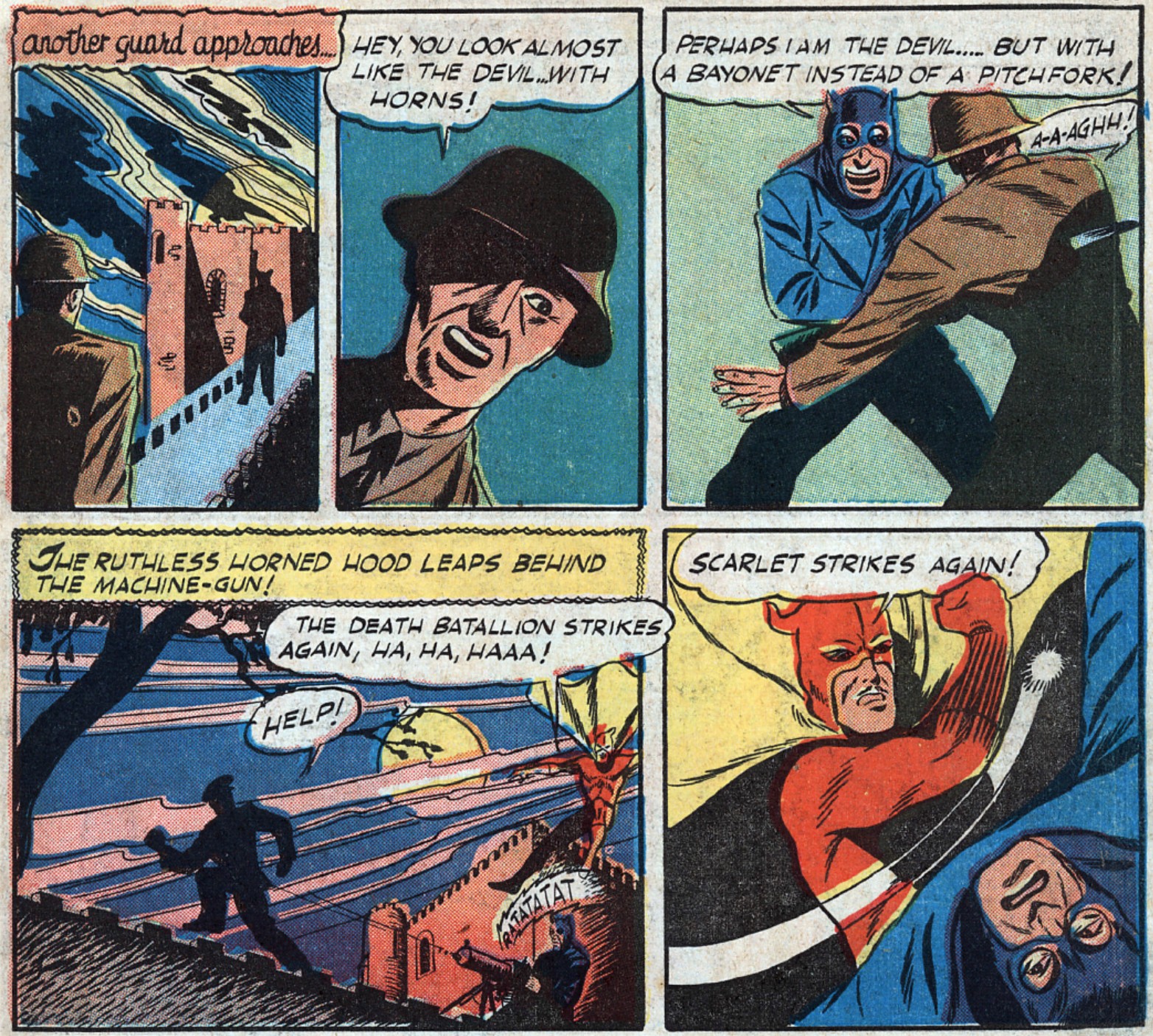
    Like Mr Skeleton before them (and possibly because I first encountered them both in the same comic), the Death Battalion is one of those super-villain concepts that really lodged itself in my brain and which I am glad to have finally appear here. Unfortunately, unlike Mr Skeleton, the Death Battalion isn’t quite as great as I’d remembered. For one thing, I’d long thought that they were a Mr Scarlet revenge squad, but despite the fact that he put them all in jail, they seem to bear him very little ill will. Comparatively.

    Instead, the six members of the Death Battalion are broken out of jail by a seventh fellow, the Brain, and enlisted into his plot to take over the US. Note the Nazi-ness of the Brain’s operation, but also that there is no real connection to the Nazi Party. Instead, the Brain and his Death Battalion appear to be independent Nazis, like your neo-Nazis and so forth will be later on. If it were just a few months later they’d be heiling Hitler, but as it stands we’re dealing with locally sourced indie hipster Nazis.

    Like I said, this isn’t a Mr Scarlet revenge squad – these just happened to be the six highest profile villains available to be broken out of El Catraz Penitentiary. But just what do they bring to the table?

    the Black Clown: Former circus owner. Murderer and bank robber. Circus connections.

    the Black Thorn: Fifth columnist. Murderer. Packs a mummy ray.

    Doctor Death: Former concert pianist. Murderer. Poisons.

    the Ghost: Former charity president. Embezzler. Sheet ghost costume.

    the Horned Hood: Academic. Jewel thief. No special equipment.

    the Laughing Skull: Former banker. Extortionist and murderer. Access to stone-cutting tools and shovels.

    A motley crew indeed. There’s a pretty wide range of skills and success levels on display here – like I said, the Brain seems to have prioritized breaking out the flashiest crooks over the most competent ones.

    The Brain’s plan is simple: murder six key men, thus setting in motion a destabilization of the US government that will allow the Death Battalion to swoop in and conquer the country. Let’s see how that goes. 

    Senator Hiram Dean: 

    Spoilers, but I must lead with the fact that Doctor Death is the only one of the six to successfully kill his target. Specifically, he appears to scare him to death? Regardless of how it was done, this is the event that puts Mr Scarlet onto the Death Battalion’s trail.

    Kudsen: 

    Kudson, head of a government defense program, comes very close to being killed by the Black Clown’s gorilla due to his refusal to turn around and see if the enormous gorilla-shaped shadow that is advancing on him might indicate some sort of danger. It’s only his dumb luck that his assistant is the one who gets aped first, and that Mr Scarlet shows up in time to prevent any further aping.

    FBI Chief Doover: 

    The Ghost is one the real odd men out in the Death Battalion. Consider that he was an embezzler whose main strength was the large group of men in spooky costumes in his employ and ask yourself just what chance he might have at assassinating the head of the FBI. It’s only due to Chief Doover’s nonexistent security that he almost manages to plant a knife in his back and only due to Pinky the Whiz Kid that he fails to do so.

    Secretary of State Simpson:

    The Black Thorn on the other hand, is quite a good choice when it comes to murder, particularly as he has somehow gotten his hands on another mummy ray. He comes pretty close to getting the Secretary of State but spends a bit too much time mummifying random committee members before Mr Scarlet turns up.

    General Dodd:

    The Horned Hood manages to screw up a simple murder while armed with a light machine gun from about ten feet away. This is absolutely on-brand for him as the biggest screw-up in the whole Battalion. The Hood’s presence on this team is proof of some sort of super-villain corollary to the Peter Principle.  

    Dollar-a-Year Man Phillips:

    Finally, the Laughing Skull is sent to kill dollar-a-year man Phillips, which leads to the question: what is a dollar-a-year man? Turns out that the term describes a wealthy person who takes a nominal salary in order to be counted as an employee while essentially doing government work for free, and Phillips is one of them. Lucky for him, the Laughing Skull insists that live burial is the only acceptable way to murder someone, which gives Mr Scarlet and Pinky enough time to show up and save the day.

    But what about the brain himself? What’s his deal? Well, aside from being the leader of the whole enterprise, the Brain has precisely two things going on: he has a weird mesh bubble helmet that makes the head inside look enormous, and he “deals in poisons,” which means that he tries to kill Mr Scarlet by dangling a tarantula at him on a stick in a display that is hilariously ineffectual looking even if you, like the creators of this comic, are working from the incorrect belief that the tarantula is massively venomous.

    Having foiled all of the Death Battalion’s attempted murders (but for that one), Mr Scarlet and Pinky make their way back to the group’s HQ by employing a little subterfuge and then beat all five of them (the Horned Hood and Laughing Skull already being in custody) to a pulp. And just who does the Brain turn out to be? Why, none other than ex-Warden Loomis, who so prominently retired after six costumed criminals escaped from his prison. Presumably he now gets to revisit his old workplace!

    The Death Battalion never needs to return, unless perhaps a flashback story needs a team of Nazi super-villains in it to be stomped, but as always I must whoop and cheer for the concept of a bunch of low-grade villains teaming up like this. It’s just fun!

  • MINOR SUPER-VILLAIN 876: THE CULT OF ANKKAMAN

    (Zip Comics 006, 1940)

    Zambini the Miracle man is visiting his old friend the archaeologist Professor Lorenz when he learns that Lorenz is potentially filled with curse-energy thanks to an ancient tomb he violated. The Professor is dismissive of these concerns, even though both his daughter Greta and Zambini himself reckon that there might be something to them.

    Sure enough, the very instant that Zambini has left the Lorenz house, two members of the Cult of Ankkaman show up and kidnap Professor Lorenz, making use of the magical Doorway of King Ankkaman (one of the items that he brought back from his travels/ that the cult are angry about him making off with) to spirit him away. 

    Sensing trouble, Zambini returns and finds Greta Lorenz in a state of hypnotic paralysis thanks to the cultists’ magics. He frees her and they use the Doorway to follow.

    Now. There are exactly two things that got me excited about this particular entry, which is otherwise a pretty standard tale of a group objecting to the theft of their cultural objects from back when that was seen as unreasonable and villainous thing to do. The first of these is the fact that the Cult of Ankkaman comes from the country of Egyptasia, which I am 90% certain based on context clues is a country exactly like Egypt, only in Asia. Why set a story that could so very easily take place in regular old Egypt in this unnecessary new country you ask? Beats me, but it’s exactly the sort of weird comics thing that I love.

    The second thing is simply that Saki, the Cult’s magic user, does his spells Zatara-style, by speaking backward, and that the close proximity of this to Zambini’s “abbi dabbi” style of spellcasting really highlight just how silly both of these affectations are.

    Prof Lorenz is weirdly calm about being sacrificed to Ankkaman, which he rationalizes as some sort of extremely visceral research. Fortunately for the field of anthropology, Zambini shows up in time to ensure that he is able to publish this experience rather than perish due to it.

    Zambini, the Professor and Greta make their way back through the Doorway of Ankkaman, which Zambini then seals by the simple expedient of adding a door to the frame. The Professor is saved! Unless the cultists make their way back to his house via conventional travel, of course. 

  • MINOR SUPER-HERO ROUND-UP 064

    MINOR SUPER-HERO ROUND-UP 064

    Oh my gosh! It’s more minor super-heroes! 

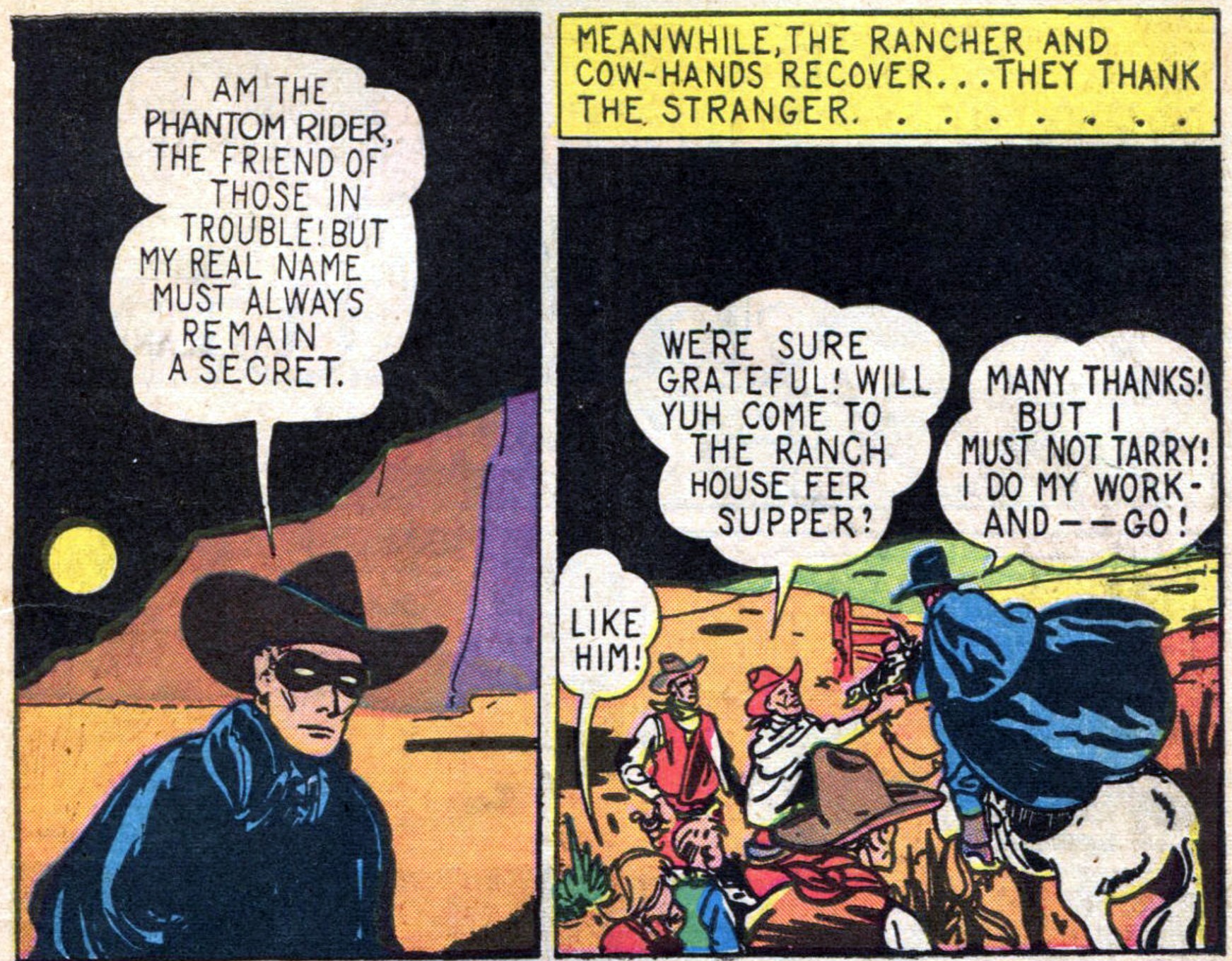
    the Phantom Rider: 

    The Phantom Rider is Tex Maxon, who was already a wandering cowboy who meted out justice for a while before getting into the masked vigilante game. Where a lot of masked cowboy vigilantes are doing a classic secret identity or concealing their identity for more specific reasons like being wanted for a crime they didn’t commit, the Phantom Rider thing honestly just seems like a fashion choice on Maxon’s part, like he found a big black cloak one day and decided to roll with it.

    The above speculation is undermined somewhat by the fact that the Phantom Rider outfit changes to this yellow cowboy shirt/jeans/mask combo pretty quickly, but maybe Maxon just found the cloak too cumbersome (or the artist found it too annoying to draw).

    Far more annoying is the fact that this strip that was clearly set in the Old West from long before the Phantom Rider identity was established switches to a Modern West setting in Wonderworld 015. Have some consistency, people. (Wonderworld Comics 011, 1940)

    **UPDATE** the Flame:

    Once again we have the origin of the Flame, and as I suspected the previous version of this that we had encountered was cut down from this one. Notably, this is the first time that the Flame is given any sort of name, Charteris, and the lack of a first name is even kind of textually supported: he is washed away in the flood immediately after being born – his parents might not have had time to name him yet. He is made Grand High Lama as a baby in this one too, which is still weird to me. (Wonderworld Comics 011, 1940)

    **UPDATE** Yarko the Great:

    In a bit of Silver Age “give everything a significant origin” style storytelling, the jewel on the front of Yarko the Great’s turban is revealed to be the Ada-La-Hoda, one of the Twin Jewels of Blood required for this one Chosen One to become ruler of all India, in a mystical sword-in-the-stone way. Unfortunately for him, his choice to wantonly murder anyone who might get in the way of his acquiring the gem leads Yarko to determine that he is unfit for the role and keep the dang thing in hopes that the next Seventh Son of the Seventh Son of the Order of Aribah might be more reasonable. (Wonderworld Comics 011, 1940)

    the Secret Band of the Purple Hood: 

    The Secret Band of the Purple Hood are a vigilante organization that operate in the city of Shanghai and who induct super-detective Dr Fung into their ranks mid-case as both he and they are attempting to battle the worshippers of Khwass, Great God of Vengeance. Sadly, as this adventure ends in a cliffhanger that is as far as I can tell never resolved, we don’t get to see the Secret Band do much more than beat up a couple of priests, but I’m just so chuffed to find a vanishingly-rare example of non-title-character masked vigilantism that I simply had to include them. (Wonderworld Comics 016, 1940)

  • MINOR SUPER-HERO ROUND-UP 063

    Pilots! Vexatious pilots! Will they give me no peace?  

    the Skull Squad: 

    Yet another gang of pilots with some pretty lacklustre skull theming to go with their name. The Skull Squad is an international affair, with American Jimmy Jones, Englishman Kent Douglas and Scotsman Jock “Sandy” MacGregor all flying a bomber for the RAF and predictably getting into wild and wooly scrapes. (Wings Comics 001, 1940)

    SKULL SCORE:  0.5/5 

    the Parachute Patrol:

    The Parachute Patrol are Tommy, Curly and Blimpo (and I know every kid gang has to have a fat kid or an ethnic kid with a cruel nickname, but “Blimpo” seems a bit extreme for a kid who is husky at best), three American teens who for some never-explained (I assume) reason live in a picket fenced neighbourhood in Central France, complete with an even more incongruous grumpy neighbour straight out of an Our Gang short. One must assume that they were originally based out of the US somewhere until someone raised the point that having them casually fly over the Atlantic Ocean in their single-engine plane in their first adventure strained credulity somewhat.

    The “parachute” in Parachute Patrol comes from their signature mode of transport, the parachute balloon, which allows them to smoothly ascend and descend from any height. (Wings Comics 001, 1940) 

    (The above only applies to the first appearance of the Parachute Patrol. From Wings Comics 002 onward the same three kids are a trio of British Boy Scouts who are loosely attached to the RAF and get into all kinds of scrapes with Axis spies and other threats. Blimpo is still called that, even though he’s about the same size as Tommy. The parachute balloon and Mrs Measly never appear again – the “parachute” in Parachute Patrol refers to parachute-spotting, i.e., looking for incoming paratroopers) 

    the Phantom Falcons: 

    A private air force founded by airplane manufacturer Davis and a handful of WWI fighter aces, the Phantom Falcons operate out of an underground air base that is probably somewhere in Switzerland but also probably moves around in order to facilitate storytelling. In their first appearance, young pilot Tom Slade stumbles across their operation and becomes the fifth Phantom Falcon. (Wings Comics 001, 1940)

    the Spitfire Ace: 

    Though the Spitfire Ace is ultimately just another WWII pilot with a cool nickname, he is remarkable for having what is one of the more complicated origins that I have ever read, and all to end up as an RAF pilot just like any number of characters who just volunteered. Here’s the skinny:

    -Tom Cassidy is a hard-boiled airplane salesman trying to sell fighter planes to the Polish government, and so is in Warsaw when the Nazis attack. Disgusted by the slaughter of civilians, he hops in his sample plane and attacks the Germans, putting in a good showing before being shot down by the Nazi ace Hornigg.

    -Hornigg blackmails the captured Cassidy by having his face disfigured and threatening to leave it that way. Cassidy is forced to participate in mock dogfights with Hornigg as a propaganda exercise, with himself as an example of a misguided former antagonist won over to the Nazi side. BUT! Cassidy is also learning all of Hornigg’s air combat tricks.

    -With the aid of a British secret agent, Cassidy and captured RAF pilot Captain Sheridan escape in a stolen plane. They are shot down near Dunkirk and Captain Sheridan is killed.

    -Cassidy takes Sheridan’s papers and joins the evacuation of Dunkirk. Once in England, he poses as Sheridan in order to have an opportunity to fight the Nazis again. He is able to claim that his face was injured and reconstructed thanks to his plastic surgery scars, and he is soon instated as RAF Captain Sheridan.

    Cassidy/Sheridan makes a name for himself thanks to his inadvertent training with Hornigg, and soon gets a chance to shoot his former captor down. Having done so kind of makes all of the above meaningless of course, but whatever. At this point, “Spitfire Ace” is just a regular aviation comic. (Wings Comics 004, 1940) 

  • FASCIST GOON CLEARING HOUSE 010

    Will we ever run out of fascist goons? 

    the Green Shirts:

    The Green Shirts’ claim to fame is their army of the resurrected dead, which they employ in their attempted takeover of the US. Or it would be, that is, if the test run of the resurrection device hadn’t resulted in the death of its inventor and incidentally the creation of the super-mummy Mystico, who ultimately ends up destroying the Green Shirts in a very satisfyingly cyclical kind of way. (Startling Comics 001, 1940)

    the Group/ the Superior Council: 

    The Group, a home-grown collection of fascist malcontents, acts as a front and recruiting arm for the Superior Council, the US arm of the espionage corps of the nation of Zatvia, a classic Nazi Germany stand-in. US secret agent Q-13 successfully infiltrates both groups in succession and foils them so hard that head honcho Miltor explodes. (Super Mystery Comics v1 002, 1940)

    the Green Tie Society: 

    Despite the Green Tie Society’s better-than-average name they’re just another miserable little German-American Bund analog who manage to drag out an adventure with the new, human-faced White Streak for three interminable issues before being rounded up and tossed in the klink. They don’t even have the good graces to wear green ties! (Target Comics v1 010, 1940)

    the Guardists: 

    A fifth column attempting to capture Aruba’s oil fields for the Nazis under the command of Dutch traitor Captain Kliefer, the Guardist movement is smashed by American ace the Lone Eagle. (Thrilling Comics 009, 1940)

  • MINOR SUPER-VILLAIN 803: THE HEADLESS HORSEMAN GANG

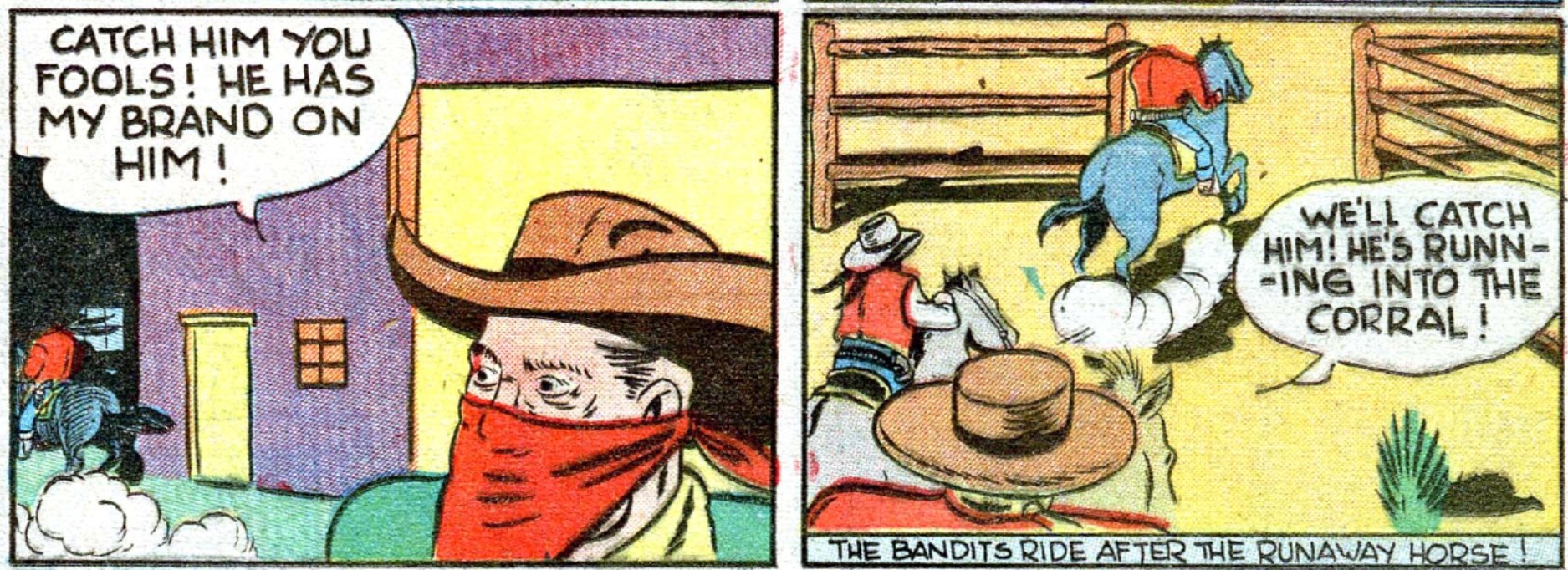
    MINOR SUPER-VILLAIN 803: THE HEADLESS HORSEMAN GANG

    (The Arrow 002, 1940)

    It’s an occupational hazard for the costumed adventurer: eventually someone is going to dress up like you so that they can do crimes and get away with it while you take all the blame. And when the hero in question is a mysterious and half-legendary figure like your typical masked cowboy tends to be, why, it must be all the more tempting, as Betty aka the Headless Horseman learns to her dismay when she learns that her own alter ego has been tearing up the Mesa County countryside in a crime spree even though she is attending college in Chicago.

    Returning on the first available stagecoach, Betty wastes no time in tracking down the real crooks, then she simply substitutes herself for the convenient her-sized dummy that has been playing the part of the Headless Horseman during the gang raids and leads the whole gang into a corral and the waiting arms of the town sheriff.

  • GENERIC COSTUMED VILLAIN ROUND-UP 021

    Another truckload of half-baked mooks for your viewing pleasure.

    The otherwise-normal gangsters who have gotten ahold of a piece of superscience and are using it for crime are an important part of the super-hero comic ecosystem. Here is a wonderful example of such in the form of a gang who have access to disintegrator ray pistols and are using them like regular guns during a bank robbery. Fantastic stuff. The Invisible Avenger hits them with a train. (Superworld Comics 002, 1940)

    He may be a mere hold-up man in a bandit mask (surely the lowest tier of costumed villainy until the invention of putting a nylon stocking on your head) but I am very pleased to tell you that this fellow’s real name is Solo Mogart. Also that he eventually gets beaten up by the Raven. (Sure-Fire Comics 002, 1940)

    This fairly nondescript gang of generically foreign spies have access to an invisible fighter plane and the best thing they could think to use it for was smuggling people into the US. Baffling! They make the mistake of tangling with flying cadet Lucky Byrd and end up in the slammer. (Target Comics v1 003, 1940)

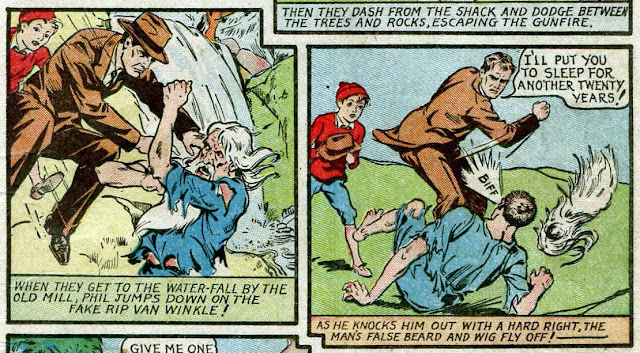
    This fellow is pretending to be Rip van Winkle or an analogous long-term sleeper for some reason related to moonshining. Maybe the full plot is interesting enough to be an entry on its own but sadly the extant copy of this comic is missing the first few pages of this story and so I have very little idea what is going on. He gets beat up and tossed in the clink thanks to crusading reporter Phil Manners. (Target Comics v1 003, 1940)

  • MINOR SUPER-VILLAIN 788: THE CRIMSON CIRCLE

    (Sure-Fire Comics 003b, 1940)

    The Crimson Circle are a masked gang with a more grandiose than normal name (and led by the Crimson Mask, as can just barely be made out under that rip in the third panel above, a rare instance of the named villain being less prominent than his named henchmen in a story), who have the fortune to rob the same loan company as the Raven, leading to them capturing, unmasking and forcing him to work for them under the threat of revealing that he is in reality Police Detective Sergeant Danny Dartin, the man in charge of catching the Raven.

    Did I say “fortune” above? That should in fact have read “to their misfortune,” since as characters in a continuity-light comic, being something as threatening to the status quo as a villain who knows the hero’s secret identity is tantamount to a death sentence, and indeed the entire Crimson Circle is gunned down by the Raven and the police as they try to shoot their way out of a bank robbery.

    Not that I would imply that Golden Age comics never have long-term plot developments. Case in point: this is the issue in which Danny Dartin’s fiance Lola Lash learns of his double life and goes from an enemy to an ally of the Raven. True love overcomes a mindless hatred of crime and so forth.