The Curse of Skeleton Munroe

Category: group

  • MINOR SUPER-VILLAIN 787: THE TERROR TRUST

    (Sure-Fire Comics 002, 1940)

    The Terror Trust is a group with a very simple money-making scheme: demand money from millionaires and then throw acid in the faces of the one who refuse to pay up. X, the Phantom Fed infiltrates this group by breaking captured member Horton out of prison and then impersonating him.

     
    X’s scheme falls apart when the Trust’s members realize that Horton was simply not clever enough to effect his own escape, leading him to capture one of the ringleaders, prominent psychologist Professor Parks, and extract the names of the remaining two from him using some legally suspect truth serum.

    Does X then complete the roundup of the Terror Trust in disguise as Parks? Nothing so simple for the Phantom Fed. First off, he disguises himself as the local Police Commissioner, then enlists the aid of the Trust’s next victim, Sir Anthony, and then poses as Parks. Or rather as the Commissioner posing as Parks. Does he do this as a way to gain Sir Anthony’s trust, perhaps? A good guess, but no, he immediately tells Sir Anthony that he is actually X in disguise. It might be in an effort to make the local police look good but honestly I reckon that it’s merely for the challenge of the thing, that by his second appearance X is getting a bit tired of the regular master of disguise schtick and looking to up the difficulty a bit. Real adrenaline junkie stuff.
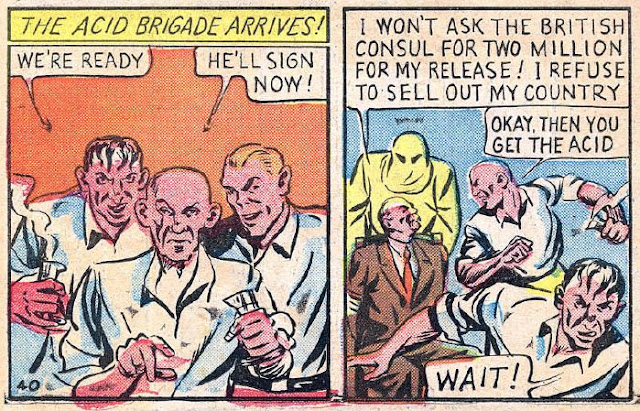
    As is customary we must take a moment to recognize the little people who make the true super-villainy happen, and this time our focus is on this bunch of absolute creeps, the Acid Brigade. Just something to keep in mind when you create a business that revolves around the act of throwing acid in people’s faces: you’re going to have to work with people willing to do that. It’s an HR nightmare, I can only assume.

  • MINOR SUPER-VILLAIN 778: THE SKYWAYMEN

    (Super-Mystery Comics v1 004, 1940)

    Over the course of the last few years I’ve really beefed up the amount of images and words I use to describe the minor super-villains I so love, but sometimes you gotta hearken back to the old ways:

    When aviator Sky Smith heads to Alaska to help out his friend Tom Harris with a mysterious problem, he finds that a band of air pirates called the Skywaymen (fantastic name) led by a man named Rolf Calgar (better-than-average name) are trying to drive him off of his land so that they can use it as an air base. Smith proceeds to blow most of the Skywaymen to smithereens using their own deathtrap and delivers Calgar to the authorities before flying off to seek further adventure.

  • MINOR SUPER-VILLAIN 764: THE BLACK KNIGHTS

    (Speed Comics 008, 1940)

    Like I said in the Queen Sheba entry, her brand of evil was a bit too depressing and I almost skipped making an entry for her in favour of doing this one but it ended up being mostly about her and her unpunished slaving ways anyway, and that wasn’t fair.

    The Black Knights are just what it says on the tin: a bunch of knights who dress in black. Presumably they are descended from the same group of crusaders as Sheba’s loyal followers, only instead of passively propping up a corrupt monarchy the Black Knights are out there busting heads and doing crimes. At least, I assume that’s their deal – the only actual crime that they are shown to have committed is kidnapping Sheba’s son, and I suppose that that could be the action of a group of slavery abolitionists who believe in direct action.

    Whatever their place on the alignment chart, the Black Knights try and fail to prevent Shock Gibson from rescuing the prince. Some days it just doesn’t pay to sally forth.

  • MINOR SUPER-VILLAIN 761: THE HOODED RIDERS

    (Speed Comics 007, 1940)

    Despite their KKK-adjacent looks and tactics, the Hooded Riders are nothing more than a gang of rural protection racketeers. Over the course of the adventure the riders keep rolling out more elaborate equipment and plans to deal with both their targets and the interference of Shock Gibson and I kept thinking that their deep well of resources was going to turn out to be due to some sort of secret funding from a hostile country but no, they’re just unusually well-prepared gangsters. 

  • FASCIST GOON CLEARING HOUSE 009

    Buncha Smash Comics fascists I lost behind the couch for a while.

    Just why this German-American Bund equivalent is called the Groups is a real mystery for the ages – it’s possible that these people are protesting, like, all bundist-style organizations at once and calling them “the Groups” collectively, though why they would do so at one specific group’s meeting is beyond me. Whatever the truth of their name, the leadership of the Groups meet their ends after an attempt to steal American defense plans is foiled by Wings Wendall. (Smash Comics 007, 1940)

    The Batzi Tribe is really just a stand-in for the Nazi party and Hugh Hazzard and his pal Bozo the Iron Man only have to contend with the espionage wing of the group, but it’s such a weird wild name that I feel compelled to highlight it here along with the information that their New York headquarters was located in a neighbourhood known as Krautville. (Smash Comics 008, 1940)

    The Metallic Army is a very cool-looking bunch who invade the US out of nowhere from the Southwest one day. Almost nothing of their origin or motivation is revealed in favour of hard-core battle action, but based on the names of its officers (Hardt, Zergoff) the Army is a communo-fascist Central-to-Eastern European pastiche.

    Wherever the Metallic Army came from I can tell you one thing: those uniforms are not metallic because of any kind of armour or even bullet-resistant cloth – once Wings Wendall gets going he mows them down like grass. (Smash Comics 012, 1940)

    The Black Troops are yet another bundist group faced by Wings Wendall, albeit an unusually successful one – they manage to capture a number of large East Coast cities and are beginning to ship American weapons and supplies to their unspecified Axis home country when Wendall manages to bring down the whole operation by throwing its leader out of a plane. (Smash Comics 016, 1940)

  • FASCIST GOON CLEARING HOUSE 009

    Buncha Smash Comics fascists I lost behind the couch for a while.

    Just why this German-American Bund equivalent is called the Groups is a real mystery for the ages – it’s possible that these people are protesting, like, all bundist-style organizations at once and calling them “the Groups” collectively, though why they would do so at one specific group’s meeting is beyond me. Whatever the truth of their name, the leadership of the Groups meet their ends after an attempt to steal American defense plans is foiled by Wings Wendall. (Smash Comics 007, 1940)

    The Batzi Tribe is really just a stand-in for the Nazi party and Hugh Hazzard and his pal Bozo the Iron Man only have to contend with the espionage wing of the group, but it’s such a weird wild name that I feel compelled to highlight it here along with the information that their New York headquarters was located in a neighbourhood known as Krautville. (Smash Comics 008, 1940)

    The Metallic Army is a very cool-looking bunch who invade the US out of nowhere from the Southwest one day. Almost nothing of their origin or motivation is revealed in favour of hard-core battle action, but based on the names of its officers (Hardt, Zergoff) the Army is a communo-fascist Central-to-Eastern European pastiche.

    Wherever the Metallic Army came from I can tell you one thing: those uniforms are not metallic because of any kind of armour or even bullet-resistant cloth – once Wings Wendall gets going he mows them down like grass. (Smash Comics 012, 1940)

    The Black Troops are yet another bundist group faced by Wings Wendall, albeit an unusually successful one – they manage to capture a number of large East Coast cities and are beginning to ship American weapons and supplies to their unspecified Axis home country when Wendall manages to bring down the whole operation by throwing its leader out of a plane. (Smash Comics 016, 1940)

  • MINOR SUPER-VILLAIN 760: THE FIRE-MEN

    (Speed Comics 004, 1940) 

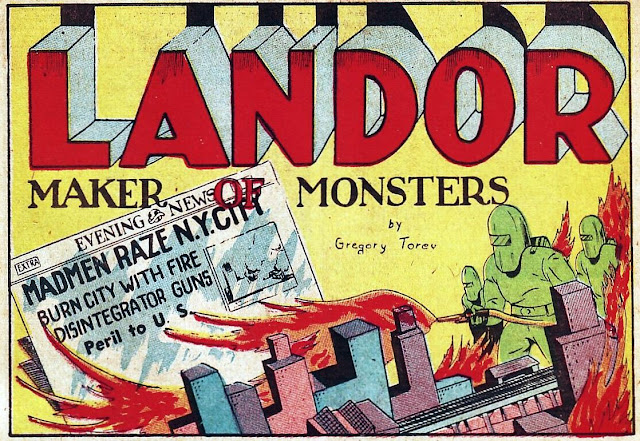
    The Fire-Men make an impressive debut: dressed in bulletproof suits and wielding powerful flamethrowers, they carve a path of destruction through both New York City and the tank division that is sent to bring them to heel. Nothing seems able to stop these mysterious marauders!

    Nothing, that is, until Landor, Maker of Monsters emerges from the shadows to offer his creature-based services to the US government. He’ll fight on the side of law and order for once, but only in exchange for his hated enemy, Tony Torrence. It’s a triumph of negotiation, in that there is absolutely no way that a patriotic fellow like Torrence could fail his country in its hour of need, even at the cost of his own life, the rube.

    To his credit, Landor follows through, and while up to this point I thought that the Fire-Men might have secretly been more of his creatures under those suits the whole time, they are in fact what will eventually be a comics staple: the minor villain that exists only to be utterly trounced as a demonstration of the prowess of another character. Whatever the Fire-Men’s goals might have been will never be revealed due to their grisly deaths at the claws of a giant fireproof cyborg.

  • MINOR SUPER-VILLAIN 760: THE FIRE-MEN

    (Speed Comics 004, 1940) 

    The Fire-Men make an impressive debut: dressed in bulletproof suits and wielding powerful flamethrowers, they carve a path of destruction through both New York City and the tank division that is sent to bring them to heel. Nothing seems able to stop these mysterious marauders!

    Nothing, that is, until Landor, Maker of Monsters emerges from the shadows to offer his creature-based services to the US government. He’ll fight on the side of law and order for once, but only in exchange for his hated enemy, Tony Torrence. It’s a triumph of negotiation, in that there is absolutely no way that a patriotic fellow like Torrence could fail his country in its hour of need, even at the cost of his own life, the rube.

    To his credit, Landor follows through, and while up to this point I thought that the Fire-Men might have secretly been more of his creatures under those suits the whole time, they are in fact what will eventually be a comics staple: the minor villain that exists only to be utterly trounced as a demonstration of the prowess of another character. Whatever the Fire-Men’s goals might have been will never be revealed due to their grisly deaths at the claws of a giant fireproof cyborg.

  • MINOR SUPER-VILLAIN 753: THE GHOST GANG

    (Smash Comics 015, 1940) 

    The Ghost Gang have a winning formula: commit a robbery and then high-tail it back to the Old Abandoned Peters Mansion (charmingly referred to a couple of times as the Haunted Hide-Out), where they transform into ghosts and can murder cops and/or drive them insane with impunity.

    It’s not a foolproof scheme, however. For one thing, you really have to complete that first step and actually get to the house, as evidenced by this poor fellow being bravely shot in the back by these two cops as he closes the garage door.

    For another and much more important thing, they aren’t actually turning into ghosts – it’s all a trick! This is important, because if there’s one real flaw to this plan it’s the “murdering cops” part. If all the gang was doing was driving them insane then maybe they could have gotten a few more days out of their arrangement but it’s just as well for them that Hugh Hazzard and Bozo the Iron Man show up to beat the tar out of them because there’s a pretty good chance that an NYPD bulldozer was already on its way to bring the whole house down around their ears, ghosts or no.

  • MINOR SUPER-VILLAIN 749: THE SABOTEURS

    (Smash Comics 015, 1940)

    Sometimes all you need is a group of mercenary saboteurs dressed in matching cloaks and gas masks to zazz up a story – Black X and his comic book contemporaries have faced and defeated hundred of sabotage plots in front of my now-jaded eyes over the course of my comics-reading career, and so it takes a bit more than your basic pseudo-Nazi in a suit and tie to get my attention. That there is a suit-and-tie pseudo-Nazi behind the scheme to blow up a city that is technically never called New York is irrelevant, as it’s the cloak-and-gas mask guys who matter.

    Black X and Batu do not of course let this campaign of destruction stand, and despite some unusually acrobatic fighting moves on behalf of the Saboteurs the whole bunch of them are brought to justice after only a moderate amount of infrastructure is exploded.