The Curse of Skeleton Munroe

Category: group

  • MINOR SUPER-VILLAIN 749: THE SABOTEURS

    (Smash Comics 015, 1940)

    Sometimes all you need is a group of mercenary saboteurs dressed in matching cloaks and gas masks to zazz up a story – Black X and his comic book contemporaries have faced and defeated hundred of sabotage plots in front of my now-jaded eyes over the course of my comics-reading career, and so it takes a bit more than your basic pseudo-Nazi in a suit and tie to get my attention. That there is a suit-and-tie pseudo-Nazi behind the scheme to blow up a city that is technically never called New York is irrelevant, as it’s the cloak-and-gas mask guys who matter.

    Black X and Batu do not of course let this campaign of destruction stand, and despite some unusually acrobatic fighting moves on behalf of the Saboteurs the whole bunch of them are brought to justice after only a moderate amount of infrastructure is exploded.

  • MINOR SUPER-VILLAIN 735: THE SILVER-WORSHIPPERS

    (Silver Streak Comics 005, 1940)

    Comics book cults, am I right? They’ll worship anything. Case in point: the Silver-Worshippers, who believe that silver is sacred and are pretty dang mad that it is being profaned by its use in finance and currency. They also very frustratingly do not seem to have a name that they use for themselves, so the Silver-Worshippers will have to do.

    But just how to remove the sacred silver from the hands of the heathen financiers? Why via a series of bank robberies, of course! The Silver-Worshippers devise a system so foolproof that they use it upwards of thirty-five times: set off a big explosion and/or fire on the edge of town and then rob the town bank of all of its silver while the emergency services are busy.

    Of course, the Silver Streak is no slouch and so by the thirty-fourth or thirty-fifth silver robbery he is ready to get in on the action, zipping off to Easton, Ohio in time to help with the fire and in grand comics tradition almost catch the bank robbers so that it will be more satisfying when he gets ’em later.

    Now to reveal a little bit about the kind of person I am: I absolutely love when an old comic uses a real place (or even better: a real street address) due to the ease with which I can use modern mapping software to check out just where things supposedly happened, and of course I was overjoyed to discover that Easton, Ohio was a real place, but let me tell you, it does not have a downtown, or a bank, or indeed a fire department.

    Our adventure in geography continues, as the Silver Streak determines that the Silver-Worshippers have been writing the word DOOM in cursive across a map of the US (this is where my “thirty-five robberies” calculation comes from, by the way), and that Clayton, Ohio is the next likely stop to complete the M.

    (Clayton, Ohio is also a real place, by the way, and while it does have a small downtown that I can believe held a robbable bank in 1940 it is not directly South of Easton. What wild geography games was Jack Cole playing with us? did he just pick two names out of the air and get lucky?)

    The Silver Streak tracks the cultists sent to rob the Clayton bank back to their hidden temple and comes very close to being gruesomely killed in a wave of molten silver, but because he is a super speed character this only comes about because he clumsily knocks himself out with a bit of falling masonry.

    The Silver Streak recovers in time to not be fatally silvered and proves my usual point about speedster heroes vs regular crooks by taking on a whole temple-full of guys using only hand-thrown bricks of silver, only they turn out to actually be silvered bricks, substituted for the real thing by the cult’s leader Gregory Randil. “Just who is Gregory Randil?” I hear you cry. Why he is the owner of Randil Silver Co and he has been playing the Silver-Worshippers for chumps by having them steal for him so that he can cut down on overhead. And to forestall any further questions: no, Randil has never appeared or been mentioned in the comic prior to his unmasking. This is the definition of an unfair mystery!

    The Randil Silver Co. deception of course does not go down well with the room full of Silver-Worshippers, and the Silver Streak has to bop every one of them into unconsciousness before hauling them off to jail.

    NEXT DAY ADDENDUM: Okay, here is a bonus thing about me. Sometimes I get so excited and full of pride in myself for figuring something out that I overlook the obvious. Yes, Easton and Clayton are real places in Ohio, as I so smugly pointed out, but it’s a Golden Age comic book – if you see a place name one of the things you have to assume is that there is a simple substitution going on. Forget Easton and Clayton, I should have checked for a Weston and assumed that it was Dayton, and when I did in fact do so, the line between them was almost perfect for the finale of a cursive “m”. Weston even has a little downtown which, while it doesn’t appear to have many buildings over two stories, probably had a perfectly lootable bank in 1940. Just a reminder for me to stay humble.

  • MINOR SUPER-VILLAIN 735: THE SILVER-WORSHIPPERS

    (Silver Streak Comics 005, 1940)

    Comics book cults, am I right? They’ll worship anything. Case in point: the Silver-Worshippers, who believe that silver is sacred and are pretty dang mad that it is being profaned by its use in finance and currency. They also very frustratingly do not seem to have a name that they use for themselves, so the Silver-Worshippers will have to do.

    But just how to remove the sacred silver from the hands of the heathen financiers? Why via a series of bank robberies, of course! The Silver-Worshippers devise a system so foolproof that they use it upwards of thirty-five times: set off a big explosion and/or fire on the edge of town and then rob the town bank of all of its silver while the emergency services are busy.

    Of course, the Silver Streak is no slouch and so by the thirty-fourth or thirty-fifth silver robbery he is ready to get in on the action, zipping off to Easton, Ohio in time to help with the fire and in grand comics tradition almost catch the bank robbers so that it will be more satisfying when he gets ’em later.

    Now to reveal a little bit about the kind of person I am: I absolutely love when an old comic uses a real place (or even better: a real street address) due to the ease with which I can use modern mapping software to check out just where things supposedly happened, and of course I was overjoyed to discover that Easton, Ohio was a real place, but let me tell you, it does not have a downtown, or a bank, or indeed a fire department.

    Our adventure in geography continues, as the Silver Streak determines that the Silver-Worshippers have been writing the word DOOM in cursive across a map of the US (this is where my “thirty-five robberies” calculation comes from, by the way), and that Clayton, Ohio is the next likely stop to complete the M.

    (Clayton, Ohio is also a real place, by the way, and while it does have a small downtown that I can believe held a robbable bank in 1940 it is not directly South of Easton. What wild geography games was Jack Cole playing with us? did he just pick two names out of the air and get lucky?)

    The Silver Streak tracks the cultists sent to rob the Clayton bank back to their hidden temple and comes very close to being gruesomely killed in a wave of molten silver, but because he is a super speed character this only comes about because he clumsily knocks himself out with a bit of falling masonry.

    The Silver Streak recovers in time to not be fatally silvered and proves my usual point about speedster heroes vs regular crooks by taking on a whole temple-full of guys using only hand-thrown bricks of silver, only they turn out to actually be silvered bricks, substituted for the real thing by the cult’s leader Gregory Randil. “Just who is Gregory Randil?” I hear you cry. Why he is the owner of Randil Silver Co and he has been playing the Silver-Worshippers for chumps by having them steal for him so that he can cut down on overhead. And to forestall any further questions: no, Randil has never appeared or been mentioned in the comic prior to his unmasking. This is the definition of an unfair mystery!

    The Randil Silver Co. deception of course does not go down well with the room full of Silver-Worshippers, and the Silver Streak has to bop every one of them into unconsciousness before hauling them off to jail.

    NEXT DAY ADDENDUM: Okay, here is a bonus thing about me. Sometimes I get so excited and full of pride in myself for figuring something out that I overlook the obvious. Yes, Easton and Clayton are real places in Ohio, as I so smugly pointed out, but it’s a Golden Age comic book – if you see a place name one of the things you have to assume is that there is a simple substitution going on. Forget Easton and Clayton, I should have checked for a Weston and assumed that it was Dayton, and when I did in fact do so, the line between them was almost perfect for the finale of a cursive “m”. Weston even has a little downtown which, while it doesn’t appear to have many buildings over two stories, probably had a perfectly lootable bank in 1940. Just a reminder for me to stay humble.

  • GENERIC COSTUMED VILLAIN ROUND-UP 018

    The hits flops just keep coming.

    This gang doesn’t bother to give themself a proper name even though their scheme is extremely big and loud: they have access to a magnetic ray device and have employed it to pull down multiple large buildings in scenic Midtown City, thus killing between one and four thousand people (a printing error obscures the exact number), all so that their demands for protection money from the owners of other buildings will be paid without question. It’s just as well that the Comet eye-beams them all.

    I really am stuck on the fact that they haven’t bothered to give themselves a name, when they have such attention to detail that the hostages they grabbed in order to stymie the Comet were literally Mr & Mrs John Q. Public Priorities differ, I suppose. (Pep Comics 009, 1940)

    Buck Brady of the FBI is investigating a gang that is smuggling Malaysians across the Canada/ US border (because nobody would expect them to, that’s why) and the ringleader, when he shows up, is dressed fantastically. I cannot believe that more super-villains aren’t wearing big fur coats when they look so great when paired with a cowl mask. Anyway, he turns out to be Lieutenant Thomas of the US Border Patrol. (Prize Comics 003, 1940)

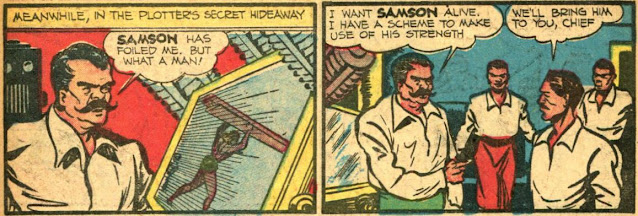
    Move over pre-2000s Wolverine, because this guy right here is possibly the most mysterious figure in comics. Samson and David track him to the hidden City of Erde after he initiates a series of attacks against the US, presumably with an eye on conquering it. But who is he? How did he become king of Erde and its population of cavemen? Where did he get the weaponry his cavemen are using in their attacks? Just how the heck did a whole city full of cavemen go unnoticed smack in the middle of the US, secret valley or no? (Samson 002, 1940)

    This unnamed mustachioed man is remarkable mostly for the number of pivots that he manages to pull off over the course of a 13-page story. He first attracts Samsons’s attention with a scheme to pit the presumably South American country of Ecuazil against its neighbour (sadly unnamed but probably something like Perile or Aregentuay) and then conquer both once they were both sufficiently weakened by the fighting. Once Samson and David put an end to that he hypnotically enslaved Samson for a while, then launched into a full-fledged invasion of the US. Pretty good range, I’d say.

    The US invasion plan also featured this amazing spindly-legged flamethrower tank. Bask in its pleasing aesthetics and questionable strategic value! Please also note David in these panels as this is a good representation of his role in the comic: all enthusiasm, willing to lasso absolutely anything, very low actual impact on events as they unfold but clearly Samson enjoys having him around.

    Finally, I don’t quite know why but I feel that I must highlight this sequence in which Samson hurls a man into a pit and then his lifeless body is just there for the next two panels. I want to frame this and hang it on my wall. (Samson 002, 1940)

  • MINOR SUPER-VILLAIN 719: THE PURPLE GANG

    (Science Comics 001, 1940)

    The Purple Gang, a bunch of guys in a gang who all wear purple suits and are getting up to no end of crime in whatever skyline-heavy city the Eagle calls home New York City, are a perfect opponent for a super-hero’s first adventure: organized enough to pose a challenge but not so tough that thy can’t really be stunted on to show how cool the Eagle is.

    They also quite noticeably do not all have purple suits on – of the six or seven Purple Gang members shown on panel, only one even comes close and his suit is more of a dark blue. And since the purple suit thing is mentioned not once but twice in the course of the story I must assume that the colourist simply did not give a care.

  • MINOR SUPER-VILLAIN 719: THE PURPLE GANG

    (Science Comics 001, 1940)

    The Purple Gang, a bunch of guys in a gang who all wear purple suits and are getting up to no end of crime in whatever skyline-heavy city the Eagle calls home New York City, are a perfect opponent for a super-hero’s first adventure: organized enough to pose a challenge but not so tough that thy can’t really be stunted on to show how cool the Eagle is.

    They also quite noticeably do not all have purple suits on – of the six or seven Purple Gang members shown on panel, only one even comes close and his suit is more of a dark blue. And since the purple suit thing is mentioned not once but twice in the course of the story I must assume that the colourist simply did not give a care.

  • FASCIST GOON CLEARING HOUSE 008

    Will they ever mend their evil ways?

    Like the Purple Shirts before them, the Black Legion exists mainly to represent the Forces of Unamericanism that Uncle Sam stands against, as they seek to win the hearts and minds of in this case the small Midwest community of Glen Valley (by shooting anyone who resists). The only real bit of innovation that they bring to the table are these rad machine gun motorcycles they go into battle on.

    They also have a nose cutout on their masks, which indicates that they prioritize comfort over style. (National Comics 005, 1940)

    The unnamed group that Uncle Sam fights in the next issue has a similar uniform in warm brown tones, and makes the interesting choice to wear it even while operating their submersible aircraft carrier base in the middle of the Pacific Ocean. That’s some real dedication to secrecy. (National Comics 006, 1940)

    The European-American Band, yet another take on the German-American Bund, is deceived and then dismantled in fairly short order by vacationing cartoonist-detective Pen Miller. (National Comics 006, 1940)

    No comic book analog of the German-American Bund is particularly kind in its depiction but the Moronia Bund might just be the most insulting. I’m not sure why all the Moronian Americans are bald – it doesn’t seem to be a requirement for entry as Perry “the Press Guardian” Chase is able to join up as a junior member to spy on them despite his luscious black locks. (Pep Comics 002, 1940)

    (surprisingly, the Moronia Bund – under the slightly more sleek name “the Moroniabund” manages to scrape up another bunch of bald fascists to make a second appearance in Pep Comics 003, but gets its ass just as thoroughly kicked by the Press Guardian as the first time)

  • FASCIST GOON CLEARING HOUSE 008

    Will they ever mend their evil ways?

    Like the Purple Shirts before them, the Black Legion exists mainly to represent the Forces of Unamericanism that Uncle Sam stands against, as they seek to win the hearts and minds of in this case the small Midwest community of Glen Valley (by shooting anyone who resists). The only real bit of innovation that they bring to the table are these rad machine gun motorcycles they go into battle on.

    They also have a nose cutout on their masks, which indicates that they prioritize comfort over style. (National Comics 005, 1940)

    The unnamed group that Uncle Sam fights in the next issue has a similar uniform in warm brown tones, and makes the interesting choice to wear it even while operating their submersible aircraft carrier base in the middle of the Pacific Ocean. That’s some real dedication to secrecy. (National Comics 006, 1940)

    The European-American Band, yet another take on the German-American Bund, is deceived and then dismantled in fairly short order by vacationing cartoonist-detective Pen Miller. (National Comics 006, 1940)

    No comic book analog of the German-American Bund is particularly kind in its depiction but the Moronia Bund might just be the most insulting. I’m not sure why all the Moronian Americans are bald – it doesn’t seem to be a requirement for entry as Perry “the Press Guardian” Chase is able to join up as a junior member to spy on them despite his luscious black locks. (Pep Comics 002, 1940)

    (surprisingly, the Moronia Bund – under the slightly more sleek name “the Moroniabund” manages to scrape up another bunch of bald fascists to make a second appearance in Pep Comics 003, but gets its ass just as thoroughly kicked by the Press Guardian as the first time)

  • MINOR SUPER-VILLAIN 671: THE ERASER GANG

    (Masked Marvel 002, 1940)

    The Eraser Gang, aka the Erasers, aka the Dead Erasers, are a gang with a gimmick: they don’t just hijack armoured cars, they make the cars and their occupants disappear completely, to the consternation of the authorities.

    But just why do they do this? It’s never actually spelled out but as the Masked Marvel discovers when he is captured by them their actual weapon of choice is not a dissolving ray or a powerful acid but a deadly gas. Presumably disappearing the bodies and the scene of the crime using a powerful helicopter hoist was a way of keeping the authorities from learning that all they needed was a few gas masks to kibosh the entire operation.

    Unluckily for the Erasers, the Masked Marvel has rendered himself “impervious to all gasses” and so is able to escape and blow all or most of them to kingdom come.

  • GENERIC COSTUMED VILLAIN ROUND-UP 015

    It’s time for another round with the guys in the masks.

    A radio announcer who tries to poison all of Inland City with chlorine gas for unclear reasons. Ends up blowing himself up while tangling with heroic pilot Captain Steve Ransom. (Keen Detective Funnies v2 006, 1939)

    This unnamed fellow takes the cake for audaciousness: his racket is drug smuggling and though traditionally one wants to keep a low profile while attempting to move controlled substances from place to place he:

    -sets up camp in the basement of an occupied house,

    -keeps a gorilla in that same basement,

    -sends that gorilla out to attack randos in hopes of driving away the locals,

    -poses as an FBI agent in an attempt to throw Power-Man off his scent.

    All of these are what I would describe as “activities likely to invite scrutiny”. And they do! (Fight Comics 005, 1940)

    Muipo here is a Japanese agent in all but name working to foment trouble in China by flooding the country with opioids. His major interesting features are a decent looking half-face draped cloth mask (rare and annoying-looking to wear) and a fake fat guy body he sits in while dealing with his underlings. He gets beat up by US Marine Strut Warren precisely one page after making his debut. (Fight Comics 007, 1940)

    The Squadron of Death is a group who blow up US defense infrastructure for… some reason. And there’s the problem: very little is given away about who the Squadron are or what their motivations might be (beyond general anti-US sentiment) in this issue, and though there is some indication that they might return to vex the Arrow in future instalments the next three issues of Funny Pages are not available to anyone without about 10 to 15 grand to spend on physical copies. 

    Pending further information the Squadron of Death are just two guys who steal a plane and then variously get thrown out of it or blown up in it by the Arrow. (Funny Pages v4 004, 1940)