The Curse of Skeleton Munroe

Category: group

  • FASCIST GOON CLEARING HOUSE 003

    More goons. Fascist goons? Yes.

    The Anti-American Party operated in the South American country of Santa Palos, home of the Red Gaucho, and got up to a lot of malarky at a fancy dress ball. Crucially, they disguised one of their agents as the Red Gaucho, leading to a lot of mixups between the agent, the Gaucho and a clueless dope who also came dressed as the hero (Nickel Comics 006, 1940)

    The Black Guard, agents of the Germany-analog country of Nordicha operating in neighbouring oil-rich country Ruina and foiled by Secret Agent X-5 (later G-5) (Hit Comics 002, 1940)

    Now that I’m revisiting them I reckon that the Green Gloves should have been a regular entry but it’s too late now. In contrast to all of the other fascist groups represented here so far, the Green Gloves are devoted to a guy amazingly named Glover Green with no allegiance to any foreign power. Green seems to be your garden variety megalomaniac with a real glove fixation, down to traitors to the group getting a green glove brand on their foreheads (Detective Comics v1 045, 1940)

    The Nastonian-American Society is just another German-American Bund analog (Adventure Comics 051, 1940)
  • FASCIST GOON CLEARING HOUSE 002

    FASCIST GOON CLEARING HOUSE 002

    More fascist chodes for your edification:

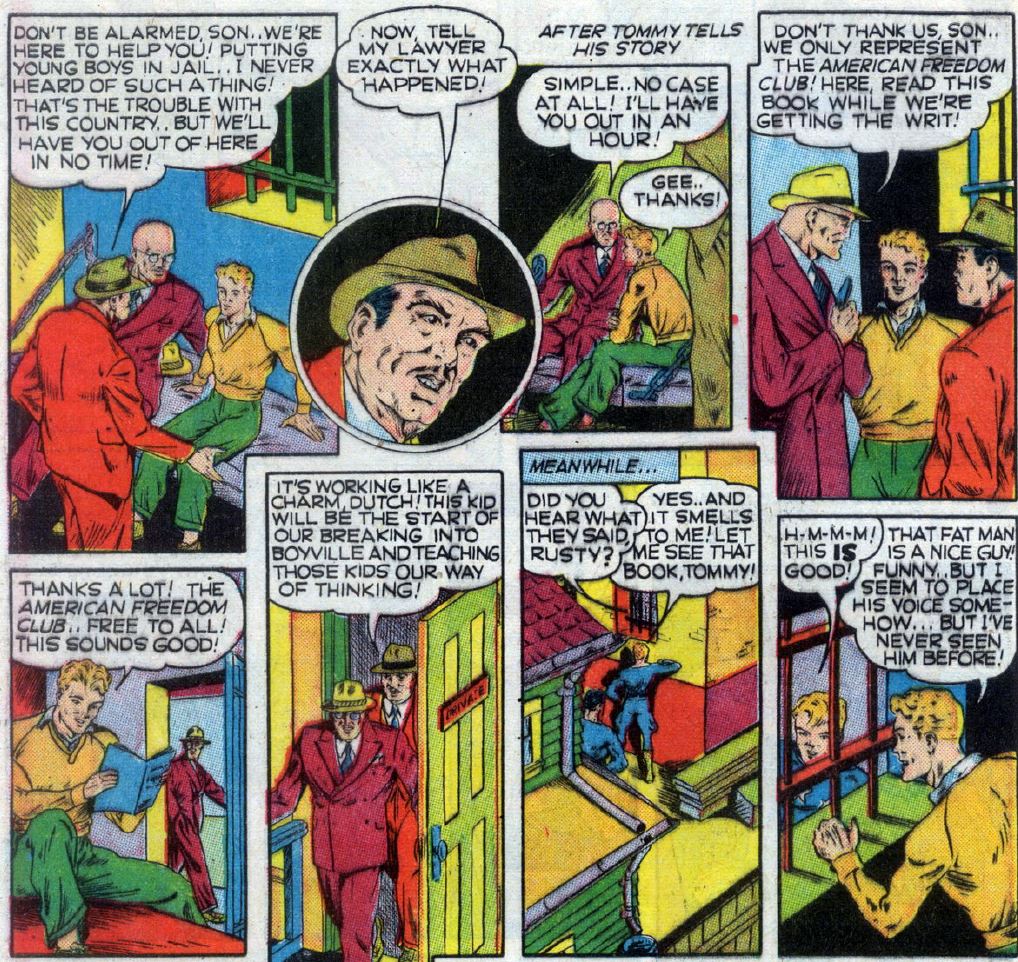
    The American Freedom Club AKA the Movement AKA the New Order were propagandists looking to corrupt the youth of the nation, starting with the Boyville Orphanage and ending with a beating from the Boyville Brigadiers (Feature Comics 047, 1941)

    The Anti-American Bund, a standard outsized play on the weenies that were the German-American Bund (remember them as the ones who ran away before Jack Kirby could ride the elevator down to beat them up). This version is for some reason forcing this lady who merely married a bundist to be their leader until she is rescued by Neon the Unknown (Hit Comics 008, 1941)

    The Double Cross! A non-specific Axis force poised to invade the US from within but foiled by the scientific acumen of Wizard Wells and the rough and tumble charm of his assistant Tug (Crack Comics 012, 1941)

    The Fasdicks/ the Fasdick Company, a fascist organization operating a business as a front for an invasion of the Phillipines and possibly a very oblique rude pun name? Foiled by Spin Shaw (Feature Comics 040, 1941)

  • MINOR SUPER-VILLAIN 380: THE ASSASSINS

    (More Fun Comics 065, 1941)

    It’s another version of a revival of the Assassins! These Assassins are very into the accuracy of it all and have their own Alamut HQ and their own top guy named Hassan (presumably followed by Ibn Sabbah but it’s never said in full). Commitment to the bit is not quite enough to save them once second-rate Lawrence of Arabia Lance Larkin gets on the case, however.

    This group were based out of Iran, unlike the Order of Assassins or the Society of Assassins, our previous claimants to the title of The Order of Assassins, Returned, For Real. Of the three, these latest guys are the least assassin-y – they operate a bit more like your standard comic book desert bandits.

  • MINOR SUPER-VILLAIN 371: THE BLITZ GANG

    MINOR SUPER-VILLAIN 371: THE BLITZ GANG

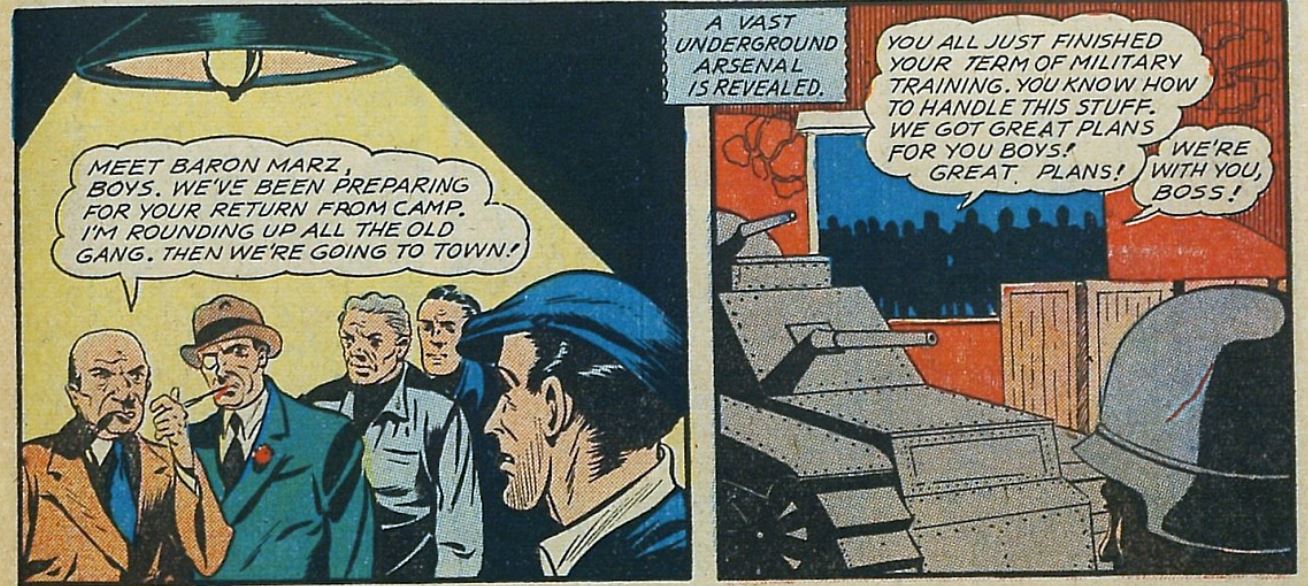
    (Minute-Man 002, 1941)

    AKA the Blitz Force AKA the Panzer Gang.

    I almost started out by saying that the idea of a criminal gang operating along military lines was an old one but no, it isn’t yet. It’s not a new idea – there might be half a dozen examples in this list so far and I’m sure it cropped up more than once in the pulps – but it’s not quite the mid-tier trope that it eventually will be.

    This time, the idea for a criminal army is inspired by US pre-war military training program crime czar Boss Donker and his don’t-say-he’s-a-Nazi pal Baron Marz have hatched a scheme that takes advantage of the readily-available supply of Army-trained men: arm them and loot cities wholesale (with an optional attempt to conquer the US for “the Fatherland,” wherever that is.

    And of course it all goes swimmingly until Minute-man shows up.

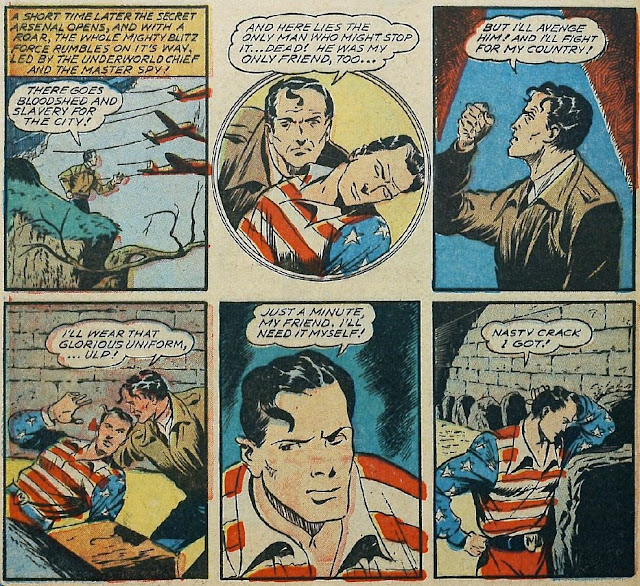
    The best part of the story by far is this bit here. Baron Marz has seemingly killed Minute-Man with a falling block of stone and Slippy, the only former gangster army recruit who doesn’t want to return to a life of crime, is about to take up the mantle in his honour. It’s actually kind of too bad that Minute-Man wasn’t actually dead, because having the identity change hands this way might have given him an interesting hook at last – maybe it could have been a series about person after person taking on th role of Minute-Man as needed and as the previous one falls instead of about a third-rate Captain America knockoff.

  • MINOR SUPER-VILLAIN 366: THE SCAVENGERS

    (Military Comics 005, 1941) 

    The Scavengers are an interesting bunch, but all of the most interesting things about them are implied rather than stated. As seen above, they show up to loot and murder in the aftermath of WWII battles. The fact that they all look the same, like little rat-men, is probably meant to be a metaphorical signifier of their moral degradation but I like the implication that this is what happens to battlefield looters, like the the transformation of a ghoul or other cannibal. This of course means that there could be Scavengers throughout human history – fun!

    The Scavengers don’t actually get to do much scavenging in-story, sadly. Instead, they are captured by the Nazis and enlisted in their capacity as weird little creeps to dispose of the Blackhawks. And they do pretty well at it! Their downfall comes due to the interference of the excellently-named femme fatale Red Laura, who somewhat predictably falls for Blackhawk’s nobility and shirtlessness.

    Despite having a heroic last stand, pictured above, Red Laura actually manages to survive the issue. One hopes that she was a bit more picky about who she worked for going forward, because I am inordinately fond of her. It’s just such a good name!

    In conclusion, the Scavengers should be BRUNG BACK. Not only did they not all die at the end of the adventure (as the Blackhawks are about as likely to punch out as to shoot an opponent) but the idea of them cropping up in the aftermath of war throughout history is very cool! We need more types of human monster who wear their spiritual corruption on the outside, if only for greater variety in D&D.

  • MINOR SUPER-HERO 044: THE Q-BOAT

    (Military Comics 001, 1941)

    This is stretching the idea of what a “minor super-hero” is quite a bit but I ultimately had to defer to my judgment rule about criminal groups: if one person were doing this would it make sense to categorize them such? And it would! The Q-Boat is just that, a warship disguised as a harmless four-masted schooner in order to prey on Nazi convoy raiders. Swap out the disguised ship for a submarine and you have the Red Torpedo, a personal fave!

    There are two interesting things about the Q-Boat the first is the fact that although it was a one-off story, whoever wrote it (probably Henry Kiefer?) left a lot of details to be filled in later. Specifically: what the heck is going on with the Q-Boat?

    As presented, the Q-Boat is not just a battle-capable schooner but a super-advanced miniature warship. It is crewed by Captain Foghorn (descended from John Paul Jones, speech balloons indicate that he’s speaking at top volume at all times) and a bunch of teen boys, including Bob Wayne, Dick Martin and Marmaduke “Freckles” van Weyden. Questions such as “where did the Q-Boat come from?” “why all the teen boys?” and “why is Freckles so good at making guided missiles?” all go unanswered (Captain Foghorn’s son-in-law is mentioned as having developed some of the tech on the Q-Boat but that just adds “who the heck is this son-in-law?” to the list).

    The second interesting thing about the Q-Boat is the fun sibling dynamic between the child soldiers.

  • MINOR SUPER-VILLAIN 364: THE BLACK DRAGON SOCIETY

    (Master Comics 021, 1941)

    The Black Dragon Society is nothing new: a bog standard Yellow Peril spy and sabotage ring that has a couple of weeks of success before being trounced by Minute-Man.

    The one interesting thing about them is that they were based on an actual Japanese secret society that was still extant at the time the comic was published. Despite the fact that the story is just as disseminating as pre-Pearl Harbor comics usually are about the exact country of origin of the Society, the fact is that this is our first Japanese super-villain, even if it’s a bunch of spies and even if it’s a technicality. History!

  • MINOR SUPER-VILLAIN 364: THE BLACK DRAGON SOCIETY

    (Master Comics 021, 1941)

    The Black Dragon Society is nothing new: a bog standard Yellow Peril spy and sabotage ring that has a couple of weeks of success before being trounced by Minute-Man.

    The one interesting thing about them is that they were based on an actual Japanese secret society that was still extant at the time the comic was published. Despite the fact that the story is just as disseminating as pre-Pearl Harbor comics usually are about the exact country of origin of the Society, the fact is that this is our first Japanese super-villain, even if it’s a bunch of spies and even if it’s a technicality. History!

  • MINOR SUPER-VILLAIN 359: THE UNHOLY THREE

    (Master Comics 017-019, 1941)

    The Unholy Three! A little guy (Nosey), a huge guy (Brutus) and a gorilla (Herbert)!

    Oh and of course we must not forget the fourth member of the Unholy Three, their boss “Doctor” J. Twiddley Fairchild (quotation marks his). Details in the actual story are sketchy but it seems as if Fairchild was jailed for larceny, escaped, assembled the other three as his minions and set out to get revenge on those who were responsible for his imprisonment – in other words an old fashioned Judge and Jury Revenge Killing scheme.

    This is where things get a bit annoying for me personally. JaJRK schemes are quantifiable based on the number of attempted slayings divided by the number of successful ones. The problem is that while we know that the Unholy Three end up killing all but one of their targets we do not in fact have any idea of how many targets there were – it’s more than three but up to something like twenty+ if the defense team and witnesses are included.

    Sadly then, JUDGE AND JURY REVENGE KILLING SCORE: n-1/n

    The Unholy Three (all four of them) end up getting caught by Bulletman and Bulletgirl before managing to finish off the last of their targets, but someone at Master Comics must have liked them because they returned for a two-issue story. Too bad for J. Twiddley Fairchild: he didn’t make it out of the initial jailbreak alive. Leadership of the group passed to Nosey and Bulletman became the new target for revenge.

    The actual action is whatever – the Unholy Three kidnap Bulletgirl and try to kill them both with a deathtrap and the second part opens with Bulletman thinking that Bulletgirl has died while the Unholy Three think that Bulletman has. This doesn’t really go anywhere interesting.

    Ultimately the Three attempt to flee the country and Bulletman kicks them off a cliff to their demise.

    OR DOES HE? Because the Unholy Three are collectively our second villain to be resurrected off-panel in time to sign the Crime Exchange petition. Like Mr Murder they never appear again but just knowing that two guys and a gorilla are out there somewhere is enough for me.

  • MINOR SUPER-VILLAIN 353: THE PURPLE HOODS

    (Master Comics 013-014, 1941) 

    I’m not going to lie: when I started reading this story I got excited for one of the more niche reasons I ever have. See, the prior Buck Jones story – the one with the Ghost Killer gang – was still wrapping up and I had a moment where I thought there would be some very exciting gang continuity if any of the former Ghost Killers, already relict of the White Arrow gang, had joined up with the Purple Hoods. That’s an unprecedented three gangs! Alas, Snake and Cope were sent to jail and the counter reset.

    Ephemeral hopes and dreams aside, the Purple Hoods are crass capitalist crooks: their big scheme involves kidnapping Mexican farm labourers and pressing them into slavery in a secret oil refinery. Ah, the romance of the Old West!

    And speaking of the Old West, this story is a perfect illustration of the weird liminal space that the West occupied in the 40s imagination: is Buck Jones an Old West marshal or a contemporary one? Does this issue offer any clues? The ascent of oil as a valuable resource does overlap with the Old West, and steel oil barrels of the kind pictured above are a 20th Century invention, but one of the major conflicts of the story is a business rivalry between two competing stagecoach lines and while I can find evidence of stagecoaches being used into the early 20th Century I doubt that they were such a going concern as that.

    What I’m getting at here is that I don’t know which way the anachronisms are going: is Buck Jones an Old West marshal with forward-thinking villains or a modern marshal in an overly romanticized setting? Who knows!

    (I must note that I do appreciate the Purple Hood leader getting his own special version of the gang costume)

    ADDENDUM:

    Two issues later (Master Comics 016, 1941), the story is clearly set in the Old West! Answers have been forthcoming at last!