The Curse of Skeleton Munroe

Category: magic

  • MINOR SUPER-HERO ROUND-UP 084

    MINOR SUPER-HERO ROUND-UP 084

    Obscure Marvel super-heroes, you say? But of course!

    Monako, Prince of Magic:

    Monako is a classic comic book magic hero in the Zatara vein, right down to the top hat, tuxedo and little mustache, though he does eventually switch to wearing a fez. His major distinction from his legion of peers is that he was brought back in a fairly recent Doctor Strange run, though as is so often the case he was dug up only to be horribly killed off.

    Monako gets an origin story in Daring Mystery Comics 004, in which he is orphaned when an Indian group referred to only as “the Cruel Tribe” ritually explode the entire caravan that he and his parents were travelling in as missionaries (this at least gives us an answer to the perennial question of why bring your young child along on such a dangerous journey: because missionaries).

    Young Monako (a last name? a stage name?) inexplicably survives the conflagration and is subsequently adopted by the chief of the Cruel Tribe, who teaches him the ways of magic. Just why he does this is not explored and will never be, because the British eventually show up to massacre the entire village and send young Monako back to England. Were he a going concern for the seventy-odd years between his final Golden Age appearance and his death, I’m sure that the question of just how a whole group of people with powers similar to the nigh-omnipotent Monako were killed with simple firearms, but alas, such was not the case. (Daring Mystery Comics 001, 1940)

    Categorized in: Locations (Unrelated Name), Power Categories (Magic), Royalty (Princes)

    Phantom of the Underworld: 

    “Doc” Denton is a surgeon-turned-detective who helps the police round up a gang boss named Perrone in his sole recorded adventure. I one hundred percent am including him here because “Phantom of the Underworld” is such a terrific name, even if nobody calls him that in-story. (Daring Mystery Comics 001, 1940)

    Categorized in: Day Jobs (Private Detectives), Locations (the Underworld), Supranormal Beings (Phantoms)

    Trojak the Tiger Man: 

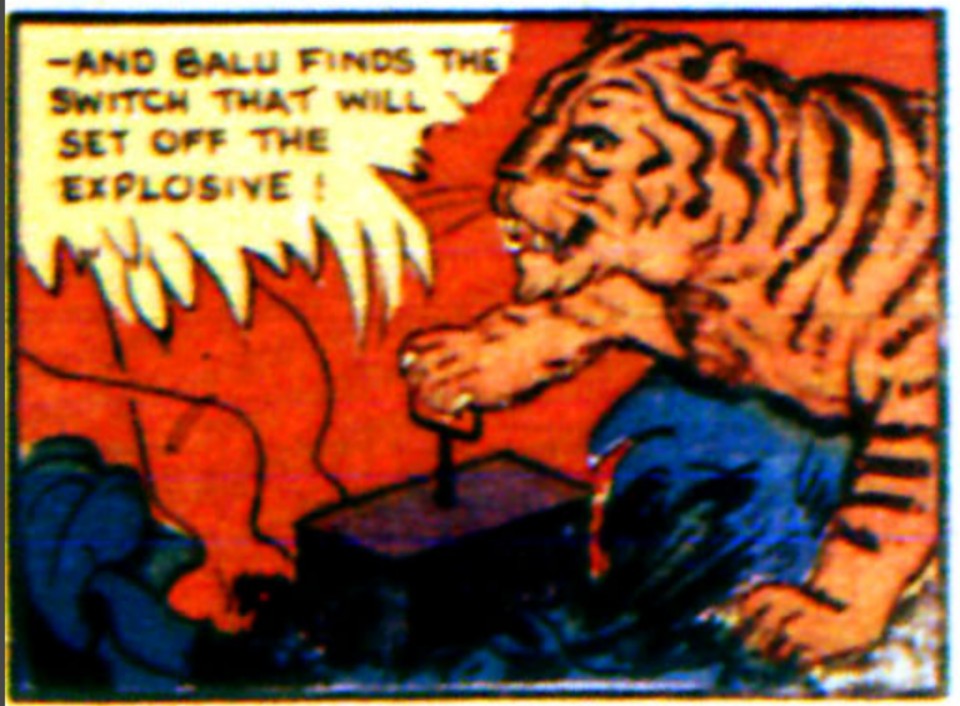
    Trojak, orphaned son of a jungle explorer who made the inexplicable yet very popular decision to bring a baby along with him on his travels (perhaps as a difficulty boost? Was Trojak’s father a gamer?), has grown up among a tribe his father died in defense of. As is so often the case in adventure literature, being a white guy in the jungle has made Trojak both stronger and cooler than everyone else, plus he can talk to animals like Balu, his geographically-anomalous tiger companion. (Daring Mystery Comics 002, 1940)

    (he is a very intelligent tiger)

    Categorized in: Animals (Tigers), Generica (Mans), Origin (Orphan Raised in Jungle)

    Tigerman:

    “Trojak the Tiger Man” becomes “Tigerman” for its final instalment, and it’s a bit of a toss-up on whether the two characters are supposed to be the same or not. Both Trojak and Tigerman are orphaned youths who were raised by jungle tribe and who now adventure while in the company of a tiger named Balu, sure, but crucially “Trojak” is set in Africa while the Tigerman roams India. You’d be forgiven for assuming that Tigerman was Indian but no, he’s American by birth – he’s just the rare near-naked jungle guy who has the ability to get a tan. 

    The one thing that could have cleared up the mystery of whether these two are the same guy or not would be more adventures featuring either one of them and sadly there are no more (Daring Mystery Comics 006, 1940)

    Categorized in: Animals (Tigers), Generica (Mans), Origin (Orphan Raised in Jungle) 

    K-4 and his Sky Devils:

    K-4 is the code name of a “flying spy,” and WWI/Spanish Civil War fighter ace (the youngest WWI ace, according to the text box, which would make him at most 18 as far as I can tell) who leads the Sky Devils, comprised of fellow WWI ace René d’Auvergne and makeup expert Ronald Wolverstone-Clodd. Some of the usual fun of the multinational team set-up is missing here because K-4 spends a lot of his time doing solo missions. (Daring Mystery Comics 002, 1940)

    Categorized in: Alphanumeric (K, 4), Origins (WWI vets), Supranormal Beings (Devils)

  • MINOR SUPER-VILLAIN 939: THE BLACK PHARAOH

    (Silver Streak Comics 014, 1941)

    After his initial defeat at the hands of Thun-Dohr, the villainous Sin Khaii is on the lookout for an ally in his war on humanity and he finds one in the pages of a tome called the Book of the Dead, and presumably it’s the Egyptian Book of the Dead because the candidate he lines up is called the Black Pharaoh, the only Pharaoh evil enough that he was cursed and sealed up in a pyramid to think about what he had done for all time. The only way he would be able to go free is if a) the pyramid moves, which will free the Pharaoh’s servant Tut-Mut, who b) must then find new guys to take the place of the Black Pharaoh and his cronies. All of this stands as a real lesson for those inclined to mete out mystic justice: if you’re going to seal away evil or otherwise prevent awfulness from getting everywhere and your work can only be undone by a very specific set of circumstances, don’t write those circumstances down anywhere.

    As usual, I attempted to figure out just who if anyone the Black Pharaoh is supposed to be, with the only real clue being that he was buried in “the oldest pyramid in Egypt,” and while there are a few contenders for that title due to the gradual development of pyramid technology, the oldest pyramid-shaped pyramid like the depicted in the story seems to be the Red Pyramid near Cairo. What does this tell us? Only that the Black Pharaoh was interred some time after 2563 BC, alas.

    Sin Khaii isn’t one to be deterred by any Ancient Egyptian mystics. He uses his dark majicks to transport the pyramid to the former site of the New York World’s Fair and then deploys a bug from the criminally-underutilized Pandora’s Box to infect passersby with Curiosity so that they will enter the structure and fall prey to Tut-Mut.

    The innocent people of Queens need not fear, however, for Thun-Dohr and his mentor the Dalai Lama (not that one) are on the case. Thun-Dohr ambushes the Black Pharaoh’s servants as they ransack a museum, only to be captured via some pretty cool shadow magic.

    Finally, the Black Pharaoh and Sin Khaii get down to business and formulate a plan: they are going to recreate Ancient Egypt on a grand scale by smothering the entire United States in a layer of sand. This is why the Pharaoh’s men are looting museums, to get all of their boss’ stuff back before it is buried forever.

    (the duo’s apocalyptic sandstorm is shown blowing across the Atlantic from Egypt, and there’s a part of me that wants to get really pedantic about the relative sizes of the two countries and point out just how thin the available sand would be spread, but we are dealing with magic after all. Presumably the sand would be multiplied somehow? I’m much more concerned about the state that Egypt was left in – just how much of that sand was load-bearing?) 

    If there’s one thing about shadow magic, it’s that you need shadows to use it, and the Dalai Lama deals with that by blowing out the candle that was supplying the particular shadows keeping Thun-Dohr bound. Thun-Dohr disrupts the ritual – is the sand just hovering somewhere in the mid-Atlantic? This has to be the kind of thing that inspires conspiracy theories in a comic book universe, particularly in the kind where super-heroic stuff isn’t front page news.

    Thun-Dohr and the Black Pharaoh engage in Thrilling Astral Combat (I think. Whenever two people are battling on a cloud I assume that this is shorthand for their astral forms duking it out in the Aetherial Realms, but in this case it’s possible that they have merely chosen the clouds as their battlefield for some unexplained reason) with Our Hero emerging victorious and the villainous Pharaoh at the bottom of the ocean, weighed down by his sins. After that it is a simple matter for Thun-Dohr and his mentor to restore the pyramid and sand to Egypt.

    As always, it’s kind of disappointing when an ancient evil that was sealed away for untold eons is dispatched with relative ease in the present day. After all, why go to all the trouble with the curse of eternal slumber if you could just murder the guy in the first place? I suppose the fact that the Black Pharaoh was royalty might have played into it somehow, though on the other hand “being murdered” has to be the most expected way to die for a historical royal. Give me more formidable primordial evils!

    Categorized in: Colour (Black), Origin (Resurrected Mummy), Royalty (Pharaoh)

  • MINOR SUPER-VILLAIN 930: THE BLACK DRAGON

    MINOR SUPER-VILLAIN 930: THE BLACK DRAGON

    (Silver Streak Comics 010, 1941)

    Here’s the thing about the Black Dragon: though he looms large in the early adventures of Captain Battle and is a key player in the origin of Hale Battle, he doesn’t personally do that much villainy.

    So just what is the Black Dragon’s deal? Well, he’s a magic using tyrant who lives in a secret castle in some unspecified Asian mountains, and he’s the secret mastermind behind the Axis Axian Powers, making him the guy behind WWII! Like I said above: he doesn’t personally get his hands dirty.

    So what kind of evil does the Black Dragon get up to? Mostly he captures people and turns them into monsters with his fell majicks, such as when he attempts to do so to Captain Battle, above. This attempt fails because the Black Dragon fails to think to take his prisoner’s iconic jet pack away.

    In his second appearance, in Silver Streak Comics 011, the Black Dragon captures Captain Battle’s assistant Jane Lorrain and offers her the creep villain’s choice of becoming his queen or being transformed into a monster. He then attempts to take on Captain Battle in hand-to-hand combat and is quickly disabused of any illusions he might have had about his martial prowess. 

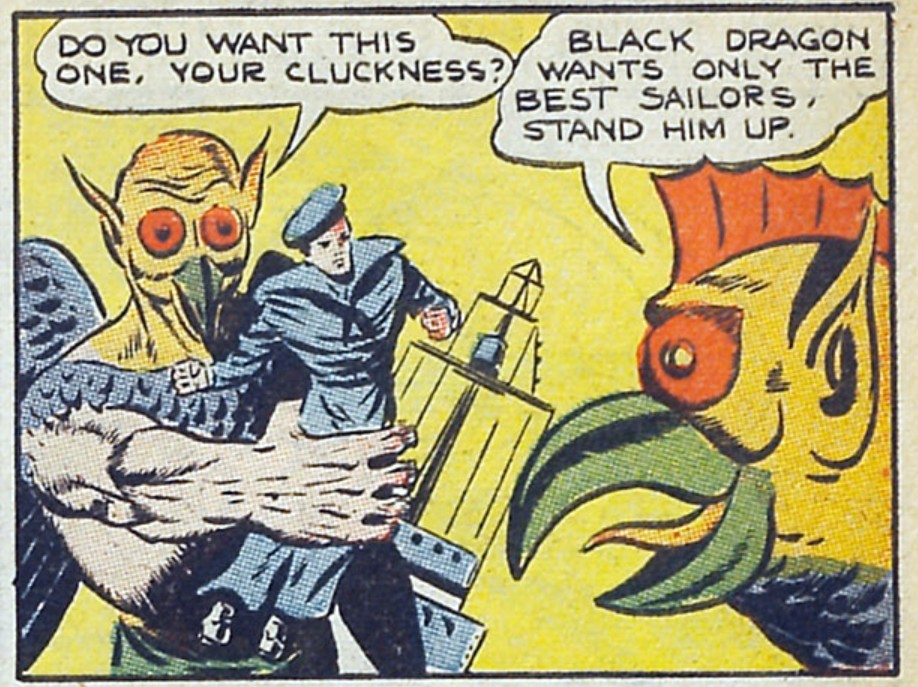
    The reason that the Black Dragon is so personally unimpressive as a villain is that all of his important evil works are done by Deaglos, giant bird-men that he makes out of captives. Monstrous humanoid mutates are nothing new in comics even this early in their history, but the Deaglos have one very cool feature that almost feels like it comes from a Vertigo-era New Weird comic: they are created using the spirits of the extinct dodo and so are immune to death.

    (the Deaglos also have field commanders referred to a “your cluckness,” which is very fun)

    By Silver Streak Comics 012: Captain Battle gets on the right page and realizes that if he cuts off the Black Dragon from his Deaglo supply he will have little to no ability to do evil. Plus the Deaglos are technically also victims, so his prior solutions of horrifically melting them with his dissolvo ray or using their inexplicable vulnerability to radio waves to kill them all are no very heroic acts. Accordingly, he brews up a “de-witcher solution” and applies it to a captive Deaglo, restoring him to his human form of Major Ling Fu.

    Captain Battle and the Major then go on to blast all the other Deaglos with the de-witcher, which coincidentally places a hostile force within the very walls of the Black Dragon’s fortress (this is where Hale Battle comes from).

    In his final act as a super-villain, the Black Dragon responds to this invasion by making what is probably the funniest evil exit of the Golden Age. “Ha Ha-Haaaaaa!” *strikes evil pose* *sinks into floor* *is never seen again*. I can’t endorse the whole thing where he started World War Two, but this exit really engenders a lot of affection for the guy in my heart.

    Categorized in: Animals (Dragons), Henchmen (Deaglos), Supercrime (Attempted World Conquest) 

  • MINOR SUPER-VILLAIN 539 UPDATE: THE CLAW (1941 PART 1: THE CLAW VS DAREDEVIL)

    The Claw simply has too many appearances in 1941 and if we covered them all in one post it would be exceptionally long. Thus, we are breaking things up into three chunks. The first and longest of these chunks concerns the Claw battling his most famous opponent, the Daredevil, across five issues of Silver Streak Comics.

    The Claw is now firmly established as being based in Tibet and he has a brand new headquarters: a cool skull-shaped castle. He also has a new goal, to invade and conquer the United States, and to that end he uses a combination of a drilling machine and the labour of his horde of undifferentiated fanatical Asian followers (a hoary old racist trope when this comic was published in 1941 and one that crops up again to this day). I was all set to clown on the Claw for going under the Atlantic rather than the Pacific but then I checked on a map and it seems that it is in fact 5000 km shorter to go that way.

    The Claw’s initial approach to conquering the US is to use simple shock and awe to cow the nation into surrender. He attacks New York City in his giant form and employs an underground generator to fire lightning bolts from his fingers in a way that I don’t quite understand. Is the Claw shooting lightning and the generator merely draws it downward or is the generator solely responsible for the bolts? Either way, New York takes a real beating – so much so that the next issue features a short segment on how it gets put back together again.

    It is at this point that the Daredevil, long established as a New Yorker, steps in. He busts up the lightning generator and beats up the ground troops that the Claw had sent in to pillage the town, then engages the Claw himself. This first battle between them ends when a temporarily-ingested Daredevil drops a stick of dynamite down the Claw’s throat and the villain retreats in a puff of smoke.

    The Claw returns Silver Streak Comics 008 with the maximum degree of subtlety that he appears to be capable of exercising. In an excellent initial plan, he mind control the President (and possibly other government officials) and begins shaping government policy through him. The only major flaw in this plan is the fact that the Claw is constitutionally unable to operate at anything but full throttle, and so he essentially speedruns totalitarianism with a series of reforms designed to impoverish the nation and curtail personal freedom.

    It is only at the point that armed guards are preventing people from going to church that the Daredevil once again takes a hand and exposes the fact that FDR is a mind-controlled thrall. The reins of government are passed off to the Vice-President – presumably Henry A. Wallace, given the publication date – and the Claw is so annoyed by this that he has his men begin to systematically loot US cities including Boston, Philadelphia and Washington.

    Daredevil manages to play on the Claw’s pride and goad him into single combat at a normal human size, which ends in the Claw being beaten up so badly that he is no longer able to access his powers and is easily slung into jail.

    Silver Streak Comics 009: With the Claw in jail, powerless and scheduled for execution in one week’s time, Bart “the Daredevil” Hill decides that, having saved the entire nation on two separate occasions, it’s high time that he take a vacation. So resolved, he hops a yacht for the South Seas and some fishing.

    This proves to be a grave mistake, as the charge of the electric chair is just what the Claw needs to be revitalized. In short order, he breaks jail and sets out with his fellow prisoners, now joined up with him as a criminal army, to make yet another attempt to take over the US. 

    The Claw and his new followers retreat to an extinct volcano in the Rockies and there found a criminal city, which is a concept that I personally have a great deal of affection for and am very pleased whenever I encounter. There, the Claw develops another comic book classic, the engine-killing ray, and uses it to systematically lure and capture US military aircraft until he holds absolute air superiority over the North American continent.

    (about here is when Daredevil II, aka Bart Hill’s unnamed and unmourned brother, makes his run at the Claw and is moderately ceremoniously killed)

    Using his overwhelming air might, the Claw forces the US – possibly still under Vice-Presidential control, which would go far to help FDR’s legacy in light of what happens next – to surrender to his rule. The newly-proclaimed Emperor of America is without effective opposition, having captured the original Daredevil when he deigned to return from his vacation. The modest crime city in the Rockies grows into a bustling new capitol city of the USA over the multiple months that the Claw is in control of the country.

    Having achieved his goal, the Claw enacts a nationwide search for an appropriate consort, finally settling on a luckless young woman to be his unwilling Empress of America. This backfires almost immediately, as the new Empress uses the freedom of her position to sabotage the execution of Daredevil and then escape with him on a handy motorcycle.

    Daredevil returns, of course, and in swift order tricks the Claw into stomping his foot hard enough to set off the dormant volcano under his city, thus destroying it, his criminal army and seemingly himself (and probably a lot of political prisoners and rejected Empress of America candidates, too). The Nation is safe!

    Silver Streak Comics 011: Having repeatedly met defeat at the hands of one man, the Claw grows somewhat discouraged and so turns to the dark arts for aid, and specifically turns to the “genii” Lucifer, to whom he claims to have already sold his soul. A few things about all this:

    Why call him a genii and not a demon? No idea. If this comic were produced in the mid 50s or the mid 80s I might say that it was an attempt to avoid the scrutiny of moral crusaders, but nobody else in 1941 is shy about calling a demon a demon.

    Did this Lucifer stuff ever come up before? It did not and furthermore will not come up again. The Claw has used magic in the past, however, so I guess we must assume that he gained that power through selling his soul.

    If Lucifer already has the Claw’s soul then what’s in this deal for him? Lucifer seems to accept the Claw’s proposal out of mere caprice. Perhaps he looks forward to seeing more chaos being inflicted on the world. The only payment he extracts from the Claw is a stipulation that if he does not defeat Daredevil this time then he will be “banished to Asia,” which I read as some sort of mystic travel restriction.

    Flush with new power, the Claw challenges the Daredevil to a battle to the death and enhances the challenge by attacking the country with various demonic genii entities. How can Daredevil hope to prevail?

    With relative ease, as it turns out. The Claw’s monstrous minions might be dangerous but, like all of us,  are vulnerable to the awesome might of an avalanche, while the Claw, weakened and abandoned by his demonic genii ally, once again falls prey to a Daredevil right hook. The Daredevil and the USA are free of the Claw forever!

    (in actuality the Claw and Daredevil meet up one last time, in Daredevil Comics 001, aka Daredevil Battles Hitler, though the Claw never knows that Daredevil is there. In the story, the Claw has made a pact with Hitler to aid the Japanese in their conquest of China and Daredevil employs subterfuge and sabotage to set the two villains against one another. Also, the Claw absolutely returns to the US – I guess that’s what comes of going with a genii instead of a demon for your fell curses)

    And one last thing that didn’t fit anywhere else: though the Claw is a long-time size changer, this is the year that he demonstrates the ability to selectively grow parts of his body, seen here in Silver Streak Comics 009.

  • MINOR SUPER-HERO ROUND-UP 073

    It’s a fine day for a dose of minor super-heroes. 

    Alias X: 

    Alias, aka just X, is a mysterious master of disguise who has been cleaning up crime in NYC for the better part of a year and who, as of his first appearance, has now deigned to tell his origin story to Police Commissioner Malley and newspaper editor Hunch Armstrong.

    Turns out that X was a small-town taxi company owner who was railroaded and sent to prison for a crime he didn’t commit, and that after two years in prison he managed to escape, became a master of disguise by sheer willpower and set out to battle crime until he could track down the crooks who really committed the crimes he was convicted for and clear his name.

    The police commissioner must be a trusting guy, because he refrains from putting out an APB or whatever on Alias X after he hears this confession. 

    As far as I can tell from a skim of the 1942 portion of Alias X’s dozen or so adventures, he never catches up with the crooks who framed him – just one of the many loose ends of the comics. Please also note that Alias X is a calling card guy. (Captain Fearless Comics 001, 1941)

    Citizen Smith: 

    Citizen Smith! Plain old John Smith, who could be any one of us regular Americans! Just a regular guy! So why are we reading a comic book about him?

    Citizen Smith is in actuality John Smith, an aircraft factory worker in Washington DC and also an orphan consumed with the desire to know just who his parents were. While stewing on this after work one day he wanders up to the Tomb of the Unknown Soldier, where he receives both great news and a great shock as a ghostly figure appears and tells him that he, the Unknown Soldier, is Smith’s father.

    Smith’s new ghost dad charges him to keep America safe, with the promise that he will appear and aid his son if needed (sadly this does not occur in either of the two recorded Citizen Smith adventures). The newly-created Citizen’s Guardian of Liberty and Guardian of the American Way then sallies forth to whale on fifth columnists with his two good all-American fists.

    Now, I try to take comics as they are presented to me and not engage in a lot of “what if they were dead the whole time”-style fan theory nonsense but I will say that if I were writing a gritty early-2000s Citizen Smith reboot… all this ghost stuff would just be a hallucination brought on by his obsessions, right? Just a lonely man giving his life meaning by latching on to a powerful symbol to fill the hole in his life. But of course that is not who we are here. Citizen Smith is as he appears: a divinely ordained champion of the American Way. (Captain Fearless Comics 001, 1941)

    Miss Victory: 

    Miss Victory is Joan Wayne, a woman who works in Washington DC in secretarial and similar roles and who seems to have seen an opening for a two-fisted vigilante and filled it, no further origin necessary. There is some hint that her vigilantism is officially sanctioned in the first couple of panels of her first appearance, but if so she has very little oversight. She is much more willing to resort to violence than a lot of her female contemporaries, which is kind of refreshing.

    Miss Victory does share with our old friend the Eagle the inability to really settle on a costume design, so I’m sure that we’ll be revisiting her in that capacity. 

    Case in point: this revised version of her costume from her second appearance, in Captain Fearless Comics 002. As with most of her costume changes it’s a variation on the theme of her previous look and is probably explained by the fact that she  (Captain Fearless Comics 001, 1941) 

    Mr Miracle: 

    Mr Miracle is of course among the ranks of the obscure Golden Age characters who have the same name as a more well-known modern character, but he is also a member of a much more select fraternity: of characters whose origin involves a suicide attempt, though the precise reason that the unnamed man had for jumping is never given.

    The future Mr Miracle is pulled out of the water by a helpful stranger and brought to the great scientist Professor Rietz, who revives him via a twenty hour session under his “mind-ray,” only to be betrayed and shot by his assistant Sango at the final hour. Sango turns out to have been a foreign agent who was laying in wait for the mind-ray to be perfected, and now the hour has come.

    The still-unnamed man wakes to a ruined laboratory and a dying Rietz, who reveals to him in addition to saving his life, the mind-ray has given him great if unspecified powers. He then extracts a pledge from the man that he will use this power to aid mankind and promptly dies.

    The man creates a costume, renames himself Mr Miracle and sets out to use is vast array of abilities (transmutation, teleportation, telekinesis, intangibility, size control, flight, etc, etc. Though Mr Miracle is technically some sort of psychic mutate he is in effect a nigh-omnipotent comic book magic user) to bring Sango to justice. 

    Mr Miracle gets to honour the promise he made to Prof. Rietz precisely one more time (by sinking a u-boat) before fading into the mists of comic book obscurity. (Captain Fearless Comics 001, 1941)

  • MINOR SUPER-VILLAIN 907: HALF-MAN

    (Whiz Comics 021, 1941)

    Due to Allied concerns about the Nazis generic Axis use of black magic to ensure victory, Ibis the Invincible is recruited and sent to the front as a counter-sorcerer. His foe: the mysterious Half-Man, occultist and rumoured worshipper of an ancient evil god called the Dark Spirit.

    The Half-Man served with distinction in WWI, until an artillery shell cost him a leg, an arm and an eye and he was no longer able to lead troops in battle. He then turned to the study of black magic to make himself powerful and potentially whole again, and with the advent of WWII he has offered his services to the War Lord, Fawcett’s all-purpose late-1941 Hitler stand-in.

    Some further particulars: 

    In his first appearance, Half-Man has these pseudo-Gestapo occultist minions who are masterpieces to design. They could not more obviously be weird creep villains. They also receive planchette-writing intel from “the watchful ones,” which could be flowery language describing another set of occultist creeps in a lookout post somewhere but which I prefer to think is some sore of class of spirit. 

    Perhaps it’s the Ancient Egyptian in him coming through, but Ibis is unable to treat Half-Man with anything but pity and contempt, no matter how often he is proven to be a legitimate threat, as above when he completely is completely trounced by the guy.  

    Like I said, the first issue that Half-Man appears in contains a lot of talk of the ancient god called the Dark Spirit helping to ensure the Axis victories, and I had initially thought that his magical power was also derived from this being, like a D&D warlock, but Whiz Comics 023 includes a segment in which Ibis is almost sacrificed to the Dark Spirit, here called the Angry God, and manages to turn the tables and kill the god’s one remaining priest instead. This seems to kill the Angry God as well without noticeably diminishing Half-Man’s power, so I guess it’s more of a Hellboy situation in which all of the Evil Magic Guys are lumped together into a unit.

    Speaking of the military applications of mystical power, the final act of Half-Man’s villainous career takes place on the battlefield between the War Lord’s forces and those of an unnamed Allied nation that starts out on a back foot because someone is scrying their troop deployments with a crystal ball. 

    Once Ibis joins the fighting on the small nation’s side, Half-Man too is obligated to take the field, and while no mortal army is a mach for the power of the Ibistick, he manages to capture Taia and get away. The back-and-forth between them might have gone on indefinitely, but for the fact that the War Lord himself shows up and treats Half-Man with a sneering condescension instead of acknowledging his clear need for validation. This gives Ibis the chance to step up and be nice to the guy by restoring his lost body parts. Having finally achieved a feeling of wholeness again, from being literally whole rather than from magical accomplishment, the former Half-Man reforms. Hopefully he had some sort of plan in place to get to a neutral country, since he renounced his magics and presumably fascism at the end there and I doubt that the War Lord would be too understanding of that. 

  • MINOR SUPER-VILLAIN 904: THE BLACK MAGICIAN

    (Whiz Comics 019, 1941)

    This story’s conflict is precipitated by Billy Batson dedicating his radio time one day to the subject of black magic and the nonexistence thereof, and while this dovetails nicely with the 40s and 50s US cultural project of promoting the supremacy of both scientific rationality and Protestant Christianity over superstition (which includes all other world religion, natch), it’s a bit rich coming from someone who got super powers from a wizard who lives in a magic cave.

    Billy’s broadcast also has an unintended consequence: it is heard by an actual black magician living in the hill country near New York Fawcett City, who gets a bit upset on behalf of his profession. This fellow and his son/apprentice Nip are of course examples of the pop culture hillbilly that we continue to encounter to this day but was really in full flower in the 1930s and 40s.

    The Black Magician is so insulted by Billy’s disrespectful comments about magic, in fact, that he and  Nip make two separate attempts to murder him, the first on their own and the second with the help of thugs paid for with magically-created money. These attempts fail thanks to Billy’s timely transformations into Captain Marvel, and also provide a fine illustration of that poor opsec that I always accuse Billy of having. Surely you could make it a little less clear that you and Captain Marvel are one and the same, Billy!

    Undeterred, the Black Magician next turns to sympathetic magic to strike down his enemy, fashioning a wax likeness of Billy and disabling his limbs and, crucially, his mouth and thus allowing Nip to capture him. Note, however, that the mouth thing is accidental and that despite all my complaining the majority of Captain Marvel’s enemies fail to put two and two together re: the relationship between him and Billy Batson.

    The Black Magician then learns one of those life lessons that are very situationally important, even though they don’t have a lot of day-to-day applicability, and that lesson is: don’t use cheese in your great work of magic if you have a cat or you will suffer Consequences, in this case in the form of Captain Marvel. I suppose the more universally useful version of this lesson would be If You Value Your Cheese, Don’t Leave It Out or the Cat Will Get It.

    In a fun twist on the idea of sympathetic magic, the link between Billy and his effigy is strong enough that the wax figure is transformed into a miniature Captain Marvel at the same time as Billy becomes the real thing, and both proceed to lay into the father-son duo.

    Once the pair are subdued, Captain Marvel consigns their book of magic to the flames, and this has the (presumably) unintended consequence of rendering both the Black Magician and Nip completely insane, in your classic 1940s “thinks he’s Napoleon” kind of way. We can only theorize at the dark pacts they must have signed to gain power and the terrible toll that breaking them must have taken. Sadly, they appear to have never recovered or at least were uncommonly willing to forego the traditional attempt at revenge if they did.

    TROPHY ROOM ADDENDUM: Captain Marvel keeps the effigy, still transformed but no longer animate after the burning of the book, as a souvenir.

  • MINOR SUPER-HERO ROUND-UP 067

    Something for everyone* in this one.

    *not really. 

    Zambini the Miracle Man: 

    Zambini the Miracle Man, aka Zambini the Great, is your fairly typical comic book magic man, albeit a bit more flamboyantly dressed than even that crowd normally are.

    Though Zambini has a lot of the regular magic abilities of his peer group his signature trick involves his magical Boomerang Amulet, which causes evil to rebound on its sender. This takes forms as diverse as a cobra returning to the one who released it to bombs flying back up to the plane that dropped them to magic spells rebounding on their casters. 

    (please also note the final panel above, in which Zambini is being made a Knight of Ritania, which I here recognize as an honour)

    Finally, while I generally do enjoy when a magic user has a weakness to counter their nigh-omnipotence, Zambini might just have the worst one in comics: the touch of a human hand renders him completely powerless and unable to resist, to the point that this Hundanian spy is able to gently lead him to their headquarters and he is only saved when her boss gets jealous – thank heavens that Hundania doesn’t have a robust anti-workplace romance policy. This weakness kind of falls by the roadside as time goes on but does occasionally crop up now and then in horrible ways. (Zip Comics 001, 1940)

    Perhaps the most interesting thing about Zambini is his magical system: for his first two appearances he casts spells by spouting nonsense words (as far as I can tell), but from Zip Comics 003 onward, he uses a version of Ubbi Dubbi that involves inserting the syllable “ab” instead of “ub”. I don’t know if it’s strictly better than speaking backward, Zatara style, but it certainly is unique.

    Atom Blake, Boy Wizard **UPDATE**:

    I had read the 1940-1941 issues of Wow Comics before embarking on my great comics-reading project, so I already knew going in that Atom Blake would essentially speed-run the process of getting tired of living among mere mortals and heading off into space, Dr Manhattan style, but I had forgotten that he is doing so in order to look for his long-lost father. Also, while I did remember that Blake duplicated himself before setting out I had misremembered it as him leaving behind a non-super version of himself on Earth while the superhuman part set off for adventure. What I’m saying here is that the version of Atom Blake that I had remembered is way more interesting than the actual character. (Wow Comics 002, 1941) 

    the Hunchback: 

    The Hunchback is in actuality wealthy playboy Allan Lanier, who became obsessed with the figure of Quasimodo after seeing the 1939 film version of the Hunchback of Notre Dame (or possibly a literal picture of the character – the text box isn’t 100% clear) and combined that with his interest in wiping out crime to become a weird spectre of the night, Batman-style.

    Lanier is refreshingly up-front about his interest in criminology, to the extent that he is seen droning on and on about it before a date with his fiance Betty Brenton. I don’t know if I’d like every fellow with a secret identity to abandon the “disaffected socialite” act, but it is nice to see the odd one do without it and just be a weird eccentric.

    The Hunchback really leans into two specific aspects of his inspiration: he is absurdly acrobatic, and he metes out insane and terrifying violence to his foes. The latter has git to be one of the better justifications for the dread a masked figure of the night inspires among the criminal fraternity.

    We’re on a bit of a run of characters who share their secret identity with their love interest and Alan Lanier is one of them: his fiance Betty has to be told before she will let the Hunchback help her (this might be the downside of the whole “reputation for insane violence” thing). (Wow Comics 002, 1941)

    In the Hunchback’s second adventure, in Wow Comics 003, Lanier switches to a slightly more conventional super-hero outfit. It’s a generic but not terrible design, and I always appreciate a character making a bold hat choice, but I think that it is perhaps a bit too twee for a character who is supposed to be some sort of rampaging engine of madness and destruction. The old uniform came back out of the closet for the Hunchback’s remaining appearances.

    Pinky the Whiz Kid: 

    Pinky the future Whiz Kid (not technically called that until 1942, but whatever, we’re loose and goosey around here) is already a fan of Mr Scarlet before he is rendered a crime orphan by the villainous Mr Hyde (upcoming), who seemingly randomly murders his mother.

    Pinky ends up at Oaklawn Orphanage, which just so happens to be run by Mr Hyde’s alter ego, Dr Jelke. When Hyde/Jelke and Mr Scarlet inevitably clash, Pinky is right there in his homemade sidekick costume to help out.

    Pinky is adopted by District Attorney Brian Butler, ostensibly to keep him out of trouble, but since Pinky has worked out that Brian is secretly Mr Scarlet he is able to blackmail him into becoming his sidekick. It sounds more sinister than it reads, honestly.

    The real downside to Mr Scarlet getting a sidekick is that Miss Wade, formerly a romantic sparring partner for Brian and occasional daring assistant in her own right, is relegated to the role of scolding caretaker as she sensibly attempts to prevent a teenager from flinging himself into danger. It’s a real loss to the comic.(Wow Comics 004, 1941)

  • GENERIC COSTUMED VILLAIN ROUND-UP 031

    They’re not good people and they’re not good at what they do and yet they still have a certain charm. 

    This guy is exclusively called “the Fiend” in narration boxes even though he is introduced as “the Great Master” and “Mako”. He practices voodoo and just sort of generically terrorizes the Haitian countryside until Yarko the Great comes at the behest of the intriguingly named Doctor Medico to settle his hash. And speaking of names, this issue features multiple characters referring to voodoo practitioners rather than their subjects as “zombies,” which is a new one on me unless of course you count the Grand Zombie. (Wonderworld Comics 019, 1940)

    Called “the Wolf” by detective Dr Fung as he is hunting him down, this masked fellow is actually Horace Bailey, a Wall Street financier who killed his partner to gain full control of their firm and made the mistake of involving a super-sleuth in the execution of his perfect murder. (Wonderworld Comics 020, 1940)

    Don Cervantes is a fellow who discovered silver in the hills near the small probably-Mexican town of Toranto and decided that the best way to keep it all to himself was to revive the practice of human sacrifice in the area. This does not prevent Nevada Jones from moving in and deposing him, of course. (Zip Comics 007, 1940)

    Comic books having cover illustrations that do not reflect the action in the book itself are nothing new, but this is the first time I have felt the need to highlight any of the characters on them whose adventures have gone unchronicled. Here’s to you, Executioner, Green Guy with Sickle Claw and Tiny Green Guy, I’m sure that you were very dastardly. (Zip Comics 008, 1940)

  • MINOR SUPER-VILLAIN 876: THE CULT OF ANKKAMAN

    (Zip Comics 006, 1940)

    Zambini the Miracle man is visiting his old friend the archaeologist Professor Lorenz when he learns that Lorenz is potentially filled with curse-energy thanks to an ancient tomb he violated. The Professor is dismissive of these concerns, even though both his daughter Greta and Zambini himself reckon that there might be something to them.

    Sure enough, the very instant that Zambini has left the Lorenz house, two members of the Cult of Ankkaman show up and kidnap Professor Lorenz, making use of the magical Doorway of King Ankkaman (one of the items that he brought back from his travels/ that the cult are angry about him making off with) to spirit him away. 

    Sensing trouble, Zambini returns and finds Greta Lorenz in a state of hypnotic paralysis thanks to the cultists’ magics. He frees her and they use the Doorway to follow.

    Now. There are exactly two things that got me excited about this particular entry, which is otherwise a pretty standard tale of a group objecting to the theft of their cultural objects from back when that was seen as unreasonable and villainous thing to do. The first of these is the fact that the Cult of Ankkaman comes from the country of Egyptasia, which I am 90% certain based on context clues is a country exactly like Egypt, only in Asia. Why set a story that could so very easily take place in regular old Egypt in this unnecessary new country you ask? Beats me, but it’s exactly the sort of weird comics thing that I love.

    The second thing is simply that Saki, the Cult’s magic user, does his spells Zatara-style, by speaking backward, and that the close proximity of this to Zambini’s “abbi dabbi” style of spellcasting really highlight just how silly both of these affectations are.

    Prof Lorenz is weirdly calm about being sacrificed to Ankkaman, which he rationalizes as some sort of extremely visceral research. Fortunately for the field of anthropology, Zambini shows up in time to ensure that he is able to publish this experience rather than perish due to it.

    Zambini, the Professor and Greta make their way back through the Doorway of Ankkaman, which Zambini then seals by the simple expedient of adding a door to the frame. The Professor is saved! Unless the cultists make their way back to his house via conventional travel, of course.