The Curse of Skeleton Munroe

Category: magic

  • MINOR SUPER-VILLAIN 817: ELENA

    (The Spirit Section, 9 June, 1940)

    Elena is Mr Mystic’s recurring female foe, the Tigress to his Zatara. Unlike the Tigress, however, Elena isn’t in it for the money but rather as an agent of chaos out to maximize the amount of war and bloodshed in the world, as in her first appearance, in which she is acting as the power behind the throne of fascist dictator Karoly Gore.

    The final confrontation between Elena and Mr Mystic is also the introduction of the concept that two magic users are unable to affect one another via magic, which is foundational to the Mr Mystic mythos and also a pretty good way to make your wizard duels more likely to be fist fights if that’s what you like to draw. Don’t worry about Elena in that last panel – it’s a deceptively short cliff, and Mr Mystic collars her soon after this jump.
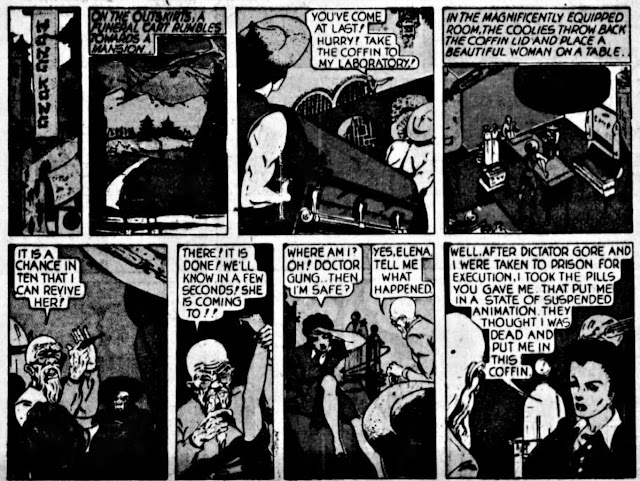
    Though she is set to be executed for her role in Karoly Gore’s administration, Elena escapes by means of some death-feigning pills provided by her old friend Dr Gung, and hopefully it’s the kind of fake death that put you in a coma of some sort because she has to be shipped from Central Europe to Hong Kong before Gung can wake her up and that would be a heckuva long time to stare at the inside of a coffin lid. Though Mr Mystic shows up soon after Elena to harsh the vibe, he focuses a bit more on Dr Gung’s unholy experiments than making sure that she doesn’t get away. Dr Gung WILL RETURN in the next Mad and Criminal Scientist Round-Up.

    Elena returns a few weeks later to interfere in the politics of the… Asian? country of Cadiwa, which is styled as India-ajacent, yes, but whose premier meets up with Elena in Nigeria and so, given the lack of any other geographic hints, I keep wanting to say is in Africa. This appearance marks the beginning of a potential romance between Elena and Mr Mystic, expressed by both when Elena is wounded while trying to escape.

    Budding romance or not, the next time that Mr Mystic pops in to check up on her he finds that she has been up to her old chaotic tricks and has been influencing King Bahroud of Cadiwa to declare war on his neighbours, thus ending centuries of peace. Clearly, this cannot stand. 

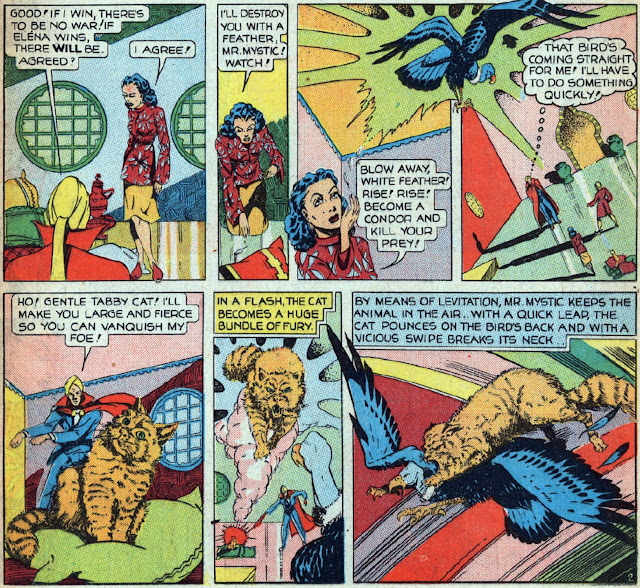
    Mr Mystic and Elena bicker their way into a magical duel, and while I said earlier that magic-users not being able to affect one another with their spells led to a lot of fist fights, that was only a partial truth, because it also leads to this kind of magical battle in which each party summons proxies, such as Mr Mystic’s giant kitty cat, to fight on their behalf. 

    Elena is defeated and reveals that her magic was granted to her by a “Cardin the Terrible” on the condition that she never lose a magical duel. Which she has just done, so bye-bye magical powers. Further, losing her magic causes Elena to turn into a small child.

    Now… there is an important question about this whole situation that is never actually answered: does Elena turn into a child as a part of the “lose a duel; lose your powers” curse as a cheeky little joke by Cardin the Terrible or because she was a child given the form of an adult as part of getting those powers? This is important mainly because Mr Mystic returns her to her adult form at the end of the episode and then they basically immediately become engaged, and it’s a very different situation, depending. 

    Cardin the Terrible himself shows up in the next installment, looking to torture Elena to death for failure, but we don’t learn too much more about him than this classic Bad Boss behaviour. Just why did he send an agent out into the world to spread chaos and war? Not a clue. What is certain however is that Mr Mystic totally murderizes him, which weirdly would indicate that he was less magical than his own protege.

    Elena spends the remainder of 1940 keeping her head down as Mr Mystic’s companion/fiance, though she does spend some time in the future as a captive of the Moon King and almost getting murdered in place of the Goddess of Fire.

    Elena’s run in the Spirit Section and as Mr Mystic’s fiance comes to an end in the second-to-last episode of the year, on 22 December, 1940. Mr Mystic had butted heads with his occasional ally/personification of death/future Divine Round-Up subject the Shadowman a few times in the weeks leading up to this, and the Shadowman’s response was to take away the thing that Mr Mystic loved best, i.e., Elena. There’s some pretty heavy allegory work going on that makes it unclear if Elena has fallen in actual love with the Shadowman and gone to live with him in the afterlife, or if the whole thing is just standing in for her dying and the love that Elena is expressing is just an expression of the natural cycle of life and death. Either way, Mr Mystic is sad, but worry not: he’s standing next to his new love interest Penny Douglas in that second last panel. The man move fast!

    So here’s to Elena, a fun villain and adequate supporting cast member who I hope is somewhere in a loving relationship with Death. Eat your heart out, Thanos.

  • MINOR SUPER-VILLAIN 814: SARKU

    (The Spirit Section, 25 August, 1940)

    I’ve mentioned before that the foes faced by magical Golden Age super-heroes break down into roughly three types: 1) regular crooks who are there to be clowned upon, 2) legitimate threats with equivalent magical power of their own and 3) crooks with a little magical power, who provide a Iof a challenge but are ultimately also clowned upon. Sarku is the third type, and has set out, fresh out of prison, to get revenge on those who put him there. Also, like all magic users in “Mr Mystic,” Sarku has an innate resistance to magic that makes even low-level practicioners more of a challenge to Our Hero than they would be to a Zatara or a Yarko.

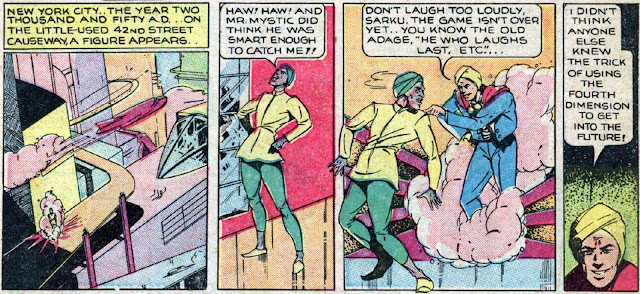
    By the time Mr Mystic has been brought in on the case, Sarku has already murdered the (police?) Commissioner of the unnamed Indian city he was incarcerated in and escaped via some handy teleportation magic. Though Mystic interrupts his attempt on the life of the French Consul, Sarku escapes again, this time into the far future world of 2050 AD.

    (just what had prevented him from time travelling or indeed merely teleporting out of his prison cell over the ten years of his incarceration is not elaborated upon. Perhaps he only just got the knack)

    Sarku does a bit of premature gloating before learning that Mr Mystic can also travel through time, and the two are quickly engaged in a high-speed rocket chase to the Moon. 

    Mystic ends up shooting Sarku down as they approach the Moon’s surface, and he makes the grim choice to pop his corpse into a handy corpse container (originally intended for the evocatively-named by alas never-seen “Moon King’s mummy”) as a sort of general warning to all would-be murderers who might be wandering around on the Moon. That’s it for Sarku!

    But perhaps I spoke too soon! Sarku is back in the next “Mr Mystic” installment, and though we don’t get to see any mummies, we are treated to a Moon King, as a not-so-dead Sarku is brought before Tan Tan, King of the Moon by his subjects. It turns out that he wasn’t quite dead when Mr Mystic shoved him in that tube, which is great for him now but horrifying in retrospect.

    Tan Tan turns out to have a weird crush on the (to him) historical figure of Elena, former Mr Mystic villain and current Mr Mystic fiance (stay tuned for her entry), and trades Sarku a space fleet for her.

    Sarku’s attempt to get revenge on the entire population of Earth for a 1930-1940 AD prison sentence that almost nobody in 2050 AD would have been alive at the same time as, let alone had anything to do with, is foiled once again by Mr Mystic, who leaves nothing to chance this time as he socks Sarku out the spaceship’s hatch and into the void of space (Tan Tan, by contrast gets a mere sock in the jaw for his creepy Elena-napping. The perks of royalty, eh?).

    REVENGE KILLER SCORE: 1/2+

  • MINOR SUPER-VILLAIN 809: GANGA LIN

    (The Spirit Section, 7 July, 1940)

    Our first Mr Mystic foe! Mystic’s old pal Mr Cooper brings him in because he’s worried about his daughter Erica’s involvement with a religious group (cult) called the Temple of Lin. It’s always a real toss-up whenever this kind of thing crops up as a comic book plot, between the cult being a total con job and it having some legitimate but sinister basis, and in this case it’s the latter. Mr Mystic goes to the Temple of Lin and after some enhanced interrogation (i.e. partially melting local Lin Temple head Mamsa Lin) learns that Erica Cooper has been mystically transported to the Paradise of Lin, a hidden city in the Himalayas.

    In the meantime, Erica has discovered that perhaps life in a cult isn’t all it’s cracked up to be, as she is horrified to learn that the Paradise of Lin has a kind of celestial “one in, one out” policy and that in order for her to enter requires the sacrifice of a slave girl. Also, they have slaves, which I would also call a red flag. Luckily for all the women involved in this little altercation, this is the point at which Mr Mystic appears to challenge the cult’s leader, the eight-foot tall mystic Ganga Lin, to a battle to the death.

    Mr Mystic and Ganga Lin engage in astral combat, much as Mystic’s inspiration Yarko the Great did with his foe Shaddiba, only even more homoerotically, with their fully nude and well-muscled astral forms clad only in their signature headwear. Mr Mystic of course comes out on top with a cool astral hawk-on astral deer kill, and he and Erica head back to the US, leaving only one question unanswered: did either of them think to free that poor slave girl/human sacrifice?

  • MINOR SUPER-HERO ROUND-UP 054

    Whoops there are two more super-heroes in the Spirit Section. Should have included them with the Spirit himself, tsk tsk. 

    Lady Luck: 

    The Spirit’s home, the “Spirit Section” of newspaper comics also included two other Will Eisner-created but not -written or -drawn characters, the first of whom is Lady Luck. In actuality wealthy socialite Brenda Banks, Lady Luck is a costumed vigilante out of boredom with the day-to-day of high society. She is wanted by the law and specifically by her civilian life love interest Police Chief Hardy Moore, a cop so dumb that not only is he about to send a woman to the electric chair for the murder of her still-living husband in the above set of panels but he also is unable to recognize the object of his affections under the brim of a big hat (in fairness to him he does mention that Brenda and Lady Luck are very similar looking but then turns out to be cartoonishly easy to fool). Lady Luck does a bit of globetrotting here and there, but her focus is mainly on high society crimes. Her adventures are a bit lighter than the Spirit’s, but not by too much. (The Spirit Section, 2 June, 1940) 

    Mr Mystic: 

    The thing about the Spirit Section is that people love the Spirit and so his two companions tend to be overshadowed, particularly when it comes to widely-available archival work: the Spirit was reprinted while Lady Luck and our new friend here Mr Mystic languished in obscurity, and while Lady Luck’s adventures were eventually reprinted in Smash Comics, the archival record of Mr Mystic is much spottier.

    Mr Mystic is supposedly a retooling of Eisner’s prior effort Yarko the Great, and I can see it – luckily for him he got the look of Yarko rather than the terrible naming sensibility. Mystic is (or was, presumably) an American diplomat who, like so many characters before and after him, acquired great mystical powers from the mysterious and spiritual residents of Tibet, specifically a “council of seven Lamas,” and brought them back to the US to be put to use in beating up ne’er-do-wells. 

    Mr Mystic is a magic-using super-hero, which means that he is a nigh-omnipotent force of nature only occasionally slowed down by a lucky bop on the bean from a crook. His major mark of distinction from his peers is a literal one: a mystic tattoo on his forehead, which would mean that he’s almost certainly the first person to have to field a lot of well-meaning concern over the effect that that sort of thing would have on his employability. (The Spirit Section, 2 June, 1940)

    ADDENDUM:

    After all my talk about how a lot of the non-Spirit related parts of the Spirit Section were unavailable I thought to double check, and I had forgot that yes, they are. Granted, it’s as medium-quality photocopies, but that’s better than nothing, right?

    Having rediscovered that fact, I went back and read the first Mr Mystic story, and was shocked and surprised to learn that rather than being a student of the occult who spent long years studying in Tibet, our unnamed hero is a cultural attache serving somewhere in presumably-Eastern Europe when he is blown very off-course while fleeing an Axis invasion force. He crashes in Tibet and is given the forehead brand/tattoo that I did not realize was the sole source of his power while still unconscious. The whole thing is a pretty far cry from what I had imagined his origin to be!

  • MINOR SUPER-HERO ROUND-UP 054

    Whoops there are two more super-heroes in the Spirit Section. Should have included them with the Spirit himself, tsk tsk. 

    Lady Luck: 

    The Spirit’s home, the “Spirit Section” of newspaper comics also included two other Will Eisner-created but not -written or -drawn characters, the first of whom is Lady Luck. In actuality wealthy socialite Brenda Banks, Lady Luck is a costumed vigilante out of boredom with the day-to-day of high society. She is wanted by the law and specifically by her civilian life love interest Police Chief Hardy Moore, a cop so dumb that not only is he about to send a woman to the electric chair for the murder of her still-living husband in the above set of panels but he also is unable to recognize the object of his affections under the brim of a big hat (in fairness to him he does mention that Brenda and Lady Luck are very similar looking but then turns out to be cartoonishly easy to fool). Lady Luck does a bit of globetrotting here and there, but her focus is mainly on high society crimes. Her adventures are a bit lighter than the Spirit’s, but not by too much. (The Spirit Section, 2 June, 1940) 

    Mr Mystic: 

    The thing about the Spirit Section is that people love the Spirit and so his two companions tend to be overshadowed, particularly when it comes to widely-available archival work: the Spirit was reprinted while Lady Luck and our new friend here Mr Mystic languished in obscurity, and while Lady Luck’s adventures were eventually reprinted in Smash Comics, the archival record of Mr Mystic is much spottier.

    Mr Mystic is supposedly a retooling of Eisner’s prior effort Yarko the Great, and I can see it – luckily for him he got the look of Yarko rather than the terrible naming sensibility. Mystic is (or was, presumably) an American diplomat who, like so many characters before and after him, acquired great mystical powers from the mysterious and spiritual residents of Tibet, specifically a “council of seven Lamas,” and brought them back to the US to be put to use in beating up ne’er-do-wells. 

    Mr Mystic is a magic-using super-hero, which means that he is a nigh-omnipotent force of nature only occasionally slowed down by a lucky bop on the bean from a crook. His major mark of distinction from his peers is a literal one: a mystic tattoo on his forehead, which would mean that he’s almost certainly the first person to have to field a lot of well-meaning concern over the effect that that sort of thing would have on his employability. (The Spirit Section, 2 June, 1940)

    ADDENDUM:

    After all my talk about how a lot of the non-Spirit related parts of the Spirit Section were unavailable I thought to double check, and I had forgot that yes, they are. Granted, it’s as medium-quality photocopies, but that’s better than nothing, right?

    Having rediscovered that fact, I went back and read the first Mr Mystic story, and was shocked and surprised to learn that rather than being a student of the occult who spent long years studying in Tibet, our unnamed hero is a cultural attache serving somewhere in presumably-Eastern Europe when he is blown very off-course while fleeing an Axis invasion force. He crashes in Tibet and is given the forehead brand/tattoo that I did not realize was the sole source of his power while still unconscious. The whole thing is a pretty far cry from what I had imagined his origin to be!

  • MINOR SUPER-HERO ROUND-UP 048

    The triumphant return of Ace Magazines to the round-up!

    Flash Lightning:

    Educated and possibly also raised by Ancient Egyptian mystic the Old Man of the Pyramids, young Robert Morgan is eventually deemed worthy of the Amulet of Annihilation, a mystic artifact that grants him the powers of flight, super strength, bulletproof skin, the ability to hurl lightning bolts and sundry others (the amulet is also immediately forgotten about, as far as I can tell – the armband design remains a part of Lightning’s costume design for the rest of his appearances but his powers are treated as integral).

    Flash Lightning is eventually renamed Lash Lightning, and the word on the street is that this was done so as to avoid confusion with prominent lightning-themed DC Comics character the Flash. (Sure-Fire Comics 001, 1940)

    UPDATE 1 

    the Raven:

    The Raven, like his fellow Ace Magazines hero the Black Spider, is your classic pulp style vigilante wanted by both the police and the underworld, with the added twist that he is primarily focused on Robin Hood-style monetary redistribution/ stealing from the crooked rich to return their ill-gotten gains to the bilked poor. At first, at least – over time the Raven starts dealing with more conventional super-threats and gangsters.

    In addition to his loyal assistant Mike, the Raven’s supporting cast includes Police Captain Lash – his boss, because the Raven is really Detective Sergeant Danny Dartin – and Lash’s daughter/Danny’s fiance Lola. Like the Black Spider before him, the Raven’s love interest Lola eventually discovers the secret of his dual identity, which must have been a particular relief for the Raven because she, like her father and (supposedly) her fiance had up to that point been dedicated to the task of capturing the Raven and had come close to doing so once or twice.

    Though the Raven’s costume starts out as a huge hooded cloak of the type more commonly worn by villains, he eventually switches to a more conventional cape and cowl number, which is a shame, as the original look was much more distinctive. (Sure-Fire Comics 001, 1940)

    Whiz Wilson:

    Whiz Wilson is a time-travelling man, but one who very specifically only travels into the future. It’s like my voice, complaining about how comic book time travellers just can’t stop interfering in historical events, itself echoed back in time and helped to create a character mostly immune to temporal paradox, as long as he doesn’t run into any older Whiz Wilsons in his travels.

    Wilson’s time harness also incorporates a space-travel functionality (as any time machine necessarily must lest one be rocketed off into the void instead of ancient Mesopotamia) and he very satisfyingly employs this as a teleportation device whenever he is in the future, though the mechanics of whether he is instantaneously transporting from one place to another or zooming very quickly between them vary according to the needs of the plot. (Sure-Fire Comics 001, 1940)

    Marvo the Magician:

    Marvo is another tuxedo-wearing magician from the same tradition that previously brought us such luminaries as Zatara. Like many of his peers he fills the time between stage performances by driving around aimlessly and meting out justice to the random criminals he encounters, with the two distinctions that a. he has a little monkey companion  named Tito and b. unlike many of his peers his powers do mainly seem to be illusions and not reality-warping chaos majicks. (Sure-Fire Comics 001, 1940)

  • MINOR SUPER-HERO ROUND-UP 045

    Ah the super-hero.

    Ace Buckley: 

    Ace Buckley is a time traveller, a subgenre of comic book hero mostly notable for the fact that they have no one to blame for their troubles but themselves. Like most of his peers, Buckley (along with his intriguingly-named companion Toni Stark, whose role in the stories is to get captured and then swan around in minimal clothing while waiting for Buckley to rescue her) flings himself willy-nilly into the hotspots of human history and then murders his way free with barely a though to such things as “causality” or “the grandfather paradox” or “the integrity of the timestream”. (Startling Comics 003, 1940)

    Magic Morro: 

    Some time around 1922, young Jack Morrow and his father are shipwrecked on an uncharted Atlantic island. Proclaimed to be the next prophesied leader of local inhabitants the Utangos, Jack is raised to be a superhuman white jungle guy in the classic Tarzan style, only with all kinds of magical knowledge imparted to him by the former ruler, Tanta Talu. As Magic Morro, he is super strong, immune to fire, possibly bulletproof, can turn himself invisible and move objects with his mind, and those are just the abilities that he demonstrated in his first year worth of adventures!

    (Bonus Parenthetical: despite having a fully magical ruler who can do prophecy and summon lightning and stuff, the Utangos also have a standard issue treacherous witch doctor, who is named Mango! What’s with all the evil Mangos?) (Super Comics 021, 1940)

    Vulcan: 

    Vulcan, the Volcanic Man is the descendant of the Roman god of the same name and shares with him a broad dominion over fire, if not an inclination toward metalworking. He generates heat, can pick up and manipulate flame, is immune to heat and flame and also the forces involved in being blasted out of a volcano in the South Pacific and landing in the United States, is bulletproof in the sense that bullets melt before they can injure him, etc. He also has a radical fire-themed haircut.

    Like a lot of fire-based super-heroes, Vulcan ends up fighting a lot of hapless arsonists who waste all of their best fire-based deathtraps of a guy who can’t shut up about how he used to live in a volcano. (Super Mystery Comics v1 001)

    UPDATE 1 

    Magno:

    Control over magnetism is one of the classic comic book powers and Magno here (not our first Magno and certainly not our last) has the bargain basement version of it: he can pull things toward himself or pull himself toward things, a version of flight that requires enough admin work on the part of the artist that it is eventually rounded up to his just being able to fly outright. He also eventually gets a magnetic anti-bullet force field for a similar reason, I reckon: it’s no fun having to do the admin of Magno disarming every crook in every room he enters individually.

    Also unfortunately falling by the wayside over time is Magno’s power to project his face onto solid objects to vex and annoy crooks and cops alike. Was this meant to be an aspect of his magnetic abilities somehow or just a cool thing he could do? It is never specified.

    Finally, I must note that the somewhat abstract design on Magno’s chest is a representation of a bar magnet, in one of its few victories over the horseshoe magnet on the battlefields of graphic design. (Super-Mystery Comics v1 001, 1940)

  • MINOR SUPER-HERO ROUND-UP 045

    Ah the super-hero.

    Ace Buckley: 

    Ace Buckley is a time traveller, a subgenre of comic book hero mostly notable for the fact that they have no one to blame for their troubles but themselves. Like most of his peers, Buckley (along with his intriguingly-named companion Toni Stark, whose role in the stories is to get captured and then swan around in minimal clothing while waiting for Buckley to rescue her) flings himself willy-nilly into the hotspots of human history and then murders his way free with barely a though to such things as “causality” or “the grandfather paradox” or “the integrity of the timestream”. (Startling Comics 003, 1940)

    Magic Morro: 

    Some time around 1922, young Jack Morrow and his father are shipwrecked on an uncharted Atlantic island. Proclaimed to be the next prophesied leader of local inhabitants the Utangos, Jack is raised to be a superhuman white jungle guy in the classic Tarzan style, only with all kinds of magical knowledge imparted to him by the former ruler, Tanta Talu. As Magic Morro, he is super strong, immune to fire, possibly bulletproof, can turn himself invisible and move objects with his mind, and those are just the abilities that he demonstrated in his first year worth of adventures!

    (Bonus Parenthetical: despite having a fully magical ruler who can do prophecy and summon lightning and stuff, the Utangos also have a standard issue treacherous witch doctor, who is named Mango! What’s with all the evil Mangos?) (Super Comics 021, 1940)

    Vulcan: 

    Vulcan, the Volcanic Man is the descendant of the Roman god of the same name and shares with him a broad dominion over fire, if not an inclination toward metalworking. He generates heat, can pick up and manipulate flame, is immune to heat and flame and also the forces involved in being blasted out of a volcano in the South Pacific and landing in the United States, is bulletproof in the sense that bullets melt before they can injure him, etc. He also has a radical fire-themed haircut.

    Like a lot of fire-based super-heroes, Vulcan ends up fighting a lot of hapless arsonists who waste all of their best fire-based deathtraps of a guy who can’t shut up about how he used to live in a volcano. (Super Mystery Comics v1 001)

    UPDATE 1 

    Magno:

    Control over magnetism is one of the classic comic book powers and Magno here (not our first Magno and certainly not our last) has the bargain basement version of it: he can pull things toward himself or pull himself toward things, a version of flight that requires enough admin work on the part of the artist that it is eventually rounded up to his just being able to fly outright. He also eventually gets a magnetic anti-bullet force field for a similar reason, I reckon: it’s no fun having to do the admin of Magno disarming every crook in every room he enters individually.

    Also unfortunately falling by the wayside over time is Magno’s power to project his face onto solid objects to vex and annoy crooks and cops alike. Was this meant to be an aspect of his magnetic abilities somehow or just a cool thing he could do? It is never specified.

    Finally, I must note that the somewhat abstract design on Magno’s chest is a representation of a bar magnet, in one of its few victories over the horseshoe magnet on the battlefields of graphic design. (Super-Mystery Comics v1 001, 1940)

  • MINOR SUPER-VILLAIN 754: BELA JAT

    (Smash Comics 016, 1940)

    It’s a classic setup: the embittered villain is released from prison and swears vengeance on those who put them there. In this case, the recently released figure is the mystic Bela Jat, who has just spent seven years behind bars for killing someone in a magical experiment and is mighty unhappy about it. Joining him are his excellently named and very loyal henchmen Shimego and Gar.

    Jat sets out to capture and kill the three men who he blames for his incarceration: the police commissioner who captured him back when he was a mere detective, the district attorney who prosecuted him and the judge who handed down the sentence. He does this by the simple expedient of anonymously gifting each with a carved wooden idol containing “ecto-fluid” that Jat is able to animate into a human form via some sort of astral projection, whereupon he simply hauls them back to his underground lair.

    This seems like a good place to raise an important consideration: Bela Jat clearly has real, working magical powers, and thus Detective Healy’s testimony above about seeing him “transform the victim’s body to a grayish fluid” is presumably truthful, but… so what? Like, legally, so what? I can absolutely see a mature super-hero universe like the present-day Marvel or DC ones having legal precedent covering the use of magic, but Bela Jat must have had a terrible lawyer if they didn’t raise the question of how exactly he was responsible for this transformation, like, provably. And that’s ignoring Jat’s assertion that police interference is what caused the victim’s death! Given these considerations, we must conclude that Bela Jat acted as his own lawyer.

    Legalities aside, Jat manages to get ahold of the commissioner and the DA before the Ray gets involved and prevents his kidnapping of the judge. Showing unusual adaptability, he decides to forego the satisfaction of a triple revenge murder in favour of the more achievable double kill now followed by a single when it’s convenient.

    But before Jat can actually murder the two to completion the Ray shows up again and spoils everything: Gar and Shimego get their blocks knocked off, the prisoners get released before Jat’s deathtrap can take effect and one of them (Police Commissioner Healy) gets to show off his skill at knife throwing by planting one in Bela Jat’s back. 

    JUDGE AND JURY REVENGE KILLER SCORE: 0/3 – that’s right friends: Bela Jat is one of the worst to ever do it.

  • MINOR SUPER-HERO ROUND-UP 042

    Boys! Boys! Boys! Super powered boys!

    Magno: 

    Magno, aka the Miracle Man, aka the Magnetic Man, aka Tom Dalton, was a power line worker who died when he was shocked with 10 000 volts DC and then revived when he was shocked again with 10 000 volts AC. As a result, Dalton developed electromagnetic powers that he used to fly, simulate super strength when dealing with metal and create magnetic force fields. Not a bad deal.

    Magno’s Golden Age career was short and fairly undistinguished, and his main claim to fame is being the only one of the old Quality heroes to be killed off by Roy Thomas in All-Star Squadron to never be brought back (Magno’s look also reminds me of Jericho of the Teen Titans for some reason, but that’s hardly another claim to fame). (Smash Comics 013, 1940)

    the Ray: 

    I had a couple of issues of The Ray comics from the early 90s when I was younger and so have a tendency to think of the Ray as being a far more prominent character than he actually is – he’s got to be fourth-tier at best, really (assuming that top-tier characters are the ones that everyone knows, your Batmans and Supermans, and second-tier are the ones that even a casual comics reader would consider essential. Third-tier and below is where you get into debating territory).

    Regardless of his level of prominence, the Ray is actually Happy Terrill, a devil-may-care young reporter who signs on as crew in a balloon trip to the upper atmosphere and is… empowered? When he ventures out into a cosmic storm to secure some essential safety equipment. Honestly, as presented on the page Terrill could be assumed to have been replaced with some sort of cosmic entity but maybe I’m the only one who thinks that because it certainly isn’t reflected in subsequent Ray lore.

    Cosmic entity posing as human or no, the Ray is endowed with a startling array of powers, including at least partial invulnerability, the ability to become and travel along light, giant growth, a healing touch, light projection and telekinetic rays. At first, anyway – after a couple of issues he adopts more of a two-fisted adventurer persona whose main power is the ability to change between Happy Terrill and Ray identities and who occasionally remembers that he can fly and shoot rays of light at people.

    A fairly consistent thing that I’ve noticed in depictions of the Ray post-Golden Age is a tendency to portray him as a very dour and serious guy, which seems a disservice to someone with the nickname “Happy.” I suppose I must give it to those later scribes in that the Ray himself almost discards his Happy Terrill identity in his first adventure before eventually coming to his senses. Neither the reason for resuming life as Happy nor the process by which he explained how he made his way back from the upper atmosphere is shown on-panel, but I have to assume that being a super-hero 24/7 just gets boring after a while and he wanted to have a bit of a break. (Smash Comics 014, 1940)

    Master Man: 

    Master Man starts out as a weedy little kid, too small to play, who is gifted a magic vitamin pill by a kindly doctor and becomes incredibly powerful adult man. It’s all there on his one-page introduction, but what’s missing is one important detail: is this a gradual process like the Champ’s origin, where he takes the vitamin every day and grows up big and strong, or did this little kid instantly transmogrify into a grown man, like a permanent Captain Marvel? I suppose that if Master Man really is a little kid in a man’s body it would explain why his first act is to build a cool clubhouse on top of a mountain, presumably containing lots of slides and fireman poles instead of stairs. 

    Being a Fawcett Comics character, Master Man is technically owned by DC Comics now, though they haven’t yet bothered to trot him out of retirement, possibly because of his name, which sounds fascist enough that Marvel Comics has several full-fledged Nazi characters that use it. He would be an interesting character to use as a foil for Superman, since his powers are magic-based, but Captain Marvel does usually fill that role so we’re unlikely to get a Master Man revival any time soon. (Master Comics 001, 1940)

    El Carim:

    One more crime-fighting-stage-magician-with-actual-magical-powers for the pile, El Carim (“miracle” backwards, as the caption box is at some pains to inform you at the start of every story) also subscribes to the same tuxedo and thin black mustache school of fashion as his contemporary Zatara, though the turban does make it easy to tell the two apart.

    What sets El Carim apart from his contemporaries early on is the fact that his crime fighting is done with a series of magical items rather than with magical spells. He has a magical monocle that can deflect bullets (in what must be a very alarming manner, visually) and project illusions and which can be combined with a device called the Spectograph to scry distant locations. In addition, he has a super powerful magnet capable of plucking bullets from the air (useful for when he already has a headache from bouncing a few off of his eye, perhaps) and the Arrestor, which is able to freeze others in place, even against the pull of gravity.

    Over time, El Carim starts slinging spells in a way more in line with the other magic men of comics, and I personally reckon that that’s why he has languished in relative obscurity since the 1940s (other than an appearance in a 2016 issue of Scooby-Doo Team-Up, that is), as without that hook he is not appreciably different from any of his peers. (Master Comics 001, 1940)