The Curse of Skeleton Munroe

Category: magic

  • MINOR SUPER-HERO ROUND-UP 042

    Boys! Boys! Boys! Super powered boys!

    Magno: 

    Magno, aka the Miracle Man, aka the Magnetic Man, aka Tom Dalton, was a power line worker who died when he was shocked with 10 000 volts DC and then revived when he was shocked again with 10 000 volts AC. As a result, Dalton developed electromagnetic powers that he used to fly, simulate super strength when dealing with metal and create magnetic force fields. Not a bad deal.

    Magno’s Golden Age career was short and fairly undistinguished, and his main claim to fame is being the only one of the old Quality heroes to be killed off by Roy Thomas in All-Star Squadron to never be brought back (Magno’s look also reminds me of Jericho of the Teen Titans for some reason, but that’s hardly another claim to fame). (Smash Comics 013, 1940)

    the Ray: 

    I had a couple of issues of The Ray comics from the early 90s when I was younger and so have a tendency to think of the Ray as being a far more prominent character than he actually is – he’s got to be fourth-tier at best, really (assuming that top-tier characters are the ones that everyone knows, your Batmans and Supermans, and second-tier are the ones that even a casual comics reader would consider essential. Third-tier and below is where you get into debating territory).

    Regardless of his level of prominence, the Ray is actually Happy Terrill, a devil-may-care young reporter who signs on as crew in a balloon trip to the upper atmosphere and is… empowered? When he ventures out into a cosmic storm to secure some essential safety equipment. Honestly, as presented on the page Terrill could be assumed to have been replaced with some sort of cosmic entity but maybe I’m the only one who thinks that because it certainly isn’t reflected in subsequent Ray lore.

    Cosmic entity posing as human or no, the Ray is endowed with a startling array of powers, including at least partial invulnerability, the ability to become and travel along light, giant growth, a healing touch, light projection and telekinetic rays. At first, anyway – after a couple of issues he adopts more of a two-fisted adventurer persona whose main power is the ability to change between Happy Terrill and Ray identities and who occasionally remembers that he can fly and shoot rays of light at people.

    A fairly consistent thing that I’ve noticed in depictions of the Ray post-Golden Age is a tendency to portray him as a very dour and serious guy, which seems a disservice to someone with the nickname “Happy.” I suppose I must give it to those later scribes in that the Ray himself almost discards his Happy Terrill identity in his first adventure before eventually coming to his senses. Neither the reason for resuming life as Happy nor the process by which he explained how he made his way back from the upper atmosphere is shown on-panel, but I have to assume that being a super-hero 24/7 just gets boring after a while and he wanted to have a bit of a break. (Smash Comics 014, 1940)

    Master Man: 

    Master Man starts out as a weedy little kid, too small to play, who is gifted a magic vitamin pill by a kindly doctor and becomes incredibly powerful adult man. It’s all there on his one-page introduction, but what’s missing is one important detail: is this a gradual process like the Champ’s origin, where he takes the vitamin every day and grows up big and strong, or did this little kid instantly transmogrify into a grown man, like a permanent Captain Marvel? I suppose that if Master Man really is a little kid in a man’s body it would explain why his first act is to build a cool clubhouse on top of a mountain, presumably containing lots of slides and fireman poles instead of stairs. 

    Being a Fawcett Comics character, Master Man is technically owned by DC Comics now, though they haven’t yet bothered to trot him out of retirement, possibly because of his name, which sounds fascist enough that Marvel Comics has several full-fledged Nazi characters that use it. He would be an interesting character to use as a foil for Superman, since his powers are magic-based, but Captain Marvel does usually fill that role so we’re unlikely to get a Master Man revival any time soon. (Master Comics 001, 1940)

    El Carim:

    One more crime-fighting-stage-magician-with-actual-magical-powers for the pile, El Carim (“miracle” backwards, as the caption box is at some pains to inform you at the start of every story) also subscribes to the same tuxedo and thin black mustache school of fashion as his contemporary Zatara, though the turban does make it easy to tell the two apart.

    What sets El Carim apart from his contemporaries early on is the fact that his crime fighting is done with a series of magical items rather than with magical spells. He has a magical monocle that can deflect bullets (in what must be a very alarming manner, visually) and project illusions and which can be combined with a device called the Spectograph to scry distant locations. In addition, he has a super powerful magnet capable of plucking bullets from the air (useful for when he already has a headache from bouncing a few off of his eye, perhaps) and the Arrestor, which is able to freeze others in place, even against the pull of gravity.

    Over time, El Carim starts slinging spells in a way more in line with the other magic men of comics, and I personally reckon that that’s why he has languished in relative obscurity since the 1940s (other than an appearance in a 2016 issue of Scooby-Doo Team-Up, that is), as without that hook he is not appreciably different from any of his peers. (Master Comics 001, 1940)
  • MINOR SUPER-VILLAIN 743: THE VOODOO MASTER

    MINOR SUPER-VILLAIN 743: THE VOODOO MASTER

    (Smash Comics 008, 1940)

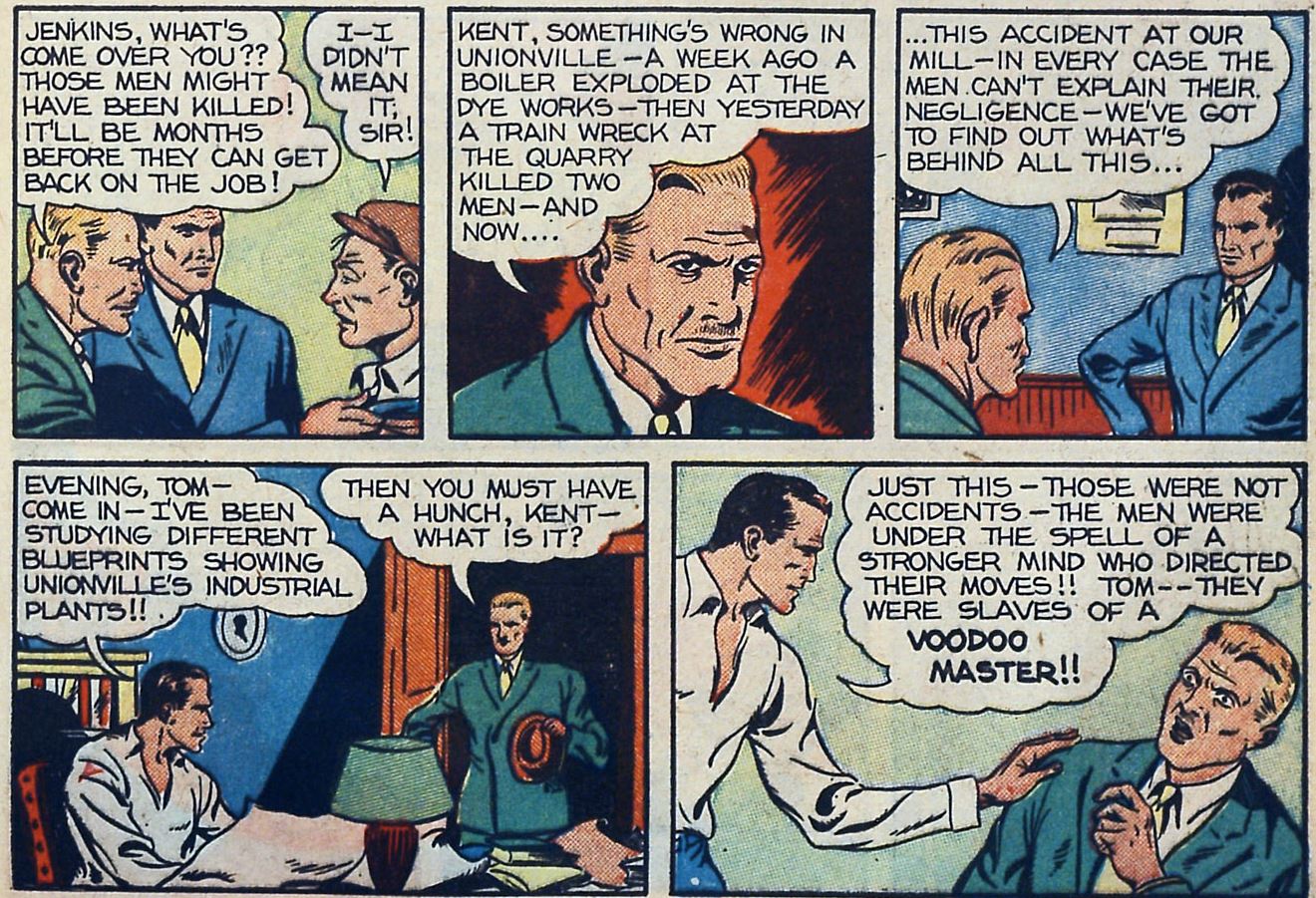
    Times are tough in Unionville: the local factories are all suffering accidents which appear to be due to systemic worker negligence but which add up to a campaign of sabotage, and since it’s a factory town, if things continue as they are then everyone is completely screwed.

    Luckily for the good folk of Unionville, the steel mill that the latest incident occurred at is managed by a guy named Tom, and Tom is friends with a fellow named Kent Thurston, and Kent Thurston is also known as the Invisible Hood, who immediately works out that the obvious culprit must be… a voodoo master!

    The Invisible Hood’s theories are vindicated when the next incident of sabotage triggers an explosion that knocks loose a couple of memories in the unwitting steelworker who set it in motion. Turns out that the mysterious villain is hiding out in the nearby abandoned castle, which is a new one on me.

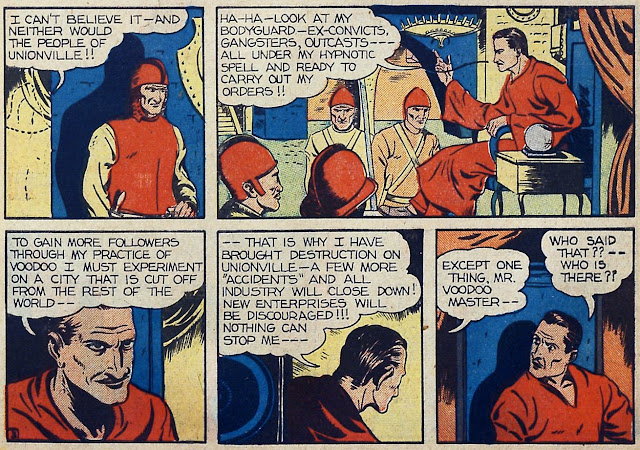
    Inside, the Hood does indeed discover the Voodoo Master (and whether this is a name he had for himself is rendered irrelevant by the fact that he accepts it as his when it is used by others – a real relief after a month or so heavy in unofficial names). The Voodoo Master has surrounded himself with crooks in faux-Medieval garb, and the goofiness of this aesthetic almost overshadows just how sinister and creepy the man’s actual scheme is: he plans to ruin Unionville financially and so isolate it from the rest of the country so that he can use its population as fodder to test out the extent of his powers. That’s some twisted 90s psychothriller shit, the sort of thing that can get very dark, very quickly.

    Invisible Hood stories aren’t very long, so there are only two further points of interest vis-a-vis the Voodoo Master. The first is that he does seem to have some credible magical acumen, as he whips up a quick anti-invisibility spell once he becomes aware of the Hood’s presence in his lair. This is honestly a lot more flexible than non-heroic comic book magic users usually are – the Voodoo Master seems to be the rare one not working off of AD&D Magic User rules.

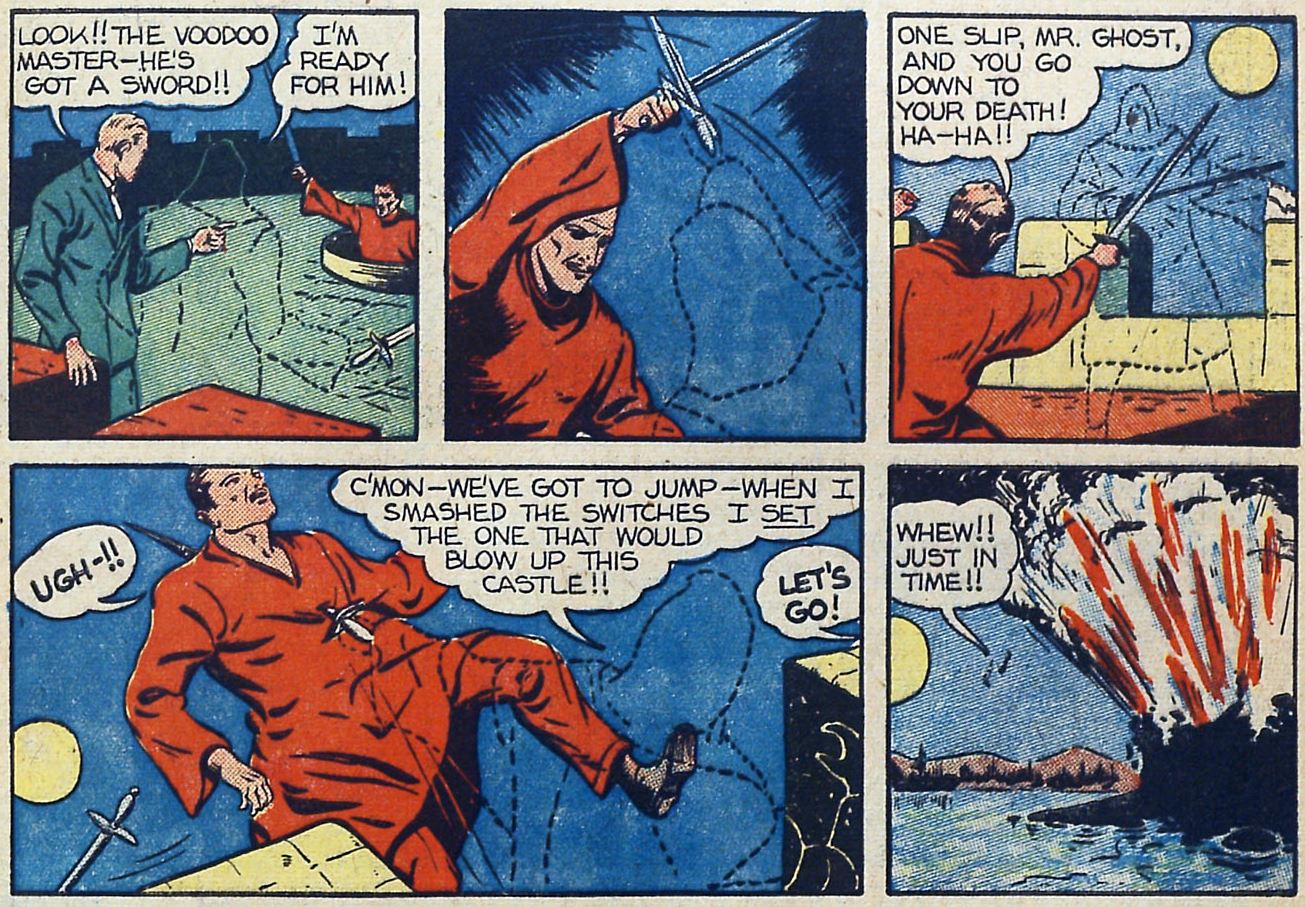
    There’s such a thing as getting too confident, however, as the Voodoo Master proves when, brimming over with hubris, he challenges an invisible man to a sword fight on his castle parapet. This ends predictably, and Unionville is saved!

  • MINOR SUPER-VILLAIN 743: THE VOODOO MASTER

    MINOR SUPER-VILLAIN 743: THE VOODOO MASTER

    (Smash Comics 008, 1940)

    Times are tough in Unionville: the local factories are all suffering accidents which appear to be due to systemic worker negligence but which add up to a campaign of sabotage, and since it’s a factory town, if things continue as they are then everyone is completely screwed.

    Luckily for the good folk of Unionville, the steel mill that the latest incident occurred at is managed by a guy named Tom, and Tom is friends with a fellow named Kent Thurston, and Kent Thurston is also known as the Invisible Hood, who immediately works out that the obvious culprit must be… a voodoo master!

    The Invisible Hood’s theories are vindicated when the next incident of sabotage triggers an explosion that knocks loose a couple of memories in the unwitting steelworker who set it in motion. Turns out that the mysterious villain is hiding out in the nearby abandoned castle, which is a new one on me.

    Inside, the Hood does indeed discover the Voodoo Master (and whether this is a name he had for himself is rendered irrelevant by the fact that he accepts it as his when it is used by others – a real relief after a month or so heavy in unofficial names). The Voodoo Master has surrounded himself with crooks in faux-Medieval garb, and the goofiness of this aesthetic almost overshadows just how sinister and creepy the man’s actual scheme is: he plans to ruin Unionville financially and so isolate it from the rest of the country so that he can use its population as fodder to test out the extent of his powers. That’s some twisted 90s psychothriller shit, the sort of thing that can get very dark, very quickly.

    Invisible Hood stories aren’t very long, so there are only two further points of interest vis-a-vis the Voodoo Master. The first is that he does seem to have some credible magical acumen, as he whips up a quick anti-invisibility spell once he becomes aware of the Hood’s presence in his lair. This is honestly a lot more flexible than non-heroic comic book magic users usually are – the Voodoo Master seems to be the rare one not working off of AD&D Magic User rules.

    There’s such a thing as getting too confident, however, as the Voodoo Master proves when, brimming over with hubris, he challenges an invisible man to a sword fight on his castle parapet. This ends predictably, and Unionville is saved!

  • MINOR SUPER-VILLAIN 539 UPDATE: THE CLAW (1940)

    (Silver Streak Comics 002, 006)

    As you may or may not recall, when I covered the Claw’s sole 1939 appearance I concluded that taken on its own, it read like one of those stories where a villain holds sway over an area by means of a fake monster and that if the Claw had never appeared again that’s what I would assume he was: just an illusion composed of papier mache and maybe a balloon or an image projected on a cloud.

    Well, surprise, surprise, because that wasn’t the only appearance of the Claw and in fact the vary next issue of Silver Streak Comics features him joining up with an unnamed but very recognizable Adolf Hitler in return for control of half of Europe following a Claw/Nazi victory.

    The first part of the Claw’s plan involves attacking allied shipping using his very cool underwater train/tank. Next, using super-powered artillery cannon to shell civilian population centres… somewhere. I mean, the cities all look pretty Western hemisphere but as the Claw’s original HQ on the island of Ricca was in the Pacific and he’s still close enough to there that the ships he sinks are being transported back to be used in Riccan munitions factories, so maybe he’s attacking the West coast of the United States? Not sure how that helps the Nazis, honestly, but it’s either that or his artillery is really really super and he’s bombing Europe.

    The Claw eventually gets impatient with just blowing things up and proves me wrong yet again by growing enormous and using his weird powers to set up a whirlpool so mighty that it not only draws in and dooms ships from across the ocean but also changes the world’s weather patterns, causing the tropics to freeze over. Bad!

    Our old pal and original Claw foe Jerry Morris is of course not going to take this, particularly after his previously-unmentioned younger brother Tad is lost at sea in the Claw’s oceanic chaos. He combines one of his signature astonishing super-science inventions – in this case a special bulb that emits light rays that instantly freeze water – with some cars stored in the hold of the ship he is on to create vehicles that are able to fabricate a sheet of ice to drive on across even the deepest water. And since the ice goes all the way to the bottom, these vehicles are able to neutralize the Claw’s maelstrom by creating a series of concentric ice walls around it.

    There ensues what is actually a pretty neat battle between ice-road cars and the submarine tank/train, with the cars attempting to hem in the train with walls while the train fires its artillery cannons upward – I would enjoy playing a video game about this! The Claw is ultimately killed in an explosion when the munitions on his train explode… OR IS HE?

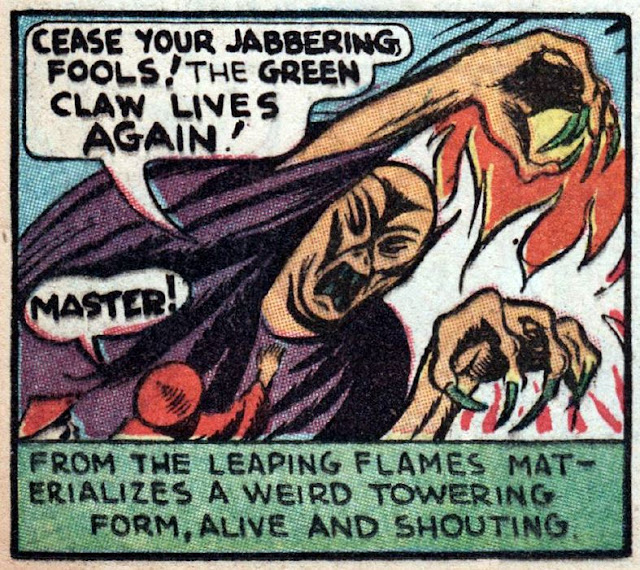
    He is not! And despite the assertion at the end of the previous story, Jerry Morris seems to have foregone taking the Claw’s body back to the US for dissection, perhaps because it was not technically a legal thing to do. Whatever the circumstances, the body ends up falling into the hands of a group of “devil worshippers” somewhere in Asia, but whether the Claw was the devil in question or not is hard to say (though in leaping back to life just as his body was consigned to the funeral pyre he certainly must have inspired some supernatural awe).

    Also, for this story alone, the Claw is referred to as the Green Claw and his claws are indeed coloured green for the occasion.

    The (Green) Claw’s opponent in this case is Major Carl Tarrant, who is either a soldier of fortune or a member of the local colonial police, but either way he simply must investigate the possibility of the Claw’s return. Tarrant manages to avoid the Claw’s cultists but is tracked down by the villain himself with some high-tech devices, then shrunk via magic and stuck in a metal box to gruesomely expire when the shrink spell wears off.

    The Claw then reveals his latest plan to take over the world: a kick-ass robot army! No notes, 10/10, a classic for a reason, just look at those cool robots.

    Tarrant of course has to spoil everything by getting out of the box before he gets squished. He destroys the robots by taking advantage of the Claw’s metal-destroying anti-bullet force field and then does one better by bombing the entire fortress/city to smithereens. But though the Claw is thwarted, HE YET LIVES. What horrors are we in store for in 1941?

    (just had to feature this cover from Silver Streak Comics 006, which I spent an inordinate amount of time being creeped out by – those hands! – as replicated in Jeff Rovin’s Encyclopedia of Super Villains)

  • PROBLEMATIC ROUND-UP 004

    Get ready for a collection of MLJ’s finest racially-problematic villains.

    Yen Fat Sing: 

    Yen Fat Sing’s deal is that he knows about a treasure buried on Fu Chang’s charity farm and, in an effort to grab that treasure for himself, has been murdering the workers using man-eating plants. He’s a pretty standard type of minor super-villain but because he is a Fu Chang foe he is of course a generic Yellow Peril character on top of that. A couple of remarkable things about Yen Fat Sing: 

    1. after all the effort to run everyone off the farm, once Fu Chang is closing in he just sneaks onto the grounds and digs up the treasure, suggesting that he could have done that all along and particularly so because nobody knew about the treasure at all until he ran his mouth about it.

    2. Yen Fat Sing is killed in the course of the story but, unlike virtually every other comic book villain to have anything to do with carnivorous plants, he is not eaten by a tree but rather dies in a car crash.

    I do rally like that the man-eating plants only attack in the dark. That’s a fun detail. (Pep Comics 005, 1940)

    Joodar the Evil:

    Joodar the Evil starts out as an evil equivalent to Fu Chang, only instead of accessing his power via supplication to an ancestral god with a tonsure, Joodar worships the Great Genii of the Water Demons, and instead of a very eclectic set of animated chess figures…

    … Joodar is granted the services of – you guessed it – water demons. Though his stated plans involve world domination, Joodar has a lot of trouble with step 1: destroy Fu Chang, to the extent that both the Great Genii and his Water Demon crew end up destroyed. (Pep Comics 006, 1940)

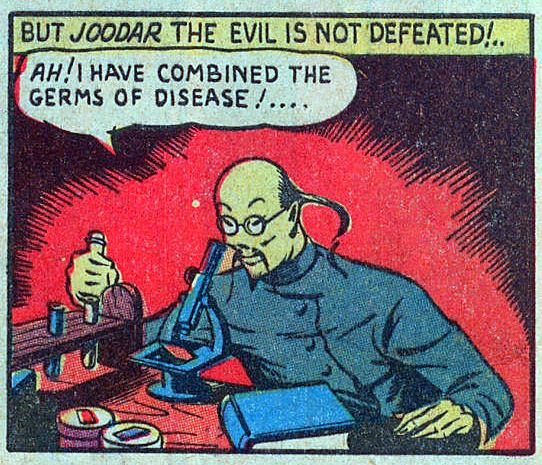
    Joodar returns in the next issue, potentially because “summoning water demons” isn’t a crime in San Francisco. This time he is without his demon pals and so he turns to the next best things: bacteria and mosquitoes! Specifically, he has mixed up a big batch of different harmful bacteria and stuck ’em in some mosquitoes in order to create havoc in San Francisco’s Chinatown. Why does he do this? It’s not entirely clear. Generic revenge? Mass chaos? Joodar doesn’t really deliver a coherent thesis statement I’m afraid.

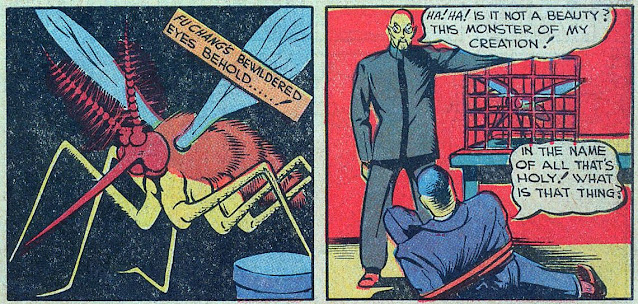
    Joodar’s greatest creation is this enormous mosquito, which almost takes out Fu Chang and his fiance Tay Ming but ultimately cannot contend with those pesky magic chessmen. Joodar, as far as I know, just absconds into the night – perhaps mosquito-crime is also not illegal in San Francisco. (Pep Comics 007, 1940)

    Dr Wang:

    Dr Wang is a Yellow Peril villain in the true Fu Manchu mould, a sinister genius who strikes at the security of the US for no stated reason. It’s possible that we are meant to read Asian villain = Japanese, but if I’m honest an evil mastermind who plots against the United States for the sheer cussed challenge of it it quite a bit more evocative.

    Dr Wang is so threatening to the secuirty of the country, in fact, that we are introduced to him in media res ad the Shield attempts to murder him by dropping a boulder on his car. This is that proactive super-hero action that we al1 wanted in the late aughts!

    Dr Wang has two things going for him: the first is his mask, which looks great. Terrific style of mask, particularly with a hat. The second is his plan to disrupt US war production, by rounding up a bunch of guys who are afflicted with cholera and hypnotizing them into getting jobs in arms factories, thus starting a targeted cholera epidemic. And the very fun thing about this is that cholera is mostly spread by contact with infected feces, so these factories must be disgusting.

    The Shield cannot of course let this stand, and goes back for another try at solving the Dr Wang Problem, and you know what they say: the second time is the charm – plus it’s a bit more narratively satisfying for the Shield not to do a premeditated murder! (Shield-Wizard Comics 002, 1940)

  • MINOR SUPER-HERO ROUND-UP 036

    Prize Comics time, bay-bee.

    Power Nelson:

    Power Nelson is from the far-off future year of 1982 CE, in which the world has been conquered by the Mongols, but the wink, wink, nudge, nudge kind of Mongols from 1940-1941 where they’re actually supposed to be the Japanese (and for some reason the nation of Mongolia is fair game as far as Explicit Villain Status goes while Japan is still off the table). He has been given super strength by some surprisingly beefy scientists so that he might save civilization from oppression. Three things about Power Nelson:

    1) I think that his first name might actually be Power. So futuristic!

    2) I kind of want to give this series credit for not being too racist but the truth is that it is fairly racist but my senses have been dulled by exposure to the excesses of post Pearl Harbor depictions of the Japanese. 

    3) Power Nelson is very bad at his job? Every issue sees him within striking distance of Emperor Seng I and while assassinating the top man isn’t a guaranteed way to end a regime, it absolutely cannot hurt. Just punch him, man! (Prize Comics 001, 1940)

    Jupiter:

    Jupiter represents two distinct super-hero archetypes: the alien lawman sent to Earth to dispense justice and the magic-user, and as those are two of the more omnipotent origins that a character can have he goes through crooks like a hot knife through butter. The most important question about Jupiter is: was he called Jupiter back on the planet Jupiter or is he adopting a cool new name like a kid at camp? (Prize Comics 001, 1940)

    K the Unknown:

    Douglas Danville, wealthy playboy, takes to the crime-ridden ski slopes as K the Unknown, feared and hunted by ski crooks and ski cops alike. And presumably regular cops and crooks too, but he only had one recorded outing and it took place entirely within the bounds of a ski resort.

    K the Unknown’s one adventure involves embezzlement and murder among the officers of a college alumni group, possibly the perfect case for a wealthy playboy type hero.

    K the Unknown is a great name but perhaps not a great super-hero name, so I can see why he only had on outing. Still, it must be handy to have a calling card that you can piss into the snow. (Prize Comics 001, 1940)

    the Black Owl: 

    It’s hardly unusual for a Golden Age character to make one appearance and then disappear forever, but much more unusually while K the Unknown never had a second adventure his alter ego Doug Danville just kept on trucking under another identity. It’s never explored in the text of the story, so any explanation for why he made the change is an equally valid bit of speculation, from “he wanted a less generic super-hero identity” to “it’s completely different guy named Doug Danville who hangs around with a completely different private eye named Terry Dane.” It turns out that I wrote that last bit prematurely, as in the Black Owl’s second outing his foe is Sigmund Rathko, the crook who was also behind the alumni association shenanigans in the K the Unknown story. I suppose that it could be three completely different people but no, at that point we’re getting silly.

    One thing that you can say for certain is that he didn’t change identities to get the cops off of his back, because they want to get the Black Owl just as much as they did K the Unknown. Moreso, honestly, because K the Unknown was safely carving powder and never even saw a cop. (Prize Comics 002, 1940)

  • MINOR SUPER-HERO ROUND-UP 036

    Prize Comics time, bay-bee.

    Power Nelson:

    Power Nelson is from the far-off future year of 1982 CE, in which the world has been conquered by the Mongols, but the wink, wink, nudge, nudge kind of Mongols from 1940-1941 where they’re actually supposed to be the Japanese (and for some reason the nation of Mongolia is fair game as far as Explicit Villain Status goes while Japan is still off the table). He has been given super strength by some surprisingly beefy scientists so that he might save civilization from oppression. Three things about Power Nelson:

    1) I think that his first name might actually be Power. So futuristic!

    2) I kind of want to give this series credit for not being too racist but the truth is that it is fairly racist but my senses have been dulled by exposure to the excesses of post Pearl Harbor depictions of the Japanese. 

    3) Power Nelson is very bad at his job? Every issue sees him within striking distance of Emperor Seng I and while assassinating the top man isn’t a guaranteed way to end a regime, it absolutely cannot hurt. Just punch him, man! (Prize Comics 001, 1940)

    Jupiter:

    Jupiter represents two distinct super-hero archetypes: the alien lawman sent to Earth to dispense justice and the magic-user, and as those are two of the more omnipotent origins that a character can have he goes through crooks like a hot knife through butter. The most important question about Jupiter is: was he called Jupiter back on the planet Jupiter or is he adopting a cool new name like a kid at camp? (Prize Comics 001, 1940)

    K the Unknown:

    Douglas Danville, wealthy playboy, takes to the crime-ridden ski slopes as K the Unknown, feared and hunted by ski crooks and ski cops alike. And presumably regular cops and crooks too, but he only had one recorded outing and it took place entirely within the bounds of a ski resort.

    K the Unknown’s one adventure involves embezzlement and murder among the officers of a college alumni group, possibly the perfect case for a wealthy playboy type hero.

    K the Unknown is a great name but perhaps not a great super-hero name, so I can see why he only had on outing. Still, it must be handy to have a calling card that you can piss into the snow. (Prize Comics 001, 1940)
    the Black Owl: 

    It’s hardly unusual for a Golden Age character to make one appearance and then disappear forever, but much more unusually while K the Unknown never had a second adventure his alter ego Doug Danville just kept on trucking under another identity. It’s never explored in the text of the story, so any explanation for why he made the change is an equally valid bit of speculation, from “he wanted a less generic super-hero identity” to “it’s completely different guy named Doug Danville who hangs around with a completely different private eye named Terry Dane.” It turns out that I wrote that last bit prematurely, as in the Black Owl’s second outing his foe is Sigmund Rathko, the crook who was also behind the alumni association shenanigans in the K the Unknown story. I suppose that it could be three completely different people but no, at that point we’re getting silly.

    One thing that you can say for certain is that he didn’t change identities to get the cops off of his back, because they want to get the Black Owl just as much as they did K the Unknown. Moreso, honestly, because K the Unknown was safely carving powder and never even saw a cop. (Prize Comics 002, 1940)

  • MINOR SUPER-VILLAIN 687: PRINCESS LING FOY

    (Pep Comics 004, 1940)

    Princess Ling Foy probably belongs in the Problematic Round-Up with all of Fu Chang’s other enemies (and Fu Chang himself, of course) – she’s just as steeped in racist tropes as any of them, right down to her dumb name. But… I have to say that I like her hat.

    I also like her minions, the Warriors of Brass, which strongly resemble robots but which are by all accounts magical creations. Let’s spit the difference and call them automata, and honestly it doesn’t really matter because Fu Chang destroys them all with what must be some wildly powerful acid.

    Fu Chang spares Ling Foy’s life but also rejects her proposal that they rule Chinatown together (and “ruling Chinatown” is just as nebulous a concept as when all those Fantomah villains were attempting to conquer “the Jungle” – are you going to be sending a representative to the San Francisco City Council or is this just a glorified protection racket?) which of course returns her to the path of crime precisely one second after Fu Chang gives her a second chance. Ling Foy heads right home to make a fairly low-effort sympathetic magic effigy out of wax, but regardless of quality it works. The only way Fu Chang is able to keep going is with the help of an infusion of healing juice from his magic chessmen, and even then he’s walking around with his arm in a sling.

    Having failed to gain revenge on Fu Chang by killing him, Ling Foy now summons an imp in an attempt to murder his fiance Tay Ming and once again the chessmen save the day, as tiny man battles tiny demon in a scene much more action-packed than a Fu Chang comic usually gets.

    The imp spills the beans on Ling Foy’s location and since Fu Chang can’t bring himself to harm a lady, Tay Ming takes out the trash.

    (If you read the Fu Chang entry and were wondering about what exactly the mermaid figure was used for, then this is your lucky day! As Ling Foy dies, the wax effigy of Fu Chang falls out the window into San Francisco Bay with a couple of knives still in it. The mermaid swims down and removes them, thus saving Fu Chang from a lifetime of feeling like he had two knives stuck in him)

  • MINOR SUPER-VILLAIN 669: ARCO

    (Jungle Comics 011, 1940)

    Arco, aka “the immortal mummy of Ancient Egypt! Old Arco, the super-scientist of long ago!” comes to the attention of Fantomah when he begins blinding the inhabitants of her home jungle using a ray with the fairly awesome name of the Scarlet Shadow. His ultimate goal – like so many Fantomah foes – is to conquer the jungle and establish an empire for himself.

    (Arco is also, somewhat surprisingly, our first actual mummy. The current ratio of fake to real mummies stands at 5:1)

    While an ancient mummy attempting to take over a quasi-mystic omnijungle using a blindness ray might be relatively normal as far as comic book plots go, Arco’s next move is amazing. In order to finalize his conquest he requires a population, and what better subjects for a mummy emperor than more mummies? What seems like most if not all Egyptian mummies in the world are reanimated and flown in on the wings of Arco’s ancient magics. Presumably he also protects their dry, dry bodies from the jungle humidity, perhaps using another ray to do so.

    Arco of course rejects Fantomah’s ritual attempt to warn off her foe. In his defense he is riding a justifiable high based on the fact that he and his followers are all already dead – how could he know that his mummy troops, so effective at attacking blind and confused people, would prove easy prey to the most powerful beasts of the jungle?

    (I can’t imagine what a blow this must have been to the fields of Anthropology and Archaeology in the world of Fantomah. Museums all over the world must be full of little plaques saying “this sarcophagus formerly held the mummy of Amenhotep III, preserved from 1353 BC until the Great Mummy Reanimation of 1940. Recent expeditions have brought back evidence that the mummy was subsequently dismembered and partially consumed by a lioness (see bone fragments in case to your left)”)

    Arco attempts to blind Fantomah in revenge for the defeat of his forces but finds himself on the receiving end of sequentially, his own ray, a fall, and a river full of crocodiles. What an end for an immortal mummy man.

  • MINOR SUPER-VILLAIN 668: THOTH

    MINOR SUPER-VILLAIN 668: THOTH

    (Jungle Comics 011, 1940)

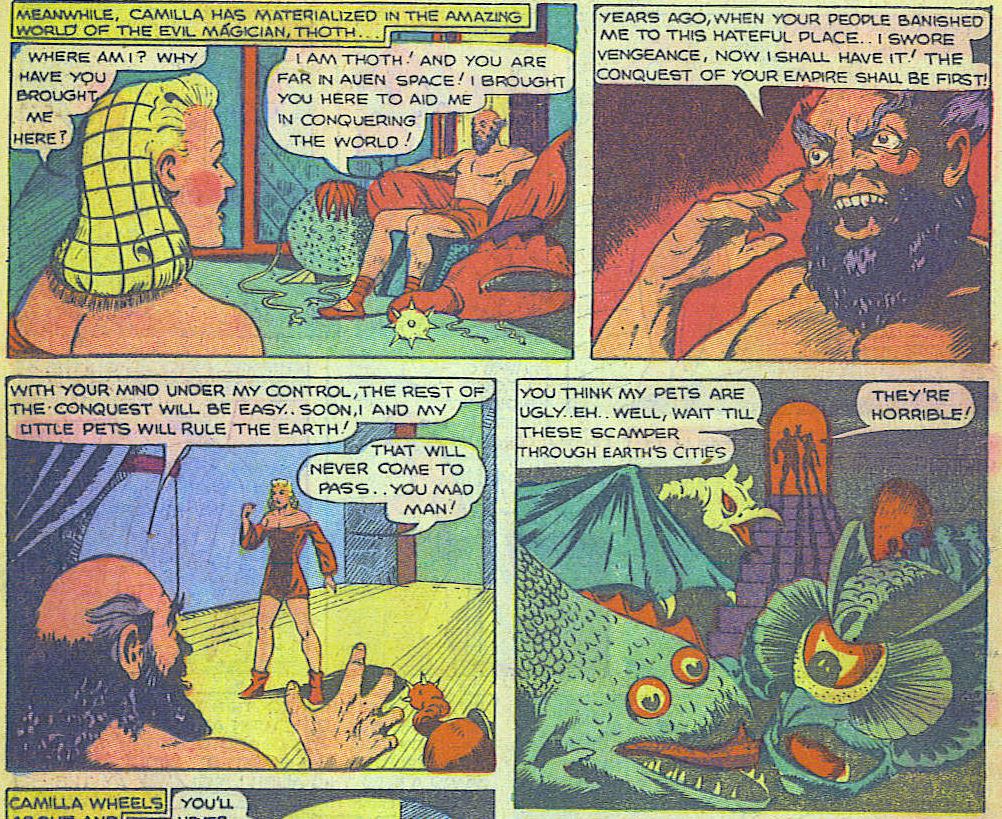
    We begin with a very comic book (or monster-of-the-week TV show) setup. Camilla notices and comments on the ancient Magician’s Pool and then is almost immediately compelled to enter that same pool and disappear from the realms of man.

    Camilla’s aide/paramour Sir Champion turns to local wizard Warlock (not that Warlock the Wizard, but it is wild that there are two of them) for help and learns that the Magician of Magician’s Pool fame is Thoth, an evil jerk who the people of the Lost Empire tossed through the pool to another dimension hundreds of years earlier. Also, it turns out that the pool links to another dimension on nights of the full moon.

    Meanwhile, Camilla has also learned these things from Thoth himself, who has been spending his time in the unnamed dimension taming weird monsters and is now ready to use them to conquer the Earth. Camilla is of course having none of this but her attempts to prevent it using violence are thwarted as Thoth and all others in his presence are immune to mundane weaponry. On an unrelated note, did I mention that Warlock the wizard gave Sir Champion a magic sword and shield?

    This is a pretty Sir Champion heavy episode overall – he encounters a cute girl who turns out to be a less attractive green assassin and so is okay to slay and then is taken to the home of a cool nude giant dude who I wish we knew more about! As it stands, Sir Champion gets directions and a guide from him and we never see him again.

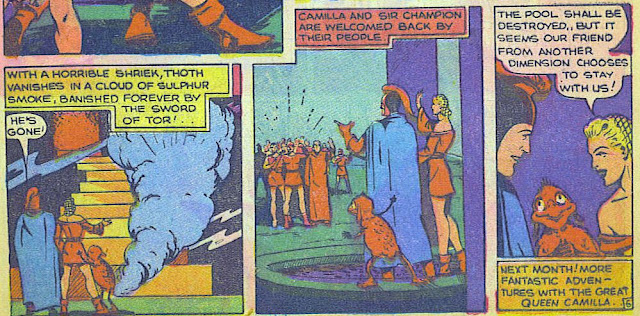
    Sometimes I get a bit lazy and just do a bullet point summary as my first draft of these entries and what I had here was simply “MAGIC SWORD, ASSHOLE” an I think that stands. Thoth (asshole) gets a magic sword to the heart and ceases to become a threat to the world as a whole and the Lost Empire in particular.

    Camilla and Sir Champion make their way home, accompanied by the giant naked laughing guy’s little beaƒt friend, which would be significant to later plots and stories in a different time, but this is the Golden Age and an extradimensional creature of unknown nature and provenance coming to Earth has no further impact.