The Curse of Skeleton Munroe

Category: magic

  • MINOR SUPER-VILLAIN 663: THE JUNGLE DEMON

    (Jungle Comics 006, 1940) 

    The Jungle Demon starts out as an unnamed boy lost in the jungle and true to the old trope he is found and nurtured by a beast – we’ve seen it many times before. The beast in this case is a mind-bogglingly large constrictor snake, which is fun. Boy grows to man and he and the snake (charmingly named “Powerhouse”) are at peace with the people and animals of the jungle until one day the still-unnamed young man chows down on what turns out to be some AD&D Alignment-flipping berries and Nice Boy becomes the Jungle Demon.

    My memory had filled in some details and I was thinking of this fellow as one of the big Fantomah villains but in fact although he talks a big game about conquering the Jungle, mostly he just steals jewels and defrauds his workers.

    Fantomah steps in a couple of times throughout the story to warn the Jungle Demon away from pursuing his darker impulses (pulling down a city to build a palace, enslaving people with dark majicks, etc) but he just can’t help but be evil and eventually she is forced to feed him an antidote salad to reverse the effects of the berries (and she exiles him and his snake to an isolated plateau, which seems a bit mean). I hadn’t really thought about it before but this tendency of Fantomah’s to watch the unfolding action but not really step in until she does so decisively at the moment of crisis is the equivalent to Stardust the Super Wizard’s very long commute: a way for there to be a story with an effectively omnipotent protagonist in which anything actually happens.

  • MINOR SUPER-HERO ROUND-UP 026

    Just look at all these guys.

    Power-Man:

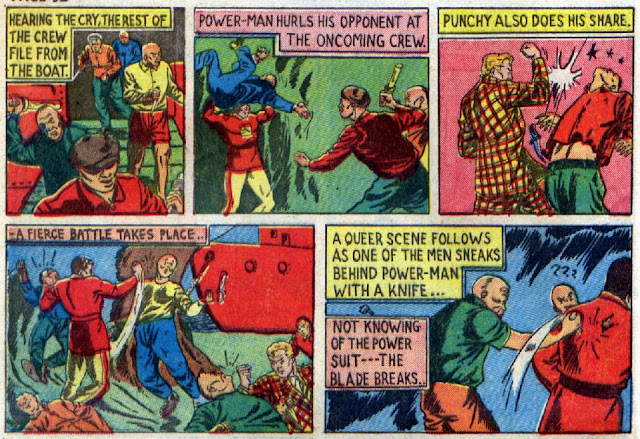
    Power-Man, aka Rip Regan, private detective or possibly just nosy guy, gets his powers in one of the classic ways: his friend Dr Austin gives him a special suit. It’s the simplest of origins and also one that puts a lot of weight on Austin’s assessment of Regan’s character.

    The Power-Man suit is one of the more hand-wavy bits of comic book super-science I have encountered, when you get down to it. Billed as chemically-treated metal woven into cloth, the suit simultaneously makes the wearer light enough to perform superhuman feats of jumping, grants super strength, provides total protection against penetrating weapons like bullets and knives but also crushing damage from a collapsing building and also somehow protects the wearer’s head despite it not being covered. It truly is a miracle of science. (Fight Comics 003, 1940)

    Mantoka, Maker of Indian Magic:

    Mantoka is a comic book magic user, with all of the nigh-omnipotent power that that entails: manipulating the elements, transforming humans to animals, giving himself superhuman attributes like flight, intangibility, size control, etc. It is slightly unclear if he receives his powers from being bitten by a magic snake or if the snakebite is merely a part of a ritual to transfer his father’s powers to him. Either way, it’s an extremely radical and cool as hell way to become a magic man.

    I keep wanting to give the Mantoka strip credit for being a not-racist comic starring a Native American character but then I look at it again and it is in fact built on racist tropes. After a few cycles of this I realized that I was thinking this way because it doesn’t go out of its way to be extra racist – the characters are being portrayed at about the racism level of a comical Cockney or a Chinese American c. 1943. Still not great but not as bad as it could be*. (Funny Pages v4 001, 1940)

    *only one out of three Mantoka adventures is actually easily available, so all of this applies to that comic only. 

    the Owl:

    The Owl is a man named Jack (no surname given) who is on a quest for revenge against the gangsters who cost his father his legs and by extension against crime in general. To that end, the never-named father has invented an owl-themed flying suit capable of speed of up to 200 mph. Also, he invented himself what I can only describe as the most unstable looking motorized wheelchair I have ever seen.

    The Owl and his dad live in a swamp near an unnamed city in the Southern US, and Jack spends his days working at a library under an assumed name and sweeps up any dirt that falls off of anyone’s shoes so that he can take it home to be analyzed in their swamp shack/laboratory. Presumably this is part of some sort of organized plan relating to the leg-revenge quest but the Owl only ever had one adventure and so in effect it’s just the weirdest version of Clark Kent working at the Daily Planet or Bruce Wayne palling around with Commissioner Gordon to hear about crime. It does work in this issue though. (Funny Pages v4 001, 1940)

    the Green Giant:

    The Green Giant! Cover model and namesake for the one and only comic put out by Pelican Productions! Thanks to me spending my formative years with my nose buried in a copy of Jeff Rovin’s Encyclopedia of Superheroes that image of him bounding over those buildings was forever seared into my brain as the definitive non-Marvel/DC Golden Age comic book cover, despite the fact that the actual comic probably wasn’t really distributed.

    I’ve never really found any information on the Green Giant beyond people
    pointing out that he wears pants on the cover but not in the actual
    story, so I kind of went in assuming that he was so bare bones as to be
    unremarkable but no, the Green Giant is as fleshed out as any single
    appearance character of the time.

    The Green Giant’s real name is Brentwood (no first name given), the owner of both a Wall Street Hall Street brokerage firm and a presumably high-tech belt, the latter of which allows him to grow to various enormous heights. I had kind of assumed that the fact of his sheer size and the problems it might cause was not really explored in-comic but there is a mention of the belt having anti-gravity properties as well. That’s why he isn’t, for example, crushing that building on the cover! How great and more well thought-out than I had assumed! This anti-gravity also explains how the Green Giant hops around like an off-brand Hulk even when at regular size.

    One thing that really stands out about the Green Giant’s sole appearance is that the problem he is dealing with is a targeted attack on his own brokerage firm. I reckon that an ongoing comic might have featured him acting in a more selfless light but as it stands all the evidence is of him being solely motivated by his own self interest. Do better, Green Giant, sheesh. (Green Giant Comics 001, 1940)

  • MINOR SUPER-VILLAIN 634: KING RATON

    (Fantastic Comics 012, 1940)

    King Raton is a fellow met by the Golden Knight and his companion/ lover Alice after the earth near a pool of water gives way and they are dropped into a cavern. He demands that they fetch a potion for him from Kataka, Witch of the Volcano, under threat of death – this is a source of conflict not only because of the threats but because he wants the potion in order to conquer Blackamoor Forest, home of their ally the Queen of Blackamoor.

    Kataka, Witch of the Volcano turns out to be Raton’s mom, which raises the question of why he has to send a couple of heroes up the volcano to get his precious potion. Families are complicated, I guess.

    On that note, Kataka goes completely off the rails and tries to kill Sir Richard and Alice as they exit her lair. Exactly why she does this is not elaborated on but it results in here death via magma pool, following which Our Heroes realize something that that seemed obvious to me: they are under no obligation or compulsion to complete this clearly evil quest.

    I had a whole thing written about how Sir Richard and Alice just took the word of this guy in a cave that he was a king and that they should be a bit less credulous about that sort of thing before embarking on hazardous quests but I’ll be danged if Raton doesn’t return in Fantastic Comics 013 with actual subjects!

    Raton’s plan to sneakily attack Queen Blackamoor and her Forest People using an Annihilating Potion (which is an explosive of some kind, I think) was a sound one because as it turns out, when they are ready for him the Forest people absolutely wipe the floor with his Sand People. 

    Raton must take after his mother, because like her he makes a poorly thought-out attack on the Golden Knight and his pals and ends up dying for it.

    (I’ve surely mentioned before that I try not to assign modern motivations etc to the characters in these comics but… the Queen of Blackamoor is explicitly into Sir Richard and I have to say that this reads like a proposition to me)

  • MINOR SUPER-VILLAIN 629: QUEEN SULIA

    (Fantastic Comics 011, 1940)

    We begin with the old comic book trope of Ignoring Bad Feelings When a Woman Has Them, as Alice senses something in the wind and Sir Richard tells her to shut up just before a giant bird gets them both.

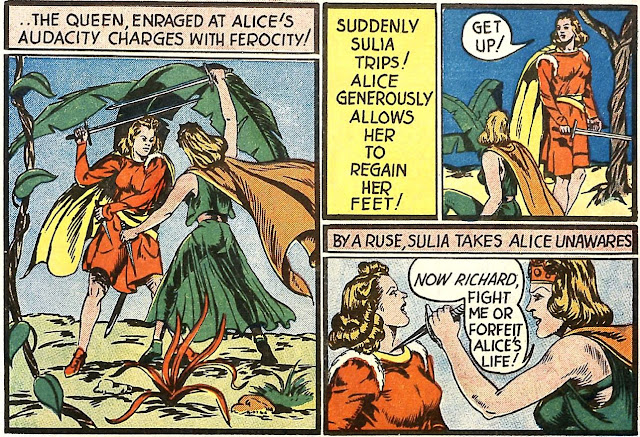
    They are flown to Soulless Isle and meet its ruler Queen Sulia, along with her coterie of beastly subjects. She wants a sword fight and Sir Richard of Warwick is who she wants it from. If this weren’t the 1940s I would suspect some double entendre was going on here. I kind of suspect it anyway.

    If this is an extended sex metaphor then things are heating up, as Alice jumps in to take over for her reluctant boyfriend only to be overwhelmed by Sulia’s technique, forcing Richard to join in. Phew!

    The prize for defeating Queen Sulia in battle is her hand in marriage and Sir Richard of Warwick seems weirdly okay with doing so. If the beastmen hadn’t sent a representative to him to reveal that they were in fact not just weirdos but regular folk transformed by Sulia’s dark majicks I reckon that the tale of the Golden Knight would have ended with him shacked up on Soulless Isle.

    But no, Sir Richard takes advantage of the beastmen’s intel re: Sulia having a magical clotting disorder and  employs a spiked wedding band to fatally wound her finger. Oddly enough, this underhanded trick doesn’t trigger his “thou shalt not fight women” chivalry. With Sulia slain and the beastmen restored to regular, Richard is free to return to Alice and I assume apologize to her.

  • MINOR SUPER-VILLAIN 616: THE HAG OF BLACKAMOOR

    MINOR SUPER-VILLAIN 616: THE HAG OF BLACKAMOOR

    (Fantastic Comics 007, 1940)

    We rejoin the European version of the Golden Knight as he and his ladyfriend Alice are having a bad time in Blackamoor Forest: both Alice and Sir Richard’s horse Whitey have broken their legs in a fall and so Richard and Alice are forced to hole up in a cave for the night (Whitey, sadly, did not make it). But who is this ominous form?

    It’s the Hag of Blackamoor and she isn’t messing around! In common with many villainous older women in comics, she wants to regain her lost youth and beauty and she’s willing to sacrifice others to do it. And because this is a Golden Knight comic, she has a proper quest for our hero to do: he must retrieve the Golden Stallion from Ice Mountain, for he alone can take the Hag to the Tree of Eternal Youth. That’s right: all the nouns are capitalized when you start talking about quest stuff.

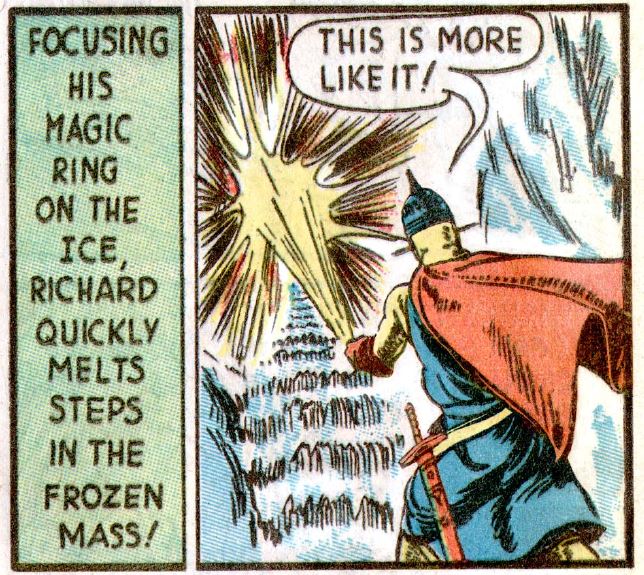
    The bulk of the story is all quest stuff with no Hag, so we’ll just run through it quickly. Sir Richard must climb the Ice Mountain (his magic ring turns out to have a heat ray setting)…

    … slay a fire-breathing dragon (his magic cloak is proof against its flames)…

    … and get past a guardian giant (his magic strength is up to the task of cleaving the giant’s head in twain).

    Golden Stallion successfully retrieved, the Golden Knight mounts up and returns to the Hag and his lady love, where it turns out that a) the Stallion doesn’t like the Hag very much and b) the Hag didn’t plan on that coming up and so does not protect herself from being trampled. Once she is dead, we learn c) that the Golden Stallion was in fact the enchanted Queen of Blackamoor. 

    This raises some questions! Like: what the hell was the point of that quest? If the Hag turned the Queen into a horse then why wasn’t she prepared for that horse to hate her? How did the Stallion get so well defended? If it was the Hag who put the Stallion there then why did she need a champion to go fetch it and if it wasn’t then who did? Does the Queen know where the Tree of Eternal Youth is or was that just a horse thing? None of these questions will ever be answered.

    As a reward, the Queen of Blackamoor gives Sir Richard a (presumably) magical horn that will summon her subjects to his aid if blown, because he certainly didn’t have enough magic items already.

  • MINOR SUPER-VILLAIN 610: ‘BDULA KHAN

    (Fantastic Comics 006, 1940)

    ‘bdula Khan is the capricious ruler of a mysterious oasis city in North Africa who offers the Golden Knight hospitality and then turns around and makes him battle monsters in an arena for his amusement. He’s not particularly notable and I’d likely have passed him over but for three things:

    1. The Name. ‘bdula is presumably short for Abdula and might be a unique name? Abdula is such an uncommon variant of Abdullah already, and it’s a bit tricky to search for a name starting with an apostrophe, but I’m reasonably certain that this is the only ‘bdula in comics.

    2. The Monsters. I love a good monster and these are suitably weird. Plus, ‘bdula Khan keeps them in line with his magical ability to place living beings in suspended animation, a good trick.

    3. The Solution to a Mystery. This is the most important one. I mentioned in the entry on the Black Death that Sir Richard and Alice are in Europe when they should be in North Africa somewhere, right? It’s not, as I had surmised, because the writer forgot, it’s because Golden Age comics and Fox Features in particular had a greater tendency than some of their competitors to swap out writers and artists, presumably for the sake of a deadline. Records of just who was on each feature are pretty spotty (and not helped by the use of a consistent house name no matter who was producing a particular feature) but I reckon that we’ve got two parallel Golden Knight timelines: one in which he’s in Europe with Alice and another in North Africa with a magic ring. I can hardly wait to see if the two timelines are merged (unlikely) or one is forgotten entirely (very likely).

    Oh also ‘bdula Khan is turned into a statue of a hyena for being a jerk.

  • MINOR SUPER-VILLAIN 607: THE MIRACLE MEN

    (Fantastic Comics 005, 1940)

    Like a fair few Fletcher Hanks villains, the Miracle Men take a regular crime and amp it up to the nth degree. In this case, thanks to the technological marvel that is the Invisible Vacuum Tube, they have industrialized kidnapping. And if the ransom is not paid an appropriately oversized response can be delivered via their tornado making machines! This is modern, industrialized crime!

    Under the direction of leader Wolf-Eye, the Miracle Men perform hundreds of simultaneous kidnappings. Should Wolf-Eye be the one in the title of this entry? Maybe.

    Unfortunately for the hundreds of rich guys and the US at large, the FBI does not want to pay up, so it’s tornado time.

    Stardust is of course all over this, so the chances of a major city being destroyed via super-tornado are only about 50% (this is, remember, a Fletcher Hanks comic – he does not shy away from mass casualties). This time there is no slaughter, but remember folks: Stardust will not necessarily save you. He will avenge you.

    The greatest and most unexpected thing in this comic is when the hitherto-normal seeming gang boss Wolf-Eye unveils his gland-control magic. Is it real magic or more super-science? Impossible to say but I choose to believe that it’s magic, a perhaps one-time spell that Wolf-Eye has kept in his back pocket for years in case his authority is sufficiently challenged. It’s really great.

    Merely being a big guy is not enough to take on an enraged Super Wizard, however, so all Wolf-Eye gets for his trouble is a sock in the mouth and a trip to Prison City by way of Getting Shrunk Avenue. It is perhaps lucky for the Miracle Men that they only kidnapped people, as the most ironic punishment for a kidnapping is of course to be taken away and confined yourself – it’s just lucky for them that Stardust didn’t decide to seal them up in a big boulder or something.

  • MINOR SUPER-VILLAIN 607: THE MIRACLE MEN

    (Fantastic Comics 005, 1940)

    Like a fair few Fletcher Hanks villains, the Miracle Men take a regular crime and amp it up to the nth degree. In this case, thanks to the technological marvel that is the Invisible Vacuum Tube, they have industrialized kidnapping. And if the ransom is not paid an appropriately oversized response can be delivered via their tornado making machines! This is modern, industrialized crime!

    Under the direction of leader Wolf-Eye, the Miracle Men perform hundreds of simultaneous kidnappings. Should Wolf-Eye be the one in the title of this entry? Maybe.

    Unfortunately for the hundreds of rich guys and the US at large, the FBI does not want to pay up, so it’s tornado time.

    Stardust is of course all over this, so the chances of a major city being destroyed via super-tornado are only about 50% (this is, remember, a Fletcher Hanks comic – he does not shy away from mass casualties). This time there is no slaughter, but remember folks: Stardust will not necessarily save you. He will avenge you.

    The greatest and most unexpected thing in this comic is when the hitherto-normal seeming gang boss Wolf-Eye unveils his gland-control magic. Is it real magic or more super-science? Impossible to say but I choose to believe that it’s magic, a perhaps one-time spell that Wolf-Eye has kept in his back pocket for years in case his authority is sufficiently challenged. It’s really great.

    Merely being a big guy is not enough to take on an enraged Super Wizard, however, so all Wolf-Eye gets for his trouble is a sock in the mouth and a trip to Prison City by way of Getting Shrunk Avenue. It is perhaps lucky for the Miracle Men that they only kidnapped people, as the most ironic punishment for a kidnapping is of course to be taken away and confined yourself – it’s just lucky for them that Stardust didn’t decide to seal them up in a big boulder or something.

  • MINOR SUPER-VILLAIN 597: NEGUS

    (Fantastic Comics 003, 1940)

    An evil African witch doctor with a magical orb, a cool tree house and a real commitment to being Chaotic Evil, Negus meets a swift end once Captain Kidd comes looking for his imprisoned and mind controlled pal Arndt Barrows Colonel Bennet (as with a surprising number of Golden Age comics, the writer seems to have lost track of the name of this secondary character over the course of a 5 page story).

  • MINOR SUPER-VILLAIN 578: SEMMURABI

    (Champion Comics 010, 1940)

    Have you ever wondered what happened to the Chaldeans, the ancient Mesopotamian people whose height was from the 9th to 6th centuries BCE, who were mentioned frequently in the Bible and whose name was lent to a Babylonian dynasty? Well wonder no longer! They were merely tucked away in a little hidden city less than a day’s travel via horse from Jerusalem! At least until 1940, that is, because that’s when the city’s leader, a fellow named Semmurabi, made the mistake of being too horny. Or maybe he’d been kidnapping clueless tourists (sincerely clueless: they were roped in by an offer to show them the remains of Noah’s Ark on Mt Arrarat) to add to his harem forever and this was just the first time he’d done it to someone who knew a super-hero.

    In Semmurabi’s defense (for not knowing to keep a lower profile, not for kidnapping women) this is a very early Dr Miracle adventure and he can be excused for assuming that he wouldn’t meet opposition from a tuxedoed magic-man (but again, he will not be excused for the kidnapping). This also might explain why he makes the classic mistake of challenging a more powerful opponent to a magical duel in the astral realm: because he simply didn’t know better.

    Ignorance is no excuse in magic as in law and Semmurabi meets his end in the depths of a star. Sorry, Chaldea. You were ruled by a dope and now you pass into history. (Champion Comics 010, 1940)