The Curse of Skeleton Munroe

Category: magic

  • MINOR SUPER-VILLAIN 578: SEMMURABI

    (Champion Comics 010, 1940)

    Have you ever wondered what happened to the Chaldeans, the ancient Mesopotamian people whose height was from the 9th to 6th centuries BCE, who were mentioned frequently in the Bible and whose name was lent to a Babylonian dynasty? Well wonder no longer! They were merely tucked away in a little hidden city less than a day’s travel via horse from Jerusalem! At least until 1940, that is, because that’s when the city’s leader, a fellow named Semmurabi, made the mistake of being too horny. Or maybe he’d been kidnapping clueless tourists (sincerely clueless: they were roped in by an offer to show them the remains of Noah’s Ark on Mt Arrarat) to add to his harem forever and this was just the first time he’d done it to someone who knew a super-hero.

    In Semmurabi’s defense (for not knowing to keep a lower profile, not for kidnapping women) this is a very early Dr Miracle adventure and he can be excused for assuming that he wouldn’t meet opposition from a tuxedoed magic-man (but again, he will not be excused for the kidnapping). This also might explain why he makes the classic mistake of challenging a more powerful opponent to a magical duel in the astral realm: because he simply didn’t know better.

    Ignorance is no excuse in magic as in law and Semmurabi meets his end in the depths of a star. Sorry, Chaldea. You were ruled by a dope and now you pass into history. (Champion Comics 010, 1940)

  • MINOR SUPER-HERO ROUND-UP 019

    Look at all these dang guys

    Lobo, the Flying Sleuth: 

    Lobo, the Flying Sleuth, aka the Lobo, had a pretty short run. But! He’s a cowboy and a pilot and a detective. That’s a lot of things! (Champion Comics 006, 1940)

    Doctor Miracle:

    We’ve seen guys like Dr Miracle before: the nigh-omnipotent magician with so much power at his fingertips that his only real challenge is in finding a foe tough enough that he doesn’t defeat them instantly. He’s even got the obligatory Huge Asian Manservant, a Nepalese man named Akim depicted with all of the racial sensitivity that one might expect from 1940s comics.

    Dr Miracle’s real mark of distinction is that he is also a scientific hero, as likely to be blasting a foe with disintegration rays as to be slinging spells. 

    It’s a neat bit of variation in his adventures and of course it gets dropped almost immediately, as his second appearance establishes him as a student of the Elders of the aptly-named City of the Elders in Tibet. After passing a test to show his magical aptitude, Dr Miracle is sent out into the world to battle injustice, with Akim coming along as a… gift? Unsettling. (Champion Comics 009, 1940)

    Doctor Hormone:

    Doctor Hormone exemplifies a particular sort of cultural ingestion/ regurgitation of scientific ideas that permeates all fiction but really found a home in the medium of comic books. Any sufficiently impressive scientific discovery can be reinterpreted as being tantamount to magic, the major example of which is of course the part that radiation would play as a catch-all origin in the Silver Age (and nanotech and genetic engineering in turn as time marched on) but as in any field there are many also-rans for every big hit: vitamins and radio waves and transistors (in the case of Silver Age Iron Man) as science-magic that can accomplish any task. With Doctor Hormone it’s hormones. Obviously.

    As we join the Doctor and his destined-to-be-bullied granddaughter Jane Hormone, he has just been saved from age-related death by a youthening hormone. He and Jane subsequently set out to help the beleaguered nation of Novoslavia defend themselves from the depredations of Germany/Russia analog Eurasia.

    Hormone’s first major antagonist is Rassinoff, aka Assinoff, a Novoslavian official secretly working for Eurasia and dosed with donkey hormones by Jane due to his initial bad vibes. Assinoff is exactly the jackass that his form reflects and is a very satisfying villain to see be repeatedly defeated and humiliated.

    Highlighting some of the more noteworthy hormone effects: the youth hormone (calibrated to make anyone who takes it 25 years old) is cool and fun when used on the elderly but the implications of using it on the young swiftly become horrific. At least the baby was turned into an adult man to save his life – these poor boy scouts are signing up to be adult child soldiers.

    It’s not particularly visually interesting but Hormones second appearance concerns his deploying a gas-based hormone that turns Eurasians into Novoslavians, which raises the question of just what they thought a hormone was over at Popular Comics.

    In Popular Comics 056, Assinoff tries to destroy Hormone’s credibility by injecting Novoslavian citizens with random samples from a captured selection of Hormone’s work, which completely backfires when it turns out that the Novoslavian national character is extremely okay with being turned into some random animal. It’s a nation of furries! 

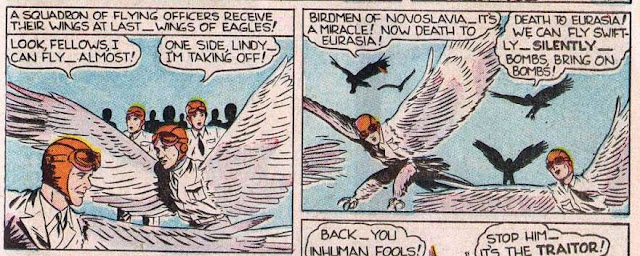
    These eagle-men pilots are the first of many Novoslavian animal-man hybrids, btw.

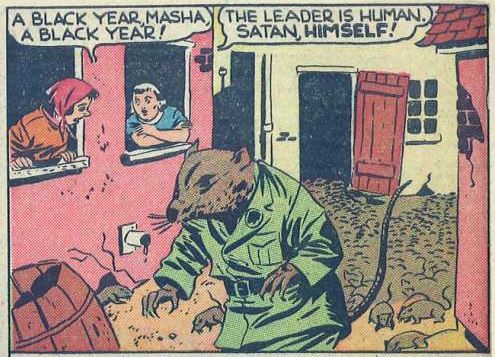
    Issue 57 of Popular Comics involves Novoslavian locust, wasp, termite and rat hybrids going out into the world to gather up plagues of their respective animals to unleash on Eurasia. Pictured here is the rat-man, my personal fave.

    The ultimate expression of Hormone’s hybridization efforts are these five Novoslavian volunteers who were turned into fleas and then restored to human form. Though they no longer look like fleas, they retain proportional jumping, flea-strength, etc, Spider-Man style. And the transformation is very gross-looking!

    So that’s Doctor Hormone in a nutshell: a bit light, plotwise, but full of charming characters and a cavalcade of new and interesting concepts in body horror. (Popular Comics 054, 1940)

    Martan the Marvel Man:

     I feel a bit bad making Martan follow Dr Hormone, honestly, because his adventures are at least as wild, but they aren’t as unique. In brief: Martan and his wife Vana are Antacleans, aliens from a super-advanced race a few million light years off. They kind of accidentally land on Earth and almost immediately get mixed up in the affairs of primitive humans. At first it’s regular old “they war amongst themselves, how foolish!” stuff but eventually they discover in incipient invasion by Antaclea’s ancient enemy the Martians and really throw their weight behind the Earth cause: supplying technology, setting up a world government etc. – Martan and Vana’s impact on the world is much greater than your typical comic book characters’. (Popular Comics 046, 1939)

  • MINOR SUPER-VILLAIN 570: OO-LHAT

    (Champion Comics 003, 1940)

    There’s a lot to like about ol’ Oo-Lhat. He appears in a gross-sounding mist after explorer Walt Worthington and his aide Snowball (did you know that there was a whole category of racist nicknames for African American characters that has largely been forgotten and that involves naming them after something very black or very white? Well now you do) discover a lost Egyptian tomb containing a blazing scarab (the gem cut, not the insect) that drew them into a pocket dimension when touched.

    Oo-Lhat captures the duo and forces them to listen to his life story, employing a magical teevee called the Curtain of Ammon to do so.

    A priest of Osiris at Karnak, Oo-Lhat gives it all up and switches allegiances to Set in order to obtain gold, power and the love of a beautiful woman.

    This is where Oo-Lhat starts to make the transition from small-b to big-b Bad Guy. He makes his way to the Oasis of Memthet, where a cult had gathered to worship the same scarab encountered by Walt and pal. Oo-Lhat takes over by the simple expedient of murdering all of the other contenders.

    Discovering the pocket dimension accessible through the scarab, Oo-Lhat moved his cult into it and had them build a city, from which they raided caravans under the somewhat grandiose name of the League of Assassins – pretty sure just jumping out of a portal and stabbing someone is just regular murder, bro.

    The real appeal of the scarab dimension, though, was the fact that time essentially did not pass there and so the population was essentially immortal – even those killed by gross bodily trauma came back as weird ghosts. Possibly the best aspect of this is the fact that animals could not properly comprehend this state of being and so immediately died and came back, and as they presumably had an imperfect vision of themselves they came back wrong, leading to the city being full of weird lumpy camels.

    The timelessness of the scarab world eventually backfires on Oo-Lhat and his followers when the temple is buried in a sandstorm, trapping them for thousands of years with nothing to do but twiddle their thumbs.

    Oo-Lhat is all set to resume his ways as an “assassin” but his followers have other ideas. Presented with the choice of whether to leave or stay, every single one of them leaves. Including Oo-Lhat, after a little five-fingered persuasion from his lieutenant Kardak.

    The explorers eventually follow (along with some babes they found and fell in love with) and discover the final fate of Oo-Lhat and the League of so-called Assassins: time spent in the pocket dimension, it turns out, was not avoided so much as deferred: Oo-Lhat, the League and even the babes were reduced to skeletons the instant they exited.

  • MINOR SUPER-VILLAIN 560: VLADIM

    (Wonderworld Comics 005, 1939) 

    Our hero, Yarko the Great, is driving along a country lane outside London when his travels are interrupted by a bestial figure who runs out of a nearby castle and immediately drops dead. While Yarko is examining the body a monocled creep emerges from some nearby bushes Homer Simpson-style to introduce himself as “Vladim, a genius!” For me, this is exciting, because he shares his somewhat-unusual name with the seldom-mentioned, never-seen airplane designer of the Blackhawk Squadron and you better believe I think about that guy more than most people (just how these two characters created by Will Eisner came to share a name is a mystery for the ages).  

    As any self-proclaimed genius would, Vlamir brings Yarko to his underground sanctum to show off his magical experiments and I just want to emphasize something about his setup: beneath his castle is a series of bridges and staircases seemingly to the scale of Moradin in the first Lord of the Rings movie, yet his magical laboratory is housed in a room the size of a large bathroom and furnished with one (1) light, one (1) art and one (1) large skull-themed throne.

    Also please note that the initial view of the throne was out of proportion for dramatic effect and that the actual placement of the skull ensures that unless it is made of plush velvet, that sucker is going to be wildly uncomfortable to sit in for any length of time. This as much as the fact that Vladim has trapped a woman in a fire pit using a voodoo doll has me convinced that he’s just started out on the road of dark magic and is indulging his every whim – a more experienced villain would know the long-term importance of good lumbar support.

    Yarko of course has little trouble dealing with a dilettante like Vladim: in short order he frees the girl, turns a bestial henchman back on his creator and kind of kills Vladim. If hounding a man along a narrow bridge with an image of your own floating head until he slips on his own knife and falls into the murky depths of his basement can be counted as killing a guy. Which I suppose it can.

  • MINOR SUPER-VILLAIN 558: DOXOL

    (Wonderworld Comics 004, 1939)

    We (and the Flame) start in media res, as a young woman unsuccessfully attempts to flee a car full of hooded goons, is captured and brought back to an ominous manor in the woods. The Flame cottons on to this and follows them.

    Inside we find Doxol! Doxol is a wizened green fellow who is using mind control drugs (mystic ones!) to create his own little crime cult. This is where the slice-of-life nature of the story gets a bit frustrating from an analytical perspective: is Doxol still setting up or has this cult been a going concern for a while? Were the new recruits all kidnapped or recruited regular cult-style? Even Doxol’s appearance – magic mutation or dramatic disguise? It’s a mystery!

    The Flame has even less information about Doxol than we do because he was dropped into a pit with crushy walls as soon as he stepped through the door. Lucky for him/ unlucky for Doxol his induction ceremony involves a flaming brazier for the Flame to appear in like he does (also lucky for that lady because she doesn’t get shot full of grody mind control drugs).

    Doxol makes his escape while the hooded riffraff deal with the Flame, or so he thinks. Turns out that the Flame was fortuitously flying his plane when he stumbled into this mess. 

    You’d think that engaging a guy like the Flame in a dogfight would level the playing field for a fellow like Doxol but no, he just leans out the window and lights Doxol’s plane on fire.

  • MINOR SUPER-VILLAIN 555: SHADDIBA

    (Wonder Comics 002, 1939)

    Shaddiba appears in the first adventure of magic hero Yarko the Great as an old enemy of Yarko who has come to the town of Hexville in the Allegheny Mountains of Pennsylvania. His exact reasons for doing so are unstated, so I reckon that it’s equally likely that Hexville is an especially ripe spot for crime as that he was attracted by the old haunted mansion on the hill that he moves into. Comic book expectations aside I reckon that sourcing those has to be a real estate nightmare – I’ve certainly never had the opportunity to rent one.

    Shaddiba’s dumb name also introduces the possibility that perhaps Yarko is not alone, that all magic users in this continuity have made-up nonsense monikers. It’s the only rational explanation!

    Shaddiba does a lot of mouthing off to Yarko about what a great magician he is and how much Yarko sucks and to be fair Yarko is unable to break the mental hold that Shaddiba has on several locals in order to compel them to rob and murder (as well as on a local woman because he is a creep), but this is definitely classified as hubris.

    The fact that Shaddiba lambastes Yarko for intruding on the “sacred arts” of the “magic of the East” and then immediately invokes Lucifer as the source of his power is weird.

    The disagreement between the two magicians comes to a head in an all-out astral smackdown. A lot of the astral battling that we’ve seen so far (e.g., the one in this Mr Justice episode) has been quite quick-and-dirty decisive, so it’s neat to see these fellows really get into it.

    Shaddiba surrenders rather than be flung into the Chasm of Oblivion but if there’s one trait almost universally shared by super-villains it’s being a sore loser and so he blows himself to smithereens rather than live with the consequences of his actions.

  • MINOR SUPER-HERO ROUND-UP 015

    Once again we take you to the world of the minor super-hero. See them dance for your amusement. 

    the Mystic: 

    Later known as Kardak the Mystic, the Mystic is a stage magician who uses stage magic to battle crime, specializing in fraudulent mediums etc. His stage magic eventually gets rounded up to real magic, of course. (Top-Notch Comics 001, 1939)

    the Phantom o’ the Hills:

    The Phantom o’ the Hills is an otherwise unnamed masked cowboy who rights wrongs in the Old West. In his first adventure he avenges the death of his younger brother but whether that’s what got him into the vigilante game is not elaborated on. The only real thing that sets him apart from the ranks of other similar characters is his better-than-average name. (Western Picture Stories 001, 1937)

    Wonder Man:

    For all that (by some accounts) Will Eisner was explicitly told to make a Superman clone when he made him for Fox Features (and that DC successfully sued Fox into canning him), Wonder Man is only kind of like Superman. Maybe it’s my modern image of what Superman is like but he’s just a strong guy who jumps around catching artillery shells and beating up warmongers. Plus he gets his powers from a magic Tibetan ring! Plus he’s blonde! (Wonder Comics 001, 1939)

    Yarko the Great:

    There are three major things to know about Yarko the Great: 

    1. He’s a magic-slinging hero in the classic mold, i.e., an American who has learned the secrets of the Far East and turned them to a career in stage magic/ crimefighting.

    2. Like a lot of early Fox Features characters he was created by Will Eisner so his adventures tend to look pretty great.

    3. “Yarko the Great” is – and this is an informed opinion – categorically the worst name that any magic-using Golden Age hero was saddled with. 

    (Wonder Comics 002, 1939)

    Yarko UPDATE 1940

    *UPDATE* the Flame *UPDATE*:

    Just wish to draw everyone’s attentions to the really boss custom-painted boat that the Flame was tooling around in during his first adventure. Plus he had a butler named Jarvis! (Wonderworld Comics 003, 1939)

    **DOUBLE UPDATE**

    And he has a plane! (Wonderworld Comics 004, 1939)

  • MINOR SUPER-VILLAIN 516: THE GHOST CROOK

    (Blue Bolt v2 003, 1941) 

    Sergeant Spook’s actual jurisdiction as a ghost cop is both broad and vague, but when he opens up his presumably black market mortal paper one day and learns that a ghost is seemingly wreaking havoc among the living it’s a no-brainer: he’s on the case. And it seems that he’s up to the task of tracking the Ghost Crook down, because just about as soon as he steps foot in the mortal world he happens across a spooky mugging!

    It doesn’t take long for Sergeant Spook to discover that the Ghost Crook is not, in fact, a ghost but an invisible man of some kind. So not a criminal ghost but something just as bad: a criminal besmirching the good name of ghosts everywhere!

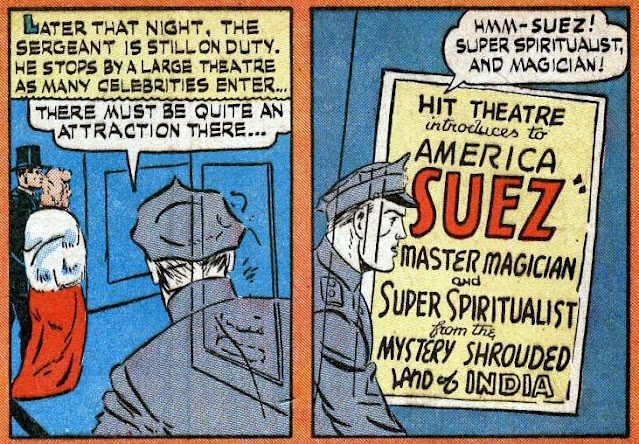
    Sergeant Spook seemingly just starts visiting all of the supernatural-adjacent locales in town and once more gets incredibly lucky as his first port of call is the theatre at which Suez, Master Magician and Super Spiritualist is performing and Suez is in fact the Ghost Crook. Why is he named the overwhelmingly-Egyptian-associated Suez when he is touted as being from “the mystery shrouded land of India”? My money is on him being a white guy who chose his name on vibes. My evidence? The history of entertainment.

    This is where things get a bit confusing. Once the Ghost Crook is revealed to be a stage magician there is some effort to reframe his invisibility as mere slight-of-hand, whether via trickery with mirrors and clouds of dust or the old standby explanation of mass hypnosis. But… we saw the Ghost Crook be fully invisible! He was running down a city street in broad daylight! And just like every time hypnosis is wheeled out in a Zatara story to explain all his wild powers, the sheer scope of what Suez could supposedly do (hypnotize everyone with eyes on him in a city street, including a ghost that he could not see and was not aware of who had just showed up while he was busy wresting a bag from a man’s hand) is so wildly over-the-top that merely turning invisible via magic is by comparison mundane.

    This question is not resolved, by the way. The Ghost Crook is felled with a spectral sock to the jaw and carted off by mortal police. Who then had to figure out if he really was an Indian citizen, presumably.

  • MINOR SUPER-VILLAIN 497: RAMUN THE EVIL ONE

    (Big Shot Comics 016, 1941)

    Ramun the Evil One aka Ramun the Great is a hypnotist/ stage magician with a simple if short-sighted plan: 1) open a club in New York 2) have it become popular with the wealthy social set 3) hypnotize rich guys 4) profit

    (aside: just look at that charming picture of a man who thinks he’s an ape! The little dance!)

    The short-sighted part goes hand-in-hand with the profit, as once Ramun has induced his victims to hand over all of their fungible wealth he orders them to drive into the Hudson River and drown themselves, and he’s done this more than a dozen times over the course of two weeks. This is… not smart. “Hey, every victim went to the Egyptian Gardens and got hypnotized just before withdrawing all their monies from the bank and disappearing” is a thought that even the most dull-witted police officer will eventually have, to say nothing of Marvelo, Monarch of Magicians.

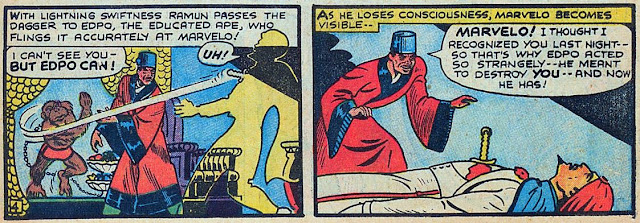
    Ramun does find an unorthodox counter to the common super-villain problem of invisible magic-men creeping around in their lairs: train an ape to deal with it. And he comes as close as anyone to killing Marvelo, so good job Ramun!

    Ramun blows himself up at the end of the story but manages to recover enough for he and Edpo the ape to return in Big Shot Comics 019, wherein they have switched their focus from larceny to espionage. This time, Ramun seems to have some actual, non-hypnosis-based magic to call on, but it’s not quite enough.

    Ramun, Edpo and their unnamed employer end up simultaneously perforated and drowned at the climax of the story, and while this is exactly the kind of off-panel “nobody could survive that” death that Ramun came back from the first time he was doomed by a far more insidious foe than mere bullets: popularity. Big Shot Comics 020 was Marvelo’s final outing and so Ramun would never get his chance to return.

    UPDATE: Ramun makes a completely unexpected return in The Face 001!

  • MINOR SUPER-HERO ROUND-UP 002

    Still lotsa super-heroes to add.

    the Marksman: 

    Single appearance hero trained by his father to be completely accurate with thrown or projectile weapons. Uses the alias John Courage. Throws a spear through a guy’s head one time. (Amazing-Man Comics 023, 1941)

    Miraco the Great:

    Circus magician with real powers. His one adventure involved running a sex pest gorilla trainer out of the circus. (Amazing-Man Comics 023, 1941)

    Super Ann:

    A young woman who was given super strength by a weird old cave-dwelling alien man as a child. She’s very charming! I particularly like how straightforward her crimefighting is – most of the time she just walks up and punches a fool, as someone who grew up with super strength might. This does leave her vulnerable to sneaky attacks, but lucky for her her fellow hero Mighty Man has decided to follow her around and keep her out of trouble. (Amazing-Man Comics 024, 1941)

    And speaking of Mighty Man…

    Mighty Man Update:

    When Mighty Man debuted he was just a 12 foot tall guy, then in Amazing-Man Comics 012 a scientist performed an operation on him that allowed him to change his size at will (and then promptly got himself murdered, natch). At first he could merely grow and shrink but pretty quickly he developed more refined shapechanging abilities, including changing his appearance and, most upsettingly, changing the size of individual parts of his body. By the time he began shadowing Super Ann, Mighty Man was just as likely to be a weird little gremlin with one huge arm, or, as in the panel above, a big ear in order to freak out a goon or Nazi. Unpleasant!