The Curse of Skeleton Munroe

Category: costumes

  • MINOR SUPER-HERO ROUND-UP 072

    Extremely minor super-heroes? Don’t mind if I do!

    the Flag-Man:

    The Flag-Man is one standard unit of patriotic American super-hero: he loves the United States and is willing to put on a costume and punch guys until it is safe. And speaking of costumes: the Flag-Man and his pal Rusty are prime examples of how piggybacking off of the iconography of the American flag can really paper over some pretty bad costume design. I mean, tank-top and cape and flared gloves? Give me a break.

    The Flag-Man’s alter ego is Captain Hornet (occasionally Major Hornet), trouble-shooter for the President, who presumably knows about the whole Flag-Man thing.

    Since Captain Hornet/the Flag-Man seems the be dedicated to solving problems exclusively via the medium of hand-to-hand combat, he is in effect a fist that FDR can send to punch anyone he wants. Mostly Nazis, to his credit. (Captain Aero Comics 001, 1941)

    Rusty:

    Just as the Flag-Man is the elemental patriotic hero, his sidekick Rusty is the basic unit of kid sidekick: no last name, no alter-ego, just a scrappy teen who tags along on adventures. I do find him the most irritating of all the Golden Age sidekicks we have yet encountered, so that’s at least one distinction. (Captain Aero Comics 001, 1941)

    Solar, Master of Magic: 

    Solar, Master of Magic is as you might have guessed another of Golden Age comics’ many, many magic guys, which in practical terms means that he can do basically anything he wants to. In contrast to a lot of his peers, he chooses to use his fists as much or more than his magic. 

    Although Solar presents as a pure magic guy, he is in fact a magic item guy, with a magic cape of invisibility and a magic ring of doing everything else. It’s a minor distinction but it introduces the possibility of the source of his powers being stolen from him, which does in fact happen during the final of his four appearances. (Captain Aero Comics 001, 1941)

    Captain Fearless:

    Comics love to tie their characters to history, usually by making them the descendant of someone famous but often by inserting their ancestors into real events, as can be seen in the case of the Wizard. This might be the first time I’ve seen it done to this extent, however, as John Fearless here is not only the instigator of the Boston Tea Party, but a member of the First and probably Second Continental Congresses and could reasonably be expected to be a signatory of the Declaration of Independence. In other words, he’s a whole-ass made-up Founding Father!

    John Fearless goes on to die in one of the opening battles of the Revolutionary War, upon which… well, the speech balloon placement is annoying, but either he ascends into heaven as an otherworldly voice tells him that his patriotism will live on in his family line or an angelic being from the newly-formed United States of Heaven descends in full uniform to collect his soul and tell him the same. I prefer the latter, but who can tell.

    Regardless of the otherworldly voice’s source, its words prove true, as evidenced when young John Fearless VI, latest member of a family of patriots, visits his ancestor’s grave and then gets to meet that very ancestor.

    The ghost of John Fearless I relates the glorious history of the other four Captains John Fearless, fighting to protect the American values of justice and liberty for all (and also in the Mexican- and Spanish-American Wars) and gasses on for a while about patriotism and so forth.

    In contrast to his forebears, John Fearless VI’s assignment is not military but vigilante in nature, as the ghost of John Fearless I is concerned about the threat of fifth columnists and is of the opinion that a costumed crimefighter is the best way to root them out. To that end, his great-great-great grandson is outfitted with a not-great costume and sent off to battle.

    He also gets an antique powder horn that doubles as a musical one, and annoyingly does not blow it during his first case. Once he finally gets around to trying it out, it summons the ghost of the original Captain Fearless to help him out by invisibly beating people up and flying him around in his ghost arms.  (Captain Fearless Comics 001, 1941)

  • MINOR SUPER-HERO ROUND-UP 072

    Extremely minor super-heroes? Don’t mind if I do!

    the Flag-Man:

    The Flag-Man is one standard unit of patriotic American super-hero: he loves the United States and is willing to put on a costume and punch guys until it is safe. And speaking of costumes: the Flag-Man and his pal Rusty are prime examples of how piggybacking off of the iconography of the American flag can really paper over some pretty bad costume design. I mean, tank-top and cape and flared gloves? Give me a break.

    The Flag-Man’s alter ego is Captain Hornet (occasionally Major Hornet), trouble-shooter for the President, who presumably knows about the whole Flag-Man thing.

    Since Captain Hornet/the Flag-Man seems the be dedicated to solving problems exclusively via the medium of hand-to-hand combat, he is in effect a fist that FDR can send to punch anyone he wants. Mostly Nazis, to his credit. (Captain Aero Comics 001, 1941)

    Rusty:

    Just as the Flag-Man is the elemental patriotic hero, his sidekick Rusty is the basic unit of kid sidekick: no last name, no alter-ego, just a scrappy teen who tags along on adventures. I do find him the most irritating of all the Golden Age sidekicks we have yet encountered, so that’s at least one distinction. (Captain Aero Comics 001, 1941)

    Solar, Master of Magic: 

    Solar, Master of Magic is as you might have guessed another of Golden Age comics’ many, many magic guys, which in practical terms means that he can do basically anything he wants to. In contrast to a lot of his peers, he chooses to use his fists as much or more than his magic. 

    Although Solar presents as a pure magic guy, he is in fact a magic item guy, with a magic cape of invisibility and a magic ring of doing everything else. It’s a minor distinction but it introduces the possibility of the source of his powers being stolen from him, which does in fact happen during the final of his four appearances. (Captain Aero Comics 001, 1941)

    Captain Fearless:

    Comics love to tie their characters to history, usually by making them the descendant of someone famous but often by inserting their ancestors into real events, as can be seen in the case of the Wizard. This might be the first time I’ve seen it done to this extent, however, as John Fearless here is not only the instigator of the Boston Tea Party, but a member of the First and probably Second Continental Congresses and could reasonably be expected to be a signatory of the Declaration of Independence. In other words, he’s a whole-ass made-up Founding Father!

    John Fearless goes on to die in one of the opening battles of the Revolutionary War, upon which… well, the speech balloon placement is annoying, but either he ascends into heaven as an otherworldly voice tells him that his patriotism will live on in his family line or an angelic being from the newly-formed United States of Heaven descends in full uniform to collect his soul and tell him the same. I prefer the latter, but who can tell.

    Regardless of the otherworldly voice’s source, its words prove true, as evidenced when young John Fearless VI, latest member of a family of patriots, visits his ancestor’s grave and then gets to meet that very ancestor.

    The ghost of John Fearless I relates the glorious history of the other four Captains John Fearless, fighting to protect the American values of justice and liberty for all (and also in the Mexican- and Spanish-American Wars) and gasses on for a while about patriotism and so forth.

    In contrast to his forebears, John Fearless VI’s assignment is not military but vigilante in nature, as the ghost of John Fearless I is concerned about the threat of fifth columnists and is of the opinion that a costumed crimefighter is the best way to root them out. To that end, his great-great-great grandson is outfitted with a not-great costume and sent off to battle.

    He also gets an antique powder horn that doubles as a musical one, and annoyingly does not blow it during his first case. Once he finally gets around to trying it out, it summons the ghost of the original Captain Fearless to help him out by invisibly beating people up and flying him around in his ghost arms.  (Captain Fearless Comics 001, 1941)
  • MINOR SUPER-VILLAIN 912: COMMANDER DARKE

    MINOR SUPER-VILLAIN 912: COMMANDER DARKE

    (Bang-Up Comics 001, 1941)

    Commander Darke, though ostensibly on a mission to invade the United States with his private military, is the arch-foe of scientist-adventurer Cosmo Mann and as such spends his entire career trying to Steal Those Gizmos. Perhaps things would be different if there had been more than three issues of Bang-Up Comics for Darke and Mann to clash, but as it stands all we get are the opening moves of their epic struggle.

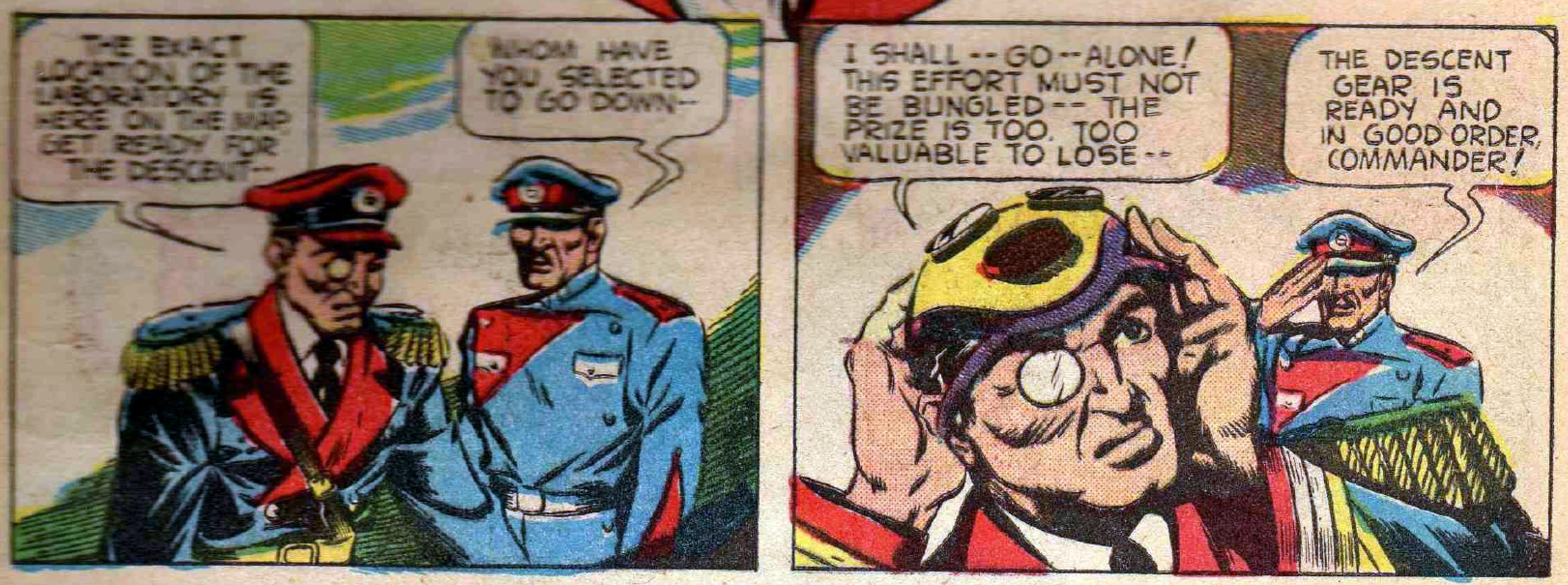
    You probably already took note of the extreme ostentation on display in Commander Darke’s (almost certainly self-designed) uniform, but the seriousness with which he takes his wardrobe is really underscored in the above panels in which we can not only see that he took the care to screw in his monocle even when waking up in the middle of the night to take a call but that even his double-breasted pyjamas have epaulettes on them. 

    I was all ready to give Darke a bit of credit for undertaking the mission to secure Cosmo Mann’s Sun Ray Gun himself, but once he left his captured underlings behind to die in a cloud of poison gas I was forced to reevaluate: going himself is a part of his being a Bad Boss, an expression of his disdain for the ability of his minions to do even this simple task. He does have a cool-looking gas mask though.

    Commander Darke has a lot of villainous presence or potential, but never really gets a chance to show it off: he captures the Sun Ray and a man who he thinks is Cosmo Mann but turns out to be his assistant Archy and then spends his next appearance on the back foot as Mann attempts to recapture them from Darke as he escapes in his dirigible. His particular brand of bombastic villainy was lost to the vagaries of the comic book boom, alas.

  • MINOR SUPER-HERO ROUND-UP 070

    MINOR SUPER-HERO ROUND-UP 070

    No more of those fancy-pants vigilantes that you’ve had a chance to have heard of: here’s some real minor super-heroes for you:

    the Rainbow: 

    The Rainbow, aka Jim Travis, may just be the first super-hero whose origin involves reading a comic book and taking inspiration from it, but unlike the other examples of this that I can think of Jim reads less like someone finding a solution to a problem that they have and more like one of those guys who is convinced that they could score a point off of a professional athlete if they tried. Most of his motivation honestly seems to come from a desire to prove his girlfriend wrong when she says that his idea is not good. 

    To his credit, Jim does put in a pretty good show as the Rainbow. He hops around the rooftops and foils some crooks with a few timely punches. Though the real-world reason that he only made one appearance was the fact that Centaur Comics was a very short-lived phenomenon that tailed off pretty sharply in 1941/1942, it is very tempting to imagine that the Rainbow’s second outing ended in some sort of career-ending and unpublishable disaster.

    Finally, the name: while the natural assumption is that Jim called himself the Rainbow after assembling such a multicoloured outfit (and making some real choices, too! The barely laced-up shirt, the cape depending from the cowl mask, the footie tights… this is one of the more eccentric costumes in comics, if only at a second or third glance), I personally think that the name was chosen solely in order to make the above very poor virtually incomprehensible joke. (The Arrow 003, 1941)

    Cosmo Mann: 

    Cosmo Mann is a scientific adventurer who has developed an extremely bulky ray gun with three different modes: a “Sun Ray” capable of vaporizing a tank, a paralysis ray and an ill-defined “G Ray” that seems to both increase the mass of the bullets being fired at him in the above demonstration and also melt them somehow. He also has a cool personal flight suit called the Sun Ray Suit that he dons in his second appearance to rescue his cigar-chomping aide Archy from the diabolical Commander Darke.

    Like all Progressive Publications characters, any enthusiasm I feel toward Cosmo Mann is tempered by the fact that he only ever appeared in three comics, one of which is currently lost to the ages. Still, I have to admit that he is a pretty cool guy. (Bang-Up Comics 001, 1941)

    Buzz Balmer: 

    Buzz Balmer is a young aircraft enthusiast whose father has just perfected his Minus-Ray shrinking device, and thanks to his youthful enthusiasm he ends up bounding directly into the Minus beam and becoming permanently shrunk to a few inches tall.

    Thanks to his guilty conscience, Professor Balmer makes sure to equip him with the very latest in shrunken aviation technology so that he can fly around the countryside making up excuses to kill the wildlife for fun. Eventually – perhaps thanks to all the favours that his dad has been calling in to procure ever-faster fighter planes – military intelligence gets wind of Buzz and recruits him as an asset. His second and final appearance is spent tooling around Europe for the Army.

    The most vexing thing about Buzz Balmer is that I want to say that his name is a pun on “buzz bomber” but I can only really find evidence of v1 Rockets being called that and they don’t start being used for three more years. While it seems like the term might have been used for something before that, any further web-based research is hampered by the popularity of both the Sonic the Hedgehog enemy and novelty fishing lures that also use the name. (Bang-Up Comics 001, 1941)

    Lady Fairplay: 

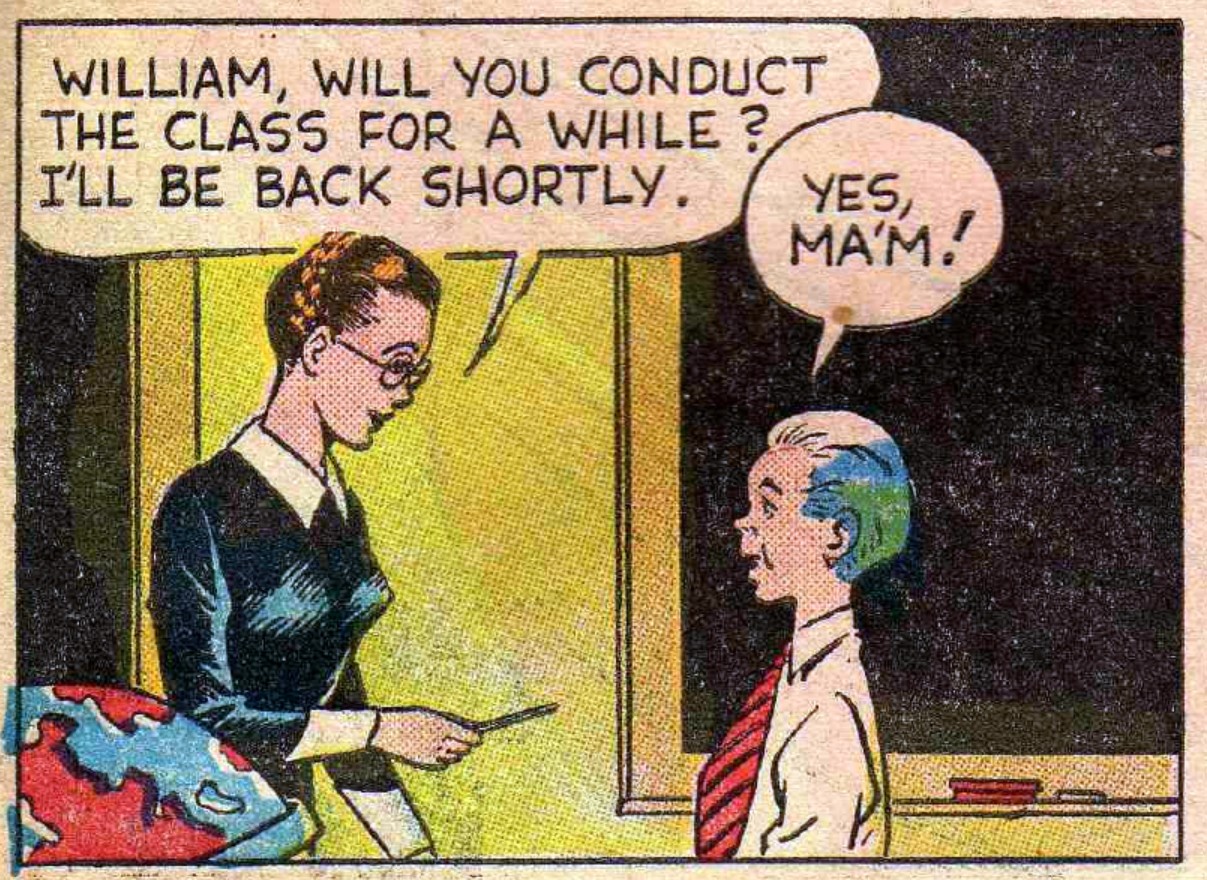
    Lady Fairplay, the “Goddess of Chastisement,” is actually Mary Lee, a mild-mannered schoolteacher given super powers by the never-seen Professor Amazo. I find her costume quite charming, particularly the scale-mail skirt.

    Here’s the thing about Lady Fairplay: she is a perfectly generic super-hero. She is super fast, super strong, agile enough to climb up the side of a plane while it is in flight. She drives around in a super car and ducks out of her day job to fight crime at the drop of a hat. 

    Perhaps the most extraordinary thing about Lady Fairplay is that she just leaves some kid named William in charge of her class while she runs off to fight crime. Good luck on the bullying, William! (Bang-Up Comics 001, 1941)

  • MINOR SUPER-HERO ROUND-UP 069

    Mostly, but not all, updates. 

    Ibis the Invincible **UPDATE**:

    1941 sees Ibis the Invincible’s omnipotence tempered a bit via a slight limitation that is added to the Ibistick: it is not directly able to affect things created by or otherwise powered by evil magic, and it might not work at all in overtly magical areas such as a giant’s floating castle.

    This is balanced out somewhat by the fact that it gives Ibis the chance to demonstrate his lateral thinking skills by indirectly affecting these things, whether it be with a right hook or a summoned Egyptian god. (Whiz Comics 016, 1941)

    the Lieutenant Marvels:

    The Lieutenant Marvels are also the members of the Billy Batson Club, being three other kids with the name Billy Batson who all gather in New York Fawcett City to… share the pain of having the same name as a media figure with the figure in question? I guess that’s what they were doing? Turns out they all get along well enough to form a club, and to distinguish themselves they all choose a nickname: the lanky Westerner becomes Tall Billy, the squat Brooklynite is Fat Billy, the Southerner chooses to be Hill Billy and the famous one is acclaimed as Real Billy. This is the sort of nicknaming system that seems fine when you’re thirteen but can really fester over the years.

    The meetup is not all about comparing names and making friend, however, because these guys all have access to the comic books from our universe somehow and as such they all know about the link between yelling “SHAZAM!” while being named Billy Batson and becoming Captain Marvel, BUT ALSO are surprised when Real Billy does so and transforms. It’s a real pickle how they might have most of the info but not that last piece – perhaps the comics in this world that will eventually be designated Earth-S posit that Billy summons Captain Marvel by yelling for him. 

    Thanks to some name-based misunderstandings, the four all end up being captured by Dr Sivana and his group the Vengeful Four and tied to a deathtrap loud enough that all four Billys need to shout together to get the SHAZAM through to the lightning dispatcher. Surprisingly, the “any Billy Batson yelling SHAZAM = Captain Marvel” idea that they all had in their heads was accurate, and they all transform into equivalently powerful super-beings, with a ready-made names that are not actually used until their second appearance: Tall Marvel, Fat Marvel and Hill Marvel.

    (I have to admit here that I had for many years thought that the “Lieutenant” in Lieutenant Marvels was like when a villain’s top guy is called their lieutenant, like these guys are Captain Marvel’s helpers. I just now realized that it is in fact a straight military hierarchy joke) 

    The Lieutenant Marvels show up now and then to this day when Captain Marvel needs three other guys to help him do something, but given that they debut just a few months before Captain Marvel Jr and a year and a bit before Mary Marvel, their services aren’t as in-demand as one might expect.  (Whiz Comics 021, 1941) 
    Golden Arrow **Update**: 

    Though as previously noted the Golden Arrow strip essentially switched from a Modern West to Old West setting after about two or three issues, there has always been a bit of ambiguity as to the specific century the action was taking place in. Though some might point to the presence of a working stagecoach system or other anachronisms in earlier issues as evidence that Golden Arrow was firmly Old West, I have been burned before and it took something like this declaration of the train as a new-fangled arrival to convince me that the comic wasn’t suddenly going to feature Nazi fifth columnists. (Whiz Comics 021, 1941)

    the Arrow **Update**: 

    The Arrow finally gets an alter ego in his final comic book appearance, and it’s US Intelligence agent Ralph Payne. Is this an improvement over being an unnamed giant of a man? I leave that as an exercise for the reader. He also gets a more conventional super-hero cowl mask (with just a hint of the visible hairline that made his fellow Centaur character the Fantom of the Fair look so distinctive) and some cool boots at the same time. (The Arrow 003, 1941)

  • MINOR SUPER-HERO ROUND-UP 068

    MINOR SUPER-HERO ROUND-UP 068

    A few classic minor super-heroes. Bulletman and Bulletgirl in particular have just barely managed not to remain relevant – I suppose the pointy helmet is too much of a hurdle for the modern audience.

    Bulletman: 

    Jim Barr is perhaps the most thoroughly-motivated super-hero of the Golden Age. He is:

    a. from a long line of police officers

    b. the son of a famed police officer who was murdered for being too good a cop and who

    c. told the young Jim that he must become a police officer while on his death bed 

    d. and after all that he was too scrawny and bookish to be a cop and so had to settle for being a forensic scientist

    Jim ends up working in his father’s old station under the command of Sergeant Kent, a pro-torture bully who is often held up as the greatest of all the cops in the city, and who is also the father of love interest Susan Barr. 

    Jim’s personal project is a serum that will destroy “all germs and toxins” in the human body, including that which he believes to be the source of crime and violence. He chooses to test this serum out on himself and his body, freed from a variety of invisible ailments, develops into a physical paragon over the course of a night’s sleep.

    (Sergeant Kent really earns his reputation as a great police officer by failing to notice that his colleague has basically doubled in size over night. In his defense, Jim is wearing big clothes)

    Jim decides that the best way to use this new power is to operate outside of the law, probably due to all of his time hanging around with top cop Kent. He uses his now super intelligence to build the Gravity-Regulator Helmet, which allows him to fly and also generates a force field that augments his natural resilience to make him nigh-invulnerable and able to smash through things head-first (I swear that somewhere I read a story in which it was explained that it made him bulletproof by drawing the bullets to the helmet but danged if I can find it now.). His costume, yellow jodhpurs and all, is assembled out of things that were lying around at the police station, no mention of where. (Nickel Comics 001, 1940)

    If I had to classify Bulletman’s personality, I would go with “extremely no-nonsense” or maybe “wooden, which is why it is important that he is eventually joined by his female counterpart: 

    Bulletgirl: 

    Bulletgirl is the aforementioned Susan Kent, daughter to good cop/bad cop Sergeant Kent and member of Bulletman’s supporting cast from the beginning. For about the first year of Bulletman’s adventures she fills a low-effort version of the Lois Lane role: curious about the hero’s identity but not especially proactive about trying to uncover it. She also gets kidnapped and targeted for death a lot thanks to her father’s skill at making enemies. Then, in Master Comics 012, Bulletman is knocked out in a collision with Triple Threat’s super vehicle and Susan learns that he is actually Jim Barr. Jim obligingly tells Susan the secret of his origin but resolutely refuses to consider teaming up with her.

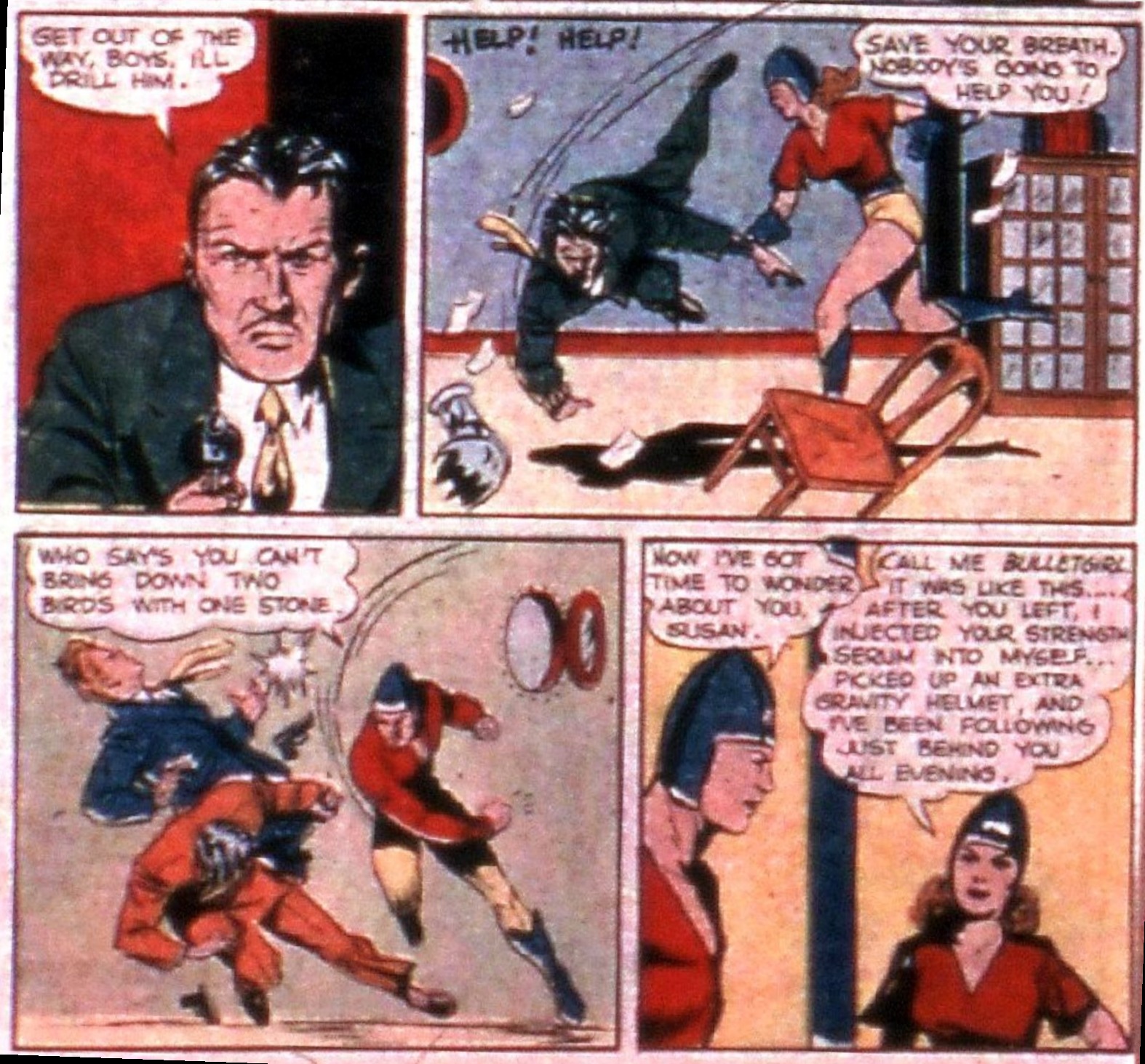
    Susan of course injects herself with the serum and crabs a spare Gravity-Regulator Helmet and costume (though she goes for hot pants over jodhpurs) the instant that Bulletman is out of the room, and This is a very good illustration of why I am so fond of Bulletgirl: she has all of the personality that Bulletman lacks. She’s scrappy and quippy and after an issue or two of “too dangerous for girls” chauvinism from Jim is a full partner in the superheroic exercise. She does get kidnapped and left behind a bit more than I’d like but that’s comic books in a nutshell. 

    In conclusion: Bulletgirl! (Master Comics 013, 1941)

    Minute-Man: 

    Like Jim Barr, Jack Weston is the son of a dead hero, though Jack’s father Robert Weston died during the Battle of Chateau-Thierry in World War I. We don’t get nearly as much background on Jack, other than the fact that he was raised by his father’s friend General Milton, but thanks to Milton, Jack becomes Minute-Man, a patriotic super-hero, in what is kind of presented as a draft.

    Jack is sent to join the Army as a lowly Private so that he can keep an eye out for sabotage and espionage affecting the armed forces. Despite having no super serum or particular special training, he proves to be physically near-superhuman as he engages a variety of costumed and non-costumed foes over the course of his mid-length career.

    Minute-Man also dabbles in leaving calling cards, which I always like to make note of. (Master Comics 011, 1941)

    Doctor Voodoo **UPDATE**: 

    In Whiz Comics 017, Doctor Voodoo returns home to find that Maxinya (the Heaven-Woman, natch) has gone missing. He tracks her abductors through the jungle until he comes across their destination: a European castle, smack in the middle of the Amazon. 

    The mystery deepens as Voodoo enters the castle and finds what seems to be an entire Medieval court, headed by the boorish King Richard, who seeks his aid in conquering the jungle. 

    Doctor Voodoo refuses to help King Richard, and so is forced to meet the knight Sir Ganal in combat. Voodoo prevails and wins Ganal over to his side, complete with a promise to reveal the origin of the castle’s presence in the jungle. Alas, this shall never come to pass, because the story does a hard pivot in the next issue. 

    King Richard plays the whole jungle conquest/attempted murder thing off as if it was some sort of test, and sends Doctor Voodoo off to meet with his court wizard. He. in turn, transports Voodoo back in time to the 1400s or thereabouts to retrieve a magical McGuffin called the Golden Flask, with another promise to explain what this whole affair is about once he returns.

    Unfortunately for all us completionists out there, the explanation never comes because Doctor Voodoo never returns. He bops around the oceans for about a year and actually does manage to get his hands on the Golden Flask but his feature is cancelled before he can return it to the wizard and find out just what the heck is going on. Maxinya is waiting for him still, presumably. (Whiz Comics 018, 1941)

  • MINOR SUPER-VILLAIN 889: THE BLACK THORN

    (Wow Comics 003, 1941)

    Inventor Phineas Cox has created a mummy ray, which is a device that fires a beam that instantly mummifies living tissue, a horrible thing that could only be used ethically by the mortuary and possibly the jerky industries. Cox intends for the weapon to be used in the defense of the United States, and to that end takes it not to the military but to something called the Defend America League, where he is somewhat predictably thrown out on his ear. 

    Phineas Cox vows to show America what he’s made of, and that very evening the Black Thorn makes his debut by desiccating an innocent woman. Why call yourself the Black Thorn when your main gimmick is a mummy ray? My guess is that the ray is a late addition to what was an already thought-out alter ego – I mean, just look at that costume! It’s not my favourite outfit of the Golden Age, but it definitely lacks some of the sense of just having been thrown together out of things that were already in the attic that some of them do.

    The Black Thorn’s schemes are, true to Cox’ pronouncement, decidedly anti-American: he steals defense funds from a bank and blows up an arsenal, leaving a trail of mummies in his wake. He’d have kept on going, too, only it is at this point that Mr Scarlet gets involved.

    Mr Scarlet himself almost gets mummified on two occasions but the Black Thorn shoots at the wrong prone figure in the dark the first time and falls for a decoy the second time, and since the both the misidentified target and decoy were the body of the slain bank guard, this means that the poor guy ends up being triple-mummified, which is a small consolation but has to be some kind of record.

    Please also note the Black Thorn using his horned headpiece as a weapon against Mr Scarlet. It’s nice to see something  seemingly purely ornamental like that see practical use. 

    In the end, the Black Thorn turns out not to be Phineas Cox but Henry Hawley, the leader of the Defend America League, which savvy readers might have already spotted as a fascist organization based on the ostentatiously patriotic name alone. Hawley had not, in fact thought Cox to be a nutjob but instead imprisoned him and stolen his invention for used in his campaign against America, and he would’ve gotten away with it if it hadn’t been for that pesky Mr Scarlet.

    Though Mr Scarlet busts up the mummy ray and tells Cox not to even think about building another one, the Black Thorn will return, and he will be mummifying his foes. Somehow.

  • MINOR SUPER-HERO ROUND-UP 059

    You thought that I couldn’t keep doing it but I can. MORE SUPER-HEROES 

    the Dart: 

    On the one hand, the Dart is just another guy with cape and a mask who fights crime alongside his kid sidekick, but on the other, he has a few interesting twists on what is already a tried-and-true formula:

    In the first place, the Dart was originally an Ancient Roman named Caius Martius who was magically sealed in a block of stone by his enemies, only to reemerge in the 20th Century. While this is only a moderately unusual origin for a super-hero, what is neat is that Caius Martius was effectively already a super-hero before he got cursed: he had his signature super-power of flight (referred to a “darting through the air,” hence the name) and was using it to fight “Roman racketeers.”

    Basically the first thing that Caius sees when he leaves the museum is a drive-by shooting, as the Ricarno Gang wipes out the Mariotti Gang, and more pertinently to his origin the parents of…

    Ace Barlow, the Amazing Boy: 

    Ace’s tragic orphaning at the hands of the Ricarno Gang leave him free to join up with Caius Martius as a crime-fighting team. Caius teaches Ace how to scrap, Roman-Style, and even more impressively goes to the trouble to teach him to fly rather than simply having an unpowered teenaged boy tagging along on all of his adventures like so many of his peers. (Weird Comics 005, 1940) 

    The Dart later gets a job as a teacher of Ancient Roman history at the school that Ace attends, and while this may seem like a good idea on the face of it, we must keep in mind that he slightly predates Julius Caesar, and so every time a kid asks a question about the Roman Empire, Caius is going to bug out his eyes and say “the Roman WHAT?”

    Also please note that while Caius Martius had the forethought to change his weird Roman name to something more modern to fit in, the change he made was to add “Wheeler” to the end, like having the last name “Martius” was the problem. (Weird Comics 006, 1940) 

    After their initial appearance, the Dart and Ace spend the rest of their 1940 appearances as nonsuper, nonflying vigilantes, but someone must have realized that that was the more boring option because the Dart was back to darting through the air in 1941.

    Finally, the creators of the Dart either vastly over-estimated the cutting power of a Roman short sword or intend for the Dart’s signature weapon to be magical in some way, because he sure does spend a lot of time carving through things that would stymie the vast majority of handheld tools.

    Dynamo **UPDATE**:

    I don’t know if it’s a new power per se, but in his first appearance in Weird Comics Dynamo continues his long habit of really expanding the limits of what you can do via control over electricity by employing it as a long-range listening device. (Weird Comics 008, 1940)

    Similar but unrelated: he can also hear radio broadcasts through his fingertips. (Weird Comics 009, 1940) 

    the Eagle **Update**: 

    The Eagle just can’t resist the lure of a new costume. Or Perhaps it’s the Eagle’s colourist, since as with several of his previous changes in outfit this one could just be some whimsical palette swap action. (Weird Comics 009, 1940)

    More importantly, that kid up there is the Eagle’s new sidekick:

    Buddy, the Daredevil Boy: 

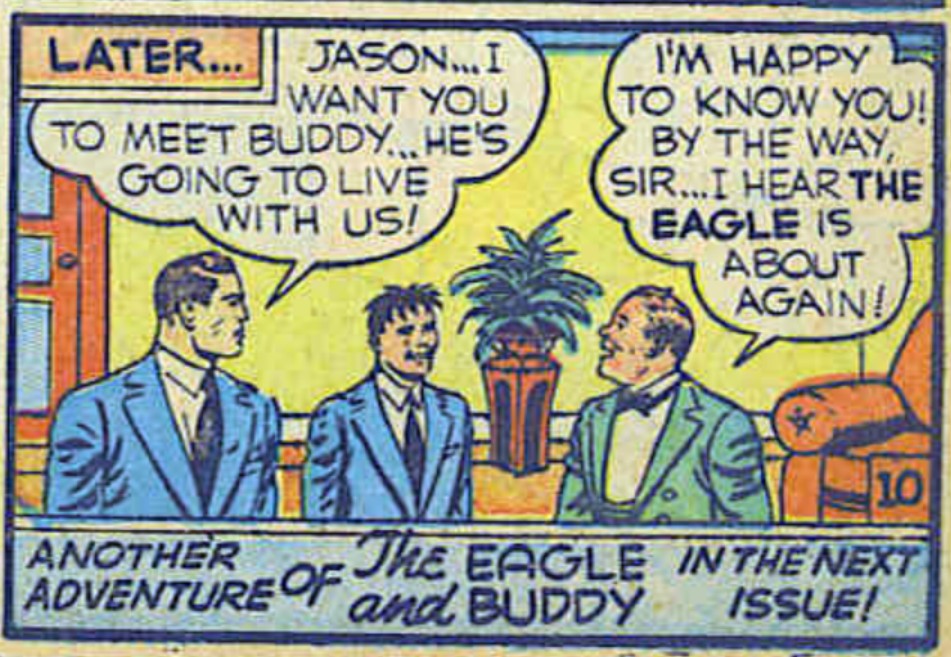
    Buddy is a kid who was presumably doing a little track-and-field when he saw the Eagle’s archfoe the Beast about to murder him with a poisoned dart and jumped in to save the day. The Eagle proceeds to adopt Buddy in such an abbreviated and perfunctory fashion that it almost serves as a parody of the idea of the kid sidekick – he doesn’t even bother to establish that he’s an orphan first.

    Buddy might just be the most hard-done-by sidekick in Golden Age comics, at least as far as costumes go, as he’s stuck in that track suit until Weird Comics 017, while the Eagle just keeps on trying new outfits the whole time. I can only imagine how galling that must have been for him. (Weird Comics 009, 1940) 

  • MINOR SUPER-HERO ROUND-UP 059

    MINOR SUPER-HERO ROUND-UP 059

    You thought that I couldn’t keep doing it but I can. MORE SUPER-HEROES 

    the Dart: 

    On the one hand, the Dart is just another guy with cape and a mask who fights crime alongside his kid sidekick, but on the other, he has a few interesting twists on what is already a tried-and-true formula:

    In the first place, the Dart was originally an Ancient Roman named Caius Martius who was magically sealed in a block of stone by his enemies, only to reemerge in the 20th Century. While this is only a moderately unusual origin for a super-hero, what is neat is that Caius Martius was effectively already a super-hero before he got cursed: he had his signature super-power of flight (referred to a “darting through the air,” hence the name) and was using it to fight “Roman racketeers.”

    Basically the first thing that Caius sees when he leaves the museum is a drive-by shooting, as the Ricarno Gang wipes out the Mariotti Gang, and more pertinently to his origin the parents of…

    Ace Barlow, the Amazing Boy: 

    Ace’s tragic orphaning at the hands of the Ricarno Gang leave him free to join up with Caius Martius as a crime-fighting team. Caius teaches Ace how to scrap, Roman-Style, and even more impressively goes to the trouble to teach him to fly rather than simply having an unpowered teenaged boy tagging along on all of his adventures like so many of his peers. (Weird Comics 005, 1940) 

    The Dart later gets a job as a teacher of Ancient Roman history at the school that Ace attends, and while this may seem like a good idea on the face of it, we must keep in mind that he slightly predates Julius Caesar, and so every time a kid asks a question about the Roman Empire, Caius is going to bug out his eyes and say “the Roman WHAT?”

    Also please note that while Caius Martius had the forethought to change his weird Roman name to something more modern to fit in, the change he made was to add “Wheeler” to the end, like having the last name “Martius” was the problem. (Weird Comics 006, 1940) 

    After their initial appearance, the Dart and Ace spend the rest of their 1940 appearances as nonsuper, nonflying vigilantes, but someone must have realized that that was the more boring option because the Dart was back to darting through the air in 1941.

    Finally, the creators of the Dart either vastly over-estimated the cutting power of a Roman short sword or intend for the Dart’s signature weapon to be magical in some way, because he sure does spend a lot of time carving through things that would stymie the vast majority of handheld tools.

    Dynamo **UPDATE**:

    I don’t know if it’s a new power per se, but in his first appearance in Weird Comics Dynamo continues his long habit of really expanding the limits of what you can do via control over electricity by employing it as a long-range listening device. (Weird Comics 008, 1940)

    Similar but unrelated: he can also hear radio broadcasts through his fingertips. (Weird Comics 009, 1940) 

    the Eagle **Update**: 

    The Eagle just can’t resist the lure of a new costume. Or Perhaps it’s the Eagle’s colourist, since as with several of his previous changes in outfit this one could just be some whimsical palette swap action. (Weird Comics 009, 1940)

    More importantly, that kid up there is the Eagle’s new sidekick:

    Buddy, the Daredevil Boy: 

    Buddy is a kid who was presumably doing a little track-and-field when he saw the Eagle’s archfoe the Beast about to murder him with a poisoned dart and jumped in to save the day. The Eagle proceeds to adopt Buddy in such an abbreviated and perfunctory fashion that it almost serves as a parody of the idea of the kid sidekick – he doesn’t even bother to establish that he’s an orphan first.

    Buddy might just be the most hard-done-by sidekick in Golden Age comics, at least as far as costumes go, as he’s stuck in that track suit until Weird Comics 017, while the Eagle just keeps on trying new outfits the whole time. I can only imagine how galling that must have been for him. (Weird Comics 009, 1940) 

  • MINOR SUPER-HERO ROUND-UP 058

    A number of minor Fox Features characters for your perusal and delight.

    the Bird Man: 

    The Bird Man, descendant of “an ancient Indian god” (no further detail provided) uses his weird demigod wing-flaps to fly around the American Southwest and render aid to people. (Weird Comics 001, 1940)

    In Bird Man’s final appearance, in Weird Comics 004, he has conformed to the heroic norm a bit more by moving to a penthouse apartment in what might be NYC (please note that he keeps a little statue of his divine ancestor on top of his TV). He also has slightly more conventional wings in this appearance, but I have to say that I prefer the flaps.

    Typhon: 

    Typhon is a near-future undersea adventurer who not only has access to various super-submarines and ray guns and so forth but also sometimes has a magic ring that allows him to combat the various supernatural threats of the deep ocean. (Weird Comics 001, 1940)

    Thor, God of Thunder: 

    Thor, God of Thunder (the Norse god) gets restless one day in 1940 and decides to invest a mortal man with some of his power, making him Thor, God of Thunder (the super-hero). This is a not-uncommon origin story for a super-hero to have, but the really important thing to note is that the human, Grant Farrel, is not some paragon of virtue or descendant of Thor, and that he isn’t being sent out into the world to combat injustice on Thor’s behalf. No, he’s just kind of a sad sack who just got dumped and Thor hands him the power with a kind of “have fun with it” attitude. Grant seems like he might be the type to get into super-heroics of his own accord but he doesn’t really have any choice because Glenda, the girl who dumped him, is a real magnet for spy rings and secret invasions of France and so forth. They do eventually get back together, don’t worry.

    Like many of his contemporaries, Grant/Thor goes through a lot of different costume variants over the course of a short career, but the thing I really want to highlight is this very weird style of Viking helmet that both he and Original Thor wear in hist first three or four appearances. I mean, what’s with the discs? 

    Thor is of course wildly over-powered, as shown in this pretty awesome sequence in which he lassos an entire Luftwaffe attack on Paris and throws it at Berlin. He can also throw both his hammer and thunderbolts to devastating effect, and kind of alternates between flying under his own power and cartoonishly riding around on a big jagged bolt of lightning.

    In his final appearance, in Weird Comics 005, Thor is sans hammer for no particular reason. This doesn’t really slow him down but even so he gets a bit of divine aid via the gift of Thor’s strength-boosting gauntlet. (Weird Comics 001, 1940)

    Dynamite Thor:

    Dynamite Thor, the Explosion Man, is actually Peter Thor, wealthy mine owner and explosives expert. I was all ready to roast him for including his surname as part of his superhero identity, but on review of his five appearances it appears that the actual name he goes my is merely Dynamite. This also leaves me with no material with which to roast Thor’s fiance Glenda (same as our last Thor – what is it with Thors and Glendas?) for not realizing just who the mysterious man she so idolizes is.

    In his initial appearance, Dynamite Thor is merely a man with a belt-full of explosives and a pretty hammer-and nail approach to problem-solving. Crooks holed up in an old shack? Blow up the shack. Crooks getting away in a vehicle? A controlled explosion will bring a nearby object down and stop their flight. A big fire? Blow it up.

    By his second appearance in Weird Comics 007, someone had evidently decided that Dynamite Thor needed more of a hook or perhaps they just couldn’t figure out a good explosion-themed vehicle for him to fly around, because he gets his signature move which is absolutely the only reason that he is still talked about: he flies by the simple expedient of setting off a series of explosions under his ass. Finally, by his next appearance in Blue Beetle Comics 006, 1941, he is explicitly mentioned to be immune to these explosions, something that must have come as a great relief to him (edit to add: I was mistaken and they do make sure to mention that he is immune to explosions at the same time as he starts flying around on a column of them). (Weird Comics 006, 1940)