The Curse of Skeleton Munroe

Category: costumes

  • MINOR SUPER-VILLAIN 839: THE DOCTOR

    (Top-Notch Comics 010, 1940) 

    The Doctor operates a simple but brutal extortion racket: a network of crooked doctors refer workplace compensation cases to him at his fake hospital and he then charges them as much as they are being paid in compensation, and if anyone dares to complain, they suddenly require urgent surgery and die on the operating table.  

    For the second time in two days I must note: surgical scrubs are such a good super-villain costume.

    This is exactly the sort of thing that the Wizard hates, and you just know that Roy the Super-Boy has to get in on Beating Up an Entire Hospital. Roy almost gets murdered for his trouble, but the Wizard shows up in the nick of time, and the Doctor’s entire network gets handed over to the authorities.

  • MINOR SUPER-HERO ROUND-UP 057

    Two MLJ Round-Ups in a row! They’re just churning out the heroes! 

    Galahad:

    Hey, it’s Galahad! Or rather a version of Galahad who is standing in for a pretty wide array of different Knights of the Round Table with lesser name brand recognition. It’s some clean-cut knightly action. (Top-Notch Comics 005, 1940)

    Shanghai Sheridan:

    Jack “Shanghai” Sheridan, aside from having a sounding like a cheeky nickname for a POW camp, is notable mostly for the fact that he is one of many characters who have “the Batman origin but for…”, in this case, the Batman origin but for the Japanese invasion of China. His adventures are nothing particularly special, alas. (Top-Notch Comics 005, 1940)

    Firefly:

    Oh hey, it’s the Firefly, wearing one of the great super-hero costumes of the Golden Age!

    The Firefly is really Harley Hudson, a young biochemist who sought to understand the tremendous proportionate strength possessed by insects and found that it was as a result of their “muscular coordination,” and further managed to unlock that same power within himself! Now he’s on an anti-crime crusade, and I’m not sure if he’s able to glow because of his muscular coordination abilities or he just has some phosphorescent paint slapped onto the front of his costume – the brief appearance of the character in the 60s Mighty Crusaders comic suggests the former, but they were also trying to make him some sort of equivalent of the Fireball and Inferno, so I don’t know if I’m going to take that as canon. (Top-Notch Comics 008, 1940)

    The Firefly also gets around in a “combination airplane and glider” called the Fireflier (or Fireflyer), which is an objectively great name for a subjectively terrible-looking vehicle. (Top-Notch Comics 009, 1940) 

    the Black Hood: 

    The Black Hood is perhaps the Archie/MLJ super-hero with the greatest number of different versions, both legacy and reboot-style. He also bumps the Wizard out of the top spot in Top-Notch as soon as he appears – someone at MLJ clearly really liked this guy from the start.

    This original Black Hood (and a pretty decent percentage of his successors) is named Kip Burland, and he was a New York cop until he attempted to arrest super-villain the Skull while he was doing some crime and ended up framed and then murdered for his troubles. Except the murder didn’t take, and Burland was found by an old hermit who nursed him back to health.

    In an amazing coincidence, the hermit in question turns out to be a former sheriff who was also framed by the Skull, and who took so long in training for his revenge/redemption that he grew too old for the job. This turns out to be a perfect combination: the Hermit teaches Kip all that he knows, and the Black Hood sallies forth to mete out justice to the Skull. (Top-Notch Comics 009, 1940) 

  • MINOR SUPER-HERO ROUND-UP 056

    Some hot Archie/MLJ super-hero action. 

    **Hero Update** Bob Phantom:

    Perhaps in honour of his making the jump from Blue Ribbon Comics to Top-Notch Comics, Bob Phantom gets two hitherto-unseen powers: super-breath powerful enough to turn aside oncoming bullets and the ability to summon cyclones by flapping his cape. (Top-Notch Comics 003, 1940) 

    Bob Phantom also demonstrates super strength sufficient to tear an airplane to pieces in mid air. (Top-Notch Comics 004, 1940)

    And not content with three new super powers, in Top-Notch 010, Bob is shown to be completely bulletproof.

    Bob Phantom’s modus operandi, to reveal crimes and taunt both police and criminals in his gossip column as Walt Whitman and then bust things up as Bob Phantom, has never been particularly kind to the police of his corner of MLJ New York, and at this point they openly hate him in both of his identities. (Top-Notch Comics 009, 1940) 

    **Hero Update** the Wizard: 

    The Wizard’s powers also get expanded once 1940 rolls around: not only can he now hypnotically mind control people with a mere glance but he can mentally contact his thralls across distances of at least 500 miles (the above message was broadcast from somewhere in the vicinity of Dallas to somewhere in Mexico). 

    1940 is also the year that the Wizard’s already-formidible strength was rounded up to full-on super, seen here as he is bodily heaving an entire u-boat Bundonian submarine out of the water with only the power of his little kicking feet to hold him up.

    The Wizard’s arsenal of weapons and gadgets also gets a fair few additions this year, including:

    – more rays guns than one would assume could fit in a suit with such clean lines: death rays, two different engine-killing rays (the vibra-ray gun and the neutronic ray gun), an explosive ray (the destructo-ray), a metal-melting ray (the VB-ray gun), a paralysis ray (the electrolysis ray), a rainmaking ray (the H2-VX-0 ray), fire-extinguishing ray (the Hydra Gun), and the dynamagno saw ray projector, a cutting ray which can be tuned to selectively destroy mechanical parts such as the wires that hold a plane together.

    – secret chemicals including: Secret Chemical L-77 (solidifies liquids), Ethyl Formula 2X-Y-BZ (superfuel additive) and Super-Caloric Capsules and Secret Formula Ho Mg 4, which put pep back in a weary Wizard’s step.

    – special vehicles, the greatest of which is the Contra-Gravity Flask, pictured above, which allows the Wizard to float harmlessly to the ground from a height or run through the air, merely by virtue of being in his pocket.

    (Top-Notch Comics 002, 1940) 

    I somehow also failed to note in the original Wizard entry that he is not only a calling card guy but an obnoxiously patriotic one. (Top-Notch Comics 001, 1939) 

    After being blinded by his enemies the Mosconians, the Wizard changes out his tuxedo costume for a more super-heroic one with even less room for ray guns. This is supposedly to protect him from getting acid splashed in his eyes again, but since the Mosconians don’t actually get a chance for a second try the actual mechanism by which the same mask but a different shirt might help in that situation is not explored. (Top-Notch Comics 007, 1940)

    Finally, Blane Whitney abandons the life of the wealthy playboy to become a crusading newspaper publisher with ex-fiance Jane Barlowe as his star reporter, though he of course does not get a break for this. (Top-Notch Comics 008, 1940)

    Roy the Super-Boy: 

    He’s not quite the Sensational Character Find of 1940, but Roy the Super-Boy is the Marvel of 1940 and that has to count for something. He’s also our first Archie/MLJ sidekick (yes, yes, Tommy the Super-Boy, but he was a reference to Roy and we only covered him first because of the alphabet and its tricks). Does he suffer the “just running around without a mask calling yourself by your own name” problem common to a lot of Golden Age sidekicks? Sure he does, but at least he has a partial code name. And I was wrong: he totally wears a mask most of the time! 

    As is often the case, Roy is just a scrappy young orphan making his way in the world as a bootblack, when he ends up in a fight with some grown-ass men and impresses the Wizard with his sweet moves and devotion to justice. He soon finds himself with an invite to a rich man’s private gymnasium!

    Thanks to an intensive training regimen, Roy is quickly developed into an impressive physical specimen. The Wizard claims that they are equivalent barring the Wizard’s mind-powers, but I haven’t seen Roy bench-press a submarine yet. (Top-Notch Comics 008, 1940) 

    Kardak the Mystic: 

    There is a general consensus online that Kardak the Mystic is the same character as the Mystic, who appeared in Top-Notch Comics 001 and 002, but I ain’t buying it. For one, where the Mystic was an ordinary stage magician who used his skills at slight-of-hand to battle crime, Kardak has actual magical power. For another, where the Mystic was already engaged to an unnamed woman in his first adventure, Kardak’s adventures are all set in motion when a girl he just met on a cruise to India is kidnapped by undersea creatures. Certainly, relationships break up all the time, but not the Mystic and Unnamed Woman! Their love is forever!

    Kardak’s adventures take him and his gal-pal Lorna from the bottom of the Indian Ocean to Louisiana, where they enter a series of extra-dimensional lands populated by hostile weirdos. It’s a pretty good setup to showcase the power of a magical hero without having story after story of him just destroying regular gangsters.

    Kardak also acquires the services of Balthar, a huge dude with a magic turban, and he’s just as annoying as Tong and the other members of the Shirtless Broken English Magicians’ Assistants Collective. (Top-Notch Comics 004, 1940) 

  • MINOR SUPER-VILLAIN 830: ROBERT W MARSH

    (Thrilling Comics 010, 1940)

    Fifth column activities are wreaking havoc on the US! Why, it’s so bad that the new National Defense Building has been bombed! Doc Strange is called in along with a crack team of industrialists to help solve the problem, and is pointed toward fellow committee member Henry Dallas by yet another member, Robert W Marsh. Could this be so easy a problem to solve?

    Henry Dallas kills himself rather than own up to working with the Nazis against American interests, but Doc Strange is able to trace his business dealings to the defunct Mammoth Automobile factory in the South, where he discovers a fascist tank-manufacturing setup. He also takes an explosive anti-tank shell to the back of the head, which is immaterial to the story, but it is fun to occasionally highlight just how powerful a super-hero is.

    Strange finally comes face to face with the leader of this operation (conveniently called the Leader) after both he and Virginia Thompson are captured by them, and unmasks him within minutes, revealing him to be… Robert W Marsh, who is coincidentally also the only other named character in the comic. I gotta say, I wish that the Leader facade had been maintained for longer, both because I always prefer referring to a guy by a codename rather than by what’s on his birth certificate, but also because that mask is a pretty sweet little number and I wish that Marsh had a reason to keep wearing it.

    Doc and Virginia of course escape from Marsh and prevent his bid to take over the US by bombing Washington DC into dust, but the former Leader is pretty conspicuously not among the casualties of that battle. And well he shouldn’t be, because he is also the antagonist of the next Doc Strange story:

    In Thrilling Comics 011, Marsh takes over the… Central?… American nation of Panamela to use as a staging area for another attempt to take over the US.

    (side note: it is pretty remarkable that Marsh is just a straight-up Nazi in 1940, albeit one with a reversed swastika. I suppose it’s possible that this is a small-n nazi, as a stand-in for fascist) 

    Marsh’s plan revolves around attacking the US using the Panamelan fleet and some new super-explosive artillery shells, but he is foiled when Doc Strange sabotages the explosive at the production stage. Pop! Plink!

    Though his fleet is blasted into oblivion by the US Navy, Marsh lives to fight another day. 

    I’ll be honest, I’m tired of the guy and I almost included his third appearance here to get him out of the way, even though it takes place in 1941. But when I started reading it to do just that I was startled to find out that it’s fun! There isn’t even any naval combat! Thus, I’m going to leave it as a treat for myself in the future.

  • MINOR SUPER-VILLAIN 830: ROBERT W MARSH

    (Thrilling Comics 010, 1940)

    Fifth column activities are wreaking havoc on the US! Why, it’s so bad that the new National Defense Building has been bombed! Doc Strange is called in along with a crack team of industrialists to help solve the problem, and is pointed toward fellow committee member Henry Dallas by yet another member, Robert W Marsh. Could this be so easy a problem to solve?

    Henry Dallas kills himself rather than own up to working with the Nazis against American interests, but Doc Strange is able to trace his business dealings to the defunct Mammoth Automobile factory in the South, where he discovers a fascist tank-manufacturing setup. He also takes an explosive anti-tank shell to the back of the head, which is immaterial to the story, but it is fun to occasionally highlight just how powerful a super-hero is.

    Strange finally comes face to face with the leader of this operation (conveniently called the Leader) after both he and Virginia Thompson are captured by them, and unmasks him within minutes, revealing him to be… Robert W Marsh, who is coincidentally also the only other named character in the comic. I gotta say, I wish that the Leader facade had been maintained for longer, both because I always prefer referring to a guy by a codename rather than by what’s on his birth certificate, but also because that mask is a pretty sweet little number and I wish that Marsh had a reason to keep wearing it.

    Doc and Virginia of course escape from Marsh and prevent his bid to take over the US by bombing Washington DC into dust, but the former Leader is pretty conspicuously not among the casualties of that battle. And well he shouldn’t be, because he is also the antagonist of the next Doc Strange story:

    In Thrilling Comics 011, Marsh takes over the… Central?… American nation of Panamela to use as a staging area for another attempt to take over the US.

    (side note: it is pretty remarkable that Marsh is just a straight-up Nazi in 1940, albeit one with a reversed swastika. I suppose it’s possible that this is a small-n nazi, as a stand-in for fascist) 

    Marsh’s plan revolves around attacking the US using the Panamelan fleet and some new super-explosive artillery shells, but he is foiled when Doc Strange sabotages the explosive at the production stage. Pop! Plink!

    Though his fleet is blasted into oblivion by the US Navy, Marsh lives to fight another day. 

    I’ll be honest, I’m tired of the guy and I almost included his third appearance here to get him out of the way, even though it takes place in 1941. But when I started reading it to do just that I was startled to find out that it’s fun! There isn’t even any naval combat! Thus, I’m going to leave it as a treat for myself in the future.

  • MINOR SUPER-VILLAIN 829: LOBELO

    (Thrilling Comics 008, 1940) 

    Lobelo is a modern day pirate, as you might guess from the splash panel above, and while my strong pro-pirate bias means that he was an easy inclusion in the ranks of the minor super-villain he is also a source of great frustration to me.


    First, though, I will note one thing that I really like about Lobelo and that is his array of costumes. Not only does he wear two distinct pirate outfits during the course of the adventure but he wears a separate classic early-1940s suit-cape-and-mask number while he is robbing the Metroploitan Museum in New York. This is clearly a man who loves an outfit – it’s like he’s padding out an action figure line over here.

    My problem with Lobelo is that he goes into piracy because he is the descendant of the famous 16th Century pirate Redhand. He sets up his headquarters on Redhand’s Crossbones Island and he is hunting for Redhand’s treasure with the help of Redhand’s map, which he stole from the museum. So why the heck doesn’t he call himself Redhand, or Redhand II, or something other than his own last name? The gall of it!

    (I’m also somewhat put out that the comic features a costume party and Doc Strange attends in a tuxedo rather than his super-suit. I suppose that Lobelo is attending in (one of) his super-villain outfit(s) at the very least)

    Lobelo has a pretty good run thanks to some poison he feeds Doc Strange at the party having a long-term weakening effect but ultimately comes up against the simple fact that he is a man armed with a sword versus a man who is completely invulnerable to harm and able to powerbomb a battleship. Lobelo is so outmatched here that maybe Doc Strange doesn’t need to kill him like a bear swatting a salmon, and yet he does. So long, Redhand Lobelo.

  • MINOR SUPER-HERO ROUND-UP 055

    Some more super-folk for your delectation. 

    Doc Strange:

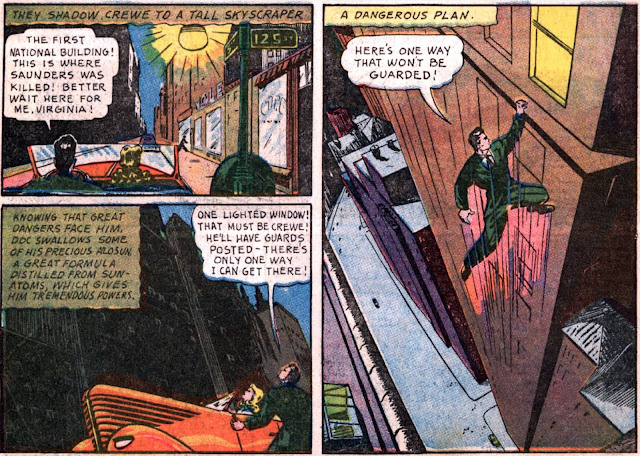
    Doc Strange (called “Dr Strange” for the first half dozen or so of his appearances, but why cause unnecessary confusion) is an almost prototypical scientist-hero: no real origin beyond being a well-known brilliant scientist who is primed and ready for adventure having just perfected Alosun, a “formula distilled from sun-atoms.” After taking his first dose of Alosun in his initial adventure, Strange has super-strength and invulnerability sufficient to take on an entire gang single-handed, and if he takes a supplemental dose he becomes exponentially more powerful.

    Doc’s sidekick Mike won’t be showing up until 1942, but in the meantime his fiance Virginia Thompson (as so often is the case, the woman he rescues during his first super-heroic adventure) acts as his adventuring companion/frequent kidnap victim in the meantime.


    In Thrilling Comics 007 Doc Strange mixes up a new formulation of Alosun that completes his powerset by allowing him to fly while under its effects. This is also the issue in which he stops fighting crime in suits and adopts his classic red t-shirt/blue jodhpurs/brown boots look. 

    Finally, I’ve noticed a lot of sites listing his name as “Hugo Strange” or “Thomas Hugo Strange” and while the Thomas is definitely an Alan Moore addition from Tom Strong I can only report that the Hugo has not yet appeared in the 1940 issues of Thrilling. (Thrilling Comics 001, 1940) 

    the Ghost:

    Young George Chance is orphaned in India and so is of course raised by yogis. He learns all of their magical secrets and is eventually sent out into the world to fight crime, as I assume all yogis are. I must say that it is something of a change of pace to see a magic-man come into his powers in India after such a long string of Tibetan origins.

    Like most magical heroes, the Ghost is a nigh-omnipotent force of nature who can be stopped only by a sneaky blow to the head, and even then only temporarily. His adventures are distinguished by the fact that his long-time foe is Professor Fenton, a scientist who has developed time travel technology, so the Ghost’s adventures are distinguished by the sheer variety of times and places he ends up.

    The Ghost takes his name from his early habit of painting his face (all the way to the back of his neck!) so as to resemble a skeleton while he is fighting crime. Sadly though the name sticks the look doesn’t. 

    In Thrilling Comics 008, the Ghost travels back to Revolutionary America and meets a patriotic woman named Betty Morris who ends up coming back to the 20th Century with him as his companion/love interest. I keep seeing claims online that she is his wife, but strongly suspect that that is another swipe from Alan Moore’s version of the characters. (Thrilling Comics 003, 1940)

    the Lone Eagle: 

    Another classic example of a pilot-hero-with-a-cool-name and not much else going on. The Lone Eagle does seem to have been a World War I veteran, which I always like to note. (Thrilling Comics 003, 1940)

    the Woman in Red: 

    The Woman in Red (an extremely good name) has what just might be the simplest origin story in comics: she is really Peggy Allen, undercover police officer, and the Woman in Red disguise is her way of investigating crimes without blowing her cover if she is caught snooping around. See? Simple! 

    Woman in Red mysteries tend to be structured as whodunnit murder mysteries, which I obviously like, and so Peggy is also frequently wanted by her comic foil, the bumbling Inspector Cavanaugh, as a suspect because he sees her creeping around the crime scene and doesn’t have a lot of critical thinking skills. (Thrilling Comics 002, 1940) 

  • MINOR SUPER-VILLAIN 805: THE GREAT ONE

    (The Funnies 042, 1940)

    I had great hopes for the Great One, a pirate captain so mysterious that he wears a full-face hood (with nostril holes! The rarest hood hole!) even while hanging out on his own South Pacific island inhabited solely by his own fanatical crew. The black skull insignia alone inspired me to hope that there might be some fun mystery behind that hood for Bruce McKay, formerly Sky Master but now Sky Ranger, to solve when he and his companions are captured by one of the Great One’s lieutenants. 

    Alas, such is not the case. Bruce is pressed into service as a scout pilot for the Great One’s fleet and quickly betrays him to the first freighter captain he sees. His fleet is blown up thanks to the fact that the freighter in question was hauling a load of hand grenades and the Great One himself dies ignominiously and still masked, in a fall from a cliff. I should have known it was all over when they didn’t bother to colour his robe in the second issue.

  • MINOR SUPER-HERO ROUND-UP 050

    Novelty Press character round-up, more like.

    the Chameleon:

    An unnamed master of disguise (throughout his 1940 appearances, at least) who dispenses vigilante justice on an ad hoc basis, the Chameleon’s major distinction is that his name is always written in cursive. Other than that: he’s got a chauffeur/sidekick (Slim) and a bumbling police nemesis (Inspector Parks) and somehow manages to simultaneously be one of those heroes who is wanted by the law and whose identity and address are just kind of common knowledge. (Target Comics v1 006, 1940)
    the Blue Zombie:

    “Fantastic Feature Films” was a strip that ran in the first couple of years of Target Comics, with the same conceit as Ed Wheelan’s Minute Movies: that the stories being presented were films in which the were being portrayed by a pool of fictional actors – the titular Blue Zombie of this feature, for instance, was played by Orson Black, a Boris Karloff-style Man of a Thousand Faces. This is a fantastic fictional conceit and I am surprised that it hasn’t cropped up more over the years.

    In the fictional movie The Blue Zombie, Bolshemanian scientist Igor Zamoisky rebels against his country’s warmongering dictator and heads to the neighbouring country of Coreland in order to put his scientific discoveries to use in thwarting a Bolshemanian invasion. Discovering a lost Bolshemanian battalion that succumbed to the harsh Corelian winter, he attempts to restore one of them, his old friend Nicholas Samousk, to life. Instead of a restored Samousk, his experiment produces a bright blue zombie version of his friend who responds to his mental commands but cannot think for itself. Zamoisky restores the rest of the battalion in a similar fashion and uses them to crush the Bolshemanian invasion of Coreland, then sets off with his zombie army to free his homeland. 

    Obviously describing a one-off like the Blue Zombie as a super-hero is a bit of a stretch, but a) he’s not that far off of the Purple Zombie in his origin and general deal, b) I wanted an excuse to talk about the fictional-actors-in-fictional-film conceit and c) the Blue Zombie is a really good name. (Target Comics v1 006, 1940)

    the Target: 

    It’s always fun when an old-school anthology comic book gets a character to match its name fairly late in the game and to prove my point here’s the Target, showing up in the tenth issue of Target Comics.

    The Target makes his debut with a big advertising push to really get the word out that he is out to crush crime in his version of NYC: full page newspaper ads, messages on the radio, threatening telegrams sent directly to crooks… at one point a lady calls that number that used to tell you the correct time and a recording of the Target tells her to keep her nose clean. It’s really the opposite of the modern Batman as Urban Legend school of superhero mystique.

    The Target’s gimmick is also Batman adjacent: like 50s 60s 70s whichever era’s Batman first justified the yellow circle on his chest as a bulletproof target for crooks to aim at, the Target is running around with a literal target painted on his chest (and back) because he has a bulletproof leotard on underneath. Just why the fact that his legs are unprotected is a) necessary and b) emphasized is never really addressed.

    Finally, the Target has a thematically appropriate calling card, a dart. We’ll see how long he keeps using it for. (Target Comics v1 010, 1940)

    the Targeteers:

    The more astute readers among you might have noticed that I didn’t really go into the actual origin of the Target in his own entry, and that’s because it’s tied in with that of his sidekicks the Targeteers and so we’re covering them all at once.

    So: Niles Reed is a brilliant but aimless metallurgist whose only relative, brother and New York City District Attorney Bill Reed, is framed for murder and scheduled to be executed at Sing Sing.

    Niles dons a domino mask and attempts to bust Bill out during his final prison transfer but the guards manage to hit Bill during their escape. After a heartfelt “why me?” Bill dies and Niles buries him in an unmarked grave, which means that he’s still considered to be at large, an evocative detail that I had hoped would lead to something like Niles hinting that the Target is actually Bill to throw suspicion off of himself and flush out the crooks who framed him, it never really seems to come up again.

    This would ordinarily be the point in an origin story in which the costume would come into play, there’s one more step to the Target’s origin and that’s the Targeteers.

    See, Niles is wandering the streets at night, trying to figure out just what he can do in the face of an uncaring world in which innocent district attorneys are gunned down in the street for merely trying to break jail, when he runs off some thugs who are attempting to kill or at least maim two teenage boys, Dave and Tommy. It turns out that the kids are both orphans who also hate crime because the crooks had already killed their father (well, one father and one unofficial adopted father, but why get technical).

    Having two young wards who love to talk about getting real beefy and wiping out crime is the final catalyst for Niles, who remembers that he has some superscientific bulletproof material and three super-hero costumes just lying around, and since the three were playing darts when they came up with the idea the whole endeavour ends up being dart and target themed (and as this is possibly my favourite style of generic supersuit it’s nice to see three people running around in it at once).

    The two lads collectively go by the Targeteers, which is a nice change of pace from teen sidekicks who just go by their own names. Finally, according to some dialogue later in the comic the jailbreak, ad hoc funeral, befriending of the boys, making costumes and the initial Target adventure in the previous issue (including the entire publicity blitz) all take place in about a week, which is very efficient. (Target Comics v1 011, 1940)

  • MINOR SUPER-VILLAIN 784: THE GREEN MASK

    (Sure-Fire Comics 001, 1940)

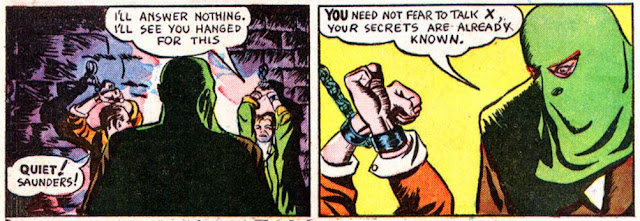
    The Green Mask is after one thing: world domination, and he’s looking to achieve it by capturing the Shock Ray, a weapon capable of paralyzing hundreds of people at a time, and which has been deemed too terrible to use by the US government (just why this is it unclear – my only idea is that it is either a fatal paralysis or a permanent one).

    The thing about the Green Mask that is very compelling is his hood – I’m always harping on about those characters who make the choice to have a nose cutout in their evil villain hood, and how that choice is a perfect one if you want comfort and also don’t mind looking bad, and while the Green Mask has chosen to have ear cutouts – very similar – he has also gone with nostril holes instead of the full nose, and I have to say that that strikes me as both bad-looking and immensely impractical/uncomfortable. His minions all look terrific in their Halloween demon masks, though.

    Another thing I’m always yapping on about is the long stretches of pointless action in the middles of Golden Age stories, and in no story is that more evident than this one. The Green Mask gets ahold of the Shock Ray plans on the first panel of the second page, and the much of the rest of the fifteen-page story involves his attempts to kill or capture various people tangentially involved in the theft for no stated reason, while X gathers more and more evidence toward his eventual capture.

    And speaking of that capture, once it happens the Green Mask is revealed to be… Sam Barkley! And let me tell you that when I first read this story I was a little tired and so I figured that the fact that I had no idea who Sam Barkley was meant that I hadn’t been paying enough attention, but no, Sam Barley is a “famous sportsman” who made a one-panel, non-speaking appearance, six pages earlier and that was it. It’s the most out-of nowhere reveal in comics history.

    Anyway, much beloved ancillary character Sam Barkley turned to a life of crime because he was mixed-race, and his American father abandoned his probably-Malaysian mother (based mostly on the fact that his henchmen are all or mostly Malaysian), leading him to hate all Americans and ultimately embark on a life of costumed crime. If his motivations were more nuanced than that then they will sadly go unexplored, as once captured he immediately chugs some prussic acid rather than be taken alive.