The Curse of Skeleton Munroe

Category: costumes

  • MINOR SUPER-HERO ROUND-UP 047

    Astonishing super-heroes of the past! And future!

    the Invisible Avenger: 

    Teen radio enthusiast Buzz Allen discovers the secret of personal invisibility shortly after the death of his father at the hands of criminals and so is perfectly primed to become part of a super-vigilante duo alongside his friend Will Lawrence (if the issue of whether they should be the Invisible Avengers ever comes up then it is in the initial adventure which I alas cannot read). 

    Their adventures are structured such that they cause maximum consternation so as to really get the most out of the invisibility gimmick: they become invisible before driving their car to the scene of a robbery, for example, and when they put on their anti-invisibility gloves so that they can flash their guns at the crooks they make sure to do so in a public place so as to freak out the subway-riding squares. If I were to devise some sort of ratings scale to score invisible characters on how well they use their powers (which I will not – I am already tracking far too many arbitrary metrics), then the Invisible Avenger and Will would score low. (Superworld Comics 001, 1940*)

    Hip Knox:

    Hip Knox! An orphaned child raised by Professor Knox to have the mightiest mind in the world and named by Professor Knox to have a silly name that kind of winks at his powerset!

    If Hip Knox is known for anything then it’s for being one of the worst-dressed men in comics. Every element of his uniform is just a little bit wrong, except for the parts that are a lot wrong. Breaking things down from top to bottom, we have:

    1. The Helmet. If there’s one piece of this costume that is 100% bad then it’s this scaly golden swim cap. I sincerely wish that Superworld Comics 001 was available for less than 2000 dollars US, because I really want to know if this is some sort of mind amplification helmet or just a bizarre affectation. Hate it. Hate that it covers his ears.

    2. The Mustache. I can get behind a super-hero with a fussy little mustache, but you aren’t Hercule Poirot, my dude. Grow it out a bit more or have fewer weird and uncanny elements to your outfit so that a little mustache is a fun little affectation and not the punchline to someone’s description of you to their friends.

    3. The Jumpsuit. This isn’t all that far off of what would come to be the standard super-hero outfit, so I should be fine with it, right? Wrong. Between the fact that Hip is drawn with a bit of a barrel chest and the noodle arms of someone who fights crime with their mind, and the suit being buttoned all the way up to a collar at the neck, this suit is bad.

    4. The Insignia. A minor nitpick but it contributes to the whole: that eye looks too realistic to just be sitting on the chest by itself. Throw it in a circle or something. Plus you gotta choose: either the eye or …

    5. The Belt Buckle. I have nothing against a good yonic symbol, but why does Hip Knox have one as his belt buckle? And why is it so big? It looks like an attempt to pick up a pencil off the ground would result in him simultaneously stabbing himself in the groin and the upper abdomen.

    What is the solution for this fashion debacle? Change one or two key elements: swap the jumpsuit out for a red tuxedo to lean into the (stage) hypnotist angle and things feel a lot more harmonious. The eye would have to become an amulet or maybe an ornament on one of those weird sashes that goes under the jacket, but everything would hold together much better. Or keep the jumpsuit and lose the helmet! Or make it a headband, that would be much less heinous!

    As befits a super-hypnotist, Hip Knox has a pretty relaxed approach to the mental autonomy of those around him, but tragically also seems to have a terrible imagination, as in the above panels in which he attempts to signal that he is being kidnapped by turning bystanders into a trail of living statues instead of, say, having them shout “Hip Knox is in that car being kidnapped!” in unison. (Superworld Comics 001, 1940*)

    Marvo 1○2 Go+:

    The Boy Genius style of comics/fiction in general has produced a lot of very fun adventure heroes over the years and also a lot of annoying little smug turds, and I’m sure that personal bias plays in to whether a particular boy reads as one or the other to you. As you might be able to tell from all of this preamble, Marvo 1○2 Go+ is very much a smug little turd in my eyes.

    Thanks to the wonders of sleep education, Marvo has all the knowledge of a forty-year-old scientist packed into his fifteen year-old head, but he’s even more intelligent than that, so much so that he gets to put a little plus sign on the end of his name (Marvo is from one of those science fiction futures where inefficient surnames have been replaced with government-assigned alphanumerical designations, like Superworld publisher Hugo Gernsback’s own novel Ralph 124C 41+ or DC Comics’ later Chris KL-99), which he makes sure to have embroidered on the front of all of his clothing in case people forget how special he is.

    Knowledge of a forty year-old or not, Marvo still has all the foresight of a fifteen year-old, as seen for instance in the above panels wherein he takes advantage of a geothermal hotspot beneath Pennsylvania to permanently alter its climate without stopping to consider the potential long term environmental effects of a permanent Summer. (Superworld Comics 001, 1940*)

    X, the Phantom Fed: 


    There are a whole lot of comic book protagonists with names like Secret Agent Q49 or Agent X-7, etc, code-named operatives two-fistedly saving the world for democracy the US Government, and X, the Phantom Fed exists at the border between that concept and that of the super-hero. Described as the “Man of a Million Faces,” X’s real face is a mystery even to his friends because he is always in some disguise or another. X is armed with an embryonic version of the James Bond-era spy’s arsenal and the best super-spy name of the bunch but sadly that doesn’t save him from having a bare handful of appearances. (Sure-Fire Comics 001, 1940)

    *I have not actually read Superworld Comics
    001 because it is not readily available to the average person. My
    information on the origins of these characters therefore might be
    slightly inaccurate.
     

  • MINOR SUPER-VILLAIN 776: THE BLUE SPARK

    (Super-Mystery Comics v1 002, 1940)

    In terms of crime, the Blue Spark is ambitious but not extraordinary: a little corporate extortion, some bank robbery, a few kidnappings. Nothing we haven’t seen a few hundred times by now.  When it comes to the trappings of super-villainy, however, the Blue Spark is on the cutting edge.

    Just look at that costume – it’s not quite the standardized super-villain getup we will eventually see on so many one-shot Batman villains but it’s pretty damn close, and particularly in an era in which most villains are still pairing a mask with a suit and tie or a robe. Even more impressive and ahead of its time is the Blue Spark’s choice to dress his henchmen in a simplified version of his own uniform. Just really impressive stuff.

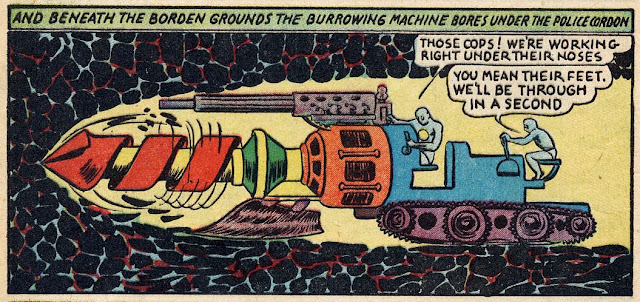
    The Blue Spark’s main gimmick, a heat ray cannon mounted on a truck, isn’t quite as remarkable but it is a pretty sweet bit of gear. Plus he has another one mounted on a cool-ass drilling machine!

    (it is somewhat unclear if the Blue Spark has a second ray that allows him to mind control people or if his heat ray doubles as a mind control ray, and determining this is not helped by the fact that he clearly has an aesthetic fondness for that particular style of scientific greebling on the outside of the rays. It’s a good clean visual on the mind control ray, I will say that)

    The Blue Spark’s henchmen (called the Blue Rubber Men at one point, btw) are not just well-dressed:  their costumes have  little nozzles in the chest that lets them be inflated like a balloon to render them immune to fisticuffs  – another idea that sounds like something out of a Silver Age comic, twenty years early.

    Technology or no, inflation fetish suits or no, the Blue Spark vs Magno is your classic case of a villain who is so little of an even match for the hero that the plotter’s concern must lie in keeping them apart for as long as possible because the instant they meet up, something like the above happens. Magno didn’t even give him a chance to blow up his suit, the poor guy.

  • MINOR SUPER-VILLAIN 776: THE BLUE SPARK

    (Super-Mystery Comics v1 002, 1940)

    In terms of crime, the Blue Spark is ambitious but not extraordinary: a little corporate extortion, some bank robbery, a few kidnappings. Nothing we haven’t seen a few hundred times by now.  When it comes to the trappings of super-villainy, however, the Blue Spark is on the cutting edge.

    Just look at that costume – it’s not quite the standardized super-villain getup we will eventually see on so many one-shot Batman villains but it’s pretty damn close, and particularly in an era in which most villains are still pairing a mask with a suit and tie or a robe. Even more impressive and ahead of its time is the Blue Spark’s choice to dress his henchmen in a simplified version of his own uniform. Just really impressive stuff.

    The Blue Spark’s main gimmick, a heat ray cannon mounted on a truck, isn’t quite as remarkable but it is a pretty sweet bit of gear. Plus he has another one mounted on a cool-ass drilling machine!

    (it is somewhat unclear if the Blue Spark has a second ray that allows him to mind control people or if his heat ray doubles as a mind control ray, and determining this is not helped by the fact that he clearly has an aesthetic fondness for that particular style of scientific greebling on the outside of the rays. It’s a good clean visual on the mind control ray, I will say that)

    The Blue Spark’s henchmen (called the Blue Rubber Men at one point, btw) are not just well-dressed:  their costumes have  little nozzles in the chest that lets them be inflated like a balloon to render them immune to fisticuffs  – another idea that sounds like something out of a Silver Age comic, twenty years early.

    Technology or no, inflation fetish suits or no, the Blue Spark vs Magno is your classic case of a villain who is so little of an even match for the hero that the plotter’s concern must lie in keeping them apart for as long as possible because the instant they meet up, something like the above happens. Magno didn’t even give him a chance to blow up his suit, the poor guy.

  • MINOR SUPER-VILLAIN 774: THE TERROR

    (Super-Mystery Comics 001, 1940)

    The Terror is really Scar (or Scar-Face) Pontois, a gang boss who is expending a lot of effort in order to drive people away from a rich gold claim that he has hijacked but has perhaps gone a bit too far, as Corporal Flint of the RCMP, the hero of our story, is only nosing around Scar’s locale because of the strange rumours he and/or his superiors have heard. Please note his giant hat.

    In addition to the fearsome Terror identity, Scar’s efforts include playing off of local superstitions by sending the daughter of the man he stole the gold claim from out to play the ominous Flame Maiden, but the real star of the show is the Coffin of the Mad. Based on the idea that radium can destroy the human brain (an idea that I can find no real source for, which probably means that it appeared in one Scientific American article that the comic’s writer read in 1935 or so), the coffin is made out of radium-bearing pitchblende ore. Various characters in the story claim that men have been made mad after being placed in the coffin, but even taking the “radium destroys brains” thing as gospel as far as I can tell pitchblende is so much less radioactive that radium that it’s more likely that they all went nuts because they were shut up in a stone coffin alive. I wouldn’t bet against their chances of getting cancer at some point though.

    In conclusion, the Terror probably would have been better off just killing people. Or just investing in that guy’s mine through a shell company.

  • MINOR SUPER-VILLAIN 774: THE TERROR

    (Super-Mystery Comics 001, 1940)

    The Terror is really Scar (or Scar-Face) Pontois, a gang boss who is expending a lot of effort in order to drive people away from a rich gold claim that he has hijacked but has perhaps gone a bit too far, as Corporal Flint of the RCMP, the hero of our story, is only nosing around Scar’s locale because of the strange rumours he and/or his superiors have heard. Please note his giant hat.

    In addition to the fearsome Terror identity, Scar’s efforts include playing off of local superstitions by sending the daughter of the man he stole the gold claim from out to play the ominous Flame Maiden, but the real star of the show is the Coffin of the Mad. Based on the idea that radium can destroy the human brain (an idea that I can find no real source for, which probably means that it appeared in one Scientific American article that the comic’s writer read in 1935 or so), the coffin is made out of radium-bearing pitchblende ore. Various characters in the story claim that men have been made mad after being placed in the coffin, but even taking the “radium destroys brains” thing as gospel as far as I can tell pitchblende is so much less radioactive that radium that it’s more likely that they all went nuts because they were shut up in a stone coffin alive. I wouldn’t bet against their chances of getting cancer at some point though.

    In conclusion, the Terror probably would have been better off just killing people. Or just investing in that guy’s mine through a shell company.

  • MINOR SUPER-HERO ROUND-UP 045

    Ah the super-hero.

    Ace Buckley: 

    Ace Buckley is a time traveller, a subgenre of comic book hero mostly notable for the fact that they have no one to blame for their troubles but themselves. Like most of his peers, Buckley (along with his intriguingly-named companion Toni Stark, whose role in the stories is to get captured and then swan around in minimal clothing while waiting for Buckley to rescue her) flings himself willy-nilly into the hotspots of human history and then murders his way free with barely a though to such things as “causality” or “the grandfather paradox” or “the integrity of the timestream”. (Startling Comics 003, 1940)

    Magic Morro: 

    Some time around 1922, young Jack Morrow and his father are shipwrecked on an uncharted Atlantic island. Proclaimed to be the next prophesied leader of local inhabitants the Utangos, Jack is raised to be a superhuman white jungle guy in the classic Tarzan style, only with all kinds of magical knowledge imparted to him by the former ruler, Tanta Talu. As Magic Morro, he is super strong, immune to fire, possibly bulletproof, can turn himself invisible and move objects with his mind, and those are just the abilities that he demonstrated in his first year worth of adventures!

    (Bonus Parenthetical: despite having a fully magical ruler who can do prophecy and summon lightning and stuff, the Utangos also have a standard issue treacherous witch doctor, who is named Mango! What’s with all the evil Mangos?) (Super Comics 021, 1940)

    Vulcan: 

    Vulcan, the Volcanic Man is the descendant of the Roman god of the same name and shares with him a broad dominion over fire, if not an inclination toward metalworking. He generates heat, can pick up and manipulate flame, is immune to heat and flame and also the forces involved in being blasted out of a volcano in the South Pacific and landing in the United States, is bulletproof in the sense that bullets melt before they can injure him, etc. He also has a radical fire-themed haircut.

    Like a lot of fire-based super-heroes, Vulcan ends up fighting a lot of hapless arsonists who waste all of their best fire-based deathtraps of a guy who can’t shut up about how he used to live in a volcano. (Super Mystery Comics v1 001)

    UPDATE 1 

    Magno:

    Control over magnetism is one of the classic comic book powers and Magno here (not our first Magno and certainly not our last) has the bargain basement version of it: he can pull things toward himself or pull himself toward things, a version of flight that requires enough admin work on the part of the artist that it is eventually rounded up to his just being able to fly outright. He also eventually gets a magnetic anti-bullet force field for a similar reason, I reckon: it’s no fun having to do the admin of Magno disarming every crook in every room he enters individually.

    Also unfortunately falling by the wayside over time is Magno’s power to project his face onto solid objects to vex and annoy crooks and cops alike. Was this meant to be an aspect of his magnetic abilities somehow or just a cool thing he could do? It is never specified.

    Finally, I must note that the somewhat abstract design on Magno’s chest is a representation of a bar magnet, in one of its few victories over the horseshoe magnet on the battlefields of graphic design. (Super-Mystery Comics v1 001, 1940)

  • MINOR SUPER-HERO ROUND-UP 045

    Ah the super-hero.

    Ace Buckley: 

    Ace Buckley is a time traveller, a subgenre of comic book hero mostly notable for the fact that they have no one to blame for their troubles but themselves. Like most of his peers, Buckley (along with his intriguingly-named companion Toni Stark, whose role in the stories is to get captured and then swan around in minimal clothing while waiting for Buckley to rescue her) flings himself willy-nilly into the hotspots of human history and then murders his way free with barely a though to such things as “causality” or “the grandfather paradox” or “the integrity of the timestream”. (Startling Comics 003, 1940)

    Magic Morro: 

    Some time around 1922, young Jack Morrow and his father are shipwrecked on an uncharted Atlantic island. Proclaimed to be the next prophesied leader of local inhabitants the Utangos, Jack is raised to be a superhuman white jungle guy in the classic Tarzan style, only with all kinds of magical knowledge imparted to him by the former ruler, Tanta Talu. As Magic Morro, he is super strong, immune to fire, possibly bulletproof, can turn himself invisible and move objects with his mind, and those are just the abilities that he demonstrated in his first year worth of adventures!

    (Bonus Parenthetical: despite having a fully magical ruler who can do prophecy and summon lightning and stuff, the Utangos also have a standard issue treacherous witch doctor, who is named Mango! What’s with all the evil Mangos?) (Super Comics 021, 1940)

    Vulcan: 

    Vulcan, the Volcanic Man is the descendant of the Roman god of the same name and shares with him a broad dominion over fire, if not an inclination toward metalworking. He generates heat, can pick up and manipulate flame, is immune to heat and flame and also the forces involved in being blasted out of a volcano in the South Pacific and landing in the United States, is bulletproof in the sense that bullets melt before they can injure him, etc. He also has a radical fire-themed haircut.

    Like a lot of fire-based super-heroes, Vulcan ends up fighting a lot of hapless arsonists who waste all of their best fire-based deathtraps of a guy who can’t shut up about how he used to live in a volcano. (Super Mystery Comics v1 001)

    UPDATE 1 

    Magno:

    Control over magnetism is one of the classic comic book powers and Magno here (not our first Magno and certainly not our last) has the bargain basement version of it: he can pull things toward himself or pull himself toward things, a version of flight that requires enough admin work on the part of the artist that it is eventually rounded up to his just being able to fly outright. He also eventually gets a magnetic anti-bullet force field for a similar reason, I reckon: it’s no fun having to do the admin of Magno disarming every crook in every room he enters individually.

    Also unfortunately falling by the wayside over time is Magno’s power to project his face onto solid objects to vex and annoy crooks and cops alike. Was this meant to be an aspect of his magnetic abilities somehow or just a cool thing he could do? It is never specified.

    Finally, I must note that the somewhat abstract design on Magno’s chest is a representation of a bar magnet, in one of its few victories over the horseshoe magnet on the battlefields of graphic design. (Super-Mystery Comics v1 001, 1940)

  • MINOR SUPER-HERO ROUND-UP 043

    A grab bag of old characters I skipped over back in the early days when I thought that this blog wasn’t going to be completely self-indulgent. 

    Mr Clue: 

    He only had one adventure in which he solves the murder of a mayor by a police chief, but Mr Clue is too great a name not to take note of. (Master Comics 001, 1940)

    the Red Gaucho: 

    A swashbuckling hero in the Zorro mode, the Red Gaucho protects the South American nation of Santa Palos from threats both foreign and domestic before eventually just kind of wandering North to have adventures in a sort of generic Central America. He’s a fun character! He has one of the biggest hats in comics!

    The Red Gaucho is also a character I think about whenever the topic of white supremacy comes up. White supremacy is one of those topics that gets a lot of people very angry, but at its base it’s simply the belief that the world consists of white people and everyone else and more specifically that it’s white people versus everyone else in a competition to keep white people on top, where they belong. And the further back you go, the less people felt the need to hide the fact that that was their worldview, and possibly the place that that attitude is most on display is in early Golden Age comics – just read any set outside North America and you’ll catch on to it pretty quickly.

    Anyway, that is all to say that even though it’s more subtle than a lot of other examples of this worldview in comics, ever since I noticed that every single appearance of the Red Gaucho includes a disclaimer assuring readers that he was in fact the child of two Americans and not some horrible South American – heavens forfend! – his smiling face pops into my head whenever the subject comes up.(Nickel Comics 004, 1940)

    the Hawk:

    On a less heavy note, here’s the Hawk! Created by George Brenner, who also created the Clock, the Hawk has the distinction of being the first masked crimefighter to appear in a comic that would eventually be amalgamated into the DC Comics fold (the Clock had only appeared in Centaur comics up until this point and wouldn’t make his way into a Quality book for a few months yet). A heady and heavily qualified distinction!

    The Hawk is secretly T. James Harrington II, wealthy and useless playboy who hangs around looking bored until some crime happens and it’s time for the Hawk to hit the streets. It’s a bit Bruce Wayne/Batman only without the parental murder.

    Unlike Batman, the Hawk leans pretty minimal on the costume front, with his major identifying feature being a set of slip-on claws. 

    The Hawk also has a couple of assistants named Link and Rollo who are touted as the only people who know the Hawk’s identity but who don’t get much time to show their stuff in this, their one-panel appearance. Astute readers might note that the crook that the Hawk has just captured likely also knows his secret identity at this point but please note that Link and Rollo are identified as the only living people to know the secret. Sinister stuff!

    DC has already gone with the Crimson Avenger as the Official First Golden Age Super-Hero but I reckon that the Hawk would be a fun guy to be brung back for some future story involving early mystery men antics. (Feature Funnies 002, 1937)

    *Hero Update* Shock Gibson:

    It had to happen someday: Shock Gibson disguises himself as a cowboy and in the process abandons his iconic helmet forever. Fare the well, helmet. (Speed Comics 007, 1940)

  • MINOR SUPER-VILLAIN 739: THE AVENGER

    (Smash Comics 003, 1939 – Smash Comics 012, 1940) 

    The Avenger is a cottage-industry villain, which is a term I just made up for particular kind of villain that you saw a fair amount in the Golden Age and then again in 1980s cartoons, wherein battling and thwarting them is the sole focus of a hero’s career – see also Mr H and the Conqueror.

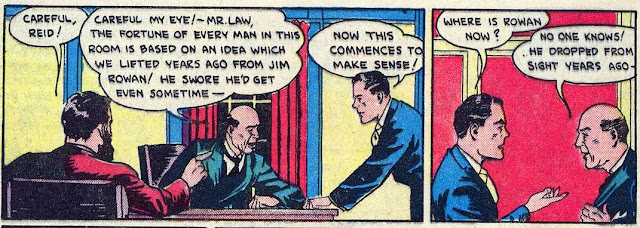
    The Avenger is also a revenge-focused villain: he is really Jim Rowan, a man who was swindled out of an unspecified invention decades earlier and now seeks to ruin and murder the thirteen men who did the swindling and have since grown wealthy off of it. This is a pretty reasonable motivation for revenge, and the Avenger might even have managed to come across as a somewhat sympathetic figure if he gave even one single damn about who else he might harm or kill in pursuit of his quest. His various schemes:

    – bankrupt airline owner Carter by blowing up his passenger planes mid-flight

    – murder electric company owner Amos Reid and frame his son George for the crime

    – ruin railroad owner Edgar Karr by wrecking his trains

    – incite mob violence against drug manufacturer Roger Carlin by tainting his products and distributing them to the poor

    – just some low-effort murder attempts against group member Albert Mills

    – ruin Rolls the bus company owner by stealing his buses, passengers and all 

    – attempt to murder industrialist Roger O. Gates directly (but mistakenly kill a man who looks like him)

    – blow up the munitions factory of Mr Arms

    There’s also a threat by the Avenger against nonspecific industrialist Albert Lewis that turns out to be bogus because Lewis has been imprisoned and impersonated by Rowan/the Avenger in order to aid his plan to destroy the others. The “death threat” is in actuality a ruse to get detective John Law alone and kill him. This leads to the discovery of another revenge scheme:

    – lock Albert Lewis up in an insane asylum and take his place while acting as the Avenger, thus not only framing him but leaving him somewhere where he can’t even tell anyone about it or be counted as even more insane

    None of these schemes actually succeed, however, because the 13 men have hired scientist/lawyer/detective John Law (aka the Scientective) to discover just who is targeting them and why. Like fellow Henry Campbell creations Wizard Wells and Dean Denton, Law is a scientific genius who uses his knowledge and inventions to further his crusade against crime. He never quite gets ahead of the Avenger, but he’s cagey enough to thwart his schemes before they can reach murderous fruition. Except for Amos Reid’s murder, of course, because that was the first step in a plan to ruin Reid’s legacy. And that one innocent man who died, that was a shame. The dozens of people who died on Carter’s planes don’t count, of course, because that happened before Law was hired. Look, the important thing is that twelve wealthy men were saved from facing the consequences of their actions.

    The Avenger/John Law stories are entertaining stuff but nothing to write home about, mostly because both characters tend to employ what was cutting-edge or unusual science c.1940 that today is either unremarkable (remote controlled aircraft, thermite, dry ice) or is still a bit sci-fi seeming (magnetic levitation, increasing the skin’s permeability via ultrasound) but all of it is applied in this very dry, matter-of-fact, everyone-is-wearing-a-suit way that drains some of the wonder and majesty from the proceedings.

    A couple of interesting things about the Avenger:


    The Avenger isn’t a habitual costume wearer but he does throw on a hood a couple of times and I thought I’d showcase that. I prefer the red one!

    This deathtrap, which involves a rapidly-spinning propeller and a strobe light synched to its movements to create the illusion of a stationary bar, is very fun and unique! Strobe lights! Very futuristic!

    Also fun: Law’s method for discovering the identity of the Avenger. He has thirteen phone lines installed, each with its own unique number, and gives one to each of his thirteen suspects. He then issues a provocative statement to the press and simply waits to see which phone rings when the Avenger calls to yell at him. This is, frankly, an amazing hack for any situation involving multiple suspects.

    I can only assume that the Avenger’s death came as a direct result of the series being discontinued – John Law, up to this point a fairly nonviolent man, abruptly shifts gears and blows the villain out of the skies with his own drone bomb. It’s an ignominious end to be sure.

    REVENGE KILLER SCORE: 1/13 – a pretty poor showing, due mostly to the Avenger’s desire to draw out his targets’ suffering. If he had gone for the kill straight away he might have done a bit better.

  • MINOR SUPER-VILLAIN 739: THE AVENGER

    (Smash Comics 003, 1939 – Smash Comics 012, 1940) 

    The Avenger is a cottage-industry villain, which is a term I just made up for particular kind of villain that you saw a fair amount in the Golden Age and then again in 1980s cartoons, wherein battling and thwarting them is the sole focus of a hero’s career – see also Mr H and the Conqueror.

    The Avenger is also a revenge-focused villain: he is really Jim Rowan, a man who was swindled out of an unspecified invention decades earlier and now seeks to ruin and murder the thirteen men who did the swindling and have since grown wealthy off of it. This is a pretty reasonable motivation for revenge, and the Avenger might even have managed to come across as a somewhat sympathetic figure if he gave even one single damn about who else he might harm or kill in pursuit of his quest. His various schemes:

    – bankrupt airline owner Carter by blowing up his passenger planes mid-flight

    – murder electric company owner Amos Reid and frame his son George for the crime

    – ruin railroad owner Edgar Karr by wrecking his trains

    – incite mob violence against drug manufacturer Roger Carlin by tainting his products and distributing them to the poor

    – just some low-effort murder attempts against group member Albert Mills

    – ruin Rolls the bus company owner by stealing his buses, passengers and all 

    – attempt to murder industrialist Roger O. Gates directly (but mistakenly kill a man who looks like him)

    – blow up the munitions factory of Mr Arms

    There’s also a threat by the Avenger against nonspecific industrialist Albert Lewis that turns out to be bogus because Lewis has been imprisoned and impersonated by Rowan/the Avenger in order to aid his plan to destroy the others. The “death threat” is in actuality a ruse to get detective John Law alone and kill him. This leads to the discovery of another revenge scheme:

    – lock Albert Lewis up in an insane asylum and take his place while acting as the Avenger, thus not only framing him but leaving him somewhere where he can’t even tell anyone about it or be counted as even more insane

    None of these schemes actually succeed, however, because the 13 men have hired scientist/lawyer/detective John Law (aka the Scientective) to discover just who is targeting them and why. Like fellow Henry Campbell creations Wizard Wells and Dean Denton, Law is a scientific genius who uses his knowledge and inventions to further his crusade against crime. He never quite gets ahead of the Avenger, but he’s cagey enough to thwart his schemes before they can reach murderous fruition. Except for Amos Reid’s murder, of course, because that was the first step in a plan to ruin Reid’s legacy. And that one innocent man who died, that was a shame. The dozens of people who died on Carter’s planes don’t count, of course, because that happened before Law was hired. Look, the important thing is that twelve wealthy men were saved from facing the consequences of their actions.

    The Avenger/John Law stories are entertaining stuff but nothing to write home about, mostly because both characters tend to employ what was cutting-edge or unusual science c.1940 that today is either unremarkable (remote controlled aircraft, thermite, dry ice) or is still a bit sci-fi seeming (magnetic levitation, increasing the skin’s permeability via ultrasound) but all of it is applied in this very dry, matter-of-fact, everyone-is-wearing-a-suit way that drains some of the wonder and majesty from the proceedings.

    A couple of interesting things about the Avenger:


    The Avenger isn’t a habitual costume wearer but he does throw on a hood a couple of times and I thought I’d showcase that. I prefer the red one!

    This deathtrap, which involves a rapidly-spinning propeller and a strobe light synched to its movements to create the illusion of a stationary bar, is very fun and unique! Strobe lights! Very futuristic!

    Also fun: Law’s method for discovering the identity of the Avenger. He has thirteen phone lines installed, each with its own unique number, and gives one to each of his thirteen suspects. He then issues a provocative statement to the press and simply waits to see which phone rings when the Avenger calls to yell at him. This is, frankly, an amazing hack for any situation involving multiple suspects.

    I can only assume that the Avenger’s death came as a direct result of the series being discontinued – John Law, up to this point a fairly nonviolent man, abruptly shifts gears and blows the villain out of the skies with his own drone bomb. It’s an ignominious end to be sure.

    REVENGE KILLER SCORE: 1/13 – a pretty poor showing, due mostly to the Avenger’s desire to draw out his targets’ suffering. If he had gone for the kill straight away he might have done a bit better.