The Curse of Skeleton Munroe

Category: costumes

  • MINOR SUPER-VILLAIN 726: PROFESSOR MEIER

    (Science Comics 005, 1940)

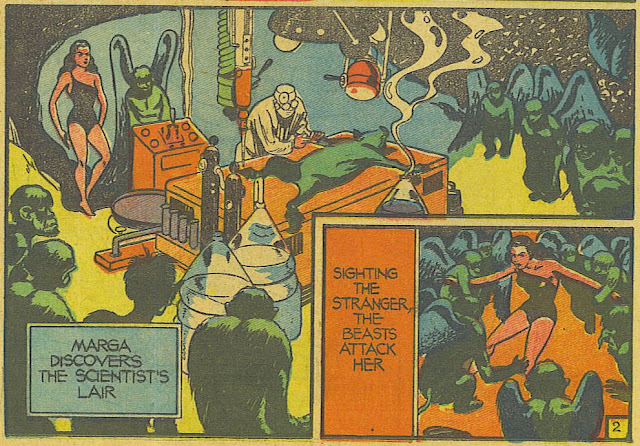
    Professor Meier, a scientist, seeks to conquer the world by unleashing an ever-growing horde of mutated life forms from his jungle HQ. This is all pretty regular stuff and he probably would have been tossed into the regular science round-up, only there are a couple of fun things that Meier brings to the table that I would like to highlight.

    First off, the mutated beasts themselves are a pretty fun design, a sort of lion/monkey/caveman/eagle chimera, plus green. What really sells them for me, though, are the dramatic shadows that they are covered with, and which usually obscure their face like they’re in a 50s horror comic and have visages too terrible for the human mind to comprehend (*CHOKE!*). Plus, they all have fun little bowl cuts.

    Professor Meier also has a fantastic look. Like, yes, most of the characters tagged “scientist” and/or “mad science” here are wearing some sort of labwear, but the whole 1940s surgical outfit complete with head mirror and black rubber gloves is a real banger of a costume. And he wears it to bed in his Safety Bedroom. Armed, of course.

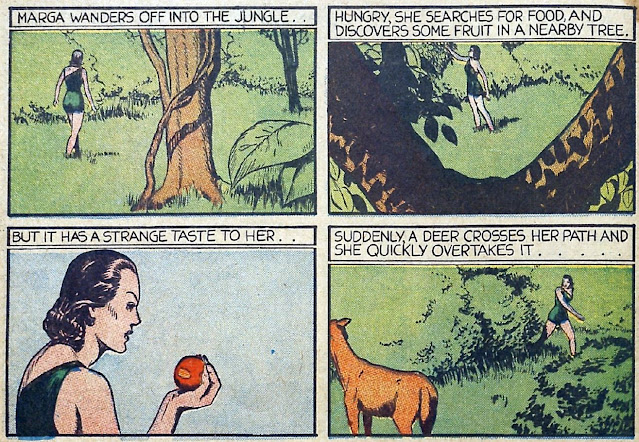
    New Power Alert: Marga the Panther Woman is already too mutated to be turned into a creature by Meier’s janky serum but she does get even stronger than she already was.

    And finally, once Marga and Homer (the one friendly beast) get Meier out of the way, all of his creatures are given an antidote and turn out mainly to be small animals like rabbits and ducks – shades of Sonic the Hedgehog! – which is pretty fun. Homer turns out to be a German Shepherd, and it looks like Marga will have a fun canine companion going forward but sadly he never returns. Professor Meier’s fate is a bit more ambiguous, but I reckon he’s dead.

  • MINOR SUPER-VILLAIN 726: PROFESSOR MEIER

    (Science Comics 005, 1940)

    Professor Meier, a scientist, seeks to conquer the world by unleashing an ever-growing horde of mutated life forms from his jungle HQ. This is all pretty regular stuff and he probably would have been tossed into the regular science round-up, only there are a couple of fun things that Meier brings to the table that I would like to highlight.

    First off, the mutated beasts themselves are a pretty fun design, a sort of lion/monkey/caveman/eagle chimera, plus green. What really sells them for me, though, are the dramatic shadows that they are covered with, and which usually obscure their face like they’re in a 50s horror comic and have visages too terrible for the human mind to comprehend (*CHOKE!*). Plus, they all have fun little bowl cuts.

    Professor Meier also has a fantastic look. Like, yes, most of the characters tagged “scientist” and/or “mad science” here are wearing some sort of labwear, but the whole 1940s surgical outfit complete with head mirror and black rubber gloves is a real banger of a costume. And he wears it to bed in his Safety Bedroom. Armed, of course.

    New Power Alert: Marga the Panther Woman is already too mutated to be turned into a creature by Meier’s janky serum but she does get even stronger than she already was.

    And finally, once Marga and Homer (the one friendly beast) get Meier out of the way, all of his creatures are given an antidote and turn out mainly to be small animals like rabbits and ducks – shades of Sonic the Hedgehog! – which is pretty fun. Homer turns out to be a German Shepherd, and it looks like Marga will have a fun canine companion going forward but sadly he never returns. Professor Meier’s fate is a bit more ambiguous, but I reckon he’s dead.

  • MINOR SUPER-HERO ROUND-UP 038

    MINOR SUPER-HERO ROUND-UP 038

    Second- and third-tier Fox Features heroes: ACTIVATE

    Dynamo:

    Jim Andrews is an electrical scientist who heroically risks his own life by using his own body as a conductor to prevent some crazy bit of machinery from blowing the whole laboratory he works at to high heaven. And since he lives in a comic book world, the reward for his bravery is some super powers! He can now emit electricity, create an electrical forcefield, kind of fly by throwing a lightning bolt and then riding it through the air and even be super strong, with the minor caveat that he has to charge himself up from time to time (over time and for narrative convenience he also develops the powers to freeze water, to repair smashed up items by shooting electricity at them and to travel interstellar distances under his own power).

    Andrews originally calls himself Electro but swaps that name out for Dynamo in his second appearance. There is some speculation that the name change comes about because there was already an extant Electro over at Marvel.

    Dynamo’s costume choices over his two years of adventuring range from “generic” to “kind of dumb-looking,” and the real kicker is that the Fox Features cover artist consistently puts him in this incredible red number. (Science Comics 001, 1940)

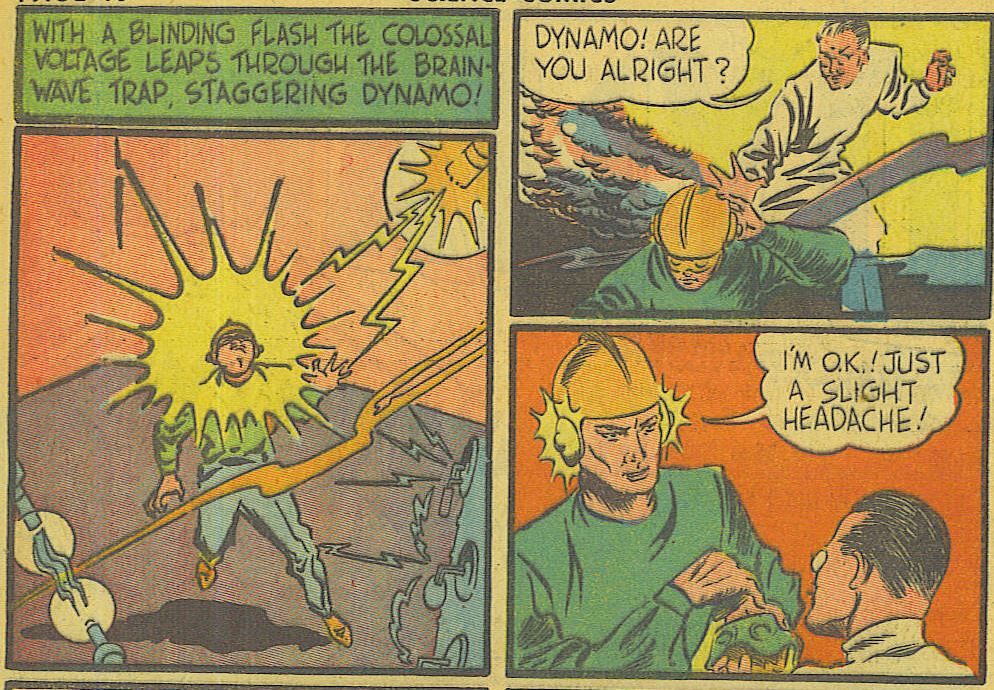
    ADDENDUM: In Science Comics 005, Dynamo, already wildly powerful, invents a device with the fairly ominous name the Brain-Wave Trap which allows him to read the minds of everyone on Earth and indeed for hundreds of light years around. Ir’s a significant power boost for something that is mainly used to keep the plot chugging along.

    UPDATE: Weird Comics 1940

    the Eagle:

    The Eagle is Bill Powers, a wealthy young gadabout who has developed an “anti-gravitation fluid” which allows him to fly when applied to his wing/flaps.


    The Eagle might just have the greatest number of costume variations before finding his groove, though I suppose a number of them can be ascribed to the whims of the colourist on any given day. While the flying squirrel style flaps are fun for their uniqueness and that fourth version has far nicer-looking wings than Hawkman was sporting at the same time I can absolutely understand the impulse to move toward a more traditional super-hero costume without a bunch of fiddly little feathers all over it. BUT! the Eagle’s costume has not reached its final form – something to look forward to once we get to Fox Features’ 1941 offerings. Or just look up on your own, I suppose.

    I don’t think that it’s intentional so much as a product of many busy hands being involved in making most if not all Fox Features comics, but Bill Powers is one of the better realizations of the “wealthy young playboy” super-hero alter ego. He really and truly comes off as someone who is just kind of doing things, including fighting crime, to keep himself occupied and the greatest example of that is all the little projects such as his “crime cartoons” or his “book on crime” that he keeps mentioning once and then never ever returning to. Plus he has a butler named Jason, whom I love.

    Finally, the Eagle might just have the most mysterious of all calling cards, an unseen “mark like that done by an eagle.” (Science Comics 001, 1940) 

    UPDATE: Weird Comics 1940

    Marga the Panther Woman:

    Marga, formerly a nurse at the asylum housing the mad physiologist von Dorf, finds herself kidnapped and made into a panther/ human hybrid. Is there just a hint of weird race science in the way that Marga going from blonde to black haired is a sign of her primitive nature being brought forward? Maybe just a skosh.

    Marga adapts fairly well to her new situation, even when it means that she is now an obligate carnivore. She just kind of accepts that her life is no longer that of a nurse but that of a jungle predator.

    Marga’s first few adventures take place in what is pretty clearly the future but a series of comics with different creative teams ends with her being a contemporary 1940 figure. (Science Comics 001, 1940)

    Navy Jones:

    Navy Jones (and let me tell you I groaned audibly about two hours after I fist read that name, when I figured out that it was a pun on Davy Jones) is a submarine commander of the future who meets with disaster when his submarine hits a free-floating mine and everyone on board but him is killed. Lucky for Jones, he is picked up by some passing Fish-Men and taken to their city, where he befriends their king.

    Things take a turn when the evil Prime Minister uses the presence of this outsider in the halls of power as a catalyst for rebellion, and Navy Jones is almost killed. In another stroke of fortune, the king happens to be a skilled surgeon and saves Jones’ life at the cost of his ability to breathe air. Jones rescues the kidnapped Princess Coral from the Prime Minister and puts down the rebellion, becoming the city’s champion (and in a final stroke of luck, the Fish-Men are the kind of comic book species where the more aristocratic you are, the more human you look, so Jones’ new Princess love interest is barely a fish at all!). (Science Comics 001, 1940)

  • MINOR SUPER-HERO ROUND-UP 038

    Second- and third-tier Fox Features heroes: ACTIVATE

    Dynamo:

    Jim Andrews is an electrical scientist who heroically risks his own life by using his own body as a conductor to prevent some crazy bit of machinery from blowing the whole laboratory he works at to high heaven. And since he lives in a comic book world, the reward for his bravery is some super powers! He can now emit electricity, create an electrical forcefield, kind of fly by throwing a lightning bolt and then riding it through the air and even be super strong, with the minor caveat that he has to charge himself up from time to time (over time and for narrative convenience he also develops the powers to freeze water, to repair smashed up items by shooting electricity at them and to travel interstellar distances under his own power).

    Andrews originally calls himself Electro but swaps that name out for Dynamo in his second appearance. There is some speculation that the name change comes about because there was already an extant Electro over at Marvel.

    Dynamo’s costume choices over his two years of adventuring range from “generic” to “kind of dumb-looking,” and the real kicker is that the Fox Features cover artist consistently puts him in this incredible red number. (Science Comics 001, 1940)

    ADDENDUM: In Science Comics 005, Dynamo, already wildly powerful, invents a device with the fairly ominous name the Brain-Wave Trap which allows him to read the minds of everyone on Earth and indeed for hundreds of light years around. Ir’s a significant power boost for something that is mainly used to keep the plot chugging along.

    UPDATE: Weird Comics 1940

    the Eagle:

    The Eagle is Bill Powers, a wealthy young gadabout who has developed an “anti-gravitation fluid” which allows him to fly when applied to his wing/flaps.


    The Eagle might just have the greatest number of costume variations before finding his groove, though I suppose a number of them can be ascribed to the whims of the colourist on any given day. While the flying squirrel style flaps are fun for their uniqueness and that fourth version has far nicer-looking wings than Hawkman was sporting at the same time I can absolutely understand the impulse to move toward a more traditional super-hero costume without a bunch of fiddly little feathers all over it. BUT! the Eagle’s costume has not reached its final form – something to look forward to once we get to Fox Features’ 1941 offerings. Or just look up on your own, I suppose.

    I don’t think that it’s intentional so much as a product of many busy hands being involved in making most if not all Fox Features comics, but Bill Powers is one of the better realizations of the “wealthy young playboy” super-hero alter ego. He really and truly comes off as someone who is just kind of doing things, including fighting crime, to keep himself occupied and the greatest example of that is all the little projects such as his “crime cartoons” or his “book on crime” that he keeps mentioning once and then never ever returning to. Plus he has a butler named Jason, whom I love.

    Finally, the Eagle might just have the most mysterious of all calling cards, an unseen “mark like that done by an eagle.” (Science Comics 001, 1940) 

    UPDATE: Weird Comics 1940

    Marga the Panther Woman:

    Marga, formerly a nurse at the asylum housing the mad physiologist von Dorf, finds herself kidnapped and made into a panther/ human hybrid. Is there just a hint of weird race science in the way that Marga going from blonde to black haired is a sign of her primitive nature being brought forward? Maybe just a skosh.

    Marga adapts fairly well to her new situation, even when it means that she is now an obligate carnivore. She just kind of accepts that her life is no longer that of a nurse but that of a jungle predator.

    Marga’s first few adventures take place in what is pretty clearly the future but a series of comics with different creative teams ends with her being a contemporary 1940 figure. (Science Comics 001, 1940)

    Navy Jones:

    Navy Jones (and let me tell you I groaned audibly about two hours after I fist read that name, when I figured out that it was a pun on Davy Jones) is a submarine commander of the future who meets with disaster when his submarine hits a free-floating mine and everyone on board but him is killed. Lucky for Jones, he is picked up by some passing Fish-Men and taken to their city, where he befriends their king.

    Things take a turn when the evil Prime Minister uses the presence of this outsider in the halls of power as a catalyst for rebellion, and Navy Jones is almost killed. In another stroke of fortune, the king happens to be a skilled surgeon and saves Jones’ life at the cost of his ability to breathe air. Jones rescues the kidnapped Princess Coral from the Prime Minister and puts down the rebellion, becoming the city’s champion (and in a final stroke of luck, the Fish-Men are the kind of comic book species where the more aristocratic you are, the more human you look, so Jones’ new Princess love interest is barely a fish at all!). (Science Comics 001, 1940)

  • MINOR SUPER-HERO ROUND-UP 033

    Minor super-heroes, we got ’em.

    Little Giant: 

    Professor Rednow has some inventions to test and he has secured an orphan boy named Rusty for that purpose. Rusty is first given a serum that is supposed to turn him into a big hunk of beefcake but instead he becomes a kid with super strength. He then gets an outfit with anti-gravity properties that allow him to leap around like a small Hulk and finally is coated in “impurvogen,” a high-tech chemical that renders him invulnerable.

    In case you were having some doubts about Professor Rednow’s devotion to scientific ethics: I don’t think that he has any. It’s just lucky for young Rusty that all of this stuff works or he might end up buried in the Professor’s back yard alongside half a dozen other orphan boys.

    Rusty and the Professor end up moving to NYC and becoming special deputies in the NYPD but, as with the Phantom Knight before him, the Little Giant only really had a couple of adventures and the second one continues to be out of my price range. (OK Comics 001, 1940)

    the Shield:

    The Shield is Joe Higgins, “G-Man Extraordinary,” an FBI agent who battles threats to the US using a super-suit of his own design (a design that supposedly was the reason for Captain America switching from his original shield to the round one so as not to look too much like his patriotic counterpart, by the way). 

    Over the years the Shield’s status is subject to the usual comic drift: his powers go from being solely derived from his suit to involving some sort of super serum or ray or two of those, or all three. We’re talking about the 1940 version of the character, though, and he was all suit, baby. The suit itself did slim down considerably from the first issue to the second, but we can chalk that up to a refinement of the technology (and to the more form-fitting top being a bit more flattering than the big chunky breastplate look).

    One thing about the Shield that I had never known prior to reading his first appearance was that his motivation for becoming a costumed crimefighter was that his father died in the Black Tom Explosion as a result of German sabotage during WWI. Thus, the Shield has the Batman origin but for espionage!  (Pep Comics 001, 1940)

    UPDATE (Shield-Wizard Comics 001, 1940)

    the Comet:

    John Dickering is a scientist who invents a gas that when injected gives him super jumping abilities. Too late he learns the reason that so many scientists do extensive testing before trying out serums etc on themselves, as the gas also gives him disintegrating ray vision that can only be held in check by a glass visor, Cyclops-style. Thus, he becomes the Comet.

    There are a number of remarkable things about the Comet over the years but the only ones relevant to the 1940 version of the character are 1. the fact that he has one of the truly great Golden Age costumes and 2. just how very willing he is to kill his foes. I guess when all you have is a disintegrating ray every problem looks like a disintegratable nail. (Pep Comics 001, 1940)

    the Rocket:

    The Rocket is your classic example of an explorer coming to a lost/hidden/alien world and becoming its greatest champion. The most common example of this is your garden-variety jungle adventurer, with “modern man transported into an effete future” and “guy falls through hole into underground world” being other common examples.

    The Rocket’s adventures, on the other hand, happen… somewhere. He
    arrives via his namesake rocket ship – is the Diamond Empire located in
    the future? on an alien world? on a lost mesa or in a hidden valley? No
    idea, never addressed. He just shows up because he heard there was a hot
    queen running the joint and that’s all we get.

    After a rocky start, the Rocket manages to win over the titular Queen of Diamonds, going from her slave to her bodyguard to eventually becoming her lover/ adventuring companion. And if you read the above panels you might have noticed how very racist the Queen’s origin story is, another thing that is extremely in keeping with this man-in-a-strange-land style comic: white guy exceptionalism. (Pep Comics 001, 1940)

  • MINOR SUPER-VILLAIN 678: AMNOZO

    (National Comics 003, 1940) 

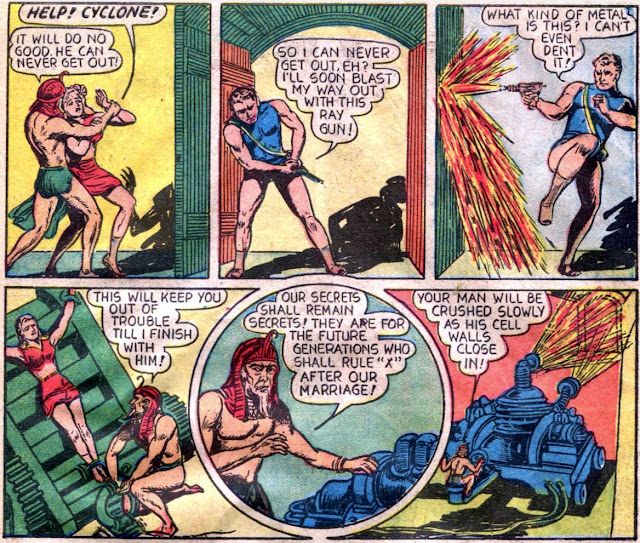
    Cyclone is an extremely minor Quality Comics future spaceman hero of the year 3000 who, in National Comics 001, participates in a competition between the planets of the solar system to see which one gets to colonize the newly discovered planet Vito. He wins of course, and the remainder of his four appearances are spent dealing with various threats to the new colony, including at least one civilization native to the planet, because colonialism. Do they leave once they realize that the planet is not, in fact, free real estate? Reader, they do not.

    But enough interpreting space opera through a historical lens, check out Cyclone’s sky skis, possibly the greatest personal flight device in the history of sci fi: little planes that you strap to your feet! And as a bonus, what is possibly the most appetizing food pill I have ever seen.

    Cyclone’s explorations are interrupted when he and his paramour Joy Sue Mary stumble upon an ancient, Ancient Egyptian style tomb, remnant of yet another civilization endemic to this uninhabited, ready-to-colonize planet. Even more troubling: the tomb’s occupant is not a mummy but Amnozo, a living man! He’s been waiting for people to show up so that he could… rule them? It’s a bit unclear.

    What is clear is that Amnozo is pulling the classic Creep’s Gambit of attempting to kill off the male protagonist so that he can capture and “romance” (or in this case “marry”) the female protagonist – we’ve seen it all a thousand times before. This is however a very nice rendition of the crushy room style of deathtrap.

    Amnozo fold like a house of cards once Cyclone’s troops show up to see what happened to him, despite a last-ditch attempt to roast them all with sick blue flame. What an achievement: waiting 4000 years only to end up rotting in whatever repurposed woodshed Cyclone’s colonial government is using as a jail just because you couldn’t not be a horrible creep to the first woman you saw.

    Also: does Amnozo’s loincloth not have a back?

  • MINOR SUPER-VILLAIN 658: THE ANT WOMAN

    (Jungle Comics 005, 1940) 

    Conceptually, I love the Ant Woman, a ruthless bandit who lives in a giant anthill and sends swarms of venomous ants out to kill and loot for her. I particularly love her little ant tiara – is it the source of her preternatural ability to control the beasts? I cannot say for they did not go into that. 

    (these pics are a bit more racist than I usually go for but they really front loaded it on this one. Just one of the reasons that jungle comics are inferior to other comic genres)

    The Ant Woman makes a solid go of trying to dispose of the Red Panther but he ultimately gets the upper hand by the simple method of setting her anthills on fire and once again the old saying is proven true: you live by the swarm of venomous ants; you die by the swarm of venomous ants.

  • MINOR SUPER-HERO ROUND-UP 029

    They’re trying, bless ’em.

    Hydroman:

    I was going to say that much levity has been mined from Hydroman’s origin over the years, but realistically this guy is obscure at best. Some levity has been mined from Hydroman’s origin over the years. Is it deserved? Certainly.

    Scientist Harry Thurston is having fun mixing up chemicals (specifically water, alcohol and sulphuric acid, though there is some speculation that there might have been some mystery residue in the glassware used) and manages to get some on his hand, which promptly turns to water. In a panic, he calls his friend Bob Blake over to help, and when Bob arrives, fellow scientist Tom Kinsman dumps an entire bucket of the mixture over him like they’re all in a dang slapstick comedy.

    They manage to counteract the formula, at which point Bob agrees to have the formula injected into him, and while this works as comic book science (if a big splash turned me to water, surely an injection will allow me to control the process! Because it’s deliberate and thus more scientific!), surely by all other metrics it is an insane decision. What’s to say, for instance, that an injection won’t merely turn all of your blood or veins to water, killing you?

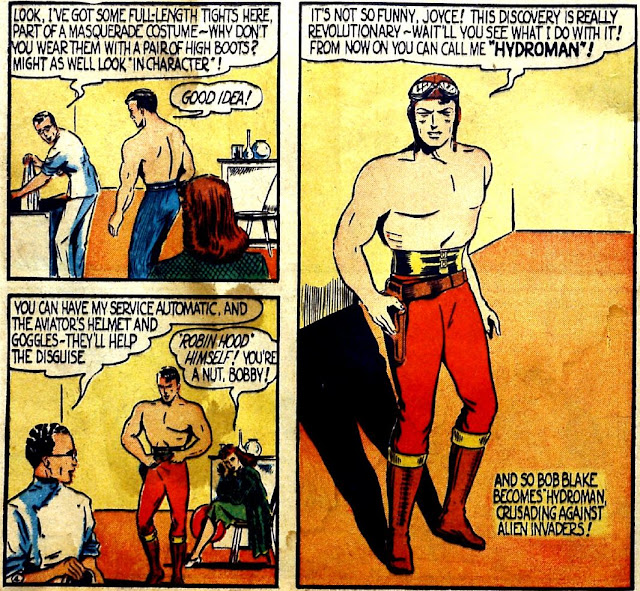
    Against all odd, the injection works and Bob Blake decides to use his newfound power to fight the wave of crime that is plaguing NYC. To go with his new role, Blake adopts a new moniker – Hydroman – and makes a super-hero costume in perhaps my favourite way, by scraping up all of the random crap in Harry Thurston’s lab.

    By issue 2, Hydroman gets what only I think of as his iconic look, a baggy suit of bulletproof Translite. It’s objectively kind of dumb looking but also… kind of great? It might be the combination of the leather pilot’s helmet and the riveted brass collar but the overall effect is very cool and retrofuturistic. Plus the transparent effect really plays well with Hydroman’s whole water theme. Finally, note that Hydroman’s assistant/ girlfriend Joyce Church is also wearing a bulletproof suit under her coat and I must commend him for being the rare Golden Age super-hero who thinks to distribute such protective super equipment to his civilian aides. (Reg’lar Fellers Heroic Comics 001, 1940)

    Update 1941 

    the Purple Zombie:

    Doctors Hale and Malinsky are partners, but while Hale was working to prolong human life, Malinsky was taking his research and using it to create an army of the undead in order to take over the world. His prototype is Zoro, the Purple Zombie, and once his zombification tech is proven to work (and once Hale starts mouthing off a bit to much), Malinsky decides that things might run a bit smoother if it was just him and the zombie and bumps off Hale.

    Unfortunately for Malinsky, some quirk of the zombie technology has made Zoro 1) amoral 2) bulletproof and super strong, and 3) loyal only to Hale, and so he makes short work of not only his erstwhile master but also his three foreign investors.

    Zoro is captured by the police and scheduled for an execution that hits a slight hitch when it turns out that in addition to bullets the Purple Zombie is immune to electricity (he also turns a more purpley purple when electrocuted!). Stymied, the authorities agree to release Zoro into the stewardship of Dr Hale (who survived the murder attempt, by the way). The Purple Zombie is not so much a hero as a gun that Hale points at people and situations, but as a pair they basically fit the brief. (Reg’lar Fellers Heroic Comics 001, 1940)

    Hyper the Phenomenal:

    Visually, Hyper the Phenomenal is great. I really like the… well “retrofuturistic” is the best description of it but of course at the time it was just futuristic. I really like his look, particularly what I assume is a breastplate since it seems to be separate to the shirt – there aren’t enough non-aquatic super-heroes with the courage to wear a big scallop shell as armour.

    Hyper is really the oddly-named Don-Vin, a scientist who has some sort of affiliation with the US Secret Service, either as an official agent or just a helpful pal. His main tools in the fight against evil are his Neogas Helmet that allows him to fly (plus is has a nifty two-way radio inside) and his Magno-Hydro Gauntlets, capable of both magnetic attraction and repulsion and with which he can both perform feats of superhuman strength (equivalent) and deflect incoming bullets.

    I chose the cover image above because it’s probably the most dynamic and interesting view available, due to the unfortunate fact that in Hyper the Phenomenal’s sole outing he does very, very little of note. His adventure on the Isle of Arunta was serialized over two issues and for fully half of that time (and somewhere between 1 and 2 days in-story), Hyper stands in front of a steel wall using his gauntlets to prevent a crushing room deathtrap from killing his ally Agent 2Y. A heroic act, to be sure, but not a visually interesting one. And since the first quarter of the story was devoted to setting up the action, Hyper only gets the final quarter to really strut his stuff, and even then he probably only gets the job done because the villains had oppressed the island’s inhabitants enough to start a rebellion. A poor showing indeed, Don-Vin. (Hyper Mystery Comics 001, 1940)

    Kaänga:

    Run-of-the-mill Tarzan clone who was orphaned in the jungle at a young age and whose Jane equivalent is named Ann Morgan. Kaänga’s only real point of interest is the umlaut on his second a, but he has close to 200 appearances over the years so I’m sure we’ll be seeing more from him. (Jungle Comics 001, 1940)
  • MINOR SUPER-HERO ROUND-UP 028

    Panther-heavy haul this time.

    the White Panther: 

    The White Panther is (along with his ancient father) the last survivor of some sort of lost jungle civilization that seems to have based their fashion sense along Jack Kirby lines, not that I’m complaining. He only has one appearance, in which he uses his supposed precognitive abilities to help a scientist and his daughter get ahold of some healing gemstones before a crook does.

    Since he never appeared again, by far the most interesting thing about the White Panther is his outfit, in which the lower portion seems to be pants and the upper to be his unclothed, chalk-white torso. Also, he appears to be using an unsheathed dagger as a belt buckle and while wildly impractical you can’t deny that that is very cool. (Jungle Comics 001, 1940)

    the Red Panther:

    The White Panther never returned, but the next issue of Jungle Comics featured the first appearance of the Red Panther (no relation), a fairly standard jungle hero and also a fairly standard costumed vigilante, a combination that I have a lot of affection for. Don’t get me wrong, the broader structural problems of the jungle adventure comic are still front and centre but at least the protagonist has a fun look so you can distract yourself occasionally with a chuckle. (Jungle Comics 002, 1940)

    Update 1941

    Tabu, Wizard of the Jungle:

    Tabu, the Wizard of the Jungle! He saved a witch-doctor’s life and was blessed with a “sixth sense” in turn unlocked a very wide range of powers and abilities that he uses to keep the peace in his jungle home! These powers include: physical abilities that outstrip those of the various jungle animals around him, including flight; the ability to communicate with and compel the actions of the animals and plants of the jungle; the ability to control the elements of the jungle to cause weather events (mist, wind) or disasters (earthquakes, plagues of insects); and his most spectacularly realized power, to change shape into animals or plants:

    Yes, this is the power that Tabu uses to dispose of a group of “slave raiders” in his first appearance by transforming into a carnivorous tree and… eating them? It’s possible that Tabu ate those guys, you guys.

    At the end of that first appearance the witch-doctor (who implicitly loved the way that Tabu ate those guys) grants him a seventh sense to allow him to “be in touch with the invisible spirits of the jungle.” Who knows what might have come of this new well of power if Fletcher Hanks had ever returned to the character but he had better things to do (see below) but sadly he never did. Tabu kept on appearing in Jungle Comics basically for the entirety of its run and the things he could or could not do varied wildly depending on who was on Tabu-duty that issue. (As far as I know he never ate any more guys) (Jungle Comics 001, 1940)

    Fantomah:

    The reason that Fletcher Hanks never went back for another pass at Tabu was presumably because he was too preoccupied with what is perhaps his finest creation: Fantomah!

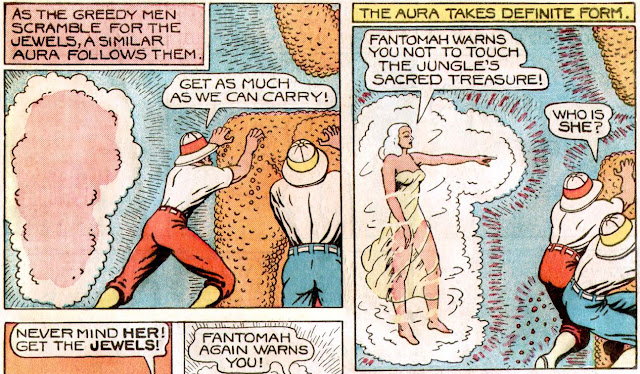
    I won’t spend too much time attempting to write the definitive Fantomah biography a) because many people have already written a lot about her and what can I add and b) because there isn’t really too much to write about. Like Stardust the Super Wizard she is just this omnipotent, all-seeing justice force who unleashes variably-proportional retribution on various Chaotic Evil criminals, only Fantomah confines her activities to either a jungle or all jungles – it’s hard to tell if Hanks was depicting different cultures and areas on purpose or just didn’t care about, eg, whether tigers lived in Africa or not.

    Fantomah continues after Fletcher Hanks stops making comics, so watch out for her wild new look when we cover the 1941 issues of Jungle Comics! (Jungle Comics 002, 1940)

    Update 1941

  • MINOR SUPER-HERO ROUND-UP 025

    Just a great bunch of guys.

    David:

    I read the Samson stories in Big 3 before those in his home comic Fantastic, so while I knew about his sidekick David I didn’t really know what his whole deal was. I had read that Samson just found him sitting around somewhere and assumed that that was hyperbole but no, it’s not: Samson is investigating some mysterious plane crashes in the Rockies when he just finds a kid, who turns out to be the only survivor of the latest crash, and just… brings him along. There’s no real attempt to address the fact that he must be an orphan now (or if not and he was travelling alone for some reason, that his family now thinks he is dead) or to find him a familial guardian – heck, his name isn’t even David. It’s low-key one of the weirdest sidekick origins in comics and that’s before he gets his own pair of fur briefs. (Fantastic Comics 010, 1940)

    UPDATES: Even in the updated Samson origin, David is still a hanger-on (Samson 001, 1940)

    UPDATE – the Fantom of the Fair:

    The Fantom of the Fair gets his own short-lived book that sees him spending more and more time fighting crime outside the New York World’s Fair, if you can believe it. To that end he adopts the more generic name of the Fantoman. The costume changes (blue instead of black, uncovered lower face) happened at the end of 1939 and technically I’ve read more Fantom stories in which he had the new one than the old but it never feels right to me. At least you can still see his hair through the cowl.

    Though he has a new name and a not-so-new look, Fantoman retains one of his most iconic properties: every time you start thinking of him as just another masked adventurer he busts out another heretofore-unseen superpower or bit of lore suggesting he is a thousand year old demigod or something. See above as he either teleports or passes through matter for the first and last time. (Fantoman 003, 1940)

    the Spy Fighter:

    It kind of says something about the mood of America in 1940 that there are multiple comic book series that take place in the 1990s after what we know as World War II has stretched on for fifty years (Marvel’s Breeze Barton is the other one that I can recall off the top of my head, while MLJ’s Doc Strong is from a future ravaged by a whole century of WWII). In this version of that, the war has resulted in an amalgamation of the world into three rival nations: Russmany (Europe and Africa), Mongo (Asia) and Greater America (the Americas), and in this world of super nations, a super spy is required to ensure the sanctity of the Greater American way of life.

    That man is Saber, the Spy Fighter! Who does eventually put on a shirt. Saber starts out as physically gifted telepath who roots out enemy agents by reading their ill intent in their own minds and then beats them up for it. Over time, the challenges he faces get larger and less specifically espionage related, and he develops new abilities to meet them, including that of changing his own size at will, to the point that he is eventually able to travel through space on his own power to fight planet-sized enemies. And what can Mongo do to challenge that? (Fight Comics 001, 1940)

    Update 1941

    the Skull Squadron:

    Chip Collins’ Skull Squadron is extremely unremarkable but at this point I have to make note of every skull-adjacent comic book thing. They operate somewhere in between a commando group and the Suicide Squad and barely even have skulls painted on their planes. SKULL SCORE: 1/2 and only for the name. (Fight Comics 001, 1940)