The Curse of Skeleton Munroe

Category: costumes

  • MINOR SUPER-VILLAIN 615: SANGLOR

    MINOR SUPER-VILLAIN 615: SANGLOR

    (Fantastic Comics 007, 1940)

    Sanglor starts out strong. He immediately charms me with his aesthetic sense: his ‘Automatic Subplane’ spy drones are delightful, his ‘Flying Castle’ is simultaneously one of the most ridiculous and great-looking mobile bases I have ever seen and his costume manages to evoke the dress sense of a 1940s comic book movie villain in a way I have not seen since the Vampire, almost exactly 300 entries ago.

    He manages to mess things up almost immediately, of course. His plan is to take over the world by hypnotizing key politicians and diplomats etc., and then presumably induce them to shift the reins of political power his way. This is the kind of scheme that requires some degree of care to set up – you have to get all of your assets in place without causing undue suspicion, so having them for example act all weird and then disappear is problematic. People are noticing your plan, Sanglor.

    This is the first evidence of what I will call Sanglor Self-Sabotages. This one seems to stem from the fact that Sanglor works completely solo, without even a weird little lab assistant to test his hypnotic ray on to see if it makes people freak out in noticeable ways before using it in a sensitive espionage operation.

    The big upshot of this Sanglor Self-Sabotage is that Samson is on the case basically the instant that the scheme is put in motion

    The second Sanglor Self-Sabotage is an extension of the first: he has no real defenses. Once Samson makes his way to the Flying Castle his only real opposition is a crowd of tuxedo-clad diplomats flailing away with their soft fists.

    Sanglor does think to call out his drone army to deal with the intruder but they don’t seem to even be armed, despite their little gun barrels – they just fly at Samson until he smashes them all.

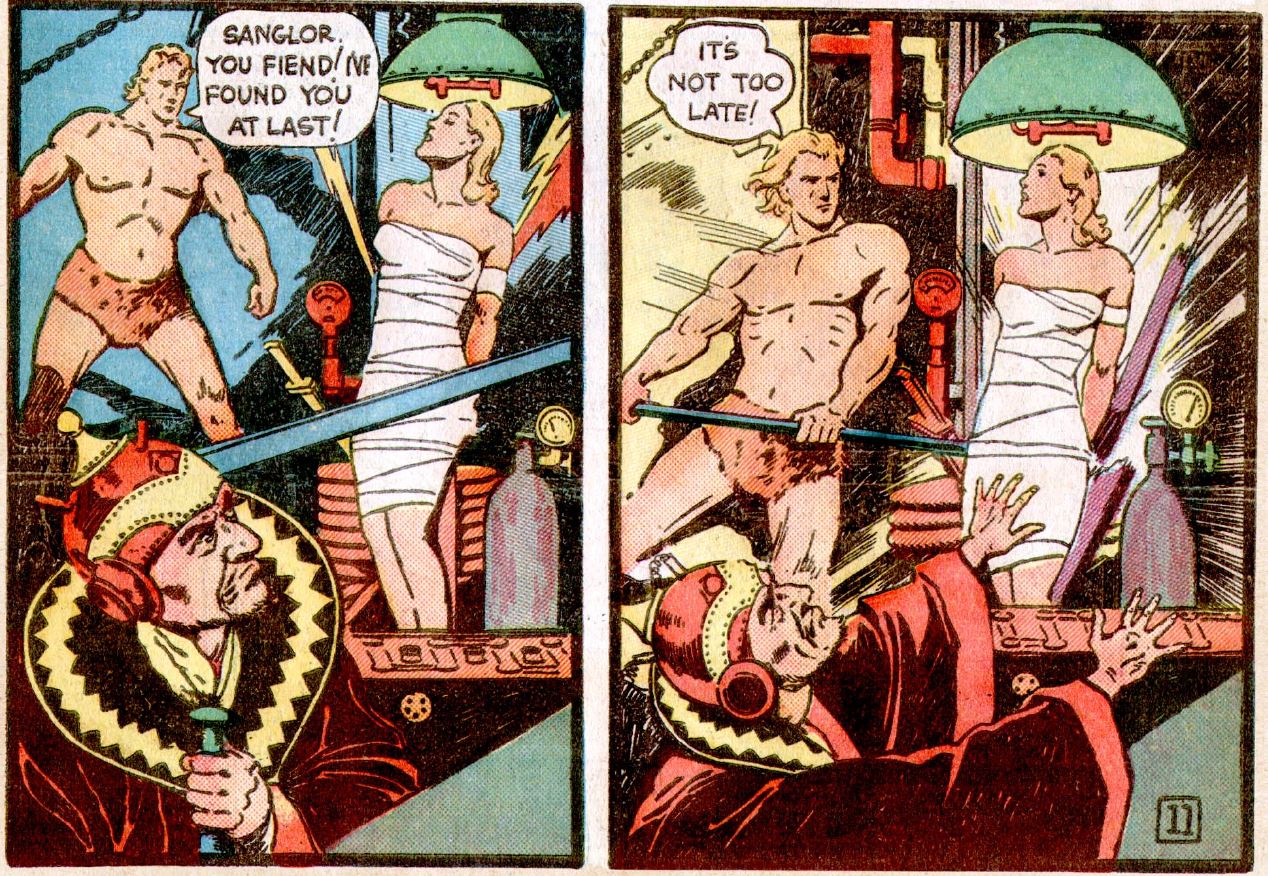
    The really big final Sanglor Self-Sabotage is revealed once Samson bursts into his inner sanctum: Sanglor is too busy being a weird creep to actively manage the defense of his headquarters. It’s not exactly clear what he’s doing with this young woman or who she is (it’s unlikely to be Miss Royce, a politician’s daughter in England and the only named female character in the story) but it’s real creep shit and it’s an unnecessary distraction from the approaching vigilante.

    Sanglor is probably still distracted as he flees through an industrial section of his base, because he can’t even run correctly – he manages to heave himself off what looks to be a pretty solid catwalk into the first available cauldron of boiling chemicals.

    I think that ultimately Sanglor serves as an object example of the need for villains to do a couple of trial runs before attempting world domination. If he’d attempted to take over a county or a small business first, maybe some of these kinks would’ve been worked out.

  • MINOR SUPER-VILLAIN 615: SANGLOR

    (Fantastic Comics 007, 1940)

    Sanglor starts out strong. He immediately charms me with his aesthetic sense: his ‘Automatic Subplane’ spy drones are delightful, his ‘Flying Castle’ is simultaneously one of the most ridiculous and great-looking mobile bases I have ever seen and his costume manages to evoke the dress sense of a 1940s comic book movie villain in a way I have not seen since the Vampire, almost exactly 300 entries ago.

    He manages to mess things up almost immediately, of course. His plan is to take over the world by hypnotizing key politicians and diplomats etc., and then presumably induce them to shift the reins of political power his way. This is the kind of scheme that requires some degree of care to set up – you have to get all of your assets in place without causing undue suspicion, so having them for example act all weird and then disappear is problematic. People are noticing your plan, Sanglor.

    This is the first evidence of what I will call Sanglor Self-Sabotages. This one seems to stem from the fact that Sanglor works completely solo, without even a weird little lab assistant to test his hypnotic ray on to see if it makes people freak out in noticeable ways before using it in a sensitive espionage operation.

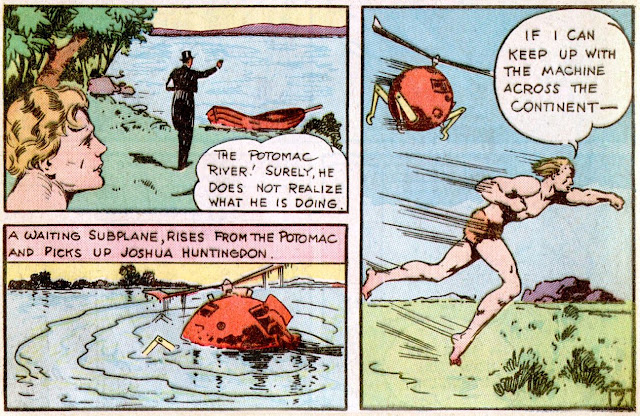
    The big upshot of this Sanglor Self-Sabotage is that Samson is on the case basically the instant that the scheme is put in motion

    The second Sanglor Self-Sabotage is an extension of the first: he has no real defenses. Once Samson makes his way to the Flying Castle his only real opposition is a crowd of tuxedo-clad diplomats flailing away with their soft fists.

    Sanglor does think to call out his drone army to deal with the intruder but they don’t seem to even be armed, despite their little gun barrels – they just fly at Samson until he smashes them all.

    The really big final Sanglor Self-Sabotage is revealed once Samson bursts into his inner sanctum: Sanglor is too busy being a weird creep to actively manage the defense of his headquarters. It’s not exactly clear what he’s doing with this young woman or who she is (it’s unlikely to be Miss Royce, a politician’s daughter in England and the only named female character in the story) but it’s real creep shit and it’s an unnecessary distraction from the approaching vigilante.

    Sanglor is probably still distracted as he flees through an industrial section of his base, because he can’t even run correctly – he manages to heave himself off what looks to be a pretty solid catwalk into the first available cauldron of boiling chemicals.

    I think that ultimately Sanglor serves as an object example of the need for villains to do a couple of trial runs before attempting world domination. If he’d attempted to take over a county or a small business first, maybe some of these kinks would’ve been worked out.

  • MINOR SUPER-VILLAIN 593: THE INVINCIBLE FIVE

    (Exciting Comics 006, 1940)

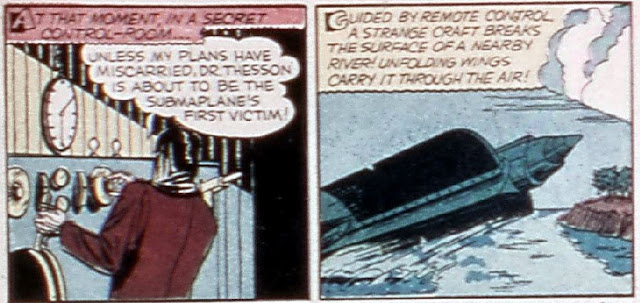
    The Invincible Five (good name!) are a mysterious group of hooded men who have been kidnapping skilled mechanics across the US in order to construct a fleet of vehicles known as Submaplanes.

    If you guessed that a Submaplane was either a submarine capable of flight or and airplane capable of operating underwater then give yourself a pat on the back because it is the former. Submaplanes also have some sort of electric forcefield, an electric ray cannon and appear to be remote controlled from a central location.

    Having seemingly done away with John “Son of the Gods” Thesson, whom they view as their only credible opposition, the Invincible Five proceed with their master plan: world conquest through intimidation and mass destruction. Various governments are given the opportunity to surrender peacefully then given the business when they refuse.

    (side note: these are some good hoods on the Invincible Five. The simple faces sketched on the front are a nice change from all of those regular-style hoods we usually see)

    Unsurprisingly, the leader of the Invincible Five is Burton, the sour-faced industrialist who turns up to advise FDR to surrender. Presumably at least some of his companions are also in on the scheme.

    It turns out that it was a good idea to try to kill John Thesson, because he ends up single-handedly taking down the entire operation by the simple expedient of punching people and things until the Submaplanes are grounded and the Invincible Five are in hand. Remember: if the only thing that stands between you and complete world domination is one person and you’re pretty sure that they’re dead: double check.

  • MINOR SUPER-VILLAIN 557: DEATH

    (Wonderworld Comics 003, 1939)

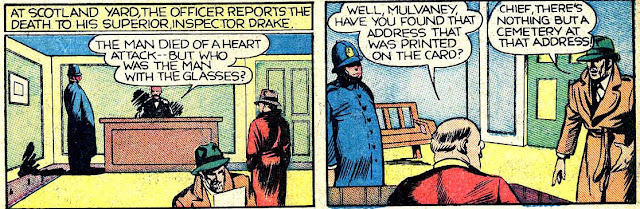
    Like I said in the Devil’s entry yesterday: Death and the Devil have teamed up as a sort of Yarko the Great Revenge Squad because Yarko saves so many live and souls, respectively. I also mentioned that Death did all of the legwork toward getting Yarko just where they wanted him, and here that is: Death kills a seemingly random London man then delivers him to the police, leaving only a calling card behind.

    The discovery that the calling card’s address was that of a cemetery is enough to convince Inspector Drake of Scotland Yard that this is a case for Yarko the Great, and… obviously Drake is right because even the most well-trained officer is going to have a hard time dealing with Death himself, but have some gumption, man. Try to track down where the card was printed or something before abdicating all responsibility.

    Yarko makes his way to Death and the Devil’s Limehouse lair, where he is promptly captured, put in a deathtrap, escapes and banishes the Devil back to the netherworld. Death takes more of a background role in this latter part of the adventure, but that’s okay because he looks great – mostly quite cool but a bit sleazy too, because this ain’t your regular Death, this is Bad Boy Death.

    In the end, the Devil having been vanquished, Death just leaves. Yarko can’t actually affect him, and there’s even some hinting that the man in the car was not killed so much as dies naturally and was just used as bait, which implies that Death has no way of affecting someone who isn’t about to die anyway. He does kill a reluctant henchman who refuses to go up against Yarko, but maybe he was about to die too – working for the Devil has to be a dangerous profession, right?

    Death returns in Wonderworld Comics 008 after a Madame Punjai finds the creatively-named Golden Amulet, which compels his service. Punjai is obsessed with her lost youth and beauty and because of this commands Death to kill the young and beautiful Carla Dennis, a former passing acquaintance. This is done seemingly on a whim? There’s no real exploration of Madame Punjai’s plans, whether toward regaining her lost youth or revenging herself on the beautiful women of the world.

    Yarko the Great of course becomes involved in these shenanigans and the more-hapless-than-evil Madame Punjai is tricked into trading her life for that of Carla’s. Death is again cheesed off about this. BUT WHY IS HE? He’s going to get basically everyone eventually, even in a comic book world with immortals and so forth. Why care? Is this a Discworld style Death who gets into human roles like hobbies? Maybe.

  • MINOR SUPER-VILLAIN 557: DEATH

    (Wonderworld Comics 003, 1939)

    Like I said in the Devil’s entry yesterday: Death and the Devil have teamed up as a sort of Yarko the Great Revenge Squad because Yarko saves so many live and souls, respectively. I also mentioned that Death did all of the legwork toward getting Yarko just where they wanted him, and here that is: Death kills a seemingly random London man then delivers him to the police, leaving only a calling card behind.

    The discovery that the calling card’s address was that of a cemetery is enough to convince Inspector Drake of Scotland Yard that this is a case for Yarko the Great, and… obviously Drake is right because even the most well-trained officer is going to have a hard time dealing with Death himself, but have some gumption, man. Try to track down where the card was printed or something before abdicating all responsibility.

    Yarko makes his way to Death and the Devil’s Limehouse lair, where he is promptly captured, put in a deathtrap, escapes and banishes the Devil back to the netherworld. Death takes more of a background role in this latter part of the adventure, but that’s okay because he looks great – mostly quite cool but a bit sleazy too, because this ain’t your regular Death, this is Bad Boy Death.

    In the end, the Devil having been vanquished, Death just leaves. Yarko can’t actually affect him, and there’s even some hinting that the man in the car was not killed so much as dies naturally and was just used as bait, which implies that Death has no way of affecting someone who isn’t about to die anyway. He does kill a reluctant henchman who refuses to go up against Yarko, but maybe he was about to die too – working for the Devil has to be a dangerous profession, right?

    Death returns in Wonderworld Comics 008 after a Madame Punjai finds the creatively-named Golden Amulet, which compels his service. Punjai is obsessed with her lost youth and beauty and because of this commands Death to kill the young and beautiful Carla Dennis, a former passing acquaintance. This is done seemingly on a whim? There’s no real exploration of Madame Punjai’s plans, whether toward regaining her lost youth or revenging herself on the beautiful women of the world.

    Yarko the Great of course becomes involved in these shenanigans and the more-hapless-than-evil Madame Punjai is tricked into trading her life for that of Carla’s. Death is again cheesed off about this. BUT WHY IS HE? He’s going to get basically everyone eventually, even in a comic book world with immortals and so forth. Why care? Is this a Discworld style Death who gets into human roles like hobbies? Maybe.

  • MINOR SUPER-VILLAIN 554: THE MASK

    (Wonder Comics 001, 1939)

    A gun runner doing business with rebel forces in the probably-South American country of Mauchako, the Mask doesn’t bring a lot to the table beyond a fairly snazzy take on the low-effort costume. He’s also the first foe faced by super-spy K-51 (is his original callsign of K-5, as you may have noticed). He’s also a US Senator, which is a heckuva job to split your attention from – also, weirdly he’s not our first one. He ends up employing K-51’s childhood pal and then murdering said pal so it’s not too surprising that he himself does not survive the adventure.

    In conclusion, the Mask isn’t terribly exciting. He does have a good look, so that’s something.

  • MINOR SUPER-VILLAIN 554: THE MASK

    (Wonder Comics 001, 1939)

    A gun runner doing business with rebel forces in the probably-South American country of Mauchako, the Mask doesn’t bring a lot to the table beyond a fairly snazzy take on the low-effort costume. He’s also the first foe faced by super-spy K-51 (is his original callsign of K-5, as you may have noticed). He’s also a US Senator, which is a heckuva job to split your attention from – also, weirdly he’s not our first one. He ends up employing K-51’s childhood pal and then murdering said pal so it’s not too surprising that he himself does not survive the adventure.

    In conclusion, the Mask isn’t terribly exciting. He does have a good look, so that’s something.

  • MINOR SUPER-VILLAIN 549: THE GREEN LIZARD

    (Smash Comics 004, 1939)

    The Green Lizard is a Floridian crook who specializes in extorting wealthy men and then kidnapping them when they fail to pay. This is the sort of thing I’ve spoken of before and will again: it absolutely makes sense to adopt a colourful identity like this if you’re a criminal in a super-hero universe, even in the not-exactly-a-rich-and-interconnected-tapestry Quality universe of 1939, with stories of the Clock or Bozo the Iron Man trickling out of New York. Heck, maybe it makes more sense in such a case: the costumed crook is a thing of the crime-ridden metropoli and suddenly it’s here, in our swamp-adjacent gated community! I’m surprised that those millionaires didn’t pay up immediately.

    The Green Lizard of course doesn’t reckon with the fact that the more millionaires he targets, the more likely a super-hero is to show up. And indeed John Blaine, his latest target, is pals with Kent “the Invisible Hood” Thurston!

    Please note also that the Green Lizard signs his note with a little lizard drawing.

    It’s been a while so I don’t recall if this is a recurring theme in Invisible Hood stories but the Green Lizard’s henchmen experience some real cosmic horror at the idea of an invisible man that is easy to mock but on reflection quite relatable. I would probably freak out too!

    I appreciate the simplicity of the Green Lizard’s costume but must say that his mask while fine aesthetically looks absolutely miserable to wear. Like, it’s either got to be held down so firmly that it’s crushing his nose or so loosely that it flaps around every time he speaks. 

    The Invisible Hood disposes of the Green Lizard with little trouble despite the horrible mud floors in his swamp lair showing off the Hood’s location via his footprints. The millionaires are saved! The henchmen all get blowed up with the HQ!

    But who was the Green Lizard? Would you be surprised to learn that it was John Blaine’s green-suited butler from before? Neither was I! Though looking again it does appear to be two different green suits and I would call that a… questionable affectation for an incognito super-villain with the word “Green” in his name to have.

  • MINOR SUPER-VILLAIN 529: RATZER

    (Blue Ribbon Comics 018, 1941)

    Ratzer is a Nazi agent who tangles with American-serving-in-the British-Army Corporal Collins a couple of times. There’s not a lot to say about him, honestly: the first time he meets Collins he’s trying to spring a load of Nazi prisoners and destroy a lot of British gun cotton in then-Bombay, while the second time he’s stealing oil in Iraq. He is not notably villainous, particularly in the ranks of Nazi super-villains.

    He does, however, have a certain style, so I’ll speak on that. Starting with his plane! I really like the question mark! Custom planes are absolutely the on the list of things that make aviator characters at least a bit interesting.

    I wouldn’t call Ratzer’s costume one of the greatest of all time but it does have some flair, particularly with the little scarf dangling off the top of his head. And as a bonus it doesn’t have any swastikas on it, which I appreciate a lot more than I did before I started posting pictures of super-villains online regularly.

    Ratzer’s second appearance doesn’t really involve flying and so he’s dressed in what I guess is his Desert Combat Costume – perhaps he has a whole closet full of slight variations on the theme, like a 1990s action figure line. Look out for Ocean Exploration Ratzer!

    In any case, I like this costume best – he looks a bit like a pro wrestler.

    At the end of his second appearance Ratzer gets away again and just… never returns. This is probably down to the end of Blue Ribbon Comics when Corporal Collins moved over to being a supporting character to MLJ’s other military hero Sergeant Boyle. No room for the secondary characters to have their own villains, after all.

  • MINOR SUPER-VILLAIN 529: RATZER

    (Blue Ribbon Comics 018, 1941)

    Ratzer is a Nazi agent who tangles with American-serving-in-the British-Army Corporal Collins a couple of times. There’s not a lot to say about him, honestly: the first time he meets Collins he’s trying to spring a load of Nazi prisoners and destroy a lot of British gun cotton in then-Bombay, while the second time he’s stealing oil in Iraq. He is not notably villainous, particularly in the ranks of Nazi super-villains.

    He does, however, have a certain style, so I’ll speak on that. Starting with his plane! I really like the question mark! Custom planes are absolutely the on the list of things that make aviator characters at least a bit interesting.

    I wouldn’t call Ratzer’s costume one of the greatest of all time but it does have some flair, particularly with the little scarf dangling off the top of his head. And as a bonus it doesn’t have any swastikas on it, which I appreciate a lot more than I did before I started posting pictures of super-villains online regularly.

    Ratzer’s second appearance doesn’t really involve flying and so he’s dressed in what I guess is his Desert Combat Costume – perhaps he has a whole closet full of slight variations on the theme, like a 1990s action figure line. Look out for Ocean Exploration Ratzer!

    In any case, I like this costume best – he looks a bit like a pro wrestler.

    At the end of his second appearance Ratzer gets away again and just… never returns. This is probably down to the end of Blue Ribbon Comics when Corporal Collins moved over to being a supporting character to MLJ’s other military hero Sergeant Boyle. No room for the secondary characters to have their own villains, after all.