The Curse of Skeleton Munroe

Category: costumes

  • MINOR SUPER-HERO ROUND-UP 010

    MINOR SUPER-HERO ROUND-UP 010

    MORE MLJ ACTION

    Doc Strong:

    Doc Strong is a famous scientist living in the year 2041, in a world where WWII dragged on for an entire century and a new Mongol Horde has swept in and conquered the battered remnants of civilization. The strangely Doc Savage-like Doc Strong gathers a group of like-minded scientists and starts a new civilization called the Isle of Right from which to strike back at the invaders with such inventions as a ray gun that solidifies shadows. (Blue Ribbon Comics 004, 1940)

    the Fox:

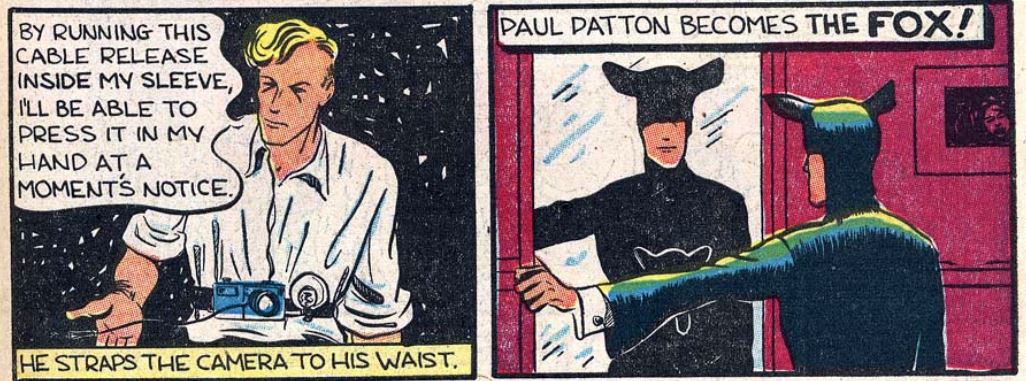
    Paul Patton, photographer for the Daily Globe, gets the tar beaten out of him by some fellows called the Night Riders and comes up with a plan:

    That’s right, he’s about halfway between Spider-Man and Batman. Okay, he’s mostly Batman but his wearable camera scheme anticipates Perter Parker’s epic work hack by about twenty years. The Fox’s first attempt at a costume is a bit rough, but eventually…

    … he adopts one of the top costumes of the Golden Age! His adventures may be a bit regular but he looks great doing it.

    BONUS FOX FACT: his “bat flies through the window” moment comes when he hears a song on the radio. (Blue Ribbon Comics 004, 1940)

    the Green Falcon: 

    The Green Falcon feature is essentially a Robin Hood Elseworlds story in which Robin is a knight instead of a forest outlaw and his pals Tiny Tuck and Jolly Roundfellow kind of encapsulate a few Merry Men each. Prince John is still there, and Maid Marion, but there are more swordfights than arrow tricks. Hey, I never said it was a particularly compelling Elseworlds story. It is more high concept than you usually get in a Golden Age comic, though. (Blue Ribbon Comics 004-015, 1940-1941)

    Ty-Gor:

    Ty-Gor is MLJ’s answer to Mowgli: a British child orphaned in the jungles of Malaysia and raised by tigers. Ty-Gor is a shortened form of his birth name, Tyrone Gorman, which he learns thanks to an absurd series of events pictured above.

    I don’t usually have a lot of time for jungle adventures but Ty-Gor does have a pretty fun twist in that after a half dozen issues he is brought to New York by explorer Dr Davis and his daughter Joan and Does Not Adapt. He’s just a wild kid who knows about five word maximum thrust into the public school system and causing havoc. It’s fun! (Blue Ribbon Comics 004, 1940)

    BONUS TY-GOR AS A BABY EATING GRAPES

  • MINOR SUPER-VILLAIN 520: THE HIGH PRIEST OF THOR

    (Blue Bolt v2 006, 1941) 

    We open on an aircraft factory. Suddenly, a strange vibration fills the air. After an initial moment of surprise, the workers all file out the door and into a cave in a nearby hillside. Inside?

    THIS MAN!

    This man is the self-proclaimed High Priest of Thor and before we get into what he’s up to I’d like to commend his commitment to the costume. Your average religious-type villain is not going to these lengths to look ceremonial and in fact are more likely to be in the Robe and Cloth Mask club. I particularly like the helmet, which looks like it must be obstructing his vision and crushing his nose at the same time but which manages to combine wings and horns in a single Platonic Fake Viking Helmet. Also note the mustache, which flies off the first time he is punched and just reaffirms his commitment to the bit.

    Of course the High Priest of Thor ends up being some sort of pseudo-Nazi spy looking to sabotage the US defense program. It’s never explicitly laid out but his vibration machine seems to put its subjects into a mentally receptive hypnotic state and the Thor stuff is all a way of getting them to do what he wants: if Thor is real and they are fanatical Thor cultists like this guy says then why not blow up an airplane factory? Too bad for the High Priest of Thor that the Twister had to show up and ruin things but at least he got to look cool with a tommy gun before it was all over.

    Bonus: this Thor explainer written by someone who did not have the gumption to look up anything about Thor.

  • MINOR SUPER-HERO ROUND-UP 008

    MINOR SUPER-HERO ROUND-UP 008

    Some real highs and lows in this one.

    the Twister: 

    The Twister is a quite minor Golden Age super-hero – he managed more than one appearance but not more than seven – who has the distinction of having one of the most well-designed costumes of the era. Not my favourite costume, mind you, but boy oh boy, you can really tell that his creators (Ray Gill and Paul Gustavson as it happens) really sat down for a good think about how to evoke “tornado” via the medium of clothing.

    The Twister turns out to be Bob Sanders, and he turns out to be a descendant of perennial fave Greek hero Odysseus. It turns out that the story of Aeolus gifting Odysseus two bags of wind and his men opening the bag of storm winds thinking that it was full of treasure was more than just another delay in Odysseus’ Bad Voyage, it was akin to the opening of Pandora’s Box and Aeolus had charged Odysseus or his descendants to round up all of the evil violent winds and return the to captivity. 

    Evidently over the years the charge to gather up evil winds has expanded to fighting all evil, and the Twister’s power set allows him to run roughshod over just about anyone using wind control, a tornado form and invulnerability to anything that couldn’t harm actual wind. There is some attempt to establish that he is vulnerable to being locked up somewhere with no airflow but that proves even easier to defeat than all the times that Silver Age Aquaman is locked up and forced to source water from unexpected places.

    The Twister’s other claim to fame is that he was introduced as a mysterious tornado that appeared in the Blue Bolt, Sub-Zero and Dick Cole stories in the issue he first appears in, which is enough to be counted as a rare Golden Age crossover even though none of them shared words. (Blue Bolt v2 001, 1941)

    Freezum:

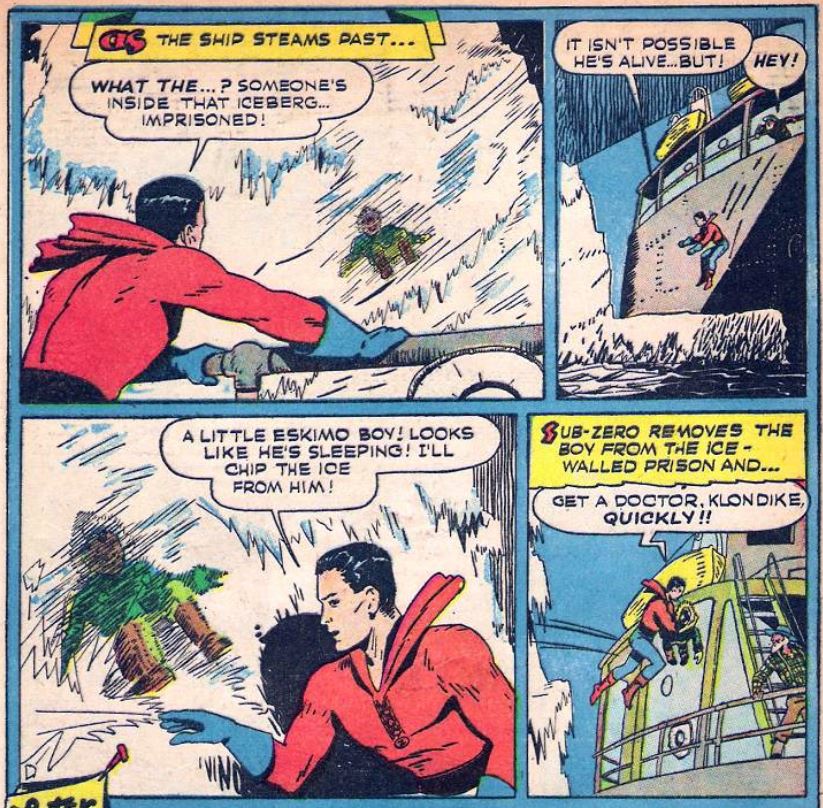
    On an adventure that takes him to Alaska, Sub-Zero happens upon a little Inuit or Aleut boy frozen in a glacier.

    Thawing the kid out and finding him to miraculously be alive, Sub-Zero (as well as an unfortunate doctor) is further astounded to discover that they share the same sort of cold-based powers due to their similar near-death freezing experiences. The kid names himself Freezum, and that’s just the first salvo of a barrage of tired comic relief sidekick shenanigans. Yes, we’ll be sighing and rolling our eyes for the remainder of Sub-Zero’s run – the joys of the Golden Age, friends! (Blue Bolt v2 005, 1941)

    Lois Blake:

    Lois Blake is a woman who Blue Bolt meets while attempting to take down a gang that was swindling immigrants using fake citizenship papers and decides to team up with. At some point when the gang is being particularly elusive he remembers that his pal Dr Bertoff down in the underground Kirby world has a viewscreen that can see virtually any location and so they head down there to use it. Bertoff then very helpfully offers to transfer some of Blue Bolt’s power to Lois and a new crimefighting team is born! (small aside: Golden Age comics don’t get a lot of praise for their art but I really enjoy both the small detail of Lois gripping Blue Bolt’s arm for comfort in the first panel above and her delighted expression in the third).

    Lois never gets a super-hero name and only really makes a handful of appearances before Blue Bolt ditches his costume and powers to become a regular if oddly-named soldier, but he’s such a nonentity post Simon and Kirby that I can’t help but love her for adding some life to the strip.(Blue Bolt v2 007, 1941)

    the Marvel:

    The Marvel is your classic mask-and-tuxedo vigilante, who specializes in showing up to bail reporter Scoop Cody out of the kind of jams you can get in when you’ve cracked a juicy crime story but not accounted for the possibility that the criminals involved might want to stop you from reporting on it.

    Three things about the Marvel: 

    1. The nose cutout never looks as cool as the full-face cowl does but I reckon it’s a heck of a lot more comfortable, so you have to give him some credit for choosing function over form.

    2. Scoop Cody and thus the Marvel only had two appearances and both of them had a teaser at the end promising that the Marvel’s identity would be revealed in the next issue. It’s always possible that they were planning on making the Marvel a completely new, never-before-seen guy but if they weren’t then literally the only suspect is this guy, Scoop Cody’s crusty old unnamed editor.

    3. Love a super-hero calling card, even in the rare cases when it’s a literal calling card.

    Also here is the Marvel’s second appearance in its entirety. (Blue Ribbon Coimcs 002, 1939)

  • MINOR SUPER-HERO ROUND-UP 008

    MINOR SUPER-HERO ROUND-UP 008

    Some real highs and lows in this one.

    the Twister: 

    The Twister is a quite minor Golden Age super-hero – he managed more than one appearance but not more than seven – who has the distinction of having one of the most well-designed costumes of the era. Not my favourite costume, mind you, but boy oh boy, you can really tell that his creators (Ray Gill and Paul Gustavson as it happens) really sat down for a good think about how to evoke “tornado” via the medium of clothing.

    The Twister turns out to be Bob Sanders, and he turns out to be a descendant of perennial fave Greek hero Odysseus. It turns out that the story of Aeolus gifting Odysseus two bags of wind and his men opening the bag of storm winds thinking that it was full of treasure was more than just another delay in Odysseus’ Bad Voyage, it was akin to the opening of Pandora’s Box and Aeolus had charged Odysseus or his descendants to round up all of the evil violent winds and return the to captivity. 

    Evidently over the years the charge to gather up evil winds has expanded to fighting all evil, and the Twister’s power set allows him to run roughshod over just about anyone using wind control, a tornado form and invulnerability to anything that couldn’t harm actual wind. There is some attempt to establish that he is vulnerable to being locked up somewhere with no airflow but that proves even easier to defeat than all the times that Silver Age Aquaman is locked up and forced to source water from unexpected places.

    The Twister’s other claim to fame is that he was introduced as a mysterious tornado that appeared in the Blue Bolt, Sub-Zero and Dick Cole stories in the issue he first appears in, which is enough to be counted as a rare Golden Age crossover even though none of them shared words. (Blue Bolt v2 001, 1941)

    Freezum:

    On an adventure that takes him to Alaska, Sub-Zero happens upon a little Inuit or Aleut boy frozen in a glacier.

    Thawing the kid out and finding him to miraculously be alive, Sub-Zero (as well as an unfortunate doctor) is further astounded to discover that they share the same sort of cold-based powers due to their similar near-death freezing experiences. The kid names himself Freezum, and that’s just the first salvo of a barrage of tired comic relief sidekick shenanigans. Yes, we’ll be sighing and rolling our eyes for the remainder of Sub-Zero’s run – the joys of the Golden Age, friends! (Blue Bolt v2 005, 1941)

    Lois Blake:

    Lois Blake is a woman who Blue Bolt meets while attempting to take down a gang that was swindling immigrants using fake citizenship papers and decides to team up with. At some point when the gang is being particularly elusive he remembers that his pal Dr Bertoff down in the underground Kirby world has a viewscreen that can see virtually any location and so they head down there to use it. Bertoff then very helpfully offers to transfer some of Blue Bolt’s power to Lois and a new crimefighting team is born! (small aside: Golden Age comics don’t get a lot of praise for their art but I really enjoy both the small detail of Lois gripping Blue Bolt’s arm for comfort in the first panel above and her delighted expression in the third).

    Lois never gets a super-hero name and only really makes a handful of appearances before Blue Bolt ditches his costume and powers to become a regular if oddly-named soldier, but he’s such a nonentity post Simon and Kirby that I can’t help but love her for adding some life to the strip.(Blue Bolt v2 007, 1941)

    the Marvel:

    The Marvel is your classic mask-and-tuxedo vigilante, who specializes in showing up to bail reporter Scoop Cody out of the kind of jams you can get in when you’ve cracked a juicy crime story but not accounted for the possibility that the criminals involved might want to stop you from reporting on it.

    Three things about the Marvel: 

    1. The nose cutout never looks as cool as the full-face cowl does but I reckon it’s a heck of a lot more comfortable, so you have to give him some credit for choosing function over form.

    2. Scoop Cody and thus the Marvel only had two appearances and both of them had a teaser at the end promising that the Marvel’s identity would be revealed in the next issue. It’s always possible that they were planning on making the Marvel a completely new, never-before-seen guy but if they weren’t then literally the only suspect is this guy, Scoop Cody’s crusty old unnamed editor.

    3. Love a super-hero calling card, even in the rare cases when it’s a literal calling card.

    Also here is the Marvel’s second appearance in its entirety. (Blue Ribbon Coimcs 002, 1939)

  • MINOR SUPER-VILLAIN 510: FARGALL

    (Blue Bolt v1 010, 1941)

    Fargall is a scientist-cum-criminal operating out of Centro, Sub-Zero’s chosen home (well, it hasn’t actually been identified as Centro for about 7 issues or so and I’m afraid that it’s slowly transmogrifying into NYC like all unnamed comic book cities but until I’m told otherwise it’s Centro to me) who has taken up the challenge of operating out of a super-hero town by inventing heat ray guns that effectively counter Sub-Zero’s whole deal.

    If that were all that Fargall had going on he’d be lumped in with all of the other one-trick scientists in the round-up but no, Fargall has something that they lack: Fargall has style.

    When Fargall’s scheme goes off he and his guys put on tuxedos and paint the town red. And unlike his underlings, Fargall keeps on wearing that tuxedo as they set out to rob the Legally Distinct from the New York World’s Fair. Because he has style.

    Heck, even the goggles that Fargall and his guys wear to protects their eyes from heat rays look good.

    At this point it would be quite narratively satisfying for Fargall to be undone by his sense of style in some way but since that’s just something I have built up in my head it wasn’t on Bill Everett’s mind when he plotted the whole thing out. Instead, Fargall falls victim to that most pervasive pattern of super-villain hubris: gloating and sadistically taking so long in finishing the hero off that they are able to escape and beat you up. It’s very common!

  • NOTES – APRIL 2024

    Nazi Superweapon:

    There’s nothing terribly special about this giant dirigible that the Phantom Sub encounters after it starts to fly as well as submerge, but I do appreciate a dirigible that can not only camouflage itself as a stormcloud but has a proper old-school lightning cannon mounted underneath. And is filled with hydrogen, nuch to its later detriment. (Blue Bolt v2 007, 1941)

    Honours:

    Corporal Collins, Infantryman earns the French Croix de Guerre. (Blue Ribbon Comics 002, 1939)

    Rang-a-Tang the Wonder Dog is made a full-fledged policeman in the NYPD (Blue Ribbon Comics 001, 1939)

    Assuming that this guy knows what he’s talking about, Rang-a-Tang the Wonder Dog probably gets the Congressional Medal (maybe of Honor, maybe another one) (Blue Ribbon Comics 004, 1940)

    Rang-a-Tang the WOnder Dog gets place of honour in a circus parade. (Blue Ribbon Comics 013, 1941)

    Place Names:

    Hercules travels to Missiansas, only our second fake state after the Whip’s “New Texirona” (Blue Ribbon Comics 005, 1940)

    Costumes:

    Speaking of Hercules, this version of Zeus from his adventures might just be the greatest outlier in general dress and design I have ever seen (Blue Ribbon Comics 005, 1940)

    Aliens:

    Really enjoy the vibe of these Martian invaders. Screw cold rationalist aliens; bring on the party aliens! (Blue Ribbon Comics 008, 1941)

    Cops Shoot:

    The police of whatever town Mr Justice lives in attempt to summarily execute him for fleeing a third degree interrogation about him supposedly being bribed by a fake medium. (Blue Ribbon Comics 012, 1941)

    And over in whatever town Captain Flag calls home the cops attempt to gun him down as he breaks jail to stop the Black Hand from carrying out the scheme that he is in jail for due to those same cops being credulous morons. (Blue Ribbon Comics 018, 1941)

  • NOTES – APRIL 2024

    Nazi Superweapon:

    There’s nothing terribly special about this giant dirigible that the Phantom Sub encounters after it starts to fly as well as submerge, but I do appreciate a dirigible that can not only camouflage itself as a stormcloud but has a proper old-school lightning cannon mounted underneath. And is filled with hydrogen, nuch to its later detriment. (Blue Bolt v2 007, 1941)

    Honours:

    Corporal Collins, Infantryman earns the French Croix de Guerre. (Blue Ribbon Comics 002, 1939)

    Rang-a-Tang the Wonder Dog is made a full-fledged policeman in the NYPD (Blue Ribbon Comics 001, 1939)

    Assuming that this guy knows what he’s talking about, Rang-a-Tang the Wonder Dog probably gets the Congressional Medal (maybe of Honor, maybe another one) (Blue Ribbon Comics 004, 1940)

    Rang-a-Tang the WOnder Dog gets place of honour in a circus parade. (Blue Ribbon Comics 013, 1941)

    Place Names:

    Hercules travels to Missiansas, only our second fake state after the Whip’s “New Texirona” (Blue Ribbon Comics 005, 1940)

    Costumes:

    Speaking of Hercules, this version of Zeus from his adventures might just be the greatest outlier in general dress and design I have ever seen (Blue Ribbon Comics 005, 1940)

    Aliens:

    Really enjoy the vibe of these Martian invaders. Screw cold rationalist aliens; bring on the party aliens! (Blue Ribbon Comics 008, 1941)

    Cops Shoot:

    The police of whatever town Mr Justice lives in attempt to summarily execute him for fleeing a third degree interrogation about him supposedly being bribed by a fake medium. (Blue Ribbon Comics 012, 1941)

    And over in whatever town Captain Flag calls home the cops attempt to gun him down as he breaks jail to stop the Black Hand from carrying out the scheme that he is in jail for due to those same cops being credulous morons. (Blue Ribbon Comics 018, 1941)

  • MINOR SUPER-VILLAIN 485: THE CONDOR

    (Big 3 005-006, 1941)

    As far as super-villains go, the Condor is a simple concept: the modern pirate. But the modern pirate is a classic character type! Murder on the high seas! Sneering braggadocio! Calling people swabs!

    And the Condor himself fits the role to a T. It doesn’t hurt that he’s such a well-designed character: who knew that a guy in a black suit would look so good as a pirate with the simple addition of a cape and tricorn hat? I couldn’t find a good picture of his face in profile but it is similarly well-designed, with a combination of intense eyes, beaklike nose and slight overbite really giving the predatory bird vibe.

    It’s not quite as on-theme, but the Condor’s plan to loot NYC York City is suitably villainous. Plus:

    … he has crooked politicians on his side! Including the mayor! (and here we must indulge in a brief aside: the Blue Beetle, like many super-heroes, operates out of a nonspecific urban landscape strongly influenced by New York City. It gets referred to as York City once or twice early on but for the most part goes nameless. But the thing is, it’s near a lot of places like Westchester and New Jersey that place it in the NYC neighbourhood, so I’ve been saying that it’s New York for a while now. Mayor Dorth here is just one too many anomalous mayors for me to ignore – I’m forced to conclude that the Blue Beetle operates out of a metropolis that may or may not be called York City and like Golden Age Gotham City essentially occupies the same geography as New York without being New York)

    And while many criminal mayors in comics are merely corrupt, Mayor Dorth is a proper wrongun – not only does he cover up the murder of Councilman Hals here by framing Joan Mason but he both helps set up the Condor’s raid on the city and attempts to betray him and make off with the loot himself. This of course only gets him killed but you have to appreciate the dynamism.

    The Condor is seemingly drowned by the Blue Beetle at the end of his first appearance but pops right back up again in the next issue to attack Dr Lane of the city museum. It’s a bit low-stakes after looting the entire city but the Condor still gives it his all.

    It’s all rather tawdry at the end: Dr Lane and the Condor have been smuggling uncut diamonds and Lane is for some reason attempting to double-cross a notably murderous pirate. There’s a lot of running around and attempted murder before the Condor is once again seemingly killed by the Blue Beetle, this time via a sock to the kisser that sends him into a ship’s boiler.

    Like Countess Belladonna before him, the Condor has all the hallmarks of a villain who would continue to return to plague the Blue Beetle if only Fox Features hadn’t had that unfortunate financial trouble and lost control of the character for a couple of years. Alas, he was forgotten during the Beetle’s time at Holyoke.

  • MINOR SUPER-VILLAIN 485: THE CONDOR

    (Big 3 005-006, 1941)

    As far as super-villains go, the Condor is a simple concept: the modern pirate. But the modern pirate is a classic character type! Murder on the high seas! Sneering braggadocio! Calling people swabs!

    And the Condor himself fits the role to a T. It doesn’t hurt that he’s such a well-designed character: who knew that a guy in a black suit would look so good as a pirate with the simple addition of a cape and tricorn hat? I couldn’t find a good picture of his face in profile but it is similarly well-designed, with a combination of intense eyes, beaklike nose and slight overbite really giving the predatory bird vibe.

    It’s not quite as on-theme, but the Condor’s plan to loot NYC York City is suitably villainous. Plus:

    … he has crooked politicians on his side! Including the mayor! (and here we must indulge in a brief aside: the Blue Beetle, like many super-heroes, operates out of a nonspecific urban landscape strongly influenced by New York City. It gets referred to as York City once or twice early on but for the most part goes nameless. But the thing is, it’s near a lot of places like Westchester and New Jersey that place it in the NYC neighbourhood, so I’ve been saying that it’s New York for a while now. Mayor Dorth here is just one too many anomalous mayors for me to ignore – I’m forced to conclude that the Blue Beetle operates out of a metropolis that may or may not be called York City and like Golden Age Gotham City essentially occupies the same geography as New York without being New York)

    And while many criminal mayors in comics are merely corrupt, Mayor Dorth is a proper wrongun – not only does he cover up the murder of Councilman Hals here by framing Joan Mason but he both helps set up the Condor’s raid on the city and attempts to betray him and make off with the loot himself. This of course only gets him killed but you have to appreciate the dynamism.

    The Condor is seemingly drowned by the Blue Beetle at the end of his first appearance but pops right back up again in the next issue to attack Dr Lane of the city museum. It’s a bit low-stakes after looting the entire city but the Condor still gives it his all.

    It’s all rather tawdry at the end: Dr Lane and the Condor have been smuggling uncut diamonds and Lane is for some reason attempting to double-cross a notably murderous pirate. There’s a lot of running around and attempted murder before the Condor is once again seemingly killed by the Blue Beetle, this time via a sock to the kisser that sends him into a ship’s boiler.

    Like Countess Belladonna before him, the Condor has all the hallmarks of a villain who would continue to return to plague the Blue Beetle if only Fox Features hadn’t had that unfortunate financial trouble and lost control of the character for a couple of years. Alas, he was forgotten during the Beetle’s time at Holyoke.

  • MINOR SUPER-HERO ROUND-UP 004

    the Lone Warrior (and Dicky): 

    The Lone Warrior and Dicky are Stan and Dicky Carter, son of the now-deceased “world’s greatest scientist” and recipients of his Power Elixir injections, leaving them generically physically enhanced and well-equipped to battle pseudo-Nazi forces seeking to wreck America’s military. Plus he made them a land/ air/ sea plane/tank called the Wonder Ship which is very useful.

    There is of course a knee-jerk impulse to snidely point out that a guy called the Lone Warrior is never seen without his sidekick, but… I think it’s on purpose? They don’t explore it well but I reckon that it’s meant to be a joke: big tough dude calls himself the Lone Warrior and can’t avoid being tailed everywhere by his little brother? It’s not a bad joke! Too bad they only had 4 or so appearances and never really explored it. (Banner Comics 003, 1941)

    Samson:

    Samson from the comics is, unsurprisingly, based off of Samson from the Bible. In fact, he’s a descendant of the Biblical Samson, which seems hard to prove. Like his supposed ancestor, Samson possesses superhuman strength as long as his hair remains uncut, which in his case means that he must maintain a sort of shoulder-length mullet. His hair of course frequently gets cut for dramatic effect but luckily for Samson his other super power is that it will grow back preternaturally fast and always into the same style, like Wolverine’s.

    At some point in a comic I have not yet read Samson finds and adopts a boy named David. David has no super-powers and is in constant peril. He also has a scientist pal named Professor Brun who acts as a sort of Samson dispatcher using advanced surveillance tech to find trouble and a teleporter with the fun nmae of the “demoleculing ray” to send Samson and David to the scene.

    Finally, Samson is a stone cold killer. He wipes out crooks by the dozen with a frankly concerning lack of care for the legal process. (Fantastic Comics 001, 1939)

    Late in 1941, Samson got a bit of sprucing up. I don’t know if this was a deliberate attempt on the part of Fox Features to rectify the formulaic nature of Samson comics or it was a simple case of a new artist/ writer shaking things up but suddenly Samson had a supporting cast beyond David: namely a gal pal with the incredibly on-the-nose name of Lila Dee and a comic relief artist named J. Rembrandt Speedball. 

    The best addition, however, was… not exactly a secret identity for Samson but an Incognito Mode in which he dressed in street clothes, but since he was an enormous, long-haired guy what this entails is his wearing a huge overcoat buttoned to the neck with the collar flipped up over his mullet. Truly great. Sadly, this revamped Samson only appeared in a handful of issues before Fox Features had the troubles that lead to them halting production for a few years. Like most of their characters, he was never seen again.

    UPDATES: He really is the descendant of the Biblical Samson (Samson 001, 1940)

    Update 1941 

    the Flame:

    Found by Tibetan lamas as a baby and taught their mystic secrets, the Flame has a lot of the standard flame powers – immunity to fire and heat (and explosions), control over flame, a high enough body temperature that bullets melt on contact with him – a few more unusual ones – the ability to walk and climb on sheets of flame as if they were solid, the weirdly common Golden Age super power of appearing suddenly in the element that they embody, in this case any size flame down to a match – and surprisingly no actual ability to produce flame. Instead, he carries a pistol-sized flamethrower (over time, the amount of heat and flame produced by his body does increase, but he’s never at Human Torch level). The Flame’s enemies of course frequently attempt to set fire to him.

    While I appreciate the Flame’s classic costume stylings, he is ultimately a pretty generic guy. Plus he’s at least as bloodthirsty as his fellow Fox Features alum Samson. (Wonderworld Comics 003, 1939)

    (the Flame also has a very cool car, as seen in Big 3 002, 1940)

    Like Samson, the Flame eventually gets a more fleshed out world just in time for Fox Features to go to heck for a few years and then fail to bring him back. In the Flame’s case he does adopt a secret identity: as Gary Preston, private investigator. He is joined by former boxer and general goofball Pug and future Flame Girl (watch for future round-ups, I guess) Linda Dale.

    Flame UPDATE 1

    Flame UPDATE 2 

    Flame UPDATE 3

    Flame UPDATE 4 

    Stardust the Super Wizard:

    Stardust the Super Wizard is an enormous, nigh-omnipotent fellow who lives in a star and deals out bizarre and ironic punishments to a cartoonishly evil rogues gallery with incredible ease – the only real obstacle that he faces in an average adventure is the travel time between him and his villains. The second-greatest creation of outsider comics artist Fletcher Hanks (after Fantomah, of course), Stardust is well-known enough that I don’t really need to go into much detail on him here but it seemed weird to leave him out. (Fantastic Comics 001, 1939)