The Curse of Skeleton Munroe

Category: costumes

  • MINOR SUPER-VILLAIN 421: THE RED-EYED KILLER

    (Jumbo Comics 020, 1940)

    What a cool-looking villain! Suit and cape combo? Blood-red eyes? Great stuff. He’s got a cool mask and a wavy dagger and he goes on an enormous spree killing in NYC while Our Hero Inspector Dayton tries to figure out just how he’s going to stop the Red-Eyed Killer.

    But they spend too much time in the setup! Dayton stumbles into a doctor’s office on the last page and the resolution happens in an instant – the Red-Eyed Killer is Dayton’s work pal, police scientist Doc Black and he gives up… pretty reasonably, I guess. Being pinned to a door by a half dozen of your own daggers will inspire compliance.

    So, the Red-Eyed Killer. Good but not great; a lesson in leaving enough room for the end of your story to have some stakes in it. Also: tell us how he get those red eyes!

  • MINOR SUPER-VILLAIN 373: THE JUNGLE SCIENTIST

    (More Fun Comics 063, 1941)

    I won’t lie to you: this initial panel really did all the work in guaranteeing the Jungle Scientist some time in the spotlight rather than a place in a mad science roundup with three other randos. There are exactly two reasons for that: 1) that he was supplied with a name in the very title of the piece and 2) that wretched little outfit that he has assembled for himself. This man was divorced just before he moved to the jungle.

    So after his divorce, the unnamed Jungle Scientist moved out into the middle of nowhere, assembled a terrific look and proceeded to create animate, carnivorous trees “by almost impossible grafting.” The next phase of his plan, that Congo Bill and his pal Professor Kent have shown up just in time to foil, is to implant the brain of his step-daughter into one of the trees. And yes, the step-daughter fits into the divorce narrative I am constructing – she could be the child of a recent (and not very picky) second wife, for example.

    It all ends as you might expect, with the scientist’s special protective perfume getting washed off just before he flees into a grove of man-eating trees. In a way though, isn’t death the ultimate divorce?

  • MINOR SUPER-VILLAIN 363: MR H

    (Master Comics 001 (behind the scenes) or Master Comics 007 (first mentioned) or Master Comics 008 (first appearance on-panel)-Master Comics 020, 1940-1941)
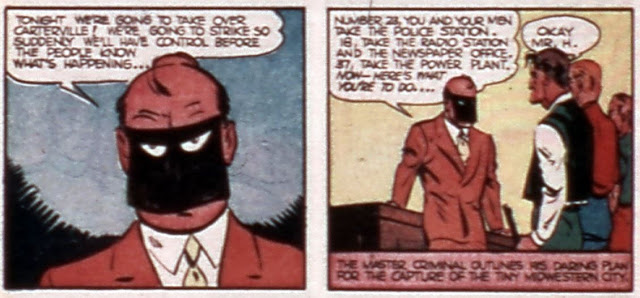
     

    Mr H, the mastermind behind all crime in the city of Carterville and its unnamed state, gets up to all kinds of schemes through his proxies. For example:

    -running an illegal casino in a hard-to-catch gambling blimp

    -robbing a munitions plant in order to outfit a small army of gangsters and enact a criminal takeover of Carterville

    -stealing an experimental bomber from the US Army and attempting to sell it to crypto-Nazis

    -having his gang murder random Carterville citizens in order to drive down confidence in the police

    -stealing an experimental paralysis gas in order to disable and rob the entire population of Carterville 

    -attempting to destroy all public transit in Carterville for unclear reasons

    -attempting to blow up the Carterville Dam for unclear reasons

    -sundry murders and robberies

    At first, Carterville’s major crime figure and the inspiration for regional super-hero the Devil’s Dagger is a guy by the name of Jeff Marlowe, but he falls off of a roof in Master Comics 007, necessitating the introduction of his boss, Mr H. Over the course of his 12-odd appearances Mr H has a variable amount of hair and a selection of different cloth masks. The consistent aspect of his adventures (aside from his orange suit) is his habit of getting away in some sort of motor vehicle at the last second.

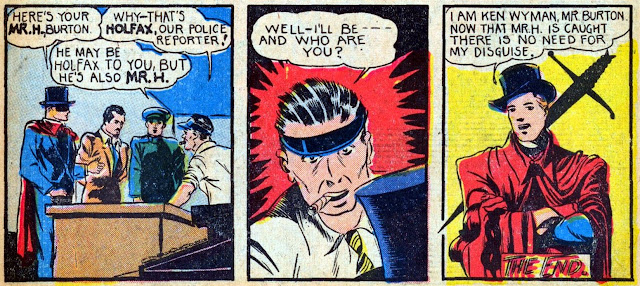
    Then, in Master Comics 018, Ken “Devil’s Dagger” Wyman gets a new coworker, police reporter Holfax. I won’t beat around the bush: Holfax is Mr H – introduced, I suspect, because the feature was coming to an end and they needed somebody to be the villain. The great thing about this is that Holfax/ Mr H thus becomes an evil equivalent to Wyman/ the Devil’s Dagger, something that I’m always excited to see.

    And the piece de resistance is of course the capture of Mr H and the subsequent retirement of the Devil’s Dagger in Master Comics 020, a rare ending not just for a Golden Age super-hero but for any super-hero ever.

    Mr H might not be terribly exciting in and of himself but I would still love to see a legacy Devil’s Dagger BRUNG BACK and who better to act as his foil than an ancient Holfax, out of prison and running Carterville once again.

    ADDENDUM: I almost forgot to highlight the fact that Mr H employs one of my favourite costume elements: the mask with attached bald cap.

    ADDENDUM II: I just read the long-unavailable Master Comics 006 and in it Mr H, through his proxy Jeff Marlowe, kidnaps the President of the United States for ransom. This is a very big crime not to have been aware of!

  • NOTES – OCTOBER 2023

    Ripped from the headlines:

    The acclimation of a new Dalai Lama must have been big headlines in 1941 because not only did Zoro the Mystery Man save him from being kidnapped for ransom… (Master Comics 014, 1941)

    … but over on Earth-Two, the Three Aces did the same! (Action Comics 032, 1941)

    Great Folk:

    Wizzar, Father of All Magic, teacher and mentor of El Carim, dead and returned as a spirit who appears “when some great crime against the dead remains unpunished” is that all-too-frequent thing in comics: a cosmic plot-hook-delivering entity used only once and never seen again (Master Comics 015, 1941) 

    Also, Wizzar sends El Carim to the planet Zaam to battle the tyrant Rashtala and basically everyone on Zaam has an amazing look:

    Just great.

    Grandfather Oyster, the big oyster that eats people when they try to get the little oysters, is a really terrific sea monster concept. Is this the only hostile oyster in comics history? Probably! (Master Comics 017, 1941)

    Memes of Yore: COWARD!

    Very unsympathetic crowd of Goat-People watching space hero Captain Venture fight a space dragon. (Master Comics 021, 1941)

    Nobody ever delivers a long monologue on why kicking people is an unmanly way to fight but there are a lot of expressions of distaste, like Spike of the Companions Three is uttering here. (Master Comics 021, 1941)

  • MINOR SUPER-HERO 035: THE HUMAN TOP

    (Red Raven 001, 1940)

    The Human Top is a guy who gets spinning powers after a science accident. The only really noteworthy things about him are that cool collar on his costume and the fact that he’s one of the very few Golden Age Marvel characters to have never had any sort of modern appearance. Spinning powers aren’t cool, I suppose.

    It’s kind of a shame that this is the first of only two appearance of the Human Top and the only one written by Dick Briefer – I really like the weird hyperbole and turns of phrase. Ah well, there’s always Frankenstein to look forward to.

  • MINOR SUPER-HERO 035: THE HUMAN TOP

    (Red Raven 001, 1940)

    The Human Top is a guy who gets spinning powers after a science accident. The only really noteworthy things about him are that cool collar on his costume and the fact that he’s one of the very few Golden Age Marvel characters to have never had any sort of modern appearance. Spinning powers aren’t cool, I suppose.

    It’s kind of a shame that this is the first of only two appearance of the Human Top and the only one written by Dick Briefer – I really like the weird hyperbole and turns of phrase. Ah well, there’s always Frankenstein to look forward to.

  • MINOR SUPER-VILLAIN 310: ZARPO

    (Captain America Comics 009, 1941)

    Zarpo is a classic example of why if you are a government or large business, etc,  you should have a process for vetting wild crackpot claims from scientists who come to your door. When a man says to you, for example, “my name is Zarpo and I have invented a bomb that blows up after spending a certain amount of time near a human being,” perhaps consider not calling him a crackpot and throuwing him out of your office. Because: what if he’s telling the truth? You just might get blowed up is what.

    Zarpo is himself blowed up in a confrontation with very minor scythe-throwing Marvel character Father Time, shown here sporting the rare nose-forward style of super-hero mask. Love that nose!

  • MINOR SUPER-VILLAIN 309: THE WHITE DEATH

    (Captain America Comics 009, 1941)

    Like the Black Witch before him, the White Death is inspired to murder by a kooky clause in a recently-deceased’s will, and it’s one I forgot to mention then: if any of the heirs dies before the money is divvied up then their portion is divided among the rest. This clause! More fictional bloodshed has resulted from it than can be counted.

    This time, the culprit is one of the heirs rather than the lawyer, but the lawyer is crooked as well. And yes, we are in the age of costume design where a KKK-adjacent look can be used without comment by anyone in the story.

  • MINOR SUPER-VILLAIN 236: THE SNOW-KING

    (Flash Comics v1 005, 1940)

    A simple concept, but an endearing one: the Snow-King is a famous spy who only works during the winter, hence the name. He’s possibly French (at least, he says “au revoir” a lot) and definitely cocky – he is so sure of success pulls the classic move of calling up the authorities to warn them of his next escapade.

    Eventually, crack government agent Cliff Cornwall is brought in on the case and works out just why the Snow-King is a cold-weather spy: he relies on the central heating units of the buildings he burgles to disperse sleeping gas throughout them. That solved, he is quickly caught.

    Love an arrogantly confident villain; love a suit accessorized with a cape; love the Snow-King. Should be BRUNG BACK as a legacy spy some day.