The Curse of Skeleton Munroe

Category: Fawcett Comics

  • DIVINE ROUND-UP 013

    Piping hot deities for you this mornining.

    Sivu the Tiger God: 

    The worshippers of Sivu the Tiger God come to New York City to recover the jewelled eyes of their great idol, which are known as the Death Ruby and the Doom Ruby and held in the New York Museum and the collection of Beverly van Pell, respectively. Detective Dan Dare gets involved when he is hired by Mrs van Pell and the rubies ultimately stay right where they are. A shame, but at least we get to see that six-armed, four-legged, chubby, tiger-headed representation of Sivu, right?

    God Style: Idol. (Whiz Comics 003b, 1940) 

    Zeus: 

    The MLJ Hercules is the first super-hero of that name to actually be the demi-god in question, and he accordingly has a couple of meetings with his dad Zeus to discuss the state of the fight for truth and justice back on Earth. What I mostly want to point out about this version of the King of Olympus is that he’s probably the most flamboyantly dressed Zeus in comics before Jack Kirby illustrates him in Thor. 

    God style: Real (Blue Ribbon Comics 005, 1940)

    Charon: 

    A pretty by-the-numbers version of Charon who doesn’t deserve to be bullied by Dr Fate just because he needs to cross the Styx. He didn’t even try a bribe first!

    God Style: Real (More Fun Comics 056, 1940) 

    Wisdom: 

    The reason that Dr Fate is visiting the underworld is to check on whether his enemy Wotan is in fact dead, and to that end he is consulting with “Wisdom, who rules the world,” which I can only assume is another entry in the long tradition (that started four issues earlier with the origin of the Spectre) of alluding to the Abrahamic (or let’s face it: Christian) god via a combination of vague wording, blinding light and dialogue from an unseen source.

    God Style: Real (More Fun Comics 056, 1940) 

    (annoyingly, I can’t figure out where the bit about the seven gates to the underworld is from. It feels familiar and I wanted to see if it was from a non-Greek, non-Christian source because then this trip would be incorporating three whole mythologies, but there is simply too much “Gates of Hell” talk online to find it easily) 

  • MINOR SUPER-HERO ROUND-UP 062

    We’re awash in minor super-heroes! 

    Golden Arrow: 

    Golden Arrow has a more convoluted origin than an Western hero has any right to, but I’ll do my best to summarize it without one million images. He is Roger Parsons, whose father, Professor Paul Parsons, develops advanced ballooning technology just before WWI breaks out and determines to test it out before donating it to the US government. To that end, he bundles his wife and infant son into a balloon and sets out on a cross-country voyage that turns out to have been a bit too well-publicized, because he is shot down by the villainous Brand Braddock while passing over the Western deserts. While Brand squirrels away Parsons’ technology until the day he can safely sell it on, the infant Roger is found by a prospector named Nugget Ned, who raises him as his own son.

    Life in the West suits Roger, and he grows up to be a physical paragon, a crack shot with the bow and arrow (with which he uses impractical but iconic golden-headed arrows, and yes, I do believe there is a story in which a crook goes around committing minor crimes in order to profit from gathering them up afterward) and a superb horseman on his faithful steed White Wind. Nugget Ned eventually dies of being Old, but passes on the truth of Roger’s parentage before he goes. Roger then takes back the ballooning technology from Brand (plus his twin sons Bronk and Brute) and donates it to the US Government. Along the way, he kind of falls into being a Western vigilante.

    Golden Arrow is also one of my classic examples of a character egregiously transitioning from the Modern to the Old West, since he is so firmly established as being in the present from the start. As usual, it’s not easy to pin down exactly when it happens, but it does. (Whiz Comics 002, 1940)

    UPDATE 1941 

    Spy Smasher:

    Spy Smasher is Alan Armstrong, a wealthy Virginia playboy who battles espionage threats to American democracy. He uses both his geographic proximity to Washington DC (via his Virginia estate) and his engagement to Eve Corby (daughter of Naval intelligence officer and eventual Chief of the US Secret Service Admiral Corby) to keep abreast of just what those threats might be and then sally forth to punch them in the face – smashing them, if you will.

    Though this setup might at first seem to be a recipe for a comic about a hero battling an endless series of nondescript men in suits, it is in fact the complete opposite, as Spy Smasher only smashes the most eccentric and flamboyant of spies, starting with the Mask, who does, yes, wear a suit most of the time, but trust me on this. He’s nutty.

    Something that I had forgotten about Spy Smasher is that they were extremely coy about his identity for the first year or so. It’s not a particularly mysterious mystery, as Armstrong is literally the only suspect and there is some allusion to the reader being able to figure it out.. They do make an attempt to imply that Armstrong could be the Mask, but there’s a period where Eve Corby knows the secret while the reader theoretically does not at I gotta assume that she would put 2 and 2 together if Spy Smasher was not Armstrong but Armstrong was still mysteriously sneaking off just before Spy Smasher and the Mask had a scrap. Basically what I’m saying is that this comic needed more white guys.

    Spy Smasher’s main bit of crime espionage-fighting technology is the Gyrosub (also Gyro-sub, Gyro Sub), a compact vehicle that combines the functions of a car, an airplane, a boat and a submarine and has a wide array of deployable weapons and technology as the story demands them. (Whiz Comics 002, 1940)

    UPDATES: 

    Smasher Spy 

    Doctor Voodoo: 

    Jungle heroes are all kind of samey: they fall into a few broad archetypes and have variably racist adventures in an abstract Jungle that frequently feels simultaneously Asian, African and South American (and indeed one of Doctor Voodoo’s own adventures involves Arab slavers raiding the Amazon from a very Sahara-like desert*). What is remarkable about Hal “Doctor Voodoo” Carey here is how he is both a white child who grew up in the jungle and excelled at jungle skills beyond his native peers and also simultaneously a magic white man from far away who brings modern science and medicine to the wilderness. How is this? Why, it is because the comic treats being a white guy as a kind of magical property that Hal has, and so even though he has never left the Amazon and learned all of his medicine from observing his father and reading his old textbooks, Hal identifies as and acts as an American doctor throughout the series.

    Hal practices his medicine among the Blanca, a tribe of “White Indians”, which is a term that I think originated in the pulps and is basically meaningless except to signal to the reader that the Blancas can be viewed as fully human. They are also the ones who give him the name “Doctor Voodoo” after deciding that his medical knowledge is magical in nature. Which I guess that it kind of is, given my earlier assertions. Annoying! (Whiz Comics 007, 1940)

    *this happens in Whiz Comics 017 if you’re interested 

    Maxinya the Heaven-Woman: 

    Doctor Voodoo’s companion/ love interest is Maxinya, the Heaven Woman, who is yet another kind of jungle hero in that she was abandoned when her explorer parents were seemingly killed in the collapse of an ancient temple and subsequently raised by jaguars. She can talk the language of jaguars and has jungle life down but ends up not having a lot to due because the focus is on Hal and he is the kind of misogynistic 40s hero who inists that adventure is no place for a lady.

    Not enough time is spent on the fact that Maxinya’s companion Jappa is a jaguar who is large enough to carry two adult humans on his back, who communicates with Maxinya and later Doctor Voodoo in an actual spoken language, with words. I feel like there’s a story there. (Whiz Comics 007, 1940)

    (it only comes up once, so I wouldn’t necessarily call it an essential part of his character, but here’s Doctor Voodoo engaging in Blanca Death Combat against his arch-foe Okoro)

    UPDATE 1941 – Dr Voodoo is flung back in time. 

  • ALIENS AND SO FORTH ROUND-UP 019

    ALIENS AND SO FORTH ROUND-UP 019

    Today we have, per usual, something from the comic I’m currently reading followed by some stuff from the archives. It’s a good system!

    Glompers: 

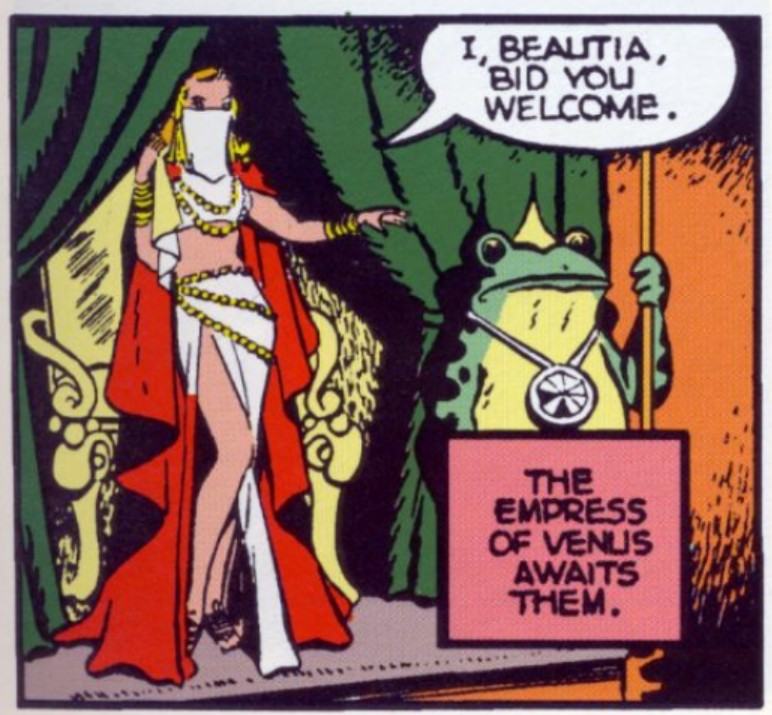
    We first meet the Glompers on the planet Venus after Dr Sivana has tricked Billy Batson and by extension Captain Marvel into joining him on an experimental rocket trip, with the intention of killing and/or stranding him there. They are immediately the most charming aliens I have ever seen, despite or perhaps because of the fact that they are just large frogs wearing trunks and little conical hats.

    The Glompers are ruled over by Beautia, Empress of Venus (later revealed to be Sivana’s daughter), and again I must emphasize just how friggin’ charming they are. Just look at his little spear! (Whiz Comics 003b, 1940)

    Sadly, as far as I can tell the Glompers only reappear one other time, as part of a plan by Dr Sivana to unleash them on Earth (Whiz Comics 015, 1941). The reformed-except-for-occasional-bursts-of-filial-duty Beautia expounds on the Glompers somewhat, revealing that they, like terrestrial frogs, are rapacious carnivores. Still charming! 

    In conclusion, since as far as I know the current DC Universe does not have a canonical native species on Venus and I have to say that I think that the Glompers should fill that roll. Make ’em big ol’ acid-spewing frog men!

    Alligator Men/Mermaids: 

    Rod Rian is an officer of Earth’s Sky Police in the year 2500 CE who finds himself on the planet Mephistos, having adventures among the various intelligent species that reside there. Perhaps the least explored of these are the friendly Alligator Men, who either coexist with a species of Mephistan mermaids or are yet another species with extreme sexual dimorphism. Either way: love a reptile man. (Flash Comics v1 011, 1940)

    Amazons of the Winged Death: 

    Don Drake, like Rod Rian, is an Earth man who finds himself on an alien world populated with all kinds of different species of intelligent life, in his case the planet Saro. Unlike Rod, Don’s adventures take place in the then-present day of 1935.

    The Amazons of the Winged Death are, as the name suggests, statuesque humanoid females. They ride horrible insects (the Winged Death of the name, natch) and are generally hostile, though Don does manage to ally with at least a few of them. (New Fun Comics 004, 1935)

    the Ape Men: 

    Brad Hardy, like Rod and Don, is an adventurer who finds himself in a world full of strange and often hostile creatures. Like Don, he is contemporary to the comic that he appears in, but unlike both of them, the world he finds himself in exists on Earth, in a cavernous realm below Mongolia. 

    The Ape Men (also Ape-Men and Apemen) are pretty typical: monkey faced humanoids with tails and a bad attitude. I do enjoy their Living Ape-God, who seems to just be the largest Ape Man. (More Fun Comics 009, 1936)

  • MINOR SUPER-HERO ROUND-UP 061

    Superfolk galore! 

    the Buzzard: 

    In an unnamed New-York-alike city, the gadgeteering mayor equips a young man with a suite of devices to help him engage in a vigilante crusade against crime. Chief among these gadgets is a gas that makes whomever it touches resemble a balding, big-nosed man in thick glasses and a tailcoat – the perfect disguise! Armed with this gas, plus some clawed gloves and a heat ray, the Buzzard begins tearing his way through the city’s underworld. 

    The gas also seems to allow the Buzzard to make his shadow resemble his namesake bird, an ability that is very useful for vexing the city’s Buzzard-hating police chief who, it turns out, is also the father of the Buzzard’s secret identity. 

    I unironically love the Buzzard and his whole weird setup, and while I find most modern revivals of public domain Golden Age characters to be a pretty mixed bag, I’m pretty bummed that none of them have elevated him out of his single issue obscurity – he’s got a real weirdo charm that the fiftieth version of the Nedor characters can’t approach. (Wham Comics 002, 1940) 

    the Cyclone: 

    The Cyclone is really Peter Grant, a young man who has a fairly unique version of the Batman origin, which of course is when a tragedy inspires an obsessive dedication to training and working toward some related goal, i.e., in Batman’s case the murder of his parents inspiring his eternal war against crime. The real twist in the Cyclone’s case seems to be the total absence of a motivation: Grant just woke up one day and decided to turn his body into a living weapon to aim at evil.

    The Cyclone is presented as being a regular human and so I had been assuming that the whirlwind patterns around his lower body when he jumps around were a stylistic choice meant to represent his fantastic leaping ability. They really are some enormous jumps, however, so it’s also possible that the Cyclone is meant to have some sort of wind-assisted jumping power. He only had three adventures, alas, so we shall never know. (Whirlwind Comics 001, 1940)

    Ibis the Invincible: 

    Ibis the Invincible, aka Prince Amentep, is a 12th Dynasty Egyptian who just kind of spontaneously comes back to life after 4000 years as a mummy. Why? Well, it’s not spelled out until the 1942 Ibis the Invincible series, but spoilers: his true love had been shot with an arrow that put her to sleep for those four millennia and he put himself in a magical sleep of his own in order to be with her again. 

    Ibis achieves this state of mystic sleep with the aid of the Ibistick, a magical wand capable of very nearly anything. Much like his fellow Golden Age magical super-heroes, Ibis’ near-omnipotence can occasionally seem plot-obliteratingly powerful. 

    The key difference between Ibis and his contemporaries, however, is that the Ibistick is a small object that is constantly being lost or stolen. Further, it requires absolutely no special knowledge to be used and can be operated by both children and animals with ease. More than a few of Ibis’ greatest foes (e.g., the Hobo-Millionaire) are simply regular humans armed with his own magic wand. The caveat to all this is the fact that the Ibistick will never harm its true owner, and will in fact inflict any baleful magic cast from it at him back on its wielder. This means that Ibis is able to defeat an evil wielder of the Ibistick by merely being annoying enough that they try to turn him into a toad or gold or ice or on on memorable occasion to mind control Taia into stabbing him to death and then wait for it to backfire on them. (Whiz Comics 002, 1940)

    UPDATE 1941 

    Taia: 

    Taia is the 4000-year-sleeping love for whom Ibis the Invincible made his way to the future. After a bit of moping around the globe he manages to track down her mummy and revive her, upon which they kind of implicitly are a married couple. While I very much enjoy Taia and the dynamic she has with Ibis, she does get a pretty raw deal – being your own husband’s de facto sidekick is bad enough, but Taia very rarely gets to be anything more than a kidnap victim/bargaining chip. The few modern versions of Ibis the Invincible try to do more with her, but they still don’t do much.

    Taia is said to be cousin to “Senwosri III” who is probably meant to be Pharaoh Senusret III, given that Taia and Ibis are said to be from the 12th Dynasty. So that’s something. (Whiz Comics 002, 1940)


  • SUPER-VILLAIN FILE 001: DR SIVANA

    (Whiz Comics 002, 1940) 

    Hearken back to yesterday’s Captain Marvel entry and you will see a tale of woe in which I lament my own poor planning with regard to how I dealt with non-obscure super-heroes. Well, I didn’t do much better with name-brand super-villains, I’ll tell you what. The Super-Villain Yearbook was an okay idea, but I didn’t really have a good implementation. I was going to be cluttering up my indices with links! Instead, we’re going to have main entries for the cads and bounders, like this one, and do all the linking to later developments here.

    So: Dr Sivana. Known very briefly as the Phantom Scientist in his first appearance, his initial scheme was a fairly straightforward ransom of the US radio broadcasting system. It is wild how thoroughly he is realized in this initial appearance, and how great a difference in quality there is between this story and some of the ones I’ve been reading lately.

    A deadly enmity is almost instantly established between Captain Marvel and Dr Sivana. Not only do they hate one another forever, but Captain Marvel is pretty clearly trying to kill Sivana as the other way around for the first couple of years. Anyway: top notch villain, little creep, very fun.

    UPDATES: 

    Dr Sivana 1940

    Dr Sivana 1941 (Whiz Comics) 

    CHILDREN: 

    Beautia Sivana (Whiz Comics 003b, 1940) 

    Magnificus Sivana (Whiz Comics 015, 1941)

    FULL NAME: 

    Dr Thaddeus Bodog Sivana 

    HENCHMEN AND CREATIONS: 

    the Beast-Ruler (Captain Marvel Adventures 003, 1941)

    Z (Captain Marvel Adventures 001, 1941) 

    MISC 

    This is a pretty good Dr Sivana thesis statement. (Whiz Comics 020, 1941)

  • SUPER-HERO FILE 001: CAPTAIN MARVEL

    (Whiz Comics 002, 1940) 

    When I fist made this blog it was mostly as a way to keep up a twitter thread that I was really enjoying but which was not enough to keep me on a rapidly-curdling social media platform. This is why all of the early entries are so short: because they’re just beefed-up tweets. This is also why I focused so heavily on obscure super-villains at first and only expanded my purview to include obscure super-heroes and more prominent super-villains gradually and haphazardly over time. Well, it’s time for another expansion of scope, because there are all kinds of interesting things about the big-name super-heroes and I just gotta mention them when I see them. Thus, the Super-Hero Files, which, if all goes to plan, are going to act as landing pages for all of those interesting things. And as he’s the first major super-hero to cross my computer screen since I decided to do this, our initial subject is Captain Marvel!

    Any super-hero origin story has its weird and charming elements that are later revisited and iterated on throughout the years, but Captain Marvel’s might just have the most of those? Let’s count them as we go.

    Billy Batson, the most downtrodden and good-hearted boy in the world (1) is approached by a mysterious shadowy man (2) and taken on a ride in a magical subway car (3).

    (1) Future retelling of this origin try to double down on both the misery and the goodness but it’s there from the start. He sleeps in a subway station, but he’s upbeat about it.

    (2) Remains mysterious until 1994, when Roy Thomas establishes that this is the ghost of Billy Batson’s father.

    (3) I don’t know if the subway car is ever revealed to actually be Zeus’ chariot or something but I am pretty happy that it keeps on showing up and hasn’t been relegated to the “Too Silly FOR COMIC BOOKS” pile.

    Billy enters a colossal cavern (4) and walks past statues of the Seven Deadly Enemies of Man (5). He is greeted by the wizard Shazam and given a brief tutorial on the meaning of his name (6). Also note the big globe and book flanking the wizard’s throne (7).

    (4) Eventually, this space is revealed to be located in the extradimensional Rock of Eternity, but as of 1940 it’s just a big magic cave that you can just wander into if you start wandering around in the tunnels below the city.

    (5) Pride, Envy, Greed, Hatred, Selfishness, Laziness and Injustice. The names get remixed occasionally – notably the more modern version read more like the Catholic Seven Deadly Sins – but this bunch will eventually get their own entry as minor super-villains after they come to life and battle Captain Marvel.

    (6) Also a quick rundown of the powers of Captain Marvel! Solomon, wisdom of; Hercules, strength of; Atlas, stamina of; Zeus, power of; Achilles, courage of; Mercury, speed of.

    (7) I don’t know if these are ever given a real explanation – I see some claims that the book is Shazam’s Historama but that’s a retcon at best.

    Shazam uses his Historama (8) to reiterate the miserable nature of Billy Batson’s life: orphaned and then chucked out on his ear by his greedy uncle Ebenezer (9).

    (8) See? The book is clearly closed in the same panel as the Historama is active.

    (9) Billy’s terrible uncle is an occasional recurring antagonist, but doesn’t recur as often as I’d expect. 

    Billy is given the power to become Captain Marvel by shouting the word SHAZAM (10), upon which the wizard, his work on Earth complete, is smushed by the symbolic granite block that has until that point hung above his throne on a slender thread (11). 

    (10) Just a classic super-hero bit. Copied ad nauseam.

    (11) I always forget that the wizard Shazam dies in his very first appearance, possibly because he continues to appear as a spectral advisor to Captain Marvel and the entire Marvel Family.

    Returning to his life in Fawcett City (12), Billy manages to finagle a job as an occasionally-roving radio announcer (13) by making a deal with radio magnate Sterling Morris before foiling the schemes of Dr Sivana (14) for the first time. 

    (12) Technically Golden Age Captain Marvel stories pretty clearly take place in New York City and Fawcett City doesn’t really come into being until the DC Comics days, and while I’m normally a dumb stickler for that sort of thing, it just feels right to go with the retcon flow on that particular point.

    (13) Just a great super-hero job, up there with reporter or newspaper photographer in terms of being in the know about developing situations. Too bad it’s not as relevant today as back in the 40s – is Billy an Extreme Vlogger or something nowadays?

    (14) Stay tuned for that guy.

    In conclusion: yes there are a lot of touchpoints in Captain Marvel’s origin, and that’s without all of the later stuff like Mary that would be included right off the bat in later retellings. It’s a rich text. 

    UPDATES:

    Update 1941

    HONOURS:

    Honours – Captain Marvel

    TROPHY ROOM: 

    Trophy Room – Captain Marvel 

  • DEMONIC ROUND-UP 003

    Two shorts and two longs.

    Bajah:

    Minor Golden Age Marvel magician Dakor has to travel all the way to the fictional Indian kingdom of Nordu to rescue his friend’s daughter from one of those cults where they worship a random blonde white lady (one of the more embarrassing stupid pulp fiction concepts to make the jump to comics, in my opinion). All that is to set up the fact that the devil figure in this cult is the oft-invoked, never-seen Bajah, as seen above. (Mystic Comics v1 003, 1940)

    the Goat-Men: 

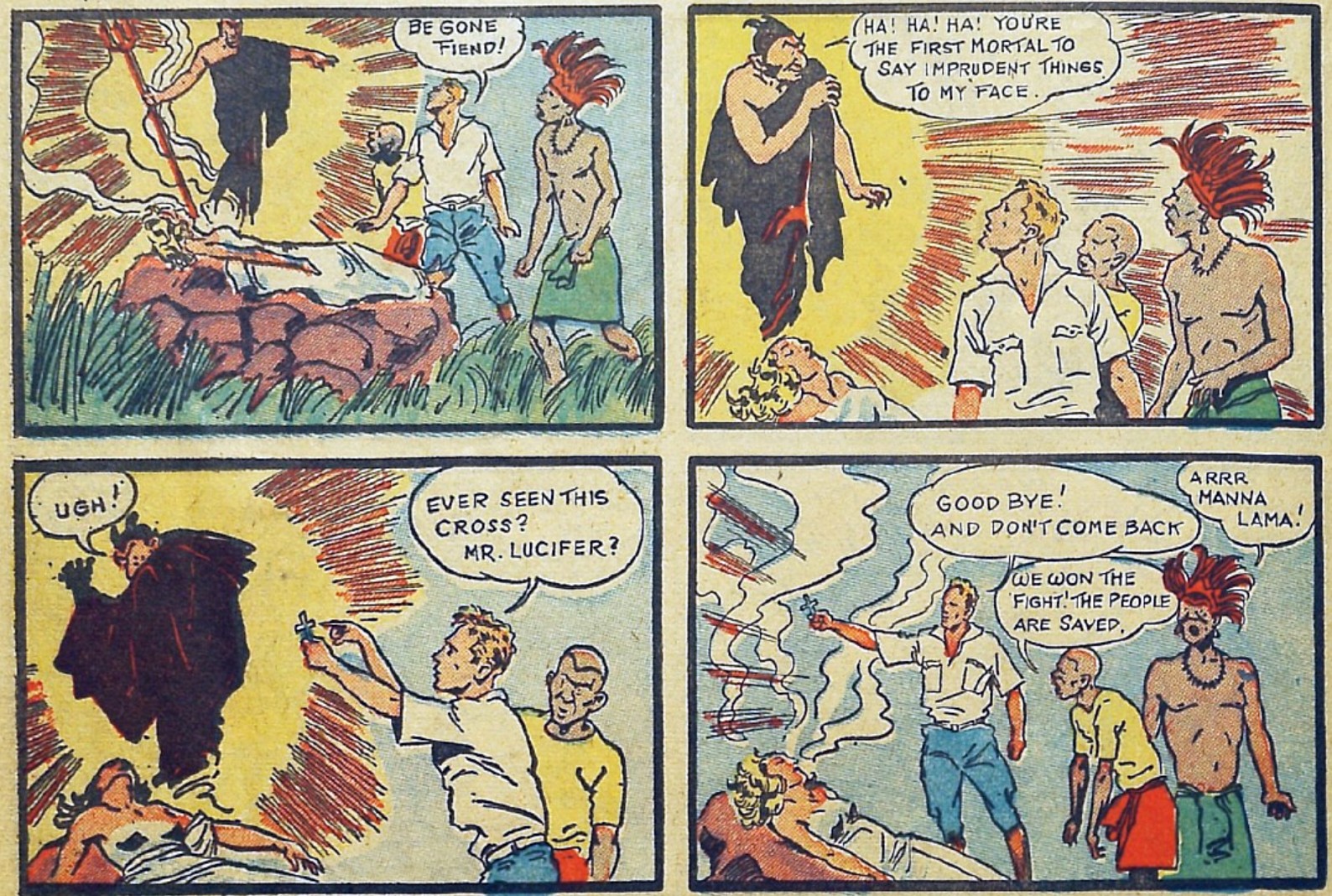
    The Goat-Men are a class of demon who serve Lucifer, and specifically the Lucifer seen in the last Demonic round-up, because this particular one is summoned by the Voodoo Man, just as his boss had been.

    The Goat-Men are fire demons, who can both breathe fire and create a ring of fire by walking in a circle around something or someone. Plus: the ring of fire gives you malaria. This is a pretty good collection of demonic powers, and while the part of me that writes about super-villains wants to say that they are insufficiently related to goats for my liking, anyone familiar with Medieval demonology will tell you that having a suite of abilities that are completely disconnected from both the demon’s physical appearance and one another is very accurate.

    Just like his boss, the Goat-Man proves to be intensely vulnerable to the sight of a cross, to the point of explosion. Just why hero Bob Warren had to light the cross he used on fire is perhaps best left unexplored. (Weird Comics 007, 1940)

    Kor Deno: 

    Kor Deno, a demon of some might, has been haunting the same family in… the rural United States? I’m pretty sure that’s where Warlock the Wizard hangs out… for generations. Any female member of the family who marries will be widowed by the demon soon after and for the latest and perhaps last scion, Valya, the curse has grown in scope to the point that Kor Deno has carried off all of her friends and family. 

    Warlock the Wizard is if nothing else a romantic, and so he challenges Kor Deno’s might in order that Valya might wed or at least kiss her love, Jim. He scores an early victory by using the the Golden Hand of Abraxas to crush the demon’s cool shadow form, but finds himself to have been overconfident, as both Jim and Valya are carried off to Kor Deno’s Black Kingdom immediately after he leaves them to finally make out.

    Kor Deno adopts the form of Simon the Hermit to lull Warlock into a false sense of security, but is unable to destroy him while he wields the Hand, and thus the Hand is what Kor Deno demands in exchange for Warlock’s freedom.

    Now armed with what he believes to be his enemy’s greatest weapon, Kor Deno attempts to slay Warlock, only to himself be destroyed by the still-greater might of the Lamp of the Gods. Bad luck, Kor Deno. (Nickel Comics 002, 1940) 

    Korieg the Sea Devil: 

    Like Bajah, Korieg the Sea Devil is invoked as a force of evilby the practitioner of a made-up Mysterious Asian Religion, in this case that practised by the inhabitants of a lost kingdom somewhere near Malaysia. No word on any of Korieg’s particulars, beyond the fact that they evidently float in water. (Action Comics v1 010, 1939) 

  • NOTES – SEPTEMBER 2025

    Honours – Beautia: 

    Beautia Not-Yet-Officially-Sivana wins the Empress of Beauty Contest (Whiz Comics 003b, 1940)

    Later in the year, Beautia saves the US Pacific fleet from being destroyed by Dr Sivana, and gets an unspecified medal from the Navy for it. (Whiz Comics 009, 1940)

    Cops Shooting Unarmed Suspects:

    This California police chief almost blows away Ibis the Invincible for sassing him and is only prevented thanks to ancient Egyptian magic. (Whiz Comics 008, 1940)

    Skeletons With Jobs:

    Soldier skeleton. (Wings Comics 002, 1940)

    the Looming Spectre of Death: 

    (Wings Comics 003, 1940) 

    (Wonderworld Comics 017, 1940) 

    (Wonderworld Comics 018, 1940) 

  • DEMONIC ROUND-UP 002

    DEMONIC ROUND-UP 002

    Look out! Its demons!

    Lucifer: 

    Dastardly voodoo man the Voodoo Man has this version of Lucifer possess a young woman for some dang reason. He’s got a pretty good look with the sideburns and all, but is surprisingly easy to chase away with an anemically-presented crucifix. (Weird Comics 006, 1940)

    the Unholy One: 

    The Unholy One is an infernal servant of some kind who has been summoned as a sort of demonic search engine by the Green Sorceress. He appears in the early Simon & Kirby days of Blue Bolt, so he gets an appropriate level of gravitas and “this guy’s face is too gross to show you” angles to render him nice and memorable. I like him! (Blue Bolt v1 005, 1940)

    Unnamed Being: 

    If I’m honest I must admit that I have no idea what this guy is. Heroic former uggo Sir Champion encounters him while searching an extradimensional dreamscape for his liege/lover Camilla after she is abducted to there by the wizard Thoth. He is generally helpful, but “capricious, horned extradimensional being” equals “demon” in my eyes. Plus he’s nude! (Jungle Comics 011, 1940)

    the Fire-Devil:

    Perhaps you will recall our old friend the Witch-Master, lord of the witches of Salem. Well, he in turn serves this fellow, who is referred to as the Fire-Devil throughout the adventure due to the fact that he is summoned out of a bonfire. The various titles that the Witch-Master gives him – Great King of Evil, Great King of Inferno, etc – indicate that he is held in some esteem, but the fact that he can’t endure the “level stare” of preteen Mark Kent does diminish this somewhat.

    Also humiliating: the fact that a simple bucket of water is sufficient to banish him back to the underworld. (Slam-Bang Comics 005, 1940) 

  • MINOR SUPER-HERO ROUND-UP 043

    A grab bag of old characters I skipped over back in the early days when I thought that this blog wasn’t going to be completely self-indulgent. 

    Mr Clue: 

    He only had one adventure in which he solves the murder of a mayor by a police chief, but Mr Clue is too great a name not to take note of. (Master Comics 001, 1940)

    the Red Gaucho: 

    A swashbuckling hero in the Zorro mode, the Red Gaucho protects the South American nation of Santa Palos from threats both foreign and domestic before eventually just kind of wandering North to have adventures in a sort of generic Central America. He’s a fun character! He has one of the biggest hats in comics!

    The Red Gaucho is also a character I think about whenever the topic of white supremacy comes up. White supremacy is one of those topics that gets a lot of people very angry, but at its base it’s simply the belief that the world consists of white people and everyone else and more specifically that it’s white people versus everyone else in a competition to keep white people on top, where they belong. And the further back you go, the less people felt the need to hide the fact that that was their worldview, and possibly the place that that attitude is most on display is in early Golden Age comics – just read any set outside North America and you’ll catch on to it pretty quickly.

    Anyway, that is all to say that even though it’s more subtle than a lot of other examples of this worldview in comics, ever since I noticed that every single appearance of the Red Gaucho includes a disclaimer assuring readers that he was in fact the child of two Americans and not some horrible South American – heavens forfend! – his smiling face pops into my head whenever the subject comes up.(Nickel Comics 004, 1940)

    the Hawk:

    On a less heavy note, here’s the Hawk! Created by George Brenner, who also created the Clock, the Hawk has the distinction of being the first masked crimefighter to appear in a comic that would eventually be amalgamated into the DC Comics fold (the Clock had only appeared in Centaur comics up until this point and wouldn’t make his way into a Quality book for a few months yet). A heady and heavily qualified distinction!

    The Hawk is secretly T. James Harrington II, wealthy and useless playboy who hangs around looking bored until some crime happens and it’s time for the Hawk to hit the streets. It’s a bit Bruce Wayne/Batman only without the parental murder.

    Unlike Batman, the Hawk leans pretty minimal on the costume front, with his major identifying feature being a set of slip-on claws. 

    The Hawk also has a couple of assistants named Link and Rollo who are touted as the only people who know the Hawk’s identity but who don’t get much time to show their stuff in this, their one-panel appearance. Astute readers might note that the crook that the Hawk has just captured likely also knows his secret identity at this point but please note that Link and Rollo are identified as the only living people to know the secret. Sinister stuff!

    DC has already gone with the Crimson Avenger as the Official First Golden Age Super-Hero but I reckon that the Hawk would be a fun guy to be brung back for some future story involving early mystery men antics. (Feature Funnies 002, 1937)

    *Hero Update* Shock Gibson:

    It had to happen someday: Shock Gibson disguises himself as a cowboy and in the process abandons his iconic helmet forever. Fare the well, helmet. (Speed Comics 007, 1940)