The Curse of Skeleton Munroe

Category: Fawcett Comics

  • MINOR SUPER-VILLAIN 759: THE IRON HAND

    (Master Comics 006, 1940)

    While monitoring the world for trouble one day (using his Troublescope, natch), Master Man spots, in quick succession: an auto-gyro creating green rainclouds, a collection of mysteriously paralyzed wildlife, a full-fledged paralysis epidemic dubbed “the Living Death” in a nearby city, and the news that the preeminent scientist working to cure the plague has been murdered. He takes what I would say is a surprising amount of time to put two and two together and determine that these events might just be linked.

    The culprit behind all of these occurrences is the arch-criminal known as the Iron Hand, due to his iron hand. He has been dispensing the Living Death disease into the city’s reservoir using the green rain, and plans on expanding his operation world wide if he is successful in bringing the unnamed city under his heel. It’s a real shame that much of the rest of the story involves the Iron Hand’s minions vs Master Man in a series of retreat actions because the Iron Hand himself is barely present and he’s just the kind of bombastic jagoff villain I love.

    Master Man eventually works his way through all of the Iron Hand’s low-level doofuses in time to crash his auto gyro in a lake and drown him. There’s a teaser that suggests that maybe the drowning wasn’t quite enough to defeat such a cool villain, but as this is the final Master Man comic, it has to stand.

  • MINOR SUPER-VILLAIN 759: THE IRON HAND

    (Master Comics 006, 1940)

    While monitoring the world for trouble one day (using his Troublescope, natch), Master Man spots, in quick succession: an auto-gyro creating green rainclouds, a collection of mysteriously paralyzed wildlife, a full-fledged paralysis epidemic dubbed “the Living Death” in a nearby city, and the news that the preeminent scientist working to cure the plague has been murdered. He takes what I would say is a surprising amount of time to put two and two together and determine that these events might just be linked.

    The culprit behind all of these occurrences is the arch-criminal known as the Iron Hand, due to his iron hand. He has been dispensing the Living Death disease into the city’s reservoir using the green rain, and plans on expanding his operation world wide if he is successful in bringing the unnamed city under his heel. It’s a real shame that much of the rest of the story involves the Iron Hand’s minions vs Master Man in a series of retreat actions because the Iron Hand himself is barely present and he’s just the kind of bombastic jagoff villain I love.

    Master Man eventually works his way through all of the Iron Hand’s low-level doofuses in time to crash his auto gyro in a lake and drown him. There’s a teaser that suggests that maybe the drowning wasn’t quite enough to defeat such a cool villain, but as this is the final Master Man comic, it has to stand.

  • MINOR SUPER-HERO ROUND-UP 042

    Boys! Boys! Boys! Super powered boys!

    Magno: 

    Magno, aka the Miracle Man, aka the Magnetic Man, aka Tom Dalton, was a power line worker who died when he was shocked with 10 000 volts DC and then revived when he was shocked again with 10 000 volts AC. As a result, Dalton developed electromagnetic powers that he used to fly, simulate super strength when dealing with metal and create magnetic force fields. Not a bad deal.

    Magno’s Golden Age career was short and fairly undistinguished, and his main claim to fame is being the only one of the old Quality heroes to be killed off by Roy Thomas in All-Star Squadron to never be brought back (Magno’s look also reminds me of Jericho of the Teen Titans for some reason, but that’s hardly another claim to fame). (Smash Comics 013, 1940)

    the Ray: 

    I had a couple of issues of The Ray comics from the early 90s when I was younger and so have a tendency to think of the Ray as being a far more prominent character than he actually is – he’s got to be fourth-tier at best, really (assuming that top-tier characters are the ones that everyone knows, your Batmans and Supermans, and second-tier are the ones that even a casual comics reader would consider essential. Third-tier and below is where you get into debating territory).

    Regardless of his level of prominence, the Ray is actually Happy Terrill, a devil-may-care young reporter who signs on as crew in a balloon trip to the upper atmosphere and is… empowered? When he ventures out into a cosmic storm to secure some essential safety equipment. Honestly, as presented on the page Terrill could be assumed to have been replaced with some sort of cosmic entity but maybe I’m the only one who thinks that because it certainly isn’t reflected in subsequent Ray lore.

    Cosmic entity posing as human or no, the Ray is endowed with a startling array of powers, including at least partial invulnerability, the ability to become and travel along light, giant growth, a healing touch, light projection and telekinetic rays. At first, anyway – after a couple of issues he adopts more of a two-fisted adventurer persona whose main power is the ability to change between Happy Terrill and Ray identities and who occasionally remembers that he can fly and shoot rays of light at people.

    A fairly consistent thing that I’ve noticed in depictions of the Ray post-Golden Age is a tendency to portray him as a very dour and serious guy, which seems a disservice to someone with the nickname “Happy.” I suppose I must give it to those later scribes in that the Ray himself almost discards his Happy Terrill identity in his first adventure before eventually coming to his senses. Neither the reason for resuming life as Happy nor the process by which he explained how he made his way back from the upper atmosphere is shown on-panel, but I have to assume that being a super-hero 24/7 just gets boring after a while and he wanted to have a bit of a break. (Smash Comics 014, 1940)

    Master Man: 

    Master Man starts out as a weedy little kid, too small to play, who is gifted a magic vitamin pill by a kindly doctor and becomes incredibly powerful adult man. It’s all there on his one-page introduction, but what’s missing is one important detail: is this a gradual process like the Champ’s origin, where he takes the vitamin every day and grows up big and strong, or did this little kid instantly transmogrify into a grown man, like a permanent Captain Marvel? I suppose that if Master Man really is a little kid in a man’s body it would explain why his first act is to build a cool clubhouse on top of a mountain, presumably containing lots of slides and fireman poles instead of stairs. 

    Being a Fawcett Comics character, Master Man is technically owned by DC Comics now, though they haven’t yet bothered to trot him out of retirement, possibly because of his name, which sounds fascist enough that Marvel Comics has several full-fledged Nazi characters that use it. He would be an interesting character to use as a foil for Superman, since his powers are magic-based, but Captain Marvel does usually fill that role so we’re unlikely to get a Master Man revival any time soon. (Master Comics 001, 1940)

    El Carim:

    One more crime-fighting-stage-magician-with-actual-magical-powers for the pile, El Carim (“miracle” backwards, as the caption box is at some pains to inform you at the start of every story) also subscribes to the same tuxedo and thin black mustache school of fashion as his contemporary Zatara, though the turban does make it easy to tell the two apart.

    What sets El Carim apart from his contemporaries early on is the fact that his crime fighting is done with a series of magical items rather than with magical spells. He has a magical monocle that can deflect bullets (in what must be a very alarming manner, visually) and project illusions and which can be combined with a device called the Spectograph to scry distant locations. In addition, he has a super powerful magnet capable of plucking bullets from the air (useful for when he already has a headache from bouncing a few off of his eye, perhaps) and the Arrestor, which is able to freeze others in place, even against the pull of gravity.

    Over time, El Carim starts slinging spells in a way more in line with the other magic men of comics, and I personally reckon that that’s why he has languished in relative obscurity since the 1940s (other than an appearance in a 2016 issue of Scooby-Doo Team-Up, that is), as without that hook he is not appreciably different from any of his peers. (Master Comics 001, 1940)

  • MINOR SUPER-HERO ROUND-UP 042

    Boys! Boys! Boys! Super powered boys!

    Magno: 

    Magno, aka the Miracle Man, aka the Magnetic Man, aka Tom Dalton, was a power line worker who died when he was shocked with 10 000 volts DC and then revived when he was shocked again with 10 000 volts AC. As a result, Dalton developed electromagnetic powers that he used to fly, simulate super strength when dealing with metal and create magnetic force fields. Not a bad deal.

    Magno’s Golden Age career was short and fairly undistinguished, and his main claim to fame is being the only one of the old Quality heroes to be killed off by Roy Thomas in All-Star Squadron to never be brought back (Magno’s look also reminds me of Jericho of the Teen Titans for some reason, but that’s hardly another claim to fame). (Smash Comics 013, 1940)

    the Ray: 

    I had a couple of issues of The Ray comics from the early 90s when I was younger and so have a tendency to think of the Ray as being a far more prominent character than he actually is – he’s got to be fourth-tier at best, really (assuming that top-tier characters are the ones that everyone knows, your Batmans and Supermans, and second-tier are the ones that even a casual comics reader would consider essential. Third-tier and below is where you get into debating territory).

    Regardless of his level of prominence, the Ray is actually Happy Terrill, a devil-may-care young reporter who signs on as crew in a balloon trip to the upper atmosphere and is… empowered? When he ventures out into a cosmic storm to secure some essential safety equipment. Honestly, as presented on the page Terrill could be assumed to have been replaced with some sort of cosmic entity but maybe I’m the only one who thinks that because it certainly isn’t reflected in subsequent Ray lore.

    Cosmic entity posing as human or no, the Ray is endowed with a startling array of powers, including at least partial invulnerability, the ability to become and travel along light, giant growth, a healing touch, light projection and telekinetic rays. At first, anyway – after a couple of issues he adopts more of a two-fisted adventurer persona whose main power is the ability to change between Happy Terrill and Ray identities and who occasionally remembers that he can fly and shoot rays of light at people.

    A fairly consistent thing that I’ve noticed in depictions of the Ray post-Golden Age is a tendency to portray him as a very dour and serious guy, which seems a disservice to someone with the nickname “Happy.” I suppose I must give it to those later scribes in that the Ray himself almost discards his Happy Terrill identity in his first adventure before eventually coming to his senses. Neither the reason for resuming life as Happy nor the process by which he explained how he made his way back from the upper atmosphere is shown on-panel, but I have to assume that being a super-hero 24/7 just gets boring after a while and he wanted to have a bit of a break. (Smash Comics 014, 1940)

    Master Man: 

    Master Man starts out as a weedy little kid, too small to play, who is gifted a magic vitamin pill by a kindly doctor and becomes incredibly powerful adult man. It’s all there on his one-page introduction, but what’s missing is one important detail: is this a gradual process like the Champ’s origin, where he takes the vitamin every day and grows up big and strong, or did this little kid instantly transmogrify into a grown man, like a permanent Captain Marvel? I suppose that if Master Man really is a little kid in a man’s body it would explain why his first act is to build a cool clubhouse on top of a mountain, presumably containing lots of slides and fireman poles instead of stairs. 

    Being a Fawcett Comics character, Master Man is technically owned by DC Comics now, though they haven’t yet bothered to trot him out of retirement, possibly because of his name, which sounds fascist enough that Marvel Comics has several full-fledged Nazi characters that use it. He would be an interesting character to use as a foil for Superman, since his powers are magic-based, but Captain Marvel does usually fill that role so we’re unlikely to get a Master Man revival any time soon. (Master Comics 001, 1940)

    El Carim:

    One more crime-fighting-stage-magician-with-actual-magical-powers for the pile, El Carim (“miracle” backwards, as the caption box is at some pains to inform you at the start of every story) also subscribes to the same tuxedo and thin black mustache school of fashion as his contemporary Zatara, though the turban does make it easy to tell the two apart.

    What sets El Carim apart from his contemporaries early on is the fact that his crime fighting is done with a series of magical items rather than with magical spells. He has a magical monocle that can deflect bullets (in what must be a very alarming manner, visually) and project illusions and which can be combined with a device called the Spectograph to scry distant locations. In addition, he has a super powerful magnet capable of plucking bullets from the air (useful for when he already has a headache from bouncing a few off of his eye, perhaps) and the Arrestor, which is able to freeze others in place, even against the pull of gravity.

    Over time, El Carim starts slinging spells in a way more in line with the other magic men of comics, and I personally reckon that that’s why he has languished in relative obscurity since the 1940s (other than an appearance in a 2016 issue of Scooby-Doo Team-Up, that is), as without that hook he is not appreciably different from any of his peers. (Master Comics 001, 1940)

  • MAD AND CRIMINAL SCIENTIST ROUND-UP 003

    They may not be the top of the class, but they did their time in the evil sciences!

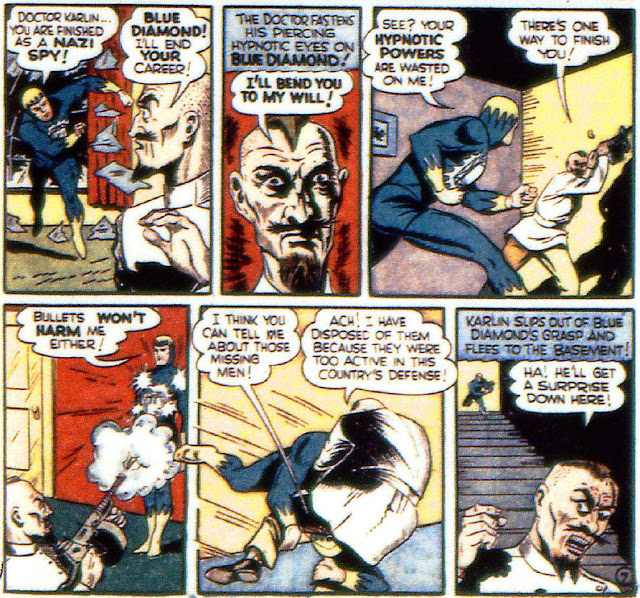
    Dr Eric Karlin has a lot of moxie on paper: a Nazi psychologist with a sideline in Egyptology, he dissolves the enemies of the Reich in acid and keeps their jellied remains in a series of jars in his basement. He also employs mind controlled pseudo-zombies in a scheme to recover frozen Nazi assets from a bank vault. The problem is that while all of this makes for a dynamite summary, the Blue Diamond story that he appears in is… not very good. (Daring Mystery Comics 008, 1942)

    DeVaux here had a plan to grow regular guys into huge guys and use them to take over the world but made the elementary mistake of trying to kill a friend of super-magician El Carim as his literal first step toward that end – it didn’t go well. (Master Comics 011, 1941)

    I’m not sure if this guy is even a scientist, but if you’re “the worst foreign spy living” and your name is Dr Evil and your cover as you plan to blow up a NYC analog is to call yourself “Dr Live” well then I can’t help but love you, even if you do get electrocuted by extremely generic Golden Age hero Lightning. (Jumbo Comics 015, 1940)

    And speaking of Lightning, he also battled Dr Tol, who used remote stone-crumbling technology to open up banks for his gang to loot. He also had very cool goggles. (Jumbo Comics 020, 1940)

  • FASCIST GOON CLEARING HOUSE 003

    More goons. Fascist goons? Yes.

    The Anti-American Party operated in the South American country of Santa Palos, home of the Red Gaucho, and got up to a lot of malarky at a fancy dress ball. Crucially, they disguised one of their agents as the Red Gaucho, leading to a lot of mixups between the agent, the Gaucho and a clueless dope who also came dressed as the hero (Nickel Comics 006, 1940)

    The Black Guard, agents of the Germany-analog country of Nordicha operating in neighbouring oil-rich country Ruina and foiled by Secret Agent X-5 (later G-5) (Hit Comics 002, 1940)

    Now that I’m revisiting them I reckon that the Green Gloves should have been a regular entry but it’s too late now. In contrast to all of the other fascist groups represented here so far, the Green Gloves are devoted to a guy amazingly named Glover Green with no allegiance to any foreign power. Green seems to be your garden variety megalomaniac with a real glove fixation, down to traitors to the group getting a green glove brand on their foreheads (Detective Comics v1 045, 1940)

    The Nastonian-American Society is just another German-American Bund analog (Adventure Comics 051, 1940)

  • GENERIC COSTUMED VILLAIN ROUND-UP 007

    The hits keep on coming:

    This Fellow’s name is Becker and he and his wife run a gang while pretending to be among its victims. An okay scheme, but not really up to foiling Bulletman and Bulletgirl. (Master Comics 014, 1941)

    This guy here is why I have such a hard time relegating masked Western bandits to the dregs of the generic costumed villains: he’s as by-the-numbers a bandit as they come, he robs one stagecoach total, he ends up dying because he falls off his horse… but he is frequently and consistently referred to a “Alkali, the Scourge of the Plains” which is as endearing as it is possible to be. (Master Comics 019, 1941)

    I’m overlooking the fact that this bundist-style not-exactly-German spy encountered by Miss America doesn’t actually wear a costume because a) he’s called the Leader, b) he lives in a wax museum and c) he has a pet gorilla named Gargo. (Military Comics 002, 1941)

    Captain Rajah, AKA the Master, was a jewel thief who ran up against Captain Desmo, in a story even more weirdly pro-colonial than Captain Desmo stories usually are – Captain Rajah is immediately suspicious for being an Indian officer in the Bengal Lancers, continued to be suspected throughout and then turned out to be the Master. The story is from before the invention of “defying expectations”. (More Fun Comics 065, 1941)

  • GENERIC COSTUMED VILLAIN ROUND-UP 007

    The hits keep on coming:

    This Fellow’s name is Becker and he and his wife run a gang while pretending to be among its victims. An okay scheme, but not really up to foiling Bulletman and Bulletgirl. (Master Comics 014, 1941)

    This guy here is why I have such a hard time relegating masked Western bandits to the dregs of the generic costumed villains: he’s as by-the-numbers a bandit as they come, he robs one stagecoach total, he ends up dying because he falls off his horse… but he is frequently and consistently referred to a “Alkali, the Scourge of the Plains” which is as endearing as it is possible to be. (Master Comics 019, 1941)

    I’m overlooking the fact that this bundist-style not-exactly-German spy encountered by Miss America doesn’t actually wear a costume because a) he’s called the Leader, b) he lives in a wax museum and c) he has a pet gorilla named Gargo. (Military Comics 002, 1941)

    Captain Rajah, AKA the Master, was a jewel thief who ran up against Captain Desmo, in a story even more weirdly pro-colonial than Captain Desmo stories usually are – Captain Rajah is immediately suspicious for being an Indian officer in the Bengal Lancers, continued to be suspected throughout and then turned out to be the Master. The story is from before the invention of “defying expectations”. (More Fun Comics 065, 1941)

  • MINOR SUPER-VILLAIN 371: THE BLITZ GANG

    MINOR SUPER-VILLAIN 371: THE BLITZ GANG

    (Minute-Man 002, 1941)

    AKA the Blitz Force AKA the Panzer Gang.

    I almost started out by saying that the idea of a criminal gang operating along military lines was an old one but no, it isn’t yet. It’s not a new idea – there might be half a dozen examples in this list so far and I’m sure it cropped up more than once in the pulps – but it’s not quite the mid-tier trope that it eventually will be.

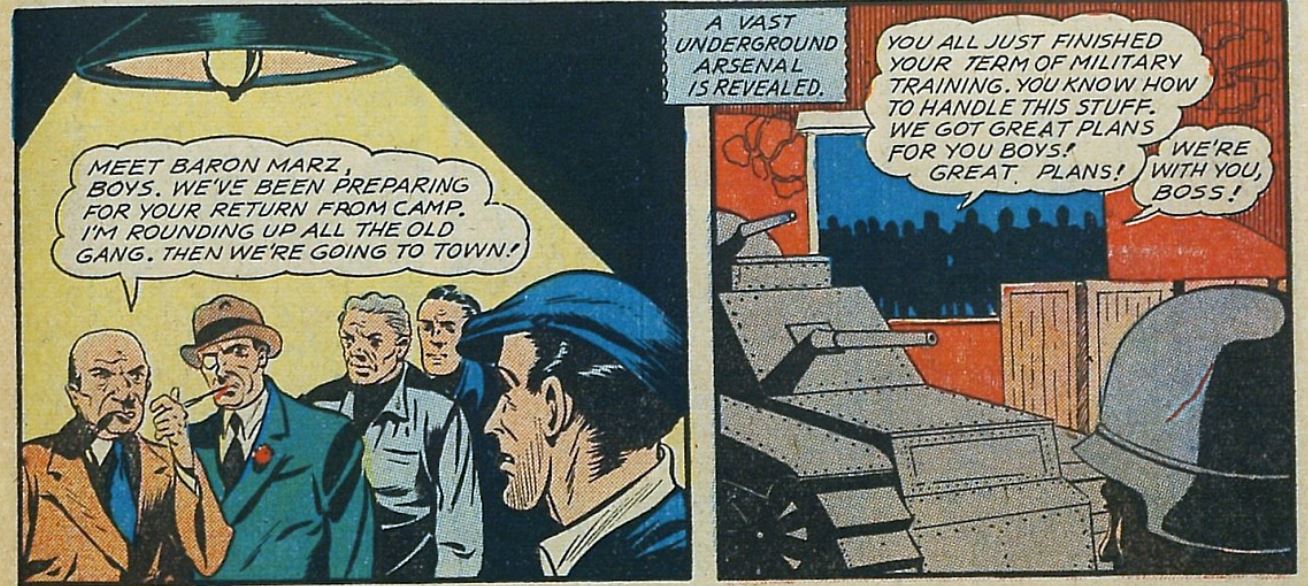
    This time, the idea for a criminal army is inspired by US pre-war military training program crime czar Boss Donker and his don’t-say-he’s-a-Nazi pal Baron Marz have hatched a scheme that takes advantage of the readily-available supply of Army-trained men: arm them and loot cities wholesale (with an optional attempt to conquer the US for “the Fatherland,” wherever that is.

    And of course it all goes swimmingly until Minute-man shows up.

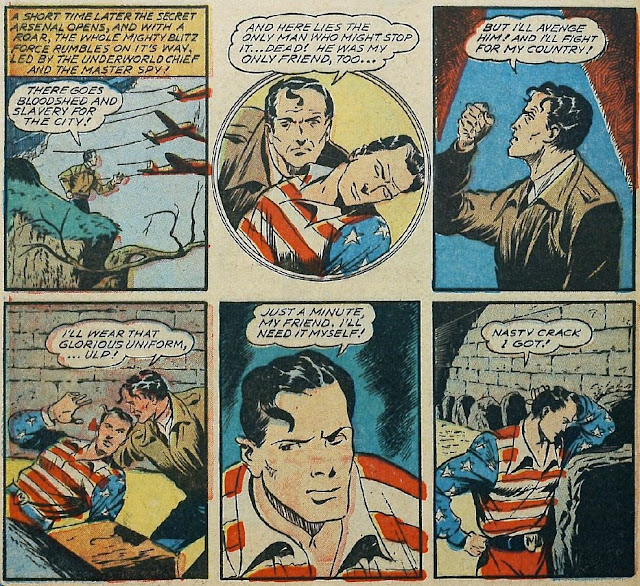
    The best part of the story by far is this bit here. Baron Marz has seemingly killed Minute-Man with a falling block of stone and Slippy, the only former gangster army recruit who doesn’t want to return to a life of crime, is about to take up the mantle in his honour. It’s actually kind of too bad that Minute-Man wasn’t actually dead, because having the identity change hands this way might have given him an interesting hook at last – maybe it could have been a series about person after person taking on th role of Minute-Man as needed and as the previous one falls instead of about a third-rate Captain America knockoff.

  • MINOR SUPER-VILLAIN 370: THE GREEN HOOD

    (Minute-Man 002, 1941)

    As mentioned in our last entry, the Green Hood was retroactively revealed to be the boss of Illyria, Queen of Spies in her final appearance (probably for the best as it’s hard maintain queenly authority when people know that you have a supervisor). He’s your standard hooded mastermind/ spymaster, albeit with a much more dramatically draped hood than most.

    He is also A Bad Boss, as shown by his demonstration of managerial style above. Having tasked Illyria with the daunting task of capturing Minute-Man, he condemns her to death (the super-villain equivalent of a very harsh write-up on her file) for capturing General Milton as bait/ in order to extract Minute-Man’s secret identity from him.

    For comparison, this is like hiring a team of scientists to travel to the centre of he Earth and then firing them when you find that they’re building a giant drill. Or, for that matter, setting someone the task of killing Batman and then getting mad when they show up with Alfred. The Green Hood’s uncle probably runs this spy business, is what I’m saying.

    Having ruined his chances of getting Minute-Man and squandered his best agent on a fit of middle-management pique, the Green Hood determines that he should make a grand gesture by attacking an unnamed New York-like city in the name of his unspecified Germany-like county using a tank that dispenses poison gas. He makes some headway but is ultimately felled by cop with a hand grenade.

    The issue ends with a hint that the Green Hood and Illyria might just be back someday and I’m sure that he would have been if the US had not entered WWII – hooded spymasters and femmes fatale were just too subtle and nuanced to be representatives of Nazi Germany in the comics. Sorry Green Hood but you are D E A D.